
Consider that you are a financial services company operating across five jurisdictions. One Monday, you found that two of those jurisdictions had updated their data-handling rules — effective in 30 days. Your legal team could scramble; the compliance officer might send a cascade of emails, and somewhere in the middle of it all, one of your product releases could get delayed because no one could confirm whether the new feature was still permissible.
That is not a hypothetical. It is a pattern playing out across industries every quarter — and it will only intensify in 2026 as regulatory cycles shorten, scrutiny on AI governance and data privacy deepens, and regulators shift toward real-time enforcement over periodic review.
The organizations that handle this well are not the ones with the largest legal teams. Rather, they are the ones with a disciplined approach to regulatory change management — a structured capability that turns reactive scrambling into a proactive, repeatable process.

Concern
Regulatory change management is now a business-critical need. Laws, rules, and enforcement priorities are changing faster across data privacy, AI governance, cybersecurity, and cross-border operations. Without a structured process, organizations risk delayed product launches, audit gaps, fines, contract loss, and weak compliance readiness.
Overview
Regulatory change management is the process of identifying, assessing, and implementing regulatory updates across policies, controls, and workflows. It connects regulatory intelligence to business action. This matters most for SaaS, fintech, healthcare technology, and other regulated businesses that must stay compliant across multiple jurisdictions and frameworks like GDPR, HIPAA, SOC 2, ISO 27001, DORA, and the EU AI Act.
Solution
A strong regulatory change management process uses continuous monitoring, clear ownership, control mapping, centralized documentation, automation, and regular review cycles. This helps teams respond faster, stay audit-ready, maintain continuous compliance, and turn regulatory change into a business advantage instead of a crisis.
Regulatory Change Management: A Basic Understanding
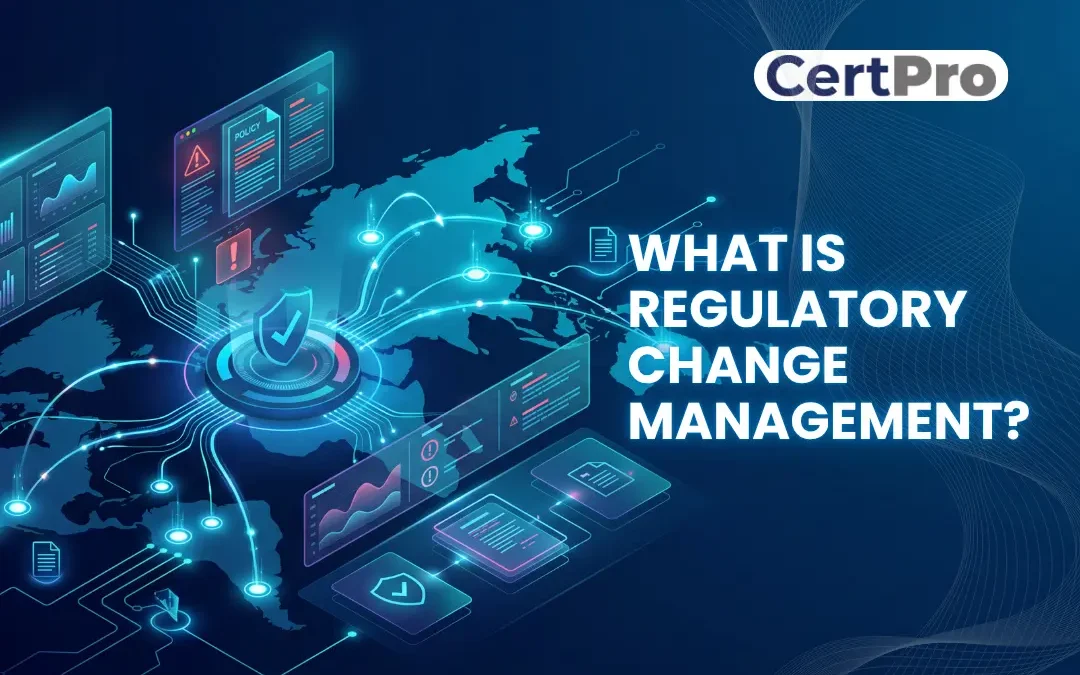
Regulatory change management is the process of identifying, assessing, and implementing changes to internal policies, controls, and workflows in response to new or updated regulations. It is not simply a matter of reading the news and forwarding a legal summary to the team. It is an end-to-end system that connects regulatory intelligence to business action.
So what is regulatory change, exactly? It is any update, revision, or introduction of a legal or compliance requirement that affects how an organization must operate. To elaborate, this includes changes to data protection laws, industry-specific mandates, financial reporting standards, cybersecurity requirements, and cross-border compliance rules. Moreover, it also includes changes in enforcement priorities — cases where the regulation itself does not change but regulators begin interpreting or applying it differently.
Regulatory change management sits at the intersection of legal, compliance, IT, and operations. Done well, it ensures that the organization's controls, documentation, and practices remain aligned with its regulatory and compliance requirements at all times — not just at the moment of an audit.
For organizations in sectors like fintech, SaaS, healthcare technology, or professional services, this is a strategic one. Staying regulatory compliant is directly linked to maintaining contracts, preserving client trust, and avoiding penalties that can reach into the millions.
Why Regulatory Change Management Matters Today
The pace of regulatory change has accelerated significantly. In the recent years, regulators across North America, Europe, and the Asia-Pacific region issued dozens of updates affecting data privacy, AI system governance, cybersecurity disclosure, and third-party vendor management. In 2026, this pace shows no signs of slowing.
Several forces are converging simultaneously:
- Data privacy regimes are fragmenting. GDPR, CCPA, and Brazil's LGPD each have distinct obligations. A company with users across these markets must track and reconcile differences at a granular level.
- AI governance is moving from soft guidance to enforceable rules. The EU AI Act, in particular, places direct obligations on organizations developing or deploying high-risk AI systems. Regulatory and compliance requirements in this space are evolving rapidly.
- Cybersecurity regulations now require proactive, documented controls — not just incident response. DORA in the EU and updated SEC cybersecurity disclosure rules in the US are examples of frameworks that demand continuous compliance readiness, not annual attestation.
- Cross-border operations introduce jurisdictional complexity. A SaaS company headquartered in the US, with customers in the EU and Southeast Asia, may need to satisfy three or four different data residency and breach notification requirements simultaneously.
- The consequence of poor regulatory change management in this environment is not just a failed audit. It is contract terminations, regulatory fines, damaged partnerships, and reputational harm that takes years to reverse. Hence, staying regulatory compliant is increasingly a prerequisite for business continuity.
Common Challenges in Managing Regulatory Change
Most compliance teams are failing to maintain the regulatory changes because the operational systems around regulatory change management are underdeveloped. Here are the challenges that surface most often:
Tracking Regulatory Updates Across Multiple Sources
Regulations are published across government portals, regulatory body websites, industry association guidance, and legal databases. Yet, there is no single authoritative feed. As a result, teams either rely on expensive monitoring subscriptions, manual checking, or the hope that someone on the legal team happens to catch something in time.
Interpreting Complex Legal Language
Regulatory text is often dense, cross-referenced, and full of defined terms. To clarify, a single change to one provision can have downstream effects on five others. Therefore, translating that into actionable internal guidance — without losing the nuance — is a significant skill gap in most organizations.
Aligning Internal Teams
A regulatory update may affect legal, IT, product, HR, and finance simultaneously. Without a clear owner and a structured workflow, these updates get lost between departments. For instance, the compliance team issues guidance, and the product team does not implement it. Thereby paving way for a gap that persists until an auditor finds it.
Maintaining Audit-Ready Documentation
Auditors do not just want to see current controls. They want evidence of how an organization responded to regulatory changes — what it identified, when, how it was assessed, and what actions were taken. Most organizations lack clear audit trails that reflect this history.
Managing Overlapping Compliance Requirements
A mid-sized SaaS company handling healthcare data might simultaneously need to meet HIPAA, SOC 2 Type II, and GDPR requirements. When one of these frameworks updates, the compliance team must assess whether the change conflicts with, reinforces, or is neutral to the others. Doing this ad hoc is error-prone and time-consuming.
Regulatory Change Management Process and Best Practices
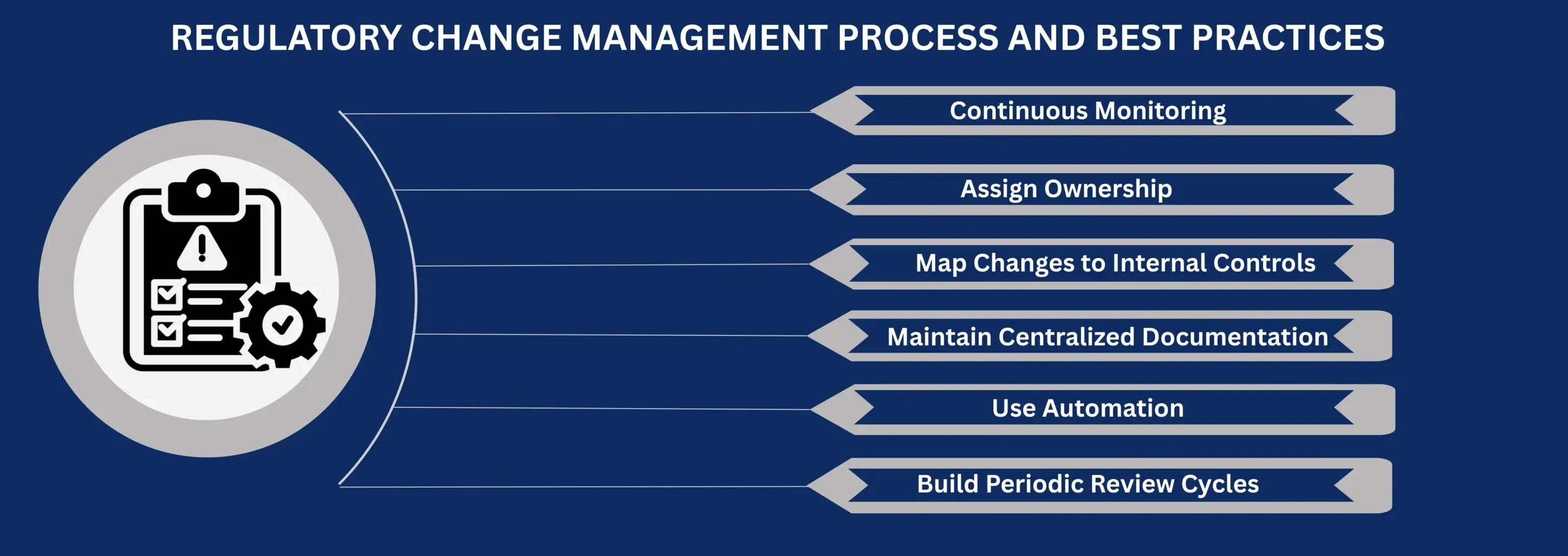
Building a reliable regulatory change management process does not require a large team. It requires a structured approach and the right tools. Here is how organizations that do this well actually operate:
-
Continuous Monitoring
Set up systematic monitoring of the regulatory environments relevant to your business. This includes subscribing to regulatory body alerts, using compliance intelligence platforms, and establishing relationships with external legal advisors who can flag material changes early. The goal is to identify what regulatory change for your industry before it becomes a crisis.
-
Assign Ownership
When a regulatory update is identified, assign a named owner responsible for the assessment. This is not a committee decision. One person coordinates the impact analysis, engages relevant stakeholders, and drives the response to completion. Without ownership, regulatory change management stalls.
-
Map Changes to Internal Controls
Assess each regulatory change against your existing control framework — whether that is a SOC 2 control set, an ISO 27001 ISMS, or internal policy documentation. Identify gaps explicitly. Document what needs to change, what does not, and why. This mapping is critical both for audit readiness and for prioritizing remediation effort.
-
Maintain Centralized Documentation
Every step in your regulatory change management process should be recorded in a single system of record. This includes the original regulatory text, your interpretation, the impact assessment, the remediation plan, the implementation evidence, and the sign-off. When an auditor asks how you handled a specific regulation update, you should be able to pull a complete record in minutes.
-
Use Automation
In 2026, compliance teams are increasingly turning to platforms that automate regulatory monitoring, map requirements to controls, and flag changes that need review. These tools do not replace human judgment, but they eliminate the manual work of tracking and cross-referencing that consumes disproportionate compliance bandwidth. Automation also supports the shift toward continuous compliance — where readiness is maintained daily rather than rebuilt every twelve months before an audit.
-
Build Periodic Review Cycles
Regulatory change management requires quarterly reviews of your regulatory landscape, annual reassessment of your monitoring approach, and ongoing training for team members who are responsible for compliance tasks. The organizations that stay regulatory compliant consistently are those that treat it as a standing operational discipline instead of a response activity.
Conclusion
Regulatory change management is a risk reduction mechanism, a client trust asset, and an increasingly important factor in business scalability.
Organizations that build a mature regulatory change management process are better positioned for growth. They can enter new markets faster because they understand their compliance obligations in advance. They perform better in audits because documentation is always current.
They lose fewer deals to compliance objections because buyers — particularly enterprise buyers — conduct thorough vendor due diligence on regulatory and compliance requirements. In a business environment where regulations are tightening, enforcement is increasing, and continuous compliance is becoming the standard, regulatory change management is a competitive differentiator.
CertPro is a licensed CPA firm with experience in compliance and audit engagements. We work with SaaS companies, technology businesses, and growth-stage organizations operating in regulated environments, including SOC 2, ISO 27001, GDPR, HIPAA, and emerging AI governance frameworks. Our work focuses on evaluating your control design, implementation, and audit readiness against applicable standards.
If your organization is formalizing its regulatory change management process, CertPro can support structured assessments aligned with audit requirements.