LAST UPDATE — 05-21-2026
Businesses operating in the current business landscape are facing evolved security incidents. If mismanaged, these security incidents will ultimately lead to the failure of the organization. Therefore, organizations must have a thorough understanding of the process of risk management. In today’s world, risk assessment and management is a crucial process that guides organizations toward stability, long-term business growth, and reputation. For example, consider risk mitigation as a process where you’re preparing for a day filled with heavy rain and storms. What will you do? You will check the weather and analyze the intensity of the storm. Thereby, decide whether to use an umbrella, avoid a route, or stay indoors.
To master the art of risk assessment and management, businesses should follow the 4 Ts of risk management types. It is an effective strategy that provides comprehensive risk administration. Furthermore, it encompasses all the necessary steps, such as risk detection, analysis, and action. The 4 Ts of risk management are tolerate, terminate, treat, and transfer. These four principles act as the foundation for effective risk governance. Oganizations are increasingly embracing unified risk management systems that bring together data from across business units, automate reporting, and support improved collaboration, which is critical for identifying risks that span multiple departments or functions.
It’s a blend of strategies, harmonizing resilience and adaptability and orchestrating a symphony of success. Therefore, this blog delves into the complexities of the 4 Ts risk management, helping to understand what is risk management , the different risk management types, and how the four Ts of risk administration provide a solid framework for detecting, assessing, and managing risks. The risk management 4 types model helps organizations choose the right strategy based on risk appetite and potential impact. Furthermore, an effective process for controlling cybersecurity risks also aligns with compliance requirements, ensuring adherence to standards like SOC 2 and ISO 27001. Organizations are raising the bar by adopting advanced risk mitigation frameworks, integrating AI-driven tools for continuous monitoring, and updating procedures to reflect fast-evolving cyber and third-party threats.
HOW TO SET THE FOUNDATION FOR 4 TS OF RISK MANAGEMENT
WHY IS IT IMPORTANT TO IDENTIFY RISKS?
THE RISK MANAGEMENT PROCESS: STEP BY STEP
WHAT ARE THE 4 Ts, AND WHY SHOULD COMPANIES IMPLEMENT THEM?
KEY STEPS TO FOLLOW IN IMPLEMENTING THE FOUR TS OF RISK MANAGEMENT
COMPARATIVE STUDY SUMMARIZING THE 4TS RISK MANAGEMENT
Tl; DR:
Concern: Every addition of a new vendor, SaaS tool, or business partner introduces hidden security risks that can lead to data breaches, compliance violations, regulatory fines, and slow down important deals. Many organizations miss out on opportunities or face risks due to rushed, outdated, or incomplete risk assessments and fragmented answers to security questionnaires.
Overview: A risk management framework based on the 4 Ts: Tolerate, Treat, Transfer, and Terminate, enables organizations to systematically identify and address both internal and third-party risks. Comprehensive security questionnaires and regular vendor assessments are now essential to evaluating cybersecurity compliance, risk mitigation strategies, incident response, and alignment with standards like ISO 27001 or SOC 2. AI-driven tools are increasingly used to automate responses, flag gaps, and maintain evidence for audit readiness, building trust and speeding up onboarding.
Solution: Prepare in advance by maintaining accurate policies, enforcing strong controls, and gathering clear audit evidence. Integrate third-party risk management into your risk assessment best practices. Partner with CertPro to map your processes to global compliance standards, stay continuously audit-ready, and confidently close deals faster. CertPro’s modern approach turns security, compliance, and vendor onboarding into growth accelerators, reducing risk and ensuring business continuity.
HOW TO SET THE FOUNDATION FOR 4 TS OF RISK MANAGEMENT
One primary step that businesses shouldn’t miss is that, before you apply the 4Ts risk management, you must understand your risk environment. But many businesses skip this step, which is a mistake. This is because, without knowing the full risk picture, your response may fail to control the risks. For instance, imagine a company transferring a cyber risk to insurance without assessing it well. What will follow is a breach that causes major losses because the policy can’t cover key exposures. An organization’s risk profile is incomplete without considering third-party risk management. The reliance on vendors and outside partners creates expanded operational, regulatory, and cybersecurity risks, especially as AI adoption accelerates and supply chain vulnerabilities multiply. Developing a robust vendor risk program, supported by regular due diligence and automated monitoring, is now standard for compliance and resilience.
Identify and Assess Your Risks: Start with risk identification by listing all possible risks. Use tools like risk registers, SWOT analysis, or risk mapping. Consequently, assess each risk using a simple formula of checking its likelihood and impact. Hence, this procedure helps you to prioritize them accordingly. Leverage risk assessment best practices that include AI-enabled analytics and dynamic risk matrices, which allow you to spot subtle threats and hidden links between risk areas often overlooked in traditional reviews.
Checklist:
- List all risks.
- Rate its likelihood.
- Rate its impact.
- Multiply to rank each risk.
Define Your Risk Appetite: Risk appetite is the level of risk your business is willing to take and tolerate. Tolerance is the maximum amount of risk that you can handle. These definitions assist you in making important business decisions. For example, a low-risk appetite means you’re more likely to terminate or transfer the risk. The explicit risk appetite and tolerance statements are required by many regulators and provide a benchmark for risk officers to justify mitigation actions and drive alignment across departments.
Match with ISO 31000 and COSO: Both ISO 31000 and COSO ERM are global standards that offer clear guidance on managing risk. Plus, the 4Ts risk management aligns with their core principles. Following these standards adds trust and credibility. Additionally, it also helps with audits and compliance. Notably, ISO 31000 sets the global benchmark for risk and management frameworks in the modern business world.
WHAT IS RISK MANAGEMENT?
Risk management is all about spotting and handling possible problems that could affect how well a company does. To put it simply, risk management involves being proactive, identifying potential issues early, and taking action to prevent them from causing harm. Thus, by understanding this risk management definition, businesses could increase their chances of success. Moreover, failure to implement strong risk and management procedures will ultimately lead businesses to face unforeseen security incidents. For example, Equifax, the largest credit reporting agency, suffered a data breach due to weak cybersecurity measures.
Moreover, the main goal of following the risk management types lies in safeguarding business assets, ensuring operational continuity, and mitigating financial and reputational losses. Plus, it’s important in decision-making because it helps companies understand what risks they could face, decide which ones are more likely to happen, and figure out how big an impact they might have. Then, the company can plan how to reduce those risks or transfer them to someone else. With cyber threats like ransomware, insider attacks, and non-human identities on the rise, cybersecurity compliance is now an essential part of every risk mitigation framework. Complying with standards such as NIST and ISO/IEC 27001 is non-negotiable, with automation and real-time compliance monitoring tools closing vulnerabilities and streamlining audits.
The risk management process begins by identifying possible risks from operations, market trends, laws, and other factors. This helps businesses understand threats early, make smarter decisions, and handle issues before they grow. Once risks are identified, the next step is to manage them. Businesses can either reduce the risk, move it to someone else, or completely remove it. Effective risk mitigation strategies now include incident response preparation, enhancing visibility across digital ecosystems, and regularly testing internal controls. Understanding what risk management is enables businesses to remain proactive, plan ahead, and prepare for any challenges that may arise. Furthermore, understanding the risk management definition and risk management types is essential for cybersecurity compliance, as different frameworks require tailored approaches to mitigate threats effectively.
TYPES OF RISK MANAGEMENT
Risk management is not a one-size-fits-all discipline. Different categories of risk require different approaches, tools, and ownership within an organization. Understanding the distinct types of risk is a prerequisite for applying any risk framework — including the 4 Ts — effectively.
Strategic Risk: Strategic risk refers to threats that affect an organization’s ability to achieve its long-term business objectives. These risks arise from poor decision-making, market shifts, competitive disruption, or misaligned business strategy. A company that expands into a new market without adequate research, or that fails to adapt to regulatory changes in its industry, is exposed to strategic risk. Unlike operational risks, strategic risks are often harder to quantify and require executive-level ownership and continuous monitoring.
Operational Risk: Operational risk covers the possibility of loss resulting from failed internal processes, human error, system failures, or external events that disrupt day-to-day operations. Examples include a misconfigured server that exposes customer data, a payroll processing error, or a supplier outage that halts production. Operational risks are among the most common and are often the first category organizations address when building a risk management program. Controls such as documented procedures, access management, and business continuity planning directly reduce operational risk exposure.
Financial Risk: Financial risk encompasses threats to an organization’s financial stability — including credit risk, liquidity risk, market risk, and currency exposure. For compliance-focused organizations, financial risk also includes the potential cost of regulatory fines, litigation, and remediation following a security or compliance failure. The IBM Cost of a Data Breach Report consistently shows that organizations without mature risk management programs face significantly higher financial losses following incidents than those with structured frameworks in place.
Compliance Risk: Compliance risk is the exposure an organization faces when it fails to meet the requirements of applicable laws, regulations, standards, or contractual obligations. For technology companies operating globally, compliance risk spans frameworks including GDPR, HIPAA, SOC 2, ISO 27001, CCPA, and PIPEDA. Non-compliance can result in regulatory fines, loss of certifications, contractual penalties, and reputational damage. Managing compliance risk requires continuous monitoring of regulatory changes, structured internal audit programs, and alignment between business processes and applicable standards.
Cyber Risk: Cyber risk refers to the potential for financial, operational, or reputational harm resulting from digital threats — including data breaches, ransomware attacks, phishing campaigns, insider threats, and supply chain compromises. In 2025, cyber risk has become the dominant risk category for most technology and data-driven organizations. AI has significantly amplified the speed and sophistication of cyber attacks, enabling threat actors to execute targeted campaigns at scale. Effective cyber risk management requires a combination of technical controls, organizational policies, third-party risk assessments, and alignment with standards such as ISO 27001 and the NIST Cybersecurity Framework.
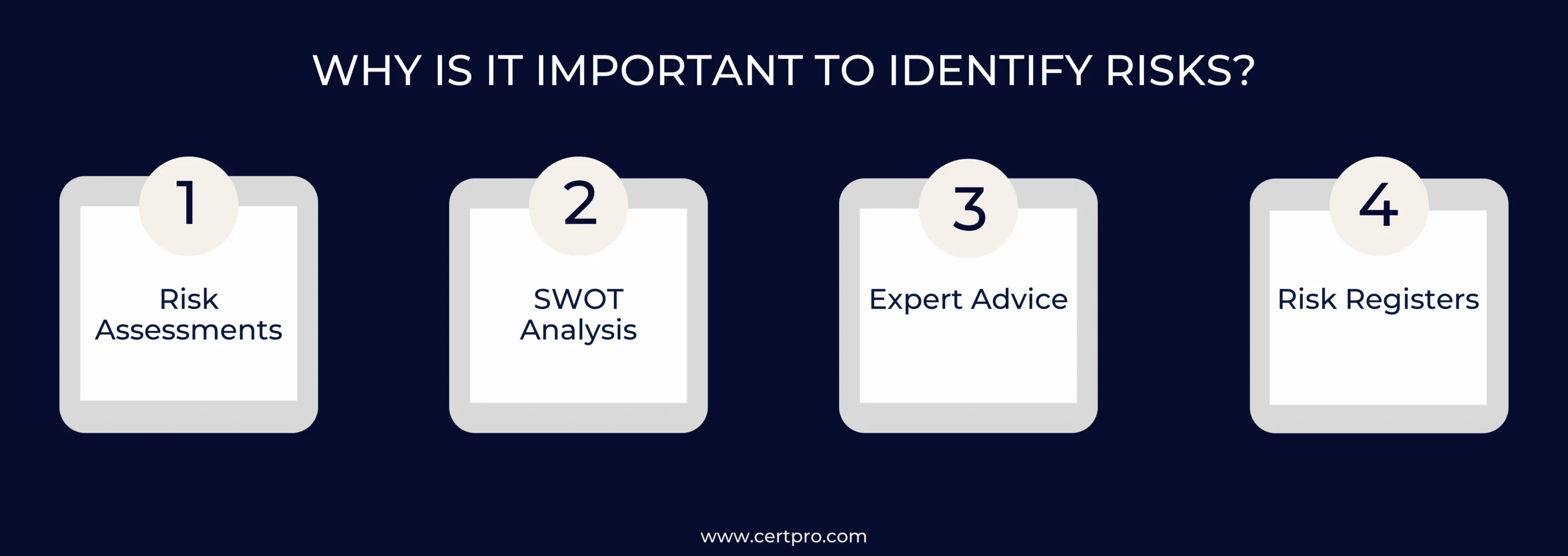
WHY IS IT IMPORTANT TO IDENTIFY RISKS?
Risk identification plays a crucial role in the risk management process as it enables businesses to remain proactive. By spotting potential risks early, companies can act quickly to reduce or even prevent problems before they occur. As a result, this approach allows them to avoid unnecessary harm and protect their interests.
Here are some common techniques used to identify risks:
- Risk Assessment: A risk assessment could help determine the most suitable risk management types to reduce the likelihood of cyberattacks and compliance violations. Also, these evaluations can be done in different ways, such as conducting interviews, surveys, and observations and reviewing documents.
- SWOT Analysis: A SWOT analysis helps identify both the strengths and weaknesses within an organization, as well as opportunities and threats from the outside. So, by looking at external factors like competition, market conditions, or changes in regulations, businesses can uncover risks that might otherwise go unnoticed.
- Expert Advice: Most often the best way to identify risks is by turning to experts. These experts could be individuals within the company or specialists in the industry. Accordingly, they can provide valuable insights, helping to pinpoint risks specific to the company’s activities or sector. Furthermore, their experience and knowledge often reveal risks that others might overlook.
4. Risk Registers:A risk register is a tool for organizing and tracking risks. To clarify, it’s essentially a central database where companies record all identified risks. This system helps businesses systematically monitor and manage risks over time, ensuring they are regularly assessed and addressed. Automated risk registers and dashboards powered by AI provide real-time insights, help document risks across the enterprise, and trigger alerts when risk thresholds are crossed. By using these techniques, organizations can identify a wide range of risks early on. Hence enabling them to safeguard the company’s operations, reputation, and overall success. Now let’s understand the different kinds of risks.
By using these techniques, organizations can identify a wide range of risks early on. Hence enabling them to safeguard the company’s operations, reputation, and overall success. Now let’s understand the different kinds of risks.
THE RISK MANAGEMENT PROCESS: STEP BY STEP
Understanding the types of risk is only the starting point. Effective risk management requires a repeatable, structured process that organizations follow consistently — not just at audit time, but as an ongoing operational discipline. The risk management process follows five sequential steps.
Step 1 — Risk Identification: Risk identification is the process of systematically discovering and documenting all potential threats that could affect the organization’s objectives, operations, assets, or stakeholders. This step requires input from across the business — not just the IT or security team. Risks can be identified through structured workshops, asset inventories, threat intelligence feeds, historical incident data, supplier assessments, and regulatory change monitoring.
The output of this step is a risk register — a documented inventory of identified risks, each described in terms of the threat source, the asset or process at risk, and the potential consequence if the risk materializes. A risk register that is not regularly updated is of limited value. Organizations should treat it as a living document, reviewed at defined intervals and updated whenever significant changes occur in the business or threat environment.
Step 2 — Risk Assessment: Once risks are identified, each must be assessed to determine its likelihood and potential impact. Risk assessment provides the basis for prioritization — ensuring that resources and controls are directed toward the risks that matter most.
Most risk assessment methodologies evaluate two dimensions:
- Likelihood — how probable is it that this risk will materialize, given existing controls?
- Impact — if the risk does materialize, what is the consequence to the organization in terms of financial loss, operational disruption, regulatory exposure, or reputational damage?
These two dimensions are combined to produce a risk rating — typically expressed as Low, Medium, High, or Critical. Organizations using ISO 27001 follow a formal risk assessment methodology defined in their Statement of Applicability, evaluating risks against each applicable Annex A control.
Step 3 — Risk Treatment (The 4 Ts): Following assessment, each risk must be treated — a decision must be made about how the organization will respond to it. This is where the 4 Ts framework applies directly. Each risk in the register is assigned one of four treatment strategies: Tolerate, Treat, Transfer, or Terminate. The choice of treatment is driven by the risk rating, the organization’s risk appetite, the cost of available controls, and the feasibility of elimination. The 4 Ts are covered in full detail in the following section.
Step 4 — Risk Monitoring: Risk treatment is not a one-time activity. Controls must be monitored continuously to confirm they are operating as intended and that the risk environment has not changed in ways that affect the organization’s exposure. Risk monitoring activities include:
- Regular review of the risk register against current business operations
- Continuous monitoring of security controls and system configurations
- Tracking of key risk indicators (KRIs) and key performance indicators (KPIs)
- Review of audit findings, incident reports, and near-misses
- Supplier and third-party risk reassessments at defined intervals
Organizations with mature risk monitoring programs detect and contain incidents significantly faster than those that treat risk management as a periodic compliance exercise. Continuous monitoring is also a formal requirement under ISO 27001 and SOC 2, and evidence of ongoing monitoring activity is reviewed during certification and surveillance audits.
Step 5 — Risk Reporting: The final step in the risk management cycle is reporting — communicating the current state of risk to the appropriate stakeholders within and outside the organization. Risk reporting serves multiple purposes: it keeps leadership informed, supports resource allocation decisions, fulfills regulatory reporting obligations, and provides evidence of due diligence during audits.
Effective risk reports are concise, audience-specific, and actionable. Board-level reports focus on aggregate risk posture, trend analysis, and strategic exposure. Operational reports provide detail on specific risks, control effectiveness, and remediation progress. Compliance reports document alignment with applicable standards and any outstanding nonconformities requiring management attention.
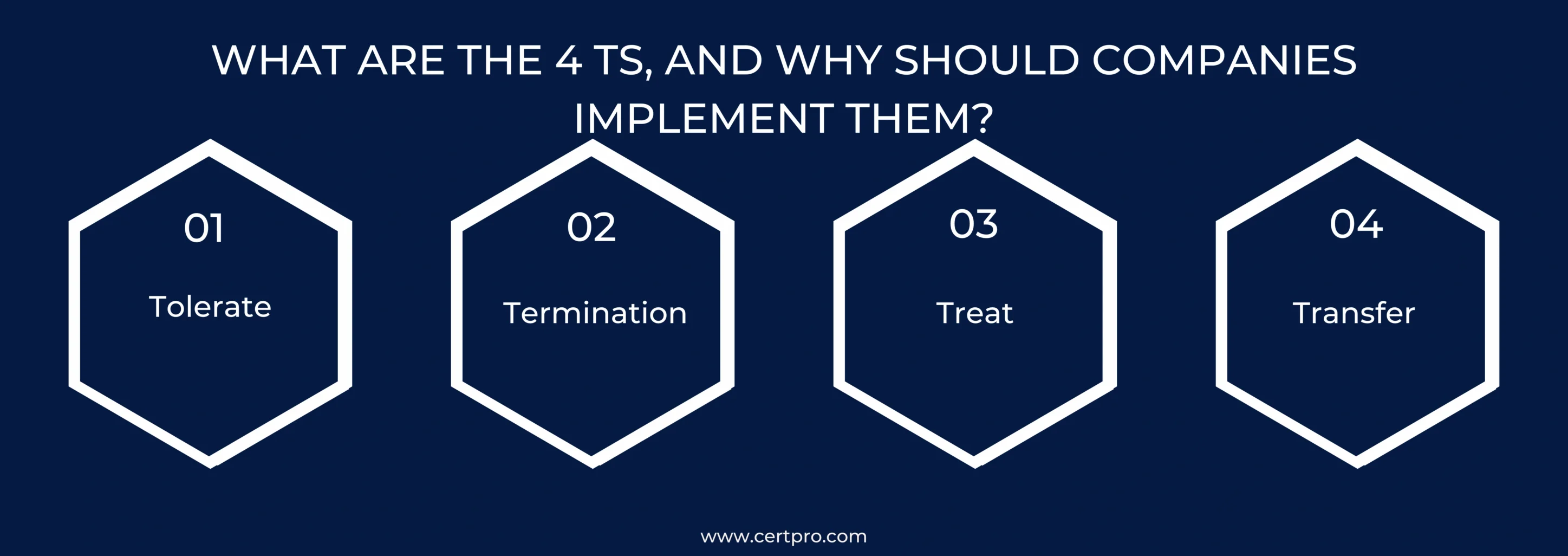
WHAT ARE THE 4 Ts, AND WHY SHOULD COMPANIES IMPLEMENT THEM?
The four Ts of risk management process are essential for businesses to effectively handle risks.
- Tolerate (Risk Acceptance): This approach is suitable for low-impact and low-likelihood risks. Companies typically choose to tolerate a risk when its potential consequences are small or when the cost of managing it outweighs the potential impact. To clarify, tolerating a risk is not an act of ignoring it. However, it requires careful monitoring to ensure it doesn’t escalate beyond a manageable level. For example, a startup can accept its minor software bugs instead of investing heavily in them.
- Terminate (Risk Avoidance): When a company terminates a risk, it fully eliminates or avoids the associated risk by halting the activity or project that caused it. Specifically, this strategy is used when the risk is deemed too serious and the potential harm far outweighs any potential benefit. For instance, political unrest in a given area may cause a business to reconsider its plans to expand internationally.
- Treat (Risk Mitigation): Treating a risk means taking proactive steps to reduce or control its impact and likelihood. Such actions can include implementing safety control measures, creating backup plans, diversifying resources, or conducting staff training. So, the goal is to reduce the negative effects of the risk to a level that the organization can accept it without ignoring its existence.
- Transfer (Outsourcing Risk Management): Transferring a risk means shifting the responsibility or impact of the risk to another party. This type of transfer is commonly done through insurance and contracts or outsourcing agreements. Thus, by transferring the risk, businesses ensure that, if it happens, the financial responsibility or consequences fall on someone else. For example, a financial institution handling sensitive customer data is sharing its cybersecurity responsibility with a Managed Security Service Provider (MSSP).
KEY STEPS TO FOLLOW IN IMPLEMENTING THE FOUR TS OF RISK MANAGEMENT
While implementing the 4 Ts framework for the risk management process, it is better to follow some key steps.
Tolerate: How to Monitor Accepted Risks
Sometimes, you must accept a risk. But that does not mean you ignore it.
- Add the risk to your register and include the impact, owner, and reason for acceptance.
- Set how often you will check the risk; specifically on a monthly, quarterly, or yearly basis.
- List warning signs that show the risk has changed. These help you decide when to act.
- Mark key moments to review the risk, such as during internal audits or after incidents.
Treat: How to Design Controls and Track KPIs
When you treat a risk, you reduce it by using controls or safety steps.
- Pick the right control, such as a firewall, backup, or training.
- Assign a person or team to manage this control and make sure it works.
- Track the control using clear KPIs. For example, keep downtime under one hour or phishing success under two percent.
- Test the internal controls often. If they are weak, fix or improve them.
Transfer: How to Shift Risk to Another Party
You can pay someone else to take the risk.
- Choose a method like insurance, outsourcing, contracts, or SLAs.
- Check if the third party is dependable. Look at their past work and financial health.
- Set clear roles and limits in your contracts.
- Watch their work through SLAs or audits.
- Review deals every year. Update them if things change.
Third-party risk management processes must be centralized and digitally enabled, as most compliance failures result from gaps in vendor oversight or absent real-time risk data sharing.
Terminate: How to Eliminate Risk Completely
- Remove a risk if it is too dangerous.
- Find what causes it, like a system or process.
- Plan how to shut it down smoothly.
- Tell everyone involved what is changing.
- Stop the activity, system, or contract causing the risk.
- Then double-check to make sure no risk remains.
COMPARATIVE STUDY SUMMARIZING THE 4TS RISK MANAGEMENT
| Risk Response | Definition | When to Use | Benefits | Compromises |
|---|---|---|---|---|
| Tolerate | Accept the risk without taking action. | When the risk is low or the cost of mitigation is too high. | Saves cost and resources for high-priority risks. | Risk remains, so requires ongoing monitoring. |
| Treat | Reduce the risk with controls or improvements. | When the risk is manageable and can be minimized. | Lowers the likelihood and impact of risk. | May require significant resources and time. |
| Transfer | Shift the risk to a third party. | When the risk is high but can be managed via insurance or outsourcing. | Limits financial or operational exposure. | Could involve ongoing costs or contract complexity. |
| Terminate | Eliminate the source of the risk entirely. | When the risk is too severe and cannot be mitigated or transferred. | Removes the threat completely. | May limit growth, opportunities, or affect operations. |
RISK MANAGEMENT FRAMEWORKS
A risk management framework provides the structure, methodology, and governance model within which an organization’s risk management process operates. Several internationally recognized frameworks are used by organizations to formalize their approach to risk. Choosing the right framework depends on the organization’s industry, regulatory environment, size, and compliance objectives.
ISO 31000 — Risk Management Guidelines: ISO 31000 is the international standard for risk management, published by the International Organization for Standardization. It provides principles, a framework, and a process for managing risk across any type of organization, regardless of industry or size. Unlike ISO 27001, ISO 31000 is not a certifiable standard — it is a guidance document designed to be adapted to each organization’s specific context.
ISO 31000 defines risk as the effect of uncertainty on objectives and emphasizes that risk management should be integrated into all organizational processes — not treated as a standalone function. Its iterative process model aligns closely with the five-step process described above, making it a natural foundation for organizations building a risk management program from the ground up.
NIST Risk Management Framework (RMF): The NIST Risk Management Framework, developed by the National Institute of Standards and Technology, provides a structured seven-step process for integrating security and risk management into the system development life cycle. Originally developed for US federal agencies, NIST RMF is now widely adopted by private sector organizations — particularly technology companies operating in the US market or serving US government clients.
NIST RMF covers: Prepare, Categorize, Select, Implement, Assess, Authorize, and Monitor. It integrates closely with the NIST Cybersecurity Framework (CSF), which organizes cybersecurity activities around five functions: Identify, Protect, Detect, Respond, and Recover. Organizations pursuing SOC 2 compliance frequently reference NIST CSF as part of their control design.
COSO Enterprise Risk Management (ERM): The Committee of Sponsoring Organizations of the Treadway Commission (COSO) Enterprise Risk Management framework is widely used in financial services, publicly traded companies, and organizations subject to Sarbanes-Oxley (SOX) requirements. COSO ERM takes a broad, enterprise-wide view of risk — encompassing strategic, operational, financial, and compliance risks within a single integrated framework.
The 2017 update to COSO ERM introduced a stronger emphasis on the relationship between risk and strategy, recognizing that the most significant risks organizations face are often strategic rather than operational. COSO ERM is particularly relevant for organizations where the board and executive leadership need a consistent language and methodology for discussing risk across all business functions.
ISO 27001 Risk Management: ISO 27001 incorporates a mandatory risk management process specifically focused on information security risks. Clause 6.1.2 of the standard requires organizations to define and apply an information security risk assessment process that identifies risks associated with the confidentiality, integrity, and availability of information assets.
ISO 27001 risk management is more prescriptive than ISO 31000 — it requires a formal risk assessment methodology, a risk register, a Statement of Applicability documenting control selection decisions, and a risk treatment plan. The 4 Ts framework maps directly onto ISO 27001’s risk treatment options: accept (tolerate), mitigate (treat), transfer, and avoid (terminate).
Organizations pursuing ISO 27001 certification must demonstrate a documented, repeatable risk management process during their Stage 2 certification audit. Evidence reviewed includes the risk register, risk assessment methodology, risk treatment plan, and records of management review of risk results.
Risk Management Tools
Effective risk management at scale requires more than spreadsheets and manual processes. Organizations are increasingly deploying dedicated tools and platforms to automate risk identification, streamline assessments, maintain audit-ready evidence, and provide real-time visibility into their risk posture.
GRC Platforms: Governance, Risk, and Compliance (GRC) platforms provide a unified environment for managing risk registers, policy libraries, audit workflows, and compliance tracking across multiple frameworks simultaneously. Leading platforms in this category include ServiceNow GRC, OneTrust, LogicGate, and Vanta. For organizations managing compliance across ISO 27001, SOC 2, HIPAA, and GDPR concurrently, a GRC platform significantly reduces duplication of effort by mapping controls across frameworks automatically.
Audit and Evidence Management Tools: Audit management tools streamline the collection, organization, and review of evidence during internal and external audits. Platforms such as Drata, Secureframe, and Sprinto integrate directly with cloud infrastructure providers — AWS, Azure, GCP — to collect technical evidence automatically, reducing the manual burden on engineering and security teams during audit preparation.
CertPro uses Asana-based audit management workflows that provide clients with real-time visibility into audit progress, evidence status, and outstanding items at every stage of the engagement.
Continuous Monitoring Platforms: Continuous monitoring tools provide ongoing visibility into the security and compliance posture of an organization’s systems and infrastructure. Rather than relying on point-in-time assessments, continuous monitoring detects configuration drift, policy violations, and emerging vulnerabilities in real time. Tools in this category include Wiz, Orca Security, Lacework, and AWS Security Hub. Continuous monitoring directly supports the risk monitoring step of the risk management process and provides the ongoing evidence required by ISO 27001 surveillance audits and SOC 2 Type II engagements.
AI-Driven Risk Tools: AI is increasingly embedded in risk management tooling — automating risk identification from unstructured data sources, predicting the likelihood of risk materialization based on historical patterns, and accelerating the completion of security questionnaires during vendor onboarding. While AI-driven tools improve efficiency, they require human oversight and governance — particularly in contexts where risk decisions have significant financial or regulatory consequences. ISO 42001, the international standard for AI management systems, provides a framework for governing the use of AI tools within compliance and risk management programs.
ACHIEVE AN EFFECTIVE RISK MANAGEMENT STRATEGY WITH CERTPRO’S GUIDANCE
Thus, we can conclude that risk assessment and management are important parts of business growth and success. So, to boost your risk management process, businesses must use proven frameworks like ERM based on ISO 31000 or COSO. This is because these frameworks not only support the application of the 4 Ts but also offer long-term value. Notably, a study by the Risk and Insurance Management Society (RIMS) shows that organizations with mature risk programs see a 25% higher firm valuation than those without one. Modern frameworks now mandate continuous improvement, full supply chain visibility, and coordinated cybersecurity compliance controls as prerequisites for certification and high assurance audits.
Therefore, the organizations must have a detailed understanding of the different risk management types. Not only that, they must follow the 4 ts risk management approach too. But businesses often struggle to understand these risks and related management measures. So, to guide them in this process, expert guidance is essential. As a result, this guidance ensures that no risk goes unreported. It also ensures the prevention of risk escalation and its potential impact. Moreover, the 4 Ts of risk management serve as a foundation for businesses to systematically assess and handle risks in a structured manner. From startups to large enterprises, applying the risk management 4 types helps teams act faster during risk assessments.
With that being said, the best partner to collaborate with to master this risk management process is CertPro. CertPro is a global audit firm with 12+ years of experience in the compliance and auditing sector. We are a team of tech-savvy auditors who offer expert guidance in the risk mitigation process. Moreover, we provide a unique auditing strategy that suits your business’s size, goals, and objectives. Connect with us today to begin your risk management journey. Consequently, we help your business demonstrate adherence to standards like ISO 27001, SOC 2, HIPAA, and GDPR.
In summary, the integration of cybersecurity compliance, advanced risk mitigation strategies, proactive third-party risk management, and explicit risk appetite and tolerance definitions are shaping effective risk management. Align your processes to these developments for stronger, audit-ready, and future-proof risk governance that protects your business from evolving threats.
FAQ
What are the 4Ts of risk management?
The 4Ts of risk management are Tolerate, Treat, Transfer, and Terminate. They provide a structured approach for businesses to decide whether to accept, reduce, share, or eliminate risks based on impact and organizational risk appetite.
What are the four types of risk management strategies?
The four types of risk management strategies are avoidance, reduction, sharing, and acceptance. These methods help organizations decide how to handle risks effectively while balancing cost, compliance requirements, and business objectives.
What are the 4 pillars of risk management?
The 4 pillars of risk management are identification, assessment, control, and monitoring. Together, they form the foundation of effective risk frameworks, ensuring organizations can anticipate threats, manage vulnerabilities, and maintain compliance with industry standards.
What are the 4 stages of the risk management process?
The 4 stages of the risk management process are risk identification, risk assessment, risk treatment, and risk monitoring. These steps provide a continuous cycle for organizations to detect threats early and adjust controls for long-term resilience.
What are the 4 main risk categories?
The 4 main risk categories are strategic, operational, financial, and compliance risks. Each impacts organizations differently, requiring tailored management approaches to safeguard assets, ensure continuity, and maintain regulatory alignment across industries.

About the Author
SUBBAIAH KU
Subbaiah Ku is the Regional Director for CertPro in Oman, bringing a wealth of expertise in process and system auditing. As a seasoned lead assessor, Subbaiah is dedicated to ensuring the highest standards in compliance and security. His unique blend of technical acumen, rooted in Mechanical Engineering, is complemented by a diverse range of certifications and extensive training.