
When auditors examine a SOC 2 or ISO 27001 environment, one of the first areas they probe is user onboarding. Not because it is a routine administrative process, but because it is where access governance either begins with integrity or quietly starts to fail. Identity verification sits at the center of that scrutiny. Before a user account is provisioned, before a role is assigned, and before system access is granted, organizations must answer and document one critical question: Has this user's identity been confirmed by an authorized individual?
Strong identity verification controls and user onboarding best practices help organizations establish accountability from the beginning of the onboarding process. As a result, auditors expect onboarding workflows to generate clear and traceable evidence for every provisioning decision. In modern compliance audits, that expectation extends far beyond service desk tickets or poorly retained email approvals. Instead, auditors now look for structured and verifiable evidence showing that each access request was authorized, role-appropriate, and properly documented through the provisioning workflow.
This shift reflects the growing maturity of modern compliance programs. Today, onboarding workflows represent some of the highest-risk control areas in any SOC 2 Type 2 or ISO 27001 audit. These workflows create access, define permissions, and establish the boundaries of what users can access within critical systems. When organizations apply weak identity verification practices during onboarding, every downstream control becomes harder to defend. Over time, excessive permissions, undocumented approvals, and inconsistent access governance create larger audit concerns.
What follows is a structured examination of how auditors evaluate identity verification and onboarding controls during a SOC 2 Type 2 compliance checklist review or ISO 27001 audit.

Concern
Identity verification has become a major audit focus in SOC 2 and ISO 27001 environments. Auditors now examine onboarding workflows as high-risk access control areas. Weak onboarding controls often create excessive permissions, undocumented approvals, and inconsistent access governance. As a result, organizations face higher audit risk when teams provision access informally or maintain incomplete records. Missing provisioning logs, weak approval workflows, and poor Role-Based Access Control (RBAC) mapping often trigger audit findings. Modern audits also place greater emphasis on evidence sufficiency. Auditors no longer rely only on written policies or management statements. Instead, they independently test whether organizations consistently followed onboarding procedures during the audit period.
Overview
During SOC 2 and ISO 27001 audits, auditors evaluate how organizations verify user identities, approve access requests, assign permissions, and document provisioning activities. They also review whether onboarding workflows follow least privilege principles and segregation of duties requirements. Auditors typically request provisioning logs, approval records, onboarding documentation, and Identity and Access Management (IAM) evidence. These records should remain immutable, timestamped, and traceable through system-generated audit trails. Additionally, auditors examine whether organizations maintain structured user onboarding best practices across departments and systems. They compare granted permissions against approved role profiles and investigate undocumented access changes carefully. Strong identity verification controls improve governance visibility, operational accountability, and audit defensibility across critical systems.
Solution
Organizations should establish structured onboarding workflows supported by documented approvals, RBAC frameworks, and centralized provisioning controls. They should also maintain durable audit evidence for identity confirmation, access approval, provisioning activity, and access validation. IAM systems should enforce approval gates, generate immutable audit trails, and support continuous monitoring activities. Furthermore, organizations should separate onboarding responsibilities between HR, managers, and IT administrators to strengthen governance oversight. Mature onboarding controls help organizations accelerate audits, reduce evidence gaps, and improve compliance readiness. They also strengthen long-term operational assurance across SOC 2, ISO 27001, HIPAA, GDPR, and multi-framework compliance environments.
Why Identity Verification Has Become a Critical Audit Area
Identity Verification and Access Governance
Identity verification now functions as a core access governance control instead of a simple administrative step. Therefore, auditors reviewing SOC 2 and ISO 27001 environments expect organizations to verify user identities before granting any system access.
Additionally, auditors examine whether onboarding workflows follow a formal provisioning process supported by documented approvals and access controls.
In SOC 2 examinations, auditors review whether organizations restrict logical access to authorized users only. They also verify whether organizations completed identity verification before users accessed critical systems.
Similarly, ISO 27001 reinforces these requirements through Annex A controls related to access management, user registration, and deprovisioning procedures.
Why User Onboarding Creates Elevated Audit Risk
User onboarding creates a high-risk access control event within modern compliance environments. During onboarding, organizations create new accounts, assign permissions, and define system boundaries. As a result, auditors increasingly evaluate whether organizations follow consistent user onboarding best practices across provisioning workflows.
If teams make provisioning decisions informally, users may receive excessive or unauthorized permissions from the beginning. Without documented approvals or Role-Based Access Control (RBAC) mapping, organizations often violate the least privilege principle during onboarding itself.
Moreover, organizations rarely correct poorly designed access profiles through periodic access reviews alone. Therefore, auditors closely examine provisioning records during access control assessments. A missing or incomplete provisioning record often signals weak access governance, poor onboarding oversight, and ineffective identity verification controls.
The Shift Toward Evidence-Driven Identity Controls
Recent audit cycles place much greater emphasis on evidence sufficiency and operational validation. Auditors now expect organizations to prove how onboarding actually occurred across sampled users and audit periods. As a result, identity verification processes must generate durable and traceable records at every stage of onboarding. These records should include:
- Identity confirmation
- Role assignment
- Access approval
- Provisioning activity
- Access validation
Auditors no longer rely only on policy statements or management representations. Instead, they independently test whether teams followed onboarding procedures consistently, accurately, and according to approved controls.
How Auditors Evaluate User Onboarding in SOC 2 and ISO 27001
Access Provisioning and Role-Based Access Control
Auditors reviewing access provisioning expect a clear and documented onboarding workflow. The process should clearly identify who requested access, who approved it, and what permissions the organization granted. Additionally, auditors verify whether Role-Based Access Control (RBAC) frameworks governed each provisioning decision. During SOC 2 and ISO 27001 audits, auditors usually sample user accounts created during the audit period and trace each account throughout the provisioning workflow.
Next, auditors compare granted permissions against the approved role profile. If users receive permissions beyond their authorized role, auditors identify the issue as a control deficiency. Repeated exceptions often indicate weak least privilege enforcement and ineffective identity verification controls. Organizations that rely on manual provisioning processes usually create higher audit risk. Informal access decisions often reduce consistency, traceability, and governance oversight.
Identity and Access Management Evidence Review
Identity and Access Management (IAM) systems support both provisioning workflows and audit evidence generation. As a result, auditors heavily rely on IAM records during access control assessments and identity verification reviews. Auditors typically request:
- Provisioning logs
- Approval timestamps
- Access review records
- Account creation documentation
Then, auditors compare system activity against approved workflows and authorization records. Missing approvals or undocumented access changes often signal control failures and weak governance oversight. Therefore, IAM platforms should enforce approval gates and maintain complete audit logs. Systems that allow undocumented access changes create serious audit concerns and weaken identity verification traceability.
Segregation of Duties and Approval Validation
Segregation of duties remains a core control requirement in both SOC 2 and ISO 27001 environments. Auditors expect different individuals to request, approve, and provision access. For example, HR teams may initiate onboarding, managers may approve access, and IT teams may execute provisioning activities.
Auditors also test whether organizations documented each step separately. When one individual controls multiple workflow stages, auditors often identify significant governance weaknesses and elevated access risks.
What Audit Evidence Organizations Should Prepare
Provisioning Logs and Immutable Audit Trails
Provisioning logs remain one of the most requested items in any SOC 2 Type 2 compliance checklist or ISO 27001 access control audit. Auditors expect logs to be immutable, timestamped, and system-generated instead of manually recreated later. A sufficient provisioning log should clearly capture:
- Who requested access
- When the request was submitted
- Who approved the request
- When the approval occurred
- Which systems received provisioning
- What permissions the organization granted
- When the account became active
Additionally, each data point should trace back to an authoritative system record instead of spreadsheets or email summaries. Immutability also plays a critical role in audit assurance. Auditors apply professional skepticism to records that users can modify after creation. If teams can alter provisioning records later, auditors cannot rely on those logs as trustworthy evidence that the organization followed proper access governance procedures.
Access Approval Tickets and Authorization Records
Beyond provisioning logs, auditors also request access approval tickets and authorization records. These records demonstrate that managers reviewed and approved access requests before provisioning occurred. During onboarding and offboarding reviews, auditors usually test whether approval records exist for every sampled account. Missing approvals, informal email approvals, or approvals submitted after provisioning often indicate weak access governance and poor operational oversight. Therefore, organizations should maintain centralized approval workflows that generate durable and traceable audit evidence.
Identity Verification Documentation and Policy Evidence
Auditors expect organizations to maintain documented identity verification policies and supporting operational evidence. The policy should define how teams verify users, who can approve access, and what documentation onboarding workflows require. However, policy documents alone do not satisfy audit expectations. Auditors also examine onboarding checklists, identity confirmation records, job aids, and provisioning workflow documentation.
These records demonstrate whether teams consistently apply identity verification controls in real operational environments. For healthcare technology and fintech organizations, identity verification documentation also supports HIPAA, GDPR, and sector-specific access control requirements. As a result, the evidentiary record becomes even more important during compliance audits.
How Identity Verification and Strong Onboarding Controls Improve Compliance Readiness
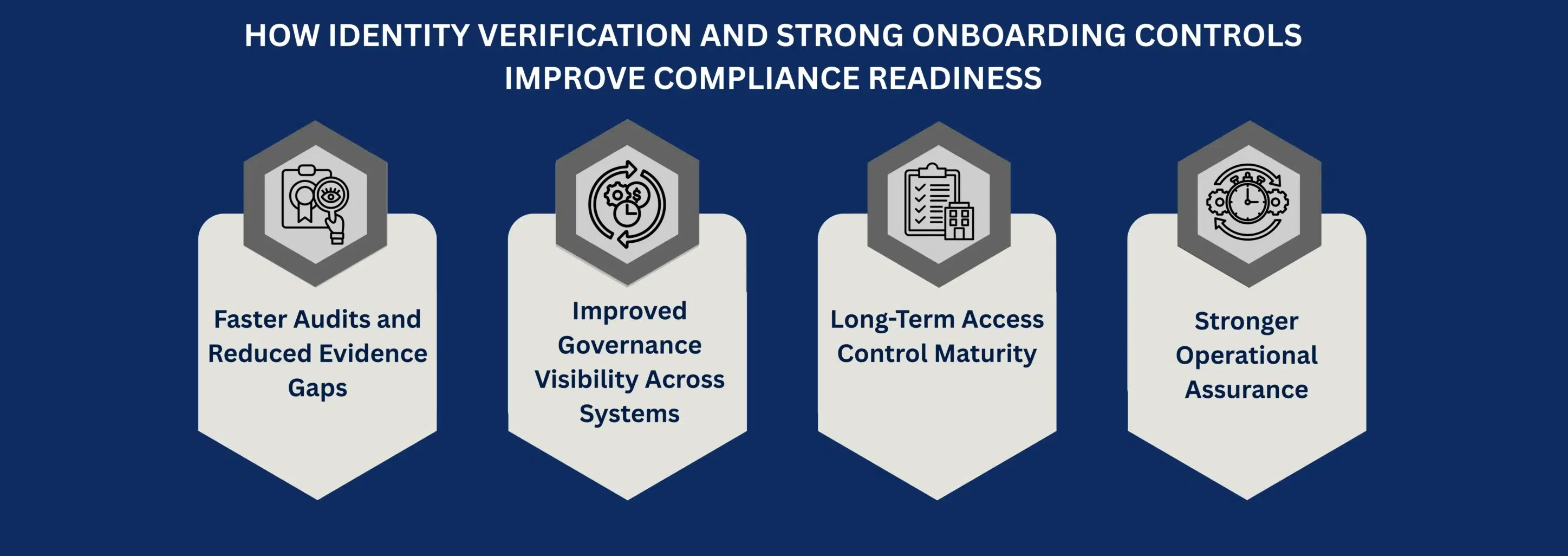
Organizations with strong onboarding controls usually perform better during SOC 2 and ISO 27001 audits. Structured onboarding workflows improve audit readiness, strengthen governance visibility, and reduce operational risk across critical systems. Organizations can achieve these benefits in the following ways.
-
Faster Audits and Reduced Evidence Gaps
Organizations with mature onboarding controls spend less time producing audit evidence. Centralized provisioning logs, documented approvals, and role-based access assignments improve audit efficiency. As a result, auditors can complete access control testing much faster. In contrast, organizations that reconstruct records from emails or spreadsheets often face delays and increased audit scrutiny. Strong onboarding workflows also reduce evidence gaps, remediation efforts, and follow-up testing requirements.
-
Improved Governance Visibility Across Systems
Structured onboarding workflows create stronger governance visibility across systems and departments. Organizations can clearly identify who received access, what systems they accessed, who approved the request, and when provisioning occurred. Consequently, compliance teams can conduct access reviews and privilege monitoring more effectively. This visibility also creates a traceable governance record for internal and external audit reviews.
-
Long-Term Access Control Maturity
Organizations that perform well during audits usually integrate identity verification and access management into daily operations. They do not depend on last-minute audit preparation activities. Instead, onboarding evidence becomes a natural result of operational processes. Over time, these operational improvements strengthen user onboarding best practices and reduce long-term governance risk.
-
Stronger Operational Assurance
Strong onboarding controls improve audit defensibility and reduce control deficiencies over time. Furthermore, organizations build greater operational trust with customers, regulators, and business partners when they maintain consistent access governance practices.
Conclusion
Identity verification is no longer a simple administrative task operating in the background. It now functions as a security control, a governance mechanism, and an auditable evidence workflow within SOC 2 and ISO 27001 environments.
During onboarding reviews, auditors consistently look for clear and verifiable evidence. They expect organizations to prove that teams completed identity verification before granting access; assigned roles through authorized provisioning workflows; recorded approvals properly; and enforced the least privilege principle throughout the process.
These onboarding controls also support stronger performance during SOC 2 Type 2 compliance checklist reviews and external examinations. As a result, auditors gain greater confidence in the overall control environment. However, organizations that cannot produce reliable identity verification evidence often face audit findings, remediation requirements, and reputational concerns related to weak access governance practices.
At CertPro, we conduct SOC 2, ISO 27001, HIPAA, GDPR, and AI governance assurance engagements for technology organizations worldwide. As a licensed CPA firm, we examine onboarding and identity verification controls with the depth and rigor modern compliance environments demand.
We help organizations determine whether their controls can withstand real audit scrutiny, not simply whether those controls exist on paper. That distinction separates basic audit readiness from true audit defensibility, and mature compliance programs should build around that standard.