
ISO 27001 Certification in Pune
CertPro is a Licensed CPA Firm delivering ISO 27001 certification audits to organizations in Pune across IT services, SaaS, software development, fintech, and BPO sectors. Audit activities are structured against ISO/IEC 27001:2022 requirements and Annex A controls. Certification scope, audit program design, and attestation issuance follow internationally recognized information security management standards.
OUR CLIENTS










What Is ISO 27001 Certification?
ISO 27001 is an internationally recognized standard published by the International Organization for Standardization (ISO) that specifies requirements for establishing, implementing, maintaining, and continually improving an Information Security Management System (ISMS). ISO/IEC 27001:2022 — the current version — defines the framework organizations must satisfy to protect information assets from unauthorized access, disclosure, modification, and destruction. Certification to this standard demonstrates that an organization’s ISMS has been independently evaluated against defined requirements by an accredited or licensed certification body.
An Information Security Management System (ISMS) is a structured set of policies, procedures, controls, and processes that an organization implements to manage information security risks in a systematic and continually improving manner. The ISMS scope under ISO 27001 can cover an entire organization or a defined subset of business units, locations, or information assets. Once an organization’s ISMS is evaluated and found to conform to ISO/IEC 27001:2022 requirements, a certification certificate is issued with a validity period of three years, subject to annual surveillance audits.
ISO 27001 vs. Previous Versions
ISO/IEC 27001:2022 replaced the 2013 version of the standard. The most significant structural change in the 2022 update was the reorganization of Annex A controls from 114 controls across 14 domains in the 2013 version to 93 controls organized into 4 themes in the 2022 version. The four Annex A themes in ISO 27001:2022 are: Organizational Controls (37 controls), People Controls (8 controls), Physical Controls (14 controls), and Technological Controls (34 controls). Organizations certified to the 2013 version were required to transition to the 2022 standard by October 31, 2025, as set by accreditation bodies. All new certifications issued from 2024 onward must reference ISO/IEC 27001:2022.
The 2022 revision introduced 11 new controls not present in the 2013 version, including controls addressing threat intelligence, information security for cloud services, ICT readiness for business continuity, physical security monitoring, configuration management, and data masking. These additions reflect the evolving threat landscape that Pune-based IT organizations, SaaS providers, and software product companies operate within. Organizations pursuing ISO 27001 certification in Pune must ensure their ISMS documentation and control implementations align with the 2022 standard’s updated Annex A control set.
Key Definitions Under ISO 27001
ISO 27001 establishes precise terminology that certification auditors use to evaluate an organization’s ISMS. The Statement of Applicability (SoA) is a mandatory document that identifies which Annex A controls are applicable to the organization, which are excluded, and the justification for each decision. The Risk Treatment Plan (RTP) is a documented output of the risk treatment process that specifies how identified information security risks will be addressed through control selection, risk acceptance, risk avoidance, or risk transfer. The Risk Register records identified risks, their likelihood and impact ratings, assigned risk owners, and treatment decisions. These documents form the evidential basis against which certification auditors evaluate ISMS conformance.
| Term | ISO 27001 Definition |
|---|---|
| ISMS | Information Security Management System — the framework of policies, processes, and controls managing information security risks |
| SoA | Statement of Applicability — mandatory document mapping Annex A controls to organizational scope |
| Risk Treatment Plan | Documented plan specifying how identified risks are addressed through selected controls |
| Nonconformity | Non-fulfillment of a requirement specified in ISO/IEC 27001:2022 |
| Corrective Action | Action taken to eliminate the cause of a nonconformity and prevent recurrence |

ISO 27001 Requirements
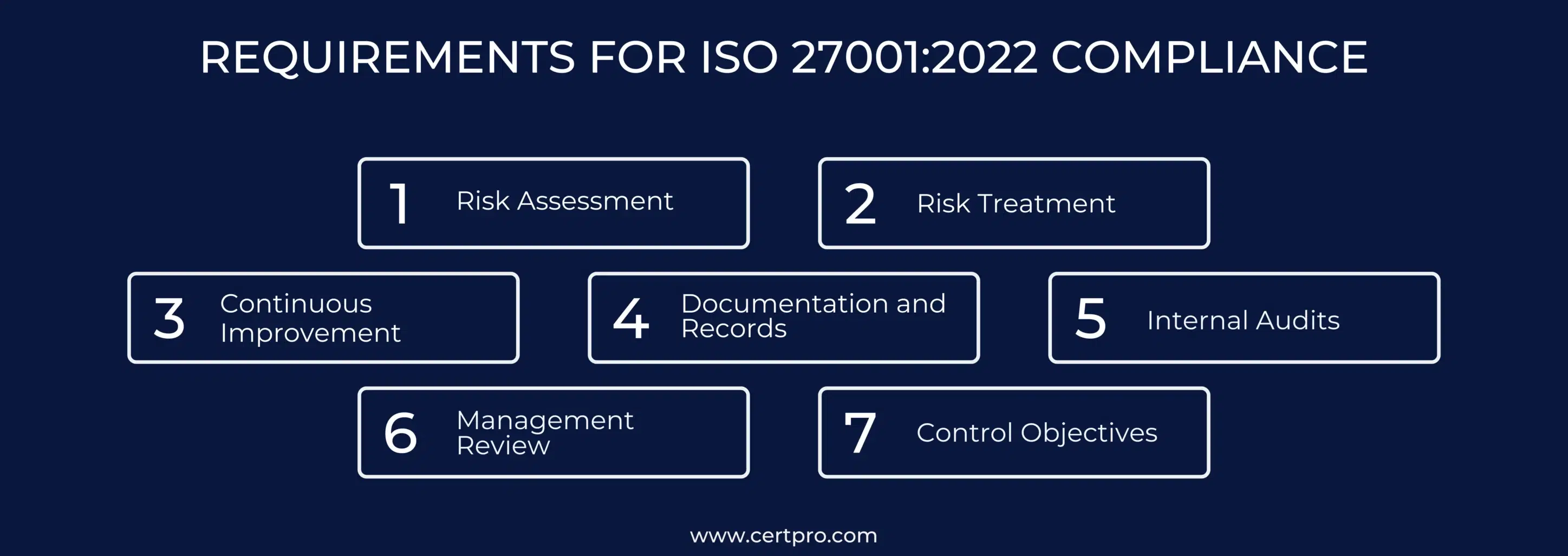
ISO/IEC 27001:2022 is structured using the High-Level Structure (HLS) common to all ISO management system standards. The normative requirements are contained in Clauses 4 through 10, each of which an organization must satisfy to achieve certification. Annex A provides a reference set of 93 controls that organizations select from when designing their risk treatment approach. Certification auditors evaluate conformance with each clause requirement and verify the implementation and effectiveness of selected Annex A controls through document review, staff interviews, and technical testing.
Clause 4 — Context of the Organization requires the organization to identify internal and external factors that affect its ability to achieve ISMS objectives, determine the needs and expectations of interested parties (including clients, regulators, and contractual counterparties), and define the ISMS scope. For Pune-based software firms and SaaS providers, the context analysis typically encompasses client data processing obligations under EU GDPR, US contractual requirements, RBI IT security guidelines, and DPDP Act 2023 obligations. The scope statement must be documented and made available to auditors.
Clause 5 — Leadership establishes that top management must demonstrate commitment to the ISMS by establishing an information security policy, assigning roles and responsibilities, and integrating ISMS requirements into the organization’s business processes. The information security policy must be documented, communicated to all personnel, and available to relevant interested parties. Auditors verify that top management has formally approved the ISMS policy and that roles such as the Information Security Manager or CISO are documented with defined responsibilities.
Clause 6 — Planning encompasses two critical requirements. Clause 6.1 — Risk Assessment and Treatment requires the organization to define and apply a documented risk assessment process that produces consistent, comparable, and valid results. Clause 6.1 also requires the organization to produce a Risk Treatment Plan and obtain risk owner approval. Clause 6.2 — Information Security Objectives requires the organization to establish measurable security objectives aligned with the information security policy. These objectives must be monitored, communicated, and updated as needed. The Statement of Applicability (SoA) is a direct output of the Clause 6.1 risk treatment process and is a mandatory certification audit deliverable.
Clause 7 — Support covers the resources, competence, awareness, communication, and documented information requirements necessary to operate the ISMS. Organizations must ensure that personnel performing security-relevant roles are competent, with evidence of education, training, or experience retained as documented information. Clause 7.5 — Documented Information requires the organization to control the creation, updating, distribution, and retention of all ISMS documents and records. For Pune IT organizations with large developer and operations teams, Clause 7.3 awareness requirements mean that all personnel with ISMS responsibilities must demonstrate understanding of the information security policy and their contribution to ISMS effectiveness.
Clause 8 — Operation requires the organization to plan, implement, and control the processes needed to meet information security requirements. This includes executing the risk assessment process at planned intervals and when significant changes occur, implementing the Risk Treatment Plan, and retaining documented information as evidence of results. For Pune-based organizations handling client data across cloud environments, Clause 8 operational controls must address vendor management, change management, and incident response procedures — all of which are subject to direct audit testing during Stage 2 certification audits.
Clause 9 — Performance Evaluation requires the organization to monitor, measure, analyze, and evaluate ISMS performance. Clause 9.2 — Internal Audit mandates that the organization conducts internal audits at planned intervals to determine whether the ISMS conforms to the organization’s own requirements and to ISO 27001 requirements. Internal audit results must be reported to management. Clause 9.3 — Management Review requires top management to review the ISMS at planned intervals, considering audit results, security performance metrics, risk treatment status, and opportunities for improvement. Management review minutes and outputs are key audit evidence items reviewed during Stage 2.
Clause 10 — Improvement covers nonconformity and corrective action requirements. When a nonconformity occurs — whether identified through internal audit, management review, or security incident — the organization must take action to control and correct it, determine its root cause, implement corrective actions, and verify their effectiveness. Clause 10.2 — Continual Improvement requires the organization to continually improve the suitability, adequacy, and effectiveness of the ISMS. Certification auditors review corrective action records to evaluate whether the organization’s improvement processes function systematically rather than reactively.
Annex A of ISO/IEC 27001:2022 provides 93 reference controls organized across four control themes. These controls are not automatically mandatory — the organization selects applicable controls based on the outcomes of the Clause 6.1 risk assessment and documents those selections in the Statement of Applicability. Auditors verify that the SoA accurately reflects the risk treatment decisions and that selected controls are implemented and operating effectively. Key control domains particularly relevant to Pune technology organizations include A.8 — Technological Controls, which covers access control, cryptography, secure development, vulnerability management, and monitoring of security events.
| Annex A Theme | Number of Controls | Key Control Areas |
|---|---|---|
| Organizational Controls | 37 | Policies, roles, asset management, supplier relationships, incident management |
| People Controls | 8 | Screening, terms of employment, awareness, confidentiality |
| Physical Controls | 14 | Physical perimeters, equipment security, clear desk/screen |
| Technological Controls | 34 | Access control, cryptography, secure development, vulnerability management, monitoring |
- ✓Clauses 4–6: Context, Leadership, and Planning
- ✓Clauses 7–8: Support and Operations
- ✓Clauses 9–10: Evaluation and Improvement
- ✓Annex A Controls in ISO 27001:2022
ISO 27001 Certification Process in Pune
The ISO 27001 certification process in Pune follows a structured sequence of activities that begins with organizational preparation and culminates in the issuance of a certification certificate by the certifying body. CertPro, as a Licensed CPA Firm, conducts certification audits against ISO/IEC 27001:2022 requirements. The process encompasses scope definition, ISMS design and documentation, internal audit execution, management review, and a two-stage external certification audit. Organizations in Pune’s technology corridors — including Hinjewadi, Magarpatta, Kharadi, and Baner — typically complete the full certification cycle within three to six months, depending on organizational size and ISMS maturity.
Step 1 — Define ISMS Scope: The organization formally documents the boundaries of its ISMS, specifying the organizational units, locations, information assets, processes, and technologies included within scope. Scope definition is a Clause 4.3 requirement and must align with the context analysis completed under Clause 4. For Pune SaaS companies and software development firms, the scope typically covers product development environments, customer data processing systems, and supporting IT infrastructure. Scope boundaries must be precise — auditors evaluate whether the defined scope accurately reflects the organization’s information security risk exposure.
Step 2 — Conduct Risk Assessment: The organization applies its documented risk assessment methodology to identify information security risks, analyze their likelihood and impact, and evaluate them against defined risk acceptance criteria. The risk assessment process must produce documented results, including a risk register that records each identified risk, its owner, likelihood rating, impact rating, and risk level. Pune-based IT service providers and BPO organizations typically identify risks related to unauthorized access to client data, cloud infrastructure vulnerabilities, insider threats, and supply chain security weaknesses.
Step 3 — Select and Implement Annex A Controls: Based on the risk assessment results, the organization selects applicable controls from ISO 27001:2022 Annex A and documents those selections in the Statement of Applicability. The SoA must include justification for all included and excluded controls. Selected controls are then implemented across the organization’s processes, systems, and facilities. For Pune technology firms, implementation activities typically involve configuring access control systems, establishing vulnerability management processes, implementing encryption for data in transit and at rest, and formalizing vendor security assessment procedures.
Step 4 — Develop ISMS Documentation: ISO 27001 requires specific documented information as mandatory output of the ISMS processes. Mandatory documents include the ISMS scope statement, information security policy, risk assessment process documentation, risk register, Risk Treatment Plan, Statement of Applicability, information security objectives, competence evidence, internal audit program and results, management review records, and corrective action records. Organizations must also retain documented information required by specific Annex A controls, such as acceptable use policies, access control policies, incident response procedures, and business continuity plans.
Step 5 — Conduct Internal Audit: Clause 9.2 requires the organization to conduct at least one complete internal audit of the ISMS before applying for external certification. The internal audit must evaluate conformance with both the organization’s own ISMS requirements and ISO/IEC 27001:2022 clause requirements. Internal auditors must be competent and must audit areas outside their own direct responsibility to maintain objectivity. Audit findings, including nonconformities and observations, must be reported to management and addressed through the corrective action process before Stage 2 certification audit activities commence.
Step 6 — Complete Management Review: Top management must conduct a formal management review of the ISMS, examining internal and external audit results, security performance data, risk treatment status, corrective action effectiveness, and opportunities for ISMS improvement. Management review outputs — including decisions on resource allocation, policy updates, and ISMS objectives revision — must be documented and retained as evidence. The management review record is a key document requested by Stage 2 certification auditors as evidence that senior leadership is actively engaged in ISMS governance.
Step 7 — Apply for Certification Audit: The organization formally applies to CertPro for ISO 27001 certification in Pune. CertPro reviews the application, agrees on the certification scope, and schedules Stage 1 and Stage 2 audit activities. The certification audit is conducted in two stages: Stage 1 is a documentation review and ISMS readiness assessment; Stage 2 is a detailed on-site or remote audit evaluating the implementation and operational effectiveness of the ISMS. Upon successful completion of Stage 2 and resolution of any identified nonconformities, CertPro issues the ISO 27001 certification certificate.
- Define ISMS scope in accordance with Clause 4.3 requirements
- Conduct information security risk assessment and produce documented risk register
- Develop Risk Treatment Plan and obtain risk owner approvals
- Complete Statement of Applicability with justification for all Annex A control decisions
- Implement selected Annex A controls across systems, processes, and facilities
- Develop all mandatory ISMS documentation including policies, procedures, and records
- Conduct Clause 9.2 internal audit and address identified nonconformities
- Complete Clause 9.3 management review and document outputs
- Submit certification application to CertPro and schedule Stage 1 audit
- Complete Stage 2 certification audit and address any nonconformities
- Receive ISO 27001:2022 certification certificate valid for three years

- ✓Steps 1–4: Scope, Risk Assessment, Controls, and Documentation
- ✓Steps 5–7: Internal Audit, Management Review, and Certification Audit
ISO 27001 Audit Process
The ISO 27001 audit process conducted by CertPro follows a structured evaluation methodology aligned with ISO/IEC 17021-1 requirements for management system certification bodies. The process encompasses two initial certification audit stages, followed by annual surveillance audits and a three-year recertification audit cycle. Each audit stage produces documented findings, nonconformity records, and audit conclusions that form the basis for the certification decision. Auditors evaluate both conformance (whether requirements are met) and effectiveness (whether the ISMS achieves its intended outcomes).
Stage 1 of the ISO 27001 certification audit is a documentation-focused evaluation conducted before the Stage 2 on-site audit. During Stage 1, CertPro auditors review the organization’s ISMS documentation to verify that mandatory documents exist, are appropriately structured, and demonstrate a foundation for Stage 2 evaluation. Key documents reviewed during Stage 1 include the ISMS scope statement, information security policy, risk assessment methodology, risk register, Risk Treatment Plan, Statement of Applicability, information security objectives, and evidence of internal audit and management review completion.
Stage 1 audit outputs include a Stage 1 audit report identifying areas of conformance, areas requiring attention before Stage 2, and any significant gaps that would prevent Stage 2 from proceeding. Stage 1 findings are classified as observations, minor nonconformities, or major nonconformities. Major nonconformities identified at Stage 1 must be addressed before Stage 2 activities can commence. For Pune-based IT organizations, Stage 1 audits are frequently conducted remotely using secure document sharing platforms, reducing logistical burden while maintaining audit rigor. Stage 1 typically takes one to two days for mid-sized organizations.
Stage 2 is the primary certification audit, during which CertPro auditors evaluate the implementation and operational effectiveness of the organization’s ISMS. Stage 2 audit activities include interviews with key personnel across IT, HR, legal, operations, and senior management; review of operational records and evidence logs; observation of security processes; and technical testing of selected controls. Auditors verify that Annex A controls documented in the SoA are implemented as described and are functioning effectively to address the risks they were selected to treat.
Stage 2 audit findings are categorized as major nonconformities, minor nonconformities, or observations. A major nonconformity indicates the absence of a required process or a systemic failure that prevents the ISMS from achieving its intended outcomes — major nonconformities must be resolved before certification can be issued. Minor nonconformities indicate isolated failures to meet a requirement — organizations are typically given a defined period (usually 90 days) to implement corrective actions and provide closure evidence. Upon satisfactory resolution of all nonconformities, CertPro issues the ISO 27001 certification certificate to the organization.
ISO 27001 certification certificates are valid for three years from the date of issue. Annual surveillance audits are conducted in Years 1 and 2 of the certification cycle to verify that the ISMS continues to conform to ISO 27001 requirements and that previously identified nonconformities have been effectively addressed. Surveillance audits are typically narrower in scope than initial certification audits, focusing on high-risk areas, corrective action follow-up, changes to the organization’s context or ISMS scope, and evidence of continual improvement activities. Failure to complete surveillance audits within required intervals can result in certification suspension.
Recertification audits are conducted in Year 3, approximately three months before the certification expiry date, to renew the ISO 27001 certificate for a further three-year cycle. Recertification audits evaluate the continued conformance and effectiveness of the ISMS across all Clauses 4–10 requirements and selected Annex A controls. Organizations that have maintained consistent surveillance audit performance and active ISMS improvement programs typically complete recertification audits efficiently. For Pune organizations with rapidly evolving technology environments, the recertification cycle provides a structured opportunity to reassess risk treatment decisions and update the SoA to reflect changes in the Annex A control set or organizational risk profile.
- ✓Stage 1 Audit: Documentation Review and ISMS Readiness Assessment
- ✓Stage 2 Audit: Implementation and Effectiveness Evaluation
- ✓Surveillance Audits and Recertification
Benefits of ISO 27001 Certification for Pune Organizations
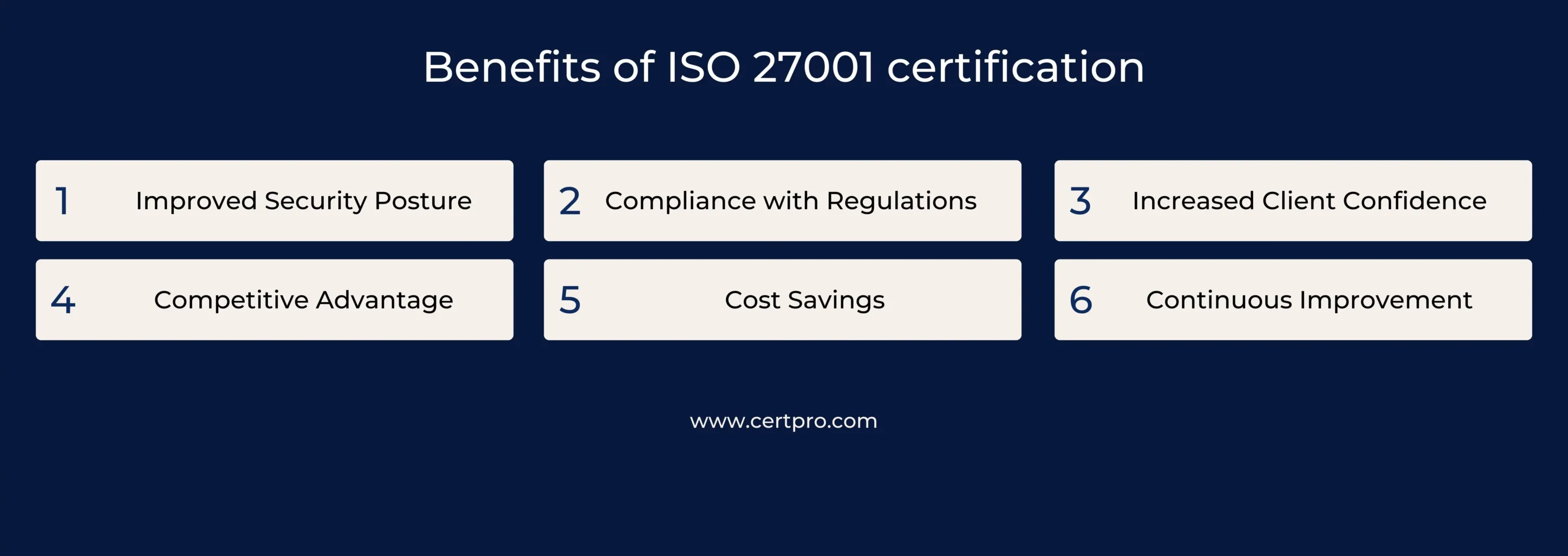
ISO 27001 certification delivers measurable, documented benefits to organizations in Pune’s technology and services sectors. These benefits span regulatory compliance, commercial competitiveness, operational resilience, and stakeholder confidence. Organizations certified to ISO/IEC 27001:2022 demonstrate to clients, regulators, and partners that their information security management system has been independently evaluated and found to conform to internationally recognized requirements — a distinction that carries significant weight in both domestic and international markets.
ISO 27001 certification enables Pune organizations to demonstrate alignment with multiple regulatory and legal requirements through a single, integrated management framework. The ISMS controls required under ISO 27001 directly support compliance with India’s Digital Personal Data Protection (DPDP) Act 2023, which mandates personal data protection obligations for data fiduciaries and data processors. ISO 27001’s Annex A controls addressing data classification, access control, incident management, and vendor security align with DPDP Act requirements for personal data security. Certification provides documented evidence of data protection controls that can be presented to regulatory authorities or affected individuals.
For Pune fintech firms and financial services organizations, ISO 27001 certification supports compliance with RBI’s IT security guidelines and SEBI’s cybersecurity and cyber resilience framework for market infrastructure institutions. RBI’s guidelines on information security explicitly reference ISO 27001 as a benchmark standard for IT risk management. ISO 27001-certified fintech organizations in Pune can demonstrate to RBI examiners that their information security management systems meet internationally recognized standards, potentially reducing regulatory scrutiny and examination frequency. Similarly, SEBI-regulated entities that achieve ISO 27001 certification demonstrate a structured approach to cybersecurity risk management consistent with SEBI framework expectations.
ISO 27001 certification is increasingly a contractual prerequisite for Pune IT service providers and software development firms seeking contracts with European and North American clients. EU-based enterprises operating under GDPR data processing obligations routinely require ISO 27001 certification from Indian IT vendors as evidence of adequate technical and organizational measures for personal data protection. US-based enterprises in regulated sectors — including healthcare, financial services, and defense — similarly require ISO 27001 certification from offshore service providers as part of their vendor security assessment programs. ISO 27001 certification removes a critical barrier to entry for Pune organizations pursuing international business development.
In Pune’s competitive IT services market — spanning Hinjewadi Phase I, II, and III, Magarpatta Cybercity, Kharadi IT Park, and Baner’s software product cluster — ISO 27001 certification differentiates certified organizations from non-certified competitors in RFP evaluations, security questionnaire responses, and due diligence reviews. Large enterprise clients conducting vendor security assessments score certified organizations more favorably than non-certified competitors, reducing the time and cost associated with security questionnaire completion and third-party risk assessment processes. The certification mark on organizational websites, proposals, and marketing materials signals verified security posture to prospective clients.
The ISMS controls implemented during ISO 27001 certification structurally improve an organization’s ability to prevent, detect, and respond to information security incidents. Annex A controls addressing security event monitoring (A.8.16), incident management (A.5.24–A.5.28), and business continuity (A.5.29–A.5.30) require organizations to establish formal processes for security event detection, incident classification, response coordination, and post-incident review. Organizations that have implemented these controls demonstrate measurably faster mean-time-to-detect and mean-time-to-respond metrics compared to organizations without structured incident management processes.
- ✓Documented conformance with DPDP Act 2023, RBI IT security guidelines, and SEBI cybersecurity framework
- ✓Prerequisite satisfaction for EU and US enterprise vendor security programs
- ✓Competitive differentiation in RFP evaluations and security questionnaire scoring
- ✓Reduced cyber insurance premiums through documented risk management controls
- ✓Structured incident detection and response capability reducing breach impact costs
- ✓Improved vendor security management through Annex A supplier controls
- ✓Structured evidence base for regulatory audits and client due diligence reviews
- ✓Three-year certification validity with annual surveillance audit verification
- ✓Demonstrated commitment to continual ISMS improvement through Clause 10 requirements
- ✓Enhanced data protection posture supporting client trust and retention
- ✓Regulatory Compliance and Legal Risk Reduction
- ✓Commercial and Competitive Advantages
- ✓Operational Resilience and Incident Response
ISO 27001 Compliance in Pune — Industry Context
Pune is one of India’s largest technology and services hubs, hosting over 1,500 IT and software companies across specialized technology zones including Hinjewadi IT Park, Magarpatta Cybercity, Kharadi Knowledge Park, and Baner-Balewadi software corridor. The city’s technology ecosystem encompasses IT-enabled services providers, global in-house centers (GICs), SaaS product companies, defense IT vendors, fintech startups, BPO operations, and software product development firms. Each of these industry segments faces distinct information security compliance drivers that make ISO 27001 certification in Pune a strategic operational requirement rather than a discretionary investment.
IT Services and Software Development Firms
Pune’s large-scale IT services and software development sector includes operations for global enterprises in BFSI, healthcare, manufacturing, and retail. These organizations process substantial volumes of client data — including personal data, financial records, healthcare information, and intellectual property — on behalf of EU, US, and Asia-Pacific clients. ISO 27001 certification is mandated by client contracts for organizations processing personal data under GDPR Article 28 (data processor requirements) or US HIPAA Business Associate Agreement frameworks. Organizations in Hinjewadi’s Rajiv Gandhi Infotech Park and Kharadi’s EON IT Park that hold ISO 27001 certification can respond to client data security questionnaires with certification evidence rather than self-attestation, significantly accelerating vendor onboarding processes.
Software product development firms operating from Pune’s Baner and Aundh corridors develop applications handling sensitive user data across consumer, enterprise, and government markets. These firms face information security requirements from multiple directions simultaneously: App Store and Play Store data security requirements, enterprise customer security assessments, SOC 2 audit prerequisites that frequently include ISO 27001 certification as a control framework reference, and India’s DPDP Act obligations for significant data fiduciaries. ISO 27001 certification provides these firms with a documented, audited control framework that satisfies multiple stakeholder security requirements through a single certification activity.
SaaS Providers and Technology Startups
Pune’s growing SaaS ecosystem — concentrated in Magarpatta Cybercity, Viman Nagar, and Kalyani Nagar — includes B2B software platforms serving enterprise clients in BFSI, healthcare, logistics, and HR technology sectors. SaaS providers processing sensitive customer data at scale face direct ISO 27001 certification requirements from enterprise procurement processes. Enterprise SaaS buyers in the US and EU routinely evaluate SaaS vendors through third-party risk assessment programs that treat ISO 27001 certification as a binary qualifying criterion — vendors without certification are disqualified from procurement shortlists regardless of technical merit. For Pune SaaS firms pursuing enterprise market penetration, ISO 27001 certification is a prerequisite for accessing the enterprise customer segment.
Technology startups in Pune’s accelerating startup ecosystem — including those operating from CoWork spaces in Koregaon Park, Deccan, and Wakad — face ISO 27001 certification requirements at earlier stages of organizational maturity than traditional enterprise IT firms. Startup-focused VC firms and enterprise angel investors increasingly require portfolio companies to demonstrate ISO 27001 certification within 12–18 months of product launch as a condition of Series A or B funding rounds. Defense-adjacent technology startups operating under iDEX (Innovations for Defence Excellence) program requirements face additional information security certification obligations that ISO 27001 certification supports.
Fintech and BPO Organizations
Pune’s fintech sector — spanning payment technology firms, lending platforms, wealth management applications, and insurance technology providers — operates under concurrent information security obligations from RBI, SEBI, IRDAI, and NPCI. RBI’s Master Directions on IT Governance, Risk, Controls, and Assurance Practices explicitly reference ISO 27001 as a recognized framework for information security management. Fintech organizations certified to ISO 27001 can reference their certification in regulatory submissions and RBI audit responses as evidence of structured IT security governance. The ISMS framework’s risk treatment approach aligns with RBI’s requirement for documented cyber risk management processes.
Pune’s BPO and knowledge process outsourcing (KPO) sector processes sensitive personal and financial data for international clients under strict contractual data security obligations. BPO organizations processing personal data of EU residents must satisfy GDPR Article 32 requirements for appropriate technical and organizational measures — ISO 27001 certification provides documented evidence that these measures have been independently evaluated. US-based clients in healthcare, legal, and financial services sectors require BPO vendors to maintain ISO 27001 certification as part of their third-party risk management programs. ISO 27001 ISMS audit in Pune for BPO organizations typically scopes the certification to cover client data processing environments, segregated network zones, and data handling procedures relevant to contractual obligations.
Why CertPro for ISO 27001 Certification in Pune?
CertPro operates as a Licensed CPA Firm delivering ISO 27001 certification audits structured exclusively around evaluation and attestation activities. CertPro does not provide implementation services, consulting, or advisory engagements — the firm’s scope is strictly limited to independent audit and certification activities. This independence ensures that CertPro’s ISO 27001 audit conclusions reflect objective evaluation of the organization’s ISMS against ISO/IEC 27001:2022 requirements, without conflict of interest arising from prior implementation involvement. CertPro’s audit methodology is designed to produce certification decisions that carry credibility with enterprise clients, regulators, and international accreditation authorities.
Audit Methodology and Technical Depth
CertPro’s ISO 27001 audit methodology for Pune organizations is structured to evaluate both conformance and effectiveness across all ISO 27001 clauses and applicable Annex A controls. Audit programs are designed based on the organization’s specific scope, risk profile, industry sector, and applicable regulatory requirements. Audit testing for Pune IT organizations typically includes technical evaluation of access control implementations, network security configurations, encryption standards, vulnerability scanning practices, and security event logging — in addition to document review and personnel interviews. Auditors with domain expertise in cloud security, application security, and financial services information security conduct sector-specific audit activities appropriate to the organization’s operating environment.
CertPro’s audit reports provide detailed findings mapped to specific ISO 27001 clause requirements and Annex A control references. Each nonconformity is documented with the specific requirement violated, objective evidence observed, and the auditor’s basis for the finding. This level of documentation specificity enables organizations to implement targeted corrective actions addressing the precise conformance gap identified, rather than broadly interpreted findings that result in disproportionate remediation effort. The structured audit report format also facilitates extraction of certification evidence for presentation to clients, regulators, and partners who require documentation of specific control areas evaluated during the certification audit.
Institutional Independence and Certification Credibility
CertPro’s Licensed CPA Firm status distinguishes its certification activities from those of non-CPA certification bodies and from organizations that combine implementation consulting with certification auditing. The institutional independence of CertPro’s audit conclusions — grounded in professional standards applicable to Licensed CPA Firms — enhances the credibility of ISO 27001 certifications issued to Pune organizations in enterprise client due diligence processes and regulatory review contexts. Enterprise procurement teams and compliance officers recognize that certifications issued by independent audit firms carry higher evidentiary weight than self-attestations or certifications issued by organizations with prior consulting relationships.
CertPro issues ISO 27001 certification certificates that specify the certification scope, audit standard (ISO/IEC 27001:2022), certification date, and certificate validity period. Certificates include a unique certificate number that enables verification by third parties — including enterprise procurement teams, cyber insurance underwriters, and regulatory authorities. CertPro maintains a current list of certified organizations that enterprise clients and regulators can reference to verify certification status and scope. The three-year certification cycle with annual surveillance audits ensures that CertPro-issued certifications reflect the organization’s current ISMS status rather than a historical point-in-time evaluation.
ISO 27001 Certification Cost in Pune
ISO 27001 certification cost in Pune is determined by several quantifiable factors that CertPro assesses during the certification application review. The primary cost drivers are the size of the organization (measured by employee count and audit person-days required), the complexity of the certification scope (number of locations, systems, and processes included), the industry sector and associated regulatory complexity, and the maturity of the existing ISMS. CertPro’s certification fees are structured on a transparent, fixed-fee basis specific to the certification scope agreed during the application process — fees do not include variable consulting add-ons or implementation charges, as CertPro does not provide those services.
Certification Fee Structure
CertPro’s ISO 27001 certification fees in Pune cover Stage 1 audit activities, Stage 2 audit activities, audit report preparation, nonconformity review, and certification decision activities. Annual surveillance audit fees are structured separately and are disclosed at the time of initial certification engagement. Recertification audit fees applicable in Year 3 are also disclosed upfront, enabling organizations to budget the full three-year certification cycle costs. The fixed-fee structure eliminates cost uncertainty that arises from time-and-materials billing models used by some certification bodies, and ensures that organizations can allocate certification budgets with accuracy.
For small and mid-sized Pune technology organizations — including SaaS startups, boutique software development firms, and specialized IT service providers — ISO 27001 certification cost typically ranges based on organizational size and scope complexity. Organizations with 50 or fewer employees and a narrowly defined certification scope (e.g., a single product or service line) typically incur lower total certification costs than large enterprises with multi-location, multi-service scopes. The total cost of certification must also account for internal resource investment — personnel time dedicated to ISMS documentation development, internal audit execution, and audit evidence preparation — which is separate from CertPro’s certification fees.
| Organization Size | Typical Audit Duration | Key Cost Factors |
|---|---|---|
| Startup / SME (1–50 employees) | 2–3 audit days | Scope simplicity, single location, focused control set |
| Mid-size IT firm (50–250 employees) | 4–6 audit days | Multiple systems, broader control scope, multi-function teams |
| Large enterprise (250+ employees) | 7–12 audit days | Multi-location, complex infrastructure, regulatory overlay |
| BPO / Multi-site (250+ employees) | 8–15 audit days | Multiple client environments, segregated networks, contractual scope requirements |
Cost Factors Specific to Pune Organizations
Pune IT organizations with operations across multiple technology park locations — for example, development centers in Hinjewadi and sales operations in Koregaon Park — may require multi-site audit activities, which affect total certification cost. Multi-site audits involve audit sampling of locations included within the certification scope and add to total audit person-days. Organizations that include cloud-hosted infrastructure within scope require auditors with cloud security expertise — CertPro’s audit teams include personnel with cloud audit competencies relevant to AWS, Azure, and GCP environments commonly used by Pune technology firms. Organizations subject to concurrent compliance frameworks (e.g., SOC 2, PCI DSS, DPDP Act) may benefit from coordinated audit scheduling that reduces total audit burden across frameworks.
FAQ
▶
What is ISO 27001 certification and why is it required for Pune IT companies?
▶
How long does ISO 27001 certification take in Pune?
▶
What is the validity period of ISO 27001 certification?
▶
What documents are required for ISO 27001 certification audit?
▶
Does ISO 27001 certification cover cloud infrastructure used by Pune SaaS companies?
▶
How does ISO 27001 certification relate to DPDP Act 2023 compliance for Pune organizations?
▶
What is the difference between Stage 1 and Stage 2 ISO 27001 audits?
▶
Can a Pune startup with 20–30 employees obtain ISO 27001 certification?
HOW COMPLIANCE AUDIT SOFTWARE IMPROVES AUDIT READINESS
Today, most companies deal with a growing number of compliance regulations. From data privacy standards to security frameworks like SOC 2 and ISO 2700…

THE ROLE OF GRC IN ISO 27001, SOC 2, AND OTHER FRAMEWORKS
The term GRC stands for Governance Risk and Compliance. It’s a system of integrated and centralized approaches used by organizations. This system comb…
HOW TO PREPARE FOR A MULTI-STANDARD AUDIT (SOC 2, ISO 27001, HIPAA) WITHOUT OVERLAPPING EFFORTS
The current regulatory landscape is no less than a proving ground for global businesses. Organizations are struggling to comply with the complex regul…
Get In Touch
have a question? let us get back to you.