
SOC 2 Certification in India
CertPro is a Licensed CPA Firm conducting SOC 2 audits for organizations operating across India. Engagements are performed against the AICPA Trust Services Criteria, covering Security, Availability, Confidentiality, Processing Integrity, and Privacy. SOC 2 attestation is issued following structured audit procedures for Indian technology, SaaS, and financial service organizations seeking recognized SOC2 Certification.
OUR CLIENTS










Introduction to SOC 2 Certification in India
SOC 2 Certification in India is a formal attestation issued by a Licensed CPA Firm confirming that an organization’s information security controls meet the American Institute of Certified Public Accountants (AICPA) Trust Services Criteria. The certification applies to technology service providers, SaaS companies, cloud infrastructure operators, data centers, and financial technology organizations that store, process, or transmit customer data on behalf of clients.
As Indian enterprises increasingly serve global markets — particularly US-based enterprises, financial institutions, and healthcare organizations — SOC 2 attestation has become a standard contractual and procurement requirement. Achieving SOC2 Certification signals to international clients that security controls have been independently verified rather than self-assessed.
The AICPA introduced the SOC 2 framework as part of its Service Organization Control reporting suite. Unlike financial audits or ISO certifications, SOC 2 is structured as an attestation engagement. A licensed CPA auditor examines an organization’s security posture against defined Trust Services Criteria (TSC) and issues a formal report confirming whether controls were suitably designed and, in the case of Type 2 reports, operated effectively over a defined review period.
SOC 2 compliance in India is increasingly demanded by enterprise customers in the United States, Europe, and the Asia-Pacific region as a precondition for vendor onboarding and data processing agreements.
What Is SOC 2 and Why Does It Matter for Indian Organizations?
SOC 2 is a reporting standard developed by the AICPA specifically for service organizations that handle customer data in cloud and technology environments. The framework defines five Trust Services Criteria: Security (the common criteria applicable to all SOC 2 engagements), Availability, Confidentiality, Processing Integrity, and Privacy. Organizations select the criteria relevant to their service commitments and contractual obligations, and auditors evaluate controls against those specific criteria during the SOC 2 audit engagement.
For Indian IT companies, software product firms, BPOs, fintech organizations, and cloud service providers, SOC 2 Certification in India carries significant commercial weight. Enterprise clients in regulated industries — including banking, insurance, healthcare, and government contracting — routinely require SOC 2 reports from their service providers before executing data processing agreements.
Indian organizations that achieve SOC 2 attestation demonstrate to international clients that their security controls have been independently verified by a licensed CPA firm, not merely self-assessed or documented internally.
The distinction between SOC 2 compliance and SOC 2 certification is important. Compliance means following internal controls or regulatory requirements without independent verification. SOC 2 Certification in India — more precisely, SOC 2 attestation — means a licensed CPA firm has formally examined those controls and issued a report attesting to their design and operating effectiveness. This independent verification is what gives the SOC 2 report its commercial and regulatory credibility in global markets.
SOC 2 Type 1 and SOC 2 Type 2 Reports Explained
SOC 2 engagements are structured as either Type 1 or Type 2 assessments. A SOC 2 Type 1 engagement evaluates whether an organization’s controls are suitably designed as of a specific point in time. The auditor reviews the control environment, confirms that policies and procedures are documented, and assesses whether controls address the selected Trust Services Criteria.
Type 1 reports are useful for organizations at earlier stages of their security program or those seeking to demonstrate a baseline level of control design to prospective clients. For many Indian companies, a Type 1 report is the first step toward full SOC2 Certification.
A SOC 2 Type 2 engagement goes significantly further. The auditor examines not only the design of controls but also their operating effectiveness over a defined period — typically six to twelve months. This means reviewing evidence of control operation, testing whether controls functioned consistently, and assessing whether deviations occurred and how they were addressed.
SOC 2 Type 2 reports carry greater evidential weight for enterprise clients because they demonstrate sustained, consistent security operations rather than a single-point-in-time snapshot. Most enterprise procurement requirements specifically request Type 2 reports when evaluating SOC 2 Certification in India.
| Feature | SOC 2 Type 1 | SOC 2 Type 2 |
|---|---|---|
| Assessment Scope | Control design at a point in time | Control design and operating effectiveness over a period |
| Review Period | Single date | Minimum 6 months (typically 12 months) |
| Evidence Required | Policy and procedure documentation | Operational evidence over the review period |
| Client Acceptance | Accepted for initial vendor onboarding | Required for enterprise and regulated industry contracts |
| Renewal | Not required annually | Annual renewal expected to maintain current status |
Trust Services Criteria Applicable to SOC 2 Audits in India
The AICPA Trust Services Criteria form the evaluative foundation of every SOC 2 audit. The Security criterion — also referred to as the Common Criteria — is mandatory for all SOC 2 engagements. It addresses logical and physical access controls, system operations, change management, risk mitigation, and monitoring. The remaining four criteria — Availability, Confidentiality, Processing Integrity, and Privacy — are selected based on the organization’s service commitments and the nature of data processed.
Indian SaaS organizations processing customer data under service level agreements typically include the Availability criterion to demonstrate uptime and resilience commitments. Fintech and healthcare data processors often include Confidentiality and Privacy criteria to address data handling obligations under client contracts and applicable regulations — such as India’s Digital Personal Data Protection Act (DPDPA) and related data localization requirements.
Organizations that process transactions or execute workflows on behalf of clients may include Processing Integrity to confirm that data is processed accurately, completely, and in a timely manner. Selecting the right criteria is a key early decision in any SOC 2 Certification in India engagement.

Benefits of SOC 2 Certification in India
SOC 2 Certification in India delivers measurable commercial, operational, and regulatory benefits for technology organizations competing in domestic and international markets. The certification signals to prospective clients that an organization’s security controls have been independently examined and attested by a Licensed CPA Firm — a standard that carries formal weight in enterprise procurement, vendor risk management programs, and regulatory audits.
Organizations that hold current SOC 2 attestation consistently report faster vendor onboarding timelines and reduced friction in security questionnaire responses, making SOC2 Certification a direct driver of revenue growth.
For SOC 2 certification for Indian IT companies, the commercial case is direct. Enterprise clients in the United States, United Kingdom, European Union, and Australia require SOC 2 reports as a condition of vendor onboarding. Organizations without a current SOC 2 attestation are frequently excluded from procurement processes or required to complete lengthy security questionnaires that delay contract execution.
SOC 2 attestation India effectively replaces hundreds of individual security questionnaire responses with a single audited report — reducing sales cycle friction and accelerating revenue generation.
Indian technology exporters — particularly those serving Fortune 500 companies, financial institutions, or US federal government contractors — operate in markets where SOC 2 compliance India is a baseline expectation rather than a differentiator. Organizations that achieve SOC 2 Type 2 attestation position themselves as audit-ready, security-mature vendors capable of meeting the oversight demands of regulated enterprise clients.
This positioning directly affects win rates in competitive procurement situations where multiple Indian vendors are evaluated simultaneously, making SOC 2 Certification in India a genuine commercial asset.
The SOC 2 audit process drives tangible improvements in an organization’s internal security operations. The structured evaluation against Trust Services Criteria requires organizations to formalize access control policies, implement logging and monitoring systems, establish change management procedures, and maintain vendor management programs. These operational requirements, when implemented to satisfy audit standards, produce security environments that are more resilient, consistently operated, and better documented than those built without external evaluation frameworks.
Organizations undergoing SOC 2 Type 2 audits in India must demonstrate that their controls functioned consistently over the review period. This requirement pushes organizations beyond point-in-time security measures toward sustained operational discipline — regular access reviews, automated alerting, documented incident response procedures, and periodic control testing.
The operational discipline required to satisfy SOC 2 Type 2 standards materially reduces the probability of security incidents and data breaches, producing risk reduction benefits that extend well beyond the certification itself.
SOC 2 compliance India intersects with the requirements of India’s Digital Personal Data Protection Act (DPDPA), which establishes data fiduciary obligations for organizations processing personal data of Indian residents. While SOC 2 attestation is not a legal requirement under DPDPA, organizations that maintain SOC 2-compliant security environments are better positioned to demonstrate compliance with DPDPA data security obligations.
The overlapping requirements across access control, data minimization, purpose limitation, and breach notification create operational synergies between SOC 2 compliance programs and DPDPA compliance frameworks.
Indian fintech organizations subject to Reserve Bank of India (RBI) cybersecurity guidelines and SEBI IT risk management frameworks also benefit from SOC 2 compliance as a supplementary control assurance mechanism. SOC 2 compliance India fintech environments address many of the same control domains — logical access, encryption, monitoring, incident response — that RBI and SEBI guidelines require.
This alignment reduces duplicative compliance effort and provides auditable evidence of security program effectiveness to multiple regulatory stakeholders simultaneously.
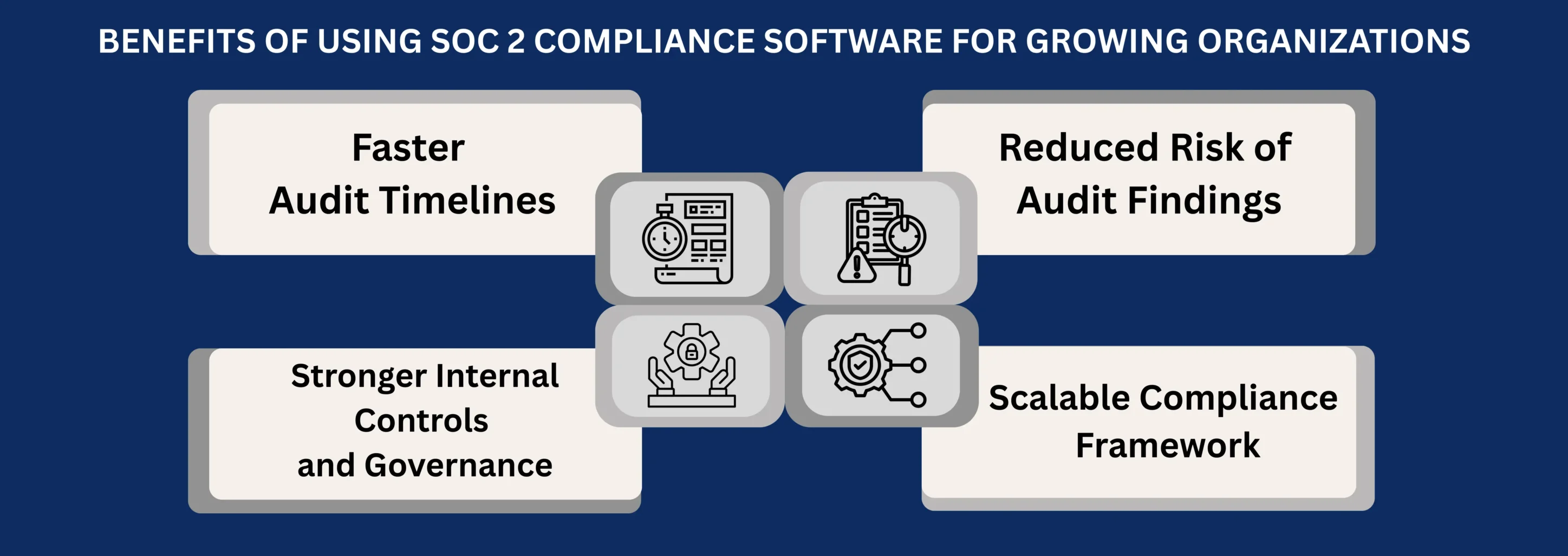
- ✓Accelerates enterprise vendor onboarding by providing an audited security report in place of security questionnaires
- ✓Demonstrates independent verification of security controls to US, UK, EU, and APAC enterprise clients
- ✓Supports compliance with India’s Digital Personal Data Protection Act (DPDPA) data security obligations
- ✓Provides operational security improvements through structured control implementation and monitoring
- ✓Reduces security incident probability through sustained operational discipline required for Type 2 attestation
- ✓Enables Indian IT companies to compete for regulated industry contracts requiring SOC 2 attestation
- ✓Aligns with RBI cybersecurity guidelines and SEBI IT risk frameworks for Indian fintech organizations
- ✓Strengthens organizational risk management through formalized access control, change management, and incident response
- ✓Supports data center and cloud service provider compliance with client contractual security requirements
- ✓Provides annual renewal cycle that maintains current security posture and demonstrates continued control effectiveness
- ✓Commercial Advantages for Indian IT and SaaS Companies
- ✓Operational Security Improvements Through SOC 2 Compliance
- ✓Regulatory Alignment and Data Protection Compliance
SOC 2 Certification Process in India
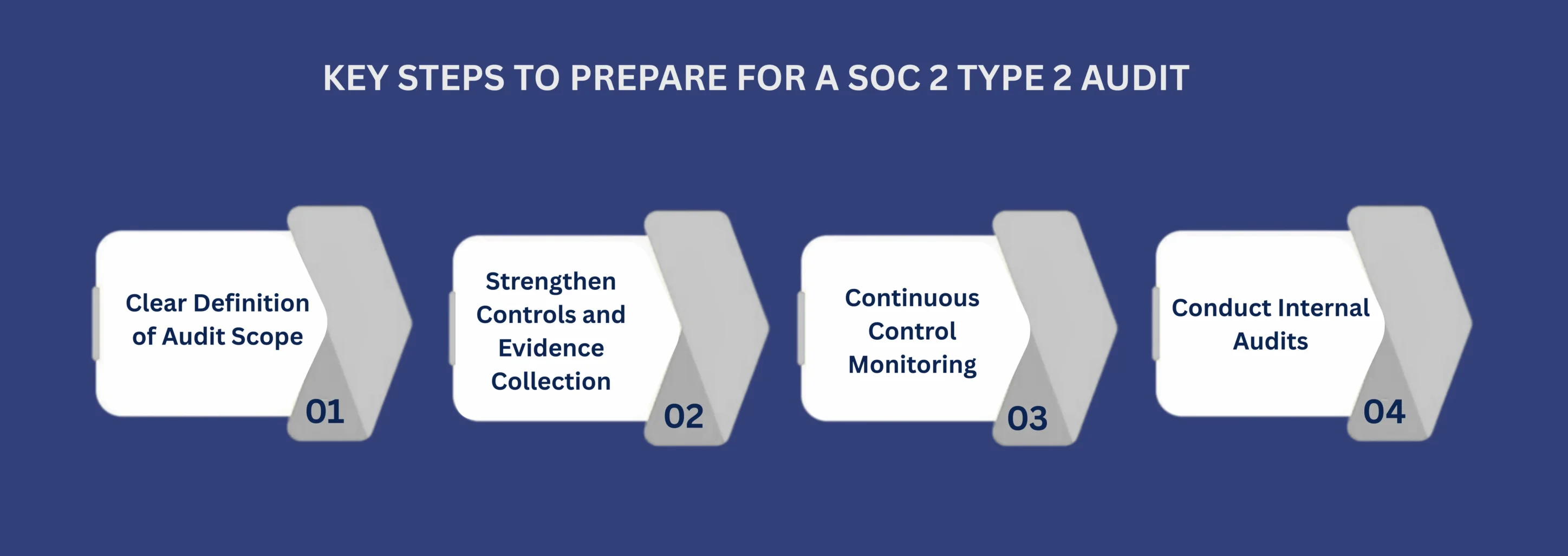
The SOC 2 certification process in India follows a structured sequence of audit stages defined by AICPA attestation standards. Each stage involves specific evaluation activities performed by a Licensed CPA Firm. The process begins with scope definition and concludes with the issuance of the formal SOC 2 attestation report. Understanding each stage enables organizations to allocate appropriate resources, prepare required evidence, and engage audit procedures effectively.
The SOC 2 audit begins with scope definition — the formal determination of which systems, services, infrastructure components, and personnel fall within the audit boundary. The auditor reviews the organization’s service description, system inventory, data flow documentation, and service commitments to establish a scope that accurately reflects the systems and processes relevant to the Trust Services Criteria being evaluated.
Scope definition is a critical stage because an incorrectly scoped audit may either exclude material systems from evaluation or include systems that add complexity without adding evidential value to the SOC 2 Certification in India engagement.
Audit program determination follows scope definition. The Licensed CPA Firm develops the specific control objectives, testing procedures, and evidence requirements that will govern the engagement. The audit program is aligned to the selected Trust Services Criteria and accounts for the organization’s technology environment, third-party dependencies, and the review period under examination.
For SOC 2 audit India engagements, audit programs also account for India-specific infrastructure considerations such as local data center dependencies, cloud service provider configurations, and cross-border data transfer arrangements.
Following scope and program determination, the organization provides documentation of its control environment. This includes policies, procedures, system configurations, access control records, vendor agreements, training completion records, and operational logs. The auditor reviews this documentation to assess whether controls are suitably designed to address the requirements of the selected Trust Services Criteria. For Type 1 engagements, this documentation review is the primary basis for the auditor’s conclusions.
For SOC 2 Type 2 engagements, evidence collection extends throughout the review period — typically six to twelve months. The auditor requires operational evidence demonstrating that controls functioned as designed during that period. Evidence may include access review logs, change management records, security monitoring alerts, incident response tickets, backup verification logs, and vulnerability management reports.
The quality and completeness of evidence collection directly affects the auditor’s ability to conclude on operating effectiveness and the ultimate scope of the SOC 2 attestation report.
Control testing is the core evaluative activity of the SOC 2 audit. The Licensed CPA Firm selects samples from the evidence population and performs defined testing procedures to determine whether controls operated effectively during the review period. Testing procedures vary by control type and may include inspection of documentation, re-performance of control procedures, observation of operational processes, and inquiry of control owners. The auditor documents the results of each test and identifies any instances where controls did not operate as designed.
Nonconformities identified during control testing are classified by severity and assessed for their impact on the overall audit conclusions. The auditor reviews identified exceptions with the organization, obtains explanations and compensating control evidence where applicable, and determines whether exceptions are isolated incidents or systemic control failures.
Nonconformities that are isolated, promptly remediated, and do not affect the overall effectiveness of the control environment may be noted as exceptions within the report without qualifying the overall opinion. Systemic or uncorrected nonconformities may result in a qualified or adverse opinion in the final SOC 2 attestation report.
Following the completion of control testing and nonconformity review, the Licensed CPA Firm makes a certification decision based on the aggregate audit findings. The auditor’s opinion reflects whether the organization’s controls were suitably designed (Type 1) and operated effectively (Type 2) during the defined period. The formal SOC 2 attestation report is then issued, comprising the auditor’s opinion, a description of the service organization’s system, the organization’s assertion regarding control effectiveness, and detailed findings organized by Trust Services Criteria.
The SOC 2 attestation report is a confidential document typically shared with existing and prospective clients under non-disclosure agreements. The report does not carry an expiration date but reflects a specific period of evaluation. Enterprise clients and regulated industry procurement programs generally require reports dated within the past twelve months to ensure currency.
Organizations must therefore complete annual audit cycles to maintain current SOC 2 Certification in India and meet ongoing customer expectations for up-to-date attestation.
- ✓Stage 1: Scope Definition and Audit Program Determination
- ✓Stage 2: Control Documentation and Evidence Collection
- ✓Stage 3: Control Testing and Nonconformity Review
- ✓Stage 4: Certification Decision and Issuance of SOC 2 Attestation
Steps to Obtain SOC 2 Certification in India
Organizations pursuing SOC 2 Certification in India follow a defined sequence of preparation and audit activities. The steps below reflect the structured process followed by CertPro as a Licensed CPA Firm conducting SOC 2 audits across India. Each step involves specific organizational actions and auditor evaluation activities that collectively produce the formal SOC 2 attestation report.
- Determine the applicable Trust Services Criteria based on service commitments and contractual obligations
- Define the audit scope including in-scope systems, services, data flows, infrastructure, and personnel
- Document the organization’s system description covering technology, processes, people, and data
- Compile control policies, procedures, and operational documentation aligned to each Trust Services Criterion
- Establish the evidence collection period for Type 2 engagements (minimum six months, typically twelve months)
- Engage the Licensed CPA Firm to initiate Stage 1 audit activities including documentation review and walkthroughs
- Provide operational evidence demonstrating control operation during the defined review period
- Participate in control testing activities including auditor inquiries, observations, and document inspections
- Address identified nonconformities and provide additional evidence or remediation documentation as required
- Review the draft attestation report for accuracy and completeness before final issuance
- Receive the final SOC 2 attestation report and distribute to clients under appropriate non-disclosure agreements
- Plan the annual recertification cycle to maintain current SOC 2 attestation status
Requirements for SOC 2 Certification in India
SOC 2 Certification in India requires organizations to establish and maintain a defined set of information security controls evaluated against the AICPA Trust Services Criteria. The requirements span documentation, technical controls, operational processes, and organizational governance. Organizations must satisfy requirements across all selected criteria before the Licensed CPA Firm can issue an unqualified attestation opinion. The following sections detail the key requirement categories evaluated during a SOC 2 audit in India.
Documentation requirements for SOC 2 compliance India include a formal information security policy framework covering access control, data classification, acceptable use, incident response, business continuity, and vendor management. Each policy must be formally approved by organizational leadership, communicated to relevant personnel, and reviewed at defined intervals.
The organization must also maintain a system description — a formal narrative document that describes the services provided, the technology environment, the personnel responsible for control operation, and the Trust Services Criteria applicable to the audit scope.
Process documentation requirements include formal change management procedures governing modifications to in-scope systems, access provisioning and deprovisioning workflows, vendor onboarding and risk assessment procedures, and incident response runbooks. For SOC 2 Type 2 engagements, documentation must also demonstrate that these procedures were followed consistently during the review period — not merely that they exist on paper.
Auditors verify documentation currency, approval signatures, version control, and evidence of actual procedural adherence through sampling of operational records as part of the SOC 2 audit.
Technical requirements for SOC 2 audit India engagements address the specific security controls implemented within the organization’s technology environment. Access control requirements include multi-factor authentication for privileged accounts and remote access, role-based access control aligned to least privilege principles, periodic access reviews, and automated deprovisioning upon employee termination. Encryption requirements cover data at rest and in transit, with specific attention to encryption standards applied to sensitive customer data stored in cloud environments or transmitted across network boundaries.
Monitoring and logging requirements specify that organizations must implement centralized log management, security information and event management (SIEM) capabilities, and defined alert thresholds for anomalous activity. Auditors review log configurations, alert histories, and evidence of security event investigations to confirm that monitoring controls operated during the review period.
Vulnerability management requirements address the frequency of internal and external vulnerability scanning, patch management timelines, and penetration testing conducted against in-scope systems. These technical controls collectively form the operational foundation of SOC 2 compliance for Indian organizations.
Organizational requirements for SOC 2 certification for India companies include the establishment of formal risk assessment procedures conducted at least annually, defined roles and responsibilities for information security governance, and executive-level accountability for the security program. The AICPA Common Criteria reference the COSO (Committee of Sponsoring Organizations) Internal Control — Integrated Framework as the foundational governance model for SOC 2 control environment assessment. Auditors evaluate the organization’s control environment, risk assessment processes, control activities, information and communication structures, and monitoring activities against COSO principles.
Human resources and personnel security requirements include background verification procedures for employees with access to in-scope systems, security awareness training completed at defined intervals, and formal acknowledgment of security policies by all relevant personnel. Third-party management requirements address vendor risk assessments, contractual security obligations, and sub-service organization monitoring.
These requirements are particularly relevant for Indian organizations that rely on cloud infrastructure providers, third-party software platforms, or offshore development partners as components of their service delivery model — a common scenario in SOC 2 Certification in India engagements.

- ✓Documentation Requirements
- ✓Technical Control Requirements
- ✓Organizational and Governance Requirements
SOC 2 Certification Cost in India
SOC 2 certification cost in India varies based on multiple factors including organizational size, technology environment complexity, number of Trust Services Criteria included in scope, audit type (Type 1 or Type 2), and the review period duration for Type 2 engagements. Understanding the cost structure enables organizations to budget appropriately and prioritize certification activities in alignment with commercial timelines and client procurement requirements.
Factors Influencing SOC 2 Certification Cost
The primary cost drivers for SOC 2 certification cost in India include the scope of the audit engagement, the number of in-scope systems and services, the number of Trust Services Criteria selected, and whether the organization is pursuing a Type 1 or Type 2 report. Type 2 audits with twelve-month review periods require more extensive evidence collection, sampling, and testing than Type 1 engagements, and are accordingly more resource-intensive for both the organization and the Licensed CPA Firm.
Organizations with complex multi-cloud environments, large numbers of in-scope personnel, or extensive third-party dependencies typically incur higher audit costs due to expanded testing scope in the SOC 2 audit.
Smaller Indian SaaS organizations with simpler technology environments and a single Trust Services Criterion (Security only) can achieve SOC 2 Type 1 certification at lower cost compared to large enterprises with multi-criteria scopes and complex infrastructure. The annual recertification cycle also creates ongoing cost considerations — organizations must budget for annual Type 2 audit fees, internal resource allocation for evidence collection, and any remediation activities required to address audit findings.
The total cost of maintaining SOC 2 certification should be evaluated against the commercial value of accelerated enterprise sales cycles and reduced vendor risk questionnaire burden.
| Organization Profile | Audit Type | Estimated Scope Factors |
|---|---|---|
| Small SaaS (50 employees, single product) | Type 1 — Security only | Limited systems, single criteria, shorter timeline |
| Mid-size IT services firm (200 employees) | Type 2 — Security + Availability | Multiple services, 12-month review, expanded evidence |
| Fintech organization (500 employees) | Type 2 — Security + Confidentiality + Privacy | Regulatory alignment, complex data flows, multiple criteria |
| Large data center / cloud provider | Type 2 — All 5 criteria | Multi-site, broad scope, extensive third-party dependencies |
| Enterprise BPO (1000+ employees) | Type 2 — Security + Processing Integrity | High transaction volumes, complex processing controls |
Annual Recertification and Ongoing Maintenance Costs
SOC 2 certification is not a one-time achievement. Enterprise clients and regulated industry procurement programs expect organizations to maintain current SOC 2 attestation — typically defined as a report issued within the preceding twelve months. Organizations must therefore complete annual audit cycles to maintain certified status. Annual recertification costs are generally comparable to initial certification costs for organizations that maintain stable control environments, though organizations that expand their service scope, add criteria, or undergo significant infrastructure changes may see increased audit costs in subsequent cycles.
Internal resource costs associated with SOC 2 compliance India include the time investment of IT security personnel, legal and compliance staff, and operations teams responsible for evidence collection and control operation during the review period. Organizations that implement automated evidence collection tools, integrated compliance platforms, and continuous monitoring capabilities can reduce the internal labor costs associated with annual SOC 2 audit cycles.
These investments in compliance infrastructure typically yield cost savings over multiple audit cycles while also improving the quality and completeness of evidence provided to auditors.
SOC 2 Compliance India: Industry-Specific Considerations
SOC 2 compliance requirements and commercial drivers vary across industry sectors in India. Technology services, fintech, healthcare IT, and data center operators each face distinct client expectations, regulatory contexts, and audit scope considerations that shape how SOC 2 certification is pursued and maintained. Understanding industry-specific SOC 2 requirements enables organizations to align their audit scope with both client demands and applicable regulatory frameworks.
SOC 2 for Indian IT Services and SaaS Companies
India’s information technology sector — including software exporters, SaaS product companies, and IT-enabled services providers — represents the largest segment of organizations pursuing SOC 2 Certification in India. Indian IT companies serving US, UK, and European enterprise clients face systematic SOC 2 requirements embedded in vendor contracts, RFP evaluation criteria, and annual vendor recertification programs. SOC 2 certification for Indian IT companies is increasingly a baseline commercial requirement rather than a competitive differentiator in mature US market segments.
SaaS organizations with multi-tenant architectures must pay particular attention to the logical separation and access control requirements evaluated under the Security criterion. Auditors examine whether tenant data is appropriately isolated, whether administrative access is logged and reviewed, and whether change management processes prevent unauthorized modifications to production systems that could affect multiple customer environments simultaneously.
These multi-tenancy considerations are specific to SaaS audit scopes and require detailed system description documentation that accurately reflects the architecture and control responsibilities within the SOC 2 audit.
SOC 2 Compliance for Indian Fintech Organizations
SOC 2 compliance India fintech organizations navigate a complex intersection of AICPA audit requirements, RBI cybersecurity guidelines, SEBI IT governance frameworks, and international client security demands. Fintech companies processing payment transactions, managing lending platforms, or operating investment infrastructure must address Processing Integrity and Confidentiality criteria alongside the mandatory Security criterion. The Processing Integrity criterion evaluates whether transactions are processed completely, accurately, validly, and in a timely manner — directly relevant to payment processing and financial transaction platforms.
Indian fintech organizations that process data for US-regulated financial institutions — or operate under cross-border data sharing arrangements with US-domiciled financial entities — face particularly stringent SOC 2 Type 2 requirements. US banking regulators expect financial institutions to obtain and review SOC 2 Type 2 reports from third-party service providers as part of their third-party risk management programs.
Indian fintech organizations in the supply chain of US-regulated financial institutions must therefore maintain current SOC 2 attestation to remain compliant with their clients’ regulatory obligations.
SOC 2 for Indian Data Centers and Cloud Providers
India’s expanding data center sector — driven by data localization requirements under DPDPA, growth in domestic cloud adoption, and increasing foreign direct investment in hyperscale infrastructure — faces strong SOC 2 demand from enterprise tenants, cloud service resellers, and international organizations subject to data residency requirements. Data center operators and infrastructure-as-a-service providers pursuing SOC 2 Certification in India typically scope their audits against Security and Availability criteria, reflecting tenant expectations around physical security, environmental controls, network availability, and incident response capabilities.
Cloud service providers operating in India’s technology infrastructure ecosystem — including managed service providers, colocation facilities, and platform-as-a-service operators — must address the sub-service organization requirements in SOC 2 audit engagements. Where the organization relies on upstream infrastructure providers (such as AWS, Microsoft Azure, or Google Cloud) as components of its service delivery, the SOC 2 audit must address how the organization monitors and relies upon the controls of these sub-service organizations.
Complementary user entity controls must be clearly defined, and auditors evaluate whether the organization has appropriate oversight mechanisms for critical infrastructure dependencies.
SOC 2 vs ISO 27001: Choosing the Right Standard for Indian Organizations
Indian organizations frequently evaluate whether to pursue SOC 2 attestation, ISO 27001 certification, or both. The choice between these standards depends on target market requirements, customer geography, contractual demands, and the nature of the organization’s services. SOC 2 and ISO 27001 address overlapping security domains but differ fundamentally in their structure, reporting format, and market recognition. Understanding these differences enables Indian organizations to prioritize certification investments aligned to their commercial requirements.
Key Differences Between SOC 2 and ISO 27001
SOC 2 is an attestation standard issued by a Licensed CPA Firm under AICPA standards. It produces a detailed report describing specific controls tested, the results of testing, and the auditor’s opinion on control effectiveness. The report is shared confidentially with clients and prospects as evidence of security posture. ISO 27001 is an international management system standard issued by accredited certification bodies. It produces a certificate confirming that the organization’s Information Security Management System (ISMS) meets defined requirements — but does not detail specific control test results or provide evidence of control operating effectiveness over time.
For Indian organizations serving US enterprise markets, SOC 2 attestation is typically the primary requirement. US enterprise clients — particularly in financial services, healthcare, and technology sectors — are structured to receive and evaluate SOC 2 reports through their vendor risk management programs. ISO 27001 certificates, while recognized globally, do not provide the specific control-level evidence that US enterprise vendor risk teams require.
Organizations primarily serving European or Asia-Pacific markets may find ISO 27001 sufficient for initial client requirements, with SOC 2 Certification in India added when US market penetration becomes a commercial priority.
| Attribute | SOC 2 | ISO 27001 |
|---|---|---|
| Issuing Body | Licensed CPA Firm (AICPA standards) | Accredited Certification Body (ISO/IEC standards) |
| Output | Detailed attestation report with control test results | Certificate confirming ISMS conformance |
| Primary Market | United States enterprise clients | Global (especially Europe and Asia-Pacific) |
| Control Detail | Specific controls tested with findings disclosed | Management system requirements without test detail |
| Review Period | Point in time (Type 1) or defined period (Type 2) | 3-year certification cycle with annual surveillance |
Pursuing Both SOC 2 and ISO 27001 Simultaneously
Many Indian organizations serving both US and European enterprise markets pursue SOC 2 and ISO 27001 simultaneously or in sequence. The two frameworks share significant control domain overlap across access management, risk assessment, incident response, and physical security. Organizations that implement controls to satisfy SOC 2 Trust Services Criteria will find that many of those same controls address ISO 27001 Annex A requirements, reducing the incremental effort required to achieve dual certification. Integrated audit programs that address both frameworks concurrently can reduce overall audit cost and personnel burden.
The decision framework for Indian organizations should prioritize customer requirements above all other factors. Organizations with active US enterprise sales pipelines or existing US clients requesting SOC 2 reports should prioritize SOC2 Certification immediately. Organizations entering European markets or responding to EU-based RFPs should prioritize ISO 27001. Organizations with both US and European commercial targets should evaluate a combined program that delivers both certifications within the same twelve-to-eighteen month window, leveraging shared documentation and control infrastructure to minimize total program cost.
CertPro SOC 2 Certification and Auditing Services in India
CertPro operates as a Licensed CPA Firm conducting SOC 2 audits for organizations across India under AICPA attestation standards. SOC 2 audit engagements performed by CertPro follow structured audit procedures aligned to SSAE 18 (Statements on Standards for Attestation Engagements) and the AICPA Trust Services Criteria. All audit work is performed by licensed CPA professionals with direct expertise in information security control evaluation across Indian technology, financial services, and data center environments.
CertPro’s Audit Methodology for SOC 2 in India
CertPro’s SOC 2 audit methodology follows a defined sequence of evaluation stages from scope definition through attestation issuance. The methodology incorporates risk-based sampling procedures, structured control testing protocols, and formal nonconformity classification frameworks aligned to AICPA attestation standards. Audit programs are customized to reflect the organization’s specific technology environment, Trust Services Criteria selection, and review period — ensuring that audit procedures are both comprehensive and precisely targeted to the systems and processes within scope.
CertPro conducts SOC 2 attestation engagements for Indian organizations across multiple industry sectors including software product companies, IT-enabled services providers, fintech and payments organizations, healthcare technology firms, data centers, and cloud infrastructure operators. The firm’s audit teams maintain current knowledge of India-specific regulatory frameworks — including DPDPA, RBI cybersecurity guidelines, and SEBI IT risk management requirements — enabling audit programs that account for the intersection of AICPA Trust Services Criteria and applicable Indian regulatory obligations.
Why Indian Organizations Choose CertPro for SOC 2 Attestation
Organizations pursuing SOC 2 Certification in India select CertPro based on the firm’s status as a Licensed CPA Firm, the depth of audit expertise applied to Indian technology environments, and the structured audit procedures that produce SOC 2 attestation reports accepted by enterprise clients globally. CertPro’s audit reports are structured to meet the evidentiary expectations of US enterprise vendor risk management programs, financial institution third-party oversight requirements, and regulatory audit programs in multiple jurisdictions — ensuring that the attestation report delivers commercial value across the organization’s full client base.
The firm conducts SOC 2 audit India engagements with defined timelines, structured evidence collection procedures, and clear communication protocols that enable organizations to manage the audit process without disrupting core operations. CertPro’s audit approach includes detailed scope definition sessions, structured evidence request lists organized by Trust Services Criterion, and formal nonconformity review processes that provide organizations with clear visibility into audit findings and their implications before the final SOC 2 attestation report is issued.
FAQ
▶
What is SOC 2 Certification and who issues it in India?
▶
How long does the SOC 2 audit process take for Indian organizations?
▶
What is the difference between SOC 2 certified and SOC 2 compliant?
▶
Which Indian companies need SOC 2 Certification?
▶
How does SOC 2 attestation differ from ISO 27001 for Indian companies?
▶
What does SOC 2 Type 2 certification involve for Indian organizations?
▶
How often must SOC 2 certification be renewed in India?
▶
What Trust Services Criteria should Indian organizations include in their SOC 2 scope?
SOC 1 VS SOC 2: WHICH REPORT YOUR CUSTOMERS ACTUALLY ASK FOR
If you sell SaaS or provide outsourced services, you have likely been asked for a SOC report. However, the follow-up question is rarely easy to answer…

Secure Email Platform Exclaimer Renews ISO, SOC 2
Excerpt from The Manila Times Article, Published on February 26, 2026 Secure email solutions provider Exclaimer has renewed its ISO and SOC 2 certific…
SOC 2 FRAMEWORK REQUIREMENTS IN 2026. WHAT HAS CHANGED?
Security reviews used to happen at the tail end of a deal. Today, they happen in the first conversation. Enterprise buyers come prepared. They ask abo…
Get In Touch
have a question? let us get back to you.