
HIPAA Certification in Florida
CertPro is a Licensed CPA Firm conducting HIPAA certification audits for covered entities and business associates operating in Florida. Audit scope encompasses the HIPAA Privacy Rule, Security Rule, and Breach Notification Rule. Certification evaluations are performed against federally mandated administrative, physical, and technical safeguard requirements for organizations across the Florida healthcare ecosystem.
OUR CLIENTS










Introduction to HIPAA Certification
The Health Insurance Portability and Accountability Act (HIPAA) was enacted by the United States federal government in 1996 to establish national standards for the protection of sensitive patient health information. HIPAA certification in Florida represents a formal evaluation process through which covered entities and business associates demonstrate measurable compliance with federally mandated administrative, physical, and technical safeguards. Certification is not a one-time event but an ongoing commitment to maintaining the integrity, confidentiality, and availability of protected health information (PHI) across all organizational operations.
Florida’s healthcare landscape is one of the largest and most complex in the United States. The state is home to more than 700 hospitals, thousands of physician practices, hundreds of health insurance carriers, and a rapidly growing health technology sector. Each of these organizations either qualifies as a covered entity under HIPAA or operates as a business associate handling PHI on behalf of covered entities. For organizations operating in this environment, HIPAA certification in Florida serves as an independent, audit-based attestation that their privacy and security controls meet the requirements established under federal law.
What HIPAA Certification Means for Florida Organizations
HIPAA certification means that an independent, licensed auditing body has evaluated an organization’s policies, procedures, controls, and technical infrastructure against the full scope of HIPAA requirements and found them to be compliant. For Florida organizations, this certification signals to patients, partners, regulators, and the broader healthcare community that PHI is handled with the highest standard of care. The certification process involves a structured audit conducted by qualified professionals who assess each element of the HIPAA regulatory framework — including the Privacy Rule, Security Rule, and Breach Notification Rule — and issue a formal attestation based on documented evidence.
HIPAA certification differs from self-attestation or internal compliance assessments in that it involves an external, independent evaluation conducted by a Licensed CPA Firm with specialized expertise in healthcare regulatory requirements. This distinction is critically important in Florida, where enforcement actions by the U.S. Department of Health and Human Services (HHS) Office for Civil Rights (OCR) have targeted organizations that claimed compliance without the infrastructure to support it. An independent HIPAA audit in Florida provides documented, defensible evidence of compliance that can withstand regulatory scrutiny and legal examination.
Covered Entities and Business Associates Under HIPAA
Under HIPAA, a covered entity is defined as a health plan, a healthcare clearinghouse, or a healthcare provider that transmits health information in electronic form in connection with certain transactions. In Florida, covered entities include hospitals, physician practices, dental offices, pharmacies, health insurance companies, and Medicare and Medicaid managed care organizations. Each of these entities is directly subject to all three HIPAA rules and must implement the full spectrum of required safeguards to achieve and maintain certification.
A business associate is any person or organization that performs functions or activities on behalf of a covered entity that involve the use or disclosure of PHI. In Florida’s technology-driven healthcare environment, business associates include electronic health record (EHR) vendors, cloud storage providers, billing and coding companies, medical transcription services, healthcare analytics firms, and cybersecurity vendors. Business associates are directly liable under HIPAA and must enter into Business Associate Agreements (BAAs) with covered entities. HIPAA certification for business associates in Florida confirms that the organization’s controls, contractual obligations, and data handling practices align with federally mandated requirements.
The Three Rules of HIPAA: Privacy, Security, and Breach Notification
The HIPAA Privacy Rule, codified at 45 CFR Parts 160 and 164, establishes national standards for the protection of individually identifiable health information. The Privacy Rule defines PHI, sets limits on the use and disclosure of PHI without patient authorization, and grants patients rights over their health information — including the right to access, amend, and receive an accounting of disclosures. For Florida organizations, compliance with the Privacy Rule requires the implementation of comprehensive written policies and procedures, designation of a Privacy Officer, and regular staff training on permissible uses and disclosures of PHI.
The HIPAA Security Rule, codified at 45 CFR Part 164, Subparts A and C, establishes specific requirements for safeguarding electronic PHI (ePHI). The Security Rule is organized into three categories of safeguards: administrative safeguards (policies, workforce training, access management), physical safeguards (facility access controls, workstation security, device controls), and technical safeguards (access controls, audit controls, integrity controls, transmission security). The Breach Notification Rule, codified at 45 CFR Part 164, Subpart D, requires covered entities and business associates to notify affected individuals, HHS, and in some cases the media, following a breach of unsecured PHI. Together, these three rules form the complete regulatory framework evaluated during a HIPAA audit in Florida.
| HIPAA Rule | Primary Focus | Key Requirement for Florida Organizations |
|---|---|---|
| Privacy Rule | Use and disclosure of PHI | Written policies, patient rights, Privacy Officer designation |
| Security Rule | Protection of electronic PHI (ePHI) | Administrative, physical, and technical safeguards |
| Breach Notification Rule | Response to PHI breaches | Timely notification to individuals, HHS, and media |
| Enforcement Rule | Penalties and compliance | Investigation procedures and civil monetary penalties |
| Omnibus Rule (2013) | Expanded HIPAA requirements | Business associate direct liability and BAA requirements |

Benefits
HIPAA certification in Florida delivers measurable, concrete benefits that extend well beyond regulatory compliance. For covered entities and business associates operating in Florida’s competitive healthcare market, HIPAA certification serves as a verifiable signal of organizational maturity, data security competence, and institutional trustworthiness. The certification audit process itself drives meaningful improvements in organizational controls, documentation practices, and risk management infrastructure — benefits that directly reduce the likelihood and severity of data breaches, regulatory enforcement actions, and reputational harm.
HIPAA certification significantly reduces an organization’s exposure to enforcement actions by the HHS Office for Civil Rights and the Florida Agency for Health Care Administration (AHCA). Florida has historically been among the states with the highest number of HIPAA complaints and breach notifications filed with HHS. Organizations that maintain current HIPAA certification can demonstrate, through audit documentation and attestation reports, that their controls were operating effectively at the time of any alleged violation — a critical factor in enforcement investigations and civil litigation. This documented evidence of compliance is substantially more defensible than an uncorroborated self-assessment.
Civil monetary penalties under HIPAA range from $137 per violation for unknowing violations to $2,067,813 per violation category per year for willful neglect. Criminal penalties for knowing violations of HIPAA can reach $250,000 in fines and up to 10 years imprisonment. Florida organizations that undergo regular HIPAA certification audits establish a documented compliance history that regulators consider during penalty determinations. Moreover, HIPAA certification supports compliance with Florida’s own health data protection statutes, including the Florida Information Protection Act (FIPA) and the Florida Health Insurance Portability Act, creating a comprehensive state-federal compliance posture.
Florida’s healthcare market serves one of the most demographically diverse patient populations in the United States, including a large elderly population, significant immigrant communities, and a high proportion of patients with chronic conditions requiring ongoing care coordination. These patients are increasingly aware of their rights under HIPAA and are more likely to choose healthcare providers and insurers who can demonstrate a formal, independently verified commitment to protecting their health information. HIPAA certification in Florida provides covered entities with a credentialed, third-party verified marker of compliance that builds patient confidence and strengthens provider-patient relationships.
For health technology companies, fintech firms operating in the healthcare payments space, and business associates competing for contracts with Florida hospitals and health systems, HIPAA certification is increasingly a procurement requirement rather than a differentiator. Major Florida health systems including AdventHealth, HCA Florida, Baptist Health, and BayCare routinely require vendors and business associates to demonstrate HIPAA compliance as a condition of contract execution. Organizations that hold current HIPAA certification can respond to these procurement requirements with documented, audit-based evidence — accelerating contracting timelines and reducing due diligence friction.
The HIPAA certification audit process drives systematic improvements in an organization’s security infrastructure, data governance practices, and incident response capabilities. During the audit, evaluators assess whether the organization has implemented required technical controls — including encryption of ePHI at rest and in transit, multi-factor authentication for systems containing PHI, audit logging and monitoring, and documented access control policies. Organizations that successfully complete the certification process typically emerge with stronger, more consistently enforced security controls than organizations that rely solely on internal compliance reviews.
- ✓Documented reduction in data breach risk through verified technical safeguards
- ✓Strengthened Business Associate Agreement (BAA) management and vendor oversight
- ✓Improved workforce training documentation and HIPAA awareness programs
- ✓Enhanced incident response and breach notification procedures
- ✓Formalized risk analysis and risk management program documentation
- ✓Verified encryption and access control implementation for ePHI systems
- ✓Demonstrated compliance posture for regulatory inquiries and OCR audits
- ✓Competitive advantage in Florida healthcare vendor procurement processes
- ✓Reduced cyber liability insurance premiums through verified security controls
- ✓Strengthened patient and partner confidence through independent attestation
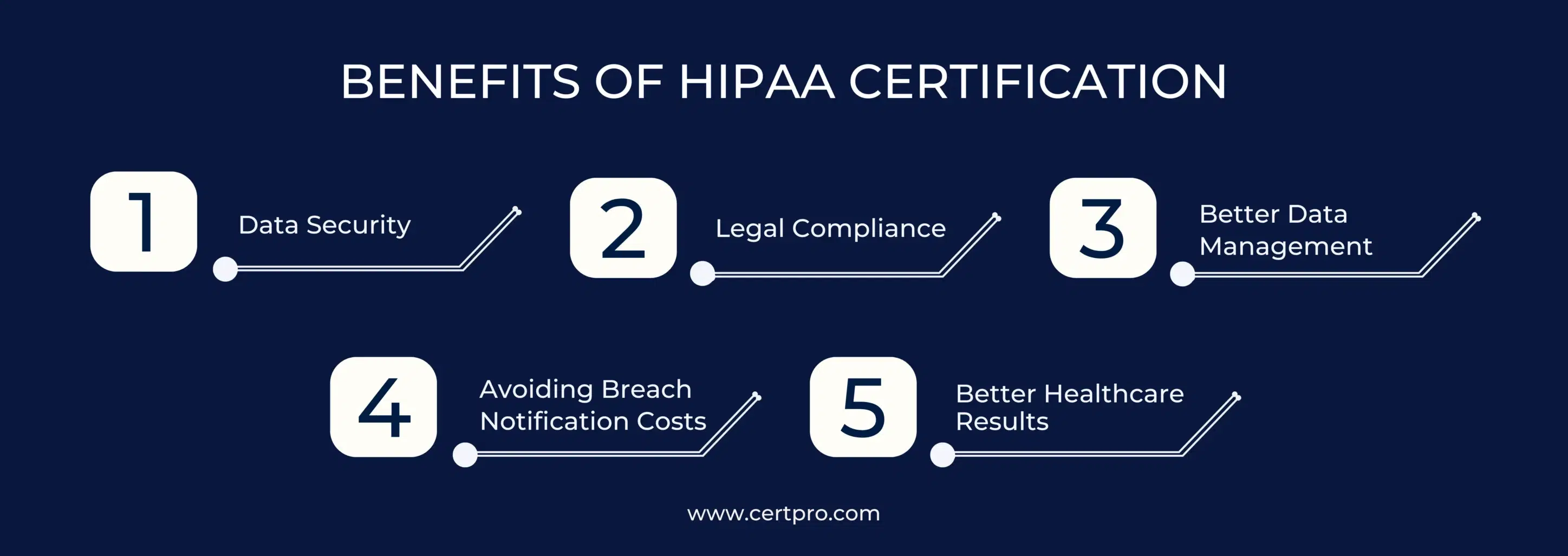
- ✓Regulatory and Legal Risk Reduction
- ✓Patient Trust and Market Differentiation in Florida
- ✓Operational and Security Improvements
Process
The HIPAA certification process conducted by CertPro follows a structured, audit-based methodology that evaluates an organization’s compliance with the full scope of HIPAA requirements. Each stage of the process is designed to produce documented, objective evidence of compliance or nonconformity, culminating in the issuance of a formal certification attestation for organizations whose controls meet the required standards. The process is applicable to all covered entities and business associates seeking HIPAA certification in Florida, regardless of organizational size or operational complexity.
The first stage of the HIPAA certification process involves a formal determination of audit scope. Scope definition identifies all systems, processes, locations, and personnel involved in the creation, receipt, maintenance, transmission, or disposal of PHI and ePHI. For Florida organizations with multiple facilities, remote workforce components, or cloud-hosted health information systems, scope definition is a critical control point that establishes the precise boundaries of the certification evaluation. The scope document serves as the foundational reference for all subsequent audit activities and is reviewed and agreed upon by both the auditing firm and the organization prior to audit commencement.
Scope definition for HIPAA certification in Florida must account for all three regulatory rules — Privacy Rule, Security Rule, and Breach Notification Rule — and must identify which organizational units, information systems, and workforce members fall within the certification boundary. Organizations operating multiple lines of business, such as a health system that also operates a health plan or a technology company that serves both healthcare and non-healthcare clients, must carefully delineate the HIPAA-regulated portions of their operations within the scope document. Incomplete or inaccurate scope definition represents one of the most common causes of certification delays or nonconformity findings.
Following scope definition, the audit program is established based on the organization’s specific operational profile, identified risk factors, and the regulatory requirements applicable to its classification as a covered entity or business associate. The audit program specifies the audit procedures, evidence collection methods, testing approaches, and evaluation criteria that will be applied during the certification assessment. For HIPAA audits in Florida, the audit program addresses all required specifications under the Privacy Rule (45 CFR §§ 164.500–164.534), Security Rule (45 CFR §§ 164.302–164.318), and Breach Notification Rule (45 CFR §§ 164.400–164.414).
The Stage 1 audit is a documentation-focused evaluation that examines the organization’s written policies, procedures, risk analysis documentation, workforce training records, Business Associate Agreements, and other required HIPAA documentation. During this stage, auditors review whether the organization has produced all required documentation artifacts specified under HIPAA and whether those documents accurately reflect the organization’s operational practices. Stage 1 findings are used to identify documentation gaps or inconsistencies that must be addressed before proceeding to Stage 2 control testing.
Key documentation evaluated during Stage 1 includes the organization’s HIPAA risk analysis and risk management plan, Notice of Privacy Practices (NPP), workforce training and sanction policies, physical safeguard documentation, contingency planning documentation, and all executed Business Associate Agreements. For Florida organizations operating under state-specific regulations, Stage 1 also evaluates alignment between HIPAA documentation and applicable Florida statutes, including FIPA requirements for breach notification timelines that may be shorter than HIPAA’s 60-day federal standard.
Stage 2 of the HIPAA certification audit involves direct testing of the administrative, physical, and technical controls identified in the audit scope. Auditors collect and evaluate evidence that controls are not only documented but are consistently implemented and operating as designed. Technical control testing includes verification of encryption implementation for ePHI at rest and in transit, testing of access control configurations, review of audit log generation and monitoring practices, and assessment of network security architecture. Physical control testing involves evaluation of facility access controls, workstation security measures, and device and media disposal procedures.
Administrative control testing during Stage 2 evaluates workforce training program effectiveness, sanction policy application, security incident response procedures, and contingency plan testing. Auditors interview key personnel — including Privacy Officers, Security Officers, IT administrators, and clinical staff — to verify that documented policies are understood and applied in practice. Evidence collected during Stage 2 forms the factual basis for all audit findings and the ultimate certification determination. For Florida healthcare organizations with large, distributed workforces, administrative control testing often reveals the most significant compliance gaps requiring remediation.
Nonconformities identified during Stages 1 and 2 are documented in a formal nonconformity report that specifies the HIPAA requirement violated, the nature of the gap, and the evidence supporting the finding. Organizations are given an opportunity to review the findings, respond with factual corrections where appropriate, and develop corrective action plans for substantiated nonconformities. The nonconformity review stage is a critical quality control mechanism that ensures audit findings are accurate, well-evidenced, and proportionate to the compliance gap identified. For organizations seeking HIPAA certification in Florida, the nonconformity report provides a precise, actionable roadmap for achieving full compliance.
Upon satisfactory resolution of all nonconformities and verification that the organization’s controls meet HIPAA requirements across the full audit scope, the certification decision is made and a formal attestation is issued. The HIPAA certification attestation documents the organization’s compliance with the Privacy Rule, Security Rule, and Breach Notification Rule as of the audit evaluation date. The attestation is signed by a licensed CPA and references the specific audit scope, evaluation period, and regulatory standards applied. Florida organizations receiving certification can present this attestation to regulators, contracting parties, and other stakeholders as evidence of independently verified HIPAA compliance.
- Scope Definition — Identify all PHI and ePHI systems, locations, and personnel within the certification boundary
- Audit Program Determination — Establish audit procedures, evidence requirements, and evaluation criteria
- Stage 1 Documentation Audit — Review all required HIPAA policies, procedures, and documentation artifacts
- Control Testing and Evidence Collection — Test administrative, physical, and technical safeguards against HIPAA requirements
- Nonconformity Review — Document findings, receive organizational response, and evaluate corrective actions
- Certification Decision — Evaluate all evidence and determine compliance status across the full audit scope
- Attestation Issuance — Issue signed certification attestation documenting compliance with all three HIPAA rules
- Surveillance and Recertification — Conduct periodic surveillance audits and annual recertification to maintain compliance status

- ✓Stage 1: Scope Definition
- ✓Stage 2: Audit Program Determination
- ✓Stage 3: Stage 1 Documentation Audit
- ✓Stage 4: Control Testing and Evidence Collection
- ✓Stage 5: Nonconformity Review and Remediation
- ✓Stage 6: Certification Decision and Attestation Issuance
How to Get HIPAA Certified in Florida
Achieving HIPAA certification in Florida requires a systematic, evidence-based approach to building and documenting compliance with all applicable HIPAA requirements before engaging an independent certified auditor for the formal certification assessment. The path to HIPAA certification is structured around the three core HIPAA rules, and organizations must demonstrate compliance with both the required specifications — which are mandatory — and the addressable specifications — which must either be implemented or documented with a rationale for alternative measures. Understanding this distinction is fundamental to building a compliant HIPAA program that will withstand independent audit scrutiny.
Conducting a HIPAA Risk Analysis
A comprehensive, organization-wide HIPAA risk analysis is the foundational requirement for both the Privacy Rule and the Security Rule. Under 45 CFR § 164.308(a)(1)(ii)(A), covered entities and business associates are required to conduct an accurate and thorough assessment of the potential risks and vulnerabilities to the confidentiality, integrity, and availability of ePHI held by the organization. The risk analysis must identify all sources of ePHI, all human, natural, and environmental threats to ePHI, current security measures, the likelihood of threat occurrence, the potential impact of threat occurrence, and the resulting level of risk.
For Florida organizations, the risk analysis must account for state-specific threat factors including the elevated hurricane risk that threatens physical facility security and data center availability, the high population density of healthcare facilities in major metropolitan areas such as Miami, Orlando, Tampa, and Jacksonville, and the significant use of mobile devices and remote access technologies in Florida’s geographically dispersed healthcare workforce. The risk analysis document is one of the first items reviewed during a HIPAA certification audit and must be current, comprehensive, and directly linked to the organization’s risk management and remediation activities.
Implementing Required Policies and Procedures
HIPAA requires covered entities and business associates to implement reasonable and appropriate written policies and procedures that comply with all applicable HIPAA standards and implementation specifications. The Privacy Rule requires, at minimum, policies governing: permissible uses and disclosures of PHI, minimum necessary use, patient rights (access, amendment, accounting of disclosures, restrictions, confidential communications), NPP content and distribution, workforce training, and sanctions for workforce members who violate HIPAA policies. The Security Rule requires written policies addressing each of the 18 standards and 36 implementation specifications contained in the administrative, physical, and technical safeguard categories.
Policies and procedures must be documented in written form, maintained for a minimum of six years from the date of creation or the date they were last in effect (whichever is later), and made available to workforce members who require access to perform their duties. Florida organizations with multiple facilities or business units must ensure that their policies and procedures are consistently applied across all in-scope locations and that location-specific variations are documented and justified. HIPAA certification auditors will test whether documented policies match actual operational practices — discrepancies between policy documentation and real-world implementation represent a significant category of nonconformity findings.
Workforce Training and HIPAA Awareness Programs
HIPAA requires covered entities to train all workforce members on HIPAA policies and procedures relevant to their job functions as a condition of the Privacy Rule (45 CFR § 164.530(b)) and the Security Rule (45 CFR § 164.308(a)(5)). While HIPAA does not mandate annual training by name, OCR guidance and enforcement actions have consistently established that organizations must provide initial training upon hiring and periodic retraining whenever policies or procedures change materially. In practice, annual HIPAA training has become the standard for demonstrating ongoing compliance, and HIPAA certification auditors in Florida will review training records to verify that all in-scope workforce members have completed required training within the expected timeframe.
Effective HIPAA training programs for Florida organizations must address the specific PHI-handling practices relevant to each workforce member’s role — clinical staff require training on patient rights and permissible disclosures, IT staff require training on Security Rule technical safeguard requirements, and administrative staff require training on minimum necessary use and business associate relationships. Training must be documented with completion records that include the workforce member’s name, training date, training content, and completion status. These records are subject to HIPAA’s six-year retention requirement and are reviewed during certification audits as primary evidence of workforce training compliance.
HIPAA Compliance Services in Florida: An Expert’s Guide
HIPAA compliance in Florida encompasses a broad spectrum of organizational activities that covered entities and business associates must sustain on an ongoing basis to maintain certification status and regulatory compliance. Unlike a one-time implementation project, HIPAA compliance is a continuous organizational discipline that requires regular risk analysis updates, policy reviews, workforce training cycles, business associate oversight, and incident monitoring. Florida organizations that treat HIPAA compliance as an ongoing operational function — rather than a periodic project — are better positioned to sustain certification status and respond effectively to the evolving regulatory and threat landscape.
HIPAA Compliance for Florida Healthcare Providers
Florida healthcare providers — including hospitals, physician practices, dental offices, behavioral health providers, and home health agencies — are the primary covered entities subject to HIPAA’s full regulatory requirements. For these organizations, HIPAA compliance encompasses clinical workflow design (ensuring that PHI access is limited to workforce members with a need to know), patient rights management (responding to access requests, amendment requests, and opt-out requests within HIPAA’s required timeframes), Notice of Privacy Practices distribution (providing NPPs to patients at first point of service contact), and telehealth platform compliance (ensuring that telehealth services are delivered through HIPAA-compliant technology platforms).
Florida’s large and growing telehealth market — accelerated significantly by the COVID-19 public health emergency and subsequent regulatory changes — creates specific HIPAA compliance obligations that healthcare providers must address. Telehealth platforms that handle video consultations, remote patient monitoring data, electronic prescribing, or patient-provider messaging must be evaluated for HIPAA compliance and covered by executed BAAs with the platform vendors. Florida healthcare providers that adopted telehealth solutions rapidly during the public health emergency period should ensure that their telehealth BAAs and related documentation have been reviewed, updated, and aligned with current HIPAA requirements as enforcement flexibilities from the emergency period have concluded.
HIPAA Compliance for Florida Fintech and Health Technology Companies
Florida’s technology sector includes a significant and growing cluster of health technology companies, healthcare fintech organizations, and digital health startups operating in cities including Miami, Tampa, Orlando, and Jacksonville. Many of these organizations function as business associates to Florida’s covered entities, providing services such as revenue cycle management, healthcare payments processing, patient engagement platforms, clinical decision support tools, and population health analytics. As business associates, these organizations bear direct HIPAA liability and must implement the full scope of HIPAA Security Rule safeguards for any ePHI they create, receive, maintain, or transmit on behalf of covered entities.
Florida’s healthcare fintech sector faces particular HIPAA complexity because financial data and health data frequently intersect — payment information associated with healthcare transactions may constitute PHI when it can be linked to an individual’s health condition. Organizations in the healthcare payments space must carefully evaluate whether the data they process meets the definition of PHI and, if so, implement HIPAA-compliant data handling practices accordingly. HIPAA certification for Florida fintech and health technology companies provides a formal, audited basis for demonstrating to covered entity clients that the business associate’s data handling practices satisfy HIPAA requirements — a critical factor in enterprise sales cycles and contract negotiations with major Florida health systems.
HIPAA Compliance for Florida Health Insurance and Managed Care Organizations
Florida is home to a large and competitive health insurance market, including major national carriers (UnitedHealthcare, Anthem, Aetna, Humana, Cigna), regional Florida-based health plans (Florida Blue, Molina Healthcare of Florida, Sunshine Health), and a significant Medicare Advantage and Medicaid managed care sector serving Florida’s large elderly and low-income populations. All health plans operating in Florida are covered entities under HIPAA and must comply with the full scope of Privacy Rule, Security Rule, and Breach Notification Rule requirements. Given the volume of PHI processed by large health plans — including enrollment data, claims data, prior authorization records, and care management information — HIPAA compliance for these organizations is a substantial operational and technical undertaking.
Florida Medicaid managed care organizations face additional compliance complexity due to the intersection of HIPAA requirements with Florida Medicaid program requirements administered by the Agency for Health Care Administration (AHCA). AHCA contracts with managed care organizations include specific data security and privacy requirements that must align with HIPAA standards, and AHCA conducts its own compliance oversight activities that may overlap with HIPAA certification evaluation processes. Organizations that maintain current HIPAA certification are better positioned to satisfy AHCA contract compliance requirements and to respond efficiently to AHCA audit requests, as the certification documentation provides a structured evidence base applicable to both federal and state compliance evaluations.
HIPAA Certification for Specific Florida Industries
HIPAA certification requirements apply across multiple industry sectors in Florida beyond traditional healthcare delivery — encompassing financial services, legal services, real estate, and other industries that interact with health information in the course of their business activities. Understanding which organizations in Florida qualify as covered entities or business associates under HIPAA is essential for determining certification obligations and audit scope. Several industry sectors in Florida face HIPAA certification requirements that may not be immediately apparent from their primary business activities.
Florida Pharmacies and Pharmacy Benefit Managers
Florida pharmacies — whether independent retail pharmacies, pharmacy chains, hospital pharmacies, or mail-order pharmacies — are covered entities under HIPAA when they transmit health information in electronic form in connection with standard transactions such as prescription drug claims. Florida is home to a significant concentration of independent pharmacies, pharmacy chains including CVS, Walgreens, and Publix Pharmacy, and specialty pharmacies serving Florida’s large elderly and oncology patient populations. HIPAA violations in the pharmacy sector frequently involve improper disclosure of prescription information, failure to properly dispose of PHI-containing medication containers and prescription records, and inadequate access controls for pharmacy management systems.
Pharmacy Benefit Managers (PBMs) operating in Florida function as business associates to health plans and covered entity pharmacies, processing prescription drug claims, managing formularies, and providing medication adherence programs. PBMs handle large volumes of PHI — including prescription drug history data that can reveal sensitive health conditions — and are subject to HIPAA Security Rule requirements for ePHI protection. HIPAA certification for Florida PBMs demonstrates that the organization’s data handling, access control, and security monitoring practices meet the standards required of business associates under federal law.
Florida Law Firms and Legal Services Organizations
Florida law firms that provide legal services to covered entities or business associates involving access to PHI may qualify as business associates under HIPAA. Legal services organizations that review medical records in connection with personal injury litigation, medical malpractice defense, workers’ compensation cases, or healthcare regulatory matters routinely access PHI as part of their professional activities. When a law firm receives PHI from a covered entity client and performs legal work on the covered entity’s behalf, the law firm is functioning as a business associate and must execute a BAA with the covered entity and implement appropriate HIPAA safeguards for the PHI in its possession.
Florida Behavioral Health and Substance Abuse Treatment Providers
Behavioral health providers and substance abuse treatment organizations in Florida operate under a heightened privacy and security compliance framework that combines HIPAA requirements with additional federal protections under 42 CFR Part 2 (Confidentiality of Substance Use Disorder Patient Records) and Florida’s Baker Act and Marchman Act provisions. 42 CFR Part 2 imposes restrictions on the disclosure of substance use disorder treatment records that are substantially more stringent than HIPAA’s general PHI disclosure standards — including prohibiting disclosure without patient consent even for treatment, payment, and healthcare operations purposes in most circumstances. Florida behavioral health organizations seeking HIPAA certification must demonstrate compliance with both HIPAA and the applicable provisions of 42 CFR Part 2, and their certification scope must clearly delineate how each regulatory framework applies to their operations.
FAQ
▶
Does HIPAA apply to all healthcare organizations in Florida?
▶
How long does a HIPAA certification audit take for a Florida organization?
▶
What is the difference between HIPAA certification and HIPAA compliance?
▶
Is HIPAA certification required by federal law?
▶
How often must Florida organizations renew their HIPAA certification?
▶
What are the most common HIPAA violations found during Florida certification audits?
▶
Does CertPro conduct HIPAA audits for business associates in Florida?
▶
How does Florida’s Information Protection Act (FIPA) interact with HIPAA certification?

HIPAA UPDATES 2026: KEY REGULATORY CHANGES, NEW RULES, AND COMPLIANCE IMPACT EXPLAINED
Healthcare data breaches continue to rise, and the pattern is clear. Attackers target patient records because they carry long-term value. At the same …

Why is HIPAA Important to Patients
LAST UPDATE — 10-01-2025 The Health Insurance Portability and Accountability Act, also known as HIPAA, is crucial for patients because it safeguards t…

WHAT IS THE HIPAA OMNIBUS RULE
In the U.S. healthcare sector, sensitive medical records are often subjected to cyberattacks like data breaches and ransomware. For example, recently …
Get In Touch
have a question? let us get back to you.