
ISO 42001 Certification in Florida
CertPro is a Licensed CPA Firm delivering ISO 42001 audit, assessment, and certification services to organizations across Florida. ISO 42001 Certification in Florida is evaluated against the requirements of the international AI Management System standard, covering AI risk controls, governance structures, and operational accountability for organizations that develop, deploy, or use artificial intelligence systems. Whether your organization is beginning its AI governance journey or seeking formal third-party validation, CertPro provides the structured ISO 42001 audit process your team needs.
OUR CLIENTS





What Is ISO 42001 Certification?
ISO 42001 is the first international standard specifically developed for Artificial Intelligence Management Systems (AIMS). Published by the International Organization for Standardization (ISO) in December 2023, ISO 42001 establishes requirements for responsible AI development, deployment, and oversight across any organization that develops, provides, or uses AI-based products or services. ISO 42001 Certification in Florida confirms that an organization’s AI management system meets these internationally recognized requirements through an independent third-party audit conducted by a qualified certification body.
The standard applies to all organization sizes and sectors, including healthcare, financial services, logistics, manufacturing, and technology companies. ISO 42001 does not prescribe specific AI algorithms or technology choices. Instead, it establishes a governance and control framework through which organizations document, manage, monitor, and continuously improve their AI-related activities. This makes ISO 42001 Certification applicable to Florida organizations that use commercially procured AI tools, develop proprietary AI models, or operate AI-powered services at scale.
ISO 42001 as an International Standard
ISO 42001 was developed by ISO Technical Committee 42 (ISO/TC 42) as part of a coordinated international effort to establish normative requirements for AI governance. The standard was formally published in December 2023 under the title ISO/IEC 42001:2023, making it a joint publication of the International Organization for Standardization and the International Electrotechnical Commission. This joint designation reflects the cross-disciplinary nature of AI governance, which intersects information technology, operational management, and ethical risk control.
The publication of ISO/IEC 42001:2023 marked a significant milestone in global AI governance. Prior to its release, no universally recognized management system standard existed specifically for AI. National frameworks and sectoral guidelines addressed elements of AI risk and ethics, but none provided a certifiable management system structure comparable to ISO 27001 for information security or ISO 9001 for quality management. ISO 42001 fills this gap by establishing a repeatable, auditable, and certifiable framework that organizations worldwide—including those seeking ISO 42001 Certification in Florida—can implement and independently verify.
Relationship to the ISO Management System Family
ISO 42001 follows the High-Level Structure (HLS) common to all ISO management system standards. This structural alignment means organizations already certified to ISO 27001 for information security or ISO 9001 for quality management will recognize familiar clauses covering context of the organization, leadership, planning, support, operation, performance evaluation, and improvement. The HLS framework enables organizations to integrate an ISO 42001 AI management system with existing management systems, reducing duplication of policies, roles, and review processes.
ISO 42001 also aligns with ISO 31000 for risk management, enabling organizations to apply consistent risk assessment methodologies across information security, quality, and AI governance domains simultaneously. For Florida businesses that have already invested in ISO 27001 or other management system certifications, adding ISO 42001 compliance extends existing governance structures into the AI domain without requiring the construction of an entirely new system. This integration capability is a defining structural advantage of ISO 42001 as a management system standard.
Scope and Applicability of ISO 42001
ISO 42001 is applicable to any organization that develops AI systems, provides AI-based services to customers, or uses AI tools within its operations. The standard does not limit applicability by industry sector, revenue size, or geographic location. A Florida-based fintech startup using machine learning for credit scoring, a Miami healthcare provider deploying AI-assisted diagnostics, and an Orlando logistics company using AI route optimization all fall within the scope of ISO 42001. This broad applicability reflects the standard’s design as a universal governance framework for the AI era.
The standard defines the scope of the AI management system as the boundary within which AI-related activities are governed and controlled. Organizations seeking ISO 42001 Certification in Florida must define this scope clearly during the certification process, identifying which AI systems, processes, personnel, and organizational units fall within the AIMS. Scope definition is a foundational step in both implementation and audit, as the certification issued by CertPro as a Licensed CPA Firm will specify the evaluated scope directly on the certificate.
ISO 42001 AI Management System (AIMS) Framework
The ISO 42001 AI Management System (AIMS) framework is a structured set of requirements, controls, and governance mechanisms that organizations use to manage their AI activities responsibly. The AIMS framework is organized around the Plan-Do-Check-Act (PDCA) cycle, which drives continuous improvement across all management system activities. ISO 42001 certification for Florida companies requires that the AIMS framework be fully implemented, documented, and operational before a certification audit can be conducted.
Core AIMS Clauses and Requirements
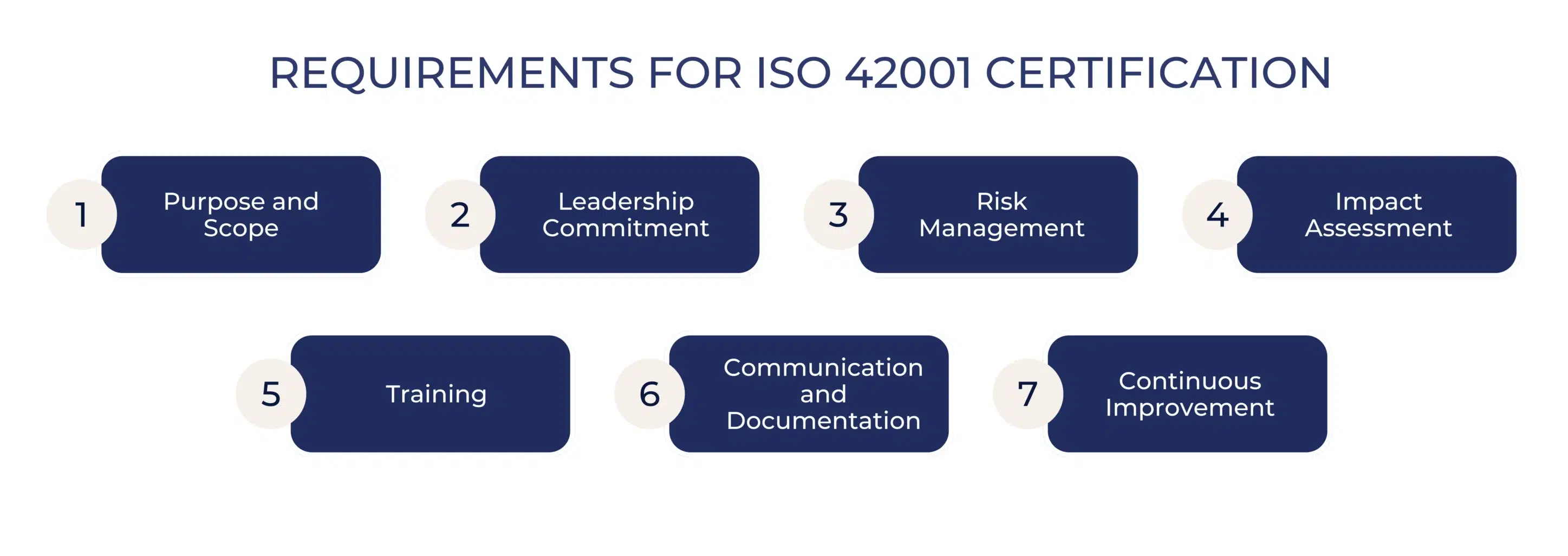
ISO 42001 is organized into ten primary clauses. Clauses 1 through 3 establish scope, normative references, and terms and definitions. Clauses 4 through 10 contain the normative requirements that form the basis of ISO 42001 compliance evaluation. Clause 4 requires organizations to understand the context of the organization, including the expectations of interested parties and the external regulatory environment relevant to AI. Clause 5 establishes leadership requirements, including top management commitment, AI policy formulation, and the assignment of organizational roles and responsibilities for AI governance.
Clause 6 addresses planning, requiring organizations to conduct AI risk assessments, identify AI-specific opportunities, and establish measurable AIMS objectives. Clause 7 covers support requirements, including the competence of personnel involved in AI activities, awareness programs, communication protocols, and documented information management. Clause 8 governs operational planning and control, which includes requirements for AI system design, development, testing, deployment, and monitoring. These operational clauses form the core of what auditors evaluate during an ISO 42001 audit in Florida to determine whether AI systems are governed in accordance with the standard’s requirements.
AI Risk Assessment and Treatment Under ISO 42001
ISO 42001 requires organizations to establish and maintain a formal AI risk assessment process. This process must identify AI-related risks, including those arising from biased training data, lack of model explainability, unintended AI outputs, security vulnerabilities in AI systems, and ethical concerns related to automated decision-making. The risk assessment must evaluate both the likelihood and potential impact of identified risks, enabling organizations to prioritize risk treatment activities based on a documented risk evaluation methodology.
Following risk assessment, organizations must implement an AI risk treatment plan that selects appropriate controls from Annex A of ISO 42001. Annex A provides a catalog of controls covering AI system impact assessment, data governance, AI transparency and explainability, human oversight mechanisms, and AI incident management. The risk treatment plan documents which controls are applied, which are excluded, and the justification for all decisions. During an ISO 42001 assessment, auditors evaluate whether the risk treatment plan is complete, implemented, and proportionate to the identified risk levels within the organization’s AI operations.
Performance Evaluation and Continuous Improvement
Clause 9 of ISO 42001 establishes requirements for performance evaluation, including monitoring, measurement, analysis, evaluation, internal audit, and management review. Organizations must define what to monitor, which methods to use, when to monitor, and who is responsible for analyzing and acting on results. Internal audits must be conducted at planned intervals to verify that the AIMS conforms to ISO 42001 requirements and is effectively implemented and maintained. Management reviews must occur at defined intervals and address the results of internal audits, AI risk assessment outcomes, AI policy relevance, and the overall performance of the AIMS.
Clause 10 addresses improvement requirements, including the process for identifying and addressing nonconformities and taking corrective actions. Organizations must evaluate the effectiveness of corrective actions and update the AIMS accordingly. This continuous improvement cycle is fundamental to ISO 42001 compliance and is assessed during surveillance audits conducted after initial certification. For Florida organizations, the performance evaluation requirements ensure that the AIMS remains relevant and effective as AI technologies evolve and as the regulatory environment for AI governance continues to develop.
ISO 42001 Certification Requirements in Florida
Organizations pursuing ISO 42001 Certification in Florida must satisfy a defined set of documentation, operational, and governance requirements before a certification audit can be completed. These requirements are drawn directly from ISO/IEC 42001:2023 and are evaluated by CertPro auditors during both Stage 1 and Stage 2 audit activities. The table below summarizes the primary documentation and system requirements for ISO 42001 certification.
| Requirement Category | Description | ISO 42001 Clause |
|---|---|---|
| AI Policy | Documented AI governance policy approved by top management, aligned with organizational objectives and AI ethics principles | Clause 5.2 |
| AIMS Scope | Documented definition of the AI management system boundary, identifying covered AI systems, processes, and organizational units | Clause 4.3 |
| AI Risk Assessment | Documented risk assessment process covering AI-specific risks including bias, explainability, security, and ethical impacts | Clause 6.1 |
| Risk Treatment Plan | Documented selection and implementation of Annex A controls proportionate to identified AI risks | Clause 6.2 |
| Internal Audit Program | Planned and executed internal audit program verifying AIMS conformance with ISO 42001 requirements | Clause 9.2 |
ISO 42001 requires organizations to maintain a comprehensive set of documented information that demonstrates AIMS implementation and operation. Required documentation includes the AI policy, AIMS scope statement, evidence of AI risk assessments and their results, the AI risk treatment plan and associated control implementation records, AI system impact assessments, competence records for personnel with AI governance responsibilities, internal audit reports, management review records, and corrective action logs. All documented information must be controlled—meaning it must be available, adequately protected, and retrievable when required for audit purposes.
The standard also requires organizations to maintain documented information about the AI systems within scope, including technical specifications, intended use cases, known limitations, training data characteristics, and performance monitoring records. For Florida organizations operating AI systems in regulated environments—such as healthcare under HIPAA or financial services under state and federal regulations—this documentation layer simultaneously supports ISO 42001 compliance and regulatory audit readiness. The completeness and accessibility of documented information is a primary focus of Stage 1 audit activities conducted by CertPro as part of the ISO 42001 certification process in Florida.
ISO 42001 places explicit requirements on top management to demonstrate leadership and commitment to the AI management system. Top management must establish, implement, and maintain an AI policy that is appropriate to the organization’s purpose. The policy must include commitments to satisfying applicable requirements and to continual improvement, and it must provide a framework for setting AI objectives. Top management must also ensure that AIMS responsibilities and authorities are assigned to appropriate roles, that resources are available for AIMS implementation, and that AI governance is integrated into the organization’s strategic direction.
The governance requirements under ISO 42001 extend beyond the appointment of an AI governance officer or equivalent role. They require that AI-related decisions—including decisions about AI system deployment, modification, and retirement—are made within a structured governance process that incorporates input from relevant stakeholders and considers the results of AI risk assessments. For Florida organizations operating at scale, particularly those deploying AI in customer-facing services or regulated decision-making contexts, these leadership and governance requirements establish the organizational accountability structures that auditors verify during ISO 42001 certification assessment activities.
Clause 8 of ISO 42001 establishes operational requirements that organizations must satisfy to achieve certification. These requirements address the planning and control of AI system development and deployment processes, including data governance, model testing and validation, AI system monitoring, and AI incident management. Organizations must establish and implement controls that ensure AI systems perform as intended, that unintended outputs are detected and addressed, and that human oversight mechanisms are in place for AI systems with significant operational or ethical implications.
Technical requirements under ISO 42001 also include controls for AI system transparency and explainability, proportionate to the risk level of each AI system. For AI systems used in high-stakes decisions affecting Florida residents—such as credit approvals, insurance underwriting, healthcare diagnostics, or law enforcement analytics—the explainability controls require that organizations maintain the ability to describe how AI outputs are generated and to demonstrate consistency with the system’s stated objectives and ethical constraints. These technical controls are evaluated during the ISO 42001 audit process through document review, staff interviews, and technical evidence examination.
- ✓Documentation Requirements
- ✓Leadership and Governance Requirements
- ✓Technical and Operational Requirements
ISO 42001 Certification Process in Florida
The ISO 42001 certification process in Florida follows a structured sequence of stages, from initial scope definition through certification decision and ongoing surveillance. CertPro, as a Licensed CPA Firm, executes each stage of the process in accordance with ISO/IEC 17021-1 accreditation requirements for management system certification bodies. The overview below describes the complete certification process applicable to Florida organizations pursuing ISO 42001 Certification.
Stage 1 of the ISO 42001 certification process is a documentation review and readiness evaluation conducted by CertPro auditors. During Stage 1, auditors review the organization’s AIMS documentation to verify that required policies, procedures, scope statements, risk assessments, and control records have been developed and are consistent with ISO 42001 requirements. Stage 1 also includes a review of the organization’s understanding of the standard’s requirements and an evaluation of whether the organization is ready to proceed to Stage 2 audit activities.
Stage 1 typically identifies documentation gaps or areas requiring clarification before Stage 2 can proceed. The Stage 1 audit report documents findings and specifies any items that must be addressed prior to the Stage 2 audit. Stage 1 may be conducted remotely or on-site, depending on the complexity of the organization’s AI management system and the number of locations within scope. For Florida organizations with AI operations distributed across multiple sites—such as a healthcare network with facilities in Miami, Orlando, and Tampa—Stage 1 planning addresses how multi-site operations will be evaluated during the certification process.
Stage 2 is the primary certification audit, during which CertPro auditors conduct a thorough evaluation of the organization’s AIMS implementation and operation against all applicable requirements of ISO 42001. Stage 2 includes on-site or remote audit activities covering interviews with management and operational personnel, observation of AI-related processes and controls, review of operational records and evidence of control implementation, and testing of specific AIMS controls to verify their effectiveness.
During Stage 2, auditors evaluate the organization’s AI risk assessment results, the completeness and proportionality of the risk treatment plan, the effectiveness of implemented Annex A controls, the operation of internal audit and management review processes, and the organization’s response to previously identified nonconformities or corrective actions. Audit findings are classified as major nonconformities, minor nonconformities, or observations. Major nonconformities represent significant failures to satisfy ISO 42001 requirements and must be resolved before a certification decision can be made. Minor nonconformities must be addressed within a defined timeframe following certification.
Following the completion of Stage 2 audit activities and the resolution of any major nonconformities, CertPro conducts a certification decision review. The certification decision is made by a qualified reviewer independent of the audit team, based on the complete audit record including Stage 1 and Stage 2 findings, nonconformity resolutions, and the auditor’s recommendation. This independent review process is a requirement of ISO/IEC 17021-1 and ensures that certification decisions are made objectively and without conflict of interest.
Upon a positive certification decision, CertPro issues an ISO 42001 certificate specifying the organization’s name, the scope of the certified AI management system, the standard to which certification is granted (ISO/IEC 42001:2023), the certification date, and the certificate validity period. ISO 42001 certificates are valid for a three-year period, subject to satisfactory annual surveillance audits. The certificate provides documented evidence of ISO 42001 compliance that organizations can present to clients, regulators, partners, and other stakeholders requiring proof of responsible AI governance.
Following initial ISO 42001 Certification, CertPro conducts annual surveillance audits to verify that the certified AIMS continues to conform to ISO 42001 requirements and that any nonconformities identified during previous audits have been effectively addressed. Surveillance audits are typically narrower in scope than the initial certification audit, focusing on areas of the AIMS identified as higher risk, changes to the organization’s AI systems or operations, and the ongoing effectiveness of key AIMS processes including internal audit, management review, and corrective action.
At the end of the three-year certification cycle, organizations must undergo a full recertification audit to maintain ISO 42001 Certification. The recertification audit is comparable in scope to the initial certification audit and evaluates the overall performance of the AIMS over the certification period, including the organization’s track record of addressing nonconformities, improving the AIMS, and managing AI-related risks. For Florida organizations, ongoing surveillance and recertification activities provide assurance to stakeholders that ISO 42001 compliance is maintained continuously—not only at the point of initial certification.
- ✓Stage 1: Documentation Review and Readiness Evaluation
- ✓Stage 2: On-Site Certification Audit
- ✓Certification Decision and Certificate Issuance
- ✓Surveillance Audits and Recertification
Steps for ISO 42001 Certification
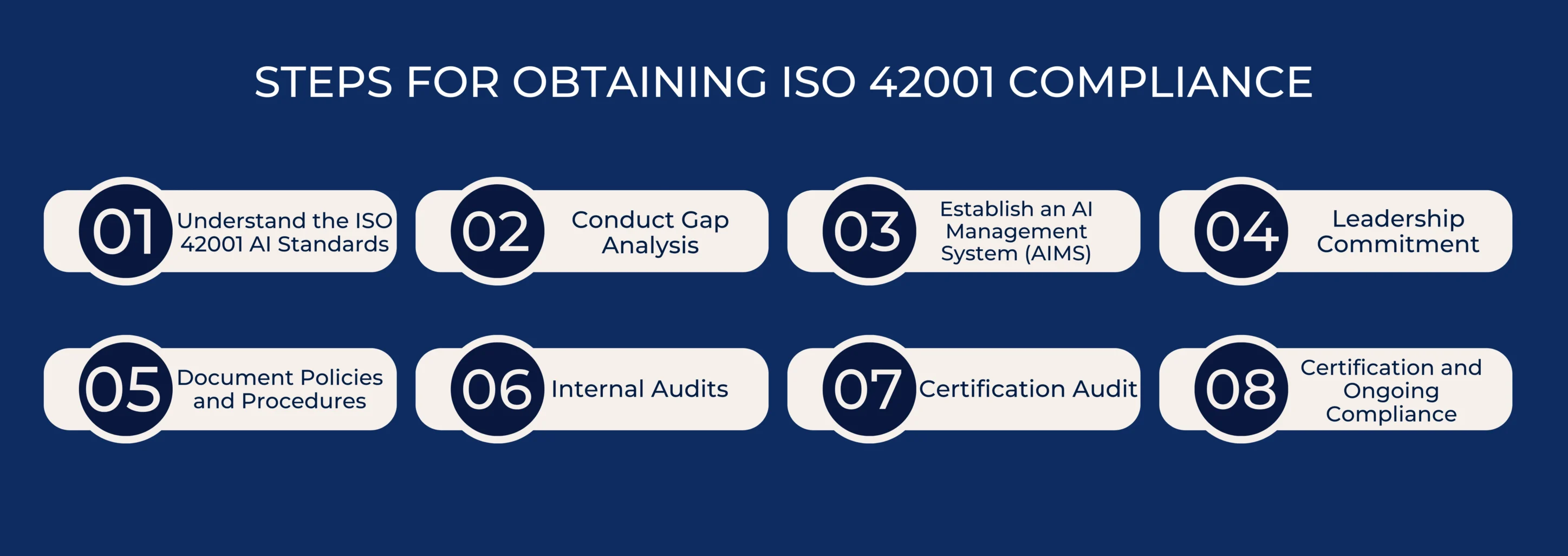
The following numbered steps represent the structured sequence organizations follow when pursuing ISO 42001 Certification in Florida. Each step corresponds to a defined phase of AIMS development and certification audit preparation. Organizations with existing ISO management system certifications may be able to complete several of these steps more efficiently by leveraging established governance structures.
- Conduct an AI inventory: Document all AI systems currently in use, under development, or planned for deployment, including system purpose, data inputs, decision outputs, and operational risk classification.
- Define the AIMS scope: Establish the documented boundary of the AI management system, specifying which AI systems, organizational units, processes, and locations are included.
- Establish the AI policy: Develop and obtain top management approval for a formal AI governance policy that includes commitments to responsible AI, legal compliance, ethical operation, and continual improvement.
- Conduct AI risk assessment: Execute a formal risk assessment process to identify, analyze, and evaluate AI-related risks across the defined scope, using a documented risk evaluation methodology.
- Develop the risk treatment plan: Select and document controls from ISO 42001 Annex A proportionate to the results of the AI risk assessment, and assign ownership and implementation timelines for each control.
- Implement AIMS controls: Execute the risk treatment plan by deploying documented controls covering data governance, model transparency, human oversight, AI incident management, and performance monitoring.
- Conduct internal audit: Execute a planned internal audit of the AIMS to verify conformance with ISO 42001 requirements, document findings, and initiate corrective actions where required.
- Conduct management review: Hold a formal management review of AIMS performance, reviewing internal audit results, AI risk assessment outcomes, AI policy relevance, and AIMS improvement opportunities.
- Submit certification application: Submit the ISO 42001 certification application to CertPro, providing organizational details, AIMS scope, and key documentation for Stage 1 audit scheduling.
- Complete Stage 1 and Stage 2 audits: Participate in CertPro’s documentation review (Stage 1) and on-site certification audit (Stage 2), addressing any nonconformities identified during the audit process.
- Receive certification decision: Upon satisfactory completion of audit activities and resolution of nonconformities, receive the ISO 42001 certificate specifying the certified AIMS scope and validity period.
ISO 42001 Audit Process
CertPro conducts ISO 42001 audits as a Licensed CPA Firm in accordance with ISO/IEC 17021-1 requirements for management system certification bodies. The ISO 42001 audit process is structured across defined stages, each with specific objectives, activities, and outputs. The audit evaluates the design, implementation, and operational effectiveness of the organization’s AIMS against ISO/IEC 42001:2023 requirements. ISO 42001 audit engagements in Florida are conducted by CertPro auditors with verified competence in AI management system evaluation and relevant industry-sector knowledge.
The ISO 42001 audit begins with formal scope definition, during which CertPro and the organization confirm the boundaries of the AIMS to be audited. Scope definition establishes which AI systems, processes, organizational units, and geographic locations fall within the audit boundary. The audit scope must align with the AIMS scope statement documented by the organization and must be sufficient to provide a meaningful evaluation of the organization’s AI governance activities. Any significant gaps between the stated AIMS scope and the actual scope of the organization’s AI operations are identified and resolved during this phase.
Audit scope definition also includes confirmation of the applicable ISO 42001 requirements based on the nature of the organization’s AI activities. Organizations that develop AI systems have different applicable requirements than those that solely use commercially procured AI tools. CertPro auditors document the rationale for any requirements determined to be not applicable to the organization’s scope. These exclusions must be justified in the audit record and cannot include requirements that would affect the organization’s ability to satisfy stakeholder expectations regarding responsible AI governance.
During Stage 2 audit activities, CertPro auditors test selected ISO 42001 controls through a combination of document review, personnel interviews, and observation of operational processes. Control testing evaluates whether documented controls are implemented as described, whether controls are effective in achieving their stated objectives, and whether control operations are consistent with ISO 42001 requirements. Evidence examined during control testing includes AI system documentation, training data governance records, AI performance monitoring reports, AI incident logs, human oversight process records, and AI ethics review documentation.
Personnel interviews are a critical component of the ISO 42001 audit process in Florida, as they provide direct evidence of whether AIMS requirements are understood and implemented at the operational level. Auditors conduct structured interviews with AI system owners, data scientists, AI product managers, compliance personnel, and members of AI governance committees. These interviews verify that personnel understand their responsibilities under the AIMS, are aware of the AI policy and relevant procedures, and have applied documented processes in their day-to-day AI activities.
ISO 42001 audit findings that identify failures to satisfy standard requirements are classified as nonconformities. CertPro classifies nonconformities as major or minor based on the significance and extent of the deviation from ISO 42001 requirements. A major nonconformity indicates a systemic failure or the complete absence of a required AIMS element and must be resolved before a positive certification decision can be made. A minor nonconformity indicates a partial or isolated failure and must be resolved within a timeframe agreed with CertPro, typically not exceeding ninety days following the certification decision.
Organizations must respond to nonconformities by conducting root cause analysis, implementing corrective actions to eliminate the root cause, and providing objective evidence to CertPro that the corrective actions have been effectively implemented. CertPro auditors evaluate the adequacy of corrective action responses before closing nonconformities. This nonconformity management process is itself a requirement of ISO 42001 compliance, and the organization’s ability to identify and resolve nonconformities effectively is an indicator of AIMS maturity that auditors assess during surveillance and recertification activities.
- ✓Audit Scope Definition
- ✓Control Testing and Evidence Evaluation
- ✓Nonconformity Review and Corrective Action Evaluation
Why Florida Businesses Need ISO 42001 Certification
Florida is one of the largest and most economically diverse states in the United States, with a business ecosystem that includes major financial services institutions, healthcare networks, technology companies, logistics operators, and multinational corporations. The state’s rapidly expanding AI adoption across these sectors creates both opportunities and governance responsibilities that ISO 42001 Certification in Florida directly addresses. Florida businesses that deploy AI systems without formal governance structures face operational, reputational, and regulatory risks that structured AIMS certification mitigates.
Florida’s AI-Intensive Industry Sectors
Florida’s healthcare sector—which includes major health systems and hospital networks across Miami, Orlando, Tampa, and Jacksonville—increasingly uses AI for clinical decision support, patient monitoring, diagnostic imaging analysis, and administrative automation. ISO 42001 AI management system requirements provide healthcare organizations with the governance framework necessary to deploy AI responsibly in patient care contexts, where AI errors can have direct human health consequences and where regulatory scrutiny from agencies including the FDA and CMS is increasing.
Florida’s fintech sector, concentrated in Miami and expanding throughout South Florida, employs AI extensively for fraud detection, credit risk modeling, algorithmic trading, and customer experience personalization. ISO 42001 compliance provides fintech organizations with documented evidence that AI systems used in financial decision-making are governed with appropriate transparency, explainability, and human oversight controls. This evidence is increasingly relevant as U.S. financial regulators—including the CFPB and banking regulators—intensify their focus on AI-driven financial services and fair lending compliance.
Regulatory and Contractual Drivers in Florida
Florida businesses that provide services to federal government agencies, defense contractors, or healthcare organizations subject to federal funding requirements face increasing contractual demands for AI governance documentation. ISO 42001 Certification in Florida provides a recognized, third-party-verified credential that satisfies many of these contractual requirements. As federal agencies including the Department of Defense, HHS, and the Office of Management and Budget develop AI governance requirements for contractors and grantees, ISO 42001 certification positions Florida organizations to demonstrate compliance efficiently and credibly.
At the state level, Florida has enacted laws governing digital privacy and data security that intersect with AI governance requirements. Florida’s Digital Bill of Rights and various sector-specific regulations create accountability expectations for automated decision-making systems that ISO 42001’s governance framework directly addresses. Organizations that have achieved ISO 42001 compliance possess documented evidence of AI risk management practices, transparency controls, and accountability structures that align with these regulatory expectations and support audit readiness during state or federal regulatory examinations.
Competitive Positioning in Florida’s AI Market
ISO 42001 certification for Miami, Orlando, and Tampa organizations demonstrates to enterprise clients, institutional investors, and procurement decision-makers that the organization’s AI operations meet an internationally recognized governance standard. As procurement processes for enterprise technology increasingly include AI governance questionnaires and due diligence requirements, ISO 42001 certified organizations can respond with documented certification evidence rather than self-assessment responses—accelerating sales cycles and reducing procurement risk barriers.
Florida’s growing international business connections—particularly its trade and investment ties to Latin America and the European Union—also create strong demand for ISO 42001 certification. The European Union’s AI Act, which entered into force in 2024, establishes mandatory requirements for high-risk AI systems used in EU-regulated contexts. Florida organizations that export AI-based services or products to EU markets, or that serve EU-headquartered multinational corporations operating in Florida, benefit from ISO 42001 Certification as a demonstration of alignment with EU AI governance expectations.
Benefits of ISO 42001 Certification in Florida
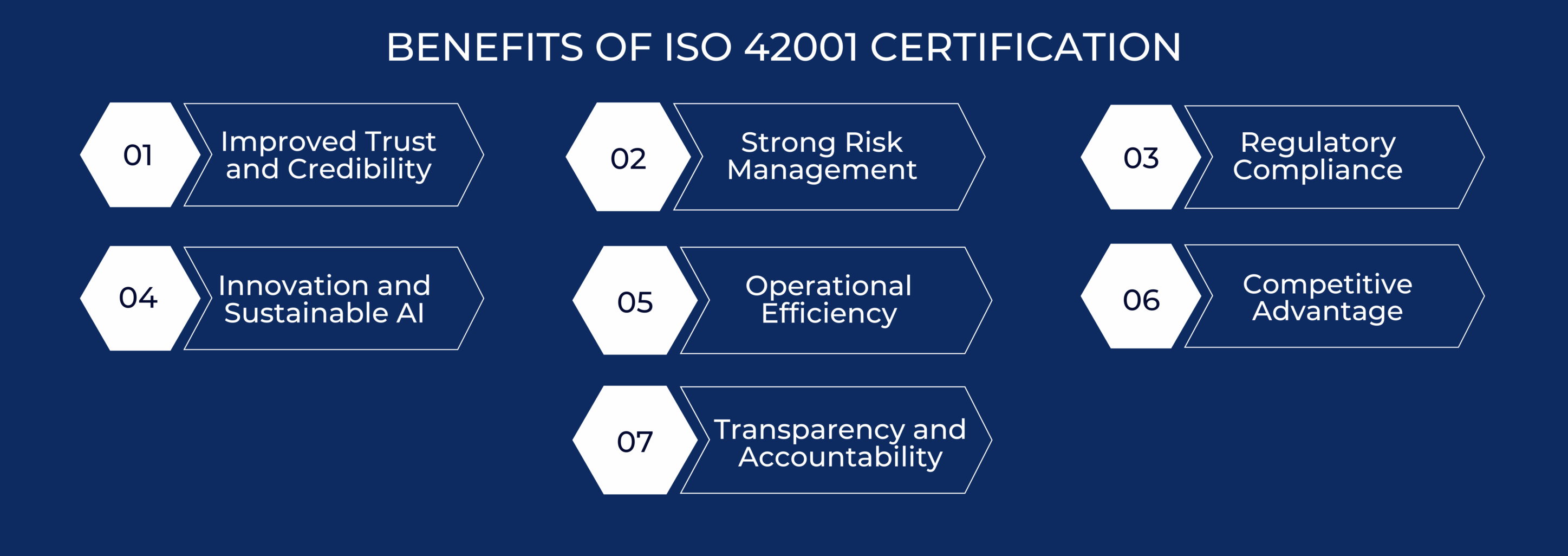
ISO 42001 Certification in Florida delivers measurable governance, operational, and commercial benefits to organizations across all sectors. The following list identifies the primary benefits of ISO 42001 certification for Florida companies, encompassing both internal governance improvements and external stakeholder value.
- ✓Documented AI governance framework: ISO 42001 certification establishes a formally documented and audited AI management system that provides organizational accountability for all AI-related decisions and activities.
- ✓AI risk reduction: The structured risk assessment and treatment requirements of ISO 42001 enable organizations to identify and mitigate AI-specific risks before they result in operational failures, regulatory sanctions, or reputational harm.
- ✓Regulatory alignment: ISO 42001 compliance supports alignment with evolving U.S. and international AI regulations, including the EU AI Act, NIST AI Risk Management Framework requirements, and sector-specific AI governance expectations from financial and healthcare regulators.
- ✓Third-party verified credibility: ISO 42001 certification issued by CertPro as a Licensed CPA Firm provides independent, third-party verified evidence of AI governance maturity that self-assessment declarations cannot replicate.
- ✓Competitive differentiation: ISO 42001 certification distinguishes Florida organizations in competitive procurement processes where AI governance documentation is increasingly required by enterprise and government clients.
- ✓Integration with existing management systems: ISO 42001’s High-Level Structure enables integration with ISO 27001, ISO 9001, and other existing certifications, avoiding duplication and leveraging established governance structures.
- ✓Enhanced stakeholder confidence: ISO 42001 certification demonstrates to customers, investors, regulators, and board members that AI systems are managed with transparency, accountability, and ethical responsibility.
- ✓Improved AI incident management: ISO 42001 requirements for AI incident management and corrective action processes strengthen organizational resilience and reduce the duration and impact of AI-related operational failures.
- ✓Data governance improvement: ISO 42001 Annex A controls for data governance improve the quality, integrity, and provenance documentation of AI training and operational data, reducing risks associated with biased or inaccurate AI outputs.
- ✓Board-level accountability: ISO 42001 certification establishes AI governance as a board-level accountability, providing executives and directors with documented evidence that AI risks are systematically identified and managed.
The operational benefits of ISO 42001 compliance extend well beyond documentation and governance paperwork. Organizations that implement the standard’s requirements systematically improve their AI development and deployment processes, resulting in more reliable AI systems with fewer unintended behaviors. The structured risk assessment process required by ISO 42001 forces organizations to articulate and document AI system objectives, expected behaviors, and performance thresholds—which in turn improves the quality of AI system design and the clarity of acceptance criteria for AI deployment decisions.
ISO 42001’s requirements for AI performance monitoring and measurement establish ongoing visibility into AI system behavior after deployment, enabling organizations to detect model drift, performance degradation, and unexpected outputs before they escalate into significant incidents. For Florida organizations operating AI systems in high-stakes contexts such as patient triage, fraud detection, or credit underwriting, this ongoing monitoring capability directly reduces the risk of AI failures with significant operational or legal consequences. The ISO 42001 assessment process evaluates whether these monitoring controls are in place and operating effectively.
From a commercial perspective, ISO 42001 certification provides Florida organizations with a differentiated market position in an environment where AI governance credibility is increasingly scrutinized. Enterprise procurement teams in financial services, healthcare, and government contracting now routinely include AI governance questions in vendor qualification processes. ISO 42001 certification provides a standardized, independently verified response to these questions, reducing the time and cost associated with responding to customer security questionnaires and AI due diligence requests.
For Florida technology companies seeking investment or partnership with larger organizations, ISO 42001 certification demonstrates governance maturity that supports institutional due diligence processes. Private equity firms, venture capital investors, and strategic acquirers increasingly assess AI governance as part of technology company due diligence. ISO 42001 certification provides documented, third-party verified evidence of AI management system maturity that supports favorable due diligence outcomes and reduces governance-related risk discounts in investment valuations.
- ✓Operational and Risk Management Benefits
- ✓Commercial and Strategic Benefits for Florida Organizations
ISO 42001 Certification Cost in Florida
The cost of ISO 42001 Certification in Florida is determined by multiple factors, including the size of the organization, the number and complexity of AI systems within the certification scope, the number of organizational sites included in the audit, the current maturity of the organization’s AIMS documentation and controls, and the number of personnel involved in AI governance activities. CertPro provides fixed-price certification engagements based on a structured assessment of these factors, enabling organizations to plan and budget for ISO 42001 audit activities with full pricing transparency.
Cost Factors for ISO 42001 Certification
| Organization Size | AI System Complexity | Estimated Certification Scope | Indicative Audit Days |
|---|---|---|---|
| Small (under 50 employees) | Single AI application, limited scope | Narrow: one system, one site | 3–5 audit days |
| Medium (50–250 employees) | Multiple AI systems, moderate complexity | Standard: multiple systems, one or two sites | 6–10 audit days |
| Large (250+ employees) | Diverse AI portfolio, high complexity | Broad: multiple systems, multiple sites | 12–20+ audit days |
| Enterprise or multi-site | Enterprise AI platform or regulated sector | Complex: enterprise scope, multi-site, regulated | Subject to scoping assessment |
For small Florida organizations with a single AI application and a limited certification scope, ISO 42001 certification costs are lower than those for large enterprises with complex, multi-site AI portfolios. The number of audit days required is the primary driver of certification audit cost, and that number is directly proportional to scope complexity and the number of personnel interviews and process observations needed to complete a thorough ISO 42001 assessment. CertPro conducts an initial scoping evaluation to determine the required audit duration and provide a fixed-price certification proposal.
Organizations that have previously achieved certification to ISO 27001, ISO 9001, or other ISO management system standards may benefit from reduced audit scope for certain AIMS clauses that overlap with existing certified management systems. The High-Level Structure alignment between ISO 42001 and other ISO standards enables CertPro auditors to reference existing certification evidence for common requirements, focusing audit effort on AI-specific controls and processes unique to ISO 42001. This integration benefit can reduce overall audit cost for organizations with mature existing management system certifications.
Ongoing Surveillance and Recertification Costs
Following initial ISO 42001 Certification, organizations incur annual surveillance audit costs and three-year recertification audit costs. Annual surveillance audits are narrower in scope than the initial certification audit, typically covering a subset of AIMS controls and processes identified as higher risk or subject to change. Surveillance audit costs are generally lower than initial certification audit costs, reflecting the reduced audit scope. Recertification audits at the end of the three-year certificate cycle are comparable in scope and cost to the initial certification audit, as they evaluate the complete AIMS over the full certification period.
CertPro provides multi-year certification engagement pricing that covers the initial certification audit, annual surveillance audits, and the recertification audit, enabling Florida organizations to plan and budget for the complete three-year certification cycle. Fixed-price engagements provide cost certainty and eliminate the risk of unexpected billing based on audit hours exceeding initial estimates. Contact CertPro for a formal scoping evaluation and a certification proposal tailored to the specific characteristics of your organization’s AI management system and ISO 42001 certification requirements in Florida.
Why Choose CertPro for ISO 42001 Certification in Florida
CertPro is a Licensed CPA Firm that delivers ISO 42001 certification audit services to organizations throughout Florida, including ISO 42001 certification engagements in Miami, Orlando, and Tampa. CertPro’s certification services are grounded in audit credibility, standards expertise, and institutional accountability—qualities that distinguish a Licensed CPA Firm from unaccredited compliance advisory providers. Organizations seeking ISO 42001 Certification in Florida benefit from CertPro’s structured audit methodology, qualified auditor team, and fixed-price certification model.
Licensed CPA Firm Audit Credibility
CertPro’s identity as a Licensed CPA Firm establishes a level of institutional credibility and regulatory accountability that is fundamental to the value of ISO 42001 certification. CPA licensure requires adherence to professional standards, continuing education requirements, and regulatory oversight that ensures auditors maintain competence and professional conduct. When Florida organizations present ISO 42001 certificates issued by CertPro to clients, regulators, or institutional stakeholders, those certificates carry the authority of a credentialed professional services firm operating under regulatory oversight.
CertPro’s auditors possess demonstrated competence in ISO 42001 requirements, AI governance frameworks, and the operational characteristics of AI systems across relevant Florida industry sectors including healthcare, financial services, technology, and logistics. Auditor competence is verified through structured qualification processes covering ISO 42001 clause knowledge, AI technology literacy, risk assessment methodology, and sector-specific AI regulatory context. This combination of accounting firm rigor and AI governance expertise positions CertPro as the preferred certification partner for ISO 42001 audit engagements in Florida.
CertPro’s ISO 42001 Assessment Methodology
CertPro’s ISO 42001 assessment methodology begins with a structured initial evaluation of the organization’s AI systems and AIMS documentation maturity. This evaluation informs the audit program design, ensuring that audit activities are proportionate to the complexity and risk profile of the organization’s AI operations. CertPro’s ISO 42001 assessment engagements in Florida use risk-based audit sampling to allocate audit effort toward the AI systems and controls where governance failures would have the most significant organizational or stakeholder impact.
CertPro’s audit reports provide clear, actionable findings that specify the ISO 42001 clause reference for each finding, the objective evidence examined, the auditor’s evaluation, and the classification of findings as major nonconformity, minor nonconformity, or observation. This structured reporting format enables organizations to understand precisely what the audit found and what actions are required to address findings. The transparency and specificity of CertPro’s ISO 42001 audit reports distinguish the firm’s certification services from less rigorous evaluation approaches that provide subjective assessments without documented evidence trails.
Florida-Specific Expertise and Local Presence
CertPro’s expertise in ISO 42001 certification engagements across Florida is informed by direct experience with the state’s business environment, regulatory landscape, and industry-specific AI adoption patterns. CertPro auditors understand the specific AI governance challenges facing Florida healthcare organizations navigating HIPAA compliance alongside AI deployment, Florida fintech companies managing AI-driven credit and fraud systems under banking regulation, and Florida technology companies serving both domestic and international markets with AI-based products and services.
CertPro delivers ISO 42001 certification services across all major Florida business centers, including Miami, Orlando, Tampa, Jacksonville, Fort Lauderdale, and Boca Raton, as well as to Florida-headquartered organizations with multi-state or international AI operations. CertPro’s capacity to conduct audits both on-site and remotely provides flexibility for organizations with distributed AI operations or geographically dispersed teams. Contact CertPro to initiate a scoping discussion and receive a certification proposal tailored to your organization’s ISO 42001 Certification requirements in Florida.
ISO 42001 Compliance and the Global AI Regulatory Landscape
ISO 42001 compliance positions Florida organizations within the evolving global framework for AI regulation. As governments and regulatory bodies worldwide develop binding AI governance requirements, ISO 42001 provides a pre-existing, internationally recognized management system framework that maps to many of these regulatory requirements. Understanding how ISO 42001 aligns with major AI regulatory frameworks helps Florida organizations assess the full multi-jurisdictional compliance value of certification.
ISO 42001 and the EU AI Act
The EU AI Act, which entered into force in August 2024, establishes risk-based requirements for AI systems used in the European Union. High-risk AI systems under the EU AI Act must satisfy requirements covering risk management systems, data governance, technical documentation, transparency, human oversight, accuracy and robustness, and cybersecurity. ISO 42001’s AIMS framework addresses many of these requirements through its risk assessment processes, data governance controls, documentation requirements, explainability controls, and human oversight mechanisms. Organizations that have achieved ISO 42001 compliance possess a documented governance framework that directly supports EU AI Act conformity assessment activities.
For Florida organizations that provide AI-based services to EU customers, supply AI systems to EU-based businesses, or operate in sectors regulated by EU financial, healthcare, or product safety authorities, ISO 42001 certification provides documented evidence of AI governance maturity that supports EU AI Act compliance claims. While ISO 42001 certification does not automatically confer EU AI Act compliance, the governance structures established through ISO 42001 implementation create a strong foundation for satisfying EU AI Act conformity assessment requirements applicable to high-risk AI systems.
ISO 42001 and the NIST AI Risk Management Framework
The National Institute of Standards and Technology (NIST) published the AI Risk Management Framework (AI RMF) in January 2023, providing U.S. organizations with a voluntary framework for managing AI risks across four core functions: Govern, Map, Measure, and Manage. ISO 42001’s AIMS structure aligns with the NIST AI RMF’s Govern function, which addresses organizational accountability, risk tolerance, policies, and oversight mechanisms for AI. Organizations implementing ISO 42001 as a certifiable management system simultaneously address many NIST AI RMF Govern requirements through their AIMS documentation and governance structures.
For Florida organizations in sectors where NIST frameworks are referenced by regulators or clients—including defense contracting, federal technology procurement, and financial services—ISO 42001 compliance provides a structured governance framework that demonstrates NIST AI RMF alignment. The combination of ISO 42001 certification and NIST AI RMF mapping enables Florida organizations to satisfy both international certification requirements and U.S. regulatory framework alignment expectations through a unified AI governance system, reducing the compliance burden associated with maintaining separate documentation sets for different frameworks.
Assessment and Certification Services for ISO 42001 in Florida
CertPro delivers comprehensive ISO 42001 assessment and certification services to Florida organizations across all industry sectors. The assessment and certification service scope covers the complete ISO 42001 certification lifecycle—from initial scoping through ongoing surveillance—providing Florida organizations with a single, credentialed certification provider for all ISO 42001 audit activities. CertPro’s service delivery model is structured around audit execution and certification decision activities, consistent with the firm’s identity as a Licensed CPA Firm focused on evaluation and attestation.
ISO 42001 Assessment Services
CertPro’s ISO 42001 assessment service in Florida provides organizations with a structured evaluation of their AIMS against ISO/IEC 42001:2023 requirements. The ISO 42001 assessment covers all mandatory AIMS clauses, evaluates the implementation and effectiveness of selected Annex A controls, and produces a structured assessment report identifying conformances, nonconformities, and observations. This ISO 42001 assessment report provides the documented audit trail that supports the certification decision and that organizations can reference in stakeholder communications and regulatory submissions as evidence of third-party evaluated AI governance.
The ISO 42001 assessment process is designed to be thorough, evidence-based, and proportionate to the risk profile of the organization’s AI operations. CertPro’s assessment methodology uses structured audit protocols developed specifically for ISO 42001, incorporating AI-specific audit techniques for evaluating AI risk assessments, data governance controls, model transparency measures, and human oversight mechanisms. The structured assessment approach ensures consistency across engagements and enables meaningful comparison of findings across surveillance cycles to track AIMS maturity over time.
Certification Services and Certificate Validity
Following a successful ISO 42001 assessment and positive certification decision, CertPro issues ISO 42001 certificates valid for a three-year period, subject to annual surveillance audits. The certificate document specifies the certified organization, the AIMS scope, the standard version (ISO/IEC 42001:2023), the certification date, and the certificate expiry date. CertPro maintains a registry of current ISO 42001 certifications that can be referenced by clients, regulators, and other stakeholders seeking to verify the currency and scope of an organization’s ISO 42001 Certification in Florida.
CertPro’s certification services extend to organizations seeking ISO 42001 certification for the first time and to organizations that have previously been certified by another certification body and are seeking to transfer their certification to CertPro. Certification transfers are conducted through a structured transfer audit that evaluates the currency and completeness of the organization’s AIMS and its previous certification record. Transfer certifications are available for Florida organizations that require a CPA Firm as their certification provider for compliance, contractual, or institutional reasons.
FAQ
▶
What is ISO 42001 and who needs it?
▶
How long does the ISO 42001 certification process take?
▶
What is the difference between ISO 42001 and ISO 27001?
▶
What does an ISO 42001 audit involve?
▶
How much does ISO 42001 certification cost in Florida?
▶
Does ISO 42001 certification satisfy EU AI Act requirements?
▶
What industries in Florida benefit most from ISO 42001 certification?
▶
How is ISO 42001 certification maintained after initial issuance?
ISO 42001 CERTIFIED: WHY AI GOVERNANCE CERTIFICATION IS BECOMING A BOARD-LEVEL REQUIREMENT
AI is now an inevitable component of major business activities in the current corporate world. To elaborate, it is now part of product design, custome…

MindSec Launches AI Compliance for Law 25 & ISO 42001
Excerpt from Barchart Article, Published on December 3, 2025 Today, Canadian organizations face increasing pressure to comply with stringent privacy a…

UNDERSTANDING ISO 42001: A GUIDE FOR RESPONSIBLE AI MANAGEMENT SYSTEMS
The invention of artificial intelligence (AI) has changed the operational processes of many industries. However, the rapid growth of technology increa…
Get In Touch
have a question? let us get back to you.