
AI is now an inevitable component of major business activities in the current corporate world. To elaborate, it is now part of product design, customer support, hiring, marketing, fraud detection, and decision support.
That means its failures now carry board-level weight. For an ISO 42001 certified organization, that risk is documented and owned. Additionally, an AI model that leaks data, makes biased recommendations, or produces unsafe outputs can create legal exposure, contract problems, and reputational damage fast.
That is why more leadership teams are asking a direct question: what is ISO 42001 certification, and why does it matter now? The answer is simple. ISO 42001 certified status shows that an organization has put AI governance into a structured management system.
ISO/IEC 42001:2023 is the international standard for establishing, implementing, maintaining, and continually improving an Artificial Intelligence Management System, or AIMS. It is meant for organizations that develop, provide, or use AI systems.
For executives, the shift is practical. Buyers want evidence, investors want control, boards want accountability, and regulators want traceability. In that environment, being ISO 42001 certified signals that AI risk is being managed with discipline, ownership, and review. It also gives teams a common language for governance that reaches across legal, security, compliance, product, and operations.
Concern
AI now drives core business decisions. That raises real risk. Models can leak data, show bias, or produce unsafe outputs. These issues impact revenue, compliance, and trust. Leaders face pressure from all sides. Boards want accountability. Buyers demand proof of AI controls. Regulators expect traceability and documentation. Many teams still rely on informal governance. That creates gaps in ownership, monitoring, and decision tracking. Without structure, audits slow down deals. Risk reviews stay inconsistent. Internal teams struggle to explain how AI decisions happen.
Overview
ISO 42001 certified status confirms that your AI governance follows a structured management system. It shows that risks are identified, assessed, and monitored with clear ownership. The standard is built on an Artificial Intelligence Management System (AIMS). This system connects policies with real execution. It includes risk assessment, approval workflows, data controls, and continuous monitoring. As a result, teams gain clarity. Leaders see how AI systems operate. Buyers get clear answers during due diligence. Auditors review documented evidence instead of assumptions. This structure improves decision-making and reduces friction across teams.
Solution
Start with a clear AI inventory. Map all systems, use cases, and owners. Then run an AIMS assessment to identify gaps against ISO 42001 requirements. Next, implement practical controls. Define risk policies, assign accountability, and track AI performance. Maintain documentation as part of daily operations. Validate the system through internal audits. Fix gaps early. Then proceed with an independent certification audit.
What Being ISO 42001 Certified Really Means
At a basic level, ISO 42001 certified means an independent body has reviewed whether your AI management system is designed, implemented and functioning as intended against the ISO 42001 requirements.
It is evidence that your organization has a consistent and structured way to identify AI risks, assign responsibility, evaluate impact, monitor controls, and improve over time. The International Organization for Standardization also notes that the standard is built around traceability, transparency, reliability, and responsible use of AI.
That matters because AI governance breaks down when it stays informal. Many companies have policy statements about responsible AI, but lack clear ownership of control, impact review, approval path, and audit trails. ISO 42001 certified programs move those ideas into an operating system. They connect use-case approval, risk assessment, data controls, model change management, third-party review, and incident response.
This is where what is ISO 42001 certification becomes more than a search term. It is a business question about proof. If a prospect asks how you control hallucinations, bias, training data use, human oversight, or vendor model risk, a certification-backed AIMS gives you a structured answer. This answer matters in enterprise sales, public procurement, due diligence, and partner onboarding. That is why ISO 42001 certified programs keep showing up in executive discussions.
A strong ISO 42001 certified program also improves internal decision quality. To clarify, teams stop arguing over vague principles and start working from defined roles, documented reviews, and measurable controls. This reduces friction during launches and makes it easier to explain decisions after something goes wrong.
Why Boards Now Treat AI Governance As A Priority
AI has become a boardroom priority as it now touches revenue, operating risk, and customer trust at the same time. A weak governance model can affect product liability, privacy, cybersecurity, employment practices, and disclosure obligations in one incident. Therefore, the boards cannot supervise that risk with ad hoc updates.
This is why ISO 42001 certified status is moving into board packets, audit committee discussions, and enterprise risk registers. It gives directors a way to see whether AI use is controlled, who owns the risk, and how often the system is reviewed. Furthermore, it also helps leadership answer a harder question: are we scaling AI faster than our controls? For many teams, ISO 42001 certified status is now a practical procurement signal.
Moreover, the market pressure is real. NIST's AI RMF frames trustworthiness as a full-lifecycle discipline, organized around Govern, Map, Measure, and Manage. That model matches what boards need to hear: AI risk is not a one-time review, but an ongoing management task.
Enterprise buyers now ask similar questions. They want to know whether you can show AI inventories, approval workflows, impact reviews, logging, escalation paths, and human oversight. If the answers stay informal, deals slow down. If the answers are documented and auditable, confidence rises. That is one reason the benefits of ISO 42001 certification are showing up in sales cycles as much as in compliance work.
For leadership teams, the most useful frame is this: ISO 42001 certified status turns AI governance into an owned business function. It gives the board clear oversight, supports operational execution, and builds confidence with external stakeholders.
Key Benefits Of ISO 42001 Certification For Businesses
-
Structured AI Risk Management
AI risk shows up in subtle ways. Models drift over time. Outputs start to change. Data sources shift without warning. ISO 42001 certification brings structure to that chaos. It helps you identify where AI is used, how decisions flow, and where risks sit. Teams start mapping each AI use case with clear ownership and define risk levels based on impact. Getting ISO 42001 certified also helps in assessing and mitigating risk — testing outputs, reviewing data sources, and setting human oversight rules. When something breaks, teams know what to do. That confidence matters when auditors or clients ask hard questions.
-
Improved Compliance Readiness
Regulations around AI are moving fast. ISO 42001 certification gives you a stable base by aligning your governance with global expectations and audit standards. You build documentation as part of daily work, including risk assessments, approval records, and monitoring logs. So when an audit starts, your evidence is already in place. Buyers often ask for proof of AI controls — a structured system answers those questions quickly and shortens review cycles, reducing friction in procurement.
-
Operational Transparency and Control
Leaders often lack visibility into how AI decisions happen. ISO 42001 certification fixes this by enforcing clear documentation and monitoring. Every AI system has a record — teams track inputs, outputs, changes, and reviews. This makes it easier to explain decisions and helps teams catch issues early. With better visibility, product, legal, and security teams align faster, reducing internal conflict and speeding up launches.
-
Scalable AI Governance Framework
AI use grows fast across teams. Without structure, governance breaks. ISO 42001 provides a framework that scales with the business. It works across departments, tools, and use cases. Teams follow the same rules, even as systems change. This keeps governance consistent without slowing innovation. As a result, companies can expand AI use with confidence without rebuilding controls each time.
How To Become ISO 42001 Certified: A Practical Roadmap
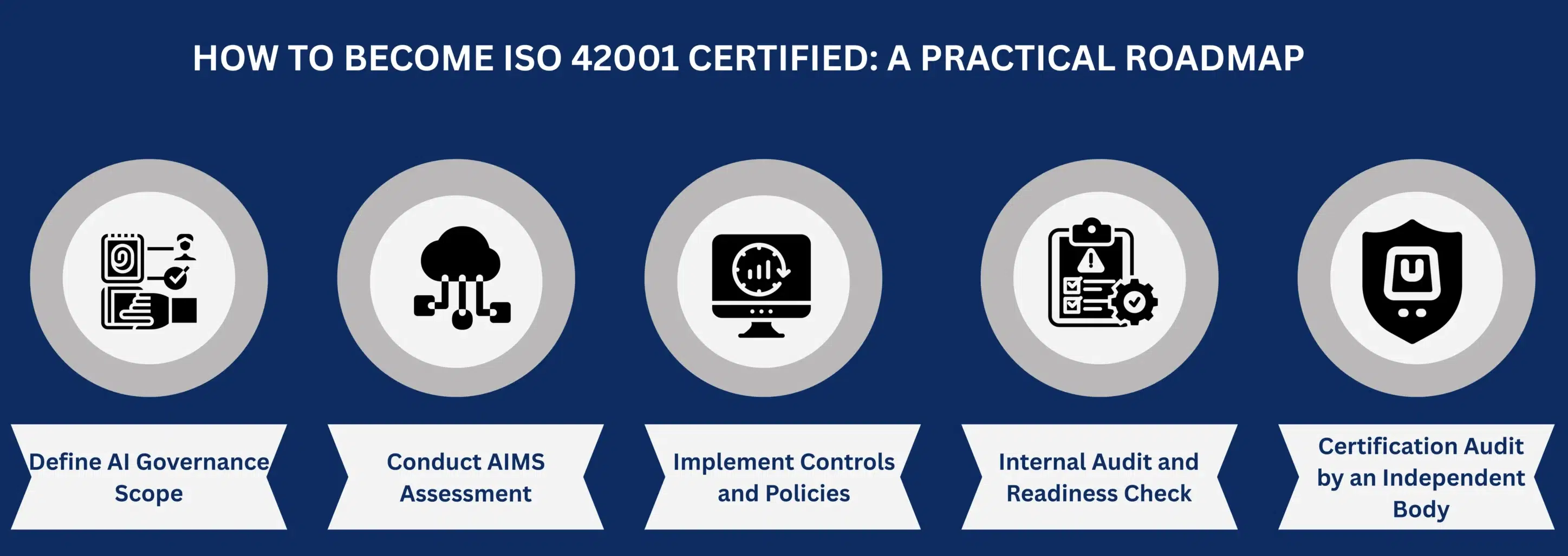
AI governance fails when it stays informal and reactive. A clear path to becoming ISO 42001 certified turns scattered efforts into a system that auditors and buyers trust.
Define AI Governance Scope: Start with clarity. Most teams don't have a full view of where AI is used. Build a simple inventory of every AI system, including internal tools, third-party models, and embedded features. Then connect each system to a real use case. Ask who owns it, what data it uses, and what decisions it influences. A hiring tool, for example, carries different risks than a marketing assistant. This step sets the foundation and gives leaders a clear picture, removing guesswork.
Conduct AIMS Assessment: Now test your current setup against the standard. An AIMS assessment shows where your governance holds up and where it breaks. Look at risk reviews, approval flows, data controls, and monitoring. Many teams find gaps here — some lack formal impact assessments, others don't track model changes. That's normal. The goal is clarity, rather than perfection. This step gives you a realistic roadmap before an auditor does.
Implement Controls and Policies: This is where governance becomes real. You define how teams manage risk in daily work. That includes risk scoring, human oversight, data checks, and incident response. Document each control in plain language. Keep it usable — if teams can't follow it, it won't work. Add monitoring so you can track performance over time.
Internal Audit and Readiness Check: Before external review, validate your system. Run an internal audit. Check if controls exist and if teams actually use them. Look for missing evidence. Review logs, approvals, and reports. Fix weak spots early. This step builds confidence and avoids surprises during the formal assessment.
Certification Audit by an Independent Body: An external auditor reviews your AIMS. They check design and execution using verifiable evidence and documented records. A successful audit confirms that your AI governance works in practice. Buyers and partners trust this signal. It shows your system can stand up to scrutiny.
How AIMS Assessment Shapes The Path To Certification
Before you aim to be ISO 42001 certified, you need a clear view of your current setup. Many teams assume they're ready. But when auditors step in, gaps show up fast. That's where an AIMS assessment comes in.
An AIMS assessment checks how your AI governance compares to ISO 42001 requirements. It looks at what you've already built and what's missing. Think of it like a reality check based on evidence, not opinions. For example, a company may say, "We track AI risks." But during the assessment, they often find the risk register is incomplete — or worse, it doesn't cover high-impact AI decisions at all.
In most cases, three common gaps show up:
- AI risk registers are incomplete or outdated.
- Human oversight is unclear for critical AI decisions.
- AI impact assessments are missing or informal.
These aren't small issues. They sit at the core of ISO 42001. Auditors look for them early in the process. Starting with an AIMS assessment shows where to act and where things are already fine. Without it, teams often fix the wrong problems — or discover major gaps during the audit, which is the worst time.
The benefits of ISO 42001 certification depend on how you prepare. If you build on a strong assessment, your system actually works in real life, not just on paper. Once gaps are clear, the next steps become simple:
- List all AI systems in one place.
- Define AI risk policies clearly.
- Set up impact assessment processes.
- Assign clear roles and accountability.
Teams that follow this path become ISO 42001 certified and build better internal systems. Hence, an ISO 42001 AIMS assessment prepares you for an audit and helps you build a governance system that holds up in real-world use.
Conclusion
AI governance is becoming a board issue because AI now affects core business decisions. Companies that move early are better prepared for enterprise scrutiny, manage trust gaps with clearer evidence, and reduce the risk of unexpected issues. Companies that delay often need to justify AI decisions after deployment.
CertPro is a licensed CPA firm and third-party compliance audit firm. It conducts independent ISO/IEC 42001:2023 assessments, AI governance audits, SOC 2 audits, and security assessments for technology organizations. The assessment follows established audit standards and structured AIMS evaluation procedures. It examines governance structures, risk controls, and accountability against ISO/IEC 42001:2023 requirements.
Audit conclusions are based on objective evidence obtained during the engagement. Findings are documented with clause references and control mappings. Certification decisions are made by an independent certification body after completion of the audit process and closure of nonconformities.