
USA
HIPAA CERTIFICATION IN WILMINGTON
Data security and patient privacy are of utmost importance in the healthcare sector. To protect the integrity and security of patient health information, the Health Insurance Portability and Accountability Act (HIPAA) was enacted in 1996. All healthcare businesses, including those in Wilmington, Delaware, must adhere to HIPAA standards. Obtaining HIPAA certification in Wilmington is essential for maintaining patient trust and avoiding expensive fines. It is also a regulatory necessity.
Healthcare providers, insurers, and their business partners must abide by stringent guidelines for protecting protected health information (PHI) in order to maintain HIPAA certification. The certification process evaluates an organization’s PHI, electronic health records (EHR), and data security policies, methods, and processes.
Healthcare businesses in Wilmington often go through thorough examinations and audits to make sure they satisfy all necessary standards before receiving HIPAA certification. This includes educating personnel about HIPAA rules, putting privacy policies in place, and performing routine security audits.
To protect patient data, adhere to legal obligations, and maintain patients’ trust, Wilmington’s healthcare organizations must obtain HIPAA certification. It’s a thorough approach to data security that benefits the company as well as the people it serves, fostering a more secure and dependable healthcare environment.
USA CLIENTS










CERTIFICATION AND AUDITING SERVICES BY CERTPRO FOR HIPAA IN WILMINGTON
CertPro provides outstanding HIPAA consulting services in Wilmington. Our knowledgeable team makes sure that your organization complies with HIPAA rules while protecting patient information and maintaining legal integrity. We assist you in complying with all HIPAA regulations, lowering legal risks, and boosting patient trust through thorough audits and in-depth training. For HIPAA compliance services in Wilmington that are dependable, effective, and customized and that help you uphold your commitment to data security and legal compliance, choosing CertPro can be a wise choice.
WHY CHOOSE CERTPRO FOR HIPAA CERTIFICATION AND AUDITING?
Choosing CertPro for HIPAA consulting services enables us to meet your data security demands with unmatched experience and dedication. Our knowledgeable team, which has a focus on healthcare compliance, will make sure that your organization complies with all HIPAA rules. We offer specialized solutions, exacting audits, and thorough training, lowering legal risks and boosting patient confidence. CertPro stands out as a reliable partner for HIPAA certification and audits. Join the countless happy customers that trust CertPro to protect their data and uphold legal compliance.
WHAT IS HIPAA?
The Health Insurance Portability and Accountability Act, or HIPAA, is a significant piece of law that was adopted in the United States in 1996. Its main goal is to solve numerous healthcare-related concerns, with a particular emphasis on protecting people’s protected health information (PHI).
HIPAA establishes strict guidelines to safeguard patients’ private and medical information. It limits who can access and share this information and gives people more control over their health data. The Act outlines security standards for electronic health records (EHR) and sets guidelines for ensuring the confidentiality, integrity, and availability of PHI. Healthcare organizations must implement safeguards to prevent data breaches. By allowing people to keep their health insurance coverage while changing employment or health plans, HIPAA lowers the chance that people will lose coverage because of pre-existing diseases.
In conclusion, HIPAA is a significant piece of law that is essential for safeguarding the security and privacy of people’s health information, fostering effective healthcare data exchange, and assuring the portability of health insurance coverage in the United States. It serves as a pillar for data protection and management in contemporary healthcare.
WHY DO WE NEED HIPAA CERTIFICATION?
The fact that it is required by law is one of the main justifications for obtaining HIPAA certification. Health Insurance Portability and Accountability Act (HIPAA) compliance is required by law for healthcare businesses, including providers, insurers, and their business partners. Healthcare businesses that have obtained HIPAA certification can be sure that the required security measures are in place to protect patients’ private health information. Implementing strong security measures, such as encryption, access controls, and recurring risk assessments, is necessary for certification. This aids healthcare organizations in lowering the risk of data breaches, which may be expensive in terms of both financial costs and reputational harm.
Patients are more likely to trust their healthcare professionals when they are aware that HIPAA standards are being strictly followed when handling their health information. For healthcare to be delivered effectively, this trust is necessary. HIPAA certification may give you a competitive advantage in the healthcare sector. HIPAA compliance frequently results in improved organization and streamlined procedures, which benefit patients and healthcare providers by raising the standard of care in general.
ENQUIRE NOW
Related Links
SOC 2 in USA
ISO 27701 in USA
GDPR in USA
ISO 27018 in USA
HIPAA in USA
CCPA in USA
PIPEDA in USA
ISO 17025 in USA
ISO 13485 in USA
CE Mark in USA
GDP in USA
GLP in USA
ISO 9001 in USA
ISO 14001 in USA
ISO 45001 in USA
ISO 22000 in USA
HACCP in USA
ISO 22301 in USA
ISO 21001 in USA
ISO 41001 in USA
ISO 20000-1 in USA

HOW TO GET HIPAA CERTIFICATION IN WILMINGTON?
To get a HIPAA certification in Wilmington, start by evaluating the present privacy and security policies, practices, and processes in your organization. To find areas where you need to improve, perform a gap analysis. Make sure that HIPAA training is provided to every employee. The fundamentals of HIPAA rules, the value of patient privacy, and proper PHI handling should all be covered in this course. Create and record HIPAA-compliant policies and procedures, including privacy policies, security measures, and breach response plans, that are specifically customized to your organization’s requirements.
Set up security safeguards to safeguard PHI, including encryption, access limits, and routine risk evaluations. To determine whether your company is in compliance with HIPAA rules, do routine internal audits. For that, you can also hire HIPAA consulting services in Wilmington for smooth running audits in the organization. Remember that maintaining HIPAA certification requires a continual commitment to protecting patient data privacy and security. Find any deficiencies and remedy them. To properly traverse this process, seek advice from professionals or speak with HIPAA compliance specialists.
STEPS FOR OBTAINING HIPAA COMPLIANCE
To assure adherence to the requirements of the Health Insurance Portability and Accountability Act (HIPAA), obtaining HIPAA certification entails a number of processes. Here is a thorough tutorial on how to become HIPAA certified:
Step 1: Recognize the HIPAA requirements: Recognize the HIPAA requirements as a first step. Make sure that you and your staff are familiar with HIPAA rules. To comprehend the needs and responsibilities for protecting protected health information (PHI), review the Privacy Rule, Security Rule, and other pertinent rules.
Step 2: Conduct a HIPAA risk assessment: To find weaknesses and potential risks to the security of PHI, conduct frequent risk assessments. Create plans to reduce these hazards.
Step 3: Construct HIPAA policies and practices: Create and maintain HIPAA-compliant privacy policies and procedures that are suited to the unique requirements of your firm. These ought to cover patient consent, PHI access, and disclosure.
Step 4: Implementing physical and technical safeguards: Create a thorough breach response strategy that describes how your firm will detect, report, and address PHI breaches. Make sure every worker is aware of what to do in the event of a breach.
Step 5: Regular monitoring: Keep a close eye on your company’s compliance-related operations, and regularly evaluate and update policies and processes to take into account any changes to the legal landscape.
Step 6: Maintain HIPAA Documentation: Keep complete records of your HIPAA compliance activities, including training logs, policies and procedures, risk evaluations, and audit reports.
Step 7: Appointing an HIPAA Compliance officer: Consider consulting with HIPAA compliance experts or consultants who can offer knowledge and direction during the certification process.
Note: Please feel free to reach out to us at CertPro.com for a more comprehensive insight into the specifics of this situation, as the nuances can differ across different companies, and we can provide you with the requisite information.
REQUIREMENTS FOR HIPAA CERTIFICATION
By adhering to the guidelines and specifications provided in the Health Insurance Portability and Accountability Act (HIPAA), firms can become HIPAA compliant.
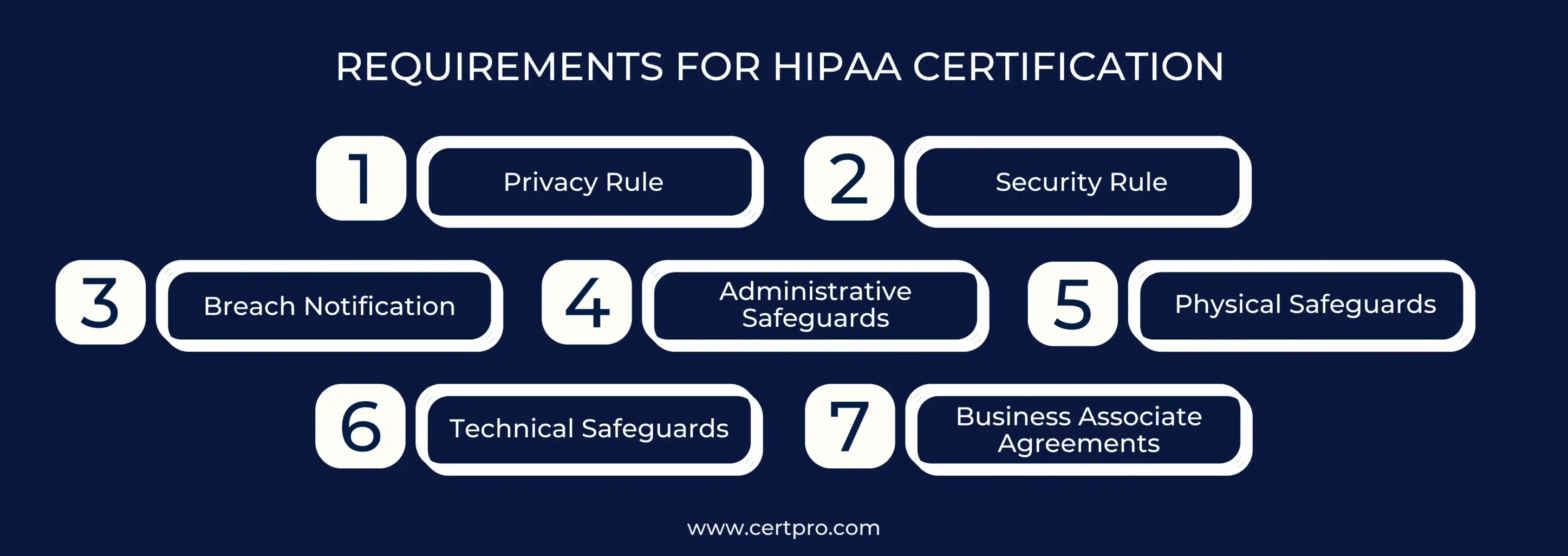
Privacy Rule: The HIPAA Privacy Rule governs the use and disclosure of protected health information (PHI). Organizations must create policies and practices to preserve patient privacy in order to be compliant, including getting patient consent, disclosing privacy practices, and regulating access to PHI.
Security Rule: The security of electronic protected health information (ePHI) is the main goal of the HIPAA Security Rule. Organizations must put in place administrative, physical, and technical measures in order to comply. This covers risk analyses, access controls, data encryption, and personnel training.
Breach Notification: In the event of a breach of unsecured PHI, organizations are required to notify the impacted individuals, the HHS, and occasionally the media. A breach response strategy, rapid breach reporting, and impact mitigation are all components of compliance.
Administrative Safeguards: The creation of written PHI security and privacy policies and procedures, the appointment of a privacy and security officer, and educating staff members on HIPAA requirements.
Physical Safeguards: Protect physical access to locations that house ePHI, such as data centers and places where files are stored.
Technical Safeguards: Access controls for ePHI protection should include one-of-a-kind user IDs and passwords, data encryption both in transit and at rest, frequent security updates, software patching, and network activity monitoring for illegal access or data breaches.
Business Associate Agreements: Contracts or agreements must be in place between healthcare organizations and any commercial partners who handle PHI on their behalf. These agreements define the obligations and specifications for protecting PHI.
Note: Please feel free to reach out to us at CertPro.com for a more comprehensive insight into the specifics of this situation, as the nuances can differ across different companies, and we can provide you with the requisite information.
HIPAA CERTIFICATION COST IN WILMINGTON
When it comes to achieving HIPAA certification in Wilmington, several factors come into play that can influence the overall cost of the process. The size and complexity of the healthcare organization play a pivotal role, as do the range of services required and the choice of the certifying body or consultant.
Many healthcare organizations in Wilmington opt to enlist the assistance of HIPAA compliance experts or specialized businesses to streamline the certification process. The costs associated with these services can fluctuate significantly, ranging from a few thousand dollars to potentially tens of thousands of dollars, contingent on the level of support needed.
For organizations equipped with internal expertise and resources dedicated to HIPAA compliance, such as employee training, software tools, and documentation efforts, the expenditure may be notably lower. Some entities may also opt for an external audit or seek certification from a reputable certification body to ensure compliance with HIPAA regulations. In light of these expenses, healthcare organizations must include HIPAA compliance Services in Wilmington in their ongoing operational budget, accounting for both the initial certification costs and the continuous maintenance required. While the investment in HIPAA certification may vary, it remains a crucial step for safeguarding patient data, ensuring legal compliance, and upholding public trust in the healthcare industry.
For reliable HIPAA consulting services in Wilmington or expert guidance on HIPAA compliance in the region, organizations can seek assistance from reputable consultants or businesses with a proven track record in the field. These professionals can help navigate the complexities of HIPAA certification and tailor compliance strategies to suit the unique needs of healthcare entities in Wilmington.
BENEFITS OF HIPAA CERTIFICATION
Health care companies and professionals can gain a lot from HIPAA (Health Insurance Portability and Accountability Act) certification. Securing patient data and ensuring compliance with privacy laws are critical in today’s data-driven healthcare environment. The following are some significant benefits of obtaining HIPAA certification:
Data security: To achieve HIPAA certification, stringent data security controls must be put in place. This not only safeguards patients’ private information but also strengthens the organization’s overall cybersecurity posture. Access controls, encryption, and regular security audits are all part of it.
Legal Compliance: The ability to continue complying with federal requirements is among the most important advantages of HIPAA certification for healthcare organizations. Compliance lowers the likelihood that data breaches or privacy violations will result in exorbitant fines and legal actions.
Better Data Management: Implementing procedures and documentation in order to achieve HIPAA certification frequently results in more productive operations. Administrative costs associated with compliance-related responsibilities may be lessened.
Avoiding Breach Notification Costs: PHI-related data breaches can be costly in terms of both financial outlays and harm to one’s reputation. With the help of HIPAA compliance, organizations may prevent breaches or handle them effectively, potentially saving money on breach notification and recovery costs.
Better Healthcare results: Healthcare professionals may concentrate on providing high-quality, patient-centered care without being diverted by concerns about data security and compliance because of HIPAA certification.

SAFEGUARD PATIENT DATA AND ACHIEVE HIPAA COMPLIANCE IN WILMINGTON WITH CERTPRO
Data security for patients is crucial in today’s healthcare environment. By working with CertPro, Wilmington healthcare providers can guarantee the highest levels of data protection and HIPAA certification in Wilmington.
HIPAA compliance services in Wilmington can be obtained from CertPro, a reputable leader in healthcare compliance solutions. Our knowledgeable staff can smoothly guide you through the procedure because they are familiar with the intricacies of HIPAA rules. You may build secure electronic health records (EHR) systems, establish strong data protection measures, train your personnel in HIPAA best practices, and more with CertPro’s expertise. We offer complete solutions, which include risk evaluations, the creation of policies, and continual compliance checking.
Don’t compromise on patient data security and HIPAA certification in Wilmington. Partner with CertPro in Wilmington and ensure your patients’ sensitive information is in safe hands. Contact us today to schedule a consultation and take the first step towards robust data protection and compliance excellence.
FAQ
What constitutes a healthcare organization's HIPAA compliance in its simplest terms?
Performing risk assessments, putting security measures in place, educating personnel, and upholding policies and procedures to secure patient information are just a few of the many facets of HIPAA compliance.
How can Wilmington's healthcare organizations determine whether they are HIPAA compliant?
By regularly completing HIPAA risk assessments, healthcare institutions may evaluate their compliance status. These evaluations assist in locating weak points and problem areas.
What actions may healthcare providers take to improve the security of patient data?
Healthcare providers can use encryption, access controls, secure EHR systems, and routine security audits to improve the security of patient data.
Is HIPAA compliance an on-going procedure or a one-time effort?
The duration of achieving HIPAA compliance varies depending on the size and complexity of your organization. To maintain compliance, ongoing efforts and actions are required.
Are there any local Wilmington resources or consultants who can help with HIPAA compliance?
Yes, Wilmington has resources and local consultants who focus on HIPAA compliance. These experts can offer personalized advice and assistance.

HIPAA UPDATES 2026: KEY REGULATORY CHANGES, NEW RULES, AND COMPLIANCE IMPACT EXPLAINED
Why is HIPAA Important to Patients
LAST UPDATE -- 10-01-2025 The Health Insurance Portability and Accountability Act, also known as HIPAA, is crucial for patients because it safeguards their privacy and health information. In order to provide national standards for the security of specific health...
WHAT IS THE HIPAA OMNIBUS RULE
In the U.S. healthcare sector, sensitive medical records are often subjected to cyberattacks like data breaches and ransomware. For example, recently a misconfigured MongoDB database has led to the exposure of 2.7 million patient profiles. This incident is due to a...