
SINGAPORE
HIPAA CERTIFICATION IN SINGAPORE
In this modern world, keeping private medical information safe is essential. The Health Insurance Portability and Accountability Act (HIPAA) sets the rules for protection and security. HIPAA has strict rules about how to keep personal health information (PHI) safe. Because of this, business partners and healthcare workers must meet high standards. Healthcare companies in the Singapore area prioritize HIPAA certification. This protects the privacy, correctness, and availability of patient data. A full evaluation is part of HIPAA compliance services. They check to see if policies, procedures, and new technologies are in line with the government’s expectations. Companies are committed to strict standards during data hacks and privacy worries.
This information also details HIPAA certification in Singapore. This article talks about its value, advantages, and difficulties. It also includes learning the basic rules of HIPAA and showing how to get certified. So, getting HIPAA approval is necessary to keep up high standards for data security. It makes a business look better and more trustworthy. Lastly, getting HIPAA certification improves data protection. But it also makes a company look more trustworthy. Getting HIPAA certification in Singapore is a smart move because of this. Ensuring compliance and creating a safe healthcare setting are two things it does.
SINGAPORE CLIENTS










CERTIFICATION AND AUDITING SERVICE BY CERTPRO FOR HIPAA IN SINGAPORE
CertPro is a professional HIPAA consultant in Singapore. We can help you understand and follow the new data security laws and get HIPAA certification. By certifying and monitoring, we ensure that companies meet the high standards to build trust in a competitive market. Our trained auditors review the rules to ensure they are correct, private, safe, and available. Our work will also make you look better and show you care about data protection.
WHY CHOOSE CERTPRO FOR HIPAA CERTIFICATION AND AUDITING?
CertPro offers affordable HIPAA certification services in Singapore. We understand that certification costs must be affordable while still meeting HIPAA requirements. Our custom approach saves money on auditing fees. This method works well because it speeds up certification, uses resources best, and keeps things running smoothly. Because of this, CertPro’s framework is cost-effective and meets HIPAA requirements while keeping quality high. You can trust CertPro to help you comply with HIPAA in Singapore at a low cost.
WHAT IS HIPAA?
The Health Insurance Portability and Accountability Act (HIPAA) is a fundamental federal rule that controls many parts of US health care. The act was created to protect patient privacy, security, and the ability to move health insurance plans.
The Privacy Rule: These rules explain how to keep personally sensitive health information safe. You cannot use or share protected health information without permission. Customers also decide what health information they want to share.
The Security Rule: This rule tells you how to keep electronic Protected Health Information (ePHI) safe. It ensures data security, privacy, and accessibility. Businesses must take several security steps to prevent people from accessing online health information without permission.
One of HIPAA’s goals is to protect private and health information. It keeps personal information safe and encourages sharing information to improve healthcare. You can not share health information online without following HIPAA rules. This way, you can use details for medical care and billing while staying anonymous.
WHY DO WE NEED HIPAA CERTIFICATION?
Healthcare industries in Singapore are less likely to have data breaches if they are HIPAA-compliant. However, new rules may not be sent out on time. This could mean that the Office for Civil Rights (OCR) doesn’t have to deal with as many patient complaints.
HIPAA certification in Singapore keeps patient data safe during crisis times. Getting certification makes companies that deal with health data look better and shows that they will follow the rules, which increases people’s trust. Certification also makes it easy for companies to do business with each other, making deals safer and faster. Thus, HIPAA certification in Singapore makes your business look more trustworthy and secure.
HOW TO GET HIPAA CERTIFIED IN SINGAPORE?
HIPAA certification in Singapore requires careful planning, execution, and persistence. HIPAA consulting services in Singapore are an excellent choice for businesses that want to make the certification process more manageable.
Seeking help from HIPAA consultants in Singapore speeds up the process. Knowing the rules makes implementing plans easier and speeds up the certification process. This improves your company’s information security management system and makes your Singapore-based company look safe and reliable. Professionals in HIPAA can make this difficult process a lot easier and ensure a successful certification outcome in Singapore’s constantly changing healthcare business.
ENQUIRE NOW
Related Links
SOC 2 in Singapore
ISO 27701 in Singapore
GDPR in Singapore
ISO 27018 in Singapore
HIPAA in Singapore
CCPA in Singapore
PIPEDA in Singapore
ISO 17025 in Singapore
ISO 13485 in Singapore
CE Mark in Singapore
GDP in Singapore
GLP in Singapore
ISO 9001 in Singapore
ISO 14001 in Singapore
ISO 45001 in Singapore
ISO 22000 in Singapore
HACCP in Singapore
ISO 22301 in Singapore
ISO 21001 in Singapore
ISO 41001 in Singapore
ISO 20000-1 in Singapore

STEPS FOR OBTAINING HIPAA CERTIFICATION
This comprehensive guide will assist you in achieving HIPAA compliance certification in Singapore.
Step 1: Recognize HIPAA Requirements: Ensure all staff members know the HIPAA requirements and your obligation to secure PHI. Review the privacy and security policies and any additional requirements.
Step 2: Conduct a HIPAA Risk Assessment: Conduct a thorough evaluation to identify any holes in PHI management protocols. Conduct a comprehensive risk assessment to identify any weaknesses. Apply the understanding to address specific problems and improve core data security protocols.
Step 3: Construct HIPAA Policies and Practices: Establish PHI management practices that comply with HIPAA rules. Customize policies to reflect your firm’s specific practices.
Step 4: Implement Physical and Technical Safeguards: Install all essential security measures, including encryption, to prevent unauthorized access. This is a critical step in ensuring data security.
Step 5: Regular Monitoring: Monitor compliance activities to ensure they are being followed. Update procedures to reflect changing legal requirements and risk management best practices.
Step 6: Maintain HIPAA Documents: Document detailed compliance measurements to monitor development efficiently. Thoroughly document training sessions and risk assessments. Regularly update incident response strategies to reflect new choices and hazards.
Step 7: Appoint a HIPAA Compliance Officer: It is critical to choose a compliance officer to supervise data security and privacy rules. This officer ensures that all rules and laws are followed. They also monitor and enforce organizational policies. The compliance officer educates employees on their responsibilities and facilitates training sessions to encourage best practices and raise awareness.
Every business in Singapore faces distinct challenges due to its size and organizational structure. By completing these steps, your organization can demonstrate its commitment to HIPAA compliance in Singapore. CertPro provides further information on certain technical issues.
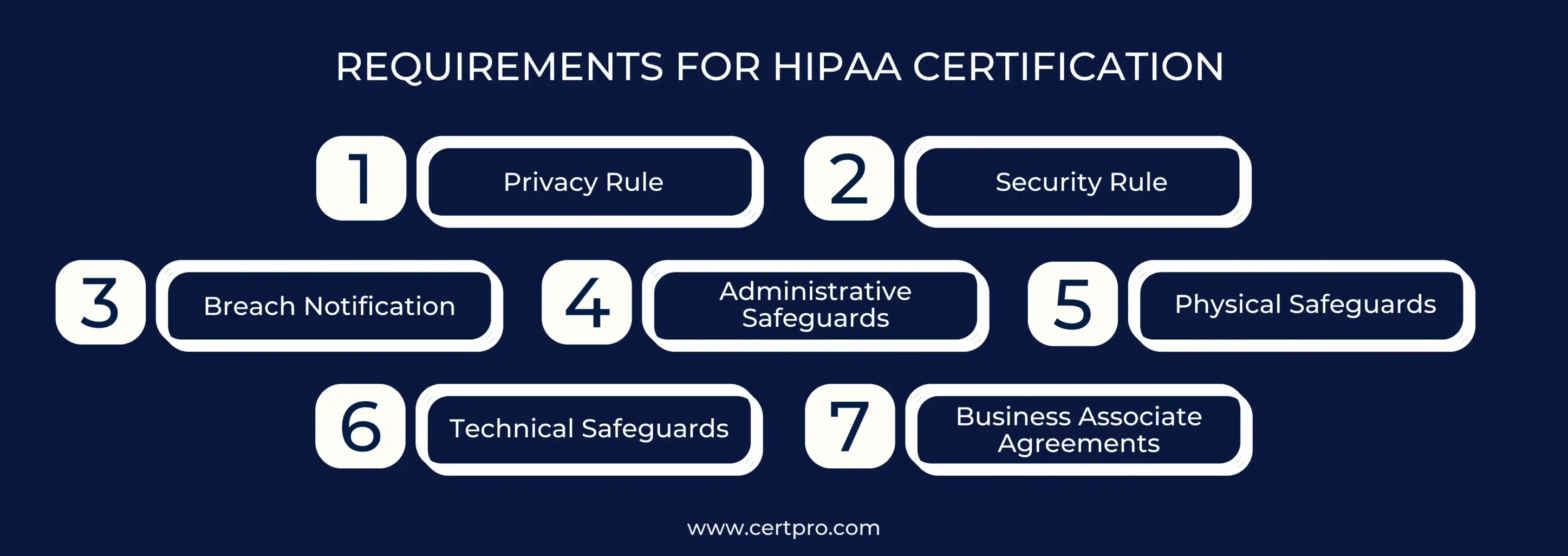
REQUIREMENTS FOR HIPAA CERTIFICATION
Businesses in Singapore are required to follow specific guidelines for HIPAA certification. Depending on the plan and certification body, different criteria could apply. Nonetheless, the following general traits are mentioned:
Privacy Rule: The Privacy Rule governs the management of Protected Health Information (PHI). Users can maintain the privacy of their health information with it.
Security Rule: The Security Rule mandates implementing administrative, technical, and physical security measures. These steps are intended to prevent unauthorized parties from accessing, using, or revealing electronic protected health information (ePHI) and ensure that ePHI is secure and protected from harm. Additionally, organizations must regularly assess their security procedures. This ensures ongoing adherence and readiness to manage emerging risks effectively.
Breach Notification: Follow these instructions in case of a data breach involving PHI. After taking the necessary actions, notify the Department of Health and Human Services and the affected parties as soon as possible.
Administrative Safeguards: Administrative measures include hiring a privacy and security officer, educating employees about HIPAA-related duties, creating well-written rules and procedures for PHI security and privacy, and effectively managing risk.
Physical Safeguards: Physical security measures include installing surveillance cameras and other security measures, restricting access to buildings containing PHI, and ensuring that media and equipment containing PHI are disposed of properly.
Technical Safeguards: Preserve information while it is being sent or stored. Use codes and passwords to limit access and look for unauthorized network access. Update the security software on your ePHI.
Business Associate Agreements (BAAs): BAAs guarantee adherence to HIPAA regulations. Consequently, this guarantees health information confidentiality, which is essential for institutions.
Note: This provides a thorough overview of the state of technology today. For more information, you can reach them directly or visit CertPro.com.
HIPAA CERTIFICATION COST IN SINGAPORE
Several factors influence the HIPAA certification cost in Singapore. These include the organization’s type and size, the certification effort’s scope, the level of compliance already in place, and the choice of certification provider or advisory firm. There are many different levels of consulting prices, from a few thousand dollars to tens of thousands of dollars. Internal staff must spend time and effort allocating resources for compliance tasks. However, this investment is crucial because it ensures that the healthcare industry follows the law, improves data security, and builds patient trust.
BENEFITS OF HIPAA CERTIFICATION
HIPAA certification in Singapore has many advantages, such as improved healthcare.
Data Security: HIPAA guards patient data from hackers and online dangers. As a result, there are fewer data leaks, and medical facilities maintain their positive reputation.
Legal Compliance: Healthcare facilities can comply with HIPAA in Singapore. This avoids breaking the law and incurring penalties.
Better Data Management: HIPAA enables healthcare facilities to organize their data better. They achieve this through regular audits, risk detection, and the creation of efficient patient data management procedures.
Avoiding Breach Notification Costs: Under HIPAA, Singapore’s healthcare facilities are shielded from having to pay hefty fees to alert the public about data breaches. This saves money and speeds up problem-solving.
Better Health Results: HIPAA regulations facilitate the safe exchange of medical information among healthcare professionals. Patients benefit from improved decision-making, treatment planning, and overall health.

HIPAA COMPLIANCE SERVICES IN SINGAPORE: AN EXPERT’S GUIDE
With an expert understanding, CertPro helps Singaporean businesses follow HIPAA rules. We carefully examine how you handle data, finding and fixing any issues that may arise. Your company needs to put data protection ahead of simple regulatory compliance. To ensure your business achieves HIPAA certification in Singapore, we will help you make the necessary changes and monitor its performance. We know that small businesses have multiple restrictions, and we have an affordable option for compliance.
Singaporean companies that work with CertPro earn the trust of their stakeholders. So, getting HIPAA certification in Singapore ensures that your business follows best practices when handling data, which sets it up for success in today’s data-driven world.
FAQ
Is HIPAA applicable in Singapore?
HIPAA primarily applies to entities in the United States. However, healthcare organizations in Singapore that handle U.S. patient data or work with U.S.-based healthcare entities must comply with HIPAA requirements. For local operations, organizations in Singapore must also adhere to the Personal Data Protection Act (PDPA) to ensure comprehensive data protection.
How can my company achieve HIPAA compliance?
To achieve HIPAA compliance, conduct a risk assessment, implement required security measures, train employees on HIPAA rules, and partner with a compliance expert for guidance. Note that HIPAA does not issue certifications, but third-party audits can verify compliance.
Is HIPAA limited to the U.S.?
Yes, HIPAA is a U.S. regulation and applies to entities handling protected health information (PHI) within the United States. However, international organizations dealing with U.S. patient data must also comply.
Who issues HIPAA certification?
HIPAA does not have an official certification body. However, organizations like CertPro offer comprehensive HIPAA compliance services, including assessments and attestations, to help businesses demonstrate their adherence to HIPAA requirements effectively. Partnering with CertPro ensures a thorough evaluation and expert guidance in achieving compliance.
What is the difference between HIPAA and GDPR?
HIPAA focuses exclusively on protecting healthcare information in the U.S., while GDPR (General Data Protection Regulation) is a broader European Union law that applies to all personal data. GDPR emphasizes user consent, data transparency, and global applicability, whereas HIPAA is more healthcare-specific.
HIPAA UPDATES 2026: KEY REGULATORY CHANGES, NEW RULES, AND COMPLIANCE IMPACT EXPLAINED
Why is HIPAA Important to Patients
LAST UPDATE -- 10-01-2025 The Health Insurance Portability and Accountability Act, also known as HIPAA, is crucial for patients because it safeguards their privacy and health information. In order to provide national standards for the security of specific health...
WHAT IS THE HIPAA OMNIBUS RULE
In the U.S. healthcare sector, sensitive medical records are often subjected to cyberattacks like data breaches and ransomware. For example, recently a misconfigured MongoDB database has led to the exposure of 2.7 million patient profiles. This incident is due to a...