
ISO 42001 Certification in India
CertPro is a Licensed CPA Firm conducting ISO 42001 certification audits for organizations across India. Our audit program evaluates AI Management Systems (AIMS) against ISO/IEC 42001:2023 requirements, covering scope definition, risk controls, governance structures, and conformity assessment — serving IT companies, fintech firms, SaaS providers, and data-driven enterprises operating in India’s regulated AI landscape.
OUR CLIENTS









Introduction to ISO 42001 Certification in India
ISO/IEC 42001:2023 is the first international standard that specifies requirements for establishing, implementing, maintaining, and continually improving an Artificial Intelligence Management System (AIMS). Published by the International Organization for Standardization (ISO) in December 2023, this standard provides a structured framework for organizations that develop, deploy, operate, or use AI-based systems. ISO 42001 certification in India confirms that an organization’s AI governance practices meet globally recognized requirements for responsible AI management, ethical oversight, and risk-based control implementation.
India’s technology sector represents one of the most AI-active economies in the world. With over 1,400 AI startups, a rapidly expanding SaaS ecosystem, and a dominant position in global IT outsourcing, Indian organizations face increasing pressure to demonstrate that their AI systems are trustworthy, transparent, and aligned with international governance frameworks. ISO 42001 certification in India serves as a recognized conformity marker — one that validates an organization’s commitment to structured AI lifecycle management, bias mitigation controls, and accountable decision-making processes within AI-powered operations.
The standard is applicable to any organization regardless of size, sector, or the nature of its AI involvement. Whether an organization develops proprietary AI models, integrates third-party AI tools into business workflows, or operates AI-powered platforms serving end users, ISO/IEC 42001:2023 provides the governance architecture needed to manage AI-related risks systematically. In India’s competitive digital economy, where regulatory attention to AI ethics and data protection is intensifying, ISO 42001 certification positions organizations as compliant, credible, and audit-ready participants in the global AI marketplace.
What Is an AI Management System (AIMS) Under ISO 42001?
An Artificial Intelligence Management System (AIMS) is a set of interrelated policies, processes, controls, and governance structures that an organization uses to direct and manage AI-related activities throughout the AI system lifecycle. Under ISO/IEC 42001:2023, an AIMS encompasses the organizational context, leadership commitment, resource allocation, operational controls, and performance evaluation mechanisms that collectively govern how AI systems are designed, tested, deployed, monitored, and decommissioned. The AIMS framework is structured around the Plan-Do-Check-Act (PDCA) cycle, which ensures continuous improvement and ongoing alignment with evolving AI risks and regulatory expectations.
For Indian organizations, the AIMS under ISO 42001 must address the full spectrum of AI-related risks — including algorithmic bias, data quality failures, model drift, explainability gaps, and unintended societal impacts. The standard requires organizations to define the scope of their AIMS, document AI system objectives, identify internal and external stakeholders affected by AI decisions, and establish clear roles and responsibilities for AI oversight. This structured approach transforms AI governance from an informal practice into a documented, auditable, and continuously monitored management function.
ISO 42001 vs. Other AI Governance Frameworks in India
ISO 42001 certification differs from other AI governance frameworks by providing a certifiable, third-party auditable standard rather than a voluntary code of conduct or internal policy guideline. While India’s National Strategy for Artificial Intelligence (NSAI) and NITI Aayog’s Responsible AI principles offer directional guidance, they do not carry the same level of international recognition or third-party certification validity as ISO/IEC 42001:2023. For Indian organizations serving global clients — particularly in the EU, UK, US, and the Middle East — ISO 42001 certification demonstrates alignment with internationally accepted AI governance requirements, strengthening cross-border trust and contractual credibility.
ISO 42001 shares structural DNA with ISO 9001 (Quality Management) and ISO 27001 (Information Security Management), using the same High-Level Structure (HLS) framework. This harmonization allows organizations that already hold ISO 27001 or ISO 9001 certifications to integrate ISO 42001 requirements with existing management systems, reusing established policies, review procedures, and audit documentation. For Indian IT and fintech firms that maintain ISO 27001 certification as a baseline, the transition to ISO 42001 involves mapping existing controls to the AIMS requirements rather than building an entirely new governance architecture from scratch.
| Framework | Type | Certifiable | Primary Focus | Relevance for India |
|---|---|---|---|---|
| ISO/IEC 42001:2023 | International Standard | Yes | AI Management System | IT, fintech, SaaS, data-driven enterprises |
| NITI Aayog Responsible AI | National Guidelines | No | Ethical AI principles | Policy alignment for Indian organizations |
| EU AI Act | Regulation | Compliance-based | High-risk AI classification | Indian exporters serving EU markets |
| ISO 27001:2022 | International Standard | Yes | Information Security | Integrates with ISO 42001 for AI security |
| ISO 31000:2018 | International Standard | No | Risk Management | Risk framework alignment with AIMS |
The Role of ISO 42001 in India’s AI Regulatory Landscape
India’s Digital Personal Data Protection Act (DPDPA) 2023, combined with the Securities and Exchange Board of India (SEBI) guidelines on algorithmic trading and the Reserve Bank of India (RBI) frameworks on AI-driven financial services, are collectively creating a regulatory environment where documented AI governance is becoming a baseline expectation rather than a differentiator. ISO 42001 certification in India provides organizations with a structured, internationally recognized mechanism to demonstrate that AI-related data processing activities, automated decision-making systems, and AI-powered risk assessments are governed by documented controls aligned with both Indian regulatory expectations and global standards.
As India positions itself as a global AI hub — with initiatives like IndiaAI Mission and the government’s investment in AI computing infrastructure — the demand for internationally recognized AI governance certification is expected to intensify significantly through 2025 and beyond. Organizations holding ISO 42001 certification are better positioned to participate in government AI procurement processes, respond to enterprise client due diligence requirements, and demonstrate compliance readiness when India’s formal AI regulatory framework reaches legislative maturity.

Who Needs ISO 42001 Certification in India?
ISO 42001 certification in India is applicable to any organization that develops, deploys, operates, or significantly relies on AI systems as part of its core business activities. The standard does not prescribe specific industry sectors — instead, it applies across all organization types and sizes, from early-stage AI startups to large enterprise technology firms and regulated financial institutions. The determining factor for ISO 42001 applicability is the extent to which AI systems influence organizational decision-making, customer-facing outcomes, or regulated activities.
IT Services and Software Development Companies
India’s IT services sector, which accounts for approximately 7.4% of GDP and employs over 5 million professionals, is among the primary beneficiaries of ISO 42001 certification. Software development companies building AI-powered applications, machine learning platforms, natural language processing tools, computer vision systems, or AI-integrated SaaS products require ISO 42001 certification to demonstrate that their development lifecycle includes documented controls for AI risk assessment, model validation, and responsible AI deployment. For Indian IT firms serving global enterprise clients — particularly those in the EU, the UK, and North America — ISO 42001 certification is increasingly referenced in vendor qualification requirements and procurement evaluations.
Software-as-a-Service (SaaS) providers that embed AI features into productivity, analytics, HR, or customer service platforms must also demonstrate structured governance over AI model behavior, training data quality, and automated output validation. ISO 42001 certification provides SaaS companies with a recognized framework for documenting these controls, enabling enterprise clients to satisfy their own third-party AI risk management requirements without conducting individual vendor assessments for every AI-enabled tool in their technology stack.
Fintech and Financial Services Organizations
India’s fintech ecosystem — comprising over 10,000 registered fintech companies and processing billions of digital transactions annually — relies extensively on AI and machine learning for credit scoring, fraud detection, automated underwriting, algorithmic trading, and anti-money laundering (AML) surveillance. The RBI’s guidelines on AI in financial services and SEBI’s algorithmic trading frameworks require financial institutions to maintain documented evidence of AI model governance, explainability mechanisms, and bias testing procedures. ISO 42001 certification in India provides fintech organizations with a structured audit trail demonstrating that these governance requirements are embedded within a formally maintained AIMS.
For non-banking financial companies (NBFCs), insurance technology firms, and payment processors that use AI for customer risk profiling or automated claims processing, ISO 42001 certification addresses the accountability gap that regulators increasingly scrutinize. When AI systems make consequential decisions about credit eligibility, insurance premiums, or fraud classifications, certified governance frameworks demonstrate that these decisions are traceable, contestable, and subject to documented human oversight protocols — requirements that align directly with evolving RBI and IRDAI supervisory expectations.
Healthcare, Manufacturing, and Data Processing Organizations
Healthcare organizations in India using AI for diagnostic imaging analysis, clinical decision support, patient triage systems, or drug discovery pipelines face significant AI-related risks tied to patient safety and regulatory compliance under the Central Drugs Standard Control Organisation (CDSCO) frameworks. ISO 42001 certification provides these organizations with a governance structure that documents AI system validation procedures, clinical performance monitoring controls, and escalation protocols for AI-generated diagnostic anomalies — elements that align with both international medical device AI standards and India’s evolving healthcare technology regulatory requirements.
Manufacturing companies deploying AI-powered quality control systems, predictive maintenance platforms, or autonomous production line optimization tools require ISO 42001 certification to demonstrate that these systems operate within documented safety and performance parameters. Data processing organizations — including business process outsourcing (BPO) firms and analytics service providers — that use AI to process personal data on behalf of clients must demonstrate AIMS compliance as part of data processor accountability requirements under India’s DPDPA 2023 and international data protection agreements.
- ✓IT services and software development firms building or integrating AI-powered products and platforms
- ✓SaaS providers embedding AI features into enterprise or consumer-facing applications
- ✓Fintech companies using AI for credit scoring, fraud detection, and algorithmic trading
- ✓Non-banking financial companies and insurance technology organizations with AI-driven underwriting
- ✓Healthcare organizations deploying AI for diagnostic support, imaging analysis, or clinical decision systems
- ✓Manufacturing firms operating AI-powered quality control or predictive maintenance systems
- ✓Data processing organizations handling personal data through AI-enabled analytics pipelines
- ✓E-commerce and digital platform companies using AI for recommendation engines and content moderation
- ✓Government technology contractors and public sector AI service providers
- ✓Research and development organizations developing AI models for commercial deployment
ISO 42001 Certification Requirements for Indian Organizations
ISO/IEC 42001:2023 certification requirements are structured around the ten clauses of the High-Level Structure (HLS) framework, which ensures compatibility with other ISO management system standards. Indian organizations pursuing ISO 42001 certification must demonstrate documented conformance with each applicable clause, providing objective evidence that the AIMS is operational, monitored, and subject to continual improvement. The requirements cover organizational context assessment, leadership commitment, AI-specific risk management, operational controls, performance evaluation, and formal management review processes.
Clause 4 of ISO/IEC 42001:2023 requires organizations to define the internal and external context that affects their AI management objectives. This includes identifying the types of AI systems in scope, the intended use cases for each system, the data sources and data governance policies governing AI training and inference, and the stakeholders — including users, affected third parties, and regulatory bodies — with interests in AI system behavior. For Indian organizations, this context analysis must account for India-specific regulatory requirements, the sociocultural impacts of AI deployment on Indian end users, and cross-border data transfer considerations under DPDPA 2023.
The scope definition under ISO 42001 must be documented with sufficient precision to determine the boundaries and applicability of the AIMS. An Indian IT company might scope its AIMS to cover all internally developed machine learning models used in client-facing products, while explicitly excluding legacy rule-based automation systems. The scope statement must be auditable — meaning it must be supported by evidence that demonstrates both what is included within the AIMS boundary and the rationale for any exclusions. Poorly defined scope boundaries are among the most common findings in ISO 42001 Stage 1 audits conducted by CertPro for Indian organizations.
Clause 6 of ISO/IEC 42001:2023 establishes mandatory requirements for AI risk assessment and risk treatment planning. Organizations must conduct and document a systematic assessment of AI-related risks across the full AI system lifecycle — from data collection and model training through deployment, monitoring, and decommissioning. Risk identification must address technical risks such as model hallucination, adversarial attacks, and training data poisoning, as well as non-technical risks including discriminatory algorithmic outcomes, regulatory non-compliance, reputational damage from AI failures, and third-party AI supply chain risks from using pre-trained foundation models or AI-as-a-service platforms.
The risk treatment plan must specify the controls selected to address identified AI risks, the rationale for control selection, the resources allocated for control implementation, and the timelines for control activation. Unlike generic IT risk management documentation, ISO 42001 risk treatment plans must specifically address AI-unique control categories including algorithmic fairness testing, explainability mechanisms, human oversight protocols, and AI incident response procedures. For Indian fintech and healthcare organizations, the risk treatment documentation must also cross-reference applicable regulatory requirements from RBI, SEBI, IRDAI, or CDSCO to demonstrate alignment between the AIMS risk treatment and sector-specific regulatory controls.
Clause 8 of ISO/IEC 42001:2023 specifies the operational controls that organizations must implement and maintain to govern AI system development and deployment. These controls cover AI system design requirements documentation, data management procedures for training and validation datasets, model testing and validation protocols, AI system deployment authorization processes, and post-deployment performance monitoring procedures. Each control must be supported by documented procedures and records that provide objective evidence of consistent implementation across all AI systems within the AIMS scope.
Annex A of ISO/IEC 42001:2023 provides a reference set of 38 controls organized across nine control domains, including organizational controls, human resource controls, AI system impact assessment controls, responsible AI design controls, data management controls, and information security controls specific to AI systems. Indian organizations must evaluate the applicability of each Annex A control to their specific AI context, document a Statement of Applicability (SoA) that records inclusion or justified exclusion decisions for each control, and maintain evidence that applicable controls are operating effectively. The SoA is a key audit artifact reviewed during both Stage 1 and Stage 2 certification audits.
ISO/IEC 42001:2023 mandates a documented information framework that includes both required documents — such as the AIMS scope statement, AI policy, risk assessment records, and Statement of Applicability — and records that provide evidence of AIMS operation over time. Required records include outputs from AI risk assessments, evidence of internal audit execution, management review meeting minutes, records of nonconformities identified and corrective actions taken, and training records demonstrating AI governance competency development for personnel involved in AI system management.
- ✓AIMS scope statement defining AI systems and activities within the management system boundary
- ✓AI governance policy approved and communicated by top management
- ✓Documented AI risk assessment methodology and completed risk assessment outputs
- ✓AI risk treatment plan with control selections and implementation timelines
- ✓Statement of Applicability (SoA) for all 38 Annex A controls
- ✓AI system design and development documentation including data governance procedures
- ✓AI system performance monitoring records and incident logs
- ✓Internal audit program records and audit findings reports
- ✓Management review meeting records and decisions
- ✓Corrective action records for identified nonconformities and audit findings
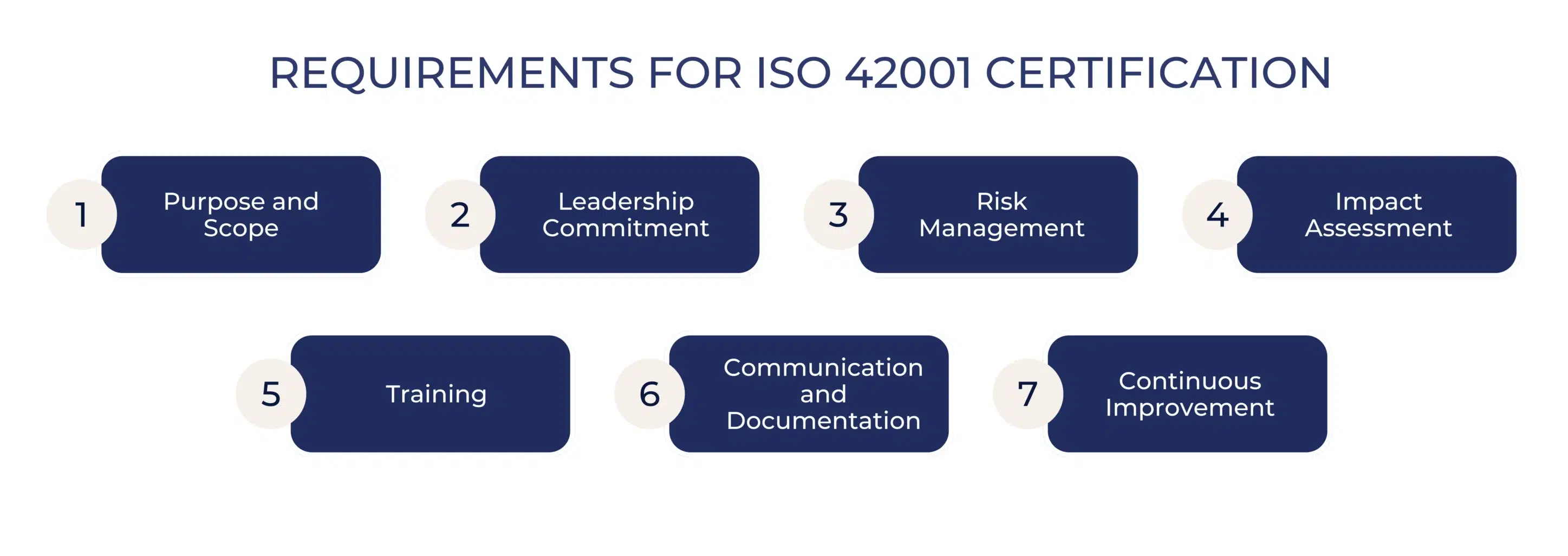
- ✓Organizational Context and Scope Definition Requirements
- ✓AI Risk Assessment and Treatment Documentation Requirements
- ✓Operational Controls and AI System Lifecycle Requirements
- ✓Documentation and Records Management Requirements
Benefits of ISO 42001 Certification for Indian Organizations
ISO 42001 certification in India delivers measurable organizational benefits that span regulatory credibility, enterprise client trust, operational risk reduction, and competitive market positioning. For organizations operating in India’s AI-driven technology economy, the certification provides a structured mechanism for demonstrating that AI governance is not an informal aspiration but a documented, audited, and continuously improved management practice. The following benefits reflect the concrete outcomes that Indian organizations achieve through ISO/IEC 42001:2023 certification.
ISO 42001 certification provides Indian organizations with documented evidence of AI governance alignment that can be presented to regulators, clients, and auditors as objective confirmation of compliance commitment. For organizations subject to RBI guidelines on AI in lending or payment systems, SEBI frameworks on algorithmic trading controls, or IRDAI requirements for AI-driven insurance underwriting, the ISO 42001 AIMS documentation demonstrates that AI risk management is systematically controlled rather than informally managed. This regulatory credibility is particularly valuable during supervisory reviews, regulatory examinations, or incident investigations where documented governance evidence directly influences regulatory outcomes.
For Indian organizations exporting IT services or AI-enabled products to EU markets, ISO 42001 certification supports alignment with the EU AI Act’s requirements for high-risk AI system providers. The EU AI Act, which entered into force in August 2024 with phased compliance deadlines through 2027, requires organizations placing high-risk AI systems on the EU market to maintain quality management systems and technical documentation that overlap significantly with ISO 42001 AIMS requirements. Indian IT exporters holding ISO 42001 certification are therefore better positioned for EU AI Act compliance readiness, reducing the incremental compliance investment required for EU market access.
Enterprise clients across banking, healthcare, manufacturing, and government sectors in India and globally are increasingly requiring their AI technology vendors and service providers to demonstrate structured AI governance as a prerequisite for vendor selection and contract renewal. ISO 42001 certification provides a third-party validated, internationally recognized proof of AI governance maturity that satisfies vendor due diligence requirements without necessitating extensive custom security questionnaires or independent audits for each client relationship. For Indian SaaS companies and IT services firms competing for large enterprise or government contracts, certification status is a concrete differentiator that signals governance maturity to procurement evaluators.
The competitive differentiation provided by ISO 42001 certification extends beyond individual client relationships to overall market positioning. As AI governance certification becomes an expected baseline capability for established AI technology providers, early certification adopters in India’s technology sector gain a temporal advantage — establishing certification status and associated processes before competitors, which reduces the risk of certification being perceived as a minimum entry requirement rather than a distinguishing credential. For Indian AI startups seeking to build enterprise client bases, early ISO 42001 certification signals operational maturity that can accelerate enterprise sales cycles and satisfy institutional investor governance expectations.
The structured risk management requirements of ISO/IEC 42001:2023 create an operational benefit beyond certification status — the systematic identification and treatment of AI risks reduces the likelihood and potential impact of AI system failures, discriminatory outcomes, regulatory violations, and reputational incidents. Indian organizations that implement AIMS controls for AI model monitoring, data quality validation, bias testing, and incident response are materially better equipped to detect and respond to AI system anomalies before they escalate into significant operational events or regulatory findings. This risk reduction translates directly into avoided costs from AI-related incidents, regulatory fines, client compensation claims, and remediation activities.
- ✓Documented AI governance framework that satisfies regulatory examinations by RBI, SEBI, IRDAI, and other Indian sectoral regulators
- ✓International certification recognition that supports EU AI Act compliance readiness for organizations exporting to European markets
- ✓Third-party validated proof of AI governance maturity that accelerates enterprise vendor qualification processes
- ✓Structured AI risk management that reduces the likelihood and impact of AI system failures and discriminatory outcomes
- ✓Competitive differentiation in contract bidding and procurement processes where AI governance requirements are evaluated
- ✓Foundation for integration with ISO 27001 and ISO 9001 management systems, enabling unified governance infrastructure
- ✓Alignment with India’s Digital Personal Data Protection Act 2023 requirements for AI-driven data processing activities
- ✓Demonstrated commitment to ethical AI that builds stakeholder confidence among customers, investors, and regulators
- ✓Structured AI incident management procedures that reduce response time and regulatory notification obligations
- ✓Continuous improvement mechanism that keeps AI governance practices current with evolving AI risks and regulatory expectations
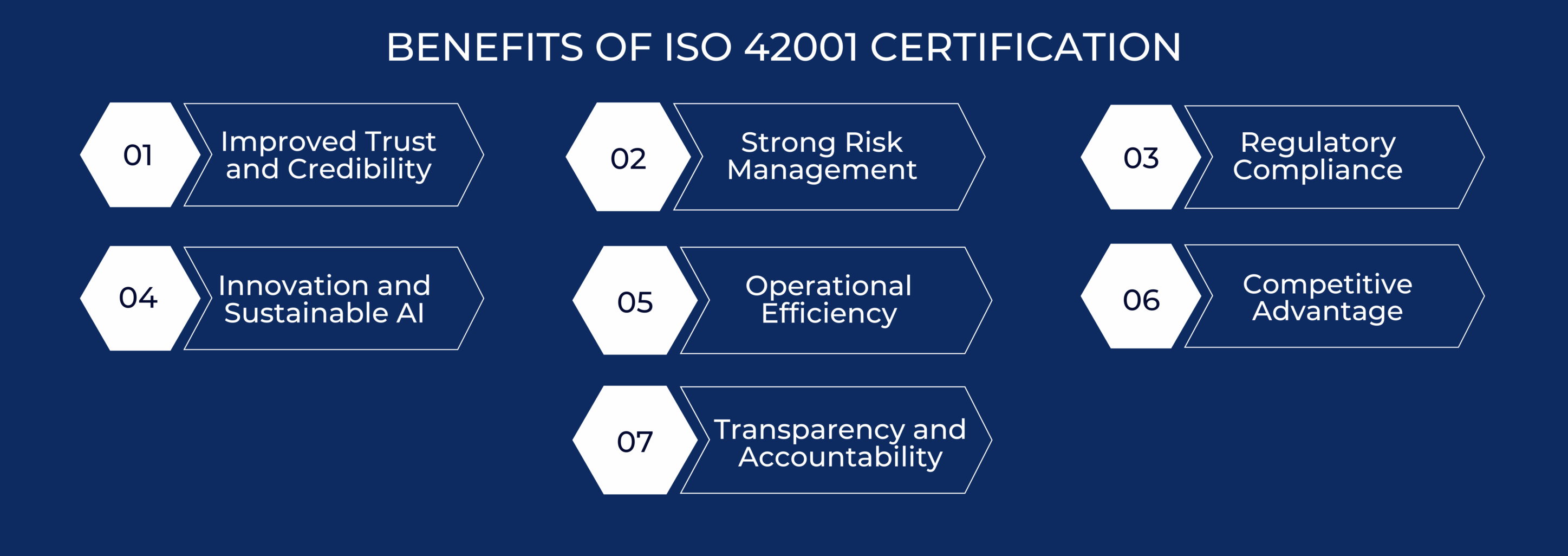
- ✓Regulatory Alignment and Compliance Credibility
- ✓Enhanced Client Trust and Competitive Differentiation
- ✓Operational Risk Reduction and AI Incident Prevention
ISO 42001 Certification Cost in India
ISO 42001 certification costs in India vary based on several organizational factors that affect the scope, complexity, and duration of the certification audit program. Unlike fixed-price compliance products, ISO 42001 certification audit costs are determined by the specific characteristics of the organization’s AI environment, the complexity of the AIMS being evaluated, and the number of AI systems and organizational units included within the certification scope. CertPro determines certification audit fees based on a structured scope assessment that considers all relevant cost factors before audit engagement begins.
Key Cost Factors for ISO 42001 Certification in India
Organization size — measured by the number of employees involved in AI-related activities, the number of distinct AI systems in scope, and the geographic spread of AI operations across India or internationally — is the primary driver of ISO 42001 certification audit costs. Larger organizations with complex, multi-system AI environments require greater audit duration and more extensive sampling to achieve the level of evidence coverage needed for a credible conformity assessment. For a small SaaS startup with one or two AI-powered product features, the certification audit scope is substantially narrower than for a large IT services firm operating a portfolio of AI systems across multiple client engagements and geographies.
The complexity and risk classification of AI systems within scope also directly influence certification costs. Organizations operating high-risk AI systems — such as AI-powered credit scoring engines, healthcare diagnostic AI, or AI systems making consequential decisions about individuals — require more intensive control testing and technical audit procedures than organizations using AI for lower-risk applications such as internal productivity tools or content generation assistants. The risk profile of the AI systems in scope determines the depth of audit procedures required to provide adequate conformity assurance, which in turn affects the total audit day requirement and associated certification fee structure.
| Cost Factor | Lower Cost Scenario | Higher Cost Scenario |
|---|---|---|
| Organization size | Small startup, 10-50 AI staff, 1-2 AI systems | Large enterprise, 500+ AI staff, 10+ AI systems |
| AI system complexity | Low-risk AI tools, narrow use cases | High-risk AI, automated decisions, regulated sectors |
| AIMS maturity | Well-documented, established AIMS processes | New AIMS, limited documentation, multiple gaps |
| Geographic scope | Single location, one city in India | Multi-site, pan-India operations or offshore AI teams |
| Existing certifications | ISO 27001 certified, reusable documentation | No prior management system certifications |
Internal vs. External Certification Costs
ISO 42001 certification costs in India encompass both external certification body audit fees — charged by CertPro for Stage 1, Stage 2, surveillance, and recertification audits — and internal organizational costs associated with AIMS development, documentation, staff training, and internal audit execution. For organizations without prior ISO management system experience, internal AIMS development costs can be significant, as they involve the time investment of senior AI engineering and governance personnel in creating the documented information infrastructure required for certification. Organizations with existing ISO 27001 or ISO 9001 certifications typically realize lower internal development costs due to reusable governance infrastructure and staff familiarity with management system disciplines.
Annual certification maintenance costs — covering surveillance audit fees and internal AIMS operational activities such as ongoing risk assessment updates, management reviews, internal audits, and corrective action management — should be factored into the total cost of ISO 42001 certification ownership over the three-year certification cycle. For most Indian organizations, the total cost of ISO 42001 certification over a three-year cycle represents a small fraction of the potential cost of a significant AI governance failure, regulatory enforcement action, or enterprise client disqualification event resulting from inadequate AI governance documentation.
ISO 42001 and AI Governance in India’s Regulated Sectors
India’s regulated sectors — including financial services, healthcare, telecommunications, and government technology — face distinct AI governance obligations that intersect with ISO 42001 certification requirements. Understanding how ISO 42001 aligns with sector-specific regulatory frameworks in India enables organizations to design AIMS controls that simultaneously satisfy certification requirements and meet applicable regulatory mandates, creating an integrated governance architecture rather than parallel compliance silos.
Financial Services: RBI, SEBI, and ISO 42001 Alignment
The Reserve Bank of India’s guidance on AI-driven credit assessment, fraud detection, and customer risk profiling requires financial institutions to maintain documented evidence of model validation, bias testing, and human oversight protocols for consequential AI decisions. These requirements map directly onto ISO 42001 Annex A controls covering AI system impact assessment, bias mitigation, explainability requirements, and human oversight mechanisms. Indian banks, NBFCs, and payment service providers that structure their AIMS controls around ISO 42001 requirements are therefore building governance documentation that simultaneously addresses RBI supervisory expectations, reducing duplicative compliance documentation efforts.
SEBI’s framework for algorithmic trading oversight requires registered stockbrokers and algorithmic trading participants to maintain documented audit trails for all algorithmic trading decisions, with controls for order rate throttling, system performance monitoring, and kill switch mechanisms. For fintech firms providing algorithmic trading infrastructure or AI-powered investment advisory services, ISO 42001 certification provides a structured framework for documenting these SEBI-required controls within a comprehensive AIMS that covers the full trading AI system lifecycle — from algorithm development and backtesting through deployment, monitoring, and algorithm decommissioning.
Healthcare and Pharmaceutical AI Governance Requirements
India’s healthcare technology sector is experiencing rapid AI adoption — from AI-assisted radiology platforms and clinical decision support systems to AI-powered drug discovery pipelines and remote patient monitoring tools. The CDSCO’s emerging framework for AI-based medical devices, developed in alignment with international guidance from the International Medical Device Regulators Forum (IMDRF), requires AI medical device manufacturers to implement software as a medical device (SaMD) quality management controls that overlap substantially with ISO 42001 AIMS requirements for AI system performance monitoring, model change management, and post-market surveillance.
For Indian pharmaceutical companies using AI for drug candidate identification, clinical trial optimization, or manufacturing quality control, ISO 42001 certification demonstrates that AI-related data management, model validation, and risk assessment processes are governed by documented controls aligned with international pharmaceutical AI governance expectations. As regulatory convergence between AI governance standards and pharmaceutical regulatory requirements accelerates globally, Indian pharma and healthtech firms holding ISO 42001 certification are better positioned to satisfy the combined governance documentation requirements of CDSCO, the US FDA’s AI action plan, and the European Medicines Agency’s guidance on machine learning in drug development.
ISO 42001 Integration with ISO 27001 for IT and Data Organizations
ISO 42001 and ISO 27001 share the High-Level Structure framework, enabling Indian IT organizations to integrate both management systems into a unified governance architecture with shared documentation, review processes, and audit procedures. The information security controls required under ISO 27001 Annex A complement the AI-specific controls in ISO 42001 Annex A — particularly in areas of data protection for AI training datasets, access controls for AI model repositories, incident management for AI security breaches, and supplier security for third-party AI components. Indian IT firms that already hold ISO 27001 certification can extend their existing Information Security Management System (ISMS) to encompass AI-specific AIMS requirements, leveraging established security control documentation as a foundation for ISO 42001 conformance.
The integration of ISO 42001 with ISO 27001 also creates a coherent response to India’s DPDPA 2023 requirements. Personal data processed by AI systems — for customer profiling, fraud detection, healthcare analytics, or HR automation — requires both information security controls (addressed by ISO 27001) and AI governance controls (addressed by ISO 42001) to satisfy DPDPA data processing accountability requirements. Organizations with integrated ISMS and AIMS certifications are able to demonstrate a comprehensive governance response to DPDPA obligations, addressing both the security and the AI governance dimensions of personal data processing accountability within a single integrated management system framework.
CertPro’s ISO 42001 Certification Audit Program in India
CertPro is a Licensed CPA Firm providing ISO 42001 certification audit services to organizations across India. The CertPro audit program for ISO/IEC 42001:2023 is designed to provide objective, evidence-based conformity assessments that give Indian organizations and their stakeholders credible assurance regarding AIMS design adequacy and operational effectiveness. CertPro auditors bring domain expertise in AI governance, risk management, and information security — combined with deep familiarity with India’s regulatory landscape — to each ISO 42001 certification engagement.
CertPro’s Audit Methodology and Technical AI Expertise
CertPro’s ISO 42001 audit methodology integrates standard management system audit techniques with specialized AI technical assessment capabilities. Auditors evaluate not only the existence and documentation of AIMS controls but also the technical adequacy of AI-specific governance mechanisms — including the effectiveness of model validation procedures, the rigor of bias testing methodologies, the operational completeness of AI incident detection and response protocols, and the appropriateness of explainability mechanisms relative to the risk classification of the AI systems in scope. This technical depth enables CertPro to conduct conformity assessments that reflect the actual governance maturity of the organization’s AI systems, not merely the completeness of its documentation library.
CertPro’s audit team for ISO 42001 engagements in India includes professionals with backgrounds spanning artificial intelligence engineering, machine learning operations, information security management, risk management, and regulatory compliance — ensuring that the audit team composition is appropriate for the technical complexity and sectoral context of each certification engagement. This multidisciplinary expertise is particularly relevant for Indian organizations operating in complex AI domains such as fintech AI, healthcare AI, and large-scale data analytics platforms, where shallow technical understanding of the AI systems in scope would limit the credibility and depth of the conformity assessment.
CertPro’s Track Record with Indian Organizations
CertPro has conducted ISO 42001 certification audits for organizations across India’s primary technology hubs — including Bengaluru, Hyderabad, Pune, Chennai, Mumbai, and Delhi-NCR — spanning IT services, SaaS, fintech, healthtech, and manufacturing sectors. This geographic and sectoral breadth provides CertPro with applied experience in the AI governance patterns, documentation practices, and organizational structures typical of Indian AI organizations at various stages of AIMS maturity. CertPro’s India-specific audit experience enables the audit team to calibrate assessment sampling and evidence expectations to the realistic operational characteristics of Indian AI organizations rather than applying generic international audit templates.
CertPro’s certification audit reports are structured to provide maximum value as regulatory and client-facing governance documents. Each ISO 42001 certification audit report includes a detailed conformity assessment summary, a clear statement of certification scope, documented audit findings with objective evidence references, and the certification decision rationale. These reports are designed to satisfy the documentation requirements of enterprise client vendor qualification processes, regulatory examinations by Indian financial and healthcare regulators, and international procurement due diligence requirements for AI governance certification evidence.
Why Choose CertPro for ISO 42001 Certification in India
CertPro’s positioning as a Licensed CPA Firm — rather than a management consulting firm or IT advisory practice — reflects a fundamental institutional difference in how ISO 42001 certification services are delivered. As a certification body conducting independent conformity assessments, CertPro maintains strict separation between audit and advisory activities, ensuring that the certification opinion is objective, credible, and free from the conflict of interest that arises when the same organization both designs an AIMS and subsequently certifies its conformance. This independence is a requirement under ISO/IEC 17021-1 and is a critical factor for Indian organizations whose certification must withstand scrutiny from regulators, enterprise clients, and international trading partners.
- ✓Licensed CPA Firm status ensuring independent, conflict-free certification audit delivery
- ✓Dedicated ISO 42001 audit team with combined expertise in AI engineering, risk management, and information security
- ✓Deep familiarity with India’s regulatory landscape across financial services, healthcare, IT, and government sectors
- ✓Established audit presence across India’s major technology hubs including Bengaluru, Hyderabad, Mumbai, Chennai, Pune, and Delhi-NCR
- ✓Structured two-stage audit methodology aligned with ISO/IEC 17021-1 accreditation requirements
- ✓Comprehensive certification audit reports suitable for regulatory examination and enterprise client due diligence
- ✓Experience integrating ISO 42001 audit programs with existing ISO 27001 and ISO 9001 certification engagements
- ✓Internationally recognized certification credentials accepted by global enterprise clients and regulatory bodies
Secure ISO 42001 Certification in India with CertPro
ISO 42001 certification indicates that an organization’s AI governance practices have been independently evaluated against internationally recognized requirements and found to conform. For Indian organizations operating in a technology economy where AI adoption is accelerating faster than regulatory frameworks are codifying requirements, ISO/IEC 42001:2023 certification provides a proactive governance posture that positions organizations ahead of mandatory compliance timelines rather than behind them. The certification demonstrates to regulators, clients, investors, and AI system users that AI governance in the organization is structured, documented, monitored, and continuously improved.
CertPro, as a Licensed CPA Firm with established ISO 42001 audit experience across India’s major technology sectors and geographic hubs, conducts conformity assessments that provide credible, evidence-based certification outcomes. The CertPro ISO 42001 audit program evaluates the full scope of AIMS requirements — from organizational context and AI risk assessment through operational controls, performance evaluation, and management review — generating certification documentation that satisfies the governance evidence requirements of Indian regulators, international enterprise clients, and global trading partners. Organizations seeking ISO 42001 certification in India are encouraged to initiate the scope assessment process with CertPro to determine the specific audit program requirements applicable to their AI systems, organizational context, and certification timeline objectives.
As India’s AI regulatory environment continues to mature — with the anticipated introduction of formal AI governance legislation, the expansion of DPDPA 2023 enforcement, and the increasing alignment between Indian regulatory expectations and international frameworks such as the EU AI Act — the value of ISO 42001 certification as a baseline governance credential will continue to grow. Indian organizations that establish ISO 42001 certified AIMS today are building the governance infrastructure that will be required to remain competitive, compliant, and credible in India’s AI-driven digital economy throughout the decade ahead.
FAQ
▶
What is ISO 42001 certification and why does it matter for Indian organizations?
▶
How long does ISO 42001 certification take for an Indian organization?
▶
What is the difference between Stage 1 and Stage 2 ISO 42001 audits?
▶
Is ISO 42001 certification mandatory in India?
▶
Can Indian organizations integrate ISO 42001 with their existing ISO 27001 certification?
▶
What AI systems must be included in the ISO 42001 certification scope?
▶
How does ISO 42001 certification address AI bias and fairness requirements?
▶
What happens during an ISO 42001 surveillance audit in India?

MindSec Launches AI Compliance for Law 25 & ISO 42001
Excerpt from Barchart Article, Published on December 3, 2025 Today, Canadian organizations face increasing pressure to comply with stringent privacy a…

UNDERSTANDING ISO 42001: A GUIDE FOR RESPONSIBLE AI MANAGEMENT SYSTEMS
The invention of artificial intelligence (AI) has changed the operational processes of many industries. However, the rapid growth of technology increa…
ENSURING AI DATA PRIVACY COMPLIANCE WITH ISO 42001
According to Stanford’s AI report, the private AI investment in the U.S. alone reached more than $109 billion last year, which is equal to 12 times th…
Get In Touch
have a question? let us get back to you.