The contemporary business environment is a period of major evolution. This evolution is marked by one common factor, which is the movement of organizations toward data-driven business models. Moreover, businesses of all sizes and natures now use data as an integral part of their business operations. However, the business landscape is also facing evolving cyber threats and data security incidents. In addition, there is a rising demand for compliance and data security practices among the interested parties.
Thus, to overcome these challenges, businesses should consider conducting quality audits. Particularly, the SOC 2 audits hold significant potential in ensuring data security, compliance, and upholding investor trust. Quality audits are the key solution for achieving compliance and ensuring organizational growth. Organizations can also use a detailed SOC 2 compliance checklist to prepare for each phase of this audit process.
Furthermore, all types of compliance audits and frameworks undergo standard audits. But our main focus here is to learn what a well-organized quality audit is and how it is different from a weakly managed normal audit. Additionally, understanding how quality audits are performed in SOC 2 compliance assessments. The significance of SOC 2 audits is growing as cloud-based tech and SaaS firms gain prominence. Therefore, this blog provides you with a brief introduction to quality audits and their key components. It also talks about how standard audits are different from normal audits. Furthermore, it discusses the impact of quality audits in SOC 2 assessments.

WHAT ARE QUALITY AUDITS: HOW ARE THEY DIFFERENT FROM NORMAL AUDITS?
ESSENTIAL FACTORS TO CONSIDER IN A SOC 2 AUDIT GUIDE
COMMON CHALLENGES FACED BY ORGANIZATIONS DURING SOC 2 AUDITS
HOW QUALITY AUDITS HELP BUSINESSES ACHIEVE SOC 2 COMPLIANCE
ACHIEVE YOUR QUALITY SOC 2 AUDITS UNDER CERTPRO’S EXPERT GUIDANCE
TI; DR:
Concern: The global business landscape is evolving rapidly with strict regulations and cyber attacks. So businesses must consider compliance and adherence to frameworks like SOC 2 to ensure a safe and secure business environment.
Overview: Quality audits are the key to achieving an effective compliance journey. Audits of high standards and practices encompassing all the key factors are important for businesses. Such audits can help businesses achieve their SOC 2 report.
Solution: Organizations must collaborate with experienced audit firms to gain their SOC 2 compliance. These audit firms provide them with high-standard audits, which help them to overcome challenges in the compliance journey.
WHAT ARE QUALITY AUDITS: HOW ARE THEY DIFFERENT FROM NORMAL AUDITS?
Quality audits are structured processes that follow a definite guideline and a standardized approach. Generally, audits are of two types: internal and external audits. Also, in terms of planning and organization, these audits are classified into two types. They are normal audits and quality audits. Let’s learn about some of the key differences between a quality audit and a normal audit.
1. Preparation: In a quality audit, the audit scope and objectives are clearly defined right at the beginning stage. For instance, the auditors gain a thorough understanding of the concerned business entity, past audit findings, and related compliance regulations. In contrast, during normal audits, the auditors often begin the process with unclear scope and weak knowledge regarding regulations.
2. Documentation: A quality audit is characterized by clear documentation and audit communication throughout the process. Proper testing methods, such as observations, interviews, and sampling, are used by auditors in a quality audit. Conversely, in a normal audit, the auditors collect unclear evidence without any verification process. Also, they practice poor documentation processes.
3. Competence of Auditors: Skilled auditors with relevant business expertise and certifications conduct a quality audit. These auditors develop themselves with periodic training regarding updates in the compliance standards. Also, they possess the quality of working independently without giving space for management pressure. On the other hand, a normal audit is performed by auditors with weak skills and zero expertise. They lack professionalism in the audit process by allowing management interference to influence the audit findings.
4. Risk Management: In a quality audit, the auditors use all the necessary data-driven insights to identify the high-risk areas. Also, they provide risk mitigation strategies according to their impact on the business operations. On the contrary, a normal audit process will focus on the low-impact area, leading to waste of resources.
ESSENTIAL FACTORS TO CONSIDER IN A SOC 2 AUDIT GUIDE
The key resource used while conducting SOC 2 audits is the SOC 2 Audit Guide. The SOC 2 compliance audit relies on this guide as a potential roadmap. In particular, it consists of major elements such as
- Pre-audit readiness assessment
- SOC 2 compliance checklist
- Details of gap analysis
- Information regarding risk assessment procedures
Now let’s discuss the major factors to consider while performing SOC 2 audits.
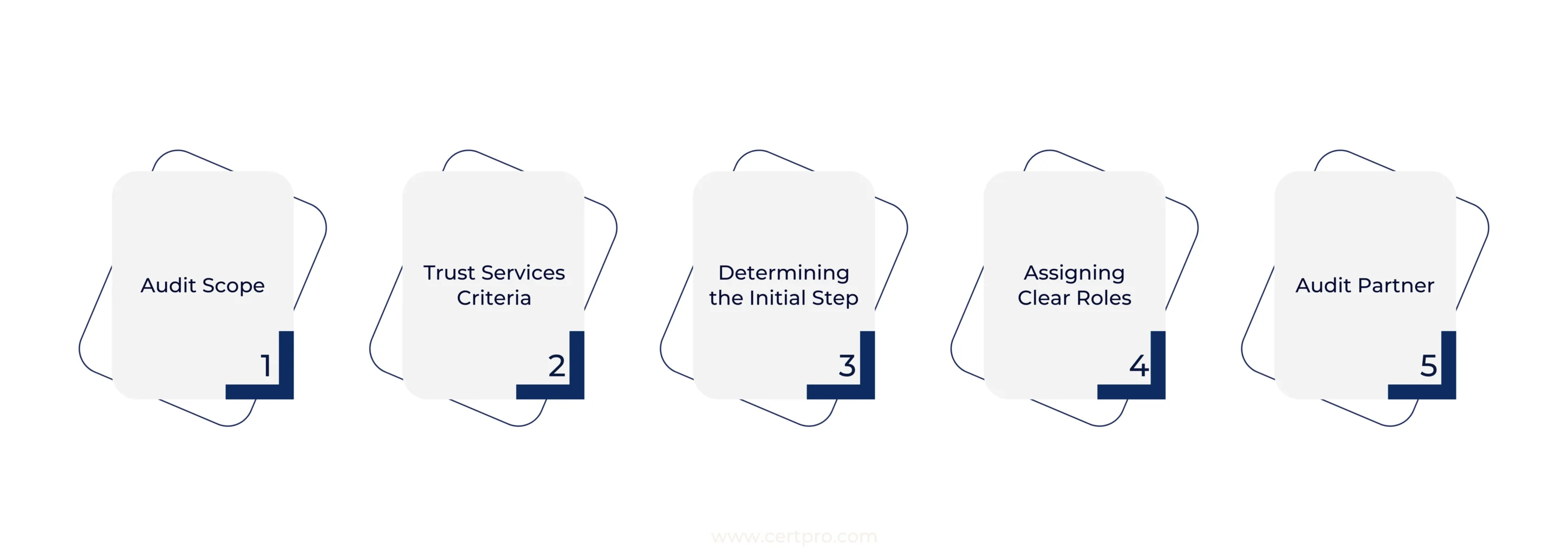
Audit Scope: The most primary step to take care of is to determine the scope of the audit. The organization must clearly define control systems, processes, services, and commitments that should be included in the audit examination.
Trust Services Criteria: The next step that follows is to determine the required trust services criteria from AICPA TSCs. Accordingly, communicate the business objectives and requirements of the key parties before determining the TSCs.
Determining the Initial Step: The next crucial step for businesses is to choose whether to start with a readiness assessment or directly go for a SOC 2 Type 2 audit. For instance, startups that are new to audits can go for a readiness assessment or Type 1 audit to identify the compliance gaps. The readiness assessment can increase your SOC 2 certification cost but will save you unwanted audit expenses in the future.
Assigning Clear Roles: The management must assign clear roles to personnel inside the organization. These personnel must be responsible for taking care of the audit processes. They act as the initial point of contact for the auditors and provide all the necessary resources required during SOC 2 audits.
Audit Partner: Choosing the right audit partner is a pivotal step in ensuring high-quality SOC 2 audits. Businesses should make sure the audit firms possess proper licensing and credentials to perform the audits.
COMMON CHALLENGES FACED BY ORGANIZATIONS DURING SOC 2 AUDITS
SOC 2 compliance audits require well-organized planning and execution. It is essential that both the service organization and audit firm exhibit commitment throughout the process. Despite this commitment and planning, businesses do face some challenges during SOC 2 audits. Let’s learn about them.
Misunderstanding of Audit Scope: The organization must clearly understand their service commitments and business objectives. This understanding helps them decide which parts of their business need to be audited.
Choosing the Right TSCs: Choosing the right SOC 2 report type and trust services criteria influences your SOC 2 audits. Therefore, businesses must gain a clear understanding regarding the types of SOC 2 reports and the AICPA TSCs. For instance, the ‘processing integrity’ criteria are suitable for financial firms with payroll activities. But it is irrelevant for cloud-based service providers.
Lack of Awareness: Insufficient awareness for employees regarding the SOC 2 audits is a major drawback to consider. The businesses should make sure that their employees are aware of what’s going to happen during the SOC 2 audit process. A pre-audit readiness assessment and proper training can help organizations tackle this problem. Furthermore, a well-structured SOC 2 compliance checklist ensures awareness across departments and boosts audit preparation.
Insufficient Evidence: SOC 2 audits remain incomplete without clear evidence. The businesses must ensure that all the policies and procedures are updated according to the security controls. Such compliance can be ensured and supported by thorough documentation and communication.
Thus, businesses should focus on rectifying the above-mentioned pitfalls to conduct audits. Now let’s learn about the benefits of conducting quality audits in the business landscape.
HOW QUALITY AUDITS HELP BUSINESSES ACHIEVE SOC 2 COMPLIANCE
In the current market, achieving SOC 2 compliance is no more a voluntary exercise but a mandatory business requirement. This ensures data security, long-term business growth and success. A quality audit is an important tool that guides businesses during the SOC 2 compliance journey. Therefore, let’s discuss how a quality audit can boost SOC 2 success.
Improved Gap Analysis: Quality audits provide a well-structured pre-audit readiness assessment. This helps them in identifying the compliance gaps and drawbacks in the control systems. For example, the quality audits identify where the current business practices are falling short according to SOC 2 requirements. Also, they assess whether the controls are designed and implemented appropriately according to SOC 2 TSCs.
Risk Management: Quality audits check whether the risk assessment strategies are aligned with the SOC 2 requirements and business objectives. Also, these audits help in developing a comprehensive risk management plan covering all the areas that needed improvement. This helps to avoid inadequate focus on key risks. Furthermore, they ensure that vulnerabilities are identified and mitigated within the set deadlines.
Effective Vendor Management: Quality compliance audits make sure that all the vendors are focusing adequately on protecting their customer data. This can be checked by demanding a detailed SOC 2 report from the key vendors.
Brand Reputation: Standard audits are the key to earning the customer trust and loyalty in the current business market. To clarify, quality audits in SOC 2 compliance aid your business in demonstrating commitment to business continuity through improved incident response plans. Accordingly, it strengthens your security posture. This, in turn, enhances your business’s reputation among clients and key stakeholders.
ACHIEVE YOUR QUALITY SOC 2 AUDITS UNDER CERTPRO’S EXPERT GUIDANCE
So, it is clear that quality audits are essential for organizations in the current business market to achieve SOC 2 compliance. Yet, most businesses hesitate to start their audit journey due to a lack of guidance and awareness. To add on, compliance audits are resource-intensive and time-consuming processes. For example, most startups hesitate to start their compliance journey due to the SOC 2 certification cost. Is there a solution to all these problems? Yes, CertPro is there to help you overcome all these challenges.
We are a global auditing firm, leading the compliance industry. At CertPro, we bring more than a decade of audit experience across ISO 27001, GDPR, HIPAA, SOC2, CCPA, and more. We follow an up-to-date SOC 2 audit guide to ensure that your businesses align with evolving compliance standards and industry best practices. Furthermore, our team of tech-forward auditors provides you with swift compliance audits as prescribed by the industry standards. We at CertPro leverage our auditing methods using modern compliance automation tools. Thus, we ensure that your businesses receive the best possible auditing service. What are you waiting for? Connect with us today to start your audit journey.
FAQ
What are the five trust services criteria of SOC 2?
The AICPA outlined five trust services criteria for the SOC 2 framework. They are security, availability, confidentiality, processing integrity, and privacy.
What is SOC 2 compliance checklist?
The SOC 2 compliance checklist is a guide that helps organizations assess their data management practices. It evaluates how data is collected, processed, stored, and delivered.
What are the factors that influence the SOC 2 certification cost?
The SOC 2 certification cost depends on multiple factors. Namely, the type of audit, the scope and complexity of the audit examination, the number of trust services criteria included, the auditor’s fee, and the level of audit readiness of the organization.
Who needs the SOC 2 certification?
In the current business world, almost any industry dealing with sensitive customer data can opt for a SOC 2 certification. In particular, the cloud service providers, SaaS firms, tech service providers, and data processing centers should achieve SOC 2 compliance.
What is COSO in the SOC 2 framework?
It is one of the two criteria used with AICPA TSCs to assess and improve the internal controls of the businesses during the SOC 2 audit.

About the Author
ANUPAM SAHA
Anupam Saha, an accomplished Audit Team Leader, possesses expertise in implementing and managing standards across diverse domains. Serving as an ISO 27001 Lead Auditor, Anupam spearheads the establishment and optimization of robust information security frameworks.