
ISO 42001 Certification in New Zealand
CertPro is a Licensed CPA firm operating as an independent third-party audit organization, conducting ISO 42001 certification audits for organizations across New Zealand. Our ISO 42001 certification scope encompasses AI Management System (AIMS) governance, lifecycle controls, risk management frameworks, and accountability documentation — all evaluated against the requirements of ISO/IEC 42001:2023.
OUR CLIENTS








What Is ISO 42001 Certification?
ISO 42001 is the international standard published by the International Organization for Standardization (ISO) that specifies requirements for establishing, implementing, maintaining, and continually improving an Artificial Intelligence Management System (AIMS) within an organization. Formally designated ISO/IEC 42001:2023, this standard was published in December 2023 and represents the first internationally recognized, auditable framework governing responsible AI governance across organizational boundaries.
ISO 42001 certification is defined as the formal third-party attestation confirming that an organization’s AIMS conforms to the documented requirements of ISO/IEC 42001:2023. This attestation is issued following a structured, independent audit process conducted by a recognized certification body.
Defining the AI Management System (AIMS)
An Artificial Intelligence Management System (AIMS) is a structured organizational framework governing the design, development, deployment, monitoring, and decommissioning of AI systems. It operates in alignment with accountability, transparency, and risk management principles. The AIMS establishes the policies, roles, processes, and controls through which an organization systematically manages AI-related risks and responsibilities across the entire AI lifecycle.
Unlike ad hoc AI policies or isolated governance documents, an AIMS is an integrated management system that operates in a continuous improvement cycle. It is specifically structured to meet external audit requirements and certification criteria under ISO 42001 assessment standards.
The AIMS framework under ISO 42001 is deliberately structured to harmonize with other ISO management system standards, including ISO 27001 for information security and ISO 31000 for risk management. This architectural compatibility enables organizations to reuse existing policy structures, governance roles, and review processes rather than constructing parallel systems from the ground up.
For New Zealand organizations already operating under ISO 27001 or similar frameworks, the AIMS structure integrates with established governance architectures. This reduces duplication while extending formal controls to AI-specific risk domains. The relationship chain governing ISO 42001 certification in New Zealand follows a clear logical sequence: AI governance requirements → risk management controls → compliance documentation → third-party audit → ISO 42001 certification issuance.
ISO 42001 as a Requirements Standard
ISO 42001 establishes requirements — not guidelines or recommendations — for responsible AI governance, making it a fully auditable, certifiable management system standard. This distinction is fundamental. Requirements-based standards create verifiable obligations that can be assessed by an independent auditor, while guidelines remain advisory and non-certifiable.
Organizations seeking ISO AIMS certification must demonstrate conformance to each applicable clause of the standard through documented evidence, implemented controls, and observable operational practices. Certification is granted only when an independent, accredited audit body confirms that the organization’s AIMS meets all applicable requirements without material nonconformity.
ISO 42001 certification differs from other AI governance frameworks by establishing a structured audit methodology that produces a certifiable outcome rather than a self-assessed maturity score. Frameworks such as NIST AI RMF or the EU AI Act provide regulatory guidance and risk categorization, but ISO 42001 certification provides formal third-party attestation that an organization’s AI management controls meet international requirements.
This distinction is increasingly significant for New Zealand organizations operating in regulated procurement environments, enterprise supply chains, and cross-border AI deployment contexts where formal ISO 42001 compliance documentation is required as a condition of engagement.
Scope and Applicability of ISO/IEC 42001:2023
ISO/IEC 42001:2023 applies to any organization — regardless of size, sector, or geographic location — that develops, deploys, or uses AI systems in the course of its operations. The standard does not prescribe specific AI technologies or algorithms. Instead, it establishes governance and management system requirements that apply to AI system oversight irrespective of the underlying technical implementation.
This technology-neutral design ensures that ISO 42001 certification remains applicable across diverse AI use cases, including machine learning models, natural language processing systems, computer vision applications, automated decision-making engines, and AI-augmented data analytics platforms.
For organizations in New Zealand, the scope of ISO 42001 certification is defined during the initial audit engagement and must accurately reflect the organizational boundaries, AI system types, and operational contexts to which the AIMS applies. Scope definition is a critical audit step that determines which AI systems, business units, and geographic locations fall within the certification boundary.
Organizations may elect to certify an enterprise-wide AIMS or define a scoped certification covering specific AI systems, products, or operational domains. The defined scope is explicitly documented in the issued certificate and audit report, providing stakeholders with precise information about the extent of conformance verification.

ISO 42001 Certification in New Zealand: Regulatory and Market Context
ISO 42001 Certification in New Zealand operates within a rapidly evolving digital economy where AI adoption is accelerating across enterprise, government, and public sector organizations. New Zealand’s technology sector has experienced sustained growth in cloud infrastructure, SaaS deployment, and AI-augmented operations — creating both significant commercial opportunities and corresponding governance obligations.
As organizations in Auckland, Wellington, Christchurch, and across the country integrate AI systems into core business functions, the requirement for structured, auditable AI governance frameworks has become both operationally and strategically critical. ISO 42001 certification provides the formal mechanism through which New Zealand organizations demonstrate that their AI operations meet internationally recognized governance requirements.
AI Adoption Across New Zealand Industries
AI system deployment in New Zealand spans multiple sectors, each presenting distinct governance challenges that ISO 42001 certification addresses through structured AIMS requirements. In the financial services sector, organizations in Auckland and Wellington are deploying AI systems for credit risk scoring, fraud detection, algorithmic trading, and automated customer service. In these applications, accountability, auditability, and bias management are regulatory and reputational imperatives.
In healthcare, AI-assisted diagnostic tools, patient data analytics, and clinical decision support systems require documented risk management controls and lifecycle oversight. These controls protect patient safety and support compliance with the Health Information Privacy Code — areas where ISO 42001 compliance provides a structured, auditable framework.
New Zealand’s agriculture sector increasingly relies on AI-powered precision farming platforms, crop yield prediction models, and environmental monitoring systems. These applications require documented governance controls when they influence land management decisions, resource allocation, or regulatory reporting.
In education, AI-powered adaptive learning platforms, student assessment tools, and administrative automation systems deployed across universities and polytechnics require formal governance structures to ensure transparency, fairness, and data protection compliance. The logistics and supply chain sector uses AI for route optimization, demand forecasting, and automated inventory management — all areas where ISO 42001 assessment evaluates operational controls and monitoring mechanisms against certification requirements.
New Zealand Regulatory Alignment
ISO 42001 compliance in New Zealand aligns with the country’s existing legal and regulatory framework governing data protection, information governance, and organizational accountability. The Privacy Act 2020 establishes obligations for the collection, use, storage, and disclosure of personal information. AI systems that process personal data must operate within these statutory boundaries.
ISO 42001 compliance requirements for data governance, risk management, and transparency controls directly support Privacy Act obligations by establishing documented processes for AI data handling, bias identification, and impact assessment. This alignment enables organizations to demonstrate coordinated compliance across both the international standard and domestic statutory requirements through a single, auditable management system.
The New Zealand government’s Algorithm Charter for Aotearoa New Zealand, adopted by a growing number of government agencies, establishes public sector accountability commitments for AI and algorithmic decision-making systems. ISO 42001 audit requirements for transparency documentation, accountability controls, and risk management oversight directly correspond to the Algorithm Charter’s accountability principles. This enables certified public sector organizations to demonstrate structured, verifiable compliance with both frameworks simultaneously.
As New Zealand’s regulatory environment for AI governance continues to develop, ISO 42001 certification positions organizations ahead of anticipated statutory requirements — establishing the governance infrastructure that future regulations are likely to mandate.
Enterprise AI Governance Expectations in New Zealand
Large enterprise organizations and government procurement agencies in New Zealand are increasingly requiring AI governance certification as a condition of vendor engagement and procurement qualification. Enterprise risk management frameworks within New Zealand’s financial services, utilities, and telecommunications sectors specify third-party AI governance verification as a supply chain risk management control.
ISO AIMS certification provides the documentary evidence required to satisfy these procurement conditions. The issued certificate and supporting audit report constitute formal attestation of AIMS conformance that procurement and risk teams can review and retain on file.
ISO 42001 Certification in New Zealand also supports organizations seeking to operate in international markets, particularly in jurisdictions where AI governance certification is becoming a regulatory or commercial prerequisite. The EU AI Act establishes risk-based regulatory requirements for AI systems operating in or affecting the European Union, creating compliance obligations for New Zealand exporters and technology companies with EU market exposure.
ISO 42001 certification does not constitute EU AI Act compliance in itself, but the structured governance controls and audit documentation it requires provide the foundational evidence base that EU regulatory compliance assessments reference.
Requirements for ISO 42001 Certification
ISO 42001 certification requires organizations to establish, document, implement, and maintain an AI Management System that conforms to the requirements specified in ISO/IEC 42001:2023. These requirements span organizational governance, lifecycle management, risk controls, accountability mechanisms, and continual improvement processes.
The following structured criteria represent the core conformance requirements that a CertPro ISO 42001 audit evaluates against documented evidence and operational observation.
ISO 42001 requires organizations to establish formal governance structures for AI system oversight, with clearly defined accountability roles assigned to senior leadership. Top management must demonstrate visible commitment to the AIMS by establishing an organizational AI policy, allocating resources for AIMS implementation and maintenance, and ensuring that AI governance objectives are integrated into strategic planning processes.
The AI policy must define the organization’s approach to responsible AI use, specify accountability boundaries, and establish principles that govern AI system design, deployment, and monitoring decisions across all applicable organizational units.
Accountability structures under ISO 42001 require organizations to designate specific roles with defined responsibilities for AIMS management, AI risk oversight, and internal audit functions. These role designations must be documented, communicated within the organization, and maintained with sufficient authority to enforce AIMS requirements across operational teams.
The standard requires that individuals in AI accountability roles possess demonstrable competence relevant to their responsibilities, with competence evidence documented and available for ISO 42001 audit review. For New Zealand organizations, these governance requirements create the formal accountability infrastructure that regulators, enterprise customers, and public stakeholders increasingly expect from AI-deploying entities.
ISO 42001 establishes requirements for documented oversight across the complete AI system lifecycle, encompassing design and development, deployment, operational monitoring, and decommissioning phases. Each lifecycle phase must be governed by defined criteria, documented processes, and review checkpoints. These ensure AI systems operate within their intended design parameters and organizational risk tolerance thresholds.
Design and development requirements include documented objectives, data governance controls, validation testing criteria, and approval processes — all of which must be in place before AI systems are deployed into operational environments.
Operational monitoring requirements under ISO 42001 specify that deployed AI systems must be subject to ongoing performance evaluation against defined metrics. Organizations must maintain documented processes for detecting model drift, output anomalies, and emerging risk indicators. When monitoring identifies deviations from expected performance parameters, the AIMS must include defined escalation and corrective action processes.
Decommissioning requirements ensure that AI systems are retired in a controlled, documented manner that addresses data retention, model disposal, and residual risk considerations. These lifecycle requirements collectively establish the operational audit trail that an ISO 42001 assessment evaluates to confirm that AI systems are governed throughout their entire operational existence.
ISO 42001 requires organizations to maintain documented information that provides evidence of AIMS conformance across all applicable clauses of the standard. Required documentation includes the organizational AI policy, AIMS scope definition, risk assessment records, AI system registers, treatment plans for identified risks, competence records, internal audit reports, management review minutes, and records of nonconformity and corrective action.
This documentation must be controlled, version-managed, and accessible to auditors in formats that permit structured review during the ISO 42001 certification audit process.
- Organizational AI policy document establishing governance principles and scope
- AIMS scope definition specifying applicable AI systems and organizational boundaries
- AI risk register with documented risk assessment methodology and outcomes
- Risk treatment plans with assigned accountability and implementation timelines
- AI system register cataloguing all in-scope AI systems with lifecycle status
- Competence records for individuals in AI governance and accountability roles
- Internal audit program and completed internal audit reports
- Management review records demonstrating top-level AIMS oversight
- Nonconformity logs and corrective action records
- Monitoring and measurement results for AI system performance evaluation
ISO 42001 requires organizations to implement a structured, documented AI risk assessment process that identifies, analyzes, and evaluates risks associated with each in-scope AI system. The risk assessment must consider AI-specific risk dimensions including model bias and fairness, data quality and integrity, explainability and transparency, cybersecurity vulnerabilities in AI systems, third-party AI component risks, and potential harms to individuals affected by AI-driven decisions.
Risk treatment decisions must be documented with defined controls, assigned ownership, implementation evidence, and residual risk acceptance criteria approved by designated authorities within the governance structure.
Transparency and accountability controls required by ISO 42001 include mechanisms for communicating AI system capabilities and limitations to affected stakeholders, processes for handling AI-related complaints and inquiries, and documented procedures for human oversight of high-impact AI decisions. These controls are evaluated during the ISO 42001 audit through document review, process observation, and stakeholder interviews.
Organizations that have implemented these controls as verifiable, auditable processes — rather than informal practices — are positioned to demonstrate conformance efficiently during the ISO 42001 certification audit.
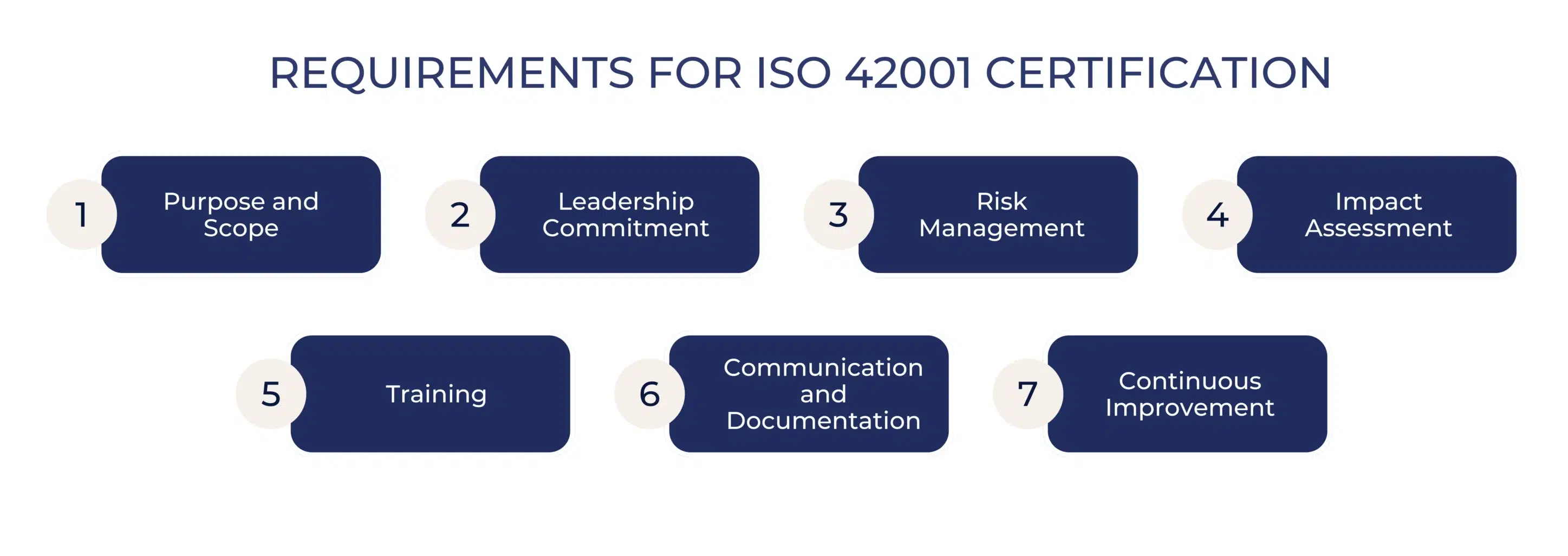
- ✓Governance and Leadership Requirements
- ✓AI Lifecycle Oversight Requirements
- ✓Documentation and Audit Evidence Requirements
- ✓Risk Management and Control Requirements
AIMS Framework Components Under ISO 42001
The AIMS framework established under ISO 42001 follows the high-level structure (HLS) common to all modern ISO management system standards. Requirements are organized across clauses addressing organizational context, leadership, planning, support, operations, performance evaluation, and improvement. This structure ensures the AIMS operates as an integrated, self-sustaining governance system rather than a static documentation exercise.
Each framework component contains specific requirements that the ISO 42001 audit verifies through evidence examination and operational assessment, ensuring that ISO 42001 compliance is demonstrated across the full management system lifecycle.
Organizational Context and AI Policy
The organizational context clause of ISO 42001 requires organizations to systematically identify internal and external factors that influence their AI governance obligations and AIMS design. Internal context factors include the organization’s AI strategy, existing governance structures, technical capabilities, workforce competencies, and risk appetite. External context factors encompass the regulatory environment, market expectations, contractual obligations, stakeholder concerns, and the societal impacts of the organization’s AI systems.
This context analysis forms the foundational input for all subsequent AIMS design decisions, ensuring that the governance framework is calibrated to the organization’s actual operating environment rather than a generic template.
Interested party requirements analysis under ISO 42001 requires organizations to identify stakeholders with relevant interests in their AI activities — including customers, employees, regulators, suppliers, and affected communities — and to determine which requirements and expectations the AIMS must address.
For New Zealand organizations, relevant interested parties may include the Office of the Privacy Commissioner, sector-specific regulators, enterprise customers with supply chain AI governance requirements, and communities affected by public sector AI decisions. Documented analysis of interested party requirements informs the AIMS scope definition and the risk assessment process, ensuring that the certification boundary reflects the full range of governance obligations the organization faces.
Planning: Risk Assessment and Objective Setting
The planning clause of ISO 42001 requires organizations to establish a systematic AI risk assessment process, define AIMS objectives with measurable outcomes, and plan the actions necessary to achieve those objectives. AI risk assessment under ISO 42001 must produce documented results that identify specific risks associated with each in-scope AI system, evaluate those risks using defined criteria, and determine appropriate treatment actions.
The risk assessment process must be repeatable, consistently applied across all in-scope AI systems, and reviewed when significant changes occur in the organizational context, AI system configuration, or operating environment.
AIMS objectives must be established at relevant organizational functions, aligned with the AI policy, measurable against defined indicators, communicated to responsible parties, and regularly monitored and updated. Objectives may address specific dimensions of AI governance performance — such as bias detection frequency, incident response timelines, monitoring coverage rates, or training completion rates for AI accountability roles.
The ISO 42001 audit verifies that objectives are documented, assigned, monitored with evidence of measurement, and reviewed through the management review process. This confirms that the planning elements of the AIMS function as an operational governance cycle rather than a documentation formality.
Support, Operations, and Performance Evaluation
Support requirements under ISO 42001 encompass resource allocation, competence management, awareness programs, and internal and external communication processes related to AI governance. Organizations must demonstrate that sufficient resources — including personnel, tools, and infrastructure — are allocated to maintain the AIMS effectively.
Competence requirements specify that individuals performing roles affecting AI governance must possess relevant education, training, or experience, with documented records providing audit evidence of competence levels. Awareness requirements extend to the broader workforce, ensuring that employees whose activities relate to in-scope AI systems understand the organization’s AI policy, their contribution to AIMS effectiveness, and the consequences of AIMS nonconformance.
Performance evaluation under ISO 42001 requires organizations to establish monitoring and measurement processes that assess AIMS effectiveness against defined indicators, conduct internal audits at planned intervals, and conduct management reviews to evaluate overall AIMS performance and identify improvement opportunities.
Internal audit requirements specify that the organization must plan, establish, implement, and maintain an audit program with defined audit criteria, scope, frequency, and reporting obligations. Auditors must maintain independence from the activities being audited to ensure objectivity. Management review must address AIMS performance data, audit results, changes in the organizational context, and resource adequacy — producing documented outputs that inform continual improvement actions.
| AIMS Clause | Key Requirement | Audit Evidence Type |
|---|---|---|
| Context of the Organization | Internal/external context analysis and interested party requirements | Documented analysis records and AIMS scope document |
| Leadership | AI policy, accountability roles, and top management commitment | Signed policy, role descriptions, management review records |
| Planning | AI risk assessment, risk treatment plans, and AIMS objectives | Risk register, treatment records, and objective monitoring data |
| Support | Resource allocation, competence records, and awareness programs | Training records, resource allocation evidence, communication logs |
| Operations | AI lifecycle controls, monitoring processes, and transparency mechanisms | Operational records, monitoring reports, and incident logs |
ISO 42001 Audit Process: Numbered Certification Methodology
The ISO 42001 audit process conducted by CertPro follows a structured, independent third-party certification methodology aligned with the requirements of ISO/IEC 17021-1 for certification body operations. Each stage of the ISO 42001 audit is executed by qualified, independent auditors whose evaluation is based exclusively on documented evidence, operational observations, and structured interviews.
The following numbered stages define the complete ISO 42001 certification audit sequence as applied to New Zealand organizations seeking ISO AIMS certification.
- Application and Scope Definition: The organization submits a certification application specifying the proposed AIMS scope, in-scope AI systems, organizational boundaries, and applicable exclusions. CertPro reviews the application to confirm scope feasibility and audit program parameters.
- Documentation Review and Readiness Assessment: CertPro auditors conduct a structured review of the organization’s AIMS documentation to evaluate whether the documented system addresses all applicable ISO 42001 requirements and whether the organization has established the foundational documentation necessary for Stage 1 audit progression.
- Stage 1 Audit (AIMS Documentation and Governance Review): A formal on-site or remote audit examining the AIMS documentation structure, governance framework, AI policy, risk assessment methodology, scope definition, and organizational context analysis. Stage 1 identifies any significant gaps that must be addressed before Stage 2 proceeds.
- Stage 2 Audit (Operational Effectiveness Verification): A comprehensive audit verifying that the documented AIMS is implemented and operating effectively across all in-scope AI systems and organizational units. Auditors examine operational records, conduct process observations, and interview personnel to confirm that AIMS controls function as documented.
- Nonconformity Identification and Corrective Action Review: Any nonconformities identified during Stage 1 or Stage 2 are formally documented and communicated to the organization. Major nonconformities must be resolved with documented corrective actions before certification can be issued. Minor nonconformities require corrective action plans with defined timelines.
- Certification Decision: CertPro’s independent certification decision function reviews the complete audit record and determines whether the organization’s AIMS demonstrates sufficient conformance with ISO 42001 requirements to warrant certification issuance. This decision is made independently of the audit team.
- Certificate Issuance: Upon a positive certification decision, CertPro issues the ISO 42001 certificate specifying the organization name, AIMS scope, certification date, and validity period. The certificate is valid for three years, subject to satisfactory surveillance audit outcomes.
- Surveillance Audits: Annual surveillance audits are conducted during the three-year certification cycle to verify that the AIMS remains effectively implemented and continues to conform to ISO 42001 requirements. Surveillance audits examine a subset of AIMS clauses and any areas identified for monitoring during the initial certification audit.
- Recertification Audit: At the conclusion of the three-year certification cycle, a full recertification audit is conducted to verify continued AIMS conformance and renew the certification for a subsequent three-year period.
The Stage 1 ISO 42001 audit focuses on verifying that the organization has established a documented AIMS that structurally addresses all applicable requirements of ISO/IEC 42001:2023. During Stage 1, CertPro auditors examine the AIMS documentation set — including the AI policy, scope statement, risk assessment records, organizational context analysis, and governance role definitions.
The audit evaluates whether the documented system is complete, internally consistent, and provides a sufficient basis for operational implementation. Stage 1 typically identifies areas where documentation requires strengthening or where the documented approach does not fully address specific standard requirements.
Stage 1 audit outcomes are communicated to the organization in a formal Stage 1 audit report that documents findings, identifies any significant concerns requiring resolution before Stage 2, and confirms the proposed Stage 2 audit scope and timeline. Organizations that receive Stage 1 findings must address documented concerns within a defined timeframe before Stage 2 proceeds.
The Stage 1 to Stage 2 interval provides the organization with the opportunity to resolve documentation gaps and prepare operational evidence for the more comprehensive Stage 2 assessment. The ISO 42001 audit timeline from Stage 1 to initial certification typically ranges from three to six months, depending on the organization’s AIMS maturity and the complexity of the in-scope AI system portfolio.
The Stage 2 ISO 42001 audit is the definitive operational assessment. It verifies that the documented AIMS is actively implemented across all in-scope organizational units and AI systems, and that the implemented controls achieve their intended governance objectives. CertPro auditors conduct structured interviews with personnel in AI governance, development, operations, and monitoring roles to verify that AIMS requirements are understood and applied in practice.
Process observations during Stage 2 examine whether AI lifecycle controls, risk monitoring activities, and accountability mechanisms operate as described in AIMS documentation. Record examination verifies that required monitoring data, incident records, competence evidence, and governance decision records are maintained and controlled as specified by the standard.
Stage 2 audit findings are documented in a comprehensive audit report that records all conforming observations, identifies any nonconformities with specific reference to the ISO 42001 clause(s) violated, and provides the evidentiary basis for the certification decision. Major nonconformities — defined as the absence of a required control or a systematic failure of an implemented control — must be resolved before certification can be issued.
Minor nonconformities represent isolated deviations from standard requirements that do not indicate a systemic breakdown. These may be addressed through corrective action plans accepted by CertPro before or after certificate issuance, subject to defined conditions. The Stage 2 audit report constitutes the primary audit record reviewed by the independent certification decision function.
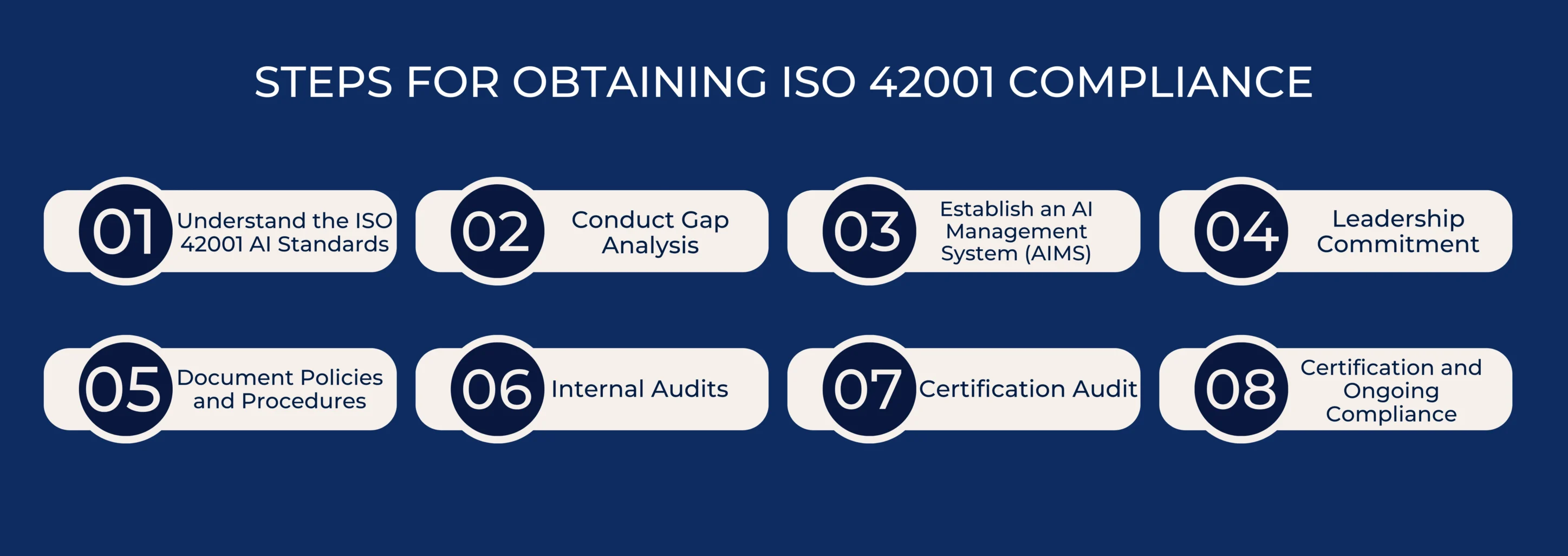
- ✓Stage 1 Audit: Documentation and Governance Review
- ✓Stage 2 Audit: Operational Effectiveness Verification
ISO 42001 Certification Cost in New Zealand
The cost of ISO 42001 certification in New Zealand is determined by several structured variables that CertPro evaluates during the application and scope definition stage. CertPro offers fixed pricing for all ISO 42001 certification engagements, providing organizations with transparent cost information before the audit process commences.
Fixed pricing eliminates budget uncertainty and enables New Zealand organizations to plan ISO 42001 certification expenditure accurately within annual technology governance and compliance budgets.
Factors Determining Certification Audit Costs
Organizational size is a primary cost determinant in ISO 42001 certification. Larger organizations with greater numbers of AI systems, personnel in governance roles, and operational units require more auditor days to complete a thorough and independent assessment. The International Accreditation Forum (IAF) provides guidance on audit day calculations based on organizational size metrics, which CertPro applies to determine the appropriate audit scope and duration for each ISO 42001 engagement.
Smaller organizations with a focused AIMS scope and a limited number of in-scope AI systems typically require fewer audit days and correspondingly lower certification costs than large enterprise organizations with complex, distributed AI portfolios.
AI system complexity is a secondary cost variable reflecting the technical and governance complexity of the AI systems within the certification scope. Organizations operating sophisticated machine learning pipelines, multi-model AI architectures, or AI systems embedded in critical infrastructure require more intensive ISO 42001 audit examination of technical controls, monitoring mechanisms, and risk management documentation.
Geographic dispersion of operations across multiple New Zealand locations — including separate facilities in Auckland, Wellington, and Christchurch — may require additional audit days for on-site verification. CertPro’s remote audit capabilities can reduce travel requirements where operational context permits remote evidence examination.
| Organization Profile | Approximate Audit Duration | Key Cost Variables |
|---|---|---|
| Small organization, 1-3 AI systems, single site | 3–5 auditor days | AIMS documentation completeness, AI system complexity |
| Medium organization, 4-10 AI systems, 1-2 sites | 5–8 auditor days | Lifecycle control maturity, risk management documentation depth |
| Large enterprise, 10+ AI systems, multiple sites | 8–15+ auditor days | Multi-site logistics, AI portfolio complexity, governance structure scale |
| Public sector organization with Algorithm Charter alignment | Variable based on scope | Regulatory alignment evidence, algorithmic impact documentation |
| Technology company with integrated ISO 27001 framework | Potentially reduced scope | Existing management system integration, control reuse documentation |
Surveillance and Recertification Cost Structure
Beyond the initial certification audit, organizations should account for the three-year certification maintenance cost structure when evaluating the total cost of ISO 42001 certification in New Zealand. Annual surveillance audits are conducted in years one and two of the certification cycle to verify continued AIMS conformance.
Surveillance audits are typically shorter in duration than the initial certification audit, as they examine a defined subset of AIMS clauses and focus on changes, improvements, and any areas flagged for monitoring during previous audit cycles. Recertification audits in year three involve a more comprehensive review similar in scope to the initial ISO 42001 certification assessment.
CertPro’s fixed pricing model applies to surveillance and recertification audits as well as the initial certification engagement, providing organizations with cost predictability across the full three-year certification cycle. Transparent pricing structures enable New Zealand technology, finance, and public sector organizations to present accurate ISO 42001 compliance budgets to finance committees and boards as part of annual technology governance investment planning.
The total cost of ISO 42001 certification, when evaluated across the three-year cycle, represents a structured investment in AI governance infrastructure that creates documented commercial, regulatory, and reputational value throughout the certification period.
Steps for Achieving ISO 42001 Compliance in New Zealand
ISO 42001 compliance in New Zealand is achieved through a structured sequence of organizational actions that establish, implement, and verify the AIMS against the requirements of ISO/IEC 42001:2023. The following steps provide a clear, numbered pathway from initial AIMS development through to certification audit completion.
These steps reflect the certification-focused implementation sequence that positions organizations for successful ISO 42001 audit outcomes and long-term ISO AIMS certification maintenance.
- Conduct an AI system inventory to identify all AI applications, models, and automated decision-making tools in organizational use, establishing the factual basis for AIMS scope definition.
- Define the AIMS scope with explicit organizational boundaries, AI system inclusions and exclusions, and documented justification for any exclusions from the scope.
- Establish the organizational AI policy with top management authorization, defining the organization’s principles for responsible AI use, accountability commitments, and governance framework.
- Assign formal governance roles including an AI Management Representative or equivalent function with defined authority and documented responsibilities for AIMS oversight.
- Conduct a structured AI risk assessment for each in-scope AI system using a documented, repeatable methodology that evaluates AI-specific risk dimensions including bias, transparency, data integrity, and security.
- Develop and implement risk treatment plans for identified risks with defined controls, assigned ownership, implementation evidence requirements, and residual risk acceptance criteria.
- Establish AI lifecycle controls covering design, development, deployment, monitoring, and decommissioning phases with documented processes and approval checkpoints.
- Implement monitoring and measurement processes for deployed AI systems, with defined metrics, measurement frequency, data collection methods, and escalation thresholds.
- Conduct an internal ISO 42001 audit to evaluate AIMS conformance against all applicable standard requirements, with documented findings and corrective action follow-up.
- Conduct a management review of AIMS performance using internal audit results, monitoring data, and contextual change information to assess overall AIMS effectiveness and identify improvement actions.
- Submit a certification application to CertPro with the defined scope and documentation set, initiating the formal ISO 42001 audit process.
The internal audit and management review stages are formal prerequisites for ISO 42001 certification — not optional preparatory activities. ISO/IEC 42001:2023 requires that organizations have conducted at least one complete cycle of internal audit and management review before the external certification audit can confirm AIMS operational maturity.
These internal processes generate the documented evidence that demonstrates the AIMS has been operational for a sufficient period to allow meaningful evaluation of its effectiveness. Internal audit records, nonconformity logs, corrective action evidence, and management review minutes are among the core documentation sets that CertPro auditors examine during Stage 2 to verify AIMS operational maturity.
The internal audit must be conducted by personnel with sufficient independence from the activities being audited, using a documented audit program and criteria derived from the ISO 42001 standard requirements. Internal auditors do not need to be external parties, but they must not audit their own work.
The management review must be conducted by top management — not delegated entirely to operational teams — and must address the specific input items specified in the standard. These include audit results, performance data, changes in the organizational context, and resource adequacy. The outputs of management review must include decisions and actions relating to AIMS improvement opportunities, and these must be documented and tracked for implementation.
- ✓Internal Audit and Management Review as Certification Prerequisites
Benefits of ISO 42001 Certification in New Zealand
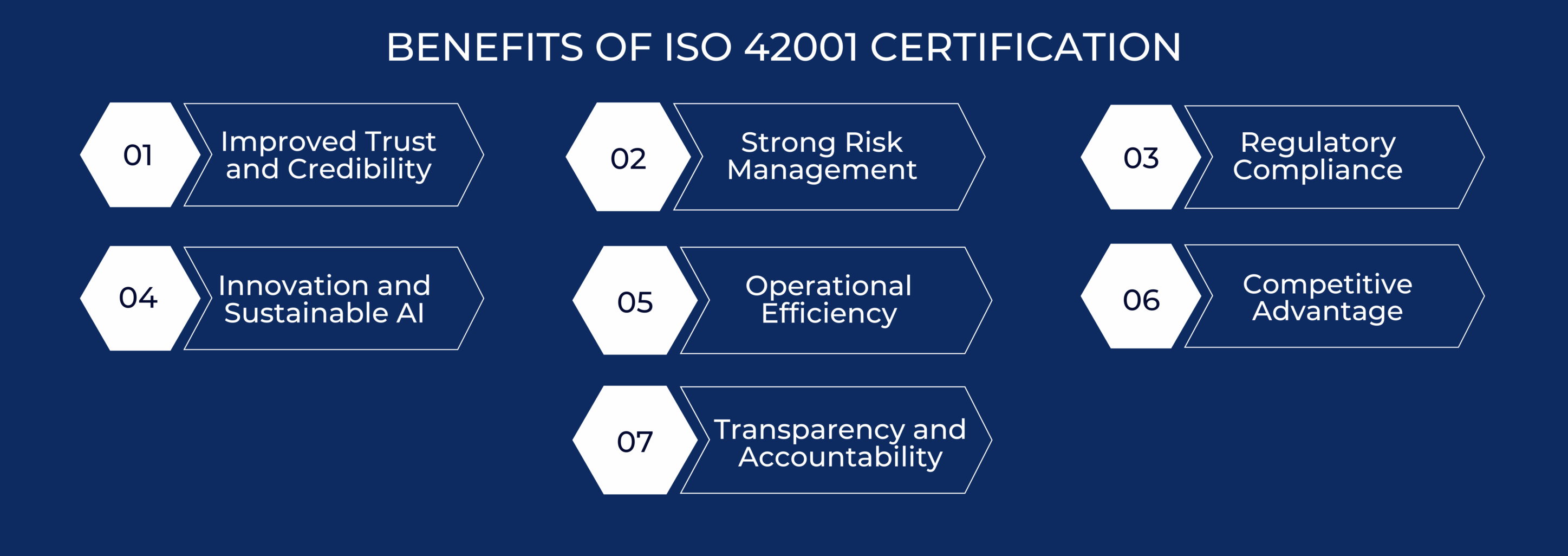
ISO 42001 Certification in New Zealand delivers structured, verifiable benefits across governance, commercial, regulatory, and reputational dimensions. These benefits are grounded in the operational reality of the certification requirements rather than aspirational outcomes — they result directly from the governance structures, control implementations, and monitoring processes that ISO 42001 certification mandates.
New Zealand organizations that achieve ISO 42001 certification gain a formal, internationally recognized attestation of AI governance maturity that distinguishes them in an increasingly competitive and governance-sensitive AI market.
ISO 42001 certification provides documented evidence that an organization’s AI governance controls meet internationally recognized requirements. This creates a structured basis for demonstrating alignment with New Zealand’s Privacy Act 2020, the Algorithm Charter for Aotearoa New Zealand, and sector-specific regulatory expectations. Regulators and oversight bodies can reference the ISO 42001 certificate and audit report as independent, third-party verification of AIMS conformance — reducing the need for bespoke regulatory evidence submissions.
This regulatory alignment benefit is particularly significant for New Zealand financial services organizations regulated by the Reserve Bank of New Zealand and the Financial Markets Authority, both of which have articulated expectations for AI risk management and operational resilience.
ISO 42001 compliance also provides a structured framework for managing the compliance implications of cross-border AI data flows and international regulatory requirements affecting New Zealand organizations with global operations or customer bases. Organizations certified under ISO 42001 possess documented risk management controls, data governance processes, and accountability mechanisms that align with the AI governance requirements emerging in major trading partner jurisdictions — including the European Union, United Kingdom, and Australia.
This international compliance alignment reduces the duplication of governance effort that would otherwise be required to address each regulatory framework independently, creating efficiency in compliance resource allocation.
ISO 42001 certification in New Zealand creates a formally verified signal of AI governance maturity that enterprise customers, government procurement agencies, and public stakeholders can rely upon as an independent attestation — rather than a self-declared claim. In an environment where AI ethics, bias management, and transparency have become board-level and public interest concerns, the ISO 42001 certificate provides a credible, auditable response to stakeholder scrutiny that promotional statements and internal governance documents cannot replicate.
New Zealand organizations that hold ISO AIMS certification can communicate their AI governance status to customers, partners, and the public with the authority of third-party verification behind their claims.
For technology companies and AI service providers operating in New Zealand, ISO 42001 certification differentiates the organization’s offering in competitive procurement processes where AI governance maturity is an evaluated criterion. Public sector procurement frameworks in New Zealand increasingly include AI governance requirements as evaluation criteria for technology vendor selection. Certified organizations can substantiate their governance claims with documentary evidence that uncertified competitors cannot present.
This commercial differentiation is measurable in procurement outcomes and reflects the growing recognition among New Zealand enterprise and government buyers that ISO 42001 certification represents a material qualification — not merely a reputational indicator.
The structured risk management controls required for ISO 42001 certification produce direct operational risk reduction benefits. By establishing systematic processes for identifying, evaluating, and treating AI-related risks, organizations can address governance failures before they materialize as incidents, regulatory violations, or reputational damage events.
Organizations that implement ISO 42001 risk assessment requirements across their AI system portfolio develop a comprehensive understanding of their AI risk exposure. This enables proactive governance decisions rather than reactive incident management. Documented risk treatment plans with assigned ownership and implementation evidence create accountability structures that reduce the probability of AI governance failures arising from unclear responsibilities or unaddressed risk conditions.
- ✓Formal third-party attestation of AIMS conformance through independent ISO 42001 certification audit
- ✓Documented regulatory alignment with New Zealand Privacy Act 2020 and Algorithm Charter obligations
- ✓Structured AI risk management reducing the probability of bias, security, and transparency incidents
- ✓Competitive differentiation in New Zealand government and enterprise AI procurement evaluations
- ✓International market access supported by globally recognized ISO AIMS certification
- ✓Stakeholder and public confidence built on independently verified AI governance maturity
- ✓Operational efficiency through systematic AI lifecycle controls and defined accountability structures
- ✓Reduced insurance and enterprise risk management costs associated with documented AI risk controls
- ✓Alignment with emerging international AI regulatory requirements in key trading partner jurisdictions
- ✓Board-level AI governance confidence supported by structured internal audit and management review evidence
- ✓Regulatory Alignment and Compliance Assurance
- ✓Stakeholder Trust and Market Credibility
- ✓Operational Risk Reduction
Why CertPro for ISO 42001 Certification in New Zealand
CertPro operates as a Licensed CPA firm and independent third-party audit organization, conducting ISO 42001 certification audits for organizations across New Zealand’s key commercial centers — including Auckland, Wellington, and Christchurch — as well as regional organizations throughout the country. CertPro’s institutional positioning as a licensed audit firm, rather than an advisory or consulting organization, ensures that all ISO 42001 certification engagements are conducted with the independence, objectivity, and structured methodology that the standard mandates.
Organizations seeking ISO 42001 certification in New Zealand engage CertPro exclusively for audit and certification services — not for AIMS design, implementation support, or governance consulting.
Independent Third-Party Audit Authority
CertPro’s independence as a Licensed CPA firm and third-party audit organization is the foundational characteristic that defines the value of the ISO 42001 certificates it issues. Third-party certification derives its authority and market credibility from the verified independence of the certifying body from the organization being certified.
CertPro maintains strict conflict-of-interest controls that prohibit the same organization from providing both advisory services and certification audit services to the same client. This ensures that the certification decision reflects objective evidence assessment rather than a vested interest in certification success. This independence is what distinguishes a CertPro-issued ISO 42001 certificate from a self-declaration of AIMS conformance — and is the characteristic that procurement agencies, regulators, and enterprise customers rely upon when evaluating certification credentials.
CertPro’s ISO 42001 audit teams possess documented expertise in AI management system requirements, audit methodology, and the sector-specific AI governance contexts relevant to New Zealand industries. Auditors conducting ISO 42001 assessments are qualified in management system audit methodology under ISO/IEC 17021-1 requirements and maintain current knowledge of ISO 42001 standard requirements and their application to diverse organizational contexts.
CertPro’s audit experience spans AI-adopting sectors across New Zealand — including financial services, healthcare technology, agriculture technology, government digital services, and enterprise software — providing the sectoral context knowledge that enables efficient, accurate AIMS conformance evaluation.
Structured Certification Methodology and Fixed Pricing
CertPro’s ISO 42001 certification methodology follows a defined, structured audit process that provides New Zealand organizations with a clear, predictable certification pathway from application through certificate issuance. The structured methodology ensures that every ISO 42001 certification engagement addresses all applicable standard requirements through a systematic, documented audit process — eliminating the variability that can arise from informal or unstructured certification approaches.
Each stage of the audit process is documented with formal outputs, including Stage 1 and Stage 2 audit reports, nonconformity records, corrective action verification evidence, and the certification decision rationale — creating a complete and transparent audit record for every engagement.
CertPro’s fixed pricing model for ISO 42001 certification in New Zealand provides organizations with transparent cost information before the audit engagement commences, enabling accurate budget planning and eliminating cost uncertainty. Fixed pricing is determined based on the defined AIMS scope, organizational size, and audit complexity assessment conducted during the application stage, and is confirmed in writing before audit activities begin.
This pricing transparency reflects CertPro’s commitment to providing New Zealand organizations with a certification service that is accessible, predictable, and structured to deliver audit value without commercial ambiguity. Organizations in Auckland, Wellington, Christchurch, and across New Zealand can access CertPro’s ISO 42001 certification services with confidence in the cost structure and audit methodology applied to their engagement.
Coverage Across New Zealand Sectors and Locations
CertPro conducts ISO 42001 certification audits across New Zealand’s primary commercial and government sectors, including financial services, healthcare and medical technology, agriculture technology, education technology, logistics and supply chain, telecommunications, public sector digital services, and enterprise software development. This cross-sector audit experience enables CertPro to apply ISO 42001 requirements with appropriate contextual understanding of the AI governance challenges and risk profiles specific to each industry.
Sector-specific audit expertise is reflected in the depth and precision of the evaluation methodology applied to each organization’s AIMS, ensuring that ISO 42001 assessment addresses the governance dimensions most material to the organization’s actual AI risk landscape.
CertPro’s operational reach across New Zealand supports both on-site and remote audit delivery, enabling organizations in Auckland, Wellington, Christchurch, Hamilton, Dunedin, and regional locations to access ISO 42001 certification services without geographic constraints. Remote audit capabilities are applied where on-site verification requirements can be satisfied through secure virtual access to documentation systems, video-facilitated process observations, and structured remote interviews — reducing logistical overhead while maintaining the integrity and independence of the audit methodology.
For multi-site organizations operating across New Zealand, CertPro develops coordinated audit programs that efficiently address all in-scope locations within the defined certification scope.
ISO 42001 Certification and AI Governance in New Zealand: Key Considerations
ISO 42001 Certification in New Zealand operates within a specific organizational and regulatory context that shapes how AIMS requirements are applied and what certification outcomes mean for certified organizations. Understanding the key considerations that influence ISO 42001 assessment outcomes enables New Zealand organizations to develop AIMS frameworks that are substantively aligned with certification requirements — rather than superficially compliant with documentation expectations.
Integration with Existing Management System Standards
New Zealand organizations that hold existing ISO 27001 information security certifications or ISO 9001 quality management system certifications can leverage the shared high-level structure of ISO management system standards to integrate ISO 42001 AIMS requirements with their existing certified management systems. The high-level structure alignment means that governance clauses, internal audit requirements, management review processes, nonconformity management procedures, and continual improvement mechanisms function similarly across ISO 42001, ISO 27001, and ISO 9001.
This compatibility enables organizations to build AIMS governance onto existing infrastructure rather than creating entirely separate systems, reducing implementation effort and supporting more efficient ISO 42001 compliance outcomes.
ISO 42001 specifically addresses AI-related risks that complement but do not duplicate ISO 27001’s information security focus. While ISO 27001 addresses the confidentiality, integrity, and availability of information systems — including those supporting AI — ISO 42001 addresses the governance, accountability, fairness, transparency, and lifecycle management dimensions specific to AI system behavior.
Organizations maintaining both certifications develop a more comprehensive governance posture that addresses AI security risks through ISO 27001 controls and AI governance risks through ISO 42001 AIMS requirements. During the ISO 42001 audit, existing ISO 27001 controls relevant to AI security can be referenced as contributing evidence of AIMS conformance in applicable clauses, reducing audit preparation burden where documented integration exists.
AI System Register and Scope Management
Maintaining an accurate and current AI system register is one of the most operationally significant requirements for organizations pursuing ISO 42001 certification in New Zealand. The AI system register must document all AI systems within the certification scope with sufficient detail to support risk assessment, lifecycle tracking, and governance oversight activities.
Register entries typically include AI system identification and description, the operational function performed, data inputs and outputs involved, the organizational unit responsible for governance, the current lifecycle stage, and the associated risk assessment and treatment status. The completeness and currency of the AI system register is evaluated during every ISO 42001 audit cycle, as it constitutes the foundational inventory against which all other AIMS controls are applied.
Scope management — the ongoing process of maintaining accurate AIMS scope boundaries as the organization’s AI system portfolio evolves — is a certification maintenance requirement that organizations must address between annual surveillance audits. When new AI systems are deployed, when existing AI systems are significantly modified, or when organizational structural changes affect the AIMS boundaries, the scope definition must be reviewed and updated with documented management authorization.
Material scope changes that expand or contract the certification boundary must be communicated to CertPro and may require a scope change audit to verify continued ISO 42001 compliance. Organizations that establish robust change management processes for AI system lifecycle events are better positioned to maintain continuous AIMS conformance throughout the certification cycle.
Certification Timeline Expectations for New Zealand Organizations
The typical ISO 42001 certification timeline for New Zealand organizations ranges from three to nine months — from AIMS documentation completion to certificate issuance. The duration is influenced by the maturity of the organization’s existing governance infrastructure, the complexity of the AI system portfolio, and the efficiency with which any nonconformities identified during the audit process are resolved.
Organizations with well-developed governance frameworks, existing ISO management system experience, and documented AI risk management processes typically progress through the ISO 42001 certification audit cycle more efficiently than organizations establishing formal AI governance structures for the first time.
The ISO 42001 audit process does not require a minimum AIMS operational period before certification can be sought, but the standard’s requirements for internal audit completion and management review mean that the AIMS must have been operational for a sufficient period to generate the evidence records these processes produce.
In practice, organizations that have operated their AIMS for a minimum of three to six months before the Stage 2 audit have developed more robust evidence records and are better positioned for efficient certification outcomes. CertPro’s structured audit scheduling supports New Zealand organizations in planning certification timelines that align with strategic business milestones, procurement deadlines, and annual governance reporting cycles.
Conclusion: ISO 42001 Certification as an AI Governance Imperative for New Zealand Organizations
ISO 42001 Certification in New Zealand represents the definitive, internationally recognized standard for demonstrating that an organization’s AI systems are governed with accountability, transparency, and structured risk management. As AI adoption accelerates across New Zealand’s financial services, healthcare, agriculture, public sector, and technology industries, governance obligations associated with AI system deployment are becoming increasingly explicit — in regulatory frameworks, procurement requirements, and enterprise risk management standards.
ISO 42001 certification provides the formal, third-party verified attestation that distinguishes organizations with substantive AI governance maturity from those relying on self-declared claims.
The ISO 42001 audit process conducted by CertPro — a Licensed CPA firm and independent third-party audit organization — provides New Zealand organizations in Auckland, Wellington, Christchurch, and across the country with a structured, credible, and transparent pathway to ISO AIMS certification. CertPro’s fixed pricing, structured audit methodology, and sector-specific expertise across New Zealand’s AI-adopting industries make it the authoritative choice for organizations seeking ISO 42001 certification through an independent, institutional audit process.
Organizations that achieve ISO 42001 certification through CertPro’s rigorous audit process hold a certificate that reflects genuine AIMS conformance — verified by qualified, independent auditors and providing the substantive governance credential that New Zealand’s AI-accountable future demands.
ISO 42001 compliance is not a one-time documentation exercise but a continuous governance commitment maintained through annual surveillance audits, ongoing AIMS operational management, and periodic recertification. Organizations that establish robust AIMS frameworks and maintain active ISO 42001 certification build cumulative governance evidence across audit cycles — strengthening their regulatory position, commercial credibility, and operational risk management capabilities over time.
For New Zealand organizations committed to responsible AI deployment, ISO 42001 Certification in New Zealand is the structured, auditable, internationally recognized standard through which that commitment is formally verified and publicly demonstrated.
FAQ
▶
What is ISO 42001 certification?
▶
What is an AI Management System (AIMS)?
▶
How does an ISO 42001 audit work in New Zealand?
▶
Which organizations in New Zealand need ISO 42001 certification?
▶
How long does ISO 42001 certification take in New Zealand?
▶
What is the cost of ISO 42001 certification in New Zealand?
▶
How does ISO 42001 align with New Zealand’s AI and privacy regulations?
▶
What is the difference between ISO 42001 and ISO 27001 for AI governance?
ISO 42001 CERTIFIED: WHY AI GOVERNANCE CERTIFICATION IS BECOMING A BOARD-LEVEL REQUIREMENT
AI is now an inevitable component of major business activities in the current corporate world. To elaborate, it is now part of product design, custome…

MindSec Launches AI Compliance for Law 25 & ISO 42001
Excerpt from Barchart Article, Published on December 3, 2025 Today, Canadian organizations face increasing pressure to comply with stringent privacy a…

UNDERSTANDING ISO 42001: A GUIDE FOR RESPONSIBLE AI MANAGEMENT SYSTEMS
The invention of artificial intelligence (AI) has changed the operational processes of many industries. However, the rapid growth of technology increa…
Get In Touch
have a question? let us get back to you.