According to Stanford’s AI report, the private AI investment in the U.S. alone reached more than $109 billion last year, which is equal to 12 times that of China and 24 times that of what the UK has invested (Source). These stats prove that AI is indeed transforming as an integral part of business and daily life. But the real question is whether it is completely safe and trustworthy. Therefore, AI data privacy is a critical challenge, alongside other pressing concerns such as bias, explainability, and accountability. AI is one of the most powerful and disruptive technologies of this century. The global business market’s growth and adoption rate of AI represent a significant milestone. However, this innovative force requires the right amount of oversight and control to ensure data security and privacy.
AI technologies face a challenge as they process terabytes of data sets from the design stage to deployment. Furthermore, enormous amounts of data flood the daily use of tools like LLMs and chatbots. However, when it comes to the issue of AI data protection, there are no definitive answers available. For instance, consider a healthcare firm using an AI chatbot to provide medical advice. It must protect the sensitive health data it processes from misuse. This is exactly why global regulations like GDPR in Europe and CCPA in the U.S. have introduced strict requirements for personal data protection, which now extend to AI-driven systems.
ISO/IEC 42001:2023 provides a structured governance framework to address AI privacy and compliance challenges. Consequently, adhering to its strategic AI governance principles is the most suitable way to rectify the AI privacy concerns. In this blog, let’s discuss AI data privacy in detail, its importance in the current world, and how ISO 42001 helps businesses in achieving it.

Tl; DR:
Concern: AI adoption is growing at record speed, yet businesses face major risks around data privacy, bias, explainability, and accountability. Sensitive personal data used in AI models, if mismanaged, can lead to legal fines, reputational damage, and loss of customer trust.
Overview: Global regulations such as GDPR, the EU AI Act, and U.S. state privacy laws are tightening oversight on AI. Traditional data privacy practices are not enough, since AI systems process massive datasets, make automated decisions, and operate across borders.
Solution: ISO/IEC 42001:2023, the world’s first AI management system standard, provides a structured governance framework that embeds data privacy, accountability, and risk management into the AI lifecycle. By following ISO 42001 and combining it with current standards like ISO 27001 and ISO 27701, companies can meet AI data privacy rules, lower risks, and gain trust from their stakeholders.
WHAT IS AI DATA PRIVACY AND WHY IS IT IMPORTANT NOW?
We have to understand that AI is not inherently good or bad. Each and every key function it does ultimately depends on the data and resources used to train it. So, the key is to ensure that the data used for building the AI tools are clean, bias-free, and managed responsibly. AI tools often use personal and sensitive data. Protecting this data from leaks, misuse, or legal violations is critical for compliance. Hence the need for solid AI data privacy compliance. It is the process of protecting your sensitive data from security risks and making sure that the entire AI lifecycle, from design to deployment, follows responsible and ethical AI use.
Businesses must realize that AI privacy is different from the traditional privacy concerns. In traditional privacy management, limited data is stored in fixed systems. But AI privacy concerns bring new challenges. This technology uses huge datasets from multiple sources. Not only that, it stores them, identifies patterns in them, and makes critical decisions based on that sensitive information. The large scale of this technology means that even small mistakes can lead to devastating consequences. For example, a single misstep in consent handling during data collection can expose thousands of people to risk. Therefore, the key challenges that need to be addressed include obtaining consent during data collection, ensuring a secure model training process, managing cross-border data transfers, and adapting to the dynamic nature of AI models.
Why does AI data protection matter now?
- AI is used across heavily regulated industries like finance, tech, and healthcare. Here, privacy breaches can have serious effects. A leaked health record or financial detail can destroy trust.
- Governments are creating strong privacy laws. For example, GDPR in Europe, the EU AI Act, and U.S. state laws. So, companies must follow them or face heavy fines.
- People are more aware of how their data is used. They want ethical AI that respects privacy.
This is where ISO 42001 proves to be the panacea for achieving data privacy and AI compliance. It’s the world’s first AI management system standard, embedding governance, risk management, and privacy-by-design principles.
HOW DOES ISO 42001 PROVIDE AI DATA PRIVACY?
ISO 42001 is the world’s first certifiable Artificial Intelligence Management System (AIMS) standard. Global businesses have already started automating their daily tasks using AI. Given this situation, businesses cannot afford to use models that produce biased results, exhibit poor data management, or lack accountability. This is where ISO 42001 guides your business in reducing these risks using a structured approach. Furthermore, this AI compliance framework mainly focuses on ethics and governance. It incorporates essential factors like data governance, accountability, and AI data privacy into the entire AI lifecycle. As a result, your firm could use and develop AI models that are explainable, fair, and follow the legal and ethical principles.
Among the different AI privacy concerns, the topmost priority is to protect the personal data in training models. Therefore, ISO 42001 addresses it with structured controls in Annex A, which includes 38 AI-specific controls grouped under 9 control objectives. Among these, the A.7 series focuses on the heart of AI data privacy. To add on, the A.7 controls cover data acquisition, quality, provenance, and preparation. How does ISO 42001 standard help? When your firm uses incorrect and unchecked data to train AI models, it will produce biased decisions and ultimately lead to AI data privacy risks. For instance, when a firm uses scraped data without user consent, then it is a serious legal violation. Thus, ISO 42001 helps you in verifying your data source and ensures solid data management according to global AI data privacy laws.
In the upcoming section, let’s understand how this ISO AI standard helps in supporting global data privacy and AI regulatory compliance.
HOW DOES ISO 42001 SUPPORT GLOBAL DATA PRIVACY AND AI REGULATORY COMPLIANCE?
Businesses tackling modern AI privacy risks must consider blending ISO 42001 with global data privacy and AI regulations. All the global privacy regulations demand businesses prove that they are following robust AI governance, transparency and accountability. When used together with GDPR, CCPA, and frameworks like the NIST AI RMF, ISO 42001 provides organizations with a complete way to meet AI compliance. Accordingly, the AIMS helps your firms to ensure AI data privacy right from the initiate stage of design and development. It checks whether every dataset that you use is ethical and compliant with global data security and privacy standards.
Furthermore, when combined with the ISO 27701 Privacy Information Management System, this standard could ensure privacy-by-design in your AI models. To be clear, AI data privacy principles will guide any AI-based decision you make. Thereby avoiding duplication and building trust when you operate across multiple jurisdictions. The special thing about ISO 42001 is that it has a detailed framework that provides specific guidelines to help organizations meet data privacy and AI compliance. For example, the A.7 in Annex A controls deals in particular with the data considerations of the AI systems. To clarify, it helps your business to understand the role and impact of data in the application and development of AI systems throughout their lifecycles.
A.7- Data for AI Systems
| Topic & Control | What you need to do |
|---|---|
| A.7.2 - Data for development and enhancement of AI system |
|
| A.7.3 - Acquisition of data |
|
| A.7.4 - Quality of data for AI systems |
|
| A.7.5 - Data provenance |
|
| A.7.6 - Data preparation |
|
KEY STEPS IN IMPLEMENTING ISO 42001 FOR AI DATA PRIVACY COMPLIANCE
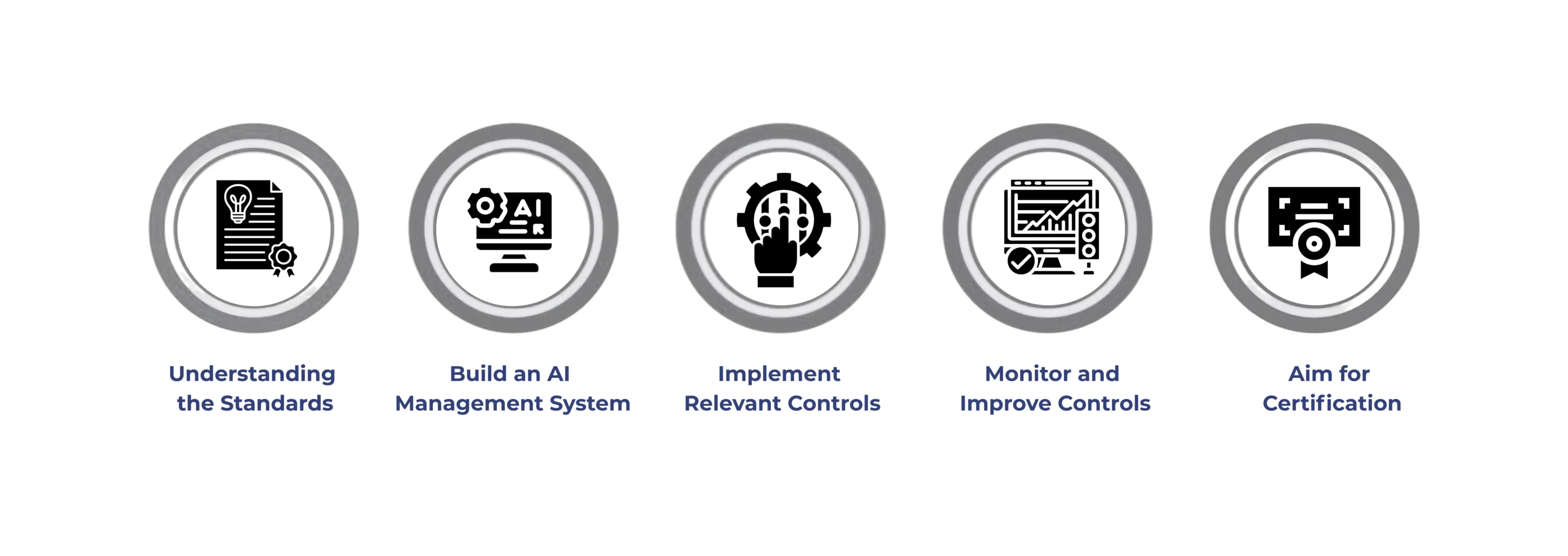
The process of implementing ISO 42001 for AI data privacy requires a conscious leadership commitment. To clarify, your firm must possess the ability to balance the immense potential that AI has along with the responsibility of managing it ethically. The following steps will assist you in achieving that.
Understanding the Standards: Begin with going through the ISO 42001 requirements and compare them with your current data privacy and AI compliance posture. This gap analysis will reveal the weaknesses in your AI processes, tools, and systems.
Build an AI Management System: Create clear policies, assign roles to govern AI data protection, and integrate privacy principles right from the initial stage. When everyone in your team knows about who is responsible for what, then your AI data privacy compliance becomes less problematic.
Implement Relevant Controls: As the name suggests, this process is about implementing strong control measures such as data encryption and access controls to ensure AI data privacy. In data security, risk management always comes first. So, it is your responsibility to find the areas of AI privacy concerns.
Monitor and Improve Controls: Like all modern technologies, AI will also evolve with updates and improved training. So, schedule regular audits and train your teams to improve your control measure as per the changes.
Aim for Certification: Integrate ISO 42001 with your existing frameworks, like ISO 27001 ISMS. Thereafter, hire an expert audit firm like CertPro to audit and assess your AI compliance posture. Based on this, you will be certified, signaling trust and commitment to ensuring AI data privacy with key stakeholders.
BENEFITS OF AI DATA PROTECTION AND PRIVACY COMPLIANCE
Demonstrating data privacy and AI compliance with ISO 42001 certification is your ethical foundation in building a business with AI. Furthermore, AI consumes sensitive data on a massive scale, and even a single privacy lapse can ruin your reputation. However, ISO 42001 enables you to demonstrate to your stakeholders that your AI tools and systems adhere to stringent AI data privacy and governance regulations. This approach builds confidence among customers, investors, partners, and regulators.
Furthermore, ISO 42001 compliance will assist you in staying ahead of global AI regulations. Data privacy standards like the EU AI Act are progressing towards strict rules, where non-compliance could cost you a fortune and your reputation. But ISO 42001 will help you adapt to these changes with ease. This transformation turns compliance from a source of stress into a competitive advantage. With AI, only the process behind it is abstract. But the risks are real. For example, a biased AI model could discriminate against or harm people. Moreover, the lack of explainability will make AI-based decisions hard to justify. With ISO 42001 controls, you can manage these issues by reducing their weaknesses and ensuring safe, fair, and ethical AI.
Finally, ISO 42001 improves your operational efficiency. To elaborate, it blends well with your existing frameworks like ISO 27001, and ISO 9001. You don’t have to feel the pressure or chaos. You can simply streamline your process by integrating the efforts and moving faster.
CONCLUSION
AI is integral to modern business growth. But with great power comes great responsibility. Therefore, mismanaging AI data can cost startups and businesses legal fines, lost customer trust, and reputational damage. That’s where CertPro steps in as your strategic audit partner. We help you achieve AI compliance effectively, ensuring your systems are ethical, secure, and fully compliant with global AI data privacy laws. With CertPro, your assumption regarding AI risks and weaknesses vanishes. We assess your data security practices, design clear policies, implement the appropriate controls, and guide you through the certification process. As a result, you could ensure that your AI practices follow the legal guidelines and earn trust with customers, investors, and partners.
The cost of delaying AI privacy compliance is devastating, with every unprotected dataset being a potential breach waiting to happen. So, act now to safeguard your business, streamline operations, and turn compliance into a competitive edge. Connect with CertPro today to build your foundation for AI data privacy compliance.
FAQ
What are the risks of AI collecting personal data?
AI collecting personal data can lead to breaches, identity theft, biased decisions, and regulatory non-compliance. Furthermore, failing to enforce privacy safeguards exposes businesses to legal penalties, reputational damage, and issues with customer trust when handling sensitive information improperly.
What privacy concerns are associated with AI models?
AI models face concerns like unauthorized data access, lack of consent, cross-border transfers, and bias. Also, poor governance can result in personal data misuse, security breaches, and ethical violations, making privacy compliance essential throughout the AI lifecycle.
What is AI data privacy?
AI data privacy means protecting sensitive information used by AI systems from misuse, leaks, or bias. It ensures ethical data handling, transparency, and compliance with global regulations like GDPR and CCPA during AI development and deployment.
How to use AI with privacy?
To use AI with privacy, implement data encryption, consent management, anonymization, and ISO 42001 governance. Moreover, adopt privacy-by-design principles, regularly audit AI models, and comply with laws like GDPR to ensure secure, ethical, and responsible AI operations.
What are GDPR and CCPA in data privacy?
GDPR (General Data Protection Regulation) and CCPA (California Consumer Privacy Act) are globally acclaimed privacy laws. They mandate businesses to protect personal data, ensure user consent, and maintain transparency when collecting, processing, or sharing personal information across systems.

About the Author
Abhijith Rajesh
Abhijith Rajesh is an Associate Manager at CertPro, specializing in ISO 27001, SOC2, GDPR, and other Information Security Compliance standards. He leads a dedicated team, ensuring the delivery of top-tier information security solutions. Abhijith excels in managing projects, optimizing security frameworks, and guiding clients through the complexities of the ever-evolving threat landscape.