

AUDITING REPORT FORMAT: BEST PRACTICES FOR CYBERSECURITY COMPLIANCE

If you are a business leader thriving in this era of strict regulations and sophisticated cyberattacks, then you must have realized the importance of compliance and security audits. According to Deloitte, 93% of audit committees rank cybersecurity in their top three priorities. Moving forward, a successful compliance audit relies heavily on a clear, consistent audit report format. A clear auditing report format matters more than most teams realize.
As a leading player in the market, we have understood the gaps in this process. Whenever a company approaches us for its first major security audit, it scrambles a lot. To clarify, their notes are scattered everywhere, screenshots are stored in random folders, and risk explanations feel like riddles. More often, when our auditors walk in, everyone freezes because no one knows which version of the report is the final one. Of course, they passed in the end, but the stress could’ve been avoided with a simple, consistent format that told the story of their security program without confusion.
Many companies still deal with the same mess. Reports land on a manager’s desk with unclear findings. Evidence shows up in different formats. Risk levels change from one page to another. When this happens, teams lose time just trying to decode the document. As a result, you can’t make decisions with confidence. Plus, your audit committees ask for rewrites, and external reviewers come back with more questions. All of this slows down compliance efforts and harms business growth.
So, what you need is a structured format to fix these problems. It gives auditors, CISOs, compliance managers, and security teams a shared way to read, understand, and explain what’s going on. A good format tells regulators and clients that the business knows how to document security work in a clear, reliable way.
This guide walks you through how to build that kind of format. Additionally, it helps you understand what audit reporting is, learn about the key components of an auditing report format, and discover the best practices to follow when creating one.

Tl; DR:
Concern: Many companies still struggle with messy audit reporting. The scattered evidence, unclear findings, and shifting risk levels from one page to another plague these companies. This slows decisions, frustrates internal teams, and creates confusion for auditors, regulators, and audit committees.
Overview: A clear auditing report format solves these issues by giving everyone a steady and predictable structure. It helps auditors record findings, evidence, and risks in a way that makes sense to both technical and non – technical leaders. It also aligns with major standards like SOC 2, ISO 27001, and NIS 2, which expect clean and consistent documentation.
Solution: A standardized format gives teams a shared language. It reduces rework, boosts accuracy, and removes the guesswork that usually surrounds audit reporting. With a stable structure, companies can prepare better, respond faster, and communicate their security posture with more confidence. CertPro helps businesses with a simple and dependable reporting structure. Its certified auditors organize evidence, explain findings clearly, and use modern GRC tools to keep every report clean and accurate. This steady format removes confusion, reduces rework, and helps teams prepare for audits with confidence. With CertPro’s guidance, companies can move faster, avoid repeat questions from assessors, and present a clear view of their security posture in every audit.
WHAT IS AN AUDITING REPORT FORMAT?
An auditing report format is the basic structure that holds a cybersecurity audit together. It is a clear layout that helps an auditor capture what they saw, how they tested it, and what it means for the business. To clarify, it is the standard structure used to present the results of a security audit. It organizes the scope, methodology, findings, evidence, risk ratings, and recommendations in a clear, repeatable way so that all stakeholders can understand the organization’s security posture.
Different frameworks use their own reporting styles, but they all depend on clean structure:
- SOC 2 reports describe the system, the trust services criteria, the tests performed, the results, any exceptions, and the auditor’s opinion.
- ISO 27001 audit reports usually cover the audit scope, methods, conformity level, nonconformities, and opportunities for improvement.
- NIS2 – aligned cybersecurity audits take a wider angle and need a clear view of how essential and important entities handle incidents, manage risks, and maintain their security posture.
Consistency is where most companies struggle while dealing with auditing report formats. For example, one team may use long explanations while another adds evidence that doesn’t match the finding. These gaps slow down decisions and create stress during external audits. Hence, solid and error – free auditing reports are necessary to remove that confusion.
WHAT AN EFFECTIVE AUDITING REPORT FORMAT SHOULD ACHIEVE
An effective auditing report format gives everyone a clear picture of a company’s security posture without forcing them to guess what the findings mean. In simple words, the main purpose of any auditing report format is to show what was tested, what worked, what failed, and what needs attention. To sum it up, when the format is clean and steady, the report becomes a reliable guide instead of a confusing bundle of technical notes.
Clarity matters because most teams are handling multiple heavy workloads. Different stakeholders use the same report in different ways:
- A CISO may skim the executive summary between meetings.
- A compliance manager needs quick proof to show a regulator or board.
- An engineer looks for the exact control that needs fixing.
Therefore, unclear auditing reports could push each person to walk away with a different interpretation. This is why a clear auditing report format is necessary to keep everyone aligned.
Moreover, accuracy plays a big role too. If the evidence you present doesn’t align with the findings, it can undermine trust. We have witnessed teams lose days trying to track down which screenshot or log file supports a specific observation. A structured auditing report format removes this pain by showing the evidence in a steady order and linking it to the right section.
Another cardinal rule is to maintain transparency. Your team wants to understand why the auditor assigned a specific risk rating and how they reached their conclusion. Accordingly, they want clean audit trails that show the steps taken during testing.
A good auditing report format should help stakeholders discuss risks with confidence. It should make the audit process feel predictable, honest, and useful, rather than stressful or chaotic.
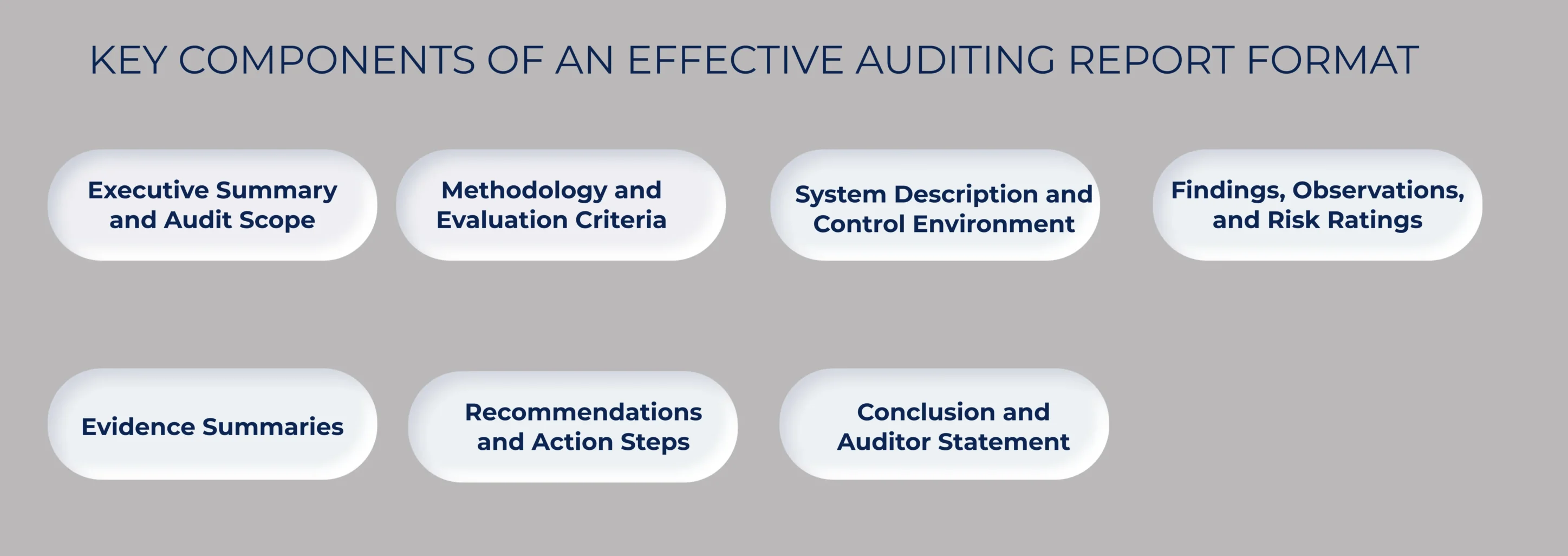
KEY COMPONENTS OF AN EFFECTIVE AUDITING REPORT FORMAT
A strong cybersecurity audit will provide you with a clear overview of how your security actually works. Having said that, the following key components help you build a report that supports smart decisions and removes confusion.
Executive Summary and Audit Scope
The executive summary sets the tone of the audit. It gives busy leaders a quick snapshot of the scope, the goals, and the main outcomes. Many CISOs read only this part first, so it needs to be clear and calm. The audit scope explains which systems, locations, and processes were included. Furthermore, it helps readers avoid guessing what was tested and what was not.
Methodology and Evaluation Criteria
This part explains the process of the audit. It shows the steps the auditor followed, the standards they used, and how they judged each control. If this section is absent or unclear, teams may perceive the findings as unexpected.
System Description and Control Environment
Here, the report describes the system under review. It explains the architecture, the processes, and the control environment that supports them. This context matters because a finding without background details often feels unfair or exaggerated.
Findings, Observations, and Risk Ratings
This is the part most teams look for. Each finding should explain the issue, its importance, and the severity of the risk. A clear rating scale helps stakeholders understand what demands urgent attention and what can wait.
Evidence Summaries
Evidence summaries show how we, as auditors, reached each conclusion. We link real proof to the observation. Without this, audit teams waste time trying to match logs, screenshots, or tickets to the right finding.
Recommendations and Action Steps
Moving forward, this section provides you a practical guidance. It explains what the team should fix and how they can fix it and sometimes offers suggested timelines. When recommendations are too vague, teams get stuck. So a clear, step – by – step suggestion is necessary to help them move forward with confidence.
Conclusion and Auditor Statement
The conclusion reflects the overall security posture and confirms the completeness of the audit. The auditor’s statement offers professional assurance. Moreover, it reassures stakeholders that the audit was thorough, fair, and aligned with recognized standards.
These components work together to create a report that’s clear, helpful, and easy for all stakeholders to understand.
BEST PRACTICES FOR WRITING A CYBERSECURITY AUDITING REPORT
In this section, let’s learn about the industry best practices that should be followed while writing a cybersecurity auditing report.
Clarity: A proper and standard cybersecurity audit report should follow a straight and sensible path. To elaborate, it must start with the scope, then walk through the controls tested, the results, and the impact on the business. When the order feels natural, CISOs and compliance managers can act faster.
- Begin with the reason for the audit.
- Move into the tested areas.
- Explain the findings and the related risks.
- End with clear next steps.
Accuracy: Accuracy is a major pain point in many reports. Therefore, use evidence that’s easy to verify and label it well.
- Link each finding to the supporting proof.
- Keep evidence in a steady format.
- Add short notes that explain why the evidence matters.
Simplicity: Most decision makers skim. They don’t have time to unpack long paragraphs or heavy jargon. Therefore, using short sentences helps them understand what the issue is and why it matters.
- Use simple examples.
- Avoid long technical chains.
- Stick to the point.
Alignment: Your report should reflect the structure and expectations of frameworks like SOC 2, ISO 27001, NIST CSF, and GDPR. This helps external reviewers trust the content and saves time during certification.
- Map findings to specific clauses or controls.
- Mention the criteria used for testing.
- Keep reviews consistent across standards.
Structure: Tables and tags make large reports easier to scan. It guides the reader’s eyes to the most important parts.
- Use tables for risk ratings.
- Add tags for evidence types.
- Include a small index for fast lookup.
Tone: Your audience may include regulators, external auditors, and clients. Hence, preferring a neutral tone builds confidence.
- Avoid emotional language.
- Stick to plain words.
- Focus on facts over opinions.
These practices help you craft auditing reports that feel clean, credible, and simple to work with, even during high – pressure audits.
HOW DOES A STANDARDIZED AUDITING REPORT FORMAT IMPROVES COMPLIANCE
A standardized auditing report format creates stability in a process that often feels rushed and unclear. When every report follows the same structure, internal teams know what to expect. As a result, your team could prepare the right evidence, understand the auditor’s expectations, and respond with fewer delays. This uniformity and steadiness also support external audits because reviewers don’t have to work through mismatched layouts or inconsistent explanations.
Clear structure improves risk visibility as well. Presenting findings, evidence, and impact consistently in the same manner makes patterns easier to identify. When teams start automating evidence collection, the information flows into the report in a cleaner and more consistent way. This reduces manual errors and keeps the audit trail simple to follow. A steady format also speeds up remediation work. Teams can move straight to the parts of the report that guide corrective action. They don’t waste time searching for missing context or unclear root causes. Eventually, this procedure leads to stronger governance because decisions are based on clean and reliable information.
It also smoothens the process of certification and regulatory audits. Assessors appreciate reports that follow a predictable flow because it reduces repeated and confusing questions.
Finally, a consistent format builds trust. Clients and partners feel more confident when they see clear, structured reporting that reflects discipline and care. It signals that the organization takes its security responsibilities seriously and communicates them with honesty and clarity.
CONCLUSION
A clear and dependable auditing report format can change how your business handles security. It gives your team a real view of what works, what breaks, and what needs attention. This is where CertPro makes a real difference. The firm has more than a decade of hands – on experience with SOC 2, ISO 27001, GDPR, HIPAA, and other major cybersecurity compliance audits. Our certified auditors know how to explain technical steps in plain terms, so you never feel lost or stuck during the process.
CertPro also works with a global network of associates, which helps you move faster with accurate results. Moreover, our audit teams use modern GRC automation platforms that cut review time and reduce human error. This helps us solve risk gaps early, avoid rising breach costs, and protect your brand from long delays in certification. Many companies wait until a contract is at risk or a client demands proof. By then, the cost shoots up because the problems pile up.
If you want clear reports, short audit cycles, and a partner who supports you at every stage, CertPro is ready to help. Connect with CertPro today and see how fast you can move toward strong and steady compliance.
FAQ
What is an audit report?
An audit report is a formal document that shares an auditor’s findings about a system or process. It shows strengths, weaknesses, and risks. Businesses use it to make better decisions, prove compliance, and improve their security posture.
What are the components of an internal audit report?
An internal audit report usually includes the audit scope, objectives, methods, findings, evidence, risk impact, and clear recommendations. These sections help leaders understand issues, set priorities, and take corrective steps without confusion.
What are the four types of audit reports?
The four types of compliance audit reports are unqualified (clean), qualified, adverse, and disclaimer. Each reflects the auditor’s opinion on whether controls meet standards, with unqualified indicating full compliance, qualified for minor exceptions, adverse for significant non – compliance, and disclaimer when evidence is insufficient.
Why is an audit report essential for cybersecurity compliance?
An audit report is important because it shows whether security controls work as expected. It highlights gaps, guides remediation, supports certifications like SOC 2 and ISO 27001, and helps businesses meet current regulatory and client requirements.
What are the challenges of writing an audit report?
Writing an audit report is tough because teams must present technical findings in clear language. Limited evidence, unclear controls, time pressure, and inconsistent formats can create gaps. These issues affect accuracy, decisions, and compliance outcomes.
WHAT IS CONTROL TESTING? A PRACTICAL GUIDE FOR COMPLIANCE AUDITS

AUDIT SAMPLING EXPLAINED: WHY AUDITORS TEST ONLY SELECTED EVIDENCE
How CertPro Conducts an Effective SOC 2 Type II Audit: A CPA-Led Playbook for SaaS
A SOC 2 Type 2 examination results in an independent CPA - issued attestation report on whether your controls are suitably designed and operated effectively over a period of time. It’s based on the AICPA Trust Services Criteria. This requirement is essential, as in...