FINTECH COMPLIANCE GUIDE 2026: AML, DATA PROTECTION & CYBERSECURITY

Fintech compliance covers the rules, controls, and operating standards that guide a fintech business to run safely and legally. It touches every part of the company. To elaborate, it protects customers, reduces risk, and builds trust with banks, regulators, and investors.
With the emergence of new digital finance models every quarter, the regulators respond with complex and stricter regulations. Moreover, banks have clear security expectations before they agree to partnerships. Furthermore, your customers also seek clear evidence that their money and data are safe. Fintech compliance is therefore an inevitable aspect of this rapidly evolving global market.
Additionally, the fintech teams are already facing the impact and consequences. They worry about approvals slowing growth, deal with long onboarding security questionnaires from banks, and face repeated audits from payment networks.
They are expected to prove their data security and fintech risk management practices. The real blocker for growth in the fintech market is the gap between the current security posture of fintech startups and the expectations for fintech regulatory compliance.
This guide helps you in closing those gaps. It gives you a clear path through the conditions shaping fintech compliance in 2026. You’ll learn the core rules you must follow and the controls you need to implement. Furthermore, it provides you with the latest insights that help you make smarter decisions as new models, such as embedded finance, AI – driven risk scoring, and digital assets, emerge.
This fintech compliance guide is crafted for founders, compliance leads, and operations teams, explaining the key fintech compliance requirements for 2026, with detailed guidance for fast – growing fintech teams. Let’s start.

Tl; DR:
Concern: Fintech teams will face rising pressure from regulators, banks, and customers. Any delays in compliance slow product launches, stall bank partnerships, increase onboarding friction, and expose your businesses to fines and data breaches. The gap between regulatory expectations and a startup’s current security posture creates real commercial risk in this situation.
Overview: Fintech compliance covers AML, KYC, data protection, cybersecurity, licensing, reporting, and consumer protection. These rules form the baseline for safe and legal operations in fintech firms. Moreover, the regulatory changes across the US, EU, UK, India, and Singapore are evident. The result means fintech companies must upgrade their controls, automate their audits, and maintain stronger evidence for external reviews.
Solution: The ultimate solution is to build a scalable compliance program with clear governance, risk assessments, policy updates, automated controls, strong training, and measurable KPIs. Hence, firms must consider early investment in fintech compliance to avoid disruption, accelerate bank onboarding, reduce costs, and improve customer trust. A well – planned compliance approach helps fintechs grow faster, close deals, and stay competitive in 2026.
WHAT IS FINTECH COMPLIANCE?
Financial transactions are no longer about major business dealings and cross – border transfers. From a common citizen to startups to medium – scale industries to huge enterprises, everyone is involved in key financial transactions today. To add on, the emergence of cloud – based applications, mobile payment services, and financial technologies plays a key role in today’s fintech market.
However, the question remains: are these transactions secure? If yes, then who regulates them, and what framework and standards do the businesses follow? Otherwise, in case of security breaches, how can firms save their customers’ sensitive financial data? This is where fintech compliance comes into play.
Fintech compliance covers the laws, regulations, security standards, and internal controls that let fintech operate in a legal and safe way. It sits at the center of your monetary transactions, so even a minor slip could cause trouble. Fintech compliance pulls in areas like Anti – Money Laundering (AML), KYC, data protection, cybersecurity, licensing, consumer protection, and different reporting duties that keep your business accountable.
The fintech compliance journey involves clear rules, solid controls, and provable evidence that you’re operating as per the regulatory expectations. When your teams accept this frame, your decisions get clearer, partnerships grow faster, and customer trust becomes easier to win.
Fintech compliance = laws + controls + evidence that your product manages risk and does not harm customers or the financial system.
CORE PILLARS OF FINTECH COMPLIANCE
In this section, let’s learn about the core pillars of fintech compliance that help you in your daily business operations.
AML and KYC Controls:
AML (Anti – Money Laundering) and KYC (Know Your Customer) always top the list of fintech risk management. To clarify, you will verify the identities, score risks, and monitor the users as they are involved in financial transactions. Furthermore, you also raise alerts when something looks unusual. These controls are necessary irrespective of the size of your business. Thus, following simple controls could assure your firm of protected growth.
Data Privacy and Protection:
Ensuring data privacy is another key component of fintech compliance. Accordingly, you must map your data collection process, understand the legal reason behind it, and set clear retention rules. Especially, you must encrypt sensitive information and review your partners’ data sharing process. The process might sound tedious, but it builds real trust with banks and customers.
Cybersecurity and Operational Resilience:
Cybersecurity keeps your platform stable by managing user access, reviewing logs, and watching systems in real time. Plus, your firm should prepare an incident response plan and keep backups ready. To ensure smooth operations during security incidents, you must also test recovery steps on a regular schedule. Thereby reducing downtime during pressurized situations. Moreover, it produces clear evidence that your fintech follows data protection laws such as GDPR and local privacy regulations.
Cybersecurity and Operational Resilience:
Cybersecurity keeps your platform stable by managing user access, reviewing logs, and watching systems in real time. Plus, your firm should prepare an incident response plan and keep backups ready to ensure a solid recovery strategy. Regular exercises and technical tests (such as vulnerability scans and penetration tests) reduce downtime during high – pressure incidents and help you align with frameworks like ISO 27001 and DORA (Digital Operational Resilience Act).
Payments, Licensing, and Capital Requirements:
Payments and licensing regulations define your storage and money transfers. Therefore, you separate client funds, submit the right reports, and maintain clean documentation for audits and partner reviews. Depending on your business models and jurisdiction, you may require licenses such as Money Transmitter, Electronic Money Institution, Payment Institution, or Major Payment Institution.
Consumer Protection and Disclosure Rules
The final pillar focuses on customers. As a result, you must share clear information, explain pricing in plain language, and respond to complaints with care. These steps prove that you value users and ensure their fair treatment with strong consumer protection controls. Such a practice is essential in a competitive fintech market.
FINTECH REGULATORY SPACE OF 2026
Globally, a few fintech compliance requirements act as the foundation for financial firms to operate. It includes anti – money laundering and counter – terrorism financing (AML/CFT), sanctions screening, data protection, transparency with consumers, and acquiring payment licensing while handling money.
These are the global pillars every fintech needs to follow. Let’s have a quick reference to the fintech regulatory compliance requirements for different jurisdictions in the following table.
| Region | Current Status |
|---|---|
| United States |
In the US, the approvals are handled by FinCEN (Financial Crimes Enforcement Network) and various state banking regulators. Some of the common licenses include Money Transmitter Licenses and money services business registrations.
The recent changes revolve around stronger AML and sanction rules, the Anti-Money Laundering Act (AMLA 2020), and strict supervision over fintech - bank partnerships. |
| European Union |
National regulators work alongside EU - wide directives. Popular licenses include Electronic Money Institution licenses, Payment Institution licenses, and account information service approvals.
From 2025 onward, the region is shifting to PSD3 (Payment Services Directive 3) and the new Payment Services Regulation. Fintech companies must also prepare for the Financial Data Access rules, MiCA (Markets in Crypto - Assets Regulation), DORA, and a new AML rulebook, along with tougher fraud controls and sustained GDPR enforcement. |
| United Kingdom |
The FCA (Financial Conduct Authority) and PRA (Prudential Regulation Authority) supervise EMIs, Authorised Payment Institutions, and digital banks.
Important topics include better implementation of Consumer Duty rules, stronger standards for business operations, stricter rules for financial product advertisements, and higher requirements for AML and CFT measures. |
| India |
The Reserve Bank of India (RBI) oversees Payment Aggregators, Payment Gateways, cross-border payment players, and prepaid instrument issuers.
In addition, the updated RBI Master Direction has updated and tightened PA requirements with stronger escrow rules, KYC checks, and risk controls. Furthermore, India is also rolling out a broad Self - Regulatory Organization framework and recognizing SROs for payment operators and NBFCs. |
| Singapore / Southeast Asia |
The Monetary Authority of Singapore (MAS) and other ASEAN regulators supervise Major Payment Institutions, e - money firms, and digital banks.
New updates expand the Payment Services Act, raise AML expectations for payment companies, and encourage joint programs for cross - border payments and CBDC pilots across Southeast Asia. |
Before you build a full compliance setup, study and understand your product thoroughly. To avoid making assumptions, ask yourself the following questions.
- Do you move money, maintain wallets, or process payments?
Then you’ll likely need a payments or EMI license. - Does your business lend, invest, or manage customer assets?
Accordingly, the lending or investment regulations apply. - Are you offering third – party tools like embedded finance or BaaS (Banking as a Service)?
In that case, both you and your partner share compliance duties, so you’ll need clear roles and documentation. - Do you store or process user data across borders?
If this is the case, GDPR and fintech privacy rules may be applicable, regardless of your location outside the EU.
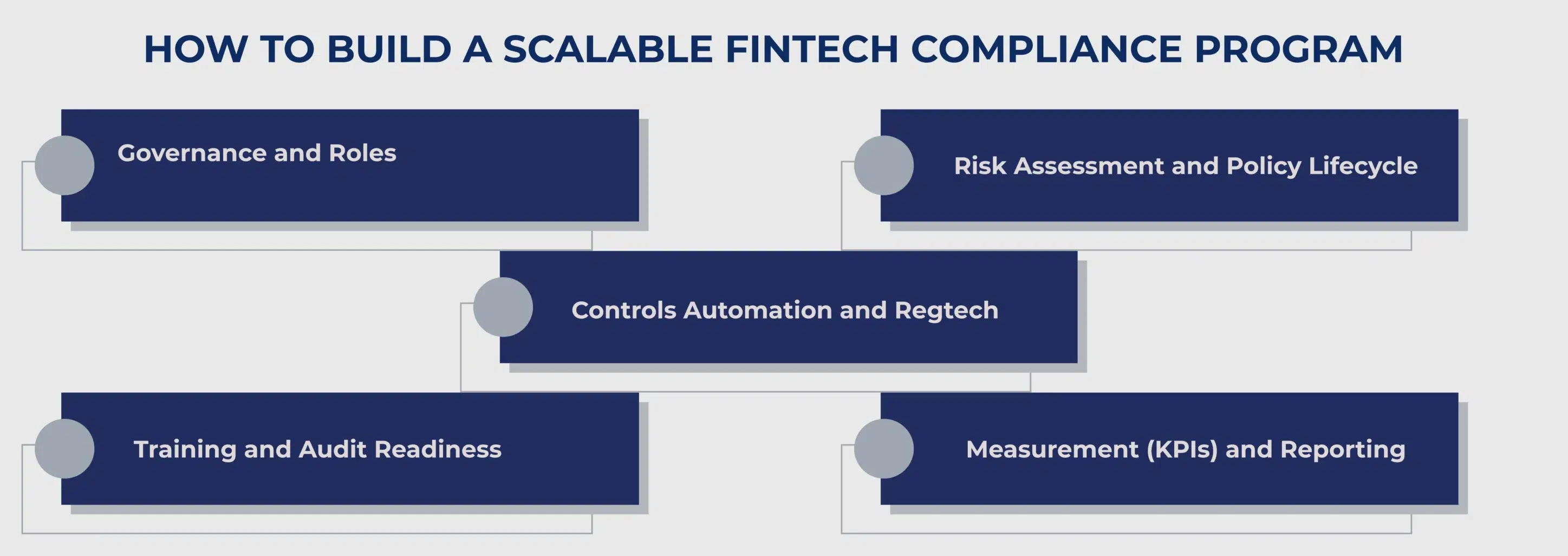
HOW TO BUILD A SCALABLE FINTECH COMPLIANCE PROGRAM
A successful compliance program must grow with your company. In the beginning stage, teams often struggle to manage product development, partner requests, and new regulations, all at the same time. But the key is to add structure to people, processes, and tools. Let’s learn how to do that. The following steps guide you in creating an effective program that remains solid as the company grows.
1. Governance and Roles: In compliance, everything begins with clarity. Therefore, define proper communication channels, implement board – level supervision, and appoint a compliance lead who understands the product. Because roles are clear, decisions are made more quickly, and audits feel less intimidating. To sum up, define board – level oversight, appoint a qualified compliance lead, and map 3 lines of defense responsibilities. These responsibilities include daily operation, compliance management, and independent audits.
2. Risk Assessment and Policy Lifecycle: List your major threats, document the gaps, and assign ownership for the mitigation process. Moving forward, build short, clear policies and review them on a regular basis. This helps the team understand what constitutes “good” performance on any given day.
3. Controls Automation and Regtech: As your business grows, relying on manual checks will not be sustainable. This is where regtech gains prominence. So, choose reliable tools for identity checks, watchlists, transaction monitoring, and policy management. Integrate systems into your in – house platform so that you maintain clean audit trails.
4. Training and Audit Readiness: Training keeps your team sharp and focused. Conduct role – based training for product, engineering, support, and leadership teams on an annual basis. Going forward, schedule internal audits annually and maintain thorough documentation for external auditors.
5. Measurement (KPIs) and Reporting: Finally, measure MTTR (Mean Time To Respond) to high – risk alerts, average identity verification time, false positives in transaction monitoring, and monthly exceptions such as failed audits and incomplete evidence. Eventually, these metrics will help you identify the blind spots and prove steady improvements to partners and regulators.
BENEFITS OF FINTECH COMPLIANCE
Strong fintech compliance turns regulatory needs into a commercial advantage by mitigating risk, accelerating partnerships, reducing costs with automation, and improving customer and investor trust.
Reliable Partnerships with Banks
As a fintech firm, if you treat compliance as part of daily operations, then things will start moving smoothly across the business. As a result, banks and major partners don’t hesitate to partner with you. Because they can see real evidence of your fintech risk management program.
Improved Investor Confidence
Your secure business practice will eventually boost the investor’s confidence. They’ll ask for risk registers, third – party assessments, and proof that you test controls regularly. Errorless documentation and solid evidence change the whole tone of the conversation, signaling that your company is growing without losing its stability.
Effective Operations with RegTech
Good compliance also lowers costs, especially when teams bring in smart RegTech solutions. This includes automated KYC, watchlists, and transaction monitoring, reducing false positives and manual workload.
Regulatory Compliance
A solid fintech compliance program also saves you from unwanted fines. Most enforcement actions begin with missing documentation or slow remediation. Therefore, by identifying and fixing the gaps early and keeping clean records, regulators consider you a responsible firm.
Stronger Customer Trust and Retention
Another major benefit that founders overlook is the ability to build customer confidence with fintech compliance. To clarify, the customers stay longer when they feel protected. Simple elements like clear privacy policies, transparent pricing, and a faster complaint process increase their trust.
Strategic Business Benefits
Finally, strong compliance opens many doors. Such as smooth licensing, faster audits, and an edge during strategic partnership negotiations.
CLOSING INSIGHTS
Fintech teams often hope compliance will become easier as they scale. But the reality is quite opposite. The longer you delay it, the more expensive and disruptive it becomes. Banks walk away from you, your audits pile up, and it also slows down your product launches. This is due to your inability to clear security reviews on time. Those delays will eventually cost money, deals, and credibility.
This is why 2026 is the moment to invest in a strong fintech compliance foundation. Also, the regulations across payments, data protection, and AML are getting more complex year by year. Partners expect provable security evidence, and customers are more vigilant when it comes to financial transactions and data protection.
When you treat compliance as part of product strategy, you create a business that scales without hurdles. As a result, you can reduce onboarding friction and make your company a safer choice for banks and investors. Therefore, if you plan to grow in this competitive market, fintech compliance is both the cost of remaining competitive and the advantage that keeps you ahead.
FAQ
What is fintech compliance?
Fintech compliance means following financial, data, and consumer protection rules that apply to digital products and services. It covers licensing, risk controls, customer checks, and data handling practices. Strong compliance helps fintech firms reduce legal risk and build long – term trust.
What are fintech regulations?
Fintech regulations are laws that guide the daily operations of digital payment firms, lenders, wealth platforms, and crypto providers. They cover licensing, money movement, data protection, customer identity checks, and fair treatment rules. These regulations protect users and keep financial systems stable.
What are the challenges of fintech compliance?
Fintech compliance is challenging due to the rate of policy changes, complex licensing requirements, cross – border data regulations, and rising security demands. Fintech firms must manage strict reporting, identity checks, and audits while growing their products and serving customers at scale.
What are AML and CFT in fintech?
AML and CFT are rules that stop money laundering and terrorist financing. In fintech, these rules require firms to verify users, monitor transactions, report suspicious activity, and maintain clear audit trails. They protect financial systems from criminal activity.
What is the role of GDPR in fintech?
GDPR guides fintech firms in collecting and using personal data. It outlines strict regulations for consent, storage, data transfers, and user rights. Fintechs must follow GDPR to protect customer information and avoid penalties when handling data from EU residents.