
Modern compliance programs are judged less by what is written and more by what can be proved. Audit teams now expect current evidence, clear traceability, and a reliable link between policy, control, and operation. That expectation has made manual evidence collection a weak point in many enterprises. Spreadsheets, email chains, and one-off file requests may work for small teams. However, they fail fast in distributed environments.
That is where automated data processing changes the operating model. In a compliance context, it connects control data, pulls evidence from trusted systems, and keeps documentation moving with the business. Furthermore, it gives compliance leaders a way to reduce manual work, improve evidence quality, and maintain stronger oversight across SOC 2, ISO 27001, HIPAA, and GDPR programs.
For licensed assurance firms, the issue is simple. Policies alone do not satisfy audit scrutiny. Auditors look for proof that controls operated effectively over time. They look for freshness, consistency, and traceability. When evidence is stale or scattered, the risk shifts from an administrative burden to an assurance problem.

Concern
Modern compliance programs face growing pressure to maintain current, traceable, and defensible audit evidence. Manual evidence collection creates operational inefficiencies that weaken audit readiness and governance oversight. Teams often rely on spreadsheets, screenshots, email requests, and disconnected documentation workflows. As a result, evidence becomes stale, fragmented, and difficult to validate during SOC 2, ISO 27001, HIPAA, and GDPR assessments. Auditors expect proof that controls operated effectively over time. When evidence lacks freshness, accuracy, and traceability, organizations experience slower audits, delayed remediation, reduced compliance visibility, and higher operational risk.
Overview
Automated data processing helps organizations collect, organize, validate, and maintain compliance evidence through connected systems and centralized workflows. In modern compliance operations, automated data processing can pull records from security platforms, identity systems, ticketing tools, governance platforms, and cloud environments without repeated manual handling. This improves automated evidence collection and creates stronger compliance visibility across enterprise controls. Compliance teams can monitor evidence continuously instead of gathering artifacts only before audits. Automated data processing tools also support multi-framework compliance by allowing organizations to reuse evidence across SOC 2, ISO 27001, HIPAA, and GDPR programs while preserving audit traceability and control integrity.
Solution
Automated data processing strengthens audit assurance by creating a continuous evidence management process built around operational transparency and control validation. It reduces manual evidence handling, standardizes documentation workflows, and maintains real-time visibility into compliance activities. Automated evidence collection improves evidence freshness, source traceability, and audit defensibility by preserving timestamps, ownership records, and processing history. It also helps compliance teams identify missing records, delayed reviews, and control exceptions earlier in the audit cycle. Over time, data processing automation supports stronger governance maturity, faster audits, improved executive oversight, and scalable compliance operations across complex enterprise environments.
What Automated Data Processing Means in Modern Compliance Operations
In compliance operations, automated data processing means using connected systems to gather, organize, validate, and route evidence without repeated manual handling. The process can pull logs from security tools, access records from identity platforms, ticket history from workflow systems, and approval trails from governance tools. The goal is control integrity rather than speed.
That matters because modern assurance depends on more than document storage. It depends on evidence that can be traced back to a real control event. When automated data processing is configured well, teams can see when a control ran, who touched the evidence, and whether the record reflects the current state of operations. This creates compliance visibility that manual methods rarely match.
Why Manual Evidence Collection Creates Risk
Manual evidence collection creates several common failures:
- Evidence arrives late.
- Screenshots are copied without context.
- Files are renamed with no standard.
- Owners forget to update artifacts after process changes.
By the time an audit begins, the evidence set often reflects last quarter, not current operations. That creates operational risk and audit risk at the same time. A control may be working, but the team cannot prove it cleanly. In that gap, auditors lose confidence. So do executives. This is why automated evidence collection has become a core part of assurance operations. It reduces dependence on memory, email follow-up, and last-minute remediation.
The Shift Toward Continuous Compliance Monitoring
The better model is continuous. Automation in data processing allows teams to treat evidence as an ongoing feed rather than a last-minute project. Instead of collecting artifacts before fieldwork, teams maintain them as part of daily operations. That improves evidence freshness and reduces the scramble that often defines audit season.
This shift also supports stronger compliance visibility. Leaders can see whether controls are active, whether exceptions are pending, and whether data is incomplete. As a result, automated data processing becomes a compliance operations layer, not just a tooling choice.
How Automated Evidence Collection Strengthens Audit Readiness
Data Collection From Connected Systems
Strong audit readiness depends on connected evidence sources. Automated data processing tools can ingest information from cloud platforms, HR systems, ticketing tools, endpoint protection, logging layers, and policy repositories. When those sources feed a central workflow, evidence becomes easier to assemble and easier to trust.
That centralization matters for audit teams because it reduces fragmentation. Evidence no longer lives in inboxes or local folders. It sits in a controlled workflow with timestamps, ownership, and version history. That is a major advantage for automated evidence collection. It gives auditors a cleaner path from control objective to supporting record.
Evidence Freshness, Accuracy, and Traceability
Audit defensibility depends on three things: freshness, accuracy, and traceability.
- Freshness shows that the evidence reflects current conditions.
- Accuracy shows that the record matches the actual control outcome.
- Traceability shows where the evidence came from and whether it changed.
Manual collection weakens all three. Files can be edited without a clear trail. Screenshots can be reused. Duplicates can appear across teams. Automated data processing reduces those gaps by preserving source linkage and processing history. That gives auditors more confidence in the control story. It also improves how teams handle exceptions. If a control fails or a log is missing, the issue is visible sooner. That makes remediation faster and reduces surprise during fieldwork. In practical terms, automated evidence collection supports better response time and stronger evidence discipline.
Improving Compliance Visibility Across Controls
Many compliance programs fail because they cannot see the full picture. Evidence is gathered by framework, by department, or by individual owner. That creates blind spots. Automation in data processing helps unify those records across control families and operating teams.
When evidence is mapped into a shared process, leaders gain stronger compliance visibility. They can see which controls are current, which are late, and which have incomplete support. That visibility supports better planning and better audit readiness. It also turns evidence management into a live operational function rather than a seasonal clean-up exercise.
How Automated Data Processing Supports SOC 2, ISO 27001, HIPAA, and GDPR
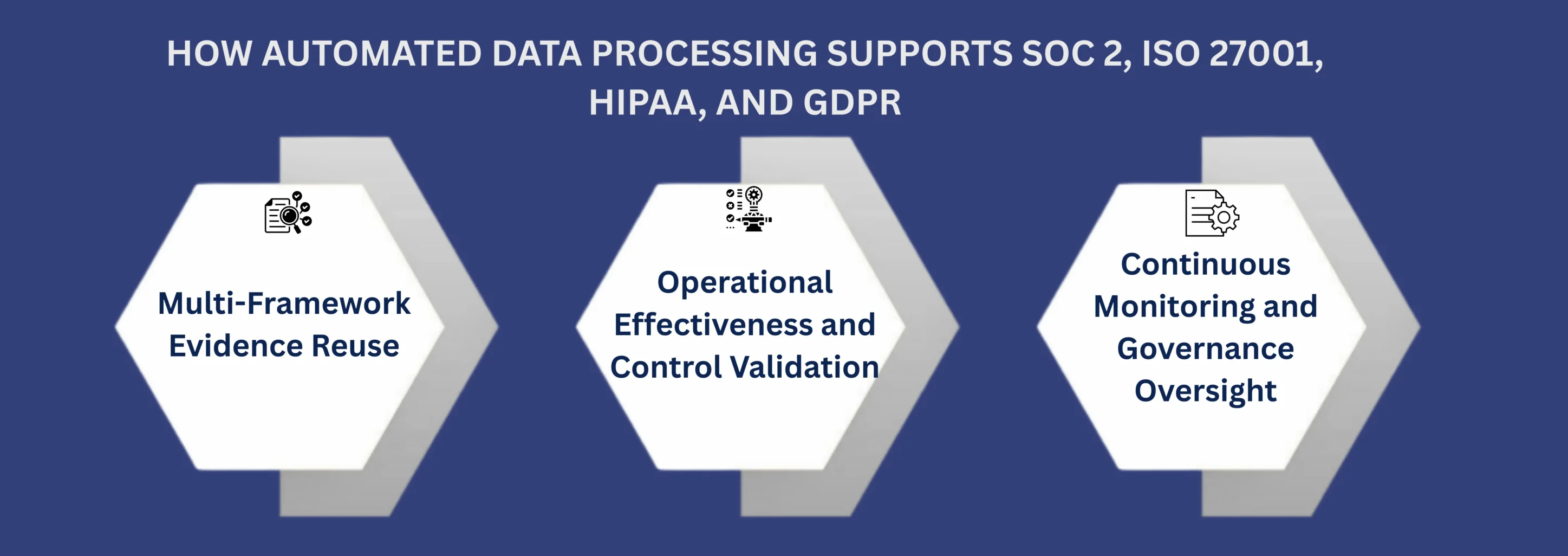
Multi-Framework Evidence Reuse
Enterprises rarely manage one framework at a time. They manage overlapping obligations. SOC 2, ISO 27001, HIPAA, and GDPR often draw from the same control families, but they ask for different forms of proof. This is where automated data processing adds real value.
A well-structured workflow allows evidence to be reused across frameworks without losing context. For example, access reviews, incident records, training completion, and vendor oversight evidence may support multiple assessments. The same source data can flow into different control mappings through controlled processing. That reduces duplication and helps teams avoid four separate evidence hunts.
For this to work, the underlying automated data processing tools must preserve lineage. Reuse is useful only when auditors can still trace the evidence back to the original event. This is why structured automation in data processing matters more than simple file transfer. It supports consistency across programs while keeping audit logic intact.
Operational Effectiveness and Control Validation
Auditors do not just ask whether a control exists. They ask whether it worked during the review period. That is an operational effectiveness test. Automated data processing supports that test by showing recurring control activity over time, not just a one-time artifact.
In SOC 2 and ISO 27001 engagements, this is especially important for access reviews, change management, logging, and incident handling. In HIPAA programs, the same principle applies to safeguards, procedures, and activity records. Similarly, during GDPR compliance assessments, evidence must show discipline around processing, access, retention, and response obligations. When automated pipelines collect this data consistently, control validation becomes easier to defend. Evidence is no longer assembled by memory. It is drawn from real operational records. That is a better basis for assurance.
Continuous Monitoring and Governance Oversight
Compliance maturity depends on oversight. Automation in data processing supports that oversight by giving leadership a current view of control activity. It highlights delays, exceptions, and missing records before they become audit findings.
This is also where compliance visibility becomes strategic. Governance teams can see whether control owners are keeping pace, whether remediation is closing on time, and whether evidence quality is drifting. Automated data processing does not remove human review. It gives governance a better lens for review.
Why Enterprise Organizations Are Investing in Data Processing Automation
Faster Audits and Reduced Manual Effort
The first business case is efficiency. Manual evidence collection consumes time across security, IT, HR, finance, and legal. Every request adds coordination overhead and follow-up creates delay. Automated data processing lowers that cost by reducing repetitive collection work and cutting down on evidence chase cycles.
That matters during audit season, but it also matters throughout the year. Compliance teams that use automated evidence collection spend less time assembling files and more time reviewing control performance. They can also respond faster when auditors request clarification or additional support. This efficiency is not just an internal benefit. It affects the quality of the audit itself. Faster retrieval usually means fresher evidence, fewer gaps, and less rework. That gives the assurance process a better starting point.
Stronger Governance and Executive Visibility
Executives need more than a pass or fail result. They need a clear view of control health. Automated data processing makes that possible by surfacing trends in control completion, evidence timeliness, and exception handling.
That visibility changes how leaders manage risk. Instead of learning about missing evidence during fieldwork, they can track issues earlier. Instead of relying on static reports, they can review current operational status. This is a practical advantage of automation in data processing. It turns compliance from a backward-looking documentation exercise into a live governance signal. It also supports board-level confidence. When a program can show repeatable evidence flow and consistent control validation, leaders can speak about assurance with more precision.
Building Sustainable Long-Term Assurance Maturity
Long-term compliance maturity comes from repeatable processes, not last-minute heroics. Automated data processing creates that repeatability. It helps standardize evidence handling, preserve traceability, and maintain a reliable audit trail across systems and frameworks.
Over time, the organization builds stronger operating discipline. Control owners know what is expected. Compliance teams know where evidence lives. Auditors see a program that is easier to test and easier to trust. That is the real value of data processing automation. It supports a durable assurance model, not a temporary audit fix.
Conclusion
Modern compliance programs need evidence that is current, traceable, and defensible. That is difficult to achieve through manual collection alone. Files get scattered. Documentation ages. Control proof loses context. Automated data processing addresses those weaknesses by creating a structured way to collect, validate, and maintain evidence across the business.
For audit-ready organizations, this is more than an efficiency upgrade. It is a stronger operating model for assurance. It improves automated evidence collection, strengthens compliance visibility, and supports continuous monitoring across SOC 2, ISO 27001, HIPAA, and GDPR programs. It also gives auditors a clearer path to evaluate operational effectiveness.
At CertPro, a licensed CPA firm, we see this shift as part of the modern assurance discipline. The organizations that perform best are the ones that treat evidence as an ongoing control asset rather than a year-end task. That mindset supports continuous compliance readiness, stronger governance confidence, and scalable audit assurance.