
ISO 42001 Certification in North Carolina
ISO 42001 Certification in North Carolina is relevant to a broad range of industries. The state’s economic profile — anchored by the Research Triangle’s technology and life sciences concentration, Charlotte’s financial services ecosystem, and statewide defense and telecommunications infrastructure — positions North Carolina organizations at the intersection of AI adoption and AI governance requirements. Enterprises across diverse sectors are actively evaluating ISO 42001 certification as AI governance expectations evolve from voluntary best practice to contractual and regulatory necessity.
OUR CLIENTS


What Is ISO 42001 Certification and Why Does It Matter for North Carolina Organizations?
ISO 42001 Certification in North Carolina represents independent, third-party verification that an organization’s Artificial Intelligence Management System (AIMS) conforms to the requirements of ISO/IEC 42001:2023 — the first internationally recognized standard specifically designed to govern the development, deployment, integration, and ongoing management of AI systems. Issued by a Licensed CPA Firm conducting structured certification audits, the credential signals to customers, regulators, partners, and investors that an organization has established documented AI governance controls, AI risk management processes, and accountability mechanisms evaluated against a rigorous international benchmark.
ISO/IEC 42001:2023 is a management-system standard. It prescribes requirements for the organizational structures, policies, objectives, and processes that govern AI — not the AI algorithms themselves. Organizations that develop AI products, embed AI into services, procure AI-enabled software, or operate AI systems in business processes all fall within scope of the ISO AIMS standard.
North Carolina’s technology ecosystem is among the most active in the United States. The Research Triangle — anchored by Raleigh, Durham, Chapel Hill, and Cary — concentrates AI startups, SaaS companies, cloud service providers, cybersecurity firms, biotechnology organizations, pharmaceutical companies, health technology enterprises, and major research universities. Charlotte functions as a leading U.S. financial services center, with fintech companies, banking institutions, insurance organizations, and financial data providers increasingly integrating AI into credit decisioning, fraud detection, customer experience, and risk management.
Across Greensboro, Winston-Salem, and the broader state, defense and aerospace contractors, telecommunications providers, data center operators, and healthcare networks are deploying AI systems at scale. For these organizations, ISO 42001 Certification in North Carolina provides a structured mechanism to demonstrate responsible AI governance to auditors, regulators, enterprise customers, and boards of directors.
The ISO AIMS standard — formally ISO/IEC 42001:2023 — was published in December 2023 by the International Organization for Standardization (ISO) and the International Electrotechnical Commission (IEC). It establishes requirements for defining AI policy, assigning AI-related roles and responsibilities, conducting AI risk assessments and risk treatment, managing AI system lifecycles, documenting controls through a Statement of Applicability, performing internal audits, conducting management reviews, and driving continual improvement.
Annex A of the standard provides 38 specific controls across nine control domains, which organizations select and implement based on their AIMS scope and AI risk profile. The standard aligns structurally with ISO 9001, ISO 27001, and ISO 31000, enabling integration into existing management-system frameworks without duplicating governance infrastructure. ISO 42001 compliance that North Carolina organizations must demonstrate is evaluated through independent certification audits — not self-declaration — and the resulting certification is typically valid for three years, subject to annual surveillance audits.
The relevance of ISO 42001 Certification in North Carolina extends well beyond voluntary market differentiation. U.S. federal AI governance developments — including the NIST AI Risk Management Framework (AI RMF), Executive Orders addressing AI safety and trustworthiness, and sector-specific guidance from the FDA, HHS, and financial regulators — are creating an environment in which documented, audited AI governance is increasingly expected.
North Carolina organizations operating in healthcare, financial services, defense, and critical infrastructure face overlapping AI-related requirements from federal and sector regulators. Importantly, ISO/IEC 42001:2023 certification does not automatically establish compliance with North Carolina law, U.S. federal regulations, or industry-specific legal obligations. However, it provides independently verified evidence of structured AI governance that regulators, enterprise customers, and contract counterparties can evaluate. For boards and executive leadership, certification delivers an auditable accountability record demonstrating that AI systems are managed within defined risk tolerances and governance structures.

ISO 42001 Certification Requirements for North Carolina Organizations
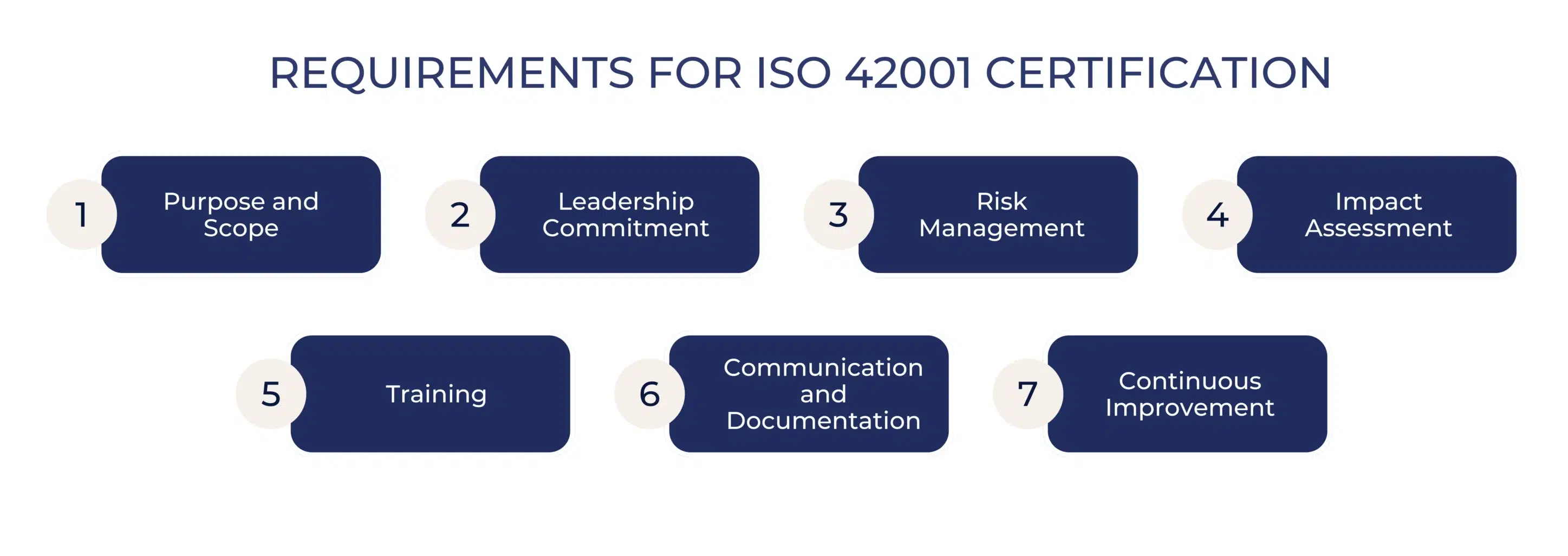
Achieving ISO 42001 Certification in North Carolina requires organizations to establish, implement, maintain, and continually improve an Artificial Intelligence Management System that satisfies each clause of ISO/IEC 42001:2023. The standard is structured across ten main clauses — Clauses 4 through 10 contain mandatory requirements — and two normative annexes.
Organizations must define the AIMS scope, document AI policies and objectives, assign roles and responsibilities, conduct AI impact assessments and risk assessments, select applicable Annex A controls, and produce a Statement of Applicability. Crucially, they must also provide objective evidence that each requirement is operationally active — not merely documented on paper. Evidence reviewed during an ISO 42001 certification audit includes policies, risk registers, AI system inventories, training records, internal audit reports, and management review minutes.
ISO/IEC 42001:2023 requires organizations to maintain documented information sufficient to demonstrate AIMS conformance and enable consistent operation. Mandatory documented information includes the AIMS scope statement, AI policy, AI objectives and plans to achieve them, AI risk assessment methodology and results, AI risk treatment plan and results, Statement of Applicability referencing all Annex A controls, internal audit program and audit results, management review records, and records of nonconformities and corrective actions.
North Carolina organizations preparing for an ISO 42001 assessment must ensure these documents are current, version-controlled, and accessible to auditors. Documentation must reflect actual organizational practice — not aspirational procedures — because certification auditors verify alignment between documented processes and operational evidence gathered through interviews, system walkthroughs, and record reviews.
The AI policy is a foundational document under ISO/IEC 42001:2023. It must be approved by top management, communicate the organization’s commitment to responsible AI, align with the organization’s strategic direction, provide a framework for setting AI objectives, and be communicated to all relevant personnel and interested parties.
For North Carolina organizations in regulated sectors — healthcare technology, fintech, life sciences — the AI policy typically addresses responsible AI principles, data governance, human oversight mechanisms, and alignment with applicable regulatory frameworks. Auditors review the AI policy not only for content but for evidence of active communication, senior leadership endorsement, and integration into operational decision-making processes across AI development and deployment activities.
ISO/IEC 42001:2023 Clause 6.1 requires organizations to define and apply an AI risk assessment process that identifies risks associated with AI systems within the defined AIMS scope. The risk assessment must consider the full AI system lifecycle — from design and data sourcing through model development, deployment, monitoring, and decommissioning — and account for risks to affected individuals, communities, and the organization itself.
Risk categories addressed under the ISO AIMS standard typically include algorithmic bias and fairness, explainability and transparency deficiencies, data quality and provenance risks, security vulnerabilities specific to AI systems, privacy and data protection risks, human oversight failures, and third-party AI supply chain risks. Each identified risk must be evaluated for likelihood and consequence, and the organization must determine appropriate treatment options — including applying Annex A controls — and document the results in a risk treatment plan.
The Statement of Applicability (SoA) is a critical ISO 42001 compliance deliverable that links the organization’s risk assessment outcomes to specific Annex A controls. All 38 Annex A controls must be addressed in the SoA, with each control either included — with justification and implementation status — or excluded with documented rationale.
Annex A control domains include AI system impact assessment, data governance, AI system lifecycle controls, responsible AI practices, third-party and supply chain AI controls, and monitoring and incident management for AI systems. During the ISO 42001 certification audit, auditors independently verify that SoA control selections are consistent with risk assessment results and that evidence of control implementation exists. Organizations that exclude controls without adequate justification will receive nonconformities during the audit.
ISO/IEC 42001:2023 Clause 8 requires organizations to plan, implement, control, and review AI-related operational processes. This includes AI system lifecycle management — covering design, development, testing, deployment, monitoring, and decommissioning phases — and ensuring that AI-related processes operate within the boundaries established by the AIMS. Organizations must also conduct AI impact assessments before deploying new or significantly changed AI systems and maintain records of assessment outcomes.
Internal audit requirements under Clause 9.2 mandate planned, independent reviews of AIMS conformance at defined intervals. Clause 9.3 requires management reviews at planned intervals to evaluate AIMS performance, suitability, and strategic alignment. Continual improvement obligations under Clause 10 require organizations to identify opportunities to enhance AIMS effectiveness, address nonconformities through root-cause analysis, and implement corrective actions with verified effectiveness.
- ✓Documentation and Policy Requirements
- ✓AI Risk Assessment and Treatment Requirements
- ✓Operational and Continual Improvement Requirements
The ISO 42001 AIMS Framework: Core Components
The ISO AIMS standard structures AI governance through an integrated management-system framework that aligns with the High-Level Structure (HLS) shared by ISO 9001, ISO 27001, and other major ISO standards. This structural alignment allows North Carolina organizations that already hold or pursue ISO 27001 or ISO 9001 certifications to integrate AIMS requirements into existing management-system infrastructure — reusing risk management processes, internal audit programs, management review cadences, and documented-information controls without constructing entirely separate governance systems.
The AIMS framework addresses six core components: organizational context and scope, leadership and AI policy, AI planning and risk management, AIMS support and resources, AI operational controls, and performance evaluation and improvement. Together, these components form the backbone of a credible ISO 42001 assessment.
Organizational Context and Scope Definition
Clause 4 of ISO/IEC 42001:2023 requires organizations to determine internal and external factors relevant to their AI activities and that affect the AIMS. Internal factors include organizational structure, AI development capabilities, data assets, existing governance frameworks, and risk appetite. External factors include the regulatory environment, customer expectations, industry norms, supply chain dependencies, and societal considerations regarding AI use.
Organizations must also identify interested parties — customers, regulators, employees, affected communities, AI supply chain partners — and their AI-related requirements and expectations. The AIMS scope defines which AI systems, processes, organizational units, and locations are subject to certification. A precisely defined scope is strategically important because it determines what the ISO 42001 certification audit evaluates and what the resulting certificate covers.
For North Carolina AI companies and technology organizations, scope definition is often the most consequential early decision in the ISO 42001 assessment process. A SaaS company in the Research Triangle may scope its AIMS to encompass all AI-enabled features within its software platform and the underlying data processing activities. A Charlotte financial institution may define scope around AI models used in credit scoring, fraud detection, or customer segmentation. A life sciences organization in Durham may scope its AIMS to AI systems used in drug discovery, clinical data analysis, or regulatory submission preparation.
The scope must be documented, justified, and maintained throughout the certification lifecycle. Narrowing or expanding scope triggers re-evaluation of risk assessments, control selections, and potentially the certification boundaries themselves.
Annex A Controls: AI Governance Control Domains
Annex A of ISO/IEC 42001:2023 provides 38 controls organized across nine control domains. These controls represent specific governance measures organizations may implement to address AI risks identified during the risk assessment process. The nine Annex A domains are: (1) Policies relating to AI, (2) Internal organization for AI governance, (3) Resources for AI systems, (4) Assessing impacts of AI systems, (5) AI system lifecycle management, (6) Data for AI systems, (7) Information for interested parties about AI systems, (8) Use of AI systems, and (9) Third-party and supplier relationships for AI systems.
Each domain addresses a distinct aspect of responsible AI management — from how organizations govern AI data sourcing and quality to how they communicate AI system limitations to users and affected parties. Control selection is a central deliverable of any ISO 42001 audit engagement.
Control selection under Annex A is risk-driven, not prescriptive. Organizations determine which controls are applicable based on the outcomes of their AI risk assessment and the characteristics of AI systems within scope. A cybersecurity firm in North Carolina deploying AI-powered threat detection must evaluate controls related to AI system security, data integrity, and human oversight. A healthcare technology company integrating AI into clinical decision support must evaluate controls relating to AI impact assessment, transparency to affected individuals, and incident management for AI system failures.
Auditors verify that control selections in the Statement of Applicability are logically consistent with identified risks and that implementation evidence — policies, system configurations, training records, audit logs — substantiates each included control’s operational status. This verification is a core element of the ISO 42001 certification audit process.
Integration with ISO 27001 and Existing Management Systems
ISO/IEC 42001:2023 is designed for integration with ISO/IEC 27001:2022 (information security management) and ISO 31000 (risk management). Organizations holding ISO 27001 certification can extend their existing information security management system to encompass AI-specific risks, using shared risk management methodology, common documented-information structures, integrated internal audit programs, and combined management review processes.
This integration is particularly valuable for North Carolina technology companies that already hold ISO 27001 certification and wish to extend governance coverage to AI systems without duplicating existing controls. Auditors conducting integrated AIMS and ISMS audits evaluate how the two management systems interact, whether risk treatment decisions are consistent across both systems, and whether AI-specific controls in Annex A of ISO 42001 are clearly distinguished from information security controls under ISO 27001 Annex A.
ISO 42001 Certification Audit Process in North Carolina
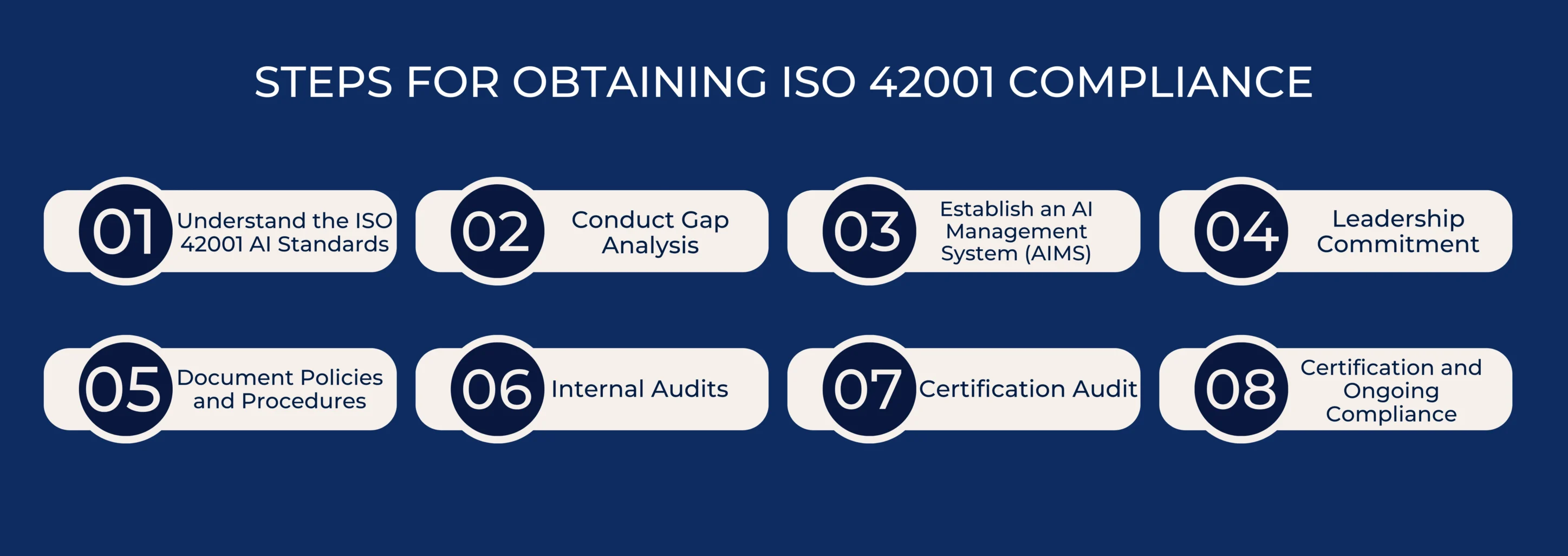
The ISO 42001 certification audit process in North Carolina follows a structured, multi-stage evaluation sequence conducted by an independent, accredited certification body. CertPro, operating as a Licensed CPA Firm, performs ISO 42001 certification audits under a defined audit program specific to each organization’s AIMS scope, industry sector, and AI system profile. The audit program establishes the sequence, timing, and methods of audit activities — from initial scope definition through certification decision and ongoing surveillance.
Organizations seeking ISO 42001 Certification in North Carolina should understand that the certification audit is an independent evaluation of objective evidence — not an advisory engagement, readiness review, or consulting activity. The auditor’s role is to evaluate conformance against ISO/IEC 42001:2023 requirements, identify nonconformities, and support the certification body’s decision-making process.
The Stage 1 audit is a documentation-focused evaluation conducted before the Stage 2 on-site audit. During the Stage 1 audit, the auditor reviews the organization’s AIMS documentation to assess readiness for a full certification audit. Documents reviewed include the AIMS scope statement, AI policy, AI objectives, risk assessment methodology and results, risk treatment plan, Statement of Applicability, internal audit records, and management review minutes.
The Stage 1 audit identifies areas where documentation is incomplete, inconsistent with standard requirements, or misaligned with the organization’s declared AIMS scope. The auditor issues a Stage 1 audit report documenting findings and identifying any issues that must be addressed before the Stage 2 audit proceeds. Stage 1 audits for North Carolina organizations may be conducted remotely or on-site depending on the complexity of the AIMS scope and the accessibility of documentation systems.
Stage 1 audit findings are classified as observations, areas for improvement, or issues requiring resolution prior to Stage 2. Auditors focus on whether the AIMS scope accurately reflects the organization’s AI activities, whether the AI risk assessment methodology is suitable for the organization’s risk profile, and whether documented controls in the Statement of Applicability are consistent with the risk treatment plan.
For North Carolina organizations with complex AI ecosystems — such as AI platform companies with multiple product lines or healthcare organizations with numerous AI-enabled clinical tools — the Stage 1 audit is particularly important. It confirms that the AIMS scope, risk assessment, and control framework are aligned before committing resources to a Stage 2 field audit. Stage 1 completion typically precedes Stage 2 by a period sufficient for the organization to address identified documentation gaps.
The Stage 2 audit is the primary ISO 42001 certification audit activity. Auditors evaluate whether the organization’s AIMS is implemented and operating effectively in accordance with ISO/IEC 42001:2023 requirements and the organization’s own documented policies and procedures. The Stage 2 audit involves structured interviews with personnel responsible for AI governance, AI development, data management, risk management, and IT security. Auditors also review operational evidence — including AI system inventories, risk registers, training completion records, incident logs, and internal audit outputs — and conduct technical walkthroughs of AI system lifecycle processes.
Auditors assess conformance clause by clause, evaluate whether Annex A controls identified in the Statement of Applicability are operationally active, and determine whether the AIMS is producing the outcomes required by the standard. All audit findings are documented in a structured audit report submitted to the certification decision-maker.
Nonconformities identified during the Stage 2 audit are classified as major or minor. A major nonconformity indicates a systematic failure to meet a clause requirement or a significant gap in AIMS implementation that undermines the integrity of the management system. A minor nonconformity indicates an isolated lapse or partial implementation of a specific requirement.
Major nonconformities must be resolved — with objective evidence of corrective action submitted and verified — before the certification decision can be made. Minor nonconformities require documented corrective action plans and are verified during the first surveillance audit. Organizations achieving a satisfactory Stage 2 outcome — with no unresolved major nonconformities — receive ISO 42001 certification valid for three years, subject to annual surveillance audits confirming continued conformance.
ISO 42001 certification is maintained through annual surveillance audits conducted in the first and second years of the three-year certification cycle. Surveillance audits are narrower in scope than Stage 2 audits but evaluate whether the AIMS continues to conform to ISO/IEC 42001:2023 requirements. Auditors focus on areas identified as significant during the initial certification audit, areas where nonconformities were recorded, and areas subject to organizational or AI system changes.
Organizations must also demonstrate that internal audits, management reviews, and continual improvement activities have been conducted as required. At the end of the three-year certification cycle, a full recertification audit — equivalent in scope to the initial Stage 2 audit — is conducted to renew ISO 42001 compliance for North Carolina certified organizations for a further three-year period. Significant AIMS scope changes between surveillance cycles must be reported to the certification body promptly.
| Audit Stage | Purpose | Typical Duration | Output |
|---|---|---|---|
| Stage 1 Audit | AIMS documentation and readiness review | 0.5–1 day | Stage 1 audit report with findings |
| Stage 2 Audit | Operational conformance evaluation against ISO/IEC 42001:2023 | 1–3 days | Audit report; certification decision |
| Surveillance Audit (Year 1 & 2) | Continued conformance verification | 0.5–1 day | Surveillance audit report |
| Recertification Audit | Full AIMS re-evaluation at three-year cycle end | 1–2 days | Renewed certificate (3 years) |
- ✓Stage 1 Audit: AIMS Documentation Review
- ✓Stage 2 Audit: Operational Conformance Evaluation
- ✓Surveillance Audits and Recertification
What Organizations Must Demonstrate During ISO 42001 Certification
During an ISO 42001 certification audit, organizations must provide objective evidence — not assertions — that each applicable clause of ISO/IEC 42001:2023 is satisfied. Auditors are trained to distinguish between documented intentions and operational reality. An organization may have a comprehensive AI policy and a well-structured risk assessment methodology, but if auditors cannot find evidence that risk assessments have been conducted for AI systems within the defined scope — or that controls identified in the Statement of Applicability are actively implemented — nonconformities will be raised.
The following areas represent the primary evidence domains evaluated during ISO 42001 certification audits conducted for North Carolina organizations seeking to achieve or maintain certification.
AI Governance Leadership and Accountability Evidence
Auditors evaluate whether top management has demonstrated active commitment to the AIMS — not merely approved documents. Evidence includes board or executive-level AI policy endorsement records, documented assignment of AIMS roles and responsibilities (including an AI governance function or equivalent), management review meeting minutes showing substantive engagement with AIMS performance data, and records of leadership decisions addressing AI risks and objectives.
For North Carolina organizations in financial services, healthcare, or defense — where boards face increasing regulatory expectations regarding AI governance — auditors may also review board-level AI risk reporting structures. This helps assess whether AI governance accountability reaches the highest organizational levels. Top management must also demonstrate awareness of the organization’s AI policy, AIMS scope, and AI objectives.
Competence and awareness requirements under ISO/IEC 42001:2023 Clauses 7.2 and 7.3 require organizations to demonstrate that personnel performing AIMS-relevant roles have the necessary AI knowledge, skills, and experience. All relevant personnel must also be aware of the AI policy, their contribution to AIMS effectiveness, and the implications of AIMS nonconformance.
Evidence includes training records, competency assessments, role descriptions for AI governance positions, and records of AI awareness activities. Organizations with large AI development teams — common among Research Triangle technology companies — must demonstrate that training programs address AI ethics, responsible AI principles, data governance, and role-specific AIMS requirements, not merely general AI technical skills.
AI System Lifecycle and Operational Controls Evidence
Auditors review evidence that AI system lifecycle processes — from AI system design and data sourcing through development, testing, deployment, monitoring, and decommissioning — are controlled within the AIMS framework. This includes documented AI system development processes specifying how AI risks are evaluated at each lifecycle stage, records of AI impact assessments conducted before system deployment, testing records demonstrating evaluation of AI system performance, fairness, and security characteristics, and monitoring logs demonstrating that deployed AI systems are subject to ongoing performance and risk evaluation.
For organizations deploying AI in high-stakes contexts — clinical decision support in healthcare, credit scoring in financial services, identity verification in fintech — auditors pay particular attention to human oversight mechanisms, audit trail completeness, and incident management procedures for AI system failures or unexpected outputs. This scrutiny is a defining feature of a rigorous ISO 42001 audit.
- ✓Documented AIMS scope statement with defined AI system boundaries
- ✓AI policy approved by top management and communicated to relevant personnel
- ✓AI risk assessment results covering all AI systems within scope
- ✓Statement of Applicability addressing all 38 Annex A controls with justification
- ✓AI impact assessment records for deployed AI systems
- ✓Internal AIMS audit reports from at least one completed audit cycle
- ✓Management review minutes demonstrating substantive AIMS performance evaluation
- ✓Corrective action records for identified nonconformities with verified effectiveness
Business Sectors in North Carolina Seeking ISO 42001 Certification
ISO 42001 Certification in North Carolina is relevant to a broad range of industries. The state’s economic profile — anchored by the Research Triangle’s technology and life sciences concentration, Charlotte’s financial services ecosystem, and statewide defense and telecommunications infrastructure — positions North Carolina organizations at the intersection of AI adoption and AI governance requirements. Enterprises across diverse sectors are actively evaluating ISO 42001 certification as AI governance expectations evolve from voluntary best practice to contractual and regulatory necessity.
Technology, AI, and SaaS Companies
The Research Triangle hosts one of the largest concentrations of AI startups, machine learning companies, SaaS providers, and cloud-native technology organizations in the United States. Companies developing AI products, AI-powered analytics platforms, natural language processing tools, computer vision systems, or AI-enabled automation software are core candidates for ISO 42001 Certification in North Carolina. Enterprise customers — particularly in healthcare, financial services, and defense — increasingly require AI vendors to provide evidence of structured AI governance as part of vendor qualification and third-party risk management programs.
ISO 42001 Certification in North Carolina gives Research Triangle AI companies a verifiable, internationally recognized credential demonstrating that their AI governance frameworks have been independently audited against the ISO AIMS standard. This satisfies enterprise procurement requirements and supports sales into regulated markets where documented AI governance is a prerequisite.
Cybersecurity firms in North Carolina deploying AI for threat detection, behavioral analytics, anomaly detection, and security automation face dual governance considerations: information security management requirements under ISO 27001 and AI-specific governance requirements under ISO 42001. For these organizations, integrated ISO 27001 and ISO 42001 certification demonstrates that AI systems used in security operations are governed under both an established information security management system and a dedicated AI management system — addressing a growing expectation from enterprise customers and government clients procuring AI-powered cybersecurity solutions.
Data center operators and cloud service providers in North Carolina similarly benefit from ISO 42001 certification as AI-enabled infrastructure management and resource optimization tools become standard components of cloud platforms. An ISO 42001 audit validates that these AI tools operate within a documented, risk-managed governance framework.
Healthcare, Life Sciences, and Pharmaceutical Organizations
North Carolina is a major center for biotechnology, pharmaceutical research, clinical research organizations (CROs), and health technology companies — with significant clusters in the Research Triangle and the broader Raleigh-Durham metropolitan area. Organizations developing AI for drug discovery, genomic analysis, clinical trial optimization, medical imaging interpretation, or clinical decision support operate in a high-stakes AI environment where governance failures can have direct patient safety implications.
The FDA has published guidance on AI and machine learning in medical device software, and regulatory expectations for AI validation, monitoring, and transparency are increasing across health technology sectors. ISO 42001 Certification in North Carolina provides healthcare and life sciences organizations with an independently audited AI governance framework that supports regulatory engagement, demonstrates responsible AI practices to healthcare system customers, and provides a structured mechanism for managing AI system risks across complex clinical AI deployments.
Financial Services and Fintech Organizations
Charlotte is the second-largest U.S. banking center and hosts major financial institutions, insurance companies, wealth management firms, and a growing fintech ecosystem. AI is deeply embedded in financial services operations — from automated underwriting and credit scoring to fraud detection, anti-money laundering surveillance, algorithmic trading, and personalized customer experience platforms.
Financial regulators including the OCC, CFPB, and SEC have issued guidance and examination expectations addressing AI governance, model risk management, explainability, and fairness in automated decision systems. ISO 42001 certification for North Carolina financial services organizations provides an independently verified AI governance credential that supports model risk management programs, demonstrates responsible AI use to regulators and examiners, and addresses enterprise customer expectations for audited AI accountability. The ISO 42001 compliance that North Carolina financial institutions demonstrate complements existing model risk management frameworks without replacing regulatory-specific obligations.
| Sector | AI Use Cases | ISO 42001 Relevance |
|---|---|---|
| AI / SaaS Technology | AI product development, ML platforms, NLP tools | Enterprise customer requirements, vendor qualification |
| Healthcare / Life Sciences | Clinical decision support, drug discovery, medical imaging AI | FDA guidance alignment, patient safety governance |
| Financial Services / Fintech | Credit scoring, fraud detection, algorithmic trading | Model risk management, regulatory examination support |
| Defense / Aerospace | AI-enabled systems, autonomous functions, data analytics | Government procurement, responsible AI frameworks |
| Cybersecurity | AI-powered threat detection, behavioral analytics | Integrated ISO 27001 + ISO 42001 governance |
Benefits of ISO 42001 Certification for North Carolina Organizations
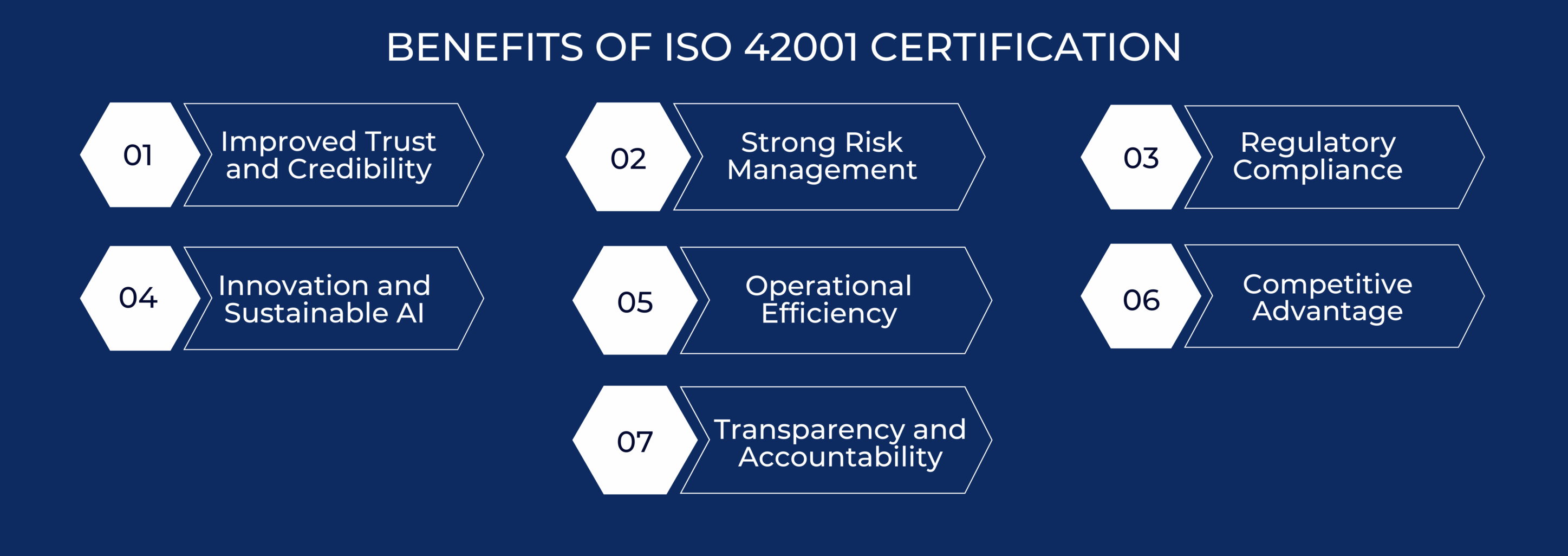
ISO 42001 Certification in North Carolina delivers measurable organizational benefits that extend beyond regulatory positioning. Certification provides independently verified evidence of AI governance maturity, supports competitive differentiation in procurement and sales processes, reduces AI-related risk exposure through structured risk management, and provides a documented accountability framework for board-level AI oversight.
For North Carolina organizations competing in AI-intensive markets — technology, financial services, healthcare, defense — certification represents a strategic asset that only independent third-party verification can uniquely provide. The structured ISO 42001 assessment process itself generates valuable governance insights, helping organizations identify and close gaps before they become operational or reputational liabilities.
Enterprise procurement teams, government contracting officers, and regulated-industry buyers are increasingly requiring documented AI governance credentials as prerequisites for vendor selection. ISO 42001 certification for North Carolina companies provides a recognized, independently verified credential that satisfies these requirements without requiring custom documentation for each customer engagement. Research Triangle AI companies competing for contracts with healthcare networks, financial institutions, defense agencies, and technology enterprises can reference their ISO 42001 certification as demonstrable evidence of AI governance maturity — reducing procurement friction and shortening sales cycles in regulated sectors.
For North Carolina organizations entering international markets — particularly in the European Union, where the EU AI Act creates binding AI governance obligations — ISO 42001 certification provides a recognized governance baseline that facilitates market entry and supports proactive regulatory engagement.
ISO 42001 audit activities in North Carolina generate structured findings and recommendations that organizations can use to continuously improve their AIMS maturity. Unlike one-time compliance exercises, the ISO 42001 certification lifecycle — with annual surveillance audits and three-year recertification cycles — creates a sustained governance improvement rhythm that compounds over time.
Organizations that embed AIMS processes into AI product development, data management, and organizational decision-making progressively strengthen their AI governance infrastructure over successive certification cycles. This ongoing improvement trajectory is increasingly recognized by sophisticated enterprise customers and institutional investors as evidence of genuine AI governance maturity — not merely a point-in-time compliance achievement.
Structured AI risk management under ISO/IEC 42001:2023 reduces the probability and consequence of AI system failures that generate financial losses, regulatory penalties, reputational damage, or harm to affected individuals. Organizations that conduct systematic AI impact assessments, maintain AI risk registers, implement Annex A controls appropriate to their risk profile, and monitor AI system performance through defined processes are better positioned to detect governance failures early — before they escalate into material incidents.
For North Carolina healthcare organizations, AI governance failures in clinical decision support systems can have direct patient safety consequences. For financial services organizations, AI model failures in credit decisioning or fraud detection can generate regulatory enforcement actions, consumer harm, and significant financial losses. ISO 42001 certification structures risk management to address these scenarios through defined, audited governance processes that are evaluated during every ISO 42001 audit cycle.
- ✓Independently verified AI governance credential recognized by enterprise customers, regulators, and investors
- ✓Structured AI risk management reducing exposure to AI system failures and associated consequences
- ✓Documented accountability framework supporting board-level AI oversight and governance reporting
- ✓Competitive differentiation in procurement processes requiring demonstrated AI governance maturity
- ✓Integration with ISO 27001 and existing management systems reducing duplicated governance infrastructure
- ✓Sustained AIMS improvement through annual surveillance audits and three-year recertification cycles
- ✓Evidence base supporting regulatory engagement with FDA, OCC, SEC, and other relevant authorities
- ✓Market access facilitation for organizations pursuing EU, UK, and international regulated markets
- ✓Market Access and Competitive Differentiation
- ✓Risk Reduction and Operational Confidence
Why AI Governance Certification Matters: U.S. and North Carolina Context
The regulatory and policy environment surrounding AI governance in the United States is evolving rapidly. Federal executive actions, agency guidance, and congressional activity are creating an environment in which documented, independently audited AI governance is increasingly expected — particularly for organizations operating in regulated sectors, providing services to government agencies, or developing AI systems with significant impact on individuals.
North Carolina organizations active in these contexts benefit from understanding how ISO 42001 Certification in North Carolina relates to this broader regulatory landscape — and where the certification’s scope and limitations lie. A well-executed ISO 42001 assessment provides both a governance credential and a strategic framework for navigating evolving AI oversight requirements.
NIST AI RMF and ISO 42001 Alignment
The NIST AI Risk Management Framework (AI RMF 1.0), published in January 2023, provides a voluntary framework for managing AI risks structured around four core functions: Govern, Map, Measure, and Manage. ISO/IEC 42001:2023 and the NIST AI RMF share foundational principles — AI risk identification, assessment, and treatment; AI governance structures; transparency and accountability; and continual improvement. Organizations that have adopted the NIST AI RMF as a voluntary governance framework will find significant conceptual alignment with ISO/IEC 42001:2023 requirements, and existing NIST AI RMF documentation can inform AIMS risk assessments, policy development, and control selection.
However, ISO 42001 certification is a formal third-party certification process evaluated against specific standard requirements — it is distinct from NIST AI RMF adoption or self-assessment. ISO 42001 certification does not certify NIST AI RMF conformance, nor does NIST AI RMF adoption alone satisfy ISO/IEC 42001:2023 certification requirements. These are complementary but separate assurance mechanisms.
North Carolina organizations — particularly universities, research institutions, and government-adjacent technology providers — that have engaged with the NIST AI RMF through federal agency relationships, research grants, or voluntary adoption programs can leverage existing AI risk documentation and governance structures when preparing for an ISO 42001 assessment. The NIST AI RMF Playbook, NIST AI RMF Profiles, and sector-specific AI risk guidance published by NIST provide detailed implementation guidance that can support AIMS development.
Auditors conducting ISO 42001 certification audits in North Carolina will evaluate whether the organization’s AIMS meets ISO/IEC 42001:2023 clause requirements — not NIST AI RMF functional requirements. That said, alignment between the two frameworks meaningfully reduces the documentation burden for organizations that have already invested in NIST AI RMF adoption.
North Carolina Regulatory and Privacy Considerations
North Carolina’s Identity Theft Protection Act and related data security requirements establish baseline data protection obligations relevant to organizations managing personal data within AI systems. North Carolina does not currently have a comprehensive consumer privacy law equivalent to Virginia’s Consumer Data Protection Act or California’s CPRA. However, organizations handling personal data of North Carolina residents must comply with applicable federal privacy regulations — including HIPAA for health information, GLBA for financial data, and FERPA for educational records — as well as sector-specific data protection requirements.
ISO 42001 Certification in North Carolina does not automatically establish compliance with these legal frameworks. However, Annex A controls addressing data governance for AI systems — including controls on data quality, data provenance, data privacy in AI processing, and information security for AI data assets — directly support the data protection practices required by applicable privacy laws when implemented effectively. Organizations should treat ISO 42001 compliance as a complement to, not a substitute for, dedicated legal and regulatory compliance analysis.
ISO 42001 Certification for Organizations in North Carolina: Scope and Decision Framework
Determining whether to pursue ISO 42001 Certification in North Carolina involves evaluating the organization’s AI activities, customer and regulatory environment, risk profile, and strategic objectives. The ISO AIMS standard applies to organizations of any size — from AI startups with focused product portfolios to large enterprises with complex, multi-system AI deployments.
The certification decision is typically driven by one or more of four primary factors: customer or contractual requirements, regulatory environment, risk management strategy, or market differentiation objectives. Organizations pursuing ISO 42001 certification for North Carolina operations should evaluate each of these factors carefully against their specific business context before defining their AIMS scope and initiating an ISO 42001 assessment.
Organizations That Need ISO 42001 Certification
Any organization that develops AI systems, integrates AI capabilities into products or services, deploys AI in business operations, or provides AI-enabled services to customers can benefit from ISO 42001 Certification in North Carolina. The standard explicitly recognizes three organizational roles relative to AI systems: AI providers (organizations that develop and supply AI systems or services), AI deployers (organizations that deploy AI systems in operational contexts), and AI consumers (organizations that use AI-enabled products or services).
Each role carries different AIMS obligations under ISO/IEC 42001:2023, and the certification scope must clearly identify the organization’s role(s) and the AI systems subject to certification. Small and medium-sized enterprises — common in North Carolina’s startup ecosystem — can scope their AIMS to address a narrowly defined set of AI systems, making certification achievable without the extensive governance infrastructure required by large-enterprise AIMS deployments.
Organizations providing AI systems or AI-enabled services to North Carolina government agencies, federal government contractors, or regulated-industry customers are among the most time-sensitive ISO 42001 certification candidates. Government procurement requirements for AI governance documentation are evolving rapidly at both the federal and state levels, and prime contractors are increasingly flowing down AI governance requirements to subcontractors and technology vendors.
ISO 42001 assessment outcomes provide documented, independently verified evidence that vendor AI systems are governed within a structured management framework — satisfying procurement requirements more efficiently than custom documentation responses and reducing vendor qualification burden in competitive procurement processes. Defense and aerospace organizations in North Carolina with AI-enabled systems in development or deployment should evaluate ISO 42001 certification as a core component of their AI governance and procurement readiness strategy.
Scoping Decisions and Certification Strategy
Effective AIMS scoping is the foundation of a credible ISO 42001 certification audit. Organizations that define AIMS scope too broadly — encompassing AI systems with insufficient governance infrastructure — risk material nonconformities and certification audit failure. Organizations that define scope too narrowly — excluding material AI systems to reduce certification burden — risk producing a credential that does not satisfy customer or regulatory expectations.
The optimal approach defines AIMS scope to include AI systems that are material to the organization’s value proposition, subject to customer or regulatory AI governance expectations, or associated with significant AI risks to individuals or the organization. For North Carolina technology companies with multiple AI products, a phased certification approach — beginning with a defined product line or business unit and expanding scope over successive certification cycles — is a viable strategy for building AIMS maturity incrementally while delivering certification value at each stage.
Independent ISO 42001 Certification by a Licensed CPA Firm in North Carolina
CertPro conducts ISO 42001 certification audits in North Carolina as a Licensed CPA Firm providing independent third-party certification services under ISO/IEC 42001:2023. CertPro’s ISO 42001 audit engagements in North Carolina follow a defined certification audit methodology covering scope determination, audit program development, Stage 1 documentation review, Stage 2 operational conformance evaluation, nonconformity assessment, certification decision, and ongoing surveillance audit activities.
All certification activities are performed by qualified auditors with demonstrated competence in AI management systems, AI risk management, and ISO management-system auditing. This ensures that ISO 42001 certification audit outcomes reflect rigorous, evidence-based evaluation — not advisory or consulting assessments. Organizations seeking ISO AIMS certification in North Carolina receive a credential backed by a structured, documented audit process aligned with international certification standards.
Audit Independence and Certification Body Positioning
CertPro’s position as an independent certification body means that all ISO 42001 assessment activities are evaluation-focused. Auditors assess objective evidence of AIMS conformance and report findings to the certification decision-maker without providing implementation advice, control design, or policy development services. This independence is fundamental to the credibility of the ISO 42001 certificate: customers, regulators, and contractual partners rely on the certificate as evidence of independent evaluation — not self-assessment or advisor-endorsed compliance.
Organizations in North Carolina seeking ISO 42001 certification that require AIMS implementation support — policy development, risk assessment design, control implementation, or internal audit program development — should engage qualified AI management system consultants separately from the certification body. Maintaining the independence of the certification audit function is essential to preserving the integrity and market value of the resulting credential.
ISO AIMS certification that North Carolina organizations receive from CertPro is issued following a defined certification decision process. Audit findings, nonconformity resolutions, and objective evidence are evaluated against ISO/IEC 42001:2023 requirements by a qualified certification decision-maker independent of the audit team. Certificates clearly identify the certified organization, the AIMS scope, the applicable standard (ISO/IEC 42001:2023), the certification validity period, and the issuing certification body.
Certificates are subject to suspension or withdrawal if surveillance audits identify major nonconformities, the organization fails to submit required corrective action evidence, or the AIMS scope changes materially without notification. The certification is publicly verifiable, providing customers, regulators, and interested parties with a reliable mechanism to confirm the organization’s current ISO 42001 compliance status.
Audit Methodology and Evidence Standards
CertPro’s ISO 42001 certification audit methodology is structured around ISO 19011 (Guidelines for Auditing Management Systems) and ISO/IEC 17021-1 (Requirements for bodies providing audit and certification of management systems). Auditors apply consistent evidence-gathering methods — document review, personnel interviews, operational process observation, technical evidence inspection, and record examination — to evaluate conformance with each applicable ISO/IEC 42001:2023 clause and Annex A control.
Audit programs are tailored to each organization’s AIMS scope, AI system complexity, sector-specific risk profile, and organizational size. Audit findings are documented in structured reports that clearly distinguish conformant areas, observations, minor nonconformities, and major nonconformities. This gives organizations actionable information about AIMS strengths and areas requiring corrective action, while maintaining the independence and objectivity required of a certification body conducting an ISO 42001 audit in North Carolina.
FAQ
▶
What is ISO 42001 certification?
▶
What is ISO 42001 certification and what does it certify?
▶
How long does ISO 42001 certification take for a North Carolina organization?
▶
What is the ISO AIMS standard and how does it differ from other AI frameworks?
▶
How does the ISO 42001 audit process work in North Carolina?
▶
Does ISO 42001 certification establish compliance with North Carolina law or U.S. federal AI regulations?
▶
Who needs ISO 42001 certification in North Carolina?
▶
What is the Statement of Applicability in ISO 42001?
ISO 42001 CERTIFIED: WHY AI GOVERNANCE CERTIFICATION IS BECOMING A BOARD-LEVEL REQUIREMENT
ISO 42001 Certified: Board-Level AI Governance Guide | CertPro CPA LLC HERO ══════════════════════════════ –> src=”https://certpro.com/wp-content/uplo…
Get In Touch
have a question? let us get back to you.