
ISO 27001 Certification in Tennessee
ISO 27001 Certification in Tennessee delivers independently verified, measurable outcomes for organizations that complete the certification process. The certificate provides structured evidence of ISMS conformance that is recognized across international procurement, regulatory, and client assurance contexts. The following benefits are directly attributable to the certified ISMS and the audit findings that support the certification decision.
OUR CLIENTS










ISO 27001 Certification in Tennessee by a Licensed CPA Firm
ISO 27001 Certification in Tennessee is issued by CertPro, a Licensed CPA Firm operating as an independent third-party certification body. CertPro evaluates organizations against the requirements of ISO/IEC 27001:2022, the internationally recognized standard for Information Security Management Systems (ISMS). The certification process involves a structured, evidence-based audit conducted by qualified ISO 27001 Auditors who assess whether an organization’s ISMS meets all mandatory clauses and applicable Annex A controls. Tennessee-based organizations that complete the ISO 27001 audit and satisfy all certification criteria receive a formal ISO 27001 certificate valid for three years, subject to annual surveillance audits.
Tennessee presents a concentrated and diverse information security landscape. The state anchors significant national capacity in healthcare and health information management, with major hospital systems, health technology companies, and revenue cycle management providers headquartered in Nashville and across the region. Memphis serves as one of the world’s primary logistics and distribution hubs, with organizations managing large volumes of supply chain, transportation, and vendor data. Knoxville and Chattanooga support advanced manufacturing, automotive components, and a growing base of SaaS and cloud infrastructure providers.
Across these sectors, organizations handle sensitive personal, financial, and operational data at scale. This makes ISO 27001 compliance in Tennessee a top priority for procurement, regulatory alignment, and enterprise risk management. Demand for ISO 27001 Certification in Tennessee continues to grow as clients, regulators, and partners require independently verified security credentials.
CertPro conducts ISO 27001 certification audits across all major Tennessee markets, including Nashville, Memphis, Knoxville, and Chattanooga. As a Licensed CPA Firm, CertPro operates under professional standards governing independence, objectivity, and attestation procedures. This institutional framework distinguishes CertPro’s ISO 27001 attestation services from consulting or advisory firms.
CertPro does not provide implementation services, policy development, or control design. The firm’s exclusive focus is on independent audit, evidence evaluation, and certification decisions — functions that require clear separation from the organizations being assessed. Tennessee companies across healthcare, fintech, managed services, cloud computing, and automotive manufacturing engage CertPro to obtain ISO 27001 Certification in Tennessee through a defined, transparent, and reproducible audit methodology aligned with ISO/IEC 27001:2022 and applicable accreditation standards.
The ISO/IEC 27001:2022 standard introduced significant structural changes from the 2013 version, reducing the number of Annex A controls from 114 to 93 and reorganizing them into four control domains: Organizational Controls, People Controls, Physical Controls, and Technological Controls. The transition deadline established by international certification bodies is October 31, 2025, after which all certifications must reference the 2022 version of the standard.
Tennessee organizations currently certified under ISO/IEC 27001:2013 are required to complete transition audits before this deadline. CertPro conducts transition assessments as part of its structured recertification and surveillance audit program, evaluating whether an organization’s ISMS has been updated to reflect the revised control set, new control categories, and updated documentation requirements mandated by the 2022 standard revision.

What Is ISO 27001 Certification?
ISO 27001 Certification is the formal recognition that an organization has implemented, operates, and maintains an Information Security Management System that conforms to the requirements of ISO/IEC 27001:2022. Certification is awarded following a successful independent audit by an accredited or qualified certification body. It demonstrates that the organization has established a systematic approach to identifying information security risks, selecting and implementing appropriate controls, measuring control effectiveness, and continuously improving its overall security posture.
ISO 27001 Certification is recognized internationally across regulated industries, government procurement, and enterprise vendor qualification processes. For Tennessee organizations, earning this credential signals a mature, independently verified commitment to information security.
The Information Security Management System (ISMS)
The ISMS is the core subject of the ISO 27001 audit. It comprises the policies, procedures, processes, organizational structures, and technical controls that an organization uses to manage information security risks. Under ISO/IEC 27001:2022, the ISMS must cover a defined scope, be supported by documented evidence, and operate under a continuous improvement cycle based on the Plan-Do-Check-Act (PDCA) model.
The standard requires leadership commitment, defined roles and responsibilities, a documented risk assessment and risk treatment process, a Statement of Applicability (SoA), and measurable objectives. ISO 27001 Auditors evaluate whether each of these elements exists, operates as documented, and produces evidence of effectiveness across the defined certification scope.
The scope of the ISMS defines which information assets, processes, locations, and organizational units fall within the ISO 27001 audit boundary. Organizations may certify the entire enterprise or a defined subset of operations, such as a specific product line, data center, or business unit. The scope statement must be documented, justified, and consistent with the organization’s context, interested party requirements, and legal obligations.
Auditors assess whether the declared scope is reasonable, whether all in-scope assets are covered by the risk assessment, and whether controls applied within the scope are adequate and operating effectively. Scope exclusions must be formally justified and must not remove controls that would otherwise be necessary to meet the standard’s requirements.
Annex A Controls and the Statement of Applicability
ISO/IEC 27001:2022 Annex A contains 93 controls organized across four domains: Organizational Controls (37 controls), People Controls (8 controls), Physical Controls (14 controls), and Technological Controls (34 controls). Organizations must evaluate the applicability of each control to their risk environment and document inclusion or exclusion decisions in the Statement of Applicability (SoA).
The SoA is a mandatory document and a primary audit artifact. It maps each Annex A control to the organization’s risk treatment plan and identifies the implementation status and justification for each control. ISO 27001 Auditors review the SoA to verify that control selection decisions are risk-driven, documented, and consistent with identified threats and vulnerabilities.
The 2022 version of the standard introduced 11 new controls not present in the 2013 edition. These include controls addressing threat intelligence, information security for cloud services, ICT readiness for business continuity, physical security monitoring, configuration management, information deletion, data masking, web filtering, and secure coding.
Tennessee organizations in cloud computing, SaaS, and healthcare information technology are particularly impacted by the new cloud services control, which requires systematic evaluation of information security obligations across cloud service agreements. ISO 27001 Auditors assess whether organizations have inventoried their cloud service dependencies, classified data processed in cloud environments, and established contractual and technical controls consistent with the standard’s requirements.
ISO 27001 Certification Audit Process in Tennessee
The ISO 27001 audit process in Tennessee follows a structured, multi-stage methodology consistent with ISO/IEC 17021-1 and ISO/IEC 27006 requirements governing management system certification bodies. Each stage produces documented findings, audit evidence, and formal reports that inform the final certification decision. The process is conducted exclusively by qualified ISO 27001 Auditors with technical competence in information security management systems and relevant industry knowledge.
The following stages define the complete certification audit lifecycle for Tennessee-based organizations seeking ISO 27001 Certification in Tennessee through CertPro.
The Stage 1 audit is a documentation review conducted to evaluate whether the organization’s ISMS is sufficiently developed and documented to proceed to Stage 2. ISO 27001 Auditors examine the ISMS scope statement, information security policy, risk assessment methodology, risk register, risk treatment plan, Statement of Applicability, and key procedural documents.
The Stage 1 audit also evaluates whether the organization understands its own ISMS, whether internal audits have been completed, and whether management review has been performed. The outcome is a formal report identifying areas of conformance, areas requiring attention, and a determination of Stage 2 readiness. Any significant documentation deficiencies identified at Stage 1 must be resolved before Stage 2 commences.
The Stage 1 ISO 27001 audit is typically conducted remotely or at the organization’s primary facility, depending on the scope and complexity of the ISMS. For multi-site Tennessee organizations, the Stage 1 audit may involve remote document collection and virtual review sessions.
Auditors issue a Stage 1 audit report that includes identified areas for further investigation during Stage 2, any observations regarding scope adequacy, and an audit program for the subsequent Stage 2 assessment. The interval between Stage 1 and Stage 2 is defined during audit planning, allowing the organization sufficient time to address any documentation gaps without causing undue delay to the certification timeline.
The Stage 2 audit is the primary conformity assessment. ISO 27001 Auditors evaluate whether the ISMS is implemented, operational, and effective across the declared certification scope. This includes testing the implementation and operating effectiveness of Annex A controls identified as applicable in the Statement of Applicability.
Auditors collect evidence through document review, process observation, personnel interviews, technical inspection, and sampling of records and logs. Evidence must demonstrate that controls are not only documented but actively operating as described and producing measurable security outcomes. The Stage 2 audit Tennessee organizations undergo is conducted on-site at all primary locations within the defined scope.
Nonconformities identified during Stage 2 are classified as major or minor. A major nonconformity indicates a fundamental failure of a mandatory ISMS requirement or the complete absence of a required control. A minor nonconformity indicates a partial failure, isolated lapse, or documentation inconsistency that does not represent a systemic breakdown.
Major nonconformities must be resolved and corrective actions verified by the auditor before a certification decision can be issued. Minor nonconformities require documented corrective action plans with defined timelines, and resolution is verified during the first surveillance audit. The Stage 2 audit report provides a complete record of findings, evidence references, and nonconformity classifications that form the basis of the certification decision.
Following successful completion of the Stage 2 audit and resolution of any major nonconformities, the certification decision is made by a qualified certification reviewer who is independent of the audit team. The ISO 27001 certificate is issued upon a positive certification decision and is valid for three years from the date of issuance.
The certificate identifies the organization’s name, the certified scope, the applicable standard (ISO/IEC 27001:2022), the certification body, and the certificate validity period. Tennessee organizations may use the ISO 27001 certificate in vendor qualification processes, regulatory submissions, client assurance documentation, and public-facing communications regarding their information security posture.
Surveillance audits are conducted annually during the three-year certification period to verify that the ISMS continues to conform to ISO/IEC 27001:2022 requirements and remains operationally effective. Surveillance audits are narrower in scope than the initial certification audit but must cover mandatory ISMS elements, including internal audit results, management review outputs, corrective action status, and a rotating sample of Annex A controls.
Failure to complete a scheduled surveillance audit or to resolve outstanding nonconformities within required timeframes may result in suspension or withdrawal of the ISO 27001 certificate. Recertification audits are conducted in the third year of the certification cycle and constitute a full reassessment comparable in depth to the original Stage 2 audit.
| Audit Stage | Purpose | Typical Duration | Outcome |
|---|---|---|---|
| Stage 1 Audit | Documentation and ISMS readiness review | 1–2 days | Stage 1 report; Stage 2 readiness determination |
| Stage 2 Audit | Control implementation and effectiveness testing | 2–5 days (scope-dependent) | Nonconformity report; certification recommendation |
| Certification Decision | Independent review of audit findings | Post-audit | ISO 27001 certificate issued or withheld |
| Surveillance Audit (Annual) | Ongoing conformance verification | 1–2 days | Continued certification or corrective action required |
| Recertification Audit | Full ISMS reassessment at three-year renewal | 2–4 days | Certificate renewed for three additional years |
- ✓Stage 1 Audit: Documentation and Readiness Review
- ✓Stage 2 Audit: Control Effectiveness and Evidence Evaluation
- ✓Certification Decision, Certificate Issuance, and Surveillance
ISO 27001 Certification Requirements and ISMS Framework
ISO 27001 compliance requires organizations to satisfy all mandatory clauses of ISO/IEC 27001:2022 (Clauses 4 through 10) and to implement applicable Annex A controls based on a documented risk assessment and treatment process. The mandatory clauses address organizational context, leadership and commitment, planning, support, operation, performance evaluation, and continual improvement.
Compliance with each clause must be demonstrated through documented evidence that ISO 27001 Auditors can examine, test, and validate during the ISO 27001 audit. Organizations pursuing ISO 27001 Certification in Tennessee must ensure their ISMS documentation is complete, current, and operationally active before the certification audit begins.
ISO/IEC 27001:2022 specifies a defined set of mandatory documents and records that must exist and be maintained throughout the ISMS operation. These include the ISMS scope document, information security policy, risk assessment and risk treatment methodology, risk register, risk treatment plan, Statement of Applicability, information security objectives, competence records, operational planning and control documentation, internal audit program and results, management review records, nonconformity and corrective action records, and evidence of monitoring and measurement activities.
Each document must be version-controlled, accessible to relevant personnel, and protected from unauthorized modification. During the ISO 27001 audit, auditors verify document existence, current version status, approval evidence, and operational use.
Beyond mandatory documents, organizations typically maintain a broader set of ISMS procedures and records that support control implementation and audit evidence. These include access control procedures, asset inventory registers, supplier security agreements, incident response records, business continuity plans, backup verification logs, change management records, security awareness training completion records, and vulnerability management reports.
While not all of these are explicitly enumerated as mandatory in the standard text, ISO 27001 Auditors evaluate their existence and adequacy as evidence of control implementation. Tennessee organizations operating in regulated sectors such as healthcare and financial services often maintain additional documentation layers driven by HIPAA, PCI DSS, or state-level data protection requirements that naturally supplement ISO 27001 documentation requirements.
ISO/IEC 27001:2022 requires organizations to establish, implement, and maintain a documented information security risk assessment process. The process must define risk acceptance criteria, identify information security risks associated with the loss of confidentiality, integrity, and availability of information assets within the ISMS scope, analyze and evaluate those risks against defined criteria, and prioritize risks for treatment.
The risk assessment must be repeatable, producing consistent results when applied by different assessors to the same information assets under the same conditions. Risk assessments must be conducted at planned intervals and whenever significant changes occur to the organization’s information assets, processes, or threat environment.
The risk treatment plan documents how each identified risk above the acceptance threshold will be addressed. Treatment options under ISO 27001 include risk modification (applying controls), risk avoidance (eliminating the risk source), risk sharing (transferring risk to a third party such as an insurer), and risk retention (accepting the risk with documented justification).
For each risk selected for modification, the organization must identify applicable Annex A controls from the 2022 standard and document the selection rationale in the Statement of Applicability. Auditors test whether the risk treatment plan has been fully implemented, whether selected controls are operating as intended, and whether residual risk levels have been formally accepted by risk owners with appropriate authority within the organization.
- ✓Mandatory Documentation Requirements
- ✓Risk Assessment and Risk Treatment Requirements
Benefits of ISO 27001 Certification for Tennessee-Based Organizations
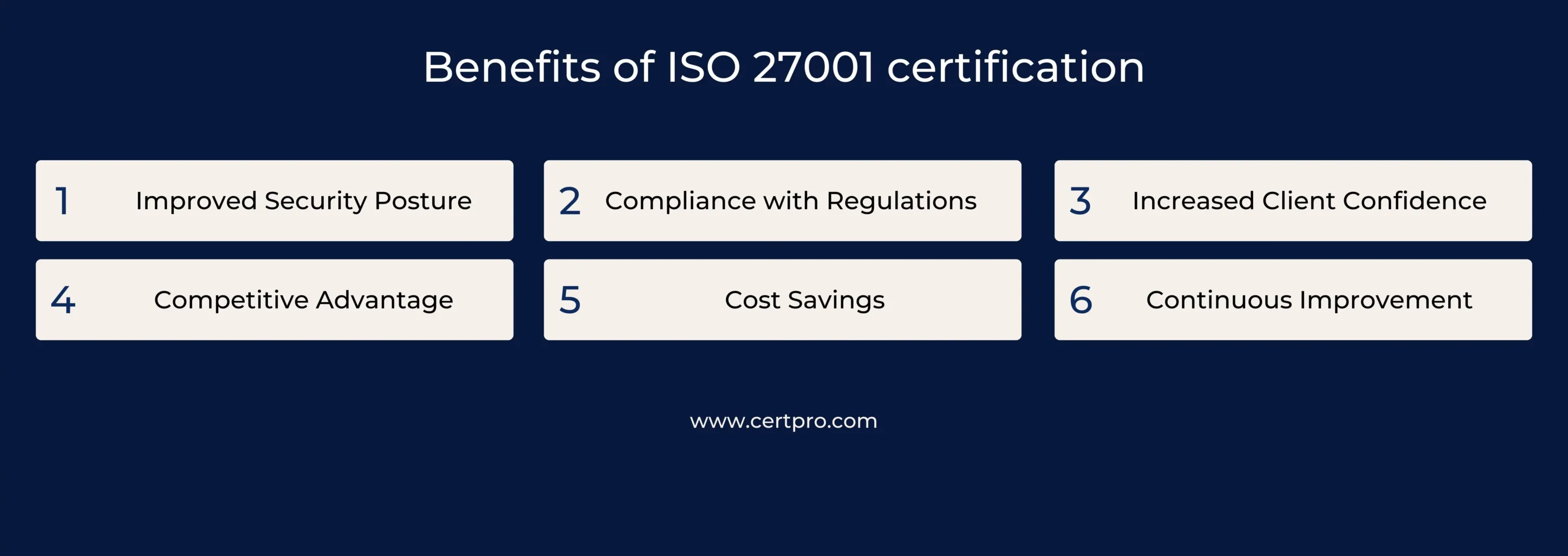
ISO 27001 Certification in Tennessee delivers independently verified, measurable outcomes for organizations that complete the certification process. The certificate provides structured evidence of ISMS conformance that is recognized across international procurement, regulatory, and client assurance contexts. The following benefits are directly attributable to the certified ISMS and the audit findings that support the certification decision.
ISO 27001 Certification in Tennessee provides organizations with a formal, third-party-verified credential that demonstrates adherence to internationally recognized information security standards. Enterprise clients, government agencies, and regulated-industry buyers increasingly require ISO 27001 Certification as a vendor qualification criterion before contracting with technology providers, managed service providers, or data processors.
For Tennessee companies competing for contracts with large healthcare systems, financial institutions, federal government agencies, or multinational manufacturers, ISO 27001 Certification is a documented differentiator that reduces the time and cost of vendor security assessments. Certified organizations can present the ISO 27001 certificate and audit summary as evidence of security posture, reducing the need to complete multiple bespoke security questionnaires.
ISO 27001 attestation provides clients and partners with independently produced evidence that security controls are implemented and operating effectively — not merely claimed. This distinction is material in sectors where data breaches carry significant financial, regulatory, and reputational consequences.
Nashville-based health technology companies, Memphis logistics providers, and Knoxville SaaS firms that hold ISO 27001 Certification in Tennessee can demonstrate to clients that their information security programs have been examined by qualified ISO 27001 Auditors and found to conform with the international standard. This audited assurance is structurally more credible than self-assessments, internal questionnaire responses, or marketing representations about security investment.
ISO 27001 compliance supports alignment with multiple U.S. regulatory frameworks relevant to Tennessee organizations. The ISMS controls required under ISO/IEC 27001:2022 map substantively to the administrative, physical, and technical safeguard categories under HIPAA’s Security Rule, which governs electronic protected health information handled by Tennessee’s extensive healthcare and health IT sector.
The standard’s access control, audit logging, encryption, and incident response controls also align with PCI DSS requirements for organizations processing payment card data. Additionally, ISO 27001 compliance addresses foundational security requirements referenced in FTC safeguards rules, NIST Cybersecurity Framework categories, and state data protection obligations. The certified ISMS provides a documented control environment that organizations can reference when demonstrating regulatory compliance across multiple frameworks simultaneously.
- ✓Independently verified information security posture recognized by enterprise and government buyers
- ✓Formal ISO 27001 certificate demonstrating ISMS conformance to ISO/IEC 27001:2022
- ✓Reduced vendor security questionnaire burden through certified credential presentation
- ✓Structured risk assessment framework identifying and prioritizing information security threats
- ✓Regulatory alignment across HIPAA, PCI DSS, NIST CSF, and FTC Safeguards Rule requirements
- ✓Annual surveillance audits providing continuous conformance verification and improvement evidence
- ✓Improved internal security culture through documented roles, responsibilities, and training requirements
- ✓Competitive differentiation in contract qualification for healthcare, fintech, and government procurement
- ✓Competitive Differentiation and Client Assurance
- ✓Regulatory Alignment and Risk Reduction
ISO 27001 Audit Scope and Certification Boundaries
The ISO 27001 audit scope defines the precise boundaries of the certified ISMS, including the organizational units, physical locations, information assets, processes, and systems covered by the certification. Scope definition is one of the most consequential decisions in the certification process, as it determines what the certificate represents and what audit evidence must be collected and evaluated.
For Tennessee organizations with operations across multiple cities or with complex technology environments spanning on-premises, cloud, and hybrid infrastructure, scope definition requires careful analysis of information flows, asset interdependencies, and contractual obligations. Proper scope documentation is essential to obtaining ISO 27001 Certification in Tennessee that accurately reflects the organization’s information security boundaries.
Defining and Documenting the Certification Scope
The certification scope must be documented in the ISMS scope statement and must accurately reflect the organization’s information security boundaries. It must identify the internal and external factors relevant to information security, the requirements of interested parties including customers, regulators, and contractual partners, and the interfaces and dependencies between the certified scope and other organizational functions or external providers.
When an organization certifies a subset of its operations — for example, a specific SaaS product line or a single data center — the scope statement must explain why other organizational functions are excluded and confirm that excluded functions do not compromise the security of in-scope assets. Auditors scrutinize scope boundaries to identify artificial exclusions that would make the certified ISMS non-representative of the organization’s actual information risk profile.
For Tennessee organizations with geographically distributed operations — such as a healthcare organization with clinical locations across Nashville, Memphis, and Knoxville, or a logistics provider with distribution centers across multiple Tennessee cities — the scope must address each relevant site. Multi-site audits require the audit team to sample a representative subset of locations, with sampling methodology documented in the audit plan.
Auditors verify that controls are consistently implemented across all in-scope locations and that site-specific risks have been addressed in the risk assessment. Organizations may also need to address third-party providers, managed service providers, and cloud platforms that process in-scope information assets, as supplier security requirements are a mandatory component of the ISO/IEC 27001:2022 control environment.
Supplier and Third-Party Security in Scope Determinations
ISO/IEC 27001:2022 Annex A includes controls specifically addressing supplier relationships. These controls require organizations to establish and maintain information security requirements for all suppliers and third-party service providers that access, process, store, or transmit in-scope information assets. This includes cloud infrastructure providers, software vendors, managed security service providers, payroll processors, and any other external entity with access to the organization’s information environment within the certified scope.
The organization must maintain a supplier register, document security requirements in supplier agreements, and implement processes for monitoring supplier security performance. Tennessee organizations relying on shared cloud platforms, co-managed IT environments, or outsourced data processing functions must demonstrate that supplier security controls are contractually mandated and periodically evaluated as part of their ISO 27001 compliance program.
Tennessee Industry Sectors Seeking ISO 27001 Certification
ISO 27001 Certification in Tennessee spans a broad and growing range of industry sectors, each driven by distinct information security imperatives, regulatory requirements, and client assurance demands. The state’s economic profile creates concentrated demand for ISO 27001 audit services across healthcare, logistics, automotive, financial services, and technology sectors.
Organizations across these industries engage CertPro to obtain ISO 27001 Certification in Tennessee as a means of strengthening vendor qualifications, satisfying enterprise procurement criteria, and building a defensible, documented information security program.
Healthcare and Health Information Technology
Tennessee is home to one of the largest concentrations of for-profit hospital systems and health information management organizations in the United States. Nashville functions as a national center for healthcare services, health technology, and revenue cycle management, with hundreds of companies managing patient records, claims data, and clinical information at scale.
ISO 27001 Certification for Tennessee companies in this sector provides a structured, audited framework for managing information security risks associated with electronic protected health information. Healthcare organizations use the certified ISMS to demonstrate security program maturity to hospital clients, payer networks, and state regulators, while also establishing a formal control environment that complements HIPAA compliance obligations. ISO 27001 Auditors working with Tennessee healthcare companies assess access controls, audit logging, encryption standards, and incident response procedures as primary control testing areas.
Health technology companies developing clinical software, patient engagement platforms, and interoperability solutions face particularly intense security scrutiny from hospital system procurement teams and federal program administrators. ISO 27001 Certification that Nashville health IT firms pursue provides an independently audited credential that satisfies vendor security assessment requirements across large health system networks.
The certification also supports alignment with ONC Health IT certification requirements and establishes documented controls for data minimization, access restriction, and audit trail requirements that regulators and hospital clients enforce through vendor agreements. For companies competing in Tennessee’s concentrated health technology market, ISO 27001 attestation produced by an independent certification body carries substantially more weight than self-reported security questionnaire responses.
Logistics, Automotive, and Advanced Manufacturing
Memphis is one of the world’s busiest cargo logistics hubs, anchored by FedEx’s global headquarters and a dense ecosystem of third-party logistics providers, freight brokers, and supply chain technology companies. Organizations in this sector handle sensitive shipment data, customer financial information, and proprietary supply chain records across complex technology environments. ISO 27001 Certification that Memphis logistics companies obtain signals to global clients that information security controls governing data transmission, system access, and third-party integrations have been independently audited and certified.
Tennessee’s automotive manufacturing sector — concentrated in Middle Tennessee and including Nissan’s North American operations in Smyrna and a growing base of EV component manufacturers — faces information security requirements driven by OEM supplier qualification standards and automotive cybersecurity frameworks including ISO/SAE 21434. ISO 27001 Certification that Chattanooga and Knoxville advanced manufacturers pursue provides the documented ISMS foundation required by OEM partner qualification processes.
Financial Services, SaaS, and Cloud Providers
Tennessee’s financial services sector includes regional and community banks, insurance companies, mortgage servicers, and a rapidly expanding base of fintech startups and payment technology providers. ISO 27001 compliance that Tennessee financial institutions establish provides a documented control framework for managing risks associated with customer financial data, transaction processing systems, and regulatory reporting environments.
ISO 27001 Certification that Knoxville and Nashville fintech companies pursue demonstrates to banking partners, payment networks, and enterprise clients that information security controls have been independently evaluated. The state’s growing SaaS and cloud infrastructure ecosystem — concentrated in Nashville and along the Knoxville technology corridor — generates consistent demand for ISO 27001 audit services from cloud-hosted application providers seeking enterprise and government contract qualification credentials.
ISO 27001 Compliance and U.S. Regulatory Framework Alignment
ISO 27001 compliance provides Tennessee organizations with a structured control environment that maps substantively to multiple U.S. regulatory and contractual information security requirements. The ISO/IEC 27001:2022 control set addresses the administrative, physical, and technical safeguard categories that appear across HIPAA, PCI DSS, SOC 2, NIST CSF, CMMC, and state data protection laws.
Organizations that maintain a certified ISMS under ISO 27001 can leverage the documented control evidence to satisfy overlapping requirements across multiple frameworks without duplicating compliance activities. This efficiency is a key reason Tennessee organizations across regulated industries pursue ISO 27001 Certification as a foundational compliance credential.
ISO 27001 and HIPAA Security Rule Alignment
The HIPAA Security Rule requires covered entities and business associates to implement administrative, physical, and technical safeguards protecting electronic protected health information. ISO/IEC 27001:2022 controls align directly with each safeguard category. The standard’s organizational controls address security policy, roles and responsibilities, access management, and supplier agreements — corresponding to HIPAA administrative safeguard requirements including workforce training, access authorization, and business associate management.
Physical controls covering secure areas, equipment security, and physical access monitoring address HIPAA physical safeguard requirements for facility access controls and workstation security. Technological controls including access control, cryptography, audit logging, and malware protection address HIPAA technical safeguard requirements for unique user identification, encryption, automatic logoff, and audit controls. Tennessee healthcare organizations that maintain a certified ISMS under ISO 27001 possess documented evidence of control implementation that directly supports HIPAA compliance demonstrations during OCR investigations or business associate audits.
ISO 27001 and HIPAA differ in important structural respects. ISO 27001 is a management system standard requiring a systematic, risk-based approach to control selection and a continuous improvement cycle, while HIPAA specifies defined safeguard categories without mandating a specific management system structure. ISO 27001 Certification does not constitute HIPAA compliance and does not replace the legal obligations imposed by the HIPAA Security Rule.
However, organizations that maintain ISO 27001 Certification produce the types of documented evidence — risk assessments, access control procedures, incident response records, and audit logs — that HIPAA compliance requires. The ISO 27001 ISMS framework provides the organizational infrastructure within which HIPAA-specific controls can be systematically managed, monitored, and demonstrated to regulators and business associates.
ISO 27001 and NIST CSF, SOC 2, and CMMC Alignment
The NIST Cybersecurity Framework organizes information security activities across five functions: Identify, Protect, Detect, Respond, and Recover. ISO/IEC 27001:2022 controls address each NIST CSF function substantively. Asset management and risk assessment controls satisfy the Identify function. Access control, data protection, and awareness training controls satisfy the Protect function. Logging, monitoring, and anomaly detection controls address the Detect function. Incident response procedures satisfy the Respond function. Business continuity and recovery planning controls address the Recover function.
Tennessee organizations that use the NIST CSF as their primary cybersecurity planning framework can adopt ISO 27001 Certification as the independent audit and management system layer that validates NIST CSF implementation. For SOC 2 engagements, ISO 27001 Certification provides documented evidence of control environment maturity that supports the Trust Services Criteria evaluated during a SOC 2 examination, though the two are distinct attestation products requiring separate engagements.
ISO 27001 Assessment: Evaluating ISMS Effectiveness
The ISO 27001 audit conducted by CertPro goes beyond document review to evaluate whether the ISMS produces measurable, demonstrable security outcomes. ISMS effectiveness evaluation is a mandatory requirement under ISO/IEC 27001:2022 Clause 9, which requires organizations to monitor, measure, analyze, and evaluate the performance of the ISMS and the effectiveness of implemented controls.
ISO 27001 Auditors assess the organization’s own performance measurement program as part of the certification audit, examining whether metrics are defined, collected, analyzed, and used to drive management decisions. This focus on demonstrated effectiveness is a distinguishing characteristic of rigorous ISO 27001 attestation.
Internal Audit and Management Review Requirements
ISO/IEC 27001:2022 Clause 9.2 requires organizations to conduct internal audits of the ISMS at planned intervals. Internal audits must be planned, conducted, and reported using a documented internal audit program that addresses all ISMS clauses and relevant Annex A controls over the audit cycle. Internal auditors must be competent and must be independent of the activities they audit.
Internal audit results must be documented and reported to relevant management, and identified nonconformities must be addressed through the organization’s corrective action process. During the ISO 27001 certification audit, CertPro auditors examine the internal audit program, review internal audit reports, verify auditor competence records, and assess whether internal audit findings have been appropriately addressed through documented corrective actions.
Clause 9.3 requires top management to review the ISMS at planned intervals to ensure its continuing suitability, adequacy, and effectiveness. The management review must consider inputs including the status of previous management review actions, changes in external and internal issues relevant to the ISMS, information security performance data including audit results and incident statistics, stakeholder feedback, risk assessment results, and opportunities for continual improvement.
Management review outputs must include decisions and actions related to continual improvement opportunities, ISMS modifications, and resource requirements. Auditors assess management review records for completeness of required inputs and outputs, frequency of reviews, and evidence that management is actively engaged in ISMS governance rather than treating the review as a compliance formality.
Corrective Action and Continual Improvement
ISO/IEC 27001:2022 Clause 10 requires organizations to maintain a documented nonconformity and corrective action process. When a nonconformity occurs — whether identified through internal audit, surveillance audit, incident investigation, or monitoring activities — the organization must document the nonconformity, determine its root cause, implement corrective actions addressing the root cause, verify corrective action effectiveness, and update the ISMS as necessary to prevent recurrence.
Corrective action records are a primary audit artifact. CertPro auditors review corrective action logs to assess the organization’s capability for systematic problem resolution, the quality of root cause analysis, and the timeliness and effectiveness of implemented corrections. A mature corrective action process is a strong indicator of a genuinely operational ISMS — one that reflects real ISO 27001 compliance rather than a documentation-only exercise.
ISO 27001 Certification in Tennessee: Summary and Key Takeaways
ISO 27001 Certification in Tennessee is a structured, independently audited credential that demonstrates an organization’s ISMS conforms to the requirements of ISO/IEC 27001:2022. CertPro, as a Licensed CPA Firm, conducts ISO 27001 audits for Tennessee organizations across all major industry sectors and geographic markets, including Nashville, Memphis, Knoxville, and Chattanooga.
The ISO 27001 attestation CertPro issues is based on evidence collected during a rigorous two-stage audit process, conducted by qualified ISO 27001 Auditors operating under professional standards governing independence, objectivity, and audit methodology. The three-year certification cycle, including annual surveillance audits, provides ongoing verification that the ISMS continues to operate effectively and conform to the standard’s requirements.
Tennessee organizations across healthcare, logistics, automotive manufacturing, financial services, SaaS, and cloud computing sectors pursue ISO 27001 Certification in Tennessee to meet enterprise procurement requirements, demonstrate information security maturity to regulated-industry clients, align with U.S. regulatory frameworks including HIPAA and NIST CSF, and establish a formal, documented risk management program for sensitive information assets.
The October 31, 2025 transition deadline to ISO/IEC 27001:2022 requires organizations currently certified under the 2013 version to complete transition audits through a qualified certification body. CertPro conducts transition assessments, initial certifications, surveillance audits, and recertification audits as independent third-party ISO 27001 audit services for Tennessee-based entities seeking to maintain or achieve ISO 27001 Certification in Tennessee.
Key Facts: ISO 27001 Certification in Tennessee
| Topic | Key Detail |
|---|---|
| Applicable Standard | ISO/IEC 27001:2022 (transition required from 2013 version by October 31, 2025) |
| Certification Body | CertPro — Licensed CPA Firm operating as independent third-party certification body |
| Audit Stages | Stage 1 (documentation review) and Stage 2 (control effectiveness testing) |
| Certificate Validity | Three years from issuance date, subject to annual surveillance audits |
| Primary Tennessee Markets | Nashville, Memphis, Knoxville, Chattanooga |
Frequently Asked Questions: ISO 27001 Certification in Tennessee
Who provides ISO 27001 certification audits in Tennessee?
CertPro, a Licensed CPA Firm, provides ISO 27001 certification audits in Tennessee. CertPro operates as an independent third-party certification body, conducting Stage 1 and Stage 2 audits for organizations across Nashville, Memphis, Knoxville, Chattanooga, and other Tennessee markets. CertPro’s ISO 27001 Auditors evaluate ISMS conformance with ISO/IEC 27001:2022 requirements and issue formal ISO 27001 Certification upon successful audit completion.
What is the difference between the Stage 1 and Stage 2 ISO 27001 audit?
The Stage 1 ISO 27001 audit is a documentation review that assesses whether the organization’s ISMS is sufficiently developed to proceed to Stage 2. The Stage 2 audit is the primary conformity assessment, during which ISO 27001 Auditors test the implementation and operating effectiveness of Annex A controls through evidence collection, interviews, and technical inspection. Both stages are required before a certification decision can be made for ISO 27001 Certification in Tennessee.
How long is an ISO 27001 certificate valid?
An ISO 27001 certificate is valid for three years from the date of issuance. During the three-year period, annual surveillance audits are required to verify ongoing conformance with ISO/IEC 27001:2022. In the third year, a recertification audit — comparable in scope to the original Stage 2 audit — must be completed to renew the certificate for an additional three-year cycle.
What are the mandatory documents required for ISO 27001 certification?
ISO/IEC 27001:2022 requires the following mandatory documents: ISMS scope statement, information security policy, risk assessment and risk treatment methodology, risk register, risk treatment plan, Statement of Applicability, information security objectives, internal audit program and results, management review records, corrective action records, and evidence of monitoring and measurement activities. During the ISO 27001 audit, auditors verify the existence, currency, and operational use of each document.
How does ISO 27001 compliance relate to HIPAA requirements for Tennessee healthcare organizations?
ISO 27001 compliance supports HIPAA Security Rule alignment by establishing documented administrative, physical, and technical controls that correspond to HIPAA safeguard categories. ISO 27001 Certification does not constitute HIPAA compliance and does not replace legal obligations under the HIPAA Security Rule. However, the certified ISMS produces documented control evidence — including risk assessments, access control procedures, and audit logs — that directly supports HIPAA compliance demonstrations during regulatory reviews and business associate audits.
What is the ISO/IEC 27001:2022 transition deadline?
The transition deadline from ISO/IEC 27001:2013 to ISO/IEC 27001:2022 is October 31, 2025. After this date, all ISO 27001 certifications must reference the 2022 version of the standard. Tennessee organizations currently certified under the 2013 version must complete a transition audit through a qualified certification body before the deadline to maintain valid ISO 27001 Certification in Tennessee.
How many Annex A controls are in ISO/IEC 27001:2022?
ISO/IEC 27001:2022 Annex A contains 93 controls organized across four domains: Organizational Controls (37), People Controls (8), Physical Controls (14), and Technological Controls (34). This represents a reduction from 114 controls in the 2013 version, alongside the introduction of 11 new controls addressing threat intelligence, cloud services, ICT business continuity, and secure coding, among others. ISO 27001 Auditors evaluate each applicable control during the ISO 27001 audit.
What is the ISO 27001 audit process timeline for Tennessee organizations?
The ISO 27001 audit process timeline varies based on organizational size, ISMS scope complexity, and the number of in-scope locations. Stage 1 audits typically require one to two days. Stage 2 audits range from two to five days depending on scope. The interval between Stage 1 and Stage 2 is defined during audit planning. Following Stage 2, the certification decision process adds additional time before the ISO 27001 certificate is formally issued. Annual surveillance audits require one to two days each.
Which Tennessee industries most commonly pursue ISO 27001 certification?
Tennessee industries most commonly pursuing ISO 27001 Certification include healthcare and health information technology companies in Nashville, logistics and supply chain providers in Memphis, automotive and advanced manufacturing firms in Middle Tennessee and Knoxville, financial services and fintech companies statewide, and SaaS, cloud infrastructure, and managed service providers across Nashville and the Knoxville technology corridor. ISO 27001 Certification in Tennessee for companies in these sectors is driven by enterprise procurement requirements, regulatory alignment needs, and client assurance demands that require independently verified ISO 27001 compliance.
FAQ
▶
What is ISO 27001 certification?
▶
Who provides ISO 27001 certification audits in Tennessee?
▶
What is the difference between the Stage 1 and Stage 2 ISO 27001 audit?
▶
How long is an ISO 27001 certificate valid?
▶
What are the mandatory documents required for ISO 27001 certification?
▶
How does ISO 27001 compliance relate to HIPAA requirements for Tennessee healthcare organizations?
▶
What is the ISO/IEC 27001:2022 transition deadline?
▶
How many Annex A controls are in ISO/IEC 27001:2022?
Get In Touch
have a question? let us get back to you.