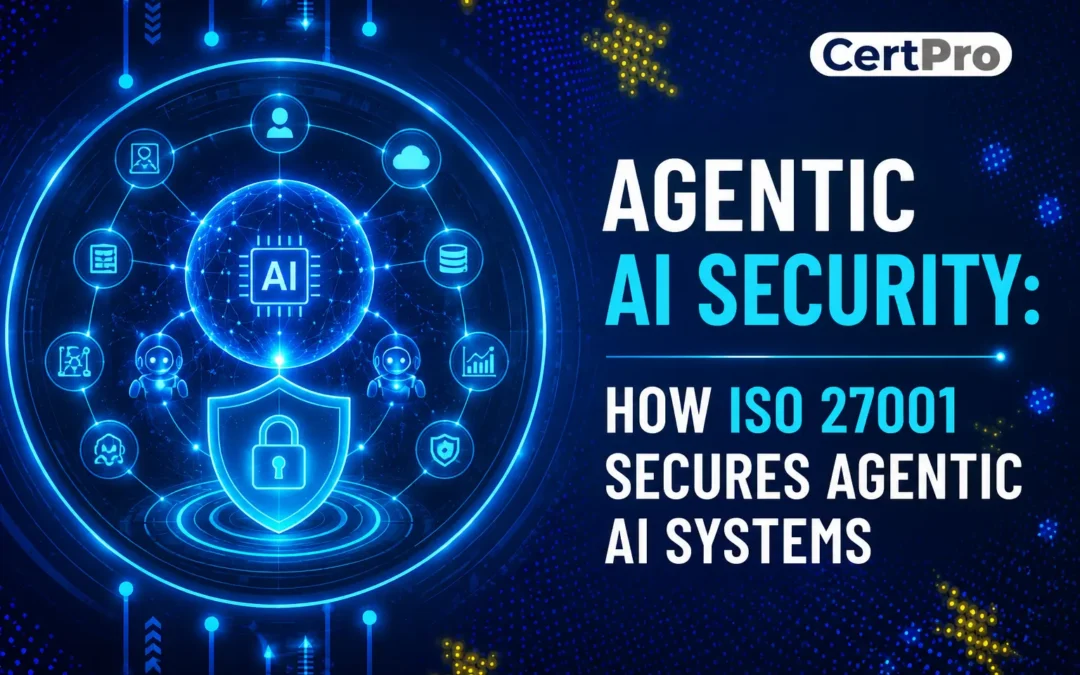

Agentic AI is transforming how enterprises automate decisions, execute workflows, and interact with business systems. Unlike traditional AI models that respond to prompts, AI agents can plan tasks, access enterprise applications, retrieve sensitive information, and perform multi-step actions with limited human intervention. As organizations expand these capabilities across critical business functions, agentic AI security has become a strategic priority rather than a future consideration.
Many organizations still view agentic AI security as a challenge that requires an entirely new governance framework. That assumption creates unnecessary risk. AI agents already operate inside enterprise environments, use privileged credentials, process organizational information, and communicate with internal and external systems. From an information security perspective, they are another component of the organization's information processing environment. Once an AI agent handles business information, agentic AI security becomes part of the Information Security Management System (ISMS). There is no separate security boundary for autonomous AI.
This guide explains what agentic AI is, how it works, the security risks that distinguish it from conventional AI systems, and how ISO 27001 provides a practical foundation for agentic AI security. Rather than waiting for AI-specific security frameworks to define every control, organizations can apply established information security principles to govern AI agents, reduce operational risk, and build secure, auditable, and resilient enterprise AI deployments from the outset.

Concern
Agentic AI security has become one of the most pressing challenges facing enterprise security teams. AI agents can hold privileged credentials, access sensitive information, interact with enterprise applications, and execute multi-step tasks with minimal human intervention. As organizations accelerate adoption, agentic AI security often fails to keep pace with deployment. When AI agents operate outside established governance processes, they create unmanaged identities, expand the attack surface, and introduce autonomous actions that are difficult to monitor, audit, and control.
Overview
Agentic AI security does not require an entirely new security foundation. Wherever AI agents process organizational information, they become part of the Information Security Management System (ISMS). They belong in the asset inventory, operate under access control policies, participate in risk assessments, follow supplier management requirements, and generate auditable security logs like any other business-critical system. While AI governance standards address broader topics such as accountability, transparency, and responsible AI, ISO 27001 already provides a mature and practical framework for agentic AI security within enterprise environments.
Solution
Build agentic AI security on the ISMS that already exists. Discover every AI agent, including shadow deployments, assign clear ownership, apply least privilege to every identity and credential, evaluate agent-specific threats through the ISMS risk assessment process, extend supplier governance to AI vendors, and capture complete, tamper-evident audit trails for every agent action. Runtime guardrails provide an important layer of protection, but they are most effective when combined with disciplined governance, continuous monitoring, strong access controls, and risk-based security management.
Agentic AI Definition: How Does Agentic AI Work?
The agentic AI definition now used in government guidance is precise. Agentic AI are systems composed of one or more agents that rely on an AI model, such as a large language model, to interpret and reason about the state of the world, and they can autonomously make decisions and take actions. The defining property is autonomy at the point of action: the system acts without a human approving each individual step.
How does agentic AI work in practice? Four components operate in a loop. A planning module breaks a goal into steps. A memory system carries context across those steps and across sessions. A tool-use layer connects the agent to external systems through APIs, connectors, and protocols such as MCP. An execution engine carries the chosen actions out, observes the results, and feeds them back into planning. In multi-agent architectures, several specialized agents chain together, with each agent's output becoming the next agent's input.
Every component in that loop is a security surface. The memory can be poisoned. The tools can be abused. The credentials can be escalated. The chain can propagate a compromise. This is why agentic AI security cannot be reduced to securing the model: the risk lives in the system around the model, which is precisely the layer an information security management system is built to govern.
What Is AI Security, and What Changes With Agents?
What is AI security? It is the discipline of protecting AI systems and the data they process across their lifecycle: securing training and inference data, controlling access to models and their outputs, defending against adversarial manipulation, and governing the infrastructure AI runs on. Our guide to AI security threats and compliance solutions covers this broader landscape in depth.
Agentic security narrows the focus to systems that act. A generative model that produces text creates informational risk, and a human can intercept the output before it causes harm. An agent that executes creates operational risk: it sends the email, commits the code, moves the data, and calls the API before any human reviews the step. Agentic AI security therefore adds requirements that model-level security never needed, including scoped machine identities, action-level authorization, human approval thresholds for consequential operations, and intervention mechanisms that can halt autonomous execution without destroying system state.
The identity problem is the sharpest difference. Unlike human users, agents lack stable behavioral baselines, and compromised agent credentials rarely trigger the anomaly signals that identity platforms rely on. Any serious agentic AI security program starts by treating every agent as a distinct, governed identity.
Agentic AI Network Security Risks
Agentic AI network security risks concentrate where agents meet the systems around them: the inputs they trust, the credentials they hold, the memory they persist, the agents they talk to, and the tools they call.
- Prompt Injection and Manipulation
Crafted inputs override an agent's instructions, redirecting it to execute unauthorized commands or exfiltrate data.
- Privilege Escalation
Agents commonly hold broad standing permissions. Researchers describe semantic privilege escalation, where an agent is manipulated into actions far beyond its intended scope, and compromised agent credentials rarely produce behavioral anomalies that detection systems catch.
- Memory Poisoning
False instructions implanted in persistent memory corrupt future sessions. Controlled research has shown memory injection attacks succeeding at rates, and one well-placed injection can influence months of agent behavior before discovery.
- Failure in Multi-Agent Pipelines
When agents consume other agents' outputs, a single compromise propagates. Security testing has recorded attacks of co-running agents from one prompt injection incident.
- Tool and Supply Chain Abuse
Connectors and MCP integrations extend the attack surface to every tool an agent can reach. Misconfigured or malicious integrations can inject instructions or request permissions the agent grants automatically.
None of these are exotic edge cases. They are structural consequences of giving software autonomy, credentials, and reach. Treating them as an agentic AI security problem to be solved after deployment is how organizations end up with ungoverned identities acting in production. The alternative is to govern agents with the same machinery that governs every other privileged actor, which is exactly what ISO 27001 provides.
Mapping ISO 27001 Controls to Agentic AI Security
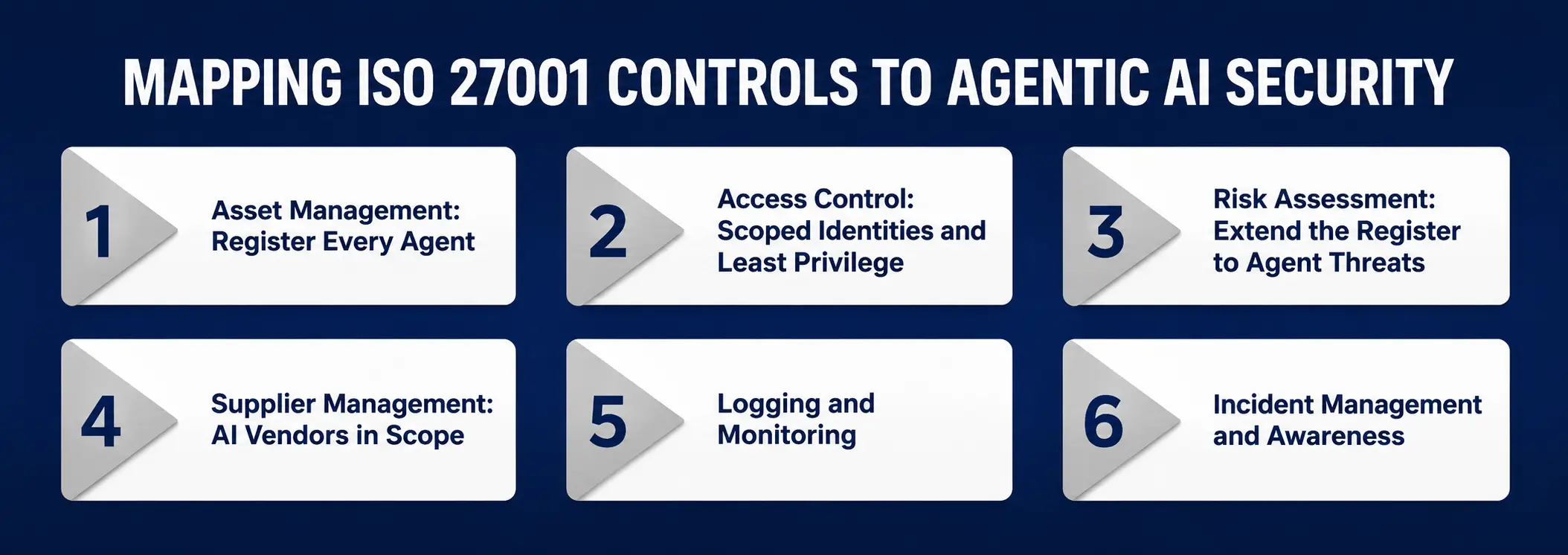
ISO 27001:2022 contains no control written specifically for AI agents, and it does not need one. The 93 Annex A controls were written to govern information processing regardless of what performs it. Applied deliberately, they cover the core of agentic AI security. The mapping below shows where each risk lands.
Asset Management: Register Every Agent
An agent that is not in the asset inventory is not governed by anything downstream of it. Discovery comes first for agentic AI security, including shadow deployments where business units enabled AI features inside existing SaaS without formal review. Each agent entry should record its purpose, model dependency, data access scope, tool integrations, and a named human owner. This registry is the anchor for every other control.
Access Control: Scoped Identities and Least Privilege
Each agent needs a distinct identity with credentials scoped to its task and revoked at completion. Shared service accounts and broad standing permissions create the exact conditions privilege escalation exploits. Role-based access control extends naturally to agents: define agent roles, bind permissions to roles rather than instances, and review agent access on the same cycle as privileged human access. In agentic AI security terms, least privilege is the single highest-leverage control.
Risk Assessment: Extend the Register to Agent Threats
The ISO 27001 risk assessment must name agent-specific threats explicitly: prompt injection against each externally exposed agent, memory poisoning where persistence exists, cascade paths in multi-agent chains, and tool supply chain exposure. Each identified risk maps to treatment decisions recorded in the Statement of Applicability, which is how agent risks become auditable rather than anecdotal.
Supplier Management: AI Vendors in Scope
Model providers, agent platforms, and every SaaS product with AI features switched on are suppliers under Annex A. They belong in the supplier register with risk classifications, contractual security requirements, and review cycles. Cloud services control 5.23 applies directly to hosted model APIs, including exit planning for critical model dependencies.
Logging and Monitoring
Every agent authentication, tool invocation, delegation handoff, and consequential action should produce a record that supports both real-time monitoring and forensic reconstruction. Regulatory pressure points the same direction: the EU AI Act's Article 12 requires high-risk AI systems to record events automatically across their lifetime, with deployers retaining logs for at least six months. Tamper-evident storage is the practical bar, because agentic AI security investigations frequently hinge on whether the log can be trusted after a compromise.
Incident Management and Awareness
Agentic AI security also reshapes incident response. Plans need agent-specific playbooks: how to sever an agent's tool access without destroying state, how to trace a poisoned memory back to its injection point, and how to assess blast radius in a multi-agent chain. Awareness training should cover the people who build and operate agents, because the most common failure mode remains a well-intentioned team granting an agent more access than its task requires.
Building an Agentic AI Security Program Under ISO 27001
An agentic AI security program does not need to be built from a blank page. It needs the existing ISMS extended with discipline. The sequence below reflects how organizations are doing this in practice.
- Complete Visibility
Inventory every agent and AI-enabled tool across the organization, including browser AI usage and features activated inside existing SaaS. Shadow AI found late becomes an audit finding; found early, it becomes a registry entry.
- Risk-Based Governance
An agent drafting internal summaries and an agent executing financial workflows do not warrant the same oversight. A structured AI risk assessment that weighs data sensitivity, action authority, and external exposure lets governance effort concentrate where consequences concentrate.
- Runtime Enforcement
Bind each agent to scoped credentials, time-limited where possible, with permissions technically enforced at the point of tool invocation. Policy statements that are not enforced in infrastructure do not count as agentic AI security controls in any audit worth passing.
- Human Oversight
Document which actions require human sign-off, then test the thresholds with crafted inputs designed to push agents past their authorized scope. OWASP and major model providers alike frame runtime guardrails as the final layer of defense, which means the layers before it must hold.
- Continuous Assurance
Agent registries, access reviews, risk assessments, supplier records, and action logs should accumulate as operations run. When agentic AI security evidence exists as a byproduct of daily operation, certification audits, customer due diligence, and regulatory requests all draw from the same pool without a preparation scramble.
Conclusion
The organizations securing agents well in 2026 share one habit: they stopped waiting. They added AI agents to the asset inventory, scoped their identities and privileges, extended the risk register, incorporated AI vendors into supplier management, and logged agent activity using the Information Security Management System they already operated. Built this way, agentic AI security follows the governance cycle of ISO 27001, including internal audits, management reviews, and continual improvement, instead of becoming a separate program with inconsistent oversight.
The boundary is equally important. ISO 27001 governs the security of agentic systems, but it does not address AI-specific requirements such as bias evaluation, transparency, or AI impact assessments, which fall within the scope of ISO/IEC 42001. The two standards share many foundational controls and complement one another. For most organizations, the practical path begins with a mature ISMS and expands to AI-specific governance as AI adoption grows.
At CertPro, we conduct independent ISO 27001 certification audits worldwide as a licensed CPA firm. Our auditors increasingly evaluate how AI agents are managed within the scope of the ISMS, including whether they appear in asset inventories, whether their identities and privileges are subject to access reviews, and whether their activities generate the objective evidence required by ISO/IEC 27001. Every audit engagement follows a structured, evidence-based methodology aligned with ISO/IEC 27001:2022 and ISO 19011, with certification decisions made by an IAF-accredited certification body.