
Most enterprise security teams have patched their perimeters, hardened their cloud environments, and documented their access controls. Then they handed employees access to AI tools — and introduced an entirely new class of risk that most compliance programs haven't caught up with yet.
Prompt security is where that gap lives. Every time an employee submits a prompt to an AI system, they make a decision about what information leaves your controlled environment. Most of those decisions happen without policy guidance, without monitoring, and without any audit trail that an assessor can evaluate.
That's not a theoretical concern. It's a live compliance exposure — one that sits squarely within the scope of ISO 27001, SOC 2, and an expanding set of AI-specific regulatory frameworks. This guide explains what prompt security risks look like in practice, why they're becoming a front-line compliance issue in 2026, and what organizations need to do to close the gap before it shows up in an audit finding or a data breach disclosure.
Concern
Employees across enterprise organizations are routinely submitting sensitive data — customer records, source code, legal documents, financial information — into AI tools that operate outside the organization's data governance perimeter. Most organizations have no prompt monitoring, no usage policy, and no audit evidence to demonstrate control over these interactions. As a result, prompt security risks are creating real exposure under ISO 27001, SOC 2, HIPAA, GDPR, and the EU AI Act — often invisibly, because the data leaves through productivity tools rather than traditional network channels.
Overview
Prompt security refers to the controls, policies, and monitoring mechanisms that govern how employees interact with AI language models in enterprise environments. AI prompt security risks include data exfiltration through generative AI inputs, prompt injection attacks that manipulate AI system behavior, and the use of AI outputs in regulated workflows without adequate validation. Each of these risk categories maps directly to existing compliance framework requirements — even where those frameworks were written before large language models existed.
Solution
Organizations need a defined AI usage policy that specifies what categories of data employees may and may not submit to external AI systems. Prompt monitoring tools should log AI interactions for audit purposes in environments handling regulated data. AI systems integrated into operational workflows require documented controls covering input validation, output review, and access governance. Risk assessments must be updated to include AI tool usage as a data flow. And where AI governance frameworks like ISO 42001 apply, organizations should begin alignment work now — enterprise buyers and regulators are already asking about it.
What Is Prompt Security And Why It Matters Now
Prompt security is the practice of governing, monitoring, and controlling the inputs that users and systems send to AI language models — and the outputs those models return. In an enterprise context, it encompasses the policies, technical controls, and audit processes that ensure AI interactions don't create unauthorized data exposure, introduce manipulated outputs into business processes, or generate compliance violations that auditors and regulators can't trace.
The reason prompt security has become urgent in 2026 is straightforward: AI tool adoption has outpaced AI governance by a significant margin. According to a 2025 survey by the Ponemon Institute, over 65% of enterprise employees report using generative AI tools for work tasks, yet fewer than 30% of their organizations have a formal AI usage policy in place. That gap — between widespread use and structured governance — is where prompt security risks accumulate.
What makes this particularly challenging for compliance teams is that prompt-based data exposure doesn't look like a traditional data breach. There's no alert. No firewall event. No anomalous login. An employee pastes a paragraph from a customer contract into a public AI tool to improve the phrasing, and the data has left the organization's control environment with no record of the interaction.
For organizations operating under ISO 27001, that interaction potentially implicates Annex A controls covering information classification (A.5.12), acceptable use (A.5.10), and supplier relationships (A.5.19) — because the AI provider is effectively acting as a third-party processor of whatever data was submitted. For SOC 2 organizations, the Confidentiality and Privacy criteria apply wherever customer data is involved. For HIPAA-covered entities, protected health information submitted to a non-covered AI tool could constitute a breach without any technical intrusion event occurring at all.
Enterprise AI security is no longer a future problem. It's a current compliance gap, and the organizations that address it now will be better positioned in procurement reviews, audits, and regulatory assessments as requirements continue to tighten.
How Prompt Security Risks Map To Compliance Frameworks
The relationship between prompt security and compliance frameworks is direct, even though most frameworks were written before large language models became commercially available. The risk categories map clearly onto existing control requirements.
-
ISO 27001
Annex A.5.10 (Acceptable Use of Information and Other Associated Assets) requires organizations to define acceptable use rules for assets, including systems that process organizational information. AI tools employees access for work purposes fall within this scope. Annex A.5.19 (Information Security in Supplier Relationships) requires organizations to address information security in relationships with suppliers — which includes AI providers that receive organizational data through prompts. ISO 27001's risk assessment requirements (Clause 6.1.2) require organizations to identify risks to the confidentiality, integrity, and availability of information in scope, which now must include AI-related data flows.
-
ISO 42001
The ISO 42001 standard for AI management systems, published in 2023, provides a framework specifically designed for organizations developing or deploying AI systems. It addresses AI risk assessment, transparency requirements, data governance, and impact evaluation. For organizations with significant AI deployment, ISO 42001 certification is becoming a procurement differentiator in enterprise sales cycles — and alignment with its requirements directly addresses the prompt monitoring and AI usage governance gap.
-
SOC 2
The Confidentiality criterion (CC9.2) requires organizations to identify and manage risks that could affect achievement of confidentiality commitments. AI tools that receive confidential customer data through unmonitored prompts represent exactly this kind of risk. The Privacy criterion applies where personal data is involved. The Common Criteria for logical access and change management apply to AI systems integrated into production environments.
-
GDPR and HIPAA
Both GDPR and HIPAA establish strict requirements around the transfer of personal data to third-party processors. Under GDPR, submitting EU personal data to an AI provider without a valid data processing agreement and appropriate transfer mechanism is a compliance violation — regardless of the channel through which the transfer occurred. HIPAA's prohibition on unauthorized disclosure of protected health information applies equally to prompt-based data sharing.
-
EU AI Act
The EU AI Act, which has been rolling out in phases through 2025 and into 2026, introduces risk-based requirements for AI systems used in enterprise contexts. Organizations using AI tools for purposes classified as high-risk under the Act — including employment decisions, credit assessments, and certain automated processing of sensitive personal data — face specific obligations around transparency, documentation, and human oversight. Enterprise AI security programs need to account for these obligations now, not when enforcement cycles begin.
What Effective Prompt Security Looks Like In Practice
Organizations that manage AI prompt security well aren't necessarily using the most sophisticated tools. They're applying the same governance discipline to AI that they apply to other information systems — with controls calibrated to the actual risk.
Define an AI Usage Policy
The starting point is a clear, written policy that specifies which AI tools employees may use for work purposes, what categories of data they may and may not submit to those tools, and what the review and approval process is for new AI tools. This policy doesn't need to be exhaustive on day one. It needs to exist, be communicated, and be enforced.
An effective AI usage policy classifies data by sensitivity level and specifies what's permissible for each level. Public information and non-sensitive internal content may be acceptable for use with approved external AI tools. Customer data, source code, financial records, and regulated personal data require explicit restrictions and, in most cases, prohibition from external AI tools without specific security review and contractual controls in place with the AI provider.
Implement Prompt Monitoring in Regulated Environments
In environments handling regulated data — healthcare organizations under HIPAA, financial services firms under SOC 2, organizations operating under GDPR — prompt monitoring is the technical control that creates the audit trail compliance requires. Prompt monitoring tools log AI interactions, flag policy violations, and provide the evidence that auditors need to assess whether controls are operating.
Several enterprise AI security platforms — including tools from Nightfall AI, Cyberhaven, and Microsoft Purview — provide prompt monitoring capabilities that integrate with common productivity environments. The specific tooling matters less than the principle: organizations handling regulated data need to know what's being submitted to AI systems, and they need that knowledge to be auditable.
Conduct an AI Risk Assessment
ISO 27001 and SOC 2 both require risk assessments that cover the organization's information environment. That environment now includes AI tools, and risk assessments need to be updated accordingly. An AI risk assessment maps the AI tools in use — both approved and shadow — identifies the data flows they involve, evaluates the risks those flows create, and documents the controls in place or required to address them.
According to NIST's AI Risk Management Framework (AI RMF), organizations should assess AI risks across four dimensions: validity and reliability, safety, security and resilience, and explainability. That structure maps usefully onto compliance framework risk assessment requirements and provides a documented basis for control decisions that auditors can evaluate.
Review AI Supplier Relationships
Every AI provider that receives organizational data through prompts is effectively a data processor or sub-processor. ISO 27001's supplier relationship controls and GDPR's data processing requirements both require organizations to assess the security posture of those suppliers, establish contractual obligations around data handling and retention, and monitor the relationship over time.
Most enterprise AI providers — including OpenAI, Google, Microsoft, Anthropic, and others — publish data handling policies and offer enterprise agreements with data processing addendums. Organizations using these tools for work purposes need to ensure those agreements are in place, reviewed, and documented. The existence of a data processing agreement is something auditors specifically look for when evaluating supplier risk management.
Build AI Controls Into Your Audit Evidence
The final step is making sure AI governance activities produce audit evidence. A policy that exists but isn't communicated doesn't satisfy auditors. A risk assessment that was completed once and never updated doesn't demonstrate continuous compliance. Prompt monitoring that logs interactions but isn't reviewed produces alerts that nobody acted on.
Effective enterprise AI security means treating AI governance as an ongoing operational discipline — with assigned ownership, review cycles, and evidence artifacts that demonstrate the controls are working, not just that they exist on paper.
What Is Changing And What Compliance Leaders Should Watch
Prompt security is a rapidly evolving area, and the regulatory and audit landscape is moving faster than most compliance programs have adjusted to.
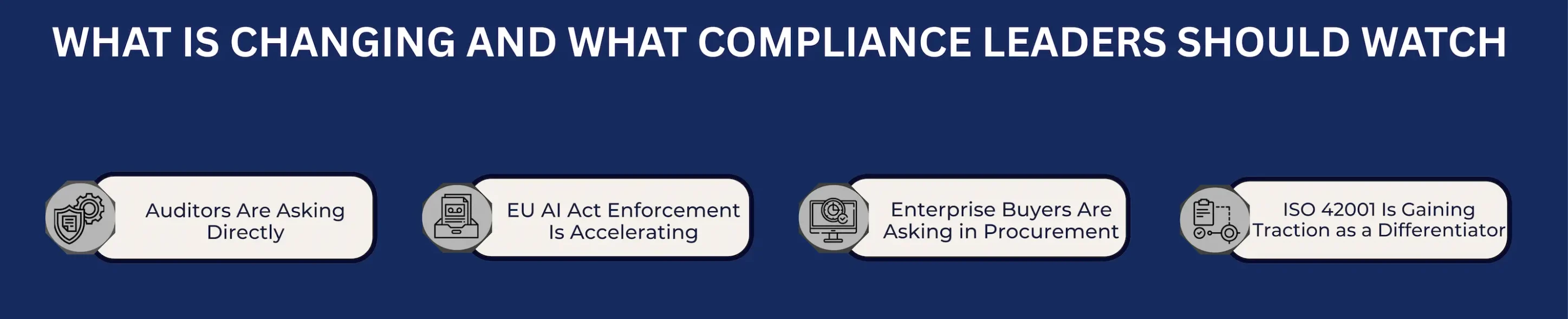
Auditors Are Asking Directly: ISO 27001 auditors and SOC 2 examiners are now routinely including AI tool usage in their scoping questions and control testing. Organizations that haven't thought through their AI environment find themselves answering questions about data flows they haven't mapped and controls they haven't documented — mid-audit. That's an avoidable situation that preparation addresses.
EU AI Act Enforcement Is Accelerating: The EU AI Act's prohibited practices provisions became enforceable in February 2025. High-risk AI system requirements are becoming applicable throughout 2026. Organizations selling AI-enabled products into European markets, or using AI tools in employee-facing processes that the Act classifies as high-risk, need legal and compliance review of their AI footprint now.
Enterprise Buyers Are Asking in Procurement: Vendor security questionnaires in 2026 increasingly include questions about AI tool governance. Enterprise buyers want to know whether vendors have AI usage policies, whether they've assessed the risk of AI tools processing customer data, and whether those assessments are documented. This is the same pattern that drove SOC 2 adoption — customer demand creating commercial pressure to operationalize compliance before regulatory requirements catch up.
ISO 42001 Is Gaining Traction as a Differentiator: Certification against ISO 42001 — the AI management system standard — is a relatively new credential, but it's gaining recognition in enterprise procurement as a signal that an organization has structured governance around its AI activities. For organizations with significant AI deployment, early alignment with ISO 42001 positions them ahead of the curve.
Conclusion
Prompt security risks don't announce themselves. They accumulate quietly in productivity tools, in employee workflows, and in the gap between how organizations think their AI environment works and how it actually does. The compliance exposure that creates is real, it's growing, and it's increasingly visible to auditors and enterprise buyers who know what questions to ask.
CertPro is a licensed CPA firm that conducts independent audits and certification engagements, including ISO 27001 certification audits and SOC 2 examinations. Our audit teams evaluate information security controls against applicable framework requirements — including controls governing AI tool usage, supplier relationships, and data governance. We assess what exists, test how it performs, and issue reports that carry the accountability of an independent, licensed CPA firm.
For organizations building or reviewing their AI security posture in advance of an audit or customer assessment, CertPro provides objective, evidence-based evaluation of where controls are sufficient and where gaps remain.