
SOC 2 Certification in Oregon
SOC 2 Certification in Oregon is performed exclusively by a Licensed CPA Firm acting as an independent attestation body under AICPA AT-C Section 205. The SOC 2 examination evaluates whether an organization’s controls are suitably designed and operating effectively against the Trust Services Criteria. Oregon’s technology, cloud, semiconductor, and healthcare sectors drive substantial demand for SOC 2 attestation across regulated and enterprise supply chains.
OUR CLIENTS










Independent SOC 2 Certification by a Licensed CPA Firm in Oregon
SOC 2 Certification in Oregon is governed by standards established by the American Institute of Certified Public Accountants (AICPA), specifically under AT-C Section 205, which defines the requirements for an independent attestation engagement. A Licensed CPA Firm conducts the SOC 2 examination as an independent third party, evaluating the design and operating effectiveness of an organization’s internal controls against the Trust Services Criteria (TSC).
The resulting SOC 2 report is an attestation document — not a consulting deliverable — issued under professional standards that carry legal and regulatory weight in enterprise procurement, vendor risk management, and regulatory oversight contexts throughout Oregon and across the United States.
Oregon’s economy encompasses a diverse range of industries that generate significant demand for SOC 2 compliance. The state is home to a growing cluster of SaaS providers, cloud infrastructure companies, semiconductor manufacturers, healthcare data organizations, clean technology enterprises, AI startups, and cybersecurity firms.
Organizations operating in these sectors routinely process, store, or transmit sensitive customer data. Their enterprise clients and regulated counterparts increasingly require independent validation of security controls as a condition of doing business. SOC 2 Certification in Oregon directly addresses these vendor assurance requirements by providing a structured, evidence-based assessment performed by an independent Licensed CPA Firm.
Regulatory Authority and Governing Standards
The SOC 2 examination is governed by AICPA AT-C Section 205, which establishes attestation standards for examination engagements. Under this framework, only a Licensed CPA Firm possesses the professional authority to issue a SOC 2 attestation report. The examination evaluates organizational controls against the AICPA Trust Services Criteria, which cover Security, Availability, Processing Integrity, Confidentiality, and Privacy.
The Security criterion — also referred to as the Common Criteria — is mandatory for all SOC 2 engagements. Additional criteria are included based on the scope of services an organization provides and the commitments made to its customers.
Oregon organizations subject to the Oregon Consumer Privacy Act (OCPA) face heightened scrutiny regarding how personal data is collected, processed, and protected. The OCPA applies to controllers processing personal data of Oregon residents, creating a regulatory environment in which SOC 2 attestation serves as documented evidence of privacy and security controls.
For organizations providing services to regulated enterprises in other U.S. states — or internationally — SOC 2 Certification in Oregon provides a recognized attestation framework that supports cross-border vendor assurance requirements and enterprise security review processes.
Distinction Between SOC 2 Attestation and Other SOC Reports
SOC 2 attestation is distinct from both SOC 1 and SOC 3 reports in scope, audience, and governing criteria. A SOC 1 report, governed by AT-C Section 320, addresses internal controls over financial reporting and is relevant primarily to organizations whose services affect their clients’ financial statements. A SOC 2 report focuses on operational controls related to security, availability, and data handling — making it the appropriate report for technology service providers, cloud platforms, and data processors.
A SOC 3 report covers the same subject matter as SOC 2 but is designed for general public distribution and does not include the detailed control descriptions and test results found in a SOC 2 report.
For Oregon-based SaaS providers serving regulated enterprises in financial services, healthcare, or government contracting, the SOC 2 Type II report is the most commonly required form of attestation. Enterprise procurement teams and vendor risk management functions across these sectors rely on SOC 2 Type II reports to evaluate whether a service provider’s controls have operated effectively over a defined review period — typically a minimum of six months.
The attestation is issued by the Licensed CPA Firm and carries professional accountability under AICPA standards, clearly distinguishing it from internally prepared compliance documentation or third-party security questionnaires.
Oregon’s Technology Ecosystem and SOC 2 Demand
Oregon’s technology sector is centered in the Portland metropolitan area and extends to technology corridors in Beaverton, Hillsboro, and Eugene. The state hosts major semiconductor manufacturing operations — including large-scale fabrication facilities — alongside a robust ecosystem of software companies, cloud service providers, and data management organizations.
These entities frequently enter into vendor relationships with enterprises headquartered in California, Washington, New York, and international markets, where SOC 2 Certification is a standard requirement in vendor onboarding and annual security review processes.
Healthcare organizations operating in Oregon — including health information exchanges, electronic health record providers, health technology platforms, and medical device software companies — process protected health information subject to HIPAA requirements. For these organizations, SOC 2 compliance in Oregon provides an additional layer of independent control validation that complements existing HIPAA compliance programs.
Enterprise clients in regulated industries routinely require SOC 2 attestation reports as part of their business associate or vendor risk assessment processes, making SOC 2 Certification in Oregon a practical necessity for technology-focused healthcare organizations operating across state lines.

What Is SOC 2 Certification?
SOC 2 Certification refers to the successful completion of a SOC 2 examination conducted by a Licensed CPA Firm, resulting in the issuance of an independent attestation report that documents the evaluation of an organization’s controls against the AICPA Trust Services Criteria. The term “SOC 2 certified” is commonly used in industry contexts to indicate that an organization has undergone an independent SOC 2 audit and received an attestation report with an unqualified opinion.
An unqualified opinion means the auditor determined that the described controls were suitably designed and — in the case of a Type II report — operating effectively during the review period.
SOC 2 Certification Defined: Attestation vs. Compliance
A critical distinction in understanding SOC 2 Certification is the difference between attestation and compliance. SOC 2 compliance refers to an organization’s internal adherence to the Trust Services Criteria — a state that can exist without independent verification. SOC 2 attestation, by contrast, is the formal product of a Licensed CPA Firm’s examination, in which the auditor independently tests and evaluates whether controls are designed and operating effectively.
The resulting attestation report carries professional authority and provides stakeholders with independent assurance that cannot be self-certified.
Organizations seeking SOC 2 Certification in Oregon must engage a Licensed CPA Firm to conduct the examination. An internal assessment or a report prepared by a non-CPA consulting firm does not constitute SOC 2 attestation under AICPA standards. Enterprise clients, regulated counterparts, and institutional procurement teams clearly distinguish between self-attested compliance documentation and independently issued SOC 2 attestation reports.
This distinction is particularly significant in financial services, healthcare, and government contracting contexts, where third-party attestation is a contractual or regulatory requirement.
Trust Services Criteria: The Evaluation Framework
The Trust Services Criteria (TSC) are the evaluation framework against which SOC 2 examinations are conducted. The AICPA established the TSC to provide a structured, principle-based approach to evaluating organizational controls relevant to technology and data service providers. The five criteria categories are: Security (mandatory for all engagements), Availability, Processing Integrity, Confidentiality, and Privacy.
Each category contains specific criteria describing the control objectives an organization must demonstrate it has addressed through its policies, procedures, technologies, and operational practices.
| Trust Services Criterion | Scope of Evaluation | Applicable Organization Types |
|---|---|---|
| Security | Logical and physical access controls, risk assessment, incident response, change management | All organizations — mandatory criterion |
| Availability | System uptime, performance monitoring, disaster recovery, backup and restoration | Cloud platforms, SaaS providers, data centers |
| Processing Integrity | Completeness, accuracy, timeliness, and authorization of processing | Transaction processors, payroll platforms, financial systems |
| Confidentiality | Protection of information designated as confidential per agreements | Legal, healthcare, financial data processors |
| Privacy | Collection, use, retention, disclosure, and disposal of personal information | Organizations subject to OCPA, HIPAA, or CCPA |
SOC 2 Type I vs. SOC 2 Type II Reports
SOC 2 examinations produce two distinct report types: Type I and Type II. A SOC 2 Type I report evaluates the design of controls at a specific point in time. It assesses whether the controls described in the organization’s system description are suitably designed to meet the applicable Trust Services Criteria as of the report date.
A SOC 2 Type II report evaluates both the design and the operating effectiveness of controls over a defined review period — typically a minimum of six months and commonly twelve months for annual reporting cycles. The Type II report is the standard required by most enterprise clients, financial sector organizations, and regulated procurement processes.
For Oregon organizations new to SOC 2 audit processes, a Type I report may be pursued initially to establish a documented baseline of control design before undertaking the longer Type II review period. However, many enterprise customers and vendor risk programs require a current SOC 2 Type II report as the minimum acceptable form of attestation.
Organizations must complete annual audit cycles to maintain current certified status and meet ongoing customer expectations. Any SOC 2 examination Oregon organizations undertake must be repeated at intervals consistent with the review period defined in the engagement scope to ensure continued attestation currency.
SOC 2 Certification Audit Process in Oregon
The SOC 2 audit process in Oregon follows a structured sequence of evaluation stages conducted by the Licensed CPA Firm. Each stage serves a defined purpose in the overall attestation engagement — from initial scope determination through issuance of the final attestation report. The process is governed by AICPA AT-C Section 205 and professional auditing standards applicable to attestation engagements.
Understanding the SOC 2 audit process enables Oregon organizations to prepare documentation, organize evidence, and coordinate with internal stakeholders effectively across each stage of the examination.
| Audit Stage | Key Activities | Output |
|---|---|---|
| Scope Definition & Engagement Planning | Define system boundaries, identify applicable Trust Services Criteria, determine report type (Type I or Type II), establish review period | Signed engagement letter, defined audit scope |
| System Description Review | Review management’s written description of the service system, assess completeness and accuracy of system boundary documentation | Documented assessment of system description adequacy |
| Control Identification & Design Evaluation | Identify controls mapped to Trust Services Criteria, evaluate whether controls are suitably designed to meet stated criteria | Design assessment findings and control mapping |
| Operating Effectiveness Testing (Type II only) | Select samples, perform attribute testing, inspect evidence of control operation across the review period | Test results, exception identification, nonconformity reporting |
| Reporting & Attestation Issuance | Prepare draft SOC 2 report, management responses, obtain final sign-off, issue attestation report with auditor’s opinion | Final SOC 2 attestation report issued by Licensed CPA Firm |
The SOC 2 audit process begins with scope definition. During this stage, the Licensed CPA Firm and the subject organization establish the boundaries of the system under examination. The system boundary defines which infrastructure components, software applications, data flows, personnel, and operational procedures fall within the scope of the SOC 2 examination.
Scope decisions directly affect which Trust Services Criteria apply and which organizational units and processes are subject to control testing. Oregon organizations with complex, multi-environment architectures — including hybrid cloud deployments common among the state’s semiconductor and healthcare technology sectors — must document the full extent of systems involved in delivering the in-scope services.
Engagement planning also establishes the report type (Type I or Type II), the review period for Type II engagements, and the applicable Trust Services Criteria. The Licensed CPA Firm issues an engagement letter that formalizes the scope, objectives, responsibilities, and terms of the SOC 2 examination.
The engagement letter is an essential document in the SOC 2 audit process. It defines the professional framework under which the attestation will be conducted and the basis on which the auditor’s opinion will be formed.
Management of the subject organization is responsible for preparing a written system description — a document that describes the services provided, system components, control environment, and relevant aspects of the organization’s operations as they relate to the Trust Services Criteria. The Licensed CPA Firm reviews the system description for completeness, accuracy, and consistency with its independent observations during the examination.
Deficiencies in the system description — such as omissions of key subservice organizations or incomplete descriptions of control activities — are identified and addressed before the SOC 2 attestation report is finalized.
Organizations undergoing a SOC 2 audit in Oregon must maintain organized control documentation that supports the assertions made in the system description. This documentation includes policies, procedures, configuration records, access control matrices, incident response logs, change management records, risk assessment documentation, vendor management records, and operational monitoring evidence.
The Licensed CPA Firm evaluates the sufficiency and accuracy of this documentation as part of the examination process. Gaps or inconsistencies between documented controls and actual operations are identified during the control design review and reported in the draft attestation report.
For a SOC 2 Type I examination, the Licensed CPA Firm evaluates whether controls are suitably designed to meet the applicable Trust Services Criteria. Suitable design means the controls, if operating as described, would be sufficient to address the risks associated with the relevant criteria. The design evaluation does not require evidence of control operation over time — it is a point-in-time assessment.
The auditor reviews control descriptions, tests a representative sample of design evidence, and forms an opinion on whether the described system and controls meet the suitability threshold as of the report date.
For a SOC 2 Type II examination, the evaluation extends to operating effectiveness — assessing whether controls operated as designed and consistently throughout the review period. The Licensed CPA Firm selects samples of control evidence across the review period and applies attribute testing to determine whether exceptions exist.
Testing procedures may include inspection of records, observation of operations, re-performance of control activities, and inquiry corroborated by documentary evidence. Identified deviations or control failures are documented as exceptions, and their impact on the overall SOC 2 audit opinion is assessed based on frequency, nature, and the risk associated with the affected criteria.
Following the completion of control testing, the Licensed CPA Firm compiles findings into a draft SOC 2 report. The draft report includes the auditor’s description of testing procedures, results, and any identified exceptions or control failures. Management of the subject organization reviews the draft report and has the opportunity to provide responses or explanations regarding identified exceptions.
These responses are included in the final report as the management response section, providing context for report users regarding corrective actions taken or planned.
The final SOC 2 attestation report is issued by the Licensed CPA Firm upon completion of the examination and resolution of any outstanding documentation matters. The auditor’s opinion — qualified or unqualified — reflects the overall assessment of control design and, for Type II engagements, operating effectiveness.
An unqualified opinion indicates that controls are suitably designed and operating effectively. A qualified opinion indicates that one or more material exceptions were identified. Under the restricted-use provisions of AICPA standards, the attestation report is intended for distribution to specified parties including the subject organization, its customers, and their auditors.
- ✓Stage 1: Scope Definition and Engagement Planning
- ✓Stage 2: System Description and Control Documentation Review
- ✓Stage 3: Control Design and Operating Effectiveness Evaluation
- ✓Stage 4: Nonconformity Review and Reporting
SOC 2 Certification Requirements and Evaluation Criteria
SOC 2 Certification requirements are defined by the AICPA Trust Services Criteria and the specific commitments an organization makes to its customers in service agreements and system documentation. The SOC 2 examination requires organizations to demonstrate that controls exist, are suitably designed, and — for Type II engagements — have operated effectively throughout the review period.
The Licensed CPA Firm evaluates these requirements through structured evidence review, documentation inspection, and attribute testing across the defined scope of the engagement.
Organizations seeking SOC 2 Certification in Oregon must maintain documentation sufficient to support the assertions made in the system description and to provide audit evidence for each control identified in the control environment. Core documentation requirements include:
An information security policy defining the organization’s approach to protecting information assets; a risk assessment identifying threats and vulnerabilities relevant to the in-scope system; a risk treatment plan documenting how identified risks are addressed through controls; access management records demonstrating how logical access is granted, reviewed, and revoked; and incident response documentation evidencing the processes in place to detect, respond to, and recover from security incidents.
For Oregon technology organizations, documentation requirements extend to system change management records, vendor and subservice organization management documentation, business continuity and disaster recovery plans, configuration management baselines, and monitoring and alerting records. The Licensed CPA Firm reviews these documents during the SOC 2 audit to assess the completeness and accuracy of the system description and to support control testing.
Documentation that is inconsistent, incomplete, or not maintained at the operational level described in policies represents a significant risk of exception findings during the Type II review period.
Technical controls evaluated during the SOC 2 examination span a broad range of IT operations and security practices. Under the Security (Common Criteria) Trust Services Criterion, the examination addresses logical and physical access controls, multi-factor authentication, encryption of data in transit and at rest, vulnerability management and patch processes, network segmentation, security monitoring and logging, and incident detection and response capabilities.
For Oregon cloud service providers and SaaS organizations, these controls are evaluated across both the organization’s own infrastructure and any subservice organizations — such as cloud infrastructure providers — whose controls are relevant to the scope of the SOC 2 engagement.
- ✓Logical access controls: role-based access, least privilege enforcement, periodic access reviews, and provisioning/de-provisioning procedures
- ✓Multi-factor authentication (MFA) for privileged access and remote system access
- ✓Encryption standards: data at rest using AES-256 or equivalent, data in transit using TLS 1.2 or higher
- ✓Vulnerability management: regular scanning, severity-based remediation timelines, and documented patch management records
- ✓Change management: formal change request, approval, testing, and documentation processes for system modifications
- ✓Security monitoring and logging: SIEM or equivalent systems with defined alert thresholds and log retention policies
- ✓Incident response: documented procedures, defined roles, evidence of training, and post-incident review records
- ✓Business continuity and disaster recovery: tested recovery procedures, defined RTO/RPO objectives, and documented test results
- ✓Vendor and subservice organization management: contracts with security provisions, periodic reviews, and subservice organization monitoring
- ✓Physical security: access controls to data center and server environments, visitor logs, and environmental monitoring
The scope of a SOC 2 Certification in Oregon defines the boundaries of the examination — including the specific services, systems, data flows, and organizational units subject to evaluation. Scope decisions have direct implications for which controls are examined and which Trust Services Criteria apply. Oregon organizations that rely on subservice organizations — such as Amazon Web Services, Microsoft Azure, or Google Cloud — for infrastructure components must address those relationships in the system description using either the inclusive method or the carve-out method.
The inclusive method brings subservice organization controls within the examination scope, while the carve-out method excludes them and references the subservice organization’s own SOC 2 report.
Conditions under which a SOC 2 attestation may be suspended, qualified, or withdrawn include: material control failures not remediated before report issuance, significant changes to the in-scope system after the examination period, discovery of material misrepresentations in the system description, or failure to complete required recertification examinations within the defined cycle.
Annual recertification is required to maintain current SOC 2 attestation status, as reports are issued for defined periods. Enterprise clients typically require a report dated within the preceding twelve months as a condition of vendor approval.
- ✓Documentation Requirements for SOC 2 Examination
- ✓Technical Control Requirements Across Trust Services Criteria
- ✓Scope of Certification and Subservice Organization Considerations
Business Sectors in Oregon Seeking SOC 2 Certification
SOC 2 Certification in Oregon is pursued across a broad range of industry sectors, driven by enterprise procurement requirements, regulatory expectations, and customer demand for independent security assurance. Oregon’s diverse technology and services economy creates multiple distinct demand contexts for SOC 2 audit engagements in Oregon, each characterized by unique compliance pressures, data sensitivity considerations, and enterprise relationship structures that make independent attestation a business-critical requirement.
SaaS Providers and Cloud Service Organizations
Oregon’s SaaS ecosystem — concentrated in the Portland metropolitan area and expanding into Hillsboro, Beaverton, and Bend — includes organizations providing enterprise software platforms, cloud-based productivity tools, workflow automation systems, and data analytics services. These organizations routinely enter into service agreements with enterprise clients in regulated industries who require SOC 2 Type II reports as a standard vendor security requirement.
SOC 2 Certification that Oregon tech companies pursue supports access to enterprise sales channels, shortens vendor onboarding timelines, and reduces the frequency of customer security questionnaires and individual audit requests.
Cloud service providers operating data centers or edge infrastructure in Oregon serve clients across the continental United States and internationally. These organizations store and process large volumes of customer data under contractual security commitments, and enterprise clients conducting annual vendor risk reviews require current SOC 2 attestation reports as evidence that security controls operate effectively.
The SOC 2 examination Oregon cloud providers undergo must address the full scope of infrastructure components involved in service delivery, including network architecture, physical security, capacity management, and incident response capabilities.
Healthcare Technology and Life Sciences Organizations
Oregon’s healthcare technology sector includes electronic health record (EHR) vendors, health information exchange organizations, telemedicine platforms, medical device software companies, and clinical data management providers. These organizations process protected health information (PHI) subject to HIPAA requirements and increasingly face demands from covered entity clients for SOC 2 attestation as a supplement to HIPAA Business Associate Agreements.
SOC 2 compliance that Oregon healthcare technology organizations demonstrate through annual examination provides documented evidence of security control effectiveness, supporting both HIPAA compliance programs and enterprise vendor assurance requirements.
Life sciences companies and clinical research organizations operating in Oregon that manage clinical trial data, genomics information, or patient-level datasets face similar attestation requirements from pharmaceutical and biotechnology enterprise clients. SOC 2 attestation in these contexts typically includes the Privacy criterion in addition to Security, reflecting the sensitivity of personal health information processed and the contractual obligations imposed by data processing agreements with research sponsors and healthcare institutions.
Semiconductor, Manufacturing Technology, and Fintech Sectors
Oregon’s semiconductor industry — anchored by large-scale fabrication facilities in Washington County — generates significant demand for SOC 2 compliance across fintech and technology supply chain contexts. Software providers servicing semiconductor design, manufacturing execution, and supply chain management must demonstrate security control effectiveness to enterprise technology clients with stringent vendor security requirements.
These clients conduct annual vendor risk assessments that require current SOC 2 Type II attestation reports as a baseline security standard for critical supply chain vendors.
Oregon’s financial technology sector includes payment processing organizations, digital banking platforms, lending technology providers, and financial data aggregation services. SOC 2 compliance that Oregon fintech organizations demonstrate is directly relevant to Bank Secrecy Act compliance programs and the vendor risk management functions of banking institutions and credit unions that use their services.
Financial sector enterprise clients require SOC 2 Type II reports addressing Security and, frequently, Availability and Confidentiality criteria — given the sensitivity of financial data and the operational continuity requirements associated with payment and banking technology services.
Cybersecurity, AI, and Clean Technology Organizations
Oregon’s emerging AI and machine learning startup ecosystem includes organizations developing AI-powered decision-support platforms, natural language processing services, and automated data analysis tools. These organizations frequently process large volumes of customer data to train models and deliver services. Enterprise clients in regulated industries require independent attestation of the security controls governing data access, processing, and storage.
SOC 2 Certification is recognized as the standard third-party validation mechanism for AI and data analytics service providers operating in enterprise B2B markets.
Clean technology companies and environmental monitoring technology providers in Oregon increasingly process operational technology data, sensor networks, and industrial control system outputs for enterprise utility and energy sector clients. These clients require vendor security assurance programs that include SOC 2 attestation for software and data management providers with access to operational technology environments.
SOC 2 audit firms in Oregon with experience in industrial and operational technology contexts are well positioned to address the specialized control evaluation requirements that apply to these engagements.
Benefits of SOC 2 Certification for Oregon-Based Organizations
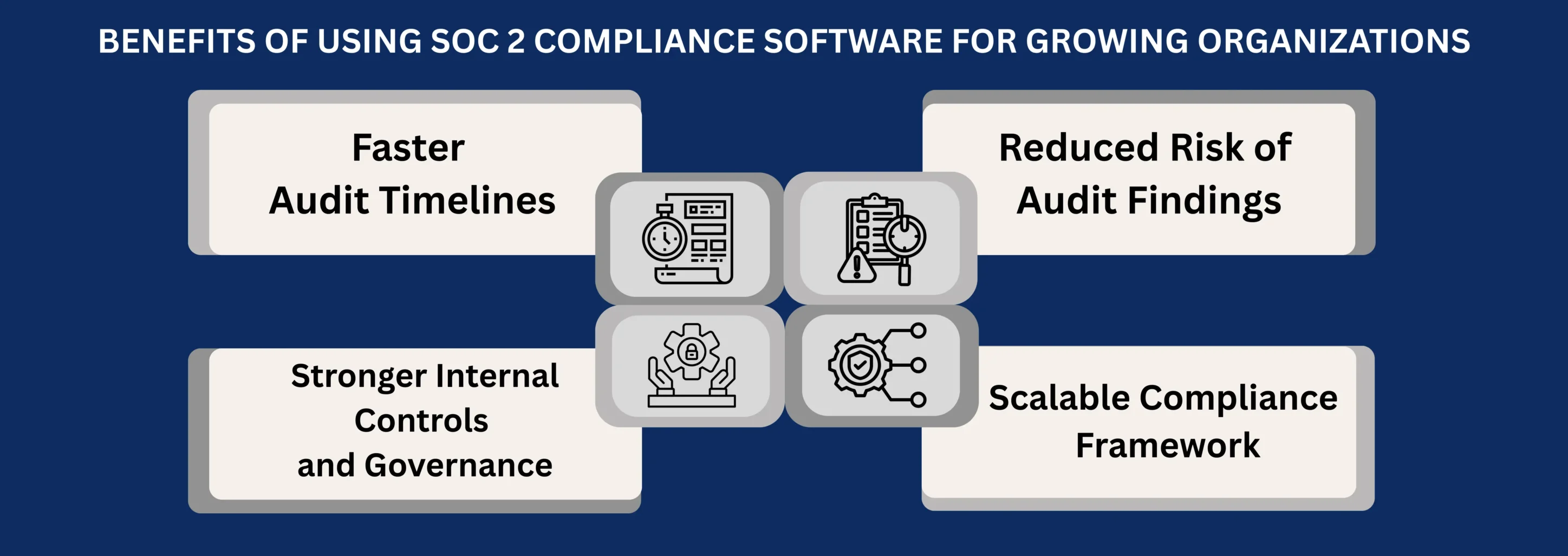
SOC 2 Certification in Oregon provides organizations with independently verified evidence of control effectiveness that supports enterprise procurement processes, regulatory compliance programs, customer due diligence requirements, and risk management frameworks. The benefits of SOC 2 attestation extend across the commercial, operational, and regulatory dimensions of technology service organizations throughout Oregon’s diverse economy.
A current SOC 2 Type II attestation report is recognized in enterprise procurement processes across financial services, healthcare, technology, government contracting, and professional services sectors as the standard evidence of third-party security control validation. Oregon-based SaaS providers and technology service organizations holding a current SOC 2 attestation are able to respond to vendor security questionnaires with documented attestation evidence, reducing the time and resources associated with individual security reviews and accelerating vendor onboarding timelines.
Enterprise clients conducting annual vendor risk reviews typically require a SOC 2 Type II report dated within the preceding twelve months as a condition of maintaining approved vendor status. Oregon organizations that maintain annual SOC 2 audit cycles satisfy this requirement systematically, avoiding the delays and disruptions associated with ad hoc security review processes.
The structured audit methodology of the SOC 2 examination also provides a documented, defensible basis for security representations made in client contracts and data processing agreements.
SOC 2 compliance that Oregon organizations achieve through the attestation process aligns with multiple regulatory and contractual requirements relevant to the state’s technology sector. The Security Trust Services Criterion encompasses control requirements addressing HIPAA Security Rule administrative, physical, and technical safeguards; Oregon Consumer Privacy Act data security obligations; PCI DSS logical access and monitoring requirements; and SOX IT general controls in environments supporting financial reporting systems.
While SOC 2 attestation does not substitute for regulatory compliance assessments under these specific frameworks, it provides documented evidence of a structured, independently evaluated control environment that supports broader regulatory compliance programs.
From a risk management perspective, the SOC 2 examination process drives organizations to establish and document controls that address identifiable security risks. The risk assessment conducted as part of the control environment documentation identifies threats and vulnerabilities specific to the in-scope system, and the controls evaluated during the SOC 2 audit are assessed against those identified risks.
The structured, evidence-based nature of the examination provides organizational leadership with independent verification that risk-mitigating controls are operating as intended — an assurance function that supplements internal audit and management review processes.
Oregon SaaS providers serving regulated enterprises in other U.S. states — including California, New York, Texas, and Illinois — or internationally encounter vendor security requirements that specify SOC 2 Type II attestation as a mandatory vendor qualification criterion. The SOC 2 report issued under AICPA standards is recognized across U.S. markets and, increasingly, in international vendor assurance programs.
For Oregon technology companies seeking to expand into enterprise markets in Canada, the European Union, or Asia-Pacific regions, a current SOC 2 attestation demonstrates a structured security control environment aligned with internationally recognized security standards.
Cross-border data transfers involving personal data of EU residents are subject to GDPR requirements, and enterprise clients in European markets may require SOC 2 attestation in combination with other data protection mechanisms such as Standard Contractual Clauses. Similarly, Canadian enterprises operating under PIPEDA or Quebec’s Law 25 include SOC 2 attestation as a component of vendor security assessments for technology providers processing Canadian personal data.
Oregon organizations that establish SOC 2 compliance through annual examinations are well positioned to satisfy these cross-border vendor assurance requirements as part of their international business development activities.
- ✓Independent verification of control design and operating effectiveness by a Licensed CPA Firm under AICPA standards
- ✓Recognition in enterprise vendor security questionnaire and procurement processes across regulated industries
- ✓Documented basis for security representations in client contracts and data processing agreements
- ✓Alignment with HIPAA, Oregon Consumer Privacy Act, and other applicable regulatory security requirements
- ✓Structured audit methodology that identifies control gaps and drives continuous improvement in the security control environment
- ✓Ongoing surveillance oversight through annual recertification that maintains current attestation status
- ✓Access to enterprise sales channels in financial services, healthcare, government, and technology sectors requiring SOC 2 attestation
- ✓Support for cross-border vendor assurance requirements in U.S. and international enterprise markets
- ✓Independent assurance for organizational leadership regarding the effectiveness of security risk management controls
- ✓Competitive differentiation in Oregon’s technology market through demonstrated third-party security validation
- ✓Enterprise Procurement and Vendor Assurance Recognition
- ✓Regulatory Compliance Alignment and Risk Management
- ✓Cross-Border Vendor Assurance and International Market Access
SOC 2 Certification vs. ISO 27001: Frameworks Compared
Oregon technology organizations evaluating security certification options frequently compare SOC 2 Certification and ISO 27001. Both frameworks address information security management, but they differ in governing authority, geographic recognition, evaluation scope, and the nature of the certification output. Understanding these differences is essential for organizations determining which framework — or combination of frameworks — best meets their customer requirements and market positioning objectives.
| Dimension | SOC 2 Certification | ISO 27001 Certification |
|---|---|---|
| Governing Standard | AICPA AT-C Section 205; Trust Services Criteria | ISO/IEC 27001; Annex A controls |
| Issuing Body | Licensed CPA Firm (independent attestation) | Accredited certification body (third-party audit) |
| Geographic Recognition | Primary recognition in U.S. markets; increasingly accepted internationally | Global recognition across international markets |
| Evaluation Approach | Tests specific controls against Trust Services Criteria and service commitments | Evaluates ISMS design and operation across Annex A control domains |
| Report Type | Attestation report (restricted use, Type I or Type II) | Certificate of registration (public, three-year cycle with surveillance) |
Oregon organizations whose customer base is primarily U.S.-based and concentrated in regulated industries such as financial services, healthcare, or government contracting typically prioritize SOC 2 Certification as the primary attestation mechanism, given its direct alignment with U.S. enterprise procurement requirements. Organizations with significant international customer relationships — particularly in Europe or Asia-Pacific — may pursue ISO 27001 certification in addition to or instead of SOC 2, depending on their specific customer and regulatory requirements.
The decision should be driven by documented customer requirements and target market analysis rather than general market positioning considerations alone.
Ongoing SOC 2 Compliance Monitoring and Annual Recertification
SOC 2 Certification is not a one-time achievement — it requires ongoing compliance monitoring and annual recertification to maintain current attestation status. Organizations that have received an initial SOC 2 Type II report must sustain the control environment evaluated during the examination, monitor for changes that may affect control effectiveness, and engage a Licensed CPA Firm for annual examination to maintain continuous SOC 2 attestation coverage.
Enterprise clients and vendor risk programs expect current reports — typically within the preceding twelve months — as evidence of sustained security control performance.
Continuous Control Monitoring Requirements
Between annual SOC 2 examinations, organizations must maintain continuous operation of the controls documented in the system description. This includes consistent execution of access management processes (user provisioning, access reviews, de-provisioning), ongoing vulnerability management and patch deployment, regular monitoring of security logs and alerts, periodic testing of incident response and business continuity procedures, and maintenance of vendor management records for subservice organizations.
Deviations from documented control procedures during the review period are identified during the operating effectiveness testing phase of the subsequent Type II examination and reported as exceptions in the attestation report.
Organizations that implement automated control monitoring — including security information and event management (SIEM) platforms, automated access certification tools, and continuous compliance monitoring software — are better positioned to maintain consistent control operation throughout the SOC 2 Type II review period. Evidence generated through automated monitoring systems provides the Licensed CPA Firm with structured, verifiable records that support operating effectiveness testing and reduce the administrative burden associated with manual evidence collection.
Oregon technology organizations with mature DevSecOps practices typically integrate SOC 2 evidence collection requirements into their existing operational workflows.
Managing System Changes During the SOC 2 Review Period
System changes that occur during the SOC 2 review period — including infrastructure migrations, application architecture changes, personnel transitions in security roles, and modifications to control procedures — must be evaluated for their impact on the scope and effectiveness of controls under examination. Material changes to the in-scope system that significantly alter the control environment may require scope adjustments, updated system description language, or additional examination procedures to address changed circumstances.
The Licensed CPA Firm must be informed of significant system changes as they occur so that the examination program can be adjusted accordingly.
Oregon cloud service providers and SaaS organizations operating in continuous deployment environments — releasing software updates multiple times per week — must ensure that their change management control procedures are consistently applied across all deployments within the review period. The SOC 2 examination evaluates the change management process itself (approval workflows, testing requirements, documentation standards) rather than individual changes, and sampling during Type II testing includes change records from across the full review period.
Consistent process execution throughout the period is essential to obtaining an unqualified opinion on change management controls.
Annual Recertification Examination Cycle
Organizations must complete annual SOC 2 audit cycles to maintain current certified status and meet customer expectations. The recertification examination follows the same structured process as the initial Type II engagement — scope confirmation, system description review, control design evaluation, operating effectiveness testing, nonconformity review, and attestation report issuance.
For organizations with a stable control environment and consistent evidence collection practices, the annual recertification examination is more efficient than the initial engagement. The Licensed CPA Firm is already familiar with the control environment and can focus testing on areas of change or prior exception findings.
Evidence Collection and Internal Controls for SOC 2 Audit Oregon
Evidence collection is a foundational operational requirement for organizations pursuing a SOC 2 audit in Oregon. The Licensed CPA Firm’s ability to test operating effectiveness depends entirely on the quality, completeness, and availability of evidence that demonstrates control operation throughout the review period. Oregon organizations that establish systematic evidence collection processes — integrated into regular operational workflows rather than assembled reactively at audit time — are better positioned to support efficient examination procedures and obtain timely attestation reports.
Types of Audit Evidence Required
SOC 2 examination evidence encompasses multiple categories of documentation and records. Policy and procedure documentation provides the documented framework for control activities and establishes the standard against which control operation is evaluated. Configuration records — including firewall rule sets, endpoint protection configurations, access control matrices, and system hardening baselines — provide evidence of technical control implementation.
Activity logs from identity and access management systems, SIEM platforms, vulnerability scanners, and change management systems provide the transactional evidence of control operation that the Licensed CPA Firm samples during operating effectiveness testing.
Operational records such as security awareness training completion records, access review sign-off documentation, incident response tickets, change request approvals, vendor assessment records, and business continuity test results provide evidence of management-level oversight controls. The Licensed CPA Firm selects samples from these records across the review period and evaluates whether each sampled instance reflects the control operating as designed.
Organizations must retain evidence in organized, retrievable form for the duration of the review period and for a sufficient period following report issuance to support any subsequent inquiries from report users.
Internal Controls Framework and SOC 2 Alignment
The internal controls framework an organization establishes to support SOC 2 compliance must address both technical and organizational dimensions of the Trust Services Criteria. Technical controls address system-level security requirements such as access management, encryption, vulnerability management, and monitoring. Organizational controls address governance requirements such as risk assessment, policy management, security awareness, vendor management, and incident response coordination.
Both dimensions are evaluated during the SOC 2 examination, and deficiencies in either area can result in qualified opinions or exception findings in the attestation report.
Oregon technology organizations that align their internal controls framework with the AICPA Trust Services Criteria from the outset — rather than mapping existing controls retroactively — establish a more efficient foundation for SOC 2 examination. The Trust Services Criteria include specific criteria numbered CC1 through CC9 under the Common Criteria, each addressing a defined aspect of the security control environment.
Organizations that document their control activities at the criterion level — identifying which specific control addresses each criterion — provide the Licensed CPA Firm with a clear control-to-criteria mapping. This approach supports efficient examination planning and reduces the risk of coverage gaps during the SOC 2 audit.
Selecting SOC 2 Audit Firms in Oregon
SOC 2 audit firms in Oregon must hold the credentials, independence, and professional qualifications required to conduct attestation engagements under AICPA AT-C Section 205. Selecting an appropriate Licensed CPA Firm for a SOC 2 examination is a consequential decision that affects the quality and credibility of the resulting attestation report. Enterprise clients and vendor risk programs scrutinize both the content of SOC 2 reports and the credentials of the issuing firm when evaluating attestation evidence.
Independence and Professional Qualification Requirements
AICPA standards require that the Licensed CPA Firm conducting a SOC 2 examination maintain independence from the subject organization. Independence requirements prohibit the examining firm from having a financial interest in, a management role at, or a consulting or advisory relationship with the organization being examined that would impair the objectivity of the examination.
Firms that have provided implementation assistance, control design recommendations, or other consulting services to an organization are generally precluded from conducting the SOC 2 examination of that same organization due to self-review threats to independence.
SOC 2 audit firms in Oregon that issue attestation reports must have staff with demonstrated expertise in the Trust Services Criteria, IT audit methodology, and the specific technical environments relevant to the organizations they examine. Cloud architecture, DevOps environments, containerized application deployment, and SaaS multi-tenant architectures require specialized technical knowledge to evaluate effectively.
Oregon organizations should assess the examining firm’s relevant industry experience — including familiarity with the specific technology stack and service delivery model under examination — when selecting a Licensed CPA Firm for a SOC 2 engagement.
Quality Standards and Peer Review Requirements
Licensed CPA Firms conducting SOC 2 examinations are subject to AICPA quality control standards and, where applicable, PCAOB oversight for engagements involving public company auditors. Firms performing attestation engagements must participate in the AICPA Peer Review Program, which requires periodic external review of the firm’s quality control policies and the quality of its attestation engagements.
Oregon organizations engaging a Licensed CPA Firm for a SOC 2 examination should confirm that the firm’s most recent peer review report reflects a passing result and that the firm maintains current participation in the AICPA Peer Review Program.
FAQ
▶
What is SOC 2 Certification in Oregon and who performs it?
▶
What is the difference between SOC 2 Type I and SOC 2 Type II in Oregon?
▶
Which Trust Services Criteria apply to a SOC 2 examination in Oregon?
▶
How long does a SOC 2 Type II audit review period typically last?
▶
Is SOC 2 Certification required for Oregon SaaS companies?
▶
How does SOC 2 attestation relate to the Oregon Consumer Privacy Act (OCPA)?
▶
What is the difference between SOC 2 compliance and SOC 2 certification?
▶
How often must an organization renew its SOC 2 Certification in Oregon?
SOC 1 VS SOC 2: WHICH REPORT YOUR CUSTOMERS ACTUALLY ASK FOR
If you sell SaaS or provide outsourced services, you have likely been asked for a SOC report. However, the follow-up question is rarely easy to answer…

AICPA Issues New Guidance for Peer Reviewers Evaluating SOC 2 Engagements
AICPA SOC 2 guidance has been issued to help peer reviewers identify quality risks associated with SOC 2 engagements as the use of compliance automati…
Read More →
SOC 2 Certified: What Does It Mean for Your Business
For companies that handle sensitive data or run cloud-based services, the question “Can you provide your SOC 2 report?” carries enormous weight. Yet, …
Read More →
Get In Touch
have a question? let us get back to you.