
SOC 2 Certification in Arlington
SOC 2 Certification in Arlington provides organizations with a documented, independently verified attestation of their security control environment. The benefits extend across commercial, operational, and regulatory dimensions, making the SOC 2 report a multi-purpose artifact for organizations operating in Arlington’s competitive defense, technology, and government contracting markets. From accelerating enterprise sales cycles to satisfying federal procurement conditions, SOC 2 Certification in Arlington delivers tangible value that directly affects an organization’s market access and competitive positioning.
OUR CLIENTS









SOC 2 Certification for Arlington-Based Technology and Defense Organizations
Arlington, Virginia occupies a distinctive position in the U.S. technology and national security ecosystem. Home to a dense concentration of federal contractors, defense technology firms, cybersecurity organizations, government IT vendors, managed service providers, cloud computing companies, and SaaS providers, Arlington’s business community operates under elevated expectations for data security, privacy, and vendor assurance. SOC 2 Certification in Arlington is conducted exclusively by a Licensed CPA Firm acting as an independent third-party attestation provider. The examination evaluates whether an organization’s controls are designed and operating effectively in accordance with the AICPA Trust Services Criteria — the authoritative framework governing Security, Availability, Processing Integrity, Confidentiality, and Privacy. This independent evaluation is what distinguishes a formal SOC 2 audit from internal reviews or self-declared compliance programs.
The SOC 2 attestation is issued under AT-C Section 205 of the AICPA attestation standards and results in a formal SOC 2 report issued by the Licensed CPA Firm. This report is not self-certification — it is an independent, evidence-based attestation reflecting the findings of a structured SOC 2 audit conducted by a qualified CPA. Arlington’s proximity to Washington D.C. and the presence of major federal agencies, the Department of Defense, and intelligence-community contractors create a procurement environment in which SOC 2 attestation is routinely required as a condition of vendor approval, contract award, or enterprise partnership. For organizations handling Controlled Unclassified Information (CUI) or sensitive government data, SOC 2 compliance serves as independently audited evidence of a functioning security control environment.
Arlington’s Federal Contracting and Defense Technology Ecosystem
Arlington hosts a significant concentration of federal contractors, defense IT vendors, and national security technology firms whose contracts and subcontracts require documented evidence of data security controls. The Pentagon, located in Arlington, anchors a broader defense-industrial ecosystem in which prime contractors and subcontractors routinely demand SOC 2 attestation as a condition of vendor enrollment. SOC 2 Certification in Arlington provides an independent, CPA-issued report that satisfies vendor assurance requirements from federal prime contractors, government agencies, and DoD-adjacent procurement processes. Organizations handling Controlled Unclassified Information (CUI), sensitive defense data, or proprietary government information are particularly subject to these expectations. A SOC 2 report serves as structured, third-party-validated evidence that security controls are both designed appropriately and operating as intended. The SOC 2 examination also supplements other frameworks such as CMMC and NIST 800-171 by providing an independent auditor’s opinion rather than a self-assessed posture.
Cloud, SaaS, and Managed Service Providers in Arlington
Arlington’s technology sector includes a growing base of SaaS companies, cloud service providers, and managed service organizations that process, transmit, or store customer data on behalf of enterprise and government clients. These organizations are frequently required to produce a SOC 2 report as part of vendor onboarding, annual security reviews, and third-party risk assessments. The SOC 2 examination evaluates whether technical and administrative controls are designed appropriately and operating as intended during the audit period. For cloud-native organizations and managed service providers operating in Arlington, the SOC 2 report functions as a primary artifact in enterprise sales cycles. It enables procurement teams and security reviewers to assess vendor risk without conducting their own independent audits. SOC 2 compliance in Arlington is therefore a commercial prerequisite for organizations targeting regulated industries, enterprise accounts, and government clients.
What SOC 2 Certification Actually Means
SOC 2 Certification signifies that a Licensed CPA Firm has independently examined and tested an organization’s security controls — not merely that controls are documented or claimed to exist. Many organizations implement security controls without obtaining independent attestation. When an organization holds a SOC 2 report, it means those controls have been evaluated against the AICPA Trust Services Criteria by a qualified CPA, evidence of operating effectiveness has been collected and reviewed, and an independent attestation opinion has been formally issued. Implementing security controls is necessary, but it is not equivalent to SOC 2 Certification. This distinction matters in procurement contexts: a vendor claiming SOC 2 compliance without a CPA-issued report is presenting an unverified self-assessment, whereas a SOC 2 report from a Licensed CPA Firm constitutes independently verified attestation. CertPro operates as a Licensed CPA Firm and independent SOC 2 attestation provider for organizations headquartered or operating in Arlington, Virginia.

What Is SOC 2 Certification?
SOC 2 Certification is a formal attestation process in which a Licensed CPA Firm independently examines an organization’s internal controls relevant to security, availability, processing integrity, confidentiality, and privacy. The framework is defined by the American Institute of Certified Public Accountants (AICPA) and governed by the Trust Services Criteria (TSC). A SOC 2 examination is not a self-assessment or a questionnaire-based review. It is a structured, evidence-driven audit conducted by a qualified CPA who evaluates whether the organization’s controls are suitably designed and — in the case of a Type 2 report — operating effectively over a defined observation period. The resulting SOC 2 report constitutes an independent attestation opinion issued under AT-C Section 205 of the AICPA attestation standards. For organizations pursuing SOC 2 Certification in Arlington, understanding this distinction between self-assessment and formal attestation is essential when responding to vendor qualification requirements.
SOC 2 Type 1 vs. SOC 2 Type 2 Reports
SOC 2 examinations produce two distinct report types, each serving a different attestation purpose. A SOC 2 Type 1 report attests to the design of controls at a specific point in time. The auditor evaluates whether controls in place are suitably designed to meet the applicable Trust Services Criteria as of the report date. A SOC 2 Type 1 audit in Arlington is typically pursued by organizations seeking initial attestation or establishing a baseline before committing to a longer observation period. A SOC 2 Type 2 report, by contrast, attests to both the design and the operating effectiveness of controls over a defined observation period — typically six to twelve months. The auditor collects and tests evidence of control operation across the full observation period, making the Type 2 report a more rigorous and widely accepted form of attestation in enterprise and government procurement contexts. Most Arlington-based organizations ultimately pursue a Type 2 report to satisfy ongoing vendor qualification requirements.
| Report Type | Attestation Scope | Observation Period | Common Use Case |
|---|---|---|---|
| SOC 2 Type 1 | Control design at a point in time | None — single date | Initial attestation, baseline establishment |
| SOC 2 Type 2 | Control design and operating effectiveness | 6–12 months (minimum) | Enterprise vendor reviews, government procurement, ongoing assurance |
AICPA Trust Services Criteria (TSC) — The Five Categories
The AICPA Trust Services Criteria define the control objectives against which a SOC 2 examination is conducted. The Security category — also called the Common Criteria — is mandatory for all SOC 2 engagements. It addresses logical and physical access controls, risk assessment, change management, monitoring, and incident response. The four additional categories — Availability, Processing Integrity, Confidentiality, and Privacy — are optional and are included in the SOC 2 scope based on the nature of the organization’s services and its commitments to customers. For example, an Arlington-based cloud hosting provider might include Availability criteria to address uptime commitments, while a SaaS organization handling personal information might include Privacy criteria. The selection of applicable Trust Services Criteria is determined during scope definition and directly drives the control evaluation performed throughout the SOC 2 audit.
- ✓Security (Common Criteria) — Mandatory: logical access, risk assessment, change management, monitoring, incident response
- ✓Availability — System uptime and performance commitments to users
- ✓Processing Integrity — Completeness, accuracy, and timeliness of data processing
- ✓Confidentiality — Protection of information designated as confidential
- ✓Privacy — Collection, use, retention, and disposal of personal information per AICPA Privacy Management Framework
SOC 2 Certification Audit Process in Arlington
The SOC 2 audit process follows a structured, multi-stage methodology governed by AICPA attestation standards. For organizations pursuing SOC 2 Certification in Arlington, each stage involves specific evaluation activities, evidence requirements, and documentation outputs. The process begins with scope definition and concludes with the issuance of a formal attestation report by the Licensed CPA Firm. Understanding the structure of the SOC 2 audit process enables internal teams to prepare their control environments effectively for the evidence-collection and testing activities the auditor will perform. Each stage builds on the previous one, creating a logical progression from planning through attestation.
The SOC 2 audit process begins with scope definition, during which the Licensed CPA Firm and the organization establish which systems, services, and Trust Services Criteria are within scope. This is followed by an audit program determination phase in which the auditor designs specific testing procedures tailored to the organization’s control environment and the applicable criteria. For a Type 1 engagement, the auditor then performs a point-in-time evaluation of control design. For a Type 2 engagement, the observation period commences and the auditor collects evidence of control operation across the defined timeframe. Evidence may include system-generated logs, access review records, configuration screenshots, policy documents, incident records, vendor agreements, and personnel records. The auditor tests this evidence against each applicable Trust Services Criterion to assess whether controls operated effectively throughout the period. This rigorous, evidence-based approach is what gives a completed SOC 2 examination its credibility in vendor procurement and security review contexts.
| Audit Stage | Key Activities | Output |
|---|---|---|
| Scope Definition | Identify in-scope systems, services, and applicable Trust Services Criteria | Defined audit boundary and criteria selection |
| Audit Program Determination | Design testing procedures aligned to TSC and control environment | Tailored audit program |
| Stage 1 — Documentation Review | Review system descriptions, policies, and control documentation | Readiness observations and documentation assessment |
| Stage 2 — Control Testing | Collect and test evidence of control design and operating effectiveness | Testing results and identified exceptions |
| Attestation Report Issuance | Issue formal SOC 2 report with auditor’s opinion under AT-C 205 | SOC 2 Type 1 or Type 2 Report |
For SOC 2 Type 2 engagements, the observation period is the defined timeframe over which the auditor evaluates whether controls operated effectively. The minimum observation period recommended by the AICPA is six months, with twelve months being standard for organizations seeking annual attestation. During this period, the auditor collects evidence of recurring control activities — such as monthly access reviews, quarterly risk assessments, patching logs, security monitoring outputs, and incident response records — to assess whether controls were consistently applied throughout. The observation period for a SOC 2 audit in Arlington begins once the organization’s controls are in place and functioning. At the conclusion of the observation period, the auditor compiles testing results, identifies any exceptions or control deviations, and prepares the attestation report. Exceptions are documented in the report but do not automatically result in an adverse opinion; the auditor assesses materiality and the organization’s response to each identified deviation.
Following the completion of control testing, the Licensed CPA Firm reviews all identified exceptions and deviations to assess their impact on the overall attestation opinion. The SOC 2 examination produces one of four opinion types: unmodified (controls are suitably designed and operating effectively), qualified (certain controls have exceptions), adverse (controls are not suitably designed or operating effectively), or disclaimer of opinion (auditor is unable to form a conclusion). The vast majority of SOC 2 reports issued to organizations with functioning control environments receive an unmodified opinion. The final attestation report consists of the auditor’s opinion, a description of the system provided by management, and the auditor’s testing procedures and results. This report is then shared with customers, prospective clients, and procurement teams under a non-disclosure agreement. SOC 2 reports are restricted-use documents intended for distribution to specific parties with a legitimate need to evaluate the organization’s security posture.
- ✓Stage-by-Stage SOC 2 Audit Methodology
- ✓Observation Period and Evidence Collection
- ✓Nonconformity Review and Attestation Report Issuance
Why Organizations in Arlington Pursue SOC 2 Certification
SOC 2 Certification in Arlington is driven by specific procurement demands, contractual obligations, and enterprise security review processes that are particularly concentrated in Arlington’s defense, government contracting, and technology sectors. Unlike voluntary security frameworks, SOC 2 attestation is frequently required as a contractual condition by enterprise customers, federal prime contractors, and government agencies conducting formal vendor security assessments. Understanding the specific demand drivers for SOC 2 compliance in Arlington helps organizations assess whether — and when — to pursue attestation. For many Arlington-based technology and defense firms, the decision is not optional; it is a market-access requirement.
Federal Procurement and Vendor Security Assessment Requirements
Federal contractors and subcontractors in Arlington operating near the Pentagon, Department of Defense agencies, and intelligence-community primes encounter SOC 2 attestation requirements embedded in vendor enrollment processes, master service agreements, and cybersecurity addenda. Prime contractors conducting annual third-party risk assessments routinely request a current SOC 2 Type 2 report as evidence of a functioning security control environment. Organizations that cannot produce a SOC 2 report face potential disqualification from vendor panels or delayed contract awards. For defense technology firms and government IT vendors in Arlington, SOC 2 Certification in Arlington is a procurement threshold — the report is required to compete, not merely to differentiate. A single SOC 2 report efficiently satisfies this requirement across multiple customers, eliminating the burden of responding to individual security questionnaires or hosting independent site visits.
Enterprise SaaS and Cloud Provider Vendor Onboarding
SaaS companies and cloud service providers based in Arlington that serve enterprise customers in financial services, healthcare, legal, or regulated industries are routinely required to provide a SOC 2 report during vendor onboarding and at annual renewal. Enterprise procurement teams and third-party risk management programs use the SOC 2 report to evaluate a vendor’s security posture before granting system access or executing data-sharing agreements. For Arlington-based technology companies pursuing contracts with large enterprise accounts, the absence of a SOC 2 report frequently results in extended procurement timelines, increased security questionnaire burdens, or loss of competitive standing to SOC 2-attested competitors. The SOC 2 examination provides a structured, standardized artifact that enterprise security reviewers recognize and can evaluate consistently — reducing friction associated with bespoke vendor assessments and accelerating commercial decision-making.
Cybersecurity Insurance and Investor Due Diligence
Beyond procurement contexts, SOC 2 attestation in Arlington is increasingly relevant in cybersecurity insurance underwriting and investor due diligence processes. Cybersecurity insurers underwriting technology errors and omissions (E&O) and cyber liability policies frequently request evidence of independent control validation as part of the application process. A SOC 2 Type 2 report provides structured documentation of security controls that underwriters can use to assess risk profile and determine coverage terms. Similarly, institutional investors and venture capital firms conducting technical due diligence on Arlington-based technology companies treat a current SOC 2 report as evidence of operational maturity and sound security governance. Organizations that have completed a formal SOC 2 examination demonstrate that their control environment has been independently verified — reducing perceived risk in both financing and insurance contexts.
SOC 2 Certification Requirements and Evaluation Criteria
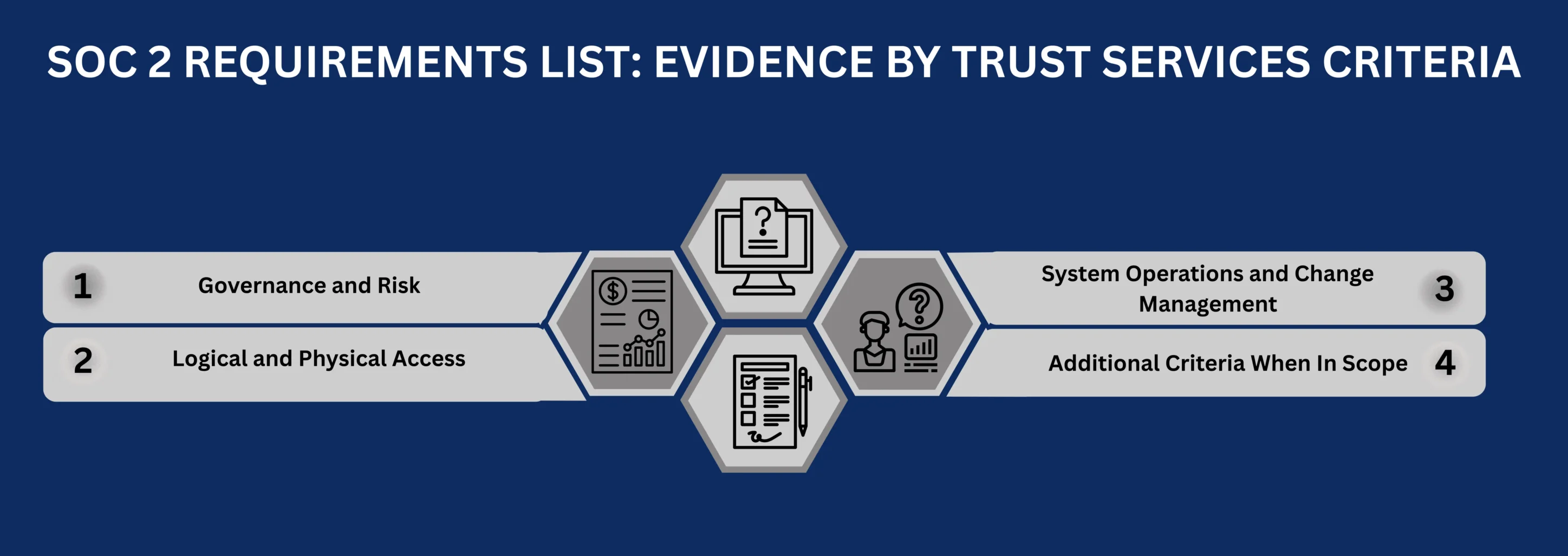
SOC 2 certification requirements are defined by the AICPA Trust Services Criteria and the scope of the organization’s service commitments and system components. Unlike prescriptive compliance frameworks that specify exact controls, the TSC defines criteria that organizations must address through controls appropriate to their own environment. The auditor evaluates whether the organization’s controls, as implemented, satisfy each applicable criterion. Understanding the evidence and documentation requirements associated with a SOC 2 examination enables organizations to structure their control environments for auditability — and to enter the SOC 2 audit process with confidence.
A SOC 2 examination requires organizations to maintain documented policies, procedures, and control activities that address each applicable Trust Services Criterion. Core documentation evaluated during the SOC 2 audit includes an information security policy, access control policy and provisioning procedures, change management policy and records, risk assessment documentation, incident response plan and logs, vendor management policy and third-party agreements, and business continuity and disaster recovery plans. The auditor reviews these documents to assess whether they are current, approved, communicated to relevant personnel, and consistent with controls actually in operation. Documentation that is outdated, incomplete, or inconsistent with observed practices creates exceptions in the audit. Organizations pursuing SOC 2 compliance in Arlington must ensure that their documentation reflects the actual state of their control environment — not an aspirational or theoretical state.
The technical control requirements evaluated during a SOC 2 examination include logical access controls (multi-factor authentication, role-based access, privileged account management), network security controls (firewalls, intrusion detection, network segmentation), encryption (data in transit and at rest), vulnerability management (regular scanning and remediation tracking), security monitoring and logging, change management controls (code review, testing, and deployment authorization), and availability controls relevant to uptime commitments. For each control, the auditor collects evidence demonstrating that the control operated during the observation period. Evidence includes system-generated logs, screenshots of configuration settings, access review records, penetration testing reports, vulnerability scan results, and change management tickets. The quality, completeness, and consistency of this evidence directly affects the auditor’s assessment of operating effectiveness throughout the SOC 2 examination in Arlington.
The scope of a SOC 2 examination is defined by the system boundary, which encompasses the infrastructure, software, people, procedures, and data relevant to the delivery of the in-scope service. Defining the system boundary accurately is critical because the auditor evaluates controls only within the defined scope. Systems, environments, or processes excluded from the boundary are not covered by the attestation. For Arlington-based organizations with complex technology environments — including multi-cloud deployments, co-located infrastructure, and third-party subservice providers — the system boundary must account for all components that collectively deliver the service. Subservice organizations may be covered using the carve-out method, where their controls are excluded from the examination, or the inclusive method, where their controls are included and must also satisfy the applicable Trust Services Criteria.
- ✓Control Environment and Documentation Requirements
- ✓Technical Control Requirements and Evidence Standards
- ✓Scope of Certification and System Boundary Definition
Benefits of SOC 2 Certification for Arlington-Based Organizations
SOC 2 Certification in Arlington provides organizations with a documented, independently verified attestation of their security control environment. The benefits extend across commercial, operational, and regulatory dimensions, making the SOC 2 report a multi-purpose artifact for organizations operating in Arlington’s competitive defense, technology, and government contracting markets. From accelerating enterprise sales cycles to satisfying federal procurement conditions, SOC 2 Certification in Arlington delivers tangible value that directly affects an organization’s market access and competitive positioning.
- ✓Independent, CPA-issued attestation of security controls verifiable by customers and procurement teams
- ✓Structured artifact accepted across enterprise vendor onboarding, federal procurement, and third-party risk management programs
- ✓Reduction of individual security questionnaire burdens through a single, reusable SOC 2 report
- ✓Differentiation in competitive sales cycles against vendors without independent attestation
- ✓Documented evidence of control operating effectiveness over a defined observation period (Type 2)
- ✓Support for cybersecurity insurance applications and investor technical due diligence processes
- ✓Foundation for ongoing security governance through structured audit cycles and continuous control monitoring
- ✓Recognition in regulated-industry procurement processes including financial services, healthcare, and defense
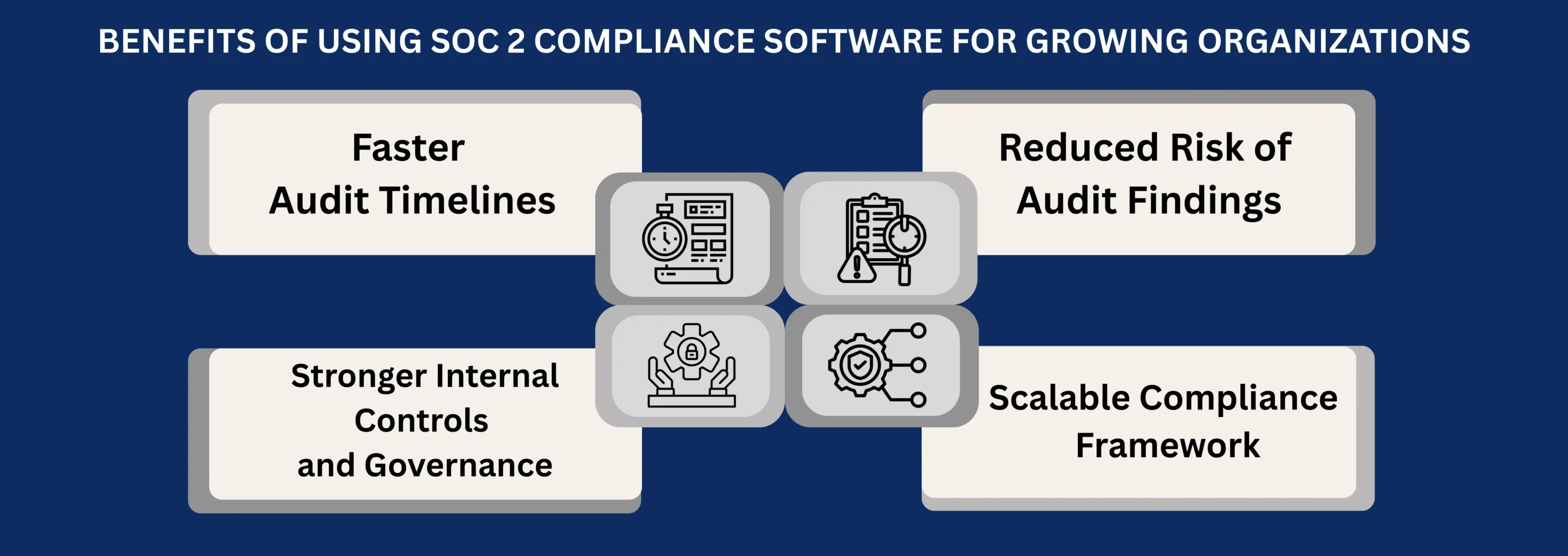
In Arlington’s defense technology and government contracting environment, SOC 2 Certification in Arlington translates directly into commercial access. Prime contractors and federal agencies that require SOC 2 attestation as a vendor enrollment condition effectively create a market-access barrier for organizations without a current report. Holding a SOC 2 Type 2 report eliminates this barrier and positions the organization as a qualified vendor in procurement processes where security attestation is a threshold requirement. For SaaS providers and managed service organizations competing for enterprise contracts in Arlington’s technology market, the SOC 2 report replaces the need for customers to conduct independent security assessments — reducing sales cycle friction and accelerating procurement decisions. The report’s structured format, including the system description and auditor’s opinion, provides reviewers with the specific information required to complete vendor risk assessments efficiently.
SOC 2 reports are point-in-time or period-specific attestations, and enterprise customers and government procurement programs typically require a current report issued within the prior twelve months. Organizations that obtain an initial SOC 2 report must complete annual SOC 2 Type 2 audits to maintain current attestation status. The annual audit cycle reinforces continuous control monitoring and operational discipline, as the organization must demonstrate consistent control operation throughout each successive observation period. This recurring attestation cadence creates an ongoing assurance mechanism that benefits both the organization and its customers: customers receive updated evidence of control effectiveness annually, while the organization maintains a structured, audited security governance program. For Arlington-based organizations with long-term federal contracts or enterprise customer relationships, the annual SOC 2 audit cycle aligns naturally with recurring vendor security reviews and contract renewals.
- ✓Commercial Value in Arlington’s Defense and Technology Markets
- ✓Ongoing Assurance Through Annual Attestation Cycles
SOC 2 Certification vs. Other Security Frameworks
Organizations in Arlington frequently operate under multiple security frameworks and must understand how SOC 2 Certification relates to — and differs from — alternative frameworks including ISO 27001, CMMC, FedRAMP, and HIPAA. Each framework serves distinct purposes and is recognized in specific procurement and regulatory contexts. SOC 2 is unique in that it produces an independent, CPA-issued attestation report accepted across a broad range of U.S. enterprise and government procurement processes. Understanding these distinctions helps Arlington organizations build a compliance strategy that satisfies multiple stakeholders without duplicating effort unnecessarily.
SOC 2 vs. ISO 27001
SOC 2 and ISO 27001 are the two most widely recognized information security attestation frameworks, but they differ significantly in structure, issuing body, and market recognition. ISO 27001 is an international standard issued by the International Organization for Standardization and is certified by accredited certification bodies. It focuses on the design and implementation of an Information Security Management System (ISMS) and results in a certificate of conformance. SOC 2, by contrast, is a U.S.-origin framework governed by the AICPA and results in a CPA-issued attestation report evaluating controls against the Trust Services Criteria. In the U.S. market — particularly in federal contracting, defense technology, and enterprise SaaS — the SOC 2 report is more widely recognized and accepted than ISO 27001 certification. For Arlington organizations serving U.S.-based enterprise and government customers, a SOC 2 audit in Arlington is typically the higher-priority attestation. Organizations with significant international customer bases may choose to pursue both frameworks.
SOC 2 and CMMC / FedRAMP for Defense and Federal Contractors
Arlington-based defense contractors and federal IT vendors frequently encounter requirements for both SOC 2 and other government-specific frameworks. CMMC (Cybersecurity Maturity Model Certification) is required for organizations in the defense industrial base handling Controlled Unclassified Information (CUI) under DoD contracts. FedRAMP (Federal Risk and Authorization Management Program) is required for cloud service providers seeking authorization to serve federal agencies. SOC 2 is distinct from both: it is not a government authorization program, but rather an independent attestation accepted broadly across enterprise and government vendor risk management programs. SOC 2 attestation complements CMMC and FedRAMP by addressing the security control evidence requirements of non-DoD enterprise customers and prime contractor vendor programs. For many Arlington organizations, SOC 2 Certification serves as the foundation of a broader compliance program that also addresses CMMC, FedRAMP, or NIST 800-171 requirements depending on the nature of government contracts held.
| Framework | Issuing Body | Report/Output | Primary Market |
|---|---|---|---|
| SOC 2 | AICPA (via Licensed CPA Firm) | Attestation Report (AT-C 205) | U.S. enterprise, government, defense technology |
| ISO 27001 | ISO (via accredited certification body) | Certificate of Conformance | International markets, global enterprise |
| CMMC | DoD (via C3PAO) | Certification Level (1–3) | U.S. defense industrial base (CUI handling) |
| FedRAMP | FedRAMP PMO (via 3PAO) | Authority to Operate (ATO) | Cloud service providers serving U.S. federal agencies |
Business Sectors in Arlington Seeking SOC 2 Certification
SOC 2 Certification in Arlington is relevant across multiple industry sectors, each with distinct procurement drivers, customer expectations, and control environment characteristics. The following sectors represent the primary categories of Arlington-based organizations that pursue SOC 2 attestation as a business requirement. In each case, the SOC 2 examination provides an objective, independently issued report that satisfies vendor assurance, regulatory, and risk management needs specific to that sector.
Defense Technology, Government IT, and Federal Contractors
Defense technology firms, government IT service providers, and federal contractors headquartered in Arlington represent the most concentrated category of SOC 2 demand in the region. These organizations handle sensitive government data, proprietary defense information, and IT infrastructure that supports federal agency operations. Prime contractors conducting vendor security assessments of their supply chain routinely require subcontractors and technology vendors to produce a current SOC 2 Type 2 report. Similarly, government agencies engaging commercial technology vendors as part of digital transformation initiatives increasingly include SOC 2 attestation as a vendor qualification requirement. For these organizations, SOC 2 Certification in Arlington represents a procurement threshold rather than a differentiating capability — the report is necessary to compete for contracts and maintain vendor relationships in Arlington’s defense ecosystem.
SaaS Companies, Cloud Providers, and Managed Service Organizations
Arlington’s growing technology ecosystem includes SaaS companies, cloud infrastructure providers, and managed IT service organizations that serve enterprise, financial services, and government customers. For these organizations, SOC 2 attestation in Arlington is a standard commercial requirement encountered during enterprise sales, vendor onboarding, and annual security reviews. Customers in regulated industries — including banking, insurance, healthcare, and legal services — operate under their own regulatory obligations that require vendor due diligence and documented evidence of third-party security controls. A SOC 2 Type 2 report satisfies this evidence requirement efficiently, enabling the customer’s procurement and security teams to complete vendor assessment processes without conducting independent audits. Arlington-based SaaS and cloud providers that hold a current SOC 2 report consistently experience faster procurement decisions and reduced questionnaire burden compared to those relying on self-attested security postures.
Cybersecurity, Data Analytics, and AI Technology Organizations
Cybersecurity firms, data analytics providers, and artificial intelligence technology companies operating in Arlington handle sensitive customer data, proprietary analytical outputs, and security-relevant information that require rigorous control validation. For cybersecurity service providers, a SOC 2 report serves as independent evidence that internal controls — not just the services delivered to clients — meet objective professional standards. Data analytics and AI organizations that process large volumes of customer or government data are evaluated against SOC 2 criteria including Processing Integrity (ensuring data is processed completely and accurately) and Confidentiality (ensuring analytical outputs and customer data are protected). The SOC 2 attestation provides a structured framework for demonstrating that these processing and confidentiality controls are functioning as intended, as evaluated by an independent Licensed CPA Firm conducting a formal SOC 2 examination.
SOC 2 Report Validity, Maintenance, and Ongoing Compliance
SOC 2 Certification is not a permanent designation. The SOC 2 report is time-bounded, reflecting either a point-in-time assessment (Type 1) or a defined observation period (Type 2). Organizations must understand the validity parameters of their SOC 2 report and the requirements for maintaining current attestation status through annual audit cycles. Allowing a SOC 2 report to lapse — or failing to renew it annually — exposes the organization to the same procurement barriers faced by organizations that have never completed an examination.
Report Validity and Renewal Cycles
A SOC 2 Type 1 report reflects controls at a single point in time and provides no assurance about subsequent periods. A SOC 2 Type 2 report covers a defined observation period and is generally considered current for twelve months following the report’s period end date. Enterprise customers and procurement programs that request a current SOC 2 report typically require the report to have been issued within the prior twelve months. Once a report ages beyond twelve months without renewal, customers may treat it as stale and require a new examination before proceeding with vendor enrollment or contract renewal. Annual recertification through a new Type 2 audit maintains continuous attestation status and ensures that the SOC 2 report remains a viable and accepted procurement artifact throughout the year. For Arlington-based organizations with active vendor relationships, maintaining report currency is a continuous operational priority.
Continuous Control Monitoring Between Audit Cycles
Maintaining SOC 2 compliance between annual audit cycles requires organizations to operate their controls consistently throughout the year — not only during the audit period itself. The SOC 2 Type 2 examination covers the entire observation period, and the auditor samples evidence from across that period to assess consistency of control operation. Controls that function during an audit window but are inconsistently applied at other times will produce exceptions when tested across a full observation period. Effective continuous control monitoring programs include regular access reviews (typically monthly or quarterly), ongoing vulnerability scanning and remediation tracking, continuous security log monitoring and alerting, periodic policy review and updates, and recurring vendor risk assessments. Organizations that maintain these activities year-round are better positioned to produce consistent, auditable evidence when the annual SOC 2 examination commences — resulting in a cleaner audit with fewer exceptions and a stronger attestation outcome.
FAQ
▶
What is SOC 2 Certification and who issues it?
▶
What is the difference between SOC 2 Type 1 and Type 2?
▶
How long does a SOC 2 audit take for an Arlington organization?
▶
Which Trust Services Criteria are required for SOC 2 Certification in Arlington?
▶
Is SOC 2 Certification required for federal contractors in Arlington?
▶
How long is a SOC 2 report valid?
▶
What is the difference between SOC 2 certified and SOC 2 compliant?
▶
Can a SOC 2 report be shared publicly?
SOC 1 VS SOC 2: WHICH REPORT YOUR CUSTOMERS ACTUALLY ASK FOR
If you sell SaaS or provide outsourced services, you have likely been asked for a SOC report. However, the follow-up question is rarely easy to answer…
SOC 2 Certified: What Does It Mean for Your Business
For companies that handle sensitive data or run cloud-based services, the question “Can you provide your SOC 2 report?” carries enormous weight. Yet, …
HOW SOC 2 AUDITORS REVIEW EVIDENCE OVER TIME
Most businesses pursuing a SOC 2 report spend months building security controls but overlook a fundamental reality: SOC 2 auditors do not just verify …
Get In Touch
have a question? let us get back to you.