
SOC 2 Certification in South Australia
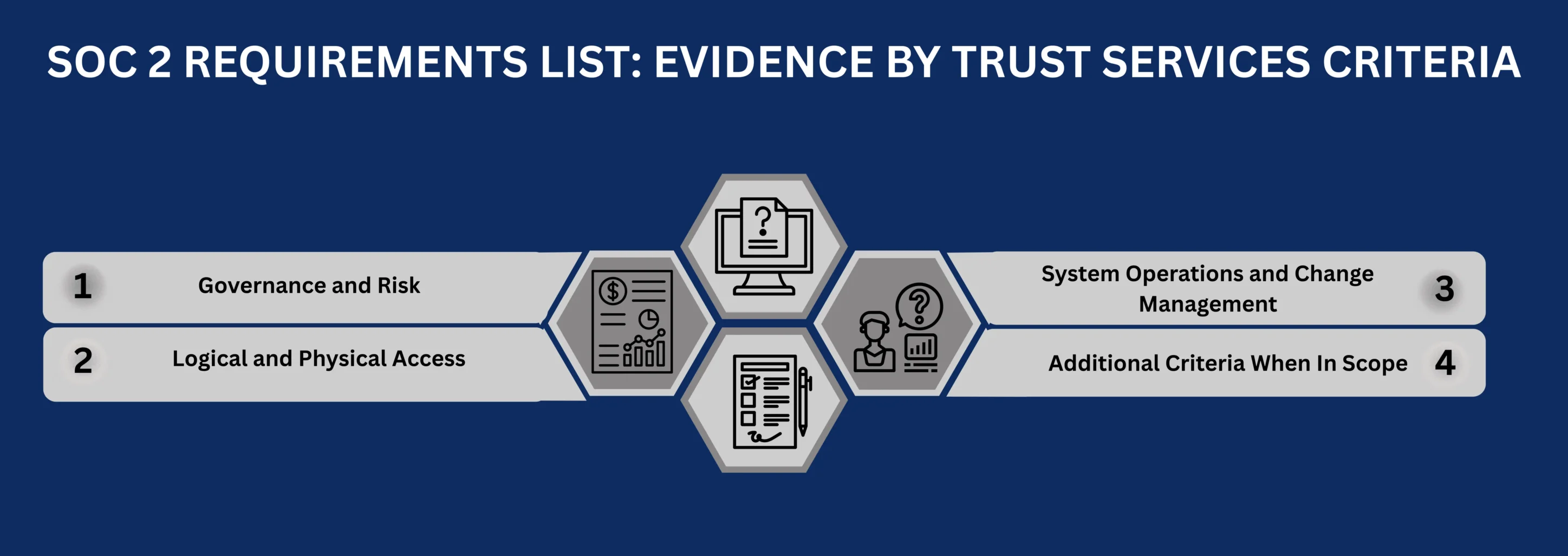
SOC 2 compliance is evaluated against the AICPA Trust Services Criteria, which define the control objectives and criteria points that service organizations must address within each applicable category. The evaluation framework is evidence-based: every control assertion made in the system description must be supported by documented evidence that the auditor can inspect, test, or verify. The following areas represent the principal domains evaluated during a SOC 2 examination for South Australian service organizations pursuing SOC 2 Certification in South Australia.
OUR CLIENTS










What SOC 2 Certification Means for South Australian Organizations
SOC 2 Certification in South Australia refers to an independent attestation engagement conducted by a Licensed CPA Firm under AICPA standards AT-C 105 and AT-C 205. When a South Australian service organization is described as SOC 2 certified, it means a licensed CPA has independently examined and reported on the design and operating effectiveness of the organization’s controls against the applicable AICPA Trust Services Criteria (TSC). The resulting document is a SOC 2 attestation report — not a certificate issued by a standards body — and it carries the auditor’s opinion on whether the service organization’s controls meet the defined criteria. Understanding this distinction is fundamental for any organization in South Australia that handles customer data, delivers cloud-based services, or operates within technology-dependent supply chains.
SOC 2 attestation differs materially from ISO certification. ISO 27001, for example, is issued by an accredited certification body following a conformity assessment. A SOC 2 examination, by contrast, is performed by a Licensed CPA Firm under the American Institute of Certified Public Accountants (AICPA) attestation standards. The service organization retains full responsibility for designing, implementing, and operating controls that satisfy the applicable Trust Services Criteria. The Licensed CPA Firm’s role is to independently examine those controls and issue a formal opinion. Management provides a written assertion accompanying the report, confirming that the system and its controls meet the stated criteria. The auditor then evaluates that assertion and the underlying evidence before forming an independent opinion.
South Australian organizations across sectors — including SaaS, cloud services, defence technology, healthcare IT, financial services, and advanced manufacturing — are increasingly required by enterprise customers, government agencies, and international procurement processes to demonstrate SOC 2 compliance. A completed SOC 2 attestation report provides objectively verified evidence that an organization’s controls are designed and operating effectively. Procurement panels, vendor risk teams, and enterprise security functions can evaluate this evidence directly. Security posture alone, without independent examination, does not satisfy the evidentiary requirements demanded in regulated industries or cross-border vendor assurance programs. SOC 2 Certification in South Australia fills that gap by introducing independent third-party verification into the trust equation.
South Australia’s technology and innovation ecosystem — anchored in Adelaide and extending across regional hubs — encompasses organizations operating in defence and aerospace, cybersecurity, artificial intelligence, health technology, energy and utilities, and professional services. Many of these organizations provide managed services, software platforms, or data processing capabilities to customers whose own regulatory obligations require evidence of third-party control assurance. SOC 2 examination provides a structured, AICPA-governed mechanism for generating that assurance. For South Australian technology providers seeking to expand into United States markets, secure contracts with federally regulated entities, or satisfy enterprise security questionnaires, SOC 2 Certification in South Australia represents the relevant, internationally recognized attestation standard against which their controls are examined and reported.

SOC 2 Examination Types: Type I and Type II Attestation
SOC 2 examinations are conducted in two distinct forms: Type I and Type II. Each serves a different evidentiary purpose and answers a different question about a service organization’s controls. Understanding this distinction is essential for South Australian organizations determining which form of SOC 2 attestation best suits their stage of control maturity and their customers’ assurance requirements. Both types are conducted by a Licensed CPA Firm under AICPA AT-C 205 and result in a formal attestation report. The choice between Type I and Type II affects the scope of evidence collected, the nature of testing performed, and the period covered by the auditor’s opinion.
SOC 2 Type I Audit: Design of Controls at a Point in Time
A SOC 2 Type I audit in South Australia evaluates whether a service organization’s controls are suitably designed to meet the applicable Trust Services Criteria as of a specific date. The auditor reviews the system description prepared by management, assesses whether the controls described are logically structured to address identified risks, and determines whether management’s assertion about control design is fairly stated. A Type I examination does not test whether controls operated effectively over a period of time — it is a point-in-time assessment of design suitability. For organizations in South Australia that have recently implemented controls and need to demonstrate initial design adequacy to prospective customers or procurement panels, a SOC 2 Type I attestation provides a structured and independently verified starting point.
Type I reports are commonly used by South Australian SaaS providers, cloud service organizations, and managed service companies entering new markets where customers require documented evidence of control design before committing to a commercial relationship. A Type I attestation also serves as a precursor to a Type II examination, establishing the baseline system description and control framework against which subsequent operating effectiveness testing will be conducted. The period covered by a Type I report is a single date — the as-of date — rather than a review period. Auditors assess evidence of control existence, design logic, and alignment with Trust Services Criteria points as of that date.
SOC 2 Type II Audit: Operating Effectiveness Over a Review Period
A SOC 2 Type II audit in South Australia evaluates both the design suitability and the operating effectiveness of a service organization’s controls over a defined review period, typically six to twelve months. The auditor applies a range of testing procedures — including inquiry, inspection, observation, reperformance, system queries, configuration reviews, log analysis, and sampling — to determine whether each control operated as described throughout the review period. Exceptions identified during testing are documented in the report, along with the auditor’s evaluation of their significance and any compensating controls. The resulting SOC 2 Type II attestation report provides the most substantive form of independent control assurance available under AICPA standards.
Enterprise customers, financial institutions, government technology panels, and international procurement functions — in South Australia and globally — typically require a SOC 2 Type II report before approving a service organization as a trusted vendor. The Type II examination’s extended review period means that evidence of consistent control operation — not just design intent — is independently verified and reported. For South Australian organizations operating in defence technology, health IT, financial services, and cloud infrastructure, a SOC 2 Type II attestation report is the standard against which vendor assurance programs assess control reliability. The review period must be clearly stated in the system description and the auditor’s report, as it defines the boundaries of the opinion issued.
| Feature | SOC 2 Type I | SOC 2 Type II |
|---|---|---|
| Assessment scope | Control design at a point in time | Control design and operating effectiveness over a defined period |
| Review period | Single as-of date | Typically 6–12 months |
| Testing procedures | Design review and walkthrough | Inquiry, inspection, observation, reperformance, and sampling |
| Exceptions reported | Design gaps identified | Operating exceptions and deviations documented |
| Common use case | Initial assurance for new market entrants | Ongoing vendor assurance and enterprise procurement |
AICPA Trust Services Criteria Applicable to SOC 2 Certification in South Australia
The AICPA Trust Services Criteria (TSC) form the evaluative framework against which all SOC 2 examinations are conducted. The TSC consists of five principal categories: Security, Availability, Processing Integrity, Confidentiality, and Privacy. Security — also referred to as the Common Criteria — is mandatory for every SOC 2 examination. The remaining four categories are selected based on the nature of the service organization’s commitments to its customers, the regulatory environment in which it operates, and the specific risks associated with the services it provides. For SOC 2 Certification in South Australia, the selection of applicable criteria is determined by the service organization in consultation with its licensed auditor, based on a review of service commitments, system boundaries, and customer contractual requirements.
The Security criterion — formally the Common Criteria — addresses the protection of information and systems against unauthorized access, unauthorized disclosure, and system damage. It encompasses logical and physical access controls, change management, risk assessment, monitoring, and incident response. All SOC 2 examinations must include Security as a minimum scope criterion. For South Australian cloud service providers, SaaS platforms, and managed service organizations, Security criteria evaluation covers access management policies, multifactor authentication controls, encryption configurations, vulnerability management programs, and security event monitoring procedures. Each control is examined against specific criteria points within the TSC, and evidence of design and operation is collected and assessed by the Licensed CPA Firm conducting the SOC 2 audit.
The Availability criterion applies to organizations whose service commitments include system uptime, performance, and recovery obligations. It examines controls over system monitoring, incident detection, backup and recovery procedures, and capacity management. South Australian organizations providing infrastructure-as-a-service, hosted platforms, or mission-critical software to healthcare providers, defence contractors, or financial institutions frequently include Availability in their SOC 2 scope. This is because their customers’ own operations depend on continuous system access. The auditor evaluates whether the service organization’s controls are designed and operating effectively to support the availability commitments defined in service level agreements and system descriptions.
The Processing Integrity criterion applies when a service organization’s core function involves processing transactions on behalf of customers — such as payment processing, data transformation, or financial calculation services. Controls examined under this criterion address whether processing is complete, accurate, timely, authorized, and valid. South Australian fintech organizations, payroll service providers, and data processing platforms handling transactions for regulated industries may include Processing Integrity in their SOC 2 scope. The Confidentiality criterion addresses controls over information designated as confidential — including customer data, trade secrets, and contractually protected information — covering its collection, use, retention, disclosure, and disposal throughout its lifecycle.
The Privacy criterion applies when a service organization collects, uses, retains, discloses, or disposes of personal information. Privacy criteria examination is aligned with the AICPA’s Generally Accepted Privacy Principles and addresses notice, choice and consent, collection, use and retention, access, disclosure to third parties, security for privacy, quality, and monitoring and enforcement. South Australian health technology organizations, digital identity platforms, and consumer-facing SaaS providers that handle personal data may include Privacy in their SOC 2 scope. This is particularly relevant where customer contracts or applicable Australian privacy legislation impose specific personal data handling obligations. Including Privacy in SOC 2 scope provides independently examined evidence of privacy control effectiveness — an increasingly valued assurance for enterprise and government customers.
- ✓Security and Availability Criteria
- ✓Processing Integrity, Confidentiality, and Privacy Criteria
SOC 2 Certification Audit Process in South Australia
The SOC 2 audit process in South Australia follows a structured sequence of stages defined by AICPA attestation standards and the engagement terms agreed between the service organization and the Licensed CPA Firm. Each stage produces documented outputs that form the evidentiary basis for the auditor’s opinion. The process is evidence-driven and designed to ensure the auditor’s independence, objectivity, and technical rigor throughout. The following stages describe the standard SOC 2 examination sequence conducted under AICPA AT-C 105 and AT-C 205.
| Audit Stage | Key Activities | Output |
|---|---|---|
| Scope Definition | Identify applicable Trust Services Criteria, system boundaries, and review period | Defined scope and engagement letter |
| System Description Review | Evaluate management’s description of the service system for completeness and accuracy | Reviewed system description draft |
| Stage 1 — Design Assessment | Assess control design suitability against applicable TSC criteria points | Design evaluation findings |
| Stage 2 — Operating Effectiveness Testing | Apply inquiry, inspection, observation, reperformance, and sampling procedures | Testing workpapers and exception log |
| Nonconformity Review | Identify and document exceptions; evaluate materiality and compensating controls | Exception summary and auditor evaluation |
| Attestation Report Issuance | Issue SOC 2 report with management assertion and auditor’s opinion | Final SOC 2 attestation report |
The SOC 2 examination begins with scope definition, during which the service organization and the Licensed CPA Firm agree on the applicable Trust Services Criteria, the boundaries of the system under examination, and the review period for a Type II engagement or the as-of date for a Type I engagement. The system description — prepared by management of the service organization — documents the infrastructure, software, people, procedures, and data that constitute the service system. It identifies the boundaries of the system, the principal service commitments and system requirements, the components of the system, the risks that threaten achievement of those commitments, and the controls implemented to address those risks. The auditor evaluates whether the system description is fairly presented and covers the elements required by AICPA standards.
For South Australian organizations, the system description must also address subservice organizations — third-party vendors or cloud providers whose services form part of the service system — and whether those subservice organizations are included in or carved out of the SOC 2 examination scope. When a subservice organization is carved out, the service organization’s system description discloses the nature of the services provided by that subservice organization and the controls the service organization applies to monitor them. Complementary subservice organization controls (CSOCs) — controls expected to be performed by subservice organizations — are documented and disclosed so that report users can fully understand the control environment and its dependencies.
During the operating effectiveness phase of a SOC 2 Type II audit, the Licensed CPA Firm applies multiple testing procedures to evaluate whether each control operated as described throughout the review period. Inquiry involves structured interviews with personnel responsible for executing and overseeing controls. Inspection involves examination of documented evidence — policies, procedures, configuration records, access logs, and system-generated reports. Observation involves direct review of control activities as they occur. Reperformance involves the auditor independently executing a control procedure to verify it produces the expected outcome. System queries and configuration reviews involve direct interrogation of technical environments to confirm system settings, access privileges, and automated control parameters. Log analysis involves examination of system event logs to assess whether monitoring and alerting controls operated consistently.
Sampling is applied where the population of control executions is too large for exhaustive testing. The auditor determines sample sizes based on the frequency of the control, the risk associated with the criterion, and professional judgment. When exceptions are identified during testing — instances where a control did not operate as described — the auditor evaluates the exception’s nature, frequency, and potential impact on the overall control objective. Exceptions are documented in the SOC 2 report along with the auditor’s assessment. The presence of exceptions does not automatically result in a qualified opinion. The auditor evaluates whether exceptions are isolated incidents addressed through compensating controls or whether they represent a pervasive failure that materially affects the control objective.
The SOC 2 attestation report contains two principal components: management’s written assertion and the auditor’s opinion. Management’s assertion is a formal written statement prepared by the service organization’s management affirming that the system description is fairly presented and that the controls described were suitably designed — and, for Type II reports, operating effectively throughout the review period — to meet the applicable Trust Services Criteria. The assertion represents management’s acceptance of responsibility for the control environment. The Licensed CPA Firm then issues its independent opinion — either unqualified, qualified, adverse, or a disclaimer of opinion — based on the evidence gathered during the SOC 2 examination.
An unqualified opinion indicates that the auditor found the system description to be fairly presented and the controls to be suitably designed and, for Type II engagements, operating effectively, with no material exceptions identified. A qualified opinion indicates that the system description, control design, or operating effectiveness deviated in a material respect from the applicable criteria. The SOC 2 attestation report also includes a description of the auditor’s tests of controls and their results, providing full transparency into the specific procedures applied and the evidence evaluated. This level of detail allows sophisticated report users — including enterprise security teams, procurement panels, and internal audit functions — to assess the rigor of the examination and the reliability of the opinion issued.
- ✓Scope Definition and System Description Preparation
- ✓Control Testing, Evidence Collection, and Auditor Procedures
- ✓Management Assertions, Auditor’s Opinion, and Report Issuance
SOC 2 Compliance Requirements and Evaluation Framework
SOC 2 compliance is evaluated against the AICPA Trust Services Criteria, which define the control objectives and criteria points that service organizations must address within each applicable category. The evaluation framework is evidence-based: every control assertion made in the system description must be supported by documented evidence that the auditor can inspect, test, or verify. The following areas represent the principal domains evaluated during a SOC 2 examination for South Australian service organizations pursuing SOC 2 Certification in South Australia.
Control design evaluation assesses whether the controls described in the system description are logically structured to address the risks that threaten achievement of service commitments and system requirements. The auditor reviews risk assessment documentation, control matrices, policy frameworks, and procedure documentation to determine whether the service organization has identified relevant risks and implemented controls calibrated to address them. Risk management under the SOC 2 framework requires the service organization to document a risk assessment process, identify threats to control objectives, evaluate the likelihood and significance of those threats, and implement controls that reduce residual risk to an acceptable level. The risk assessment is both a control requirement and an auditable artifact reviewed by the Licensed CPA Firm as part of the SOC 2 examination.
Documentation requirements for SOC 2 compliance extend beyond policy documents to include evidence of control execution. This encompasses access provisioning records, change approval logs, vulnerability scan reports, incident response records, training completion records, vendor assessment reports, backup verification logs, and system configuration documentation. The AICPA distinguishes between three categories of evidence: observational evidence — screenshots, configurations, and real-time observations demonstrating controls in action; analytical evidence — reports, dashboards, and trend analyses showing control performance over time; and testimonial evidence — interviews and written confirmations from personnel responsible for control execution. All three evidence types are collected and evaluated during a SOC 2 Type II examination.
Complementary user entity controls (CUECs) are controls that the service organization expects its customers — user entities — to implement in order for the overall control objective to be achieved. CUECs are disclosed in the SOC 2 report and represent a shared responsibility model: the service organization’s controls address one portion of the control objective, while the user entity’s controls address the remainder. For example, a cloud platform may control access at the infrastructure level, while the user entity manages application-level user provisioning and deprovisioning. The SOC 2 report identifies CUECs so that user entity auditors and internal risk functions can evaluate whether their organization has implemented the expected complementary controls.
Complementary subservice organization controls (CSOCs) apply where a service organization relies on a subservice organization — such as a cloud infrastructure provider, data center operator, or third-party identity management platform — whose controls contribute to the achievement of the service organization’s control objectives. When the inclusive method is applied, the subservice organization’s controls are included within the scope of the SOC 2 examination. When the carve-out method is applied, the subservice organization’s controls are excluded from the examination scope, and the service organization discloses the controls it expects the subservice organization to maintain. South Australian service organizations operating on major cloud platforms typically apply the carve-out method and rely on the cloud provider’s own SOC 2 report — obtained via bridge letters or complementary reports — to address subservice organization risk.
- ✓Control Design, Documentation, and Risk Management
- ✓Complementary User Entity Controls and Subservice Organization Controls
Industries in South Australia Pursuing SOC 2 Certification
SOC 2 Certification in South Australia is pursued across a broad range of industries where organizations provide services involving the processing, storage, or transmission of customer data. The demand for SOC 2 attestation is driven by enterprise procurement requirements, regulatory expectations, international market access goals, and the increasing sophistication of third-party risk management programs operated by South Australian and global customers. The following industries represent the primary sectors in which SOC 2 examination is relevant for South Australian organizations.
- ✓Software and SaaS providers delivering platforms to enterprise, government, or regulated-industry customers
- ✓Cloud service providers and data hosting organizations managing customer data infrastructure
- ✓Cybersecurity and AI technology organizations providing managed detection, response, or intelligence services
- ✓Defence and aerospace technology suppliers handling sensitive data for government and prime contractors
- ✓Health technology and digital health platforms processing clinical, patient, or administrative data
- ✓Financial services and fintech organizations providing payment processing, lending, or data aggregation services
- ✓Advanced manufacturing and industrial technology organizations integrating operational technology with customer systems
- ✓Professional services firms managing confidential client data across legal, accounting, or consulting functions
Defence, Aerospace, and Government Technology
South Australia’s defence and aerospace sector — concentrated around the Osborne Naval Shipyard, the Defence SA ecosystem, and the growing cyber and intelligence technology precinct in Adelaide — generates significant demand for independently verified control assurance. Technology suppliers providing software, data analytics, cybersecurity, communications, or managed services to defence prime contractors or government agencies are frequently required to demonstrate SOC 2 compliance as part of vendor security assessments and supply chain assurance programs. SOC 2 examination provides an independently verified report on control design and operating effectiveness that defence procurement officers and contract security managers can evaluate against vendor assurance requirements.
Government technology organizations in South Australia — including those delivering digital services, identity verification, data analytics, or cloud infrastructure to state and federal agencies — face vendor assurance requirements from agencies applying the Australian Government’s Information Security Manual (ISM) and related procurement frameworks. A SOC 2 attestation report, while not a direct substitute for ISM compliance, provides independently examined evidence of control effectiveness that government procurement panels can consider as part of broader vendor due diligence. For South Australian technology companies targeting federal contracts or cross-jurisdictional government engagements, SOC 2 Certification in South Australia establishes a recognized, internationally understood baseline of independently verified control assurance.
Financial Services, Fintech, and Health Technology
Adelaide’s growing fintech and financial services technology ecosystem includes organizations providing open banking platforms, payment infrastructure, lending technology, and data aggregation services. Financial institutions engaging these providers — including banks, credit unions, and wealth management firms — require independent assurance that third-party systems processing their customers’ financial data meet defined security and confidentiality standards. SOC 2 Type II attestation in South Australia provides that assurance in a format that financial institution risk and compliance teams can evaluate directly, satisfying their third-party risk management obligations under APRA Prudential Standards and related regulatory frameworks.
Health technology organizations in South Australia — including those providing electronic health records, telehealth platforms, clinical decision support systems, and health data analytics — process sensitive personal health information subject to the Australian Privacy Act 1988 and the My Health Records Act 2012. SOC 2 examination of Privacy and Security criteria provides independently verified evidence of controls over personal data collection, processing, access, disclosure, and retention. For health technology providers seeking to expand into hospital networks, primary health networks, or international health system markets, a SOC 2 attestation report demonstrates control effectiveness in a format recognized by enterprise procurement and risk assurance teams globally.
Benefits of SOC 2 Certification for South Australia-Based Organizations
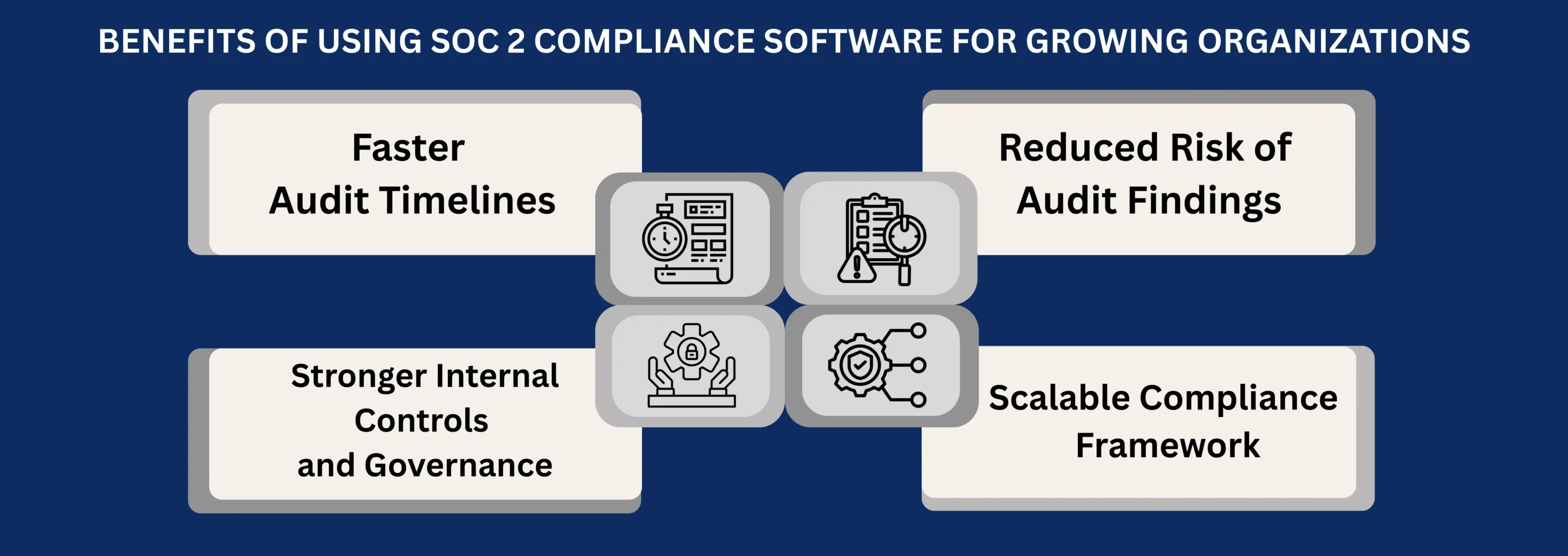
SOC 2 Certification in South Australia delivers measurable, independently verified outcomes for service organizations that complete the attestation process. The benefits are structural — they arise from the independent examination itself and the verified control evidence it produces — rather than from organizational claims about security posture. The following benefits reflect the practical outcomes of a completed SOC 2 attestation engagement for South Australian service organizations.
- ✓Independent third-party verification of control design and operating effectiveness against AICPA Trust Services Criteria
- ✓Structured, auditor-reported evidence satisfying enterprise vendor security review requirements
- ✓Recognition in financial sector, government, and defence procurement processes as an independently assessed supplier
- ✓Demonstrated SOC 2 compliance supporting customer due diligence, contract award decisions, and ongoing vendor assurance
- ✓Reduction of customer security questionnaire burden through provision of a formal SOC 2 attestation report
- ✓Ongoing surveillance through annual SOC 2 audit cycles maintaining current attestation status
- ✓Support for international market access, particularly into United States enterprise and regulated-industry markets
- ✓Documented evidence of Privacy and Confidentiality control effectiveness for organizations handling sensitive personal data
Enterprise procurement functions — particularly those operating within financial services, healthcare, government, and technology sectors — assess third-party vendors against defined security and control criteria as part of their vendor risk management programs. A SOC 2 attestation report provides a standardized, independently examined artifact that procurement teams can evaluate without conducting their own on-site audits of each vendor. For South Australian technology providers responding to enterprise RFPs, participating in government panel arrangements, or entering into data processing agreements with large organizations, a current SOC 2 Type II attestation report materially reduces the time and effort required to satisfy third-party security review requirements and accelerates procurement approval processes.
SOC 2 Certification for South Australian companies also supports cross-border vendor assurance scenarios. A South Australian SaaS provider delivering services to a United States financial institution, for example, will typically be required to provide a current SOC 2 Type II report as part of the institution’s vendor due diligence process, satisfying requirements under applicable regulatory obligations. Similarly, South Australian cloud service organizations serving European customers may use SOC 2 attestation alongside GDPR-aligned privacy controls to demonstrate a comprehensive control assurance posture. The international recognition of AICPA SOC 2 standards means that a SOC 2 report issued by a Licensed CPA Firm is understood and accepted by procurement and risk functions in the United States, Europe, and increasingly across Asia-Pacific markets.
SOC 2 attestation is not a one-time exercise. Enterprise customers and regulated-industry procurement programs require current SOC 2 reports — typically dated within the last twelve months — to maintain vendor assurance currency. South Australian service organizations maintaining SOC 2 compliance therefore complete annual SOC 2 audit cycles, with each cycle producing an updated attestation report covering the most recent review period. The annual cycle reinforces the discipline of continuous control operation and documentation, embedding structured evidence collection into operational processes rather than treating it as a periodic audit preparation exercise. Bridge letters — formal statements from the service organization extending the coverage of a prior SOC 2 report to cover a gap period before the next report is issued — are used to address timing gaps between report periods for customers requiring continuous attestation coverage.
- ✓Vendor Assurance and Enterprise Procurement Recognition
- ✓Annual Audit Cycles and Ongoing Attestation Currency
SOC 2 vs ISO 27001: Choosing the Right Attestation Framework for South Australian Organizations
SOC 2 and ISO 27001 are frequently compared by South Australian organizations evaluating which framework best addresses their customer requirements and operational context. The two frameworks serve different purposes, are governed by different standards bodies, and produce different outputs. Understanding these distinctions is important for service organizations determining which form of independent assurance is most appropriate for their market and customer base. For many organizations, the choice begins with identifying whether their primary customers demand SOC 2 compliance, ISO 27001 certification, or both.
Structural and Regulatory Differences Between SOC 2 and ISO 27001
SOC 2 is an attestation engagement conducted by a Licensed CPA Firm under AICPA standards, producing an attestation report with an auditor’s opinion. ISO 27001 is a management system certification issued by an accredited certification body following a conformity assessment audit. SOC 2 examines specific controls against Trust Services Criteria points, testing both design and operating effectiveness with detailed evidence of control execution. ISO 27001 certifies that an organization’s information security management system (ISMS) conforms to the ISO/IEC 27001 standard’s requirements — a management system assessment rather than a controls-level attestation. The outputs differ: SOC 2 produces a detailed attestation report describing specific controls and testing results, while ISO 27001 produces a certificate confirming ISMS conformance.
SOC 2 is predominantly demanded by United States enterprise customers, financial institutions, and technology sector procurement functions. ISO 27001 is recognized globally and is commonly required in European, Middle Eastern, and Asia-Pacific procurement contexts. South Australian organizations targeting United States markets should prioritize SOC 2 examination; those targeting European or broader international markets may find ISO 27001 certification more directly applicable. Organizations serving both markets frequently maintain both a current SOC 2 attestation report and an ISO 27001 certificate, using each to satisfy market-specific assurance requirements. The two frameworks are complementary rather than substitutes, and controls implemented under one framework typically contribute evidence applicable to the other.
| Dimension | SOC 2 Attestation | ISO 27001 Certification |
|---|---|---|
| Governing body | AICPA (AT-C 105, AT-C 205) | ISO/IEC (International Organization for Standardization) |
| Issued by | Licensed CPA Firm | Accredited certification body |
| Output document | Attestation report with auditor’s opinion | ISO 27001 certificate confirming ISMS conformance |
| Evaluation focus | Specific controls against Trust Services Criteria | ISMS conformance to ISO/IEC 27001 requirements |
| Primary market | United States enterprise and regulated industries | Global recognition across multiple markets |
SOC 2 Report Access, Validity, and Bridge Letters
SOC 2 attestation reports are confidential documents restricted to specified recipients. Unlike ISO certificates, which are publicly disclosed, SOC 2 reports are distributed under non-disclosure agreements to customers, prospective customers, and regulators with a legitimate need to assess the service organization’s controls. Understanding report access, validity periods, and bridge letter practices is important for South Australian service organizations managing ongoing customer assurance relationships and maintaining SOC 2 compliance currency.
Report Distribution and Restricted Use
SOC 2 reports are restricted-use documents. The auditor’s report includes a use restriction noting that the report is intended solely for the service organization, its user entities, and specified regulators. Distribution to prospective customers or other third parties typically occurs under a non-disclosure agreement executed between the service organization and the receiving party. South Australian service organizations should establish a formal report distribution process that documents each recipient, the date of distribution, and the confidentiality agreement in place. This process protects the commercial sensitivity of the detailed control descriptions and testing results contained in the report, while ensuring that legitimate user entities and their auditors can access the information needed to complete their own control evaluations.
User entities — customers of the service organization — rely on the SOC 2 report in their own financial statement audits and internal control assessments. User entity auditors review the SOC 2 report to determine whether the service organization’s controls, as examined and reported by the Licensed CPA Firm, can be relied upon as part of the user entity’s own control environment. This reliance is governed by AICPA standards applicable to user entity auditors and requires that the SOC 2 report be current, cover the relevant review period, and address the Trust Services Criteria applicable to the services relied upon. CUECs disclosed in the report must be evaluated by the user entity to confirm that the complementary controls expected of them are in place and operating effectively.
Report Validity Periods and Bridge Letters
A SOC 2 Type II report covers a defined review period — typically six to twelve months — ending on the report date. There is no formal expiration date prescribed by AICPA standards; however, enterprise customers and regulated-industry procurement functions typically treat a SOC 2 report as current for twelve months from the end of the review period. Reports older than twelve months are generally considered stale and insufficient for vendor assurance purposes, creating a practical requirement for annual SOC 2 audit cycles. For South Australian service organizations managing customer relationships during the gap between the end of one review period and the issuance of the next report, bridge letters address the currency concern effectively.
A bridge letter — also referred to as a gap letter or coverage letter — is a formal written statement provided by the service organization’s management asserting that no material changes to the control environment have occurred since the end of the most recent SOC 2 review period. Bridge letters do not replace a SOC 2 report and do not constitute independently examined evidence. They are management representations used to extend the practical reliance period of a prior report while the next examination cycle is underway. Sophisticated user entities and their auditors will evaluate the assertions in a bridge letter alongside the prior SOC 2 report, applying professional judgment to determine whether the bridge period and the nature of the assertions are sufficient for their reliance purposes.
FAQ
▶
What is SOC 2 Certification in South Australia?
▶
Is SOC 2 a certification or an attestation report?
▶
What is the difference between a SOC 2 Type I and Type II audit?
▶
Which Trust Services Criteria apply to a SOC 2 examination?
▶
How long does a SOC 2 Type II examination typically cover?
▶
Who in South Australia needs a SOC 2 examination?
▶
What is a SOC 2 examination South Australia and what does it produce?
▶
What are complementary user entity controls (CUECs) in a SOC 2 report?
SOC 1 VS SOC 2: WHICH REPORT YOUR CUSTOMERS ACTUALLY ASK FOR
If you sell SaaS or provide outsourced services, you have likely been asked for a SOC report. However, the follow-up question is rarely easy to answer…
SOC 2 Certified: What Does It Mean for Your Business
For companies that handle sensitive data or run cloud-based services, the question “Can you provide your SOC 2 report?” carries enormous weight. Yet, …
HOW SOC 2 AUDITORS REVIEW EVIDENCE OVER TIME
Most businesses pursuing a SOC 2 report spend months building security controls but overlook a fundamental reality: SOC 2 auditors do not just verify …
Get In Touch
have a question? let us get back to you.