
SOC 2 Certification in New South Wales
SOC 2 Certification for New South Wales companies spans a broad range of industries and service categories. The common thread is that organizations process, store, transmit, or otherwise handle customer data as part of their service delivery — and their customers require independently verified evidence that appropriate controls are in place.The following industries represent the primary sectors driving SOC 2 audit activity in New South Wales, reflecting the state’s diverse and growing technology economy.
OUR CLIENTS










SOC 2 Attestation Examinations Conducted by a Licensed CPA Firm in New South Wales
SOC 2 Certification in New South Wales is conducted by a Licensed CPA Firm as an independent third-party examination under AICPA attestation standards AT-C 105 and AT-C 205. The process produces an independently examined attestation report — not an ISO-style certificate — that evaluates whether a service organization’s controls meet the applicable AICPA Trust Services Criteria (TSC). The five Trust Services Criteria categories are Security, Availability, Processing Integrity, Confidentiality, and Privacy. Security is mandatory in every SOC 2 engagement. The remaining four criteria are included based on the service organization’s system description, service commitments, and contractual obligations with user entities.
SOC 2 compliance in New South Wales is increasingly a baseline requirement for technology and service organizations supplying SaaS platforms, cloud infrastructure, data processing environments, cybersecurity services, AI systems, and managed technology solutions to enterprise and government customers. A SOC 2 attestation report provides independently examined, structured evidence that internal controls are designed and operating effectively — satisfying procurement, vendor assurance, and third-party risk management requirements across New South Wales and internationally.
For organizations operating in Sydney’s financial services district, in healthcare and life sciences precincts, across government technology programs, or within advanced manufacturing and logistics supply chains, a SOC 2 examination represents a structured, auditor-verified answer to customer security questionnaires, enterprise procurement requirements, and regulatory expectations.
The SOC 2 examination is conducted exclusively by a Licensed CPA Firm authorized to issue attestation reports under AICPA standards. CertPro operates as an independent third-party attestation provider, with no involvement in designing, implementing, operating, or remediating the controls it examines. This independence is foundational to the validity and credibility of every SOC 2 audit report issued.
The service organization’s management is responsible for designing and implementing controls that meet the applicable Trust Services Criteria and for preparing a system description that accurately represents the system boundaries, control activities, and risk management processes subject to examination.
SOC 2 Certification in New South Wales applies to organizations across a wide range of sectors, including financial services and fintech, software and SaaS, cybersecurity, AI and machine learning, cloud and data services, healthcare and life sciences, telecommunications, media and technology, professional services, education and research, advanced manufacturing, construction and engineering, logistics and transport, mining and resources, energy and utilities, agriculture and agribusiness, and government technology.
Each sector involves distinct data processing profiles, service commitments, and contractual relationships with user entities that determine the scope, criteria selection, and control objectives applicable to a SOC 2 engagement. The New South Wales technology and business ecosystem — anchored in Sydney but extending to Newcastle, Wollongong, Canberra’s border region, and the broader state — represents one of Australia’s most active environments for SOC 2 attestation activity.
SOC 2 attestation in New South Wales is distinct from other assurance frameworks in two important respects. First, it is criteria-based: the AICPA Trust Services Criteria define specific points of focus against which control design and operating effectiveness are evaluated, rather than prescribing a fixed set of controls as ISO standards do. Second, it is opinion-based: the Licensed CPA Firm issues a formal auditor’s opinion on whether the service organization’s controls meet the applicable TSC.
That opinion is based on evidence gathered through inquiry, inspection, observation, reperformance, system queries, configuration reviews, log analysis, and sampling. This structured, evidence-based examination produces a report that enterprise customers, government agencies, and independent auditors can rely on as an authoritative, independently verified representation of a service organization’s control environment.

What Is SOC 2 Certification?
SOC 2 — System and Organization Controls 2 — is an attestation framework developed and maintained by the American Institute of Certified Public Accountants (AICPA). A SOC 2 examination evaluates whether a service organization’s controls relevant to one or more of the five Trust Services Criteria categories are suitably designed and, in the case of a Type II report, operating effectively over a defined period.
The framework is governed by AICPA attestation standards AT-C 105 (Concepts Common to All Attestation Engagements) and AT-C 205 (Examination Engagements), which establish the professional and procedural requirements for Licensed CPA Firms conducting SOC 2 audits. Understanding what SOC 2 Certification involves is the first step for any New South Wales service organization evaluating its vendor assurance obligations.
SOC 2 Type I vs. SOC 2 Type II
SOC 2 Type I is a point-in-time examination. The Licensed CPA Firm evaluates whether the service organization’s controls are suitably designed to meet the applicable Trust Services Criteria as of a specific date. A Type I report does not include testing of operating effectiveness — it addresses design sufficiency only.
SOC 2 Type II is an examination over a defined review period, typically six to twelve months. The auditor evaluates both the design and the operating effectiveness of controls throughout the review period, testing whether controls functioned as described across the full examination window. SOC 2 Type II reports carry greater assurance weight for enterprise and government customers in New South Wales and are increasingly required for procurement approval in regulated industries.
The distinction between Type I and Type II is material to how customers interpret and rely on a SOC 2 report. A Type I report answers whether controls are designed correctly. A Type II report answers whether those controls operated correctly and consistently over time.
For organizations seeking SOC 2 Certification in New South Wales — particularly in financial services, healthcare, government technology, or enterprise SaaS markets — a Type II report is typically the expected deliverable. Type I reports are often used as an interim step for organizations completing their first SOC 2 examination, where the review period has not yet elapsed to support a Type II opinion. Neither report type constitutes a guarantee of security; both represent an auditor’s professional opinion based on evidence gathered during the examination.
The Five Trust Services Criteria Categories
The AICPA Trust Services Criteria define the evaluative standards for every SOC 2 examination. Security — also called the Common Criteria — is mandatory in all SOC 2 engagements and covers logical and physical access controls, system operations, change management, risk mitigation, and monitoring.
Availability criteria evaluate whether systems are available for operation and use as committed. Processing Integrity criteria assess whether system processing is complete, valid, accurate, timely, and authorized. Confidentiality criteria evaluate whether information designated as confidential is protected as committed or agreed. Privacy criteria address the collection, use, retention, disclosure, and disposal of personal information in accordance with the service organization’s privacy notice and applicable regulatory requirements. Each category contains specific points of focus that auditors evaluate during the SOC 2 audit.
| TSC Category | Scope | Mandatory |
|---|---|---|
| Security (Common Criteria) | Logical and physical access, change management, risk mitigation, monitoring | Yes |
| Availability | System uptime, performance, and recovery commitments | No — scope-dependent |
| Processing Integrity | Completeness, accuracy, timeliness, and authorization of processing | No — scope-dependent |
| Confidentiality | Protection of confidential information per commitments | No — scope-dependent |
| Privacy | Collection, use, retention, and disposal of personal information | No — scope-dependent |
System Description and Management Assertion
A SOC 2 examination includes two primary documents prepared by the service organization: the system description and the management assertion. The system description defines the boundaries of the system subject to examination — including infrastructure components, software, data, people, and procedures — and describes the service organization’s control environment, risk assessment process, control activities, monitoring activities, and information and communication practices relevant to the applicable Trust Services Criteria.
The management assertion is a formal written statement in which the service organization’s management asserts that the system description is presented in accordance with the description criteria and that controls were suitably designed (Type I) or suitably designed and operating effectively (Type II) throughout the review period. The Licensed CPA Firm independently evaluates both documents against evidence gathered during the SOC 2 audit, making these documents critical inputs to the overall SOC 2 compliance process in New South Wales.
SOC 2 Certification Audit Process in New South Wales
The SOC 2 audit process in New South Wales follows a structured, staged examination methodology governed by AICPA attestation standards AT-C 105 and AT-C 205. Each stage is defined by specific auditor activities, evidence requirements, and professional judgments that collectively support the Licensed CPA Firm’s opinion on whether the service organization’s controls meet the applicable Trust Services Criteria.
The following stages describe the SOC 2 examination process as conducted by a Licensed CPA Firm operating independently from the service organization. Each stage is essential to producing a credible SOC 2 attestation report that satisfies enterprise and government customer requirements.
Scope definition establishes the boundaries of the SOC 2 examination. The auditor and service organization identify the system components — infrastructure, software, data, people, and procedures — included within the examination boundary. Applicable Trust Services Criteria categories are determined based on the service organization’s service commitments, system description, and contractual obligations with user entities.
The audit program is then structured to address each applicable TSC category with appropriate testing procedures, sampling parameters, and evidence requirements. For New South Wales-based SaaS providers, cloud infrastructure operators, and financial technology firms, scope definition often involves identifying subservice organizations — third-party vendors whose services are part of the system — and determining whether inclusive or carve-out reporting applies.
Audit program determination specifies the nature, timing, and extent of procedures the Licensed CPA Firm will perform. For a SOC 2 Type II examination, the audit program includes control testing procedures across the full review period, requiring the auditor to select samples, define testing populations, and establish criteria for evaluating exceptions.
For a SOC 2 Type I examination, the audit program focuses on design evaluation as of the specified date. Subservice organization considerations — including whether complementary subservice organization controls (CSOCs) are relied upon — are documented in the audit program and reflected in the system description and the final SOC 2 audit report.
Evidence collection during a SOC 2 audit in New South Wales involves multiple auditor procedures applied across the control environment. Inquiry involves structured interviews with personnel responsible for operating controls. Inspection involves reviewing documentation, policies, procedures, configuration settings, access logs, change records, and other artifacts. Observation involves the auditor directly witnessing control activities being performed.
Reperformance involves the auditor independently executing a procedure to confirm the control operates as described. System queries, configuration reviews, and log analysis provide technical evidence of control operation across infrastructure and application layers. Sampling is applied to populations of control instances — such as access provisioning events, change management approvals, or security incident tickets — to evaluate operating effectiveness over the review period.
Control testing evaluates whether each control activity functions as described in the system description and whether it addresses the relevant Trust Services Criteria points of focus. Where a tested control instance does not perform as described, the auditor documents an exception. Exceptions are evaluated for their nature, cause, frequency, and impact on the auditor’s opinion.
Not every exception results in a qualified opinion. The Licensed CPA Firm applies professional judgment to determine whether exceptions are isolated or indicative of a systemic control failure. The SOC 2 audit in New South Wales concludes when all planned testing procedures are complete, exceptions have been evaluated, and sufficient appropriate evidence has been gathered to support the auditor’s opinion.
The SOC 2 examination concludes with the Licensed CPA Firm issuing a formal attestation report. The report includes the auditor’s opinion, the service organization’s system description, the management assertion, a description of the auditor’s testing procedures (for Type II reports), and the results of those procedures.
The auditor’s opinion may be unqualified — indicating controls meet the applicable Trust Services Criteria — or qualified, adverse, or disclaimed, depending on the nature and extent of exceptions identified during the examination. An unqualified opinion is the standard outcome when controls are found to be suitably designed and, for Type II, operating effectively throughout the review period. The completed SOC 2 attestation report is a restricted-use document distributed to the service organization, its management, and specified user entities and their auditors.
- Scope definition: identify system boundaries, applicable TSC categories, and subservice organizations
- Audit program determination: establish testing procedures, sampling parameters, and evidence requirements
- System description and management assertion review: evaluate completeness and accuracy
- Evidence collection: inquiry, inspection, observation, reperformance, system queries, log analysis, and sampling
- Control testing: evaluate design (Type I) and operating effectiveness (Type II) against TSC points of focus
- Exception evaluation: assess nature, cause, frequency, and impact of identified exceptions
- Nonconformity review and management response documentation
- Auditor’s report issuance: opinion, description of testing, results, and restricted distribution
- ✓Scope Definition and Audit Program Determination
- ✓Evidence Collection and Control Testing Procedures
- ✓Auditor’s Report, Opinion Types, and Report Issuance
SOC 2 Certification Requirements and Evaluation Criteria
SOC 2 compliance in New South Wales does not follow a fixed checklist of prescribed controls. Instead, the AICPA Trust Services Criteria define points of focus — descriptions of characteristics that effective controls should address — and service organizations design controls appropriate to their systems, service commitments, and risk environment.
The Licensed CPA Firm evaluates whether those controls, as designed and operated, meet the applicable TSC points of focus. This criteria-based approach means that SOC 2 Certification requirements vary by organization, system scope, and applicable criteria categories — making it essential for New South Wales service organizations to understand their own service commitments before selecting applicable criteria.
The system description is the foundational document of a SOC 2 examination. It must describe the service organization’s system with sufficient detail to enable user entities and their auditors to understand the nature of the services provided, the system components within scope, the control environment, risk assessment processes, control activities, monitoring activities, and information and communication practices.
The description must also identify complementary user entity controls (CUECs) — controls that user entities are expected to implement to achieve the stated control objectives — and any subservice organizations and their functions. For SOC 2 Certification in New South Wales, particularly for financial services organizations, the system description typically addresses data processing environments, access control frameworks, encryption practices, incident response procedures, and business continuity arrangements.
Documentation requirements extend beyond the system description to the evidence that supports each control activity. Service organizations are expected to maintain records of control operation — including access provisioning and deprovisioning logs, change management approvals, security monitoring alerts and resolutions, vulnerability management records, vendor risk assessments, business continuity test results, and training completion records — that auditors can inspect, query, and sample during the SOC 2 examination.
The adequacy of documentation directly affects the auditor’s ability to gather sufficient appropriate evidence and, consequently, the quality of the SOC 2 attestation report issued. Organizations pursuing SOC 2 compliance in New South Wales should treat documentation readiness as a continuous operational priority, not a pre-audit exercise.
Many New South Wales technology and service organizations rely on subservice organizations — third-party cloud providers, data center operators, payment processors, or other service providers — whose services are part of the system subject to SOC 2 examination. The service organization must determine whether to use the carve-out method (excluding subservice organization controls from the scope of the examination) or the inclusive method (including subservice organization controls within scope).
Under the carve-out method, the system description identifies the subservice organization, describes the nature of the services provided, and specifies complementary subservice organization controls (CSOCs) that the service organization assumes the subservice organization has implemented. Under the inclusive method, the subservice organization’s controls are directly tested by the Licensed CPA Firm conducting the SOC 2 audit.
Bridge letters — also called gap letters or coverage letters — are issued by a service organization or its auditor to extend the effective coverage of a SOC 2 report for periods not covered by the current report. A bridge letter represents management’s assertion that no significant changes to the control environment have occurred since the report’s end date.
Bridge letters do not constitute an additional SOC 2 examination; they are management representations used by user entities to maintain continuous assurance between annual report cycles. SOC 2 reports are generally considered current for twelve months from the end of the review period. Organizations pursuing SOC 2 Certification in New South Wales should plan annual examination cycles to maintain current, uninterrupted SOC 2 coverage for their customers.
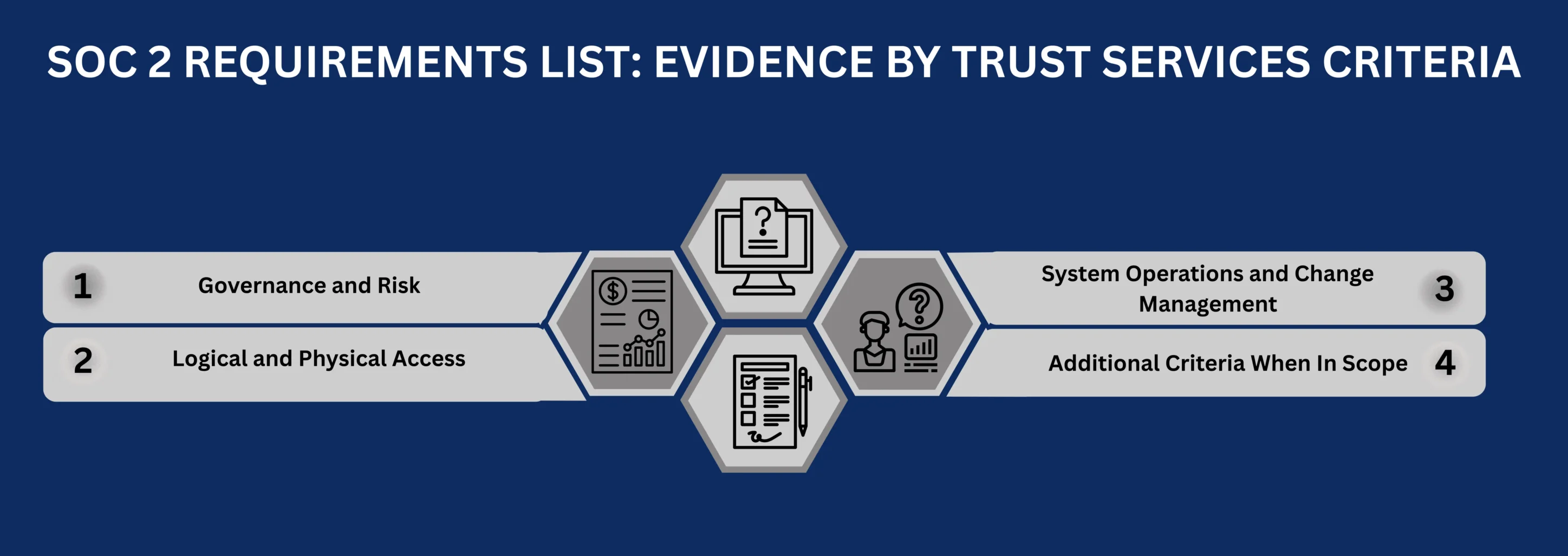
The Common Criteria — forming the Security TSC category — are organized into nine control objective areas: CC1 (Control Environment), CC2 (Communication and Information), CC3 (Risk Assessment), CC4 (Monitoring Activities), CC5 (Control Activities), CC6 (Logical and Physical Access Controls), CC7 (System Operations), CC8 (Change Management), and CC9 (Risk Mitigation).
Each CC area contains multiple points of focus that describe the characteristics effective controls should exhibit. During a SOC 2 audit in New South Wales, auditors evaluate controls across all applicable CC areas, gathering evidence through inquiry, inspection, observation, reperformance, and system testing. The depth and breadth of control testing across the Common Criteria makes Security the most substantial portion of any SOC 2 examination — and the area where most New South Wales organizations invest the greatest preparation effort.
- ✓Documentation and System Description Requirements
- ✓Subservice Organizations, CUECs, and Bridge Letters
- ✓Control Objectives and the Common Criteria
Industries in New South Wales Pursuing SOC 2 Certification
SOC 2 Certification for New South Wales companies spans a broad range of industries and service categories. The common thread is that organizations process, store, transmit, or otherwise handle customer data as part of their service delivery — and their customers require independently verified evidence that appropriate controls are in place.
The following industries represent the primary sectors driving SOC 2 audit activity in New South Wales, reflecting the state’s diverse and growing technology economy.
Financial Services, Fintech, and Professional Services
SOC 2 compliance for New South Wales fintech organizations is driven by particularly strong customer and regulatory expectations around data security and processing integrity. Sydney’s financial services district — encompassing banks, insurance firms, investment managers, superannuation funds, and the fintech ecosystem surrounding them — generates substantial demand for SOC 2 attestation from technology vendors and platform providers.
Fintech platforms handling payments, lending, wealth management, and insurance data are expected to demonstrate independently examined controls addressing security, availability, and processing integrity at minimum. Professional services firms in accounting, legal, management consulting, and human resources that process client data on technology platforms similarly require SOC 2 attestation reports from their technology providers operating in New South Wales.
SOC 2 Certification for New South Wales financial services organizations must address the intersection of AICPA Trust Services Criteria with obligations under the Australian Prudential Regulation Authority (APRA) prudential standards, particularly CPS 234 (Information Security) and CPS 230 (Operational Risk Management). While SOC 2 is not an APRA-mandated framework, a SOC 2 attestation report provides structured, independently examined evidence of control effectiveness that supports APRA-regulated entities in meeting their third-party and fourth-party risk management obligations.
Regulated financial entities in New South Wales increasingly specify SOC 2 Type II reports as a procurement requirement for technology vendors handling material information assets — making SOC 2 Certification a practical necessity for vendors in this sector.
Software, SaaS, Cloud, and Cybersecurity Organizations
Software and SaaS organizations represent the largest category of SOC 2 examination engagements in New South Wales. SaaS providers — including HR platforms, customer relationship management systems, enterprise resource planning solutions, project management tools, and data analytics platforms — process customer data within multi-tenant environments where security, availability, and confidentiality controls are critical to customer trust and enterprise procurement approval.
SOC 2 Certification for Sydney-based SaaS companies is increasingly required before enterprise customers will execute commercial agreements, particularly in regulated industries. Cloud infrastructure providers, managed service providers, and data center operators similarly pursue SOC 2 attestation to demonstrate control effectiveness to their downstream customers across New South Wales and beyond.
Cybersecurity and AI organizations in New South Wales occupy a distinctive position in the SOC 2 landscape. Cybersecurity service providers — including managed detection and response, security operations center, penetration testing, and vulnerability management firms — are themselves trusted with access to customer security environments and must demonstrate that their own internal controls meet the applicable Trust Services Criteria.
AI and machine learning organizations processing training data, inference outputs, or customer-provided datasets face increasing scrutiny around data confidentiality, processing integrity, and privacy controls. A SOC 2 examination for these organizations evaluates whether controls governing data ingestion, model training, output generation, and data retention operate as described and meet the applicable TSC commitments — making SOC 2 compliance a strategic differentiator in the AI sector.
Healthcare, Government Technology, and Other Sectors
Healthcare and life sciences organizations in New South Wales — including electronic health record providers, clinical trial data platforms, telehealth services, and medical device software vendors — process highly sensitive personal and health information subject to both the Australian Privacy Act 1988 and sector-specific obligations. SOC 2 compliance for New South Wales healthcare technology organizations often covers Security, Availability, and Privacy as applicable TSC categories, reflecting the criticality of system uptime for clinical operations and the sensitivity of health data.
Government technology vendors supplying digital services, data platforms, or cloud infrastructure to New South Wales government agencies face procurement requirements that increasingly reference SOC 2 attestation as evidence of adequate security controls — positioning SOC 2 Certification in New South Wales as a meaningful differentiator in public sector contracting.
- ✓Financial services and fintech: payments, lending, wealth management, insurance technology
- ✓Software and SaaS: multi-tenant platforms, enterprise applications, analytics tools
- ✓Cloud and data services: infrastructure-as-a-service, platform-as-a-service, data centers
- ✓Cybersecurity: managed detection and response, SOC operations, vulnerability management
- ✓AI and machine learning: data processing, model training, inference platforms
- ✓Healthcare and life sciences: EHR systems, telehealth, clinical data platforms
- ✓Government technology: digital services, data platforms, cloud for public sector
- ✓Telecommunications, logistics, energy, and advanced manufacturing technology vendors
Benefits of SOC 2 Certification for New South Wales-Based Organizations
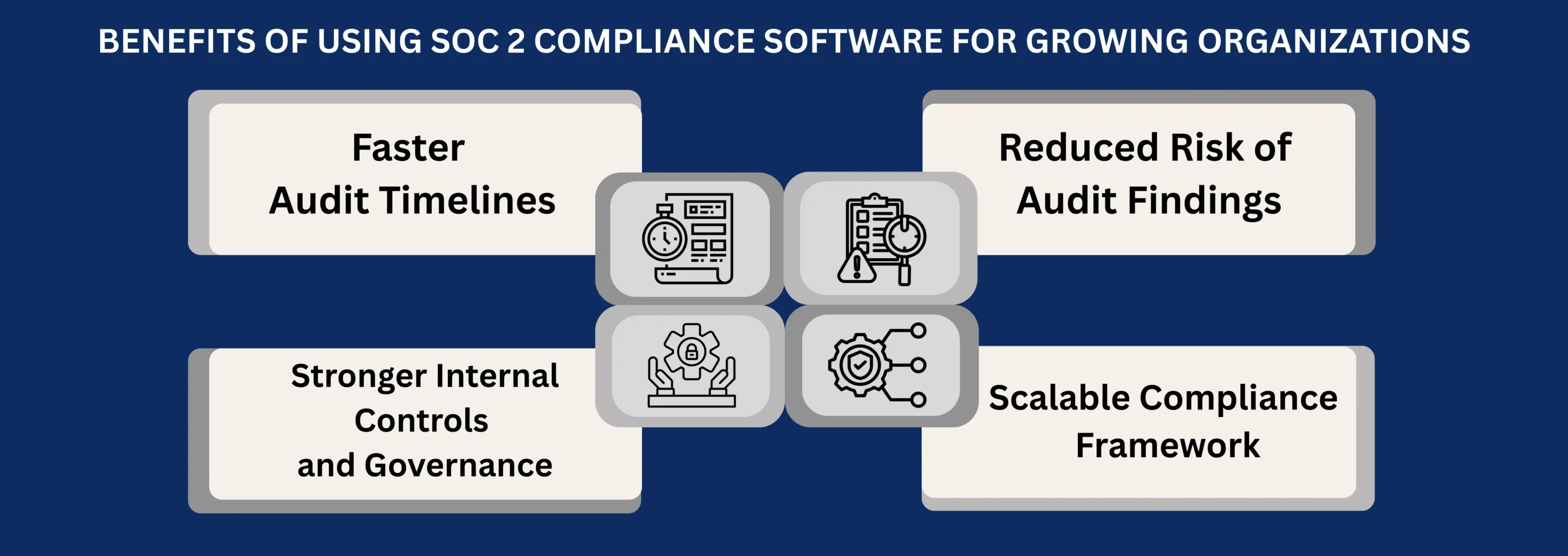
SOC 2 Certification in New South Wales delivers measurable business and operational benefits for service organizations operating in competitive, data-sensitive markets. These benefits derive directly from the independent, examination-based nature of the SOC 2 attestation — not from the existence of an internal compliance program.
The value of a SOC 2 report lies in its auditor-issued credibility: it is produced by a Licensed CPA Firm operating under professional standards, not a self-assessed questionnaire or internal audit report. For New South Wales organizations, this credibility translates directly into commercial and operational advantages.
A SOC 2 attestation report directly addresses the security questionnaire and vendor assurance requirements that enterprise and government customers impose on technology and service providers. Rather than completing bespoke security questionnaires for each customer — a time-intensive process that may still leave customers uncertain — a SOC 2 Type II report provides a standardized, independently examined answer to questions about security, availability, processing integrity, confidentiality, and privacy controls.
For New South Wales technology organizations targeting enterprise customers in financial services, healthcare, government, or multinational corporations, a current SOC 2 report is frequently a threshold requirement for entering procurement processes. SOC 2 compliance in New South Wales enables organizations to remove security-related barriers in sales cycles and accelerate contract execution.
Organizations holding SOC 2 attestation in New South Wales also benefit from expanded international market access. U.S.-headquartered enterprises and regulated financial institutions commonly require SOC 2 Type II reports from technology vendors regardless of geographic location. New South Wales SaaS, cloud, and data services organizations seeking U.S. market entry — or already serving U.S. customers — will typically encounter SOC 2 Certification as a non-negotiable procurement requirement.
Similarly, global professional services firms, multinationals, and international financial institutions with Australian operations frequently extend their vendor assurance frameworks to include SOC 2 requirements for New South Wales-based technology suppliers. Maintaining a current SOC 2 report positions these organizations competitively in global procurement processes.
The SOC 2 examination process creates a structured, documented record of control design and operating effectiveness across the service organization’s system. This documentation — encompassing the system description, control activities, risk assessment processes, and monitoring activities — provides management with a formally examined representation of the control environment that can be used for internal governance, board reporting, and regulatory engagement.
For New South Wales organizations subject to APRA, ASIC, or Australian Privacy Act obligations, a SOC 2 attestation report provides independently examined evidence of control effectiveness that supports broader compliance and regulatory reporting obligations, reinforcing the value of SOC 2 compliance beyond customer-facing assurance.
Annual SOC 2 examination cycles also impose discipline on the service organization’s control environment over time. The requirement to maintain documented, operating controls across Security and any additional applicable TSC categories — and to demonstrate their effectiveness to an independent auditor each year — drives consistency and accountability in control operations.
Exceptions identified during a SOC 2 audit in New South Wales provide actionable, auditor-documented findings that management can use to prioritize control improvements before the next examination cycle. The ongoing nature of annual SOC 2 attestation creates a continuous improvement dynamic within the service organization’s security and operations functions — one of the most enduring operational benefits of the SOC 2 Certification process.
- ✓Enterprise Procurement, Vendor Assurance, and Market Access
- ✓Operational Transparency and Internal Control Discipline
SOC 2 Certification vs. ISO 27001: Understanding the Distinction
SOC 2 and ISO 27001 are frequently compared by New South Wales organizations evaluating which framework to pursue. While both address information security controls, they differ fundamentally in their nature, governing body, methodology, output, and primary use cases. Understanding these distinctions is essential for organizations selecting the appropriate framework based on customer requirements and target markets.
New South Wales organizations considering SOC 2 Certification should evaluate these differences carefully before committing to a framework or pursuing both concurrently.
Framework Nature, Governing Body, and Output
SOC 2 is an attestation framework governed by the AICPA. It produces an auditor’s attestation report — a formal opinion issued by a Licensed CPA Firm — evaluating the design and operating effectiveness of controls against the applicable Trust Services Criteria. SOC 2 is not a certification in the ISO sense; no certificate is issued, and the report is a restricted-use document distributed only to specified parties.
ISO 27001 is an international standard governed by the International Organization for Standardization (ISO). It produces a certificate of conformity issued by an accredited certification body, confirming that the organization’s information security management system (ISMS) meets the ISO 27001 standard requirements. The ISO 27001 certificate is a publicly representable credential; the SOC 2 attestation report is not — a distinction with practical implications for how each credential is used in vendor assurance and marketing contexts.
The methodology also differs materially. SOC 2 is criteria-based: auditors evaluate controls against the AICPA Trust Services Criteria points of focus, which are specific to the service commitments and system of the organization under examination. ISO 27001 is requirements-based: organizations implement an ISMS that meets a defined set of standard requirements and select applicable controls from Annex A.
SOC 2 tests specific control instances through sampling and evidence gathering; ISO 27001 certification confirms that the ISMS conforms to the standard’s requirements. For organizations serving U.S. markets or enterprise customers with SOC 2 requirements, the SOC 2 examination is the appropriate framework. For organizations seeking globally recognized ISMS certification, ISO 27001 may be more relevant. Many New South Wales organizations pursue both frameworks to satisfy different customer and market requirements — a dual-framework approach that is increasingly common in Sydney’s enterprise technology sector.
| Dimension | SOC 2 | ISO 27001 |
|---|---|---|
| Governing Body | AICPA | ISO / IEC |
| Output | Attestation report (auditor’s opinion) | Certificate of conformity |
| Methodology | Criteria-based (Trust Services Criteria) | Requirements-based (ISMS standard) |
| Distribution | Restricted-use report | Publicly representable certificate |
| Primary Market | U.S. enterprise, financial services, SaaS | Global, government, multinational |
Selecting the Appropriate Framework for New South Wales Organizations
The primary driver for framework selection is customer requirements and target market. SOC 2 attestation is the standard expectation for technology and service organizations supplying enterprise U.S. customers, U.S.-regulated financial institutions, or multinational enterprises with vendor assurance programs rooted in AICPA standards. ISO 27001 is more commonly specified in European, government, and Asia-Pacific procurement contexts where an internationally recognized ISMS certificate is required.
New South Wales organizations with diverse customer bases — including both U.S. enterprise and Australian government or multinational clients — may find that pursuing both SOC 2 and ISO 27001 optimally addresses their full range of vendor assurance requirements. The frameworks are complementary: controls designed to meet ISO 27001 Annex A requirements will often align with SOC 2 Trust Services Criteria points of focus, particularly within the Security category — making a combined approach efficient for organizations investing in SOC 2 Certification in New South Wales alongside ISO 27001.
SOC 2 Certification New South Wales: Regulatory and Procurement Context
SOC 2 Certification in New South Wales operates within a regulatory and procurement environment shaped by Australian privacy law, prudential standards, cybersecurity policy, and enterprise vendor assurance frameworks. While SOC 2 is not mandated by Australian law, its adoption is driven by customer requirements, regulatory expectations for third-party risk management, and international market access conditions.
Understanding this context is essential for New South Wales service organizations evaluating when and why to pursue a SOC 2 examination — and how a SOC 2 attestation report fits within the broader compliance and risk management landscape.
Australian Privacy Act, APRA Standards, and Cybersecurity Policy
The Australian Privacy Act 1988, including the Australian Privacy Principles (APPs), governs the collection, use, and disclosure of personal information by Australian organizations. For service organizations handling personal information on behalf of customers, the Privacy TSC category within a SOC 2 examination provides independently examined evidence that privacy controls — including data collection limitation, use limitation, data quality, data security, and individual access rights — operate as described.
The SOC 2 examination’s Privacy evaluation does not substitute for legal compliance with the Privacy Act, but it provides structured, auditor-verified evidence of privacy control effectiveness that can be used in regulatory and customer assurance contexts — a valuable complement to legal compliance programs for New South Wales service organizations.
APRA’s CPS 234 (Information Security) requires APRA-regulated entities — including banks, insurers, and superannuation funds — to manage information security risks associated with their service providers. Technology vendors supplying systems or services to APRA-regulated entities in New South Wales face increasing pressure to provide independently verified evidence of control effectiveness. A SOC 2 Type II report issued by a Licensed CPA Firm satisfies this requirement more effectively than a self-assessed questionnaire or an internal audit report.
Australia’s Cyber Security Strategy 2023–2030 and the ACSC’s Essential Eight framework also create an environment in which independently verified security controls are increasingly valued by government and enterprise customers in New South Wales — further strengthening the case for SOC 2 Certification as a strategic compliance investment.
Procurement Requirements and Third-Party Risk Management
Enterprise procurement programs in New South Wales — particularly in financial services, healthcare, and government — increasingly specify SOC 2 Type II as a required vendor assurance deliverable. Procurement teams and third-party risk management functions use SOC 2 reports to evaluate whether technology vendors and cloud service providers maintain adequate controls over the security, availability, and confidentiality of customer data.
A current SOC 2 Type II report reduces the need for customer-directed security assessments, questionnaire responses, and on-site visits, thereby reducing friction in vendor onboarding and renewal processes. For New South Wales SaaS and cloud providers, maintaining a current SOC 2 attestation report addresses the ongoing vendor assurance requirements of their customer base without requiring bespoke responses to each customer’s security program.
SOC 2 attestation also benefits New South Wales organizations in the context of contract negotiations. Enterprise customers frequently include representations about SOC 2 compliance in master service agreements and data processing agreements, requiring vendors to maintain a current SOC 2 Type II report and provide it upon request.
Organizations that have completed a SOC 2 examination are positioned to fulfill these contractual obligations with an independently examined attestation report, rather than relying on management representations alone. The report’s validity period — generally twelve months from the end of the review period — means that annual examination cycles are necessary to maintain continuous contractual compliance and uninterrupted SOC 2 Certification status in New South Wales.
FAQ
▶
What is SOC 2 Certification in New South Wales?
▶
Is SOC 2 a certification or an attestation report?
▶
Who needs a SOC 2 examination in New South Wales?
▶
What is the difference between SOC 2 Type I and Type II?
▶
How long does a SOC 2 audit take in New South Wales?
▶
Which Trust Services Criteria should New South Wales organizations select?
▶
What is a complementary user entity control (CUEC) in a SOC 2 report?
▶
How long is a SOC 2 report valid?
SOC 1 VS SOC 2: WHICH REPORT YOUR CUSTOMERS ACTUALLY ASK FOR
If you sell SaaS or provide outsourced services, you have likely been asked for a SOC report. However, the follow-up question is rarely easy to answer…
SOC 2 Certified: What Does It Mean for Your Business
For companies that handle sensitive data or run cloud-based services, the question “Can you provide your SOC 2 report?” carries enormous weight. Yet, …
HOW SOC 2 AUDITORS REVIEW EVIDENCE OVER TIME
Most businesses pursuing a SOC 2 report spend months building security controls but overlook a fundamental reality: SOC 2 auditors do not just verify …
Get In Touch
have a question? let us get back to you.