
SOC 2 Certification in Madrid
The SOC 2 audit process in Madrid follows a structured examination methodology governed by AICPA attestation standards. Each stage involves defined activities, specific evidence requirements, and formal outputs. The Licensed CPA Firm conducts the examination independently, maintaining auditor objectivity throughout. The process is consistent regardless of the industry sector in which the Madrid-based organization operates, though scope and TSC category selection vary based on service commitments and customer contractual obligations.
OUR CLIENTS










What SOC 2 Certification Means for Madrid-Based Organizations
SOC 2 Certification in Madrid is conducted by a Licensed CPA Firm as an independent third-party examination under AICPA attestation standards AT-C 105 and AT-C 205. The process evaluates whether an organization’s security, availability, processing integrity, confidentiality, and privacy controls are designed and operating effectively against the Trust Services Criteria (TSC) established by the American Institute of Certified Public Accountants. The outcome is a formal SOC 2 attestation report — not a self-declaration or internal compliance statement — issued by an independent auditor who has examined objective evidence across a defined scope and period.
Madrid occupies a distinctive position in the European technology and financial services landscape. As Spain’s capital and primary commercial hub, the city hosts major banking institutions, a rapidly expanding fintech ecosystem, telecommunications providers, and a growing concentration of SaaS companies and cloud service providers. Many of these organizations maintain contractual relationships with U.S.-based enterprise clients, operate within U.S. compliance frameworks, or handle sensitive customer data subject to American vendor security requirements.
For these organizations, SOC 2 Certification in Madrid is not an optional credential — it is the recognized standard for demonstrating control effectiveness to U.S. procurement teams, enterprise risk functions, and regulated industry buyers.
SOC 2 compliance differs from ISO 27001 certification in a fundamental way. SOC 2 is structured as an attestation under AICPA standards, meaning a Licensed CPA Firm issues an opinion on whether controls meet the Trust Services Criteria — not simply whether a management system has been implemented. This distinction matters significantly in U.S. vendor assurance contexts.
Enterprise procurement teams and regulated financial institutions routinely require SOC 2 examination reports as part of third-party risk management reviews. A SOC 2 attestation report produced by a Licensed CPA Firm carries specific credibility in those evaluations that other certifications do not replicate.
The scope of SOC 2 Certification in Madrid is defined by the organization’s system and the Trust Services Criteria categories selected for examination. Security — represented by the Common Criteria — is mandatory in every SOC 2 audit. Additional categories, including Availability, Processing Integrity, Confidentiality, and Privacy, are incorporated based on the organization’s service commitments, contractual obligations, and the nature of customer data processed.
Madrid-based organizations in financial services, cloud infrastructure, and enterprise SaaS typically engage multiple TSC categories to satisfy the breadth of U.S. client expectations and regulatory requirements that govern their business relationships.
A SOC 2 audit in Madrid produces one of two report types: a Type 1 report assessing control design at a point in time, or a Type 2 report evaluating both design and operating effectiveness across an observation period — typically six to twelve months. Both report types require an independent Licensed CPA Firm to examine evidence, test controls, and render an attestation opinion.
The resulting report is provided to the organization and, under a confidentiality framework, shared with customers, prospects, and enterprise stakeholders who require evidence of security control effectiveness before entering or maintaining a vendor relationship. SOC 2 attestation in Madrid serves as the authoritative deliverable in those engagements.

Trust Services Criteria: The Evaluative Foundation of SOC 2 Certification
The Trust Services Criteria form the evaluative framework against which every SOC 2 examination is conducted. Developed and maintained by the AICPA, the TSC define the specific control requirements that a Licensed CPA Firm assesses during a SOC 2 audit. The TSC are organized into five categories: Security, Availability, Processing Integrity, Confidentiality, and Privacy.
Each category contains criteria specifying the controls an organization must have in place and operating effectively for the auditor to render a favorable attestation opinion. The Security category — also referred to as the Common Criteria — is mandatory in all SOC 2 examinations and addresses logical and physical access controls, risk assessment, monitoring, and change management.
The Security criteria — the Common Criteria — cover the foundational control environment required in every SOC 2 examination. These criteria address logical access controls, physical security, system operations, change management processes, and risk mitigation activities. The Availability criteria evaluate whether systems are available for operation and use as committed in service level agreements.
A Madrid-based cloud provider, for example, would be assessed against Availability criteria to confirm that uptime commitments, incident response procedures, and disaster recovery controls are designed and operating effectively. The Processing Integrity criteria assess whether system processing is complete, valid, accurate, timely, and authorized — criteria particularly relevant to financial transaction processors and data analytics platforms operating in Madrid’s fintech sector.
During a SOC 2 audit, the Licensed CPA Firm maps each Trust Services Criterion to specific controls within the organization’s environment. The auditor then gathers evidence — through inspection, observation, inquiry, and re-performance — to determine whether each control is designed to meet the criterion and, in a Type 2 examination, whether it operated effectively throughout the observation period.
Controls that do not meet the applicable TSC result in exceptions noted in the report. The relationship between TSC criteria, internal controls, and audit evidence is direct: each criterion requires specific control evidence, and the auditor’s opinion is derived from the totality of that evidence across the defined scope of the SOC 2 certification.
The Confidentiality criteria evaluate whether information designated as confidential is protected according to the organization’s commitments and the requirements of applicable agreements. This category is frequently included by Madrid-based organizations in legal technology, enterprise SaaS, and financial services that handle proprietary client data subject to non-disclosure or data protection obligations.
The Privacy criteria address the collection, use, retention, disclosure, and disposal of personal information in accordance with the organization’s privacy notice and the AICPA’s Generally Accepted Privacy Principles. Organizations subject to both European data protection requirements and U.S. privacy-based vendor expectations often include the Privacy TSC category to provide a unified attestation covering both dimensions of their data handling commitments.
TSC category selection is determined during the scope definition phase of the SOC 2 audit engagement. The Licensed CPA Firm and the organization review service commitments, system descriptions, customer contractual requirements, and applicable regulatory obligations to determine which TSC categories are relevant and necessary.
For Madrid-based organizations serving U.S. financial institutions or healthcare-adjacent clients, the scope often extends beyond Security alone to include Confidentiality and Availability. Incorrect scope selection — including too few TSC categories — can result in a SOC 2 attestation report that fails to satisfy the specific requirements of enterprise customers. This may require a supplemental examination or an expanded report scope in subsequent audit cycles.
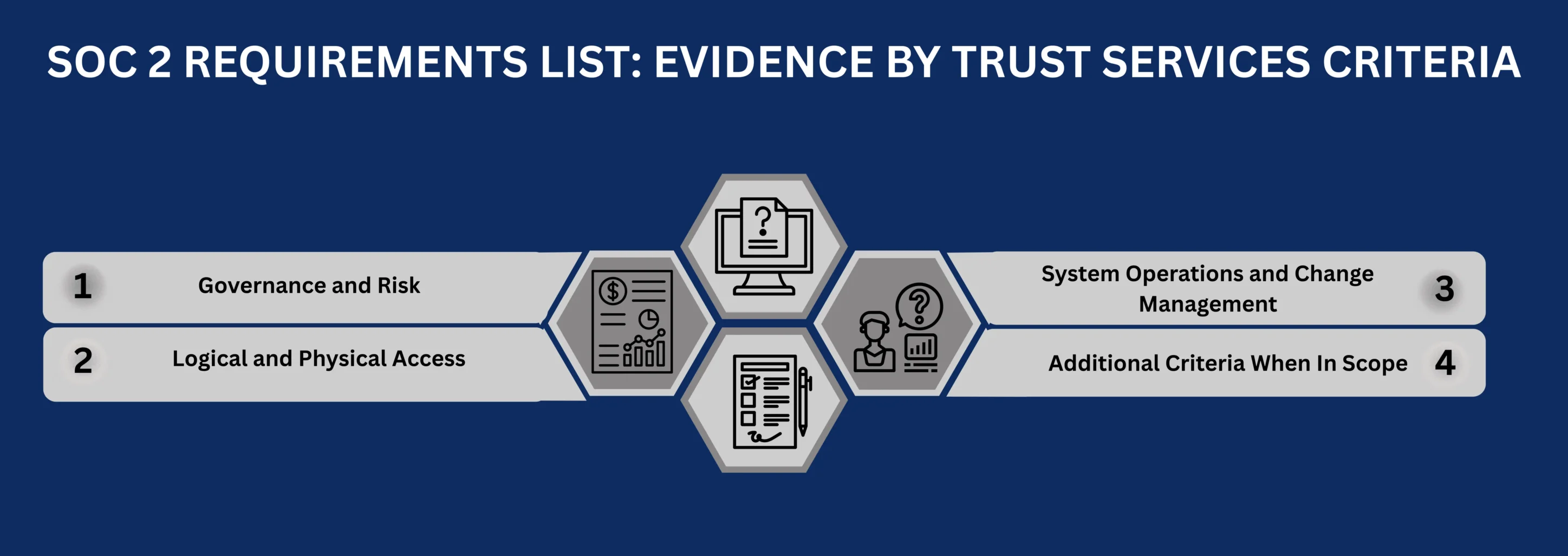
- ✓Security, Availability, and Processing Integrity Criteria
- ✓Confidentiality and Privacy Criteria
SOC 2 Type 1 and Type 2 Reports: Definitions and Distinctions
SOC 2 examinations produce two distinct report types, each serving a different evidentiary purpose in vendor assurance and enterprise procurement contexts. Understanding the difference between a SOC 2 Type 1 and a SOC 2 Type 2 report is essential for Madrid-based organizations determining which examination aligns with their customer requirements, contractual obligations, and audit readiness timeline. Both report types are produced by a Licensed CPA Firm following an independent examination and are governed by AICPA attestation standards AT-C 105 and AT-C 205.
SOC 2 Type 1 Report: Point-in-Time Design Assessment
A SOC 2 Type 1 report assesses whether an organization’s controls are suitably designed to meet the applicable Trust Services Criteria as of a specific date. The examination is point-in-time: the Licensed CPA Firm evaluates control design as it exists on the report date without testing whether those controls operated effectively over an extended period.
A Type 1 report is appropriate for organizations that have recently implemented controls and need to demonstrate design adequacy before accumulating the observation period required for a Type 2 examination. Madrid-based SaaS companies and fintech startups that have recently built out their security programs frequently pursue a SOC 2 Type 1 report as an initial attestation deliverable to satisfy early-stage U.S. enterprise customer requirements.
The Type 1 report contains a description of the organization’s system prepared by management, the auditor’s examination of that description for fair presentation, and an opinion on whether controls are suitably designed to meet the Trust Services Criteria. The report does not include testing of control operating effectiveness over time.
While a SOC 2 Type 1 report satisfies some vendor assurance requirements, many U.S. enterprise procurement processes — particularly those conducted by regulated financial institutions, healthcare organizations, and large technology companies — require a SOC 2 Type 2 report as the minimum acceptable attestation standard for ongoing vendor relationships.
SOC 2 Type 2 Report: Operating Effectiveness Over an Observation Period
A SOC 2 Type 2 report evaluates both the design adequacy and the operating effectiveness of controls over a defined observation period. The observation period is typically six to twelve months, during which the Licensed CPA Firm examines evidence that controls functioned as designed on a consistent basis.
The auditor applies testing procedures — including inspection of logs and records, re-performance of control activities, observation of processes, and inquiry of personnel — to assess whether each control operated effectively throughout the period. For Madrid-based organizations with established U.S. client relationships, a SOC 2 Type 2 report is the standard deliverable expected by enterprise buyers as evidence of sustained security and compliance control effectiveness.
The Type 2 report contains the same components as a Type 1 report — system description, auditor opinion, and TSC criteria mapping — plus a detailed description of tests performed and results for each control assessed. Any control exceptions identified during the observation period are documented in the report, along with management’s response.
The SOC 2 examination culminates in the auditor’s opinion stating whether, in all material respects, controls were suitably designed and operating effectively to meet the Trust Services Criteria throughout the observation period. This opinion is the primary artifact used by enterprise customers, procurement teams, and risk management functions to assess the security posture of Madrid-based service organizations.
| Feature | SOC 2 Type 1 | SOC 2 Type 2 |
|---|---|---|
| Assessment Scope | Control design at a specific date | Control design and operating effectiveness over a defined period |
| Observation Period | Not applicable — point-in-time assessment | Typically 6 to 12 months |
| Audit Evidence | Design review and documentation inspection | Design review plus operating effectiveness testing |
| Report Output | Opinion on control design suitability | Opinion on both design suitability and operating effectiveness |
| Typical Use Case | Initial attestation for newly implemented programs | Ongoing vendor assurance and U.S. enterprise procurement |
SOC 2 Certification Audit Process for Organizations in Madrid
The SOC 2 audit process in Madrid follows a structured examination methodology governed by AICPA attestation standards. Each stage involves defined activities, specific evidence requirements, and formal outputs. The Licensed CPA Firm conducts the examination independently, maintaining auditor objectivity throughout. The process is consistent regardless of the industry sector in which the Madrid-based organization operates, though scope and TSC category selection vary based on service commitments and customer contractual obligations.
The SOC 2 audit process begins with scope definition. During this phase, the Licensed CPA Firm reviews the organization’s system boundaries, service commitments, and applicable Trust Services Criteria categories. The auditor examines the organization’s system description to verify that it accurately represents the infrastructure, software, people, processes, and data included within the examination scope. TSC category selection is finalized based on service commitments and customer requirements.
For a Madrid-based cloud infrastructure provider, scope might include Security and Availability TSC categories covering data centers, network infrastructure, access management systems, and incident response processes. The audit program — specifying the controls to be examined, the evidence required, and the testing procedures to be applied — is established at this stage.
Audit program determination establishes the specific control objectives, control activities, and testing procedures the Licensed CPA Firm will apply throughout the examination. The program references the selected Trust Services Criteria and maps them to the organization’s stated controls. For a SOC 2 Type 2 examination, the audit program also defines the observation period — the start and end dates during which control operating effectiveness will be assessed.
The observation period must be sufficient to allow the auditor to draw conclusions about consistent control operation. Most SOC 2 audit programs for established Madrid organizations specify a twelve-month observation period to satisfy the expectations of U.S. enterprise procurement and vendor assurance requirements.
During the evidence collection and control testing phase, the Licensed CPA Firm applies audit program procedures to the organization’s systems, processes, and records. Evidence is gathered through four primary methods: inspection of documents and records, observation of control activities, inquiry of personnel responsible for control execution, and re-performance of control procedures by the auditor.
For organizations pursuing SOC 2 compliance in Madrid, evidence commonly includes access control logs, change management records, incident response documentation, encryption configuration records, vulnerability scan results, and policy documentation demonstrating that controls are formally established and consistently applied.
Control exceptions identified during testing are documented and evaluated for materiality. The Licensed CPA Firm assesses whether exceptions represent isolated incidents, systemic control failures, or design deficiencies — and this assessment informs the auditor’s opinion. Following the completion of evidence collection and testing, the auditor renders an attestation opinion and issues the SOC 2 report.
The report contains the system description, the TSC criteria mapping, a description of tests performed and results, and the auditor’s formal opinion. The SOC 2 attestation report is then provided to the organization and, under a restricted use framework, distributed to customers and stakeholders who require evidence of control effectiveness for vendor assurance and third-party risk management purposes.
| Audit Stage | Key Activities | Output |
|---|---|---|
| Scope Definition | System boundary review, TSC category selection, service commitment analysis | Defined audit scope and system description |
| Audit Program Determination | Control mapping, testing procedure specification, observation period setting | Formal audit program document |
| Evidence Collection | Document inspection, control observation, personnel inquiry, re-performance | Documented evidence for each control |
| Control Testing | Assessment of control design adequacy and operating effectiveness | Test results and exception documentation |
| Report Issuance | Auditor opinion formulation, report compilation, and attestation | SOC 2 Type 1 or Type 2 attestation report |
- ✓Scope Definition and Audit Program Determination
- ✓Evidence Collection, Control Testing, and Auditor Opinion
Why Organizations in Madrid Pursue SOC 2 Certification
Demand for SOC 2 Certification in Madrid is driven by specific market dynamics: U.S. enterprise client requirements, financial sector procurement expectations, and the internationalization strategies of Madrid’s growing technology sector. Organizations pursuing SOC 2 certification in Madrid do so in response to verifiable, external requirements — not simply as a voluntary quality initiative. Understanding these demand drivers clarifies why the SOC 2 examination has become a standard requirement for Madrid-based service organizations operating in U.S. markets or serving regulated industries.
U.S. Enterprise Vendor Security Reviews and Financial Sector Requirements
U.S.-based enterprise organizations — including financial institutions, healthcare systems, and large technology companies — conduct vendor security reviews as part of their third-party risk management programs. These reviews routinely require service providers to submit a current SOC 2 Type 2 report as evidence of security control effectiveness.
A Madrid-based SaaS provider seeking to onboard a U.S. bank as a client, for example, will typically receive a vendor questionnaire requiring SOC 2 attestation documentation before the contract can be executed. The absence of a current SOC 2 report from a Licensed CPA Firm can result in disqualification from procurement processes or require the Madrid organization to complete an extended vendor due diligence review that delays contract execution.
Madrid’s financial services sector — encompassing major banking institutions, payment processors, and a concentrated fintech community — faces SOC 2 requirements from two directions. First, Madrid-based financial technology companies serving U.S. clients must demonstrate SOC 2 compliance to satisfy U.S. regulatory expectations embedded in vendor contracts. Second, Madrid-based organizations that use cloud service providers or SaaS platforms increasingly require SOC 2 attestation reports from those providers as part of their own third-party risk management obligations.
SOC 2 certification for Madrid fintech organizations means they are both producers and consumers of SOC 2 attestation reports within their operational ecosystems.
International SaaS Expansion and Cloud Service Provider Requirements
Madrid’s SaaS and cloud infrastructure sector has expanded significantly, with a growing number of technology companies developing platforms that serve international enterprise markets. SOC 2 certification for Madrid SaaS companies is essential to access U.S. enterprise sales cycles, pass procurement security reviews, and satisfy the contractual requirements of enterprise software agreements.
Cloud service providers operating data centers in or near Madrid that serve U.S. clients face similar requirements. Hyperscale customers and regulated institutional clients require current SOC 2 Type 2 reports covering the infrastructure services on which they depend — including the Security and Availability TSC categories at minimum.
Managed service providers and enterprise IT organizations in Madrid that manage sensitive customer data — including network management, endpoint security, and cloud operations — encounter SOC 2 requirements in client contracts that explicitly mandate annual SOC 2 Type 2 examination. Telecommunications providers and data hosting organizations serving enterprise and public sector clients face similar contractual obligations.
In each scenario, the SOC 2 examination conducted by a Licensed CPA Firm and the resulting attestation report are the specific deliverables required — not a self-assessment checklist, an internal audit report, or a vendor questionnaire response. The independent SOC 2 audit conducted in Madrid produces the only acceptable evidentiary standard in these contexts.
Certification Scope, Control Environment, and Independent Decision Framework
The scope of a SOC 2 examination defines the boundaries of the system under review and determines which controls, infrastructure components, and organizational processes fall within the examination. A well-defined scope ensures that the SOC 2 attestation report accurately represents the controls relevant to the services provided and the Trust Services Criteria categories selected.
Scope precision directly affects the reliability and utility of the resulting report. An overly narrow scope may exclude controls that customers consider essential, while an overly broad scope may include systems with insufficient control maturity — generating unnecessary exceptions in the report.
Control Environment Assessment and Evidence-Based Evaluation
The control environment under AICPA Trust Services Criteria encompasses the organizational structures, policies, procedures, and technologies that together constitute the system of controls being examined. In a SOC 2 audit, the Licensed CPA Firm evaluates the control environment across several dimensions: the entity-level controls that set the tone and governance framework, the transaction-level controls that govern specific data processing activities, and the monitoring controls that ensure ongoing control effectiveness is assessed and deficiencies are remediated.
For Madrid-based organizations with complex hybrid cloud environments, the control environment may span on-premises infrastructure, cloud service provider configurations, and third-party subservice organizations whose controls affect the overall system.
Evidence-based evaluation is the defining characteristic of a SOC 2 examination conducted by a Licensed CPA Firm. Unlike self-certification frameworks, a SOC 2 audit requires the auditor to independently obtain and assess evidence for each control under examination. The auditor does not accept management representations as sufficient evidence of control effectiveness. Instead, the auditor performs procedures designed to corroborate those representations through direct observation, document review, and testing.
For Madrid-based organizations, evidence documentation must demonstrate consistent control execution throughout the observation period. Sporadic or incomplete evidence trails result in control exceptions that are disclosed in the SOC 2 attestation report and reviewed by enterprise customers during vendor due diligence processes.
Nonconformity Review, Certification Decision, and Report Validity
Following completion of control testing, the Licensed CPA Firm reviews all identified exceptions and nonconformities to determine their significance relative to the overall attestation opinion. Nonconformities are assessed for pervasiveness — whether an exception affects a single control instance or indicates a broader systemic control failure.
The auditor’s certification decision — whether to issue an unmodified, qualified, or adverse opinion — reflects the totality of evidence gathered during the SOC 2 examination. An unmodified opinion indicates that controls were suitably designed and, for Type 2 reports, operating effectively throughout the observation period. A qualified opinion identifies specific areas where controls did not meet the applicable Trust Services Criteria, and those qualifications are visible to customers who review the report.
SOC 2 attestation reports do not carry a permanent certification status. A SOC 2 Type 2 report covers a specific observation period and is typically considered current for approximately twelve months from the report end date. Enterprise customers conducting vendor security reviews expect organizations to provide a current report — one whose observation period ended within the preceding twelve months.
After that window, a new SOC 2 examination must be conducted and a new report issued to maintain the organization’s status as a currently attested service organization. Madrid-based organizations operating in U.S. markets therefore manage SOC 2 audit cycles as an annual operational requirement, scheduling new examinations to ensure continuous coverage without gaps in attestation currency.
Business Sectors in Madrid Seeking SOC 2 Certification
SOC 2 certification for Madrid financial services organizations represents one of the largest demand segments for SOC 2 examination in the city. Madrid’s position as Spain’s financial capital — hosting major banking institutions, insurance companies, asset managers, and payment infrastructure providers — creates a concentrated market of organizations that process sensitive financial data and require independent security control assurance.
The SOC 2 examination is particularly relevant for Madrid-based financial organizations that have established correspondent banking relationships, payment processing partnerships, or technology service agreements with U.S.-regulated entities that require current SOC 2 attestation as a contractual condition.
Fintech, SaaS, and Cloud Infrastructure Organizations
Madrid’s fintech sector has developed a substantial presence, with companies operating across payments, lending, insurance technology, and wealth management platforms. SOC 2 certification for Madrid companies in the fintech space addresses the specific control requirements of U.S. financial institution clients, U.S. payment network participants, and cross-border data processing frameworks.
Fintech organizations typically scope SOC 2 examinations to include Security, Availability, and Processing Integrity TSC categories — covering the control dimensions most directly relevant to financial transaction processing, system uptime commitments, and data accuracy requirements embedded in service agreements with regulated clients.
Enterprise SaaS providers and cloud infrastructure organizations based in Madrid encounter SOC 2 requirements across their customer acquisition and retention processes. A SOC 2 Type 2 report is frequently listed as a mandatory document in enterprise software procurement processes, particularly those conducted by U.S. technology companies, healthcare organizations, and government-adjacent entities.
Cloud service providers operating Madrid-based data centers that serve international enterprise clients face equivalent requirements. Infrastructure-as-a-service and platform-as-a-service providers are routinely required to demonstrate SOC 2 attestation covering the physical and logical controls governing the infrastructure on which customer data is processed and stored.
Managed Service Providers and Telecommunications Organizations
Managed service providers operating in Madrid — including IT infrastructure management firms, security operations centers, and enterprise cloud management providers — handle customer systems and sensitive data that trigger SOC 2 requirements in client contracts. These organizations typically manage privileged access to customer environments, creating a direct requirement for independent verification of access control effectiveness.
Madrid’s telecommunications sector — home to major network operators and data communications providers — faces equivalent requirements when serving enterprise and multinational clients who require SOC 2 attestation as part of vendor assurance programs governing network service providers that handle sensitive organizational data.
- ✓Banking and financial institutions processing U.S. client data or operating under U.S. compliance frameworks
- ✓Fintech companies providing payment, lending, or insurance technology services to U.S.-regulated entities
- ✓SaaS providers serving U.S. enterprise clients with contractual SOC 2 requirements
- ✓Cloud infrastructure and platform-as-a-service providers hosting U.S. client data
- ✓Managed service providers managing privileged access to enterprise customer environments
- ✓Telecommunications organizations providing data communications services to regulated enterprise clients
- ✓Data hosting organizations subject to U.S. vendor security review requirements
- ✓Enterprise IT service organizations handling sensitive customer data under U.S.-governed contracts
Benefits of SOC 2 Certification for Madrid-Based Organizations
SOC 2 Certification in Madrid provides verifiable, third-party confirmation of security control effectiveness — a credential that carries specific weight in U.S. enterprise procurement, financial sector vendor assessments, and cross-border technology partnerships. The benefits of SOC 2 attestation are concrete and directly linked to the business contexts in which Madrid-based organizations operate. Each benefit reflects an observable outcome of the independent examination process conducted by a Licensed CPA Firm under AICPA attestation standards.
A current SOC 2 Type 2 report from a Licensed CPA Firm satisfies the vendor security assurance requirements of the majority of U.S. enterprise procurement processes. For Madrid-based organizations targeting U.S. enterprise clients, SOC 2 attestation eliminates a significant barrier in sales cycles. Instead of completing lengthy security questionnaires or undergoing bespoke customer security assessments, the organization provides a current SOC 2 report that enterprise risk and procurement teams accept as standardized evidence of control effectiveness.
This accelerates vendor onboarding timelines and reduces the administrative burden associated with customer-specific security due diligence requests across multiple U.S. client relationships simultaneously.
SOC 2 attestation obtained by Madrid organizations through independent examination also supports differentiation in competitive procurement processes. When multiple vendors are evaluated by a U.S. enterprise buyer, the presence of a current SOC 2 Type 2 report — particularly one covering multiple TSC categories — signals that the organization has submitted its controls to independent scrutiny and received a formal auditor opinion.
Organizations without current SOC 2 attestation are often directed to alternative vendor tiers with increased contractual scrutiny, longer due diligence timelines, or reduced access to enterprise contract structures that require security attestation as a baseline qualification criterion.
Enterprise customers use SOC 2 reports as a primary input in their third-party risk management programs. A current SOC 2 Type 2 report from a Licensed CPA Firm provides risk management teams with independently verified information about control design and operating effectiveness across the Trust Services Criteria categories relevant to the services being procured.
This independently verified information carries greater evidentiary weight than vendor-supplied security documentation, self-assessment questionnaires, or internal audit reports in formal third-party risk assessments. Madrid-based organizations holding current SOC 2 attestation are routinely classified in lower risk tiers within enterprise vendor management programs, reducing the frequency of supplemental assessments and oversight activities required under those programs.
- ✓Independent verification of security control design and operating effectiveness by a Licensed CPA Firm
- ✓Qualification for U.S. enterprise vendor programs that mandate SOC 2 attestation as a contractual requirement
- ✓Reduced administrative burden in enterprise sales cycles through standardized attestation documentation
- ✓Lower risk tier classification in enterprise third-party risk management programs
- ✓Formal recognition of control effectiveness in regulated financial sector procurement processes
- ✓Annual examination cycle that maintains ongoing independent oversight of the control environment
- ✓Structured audit methodology that maps controls directly to Trust Services Criteria for customer clarity
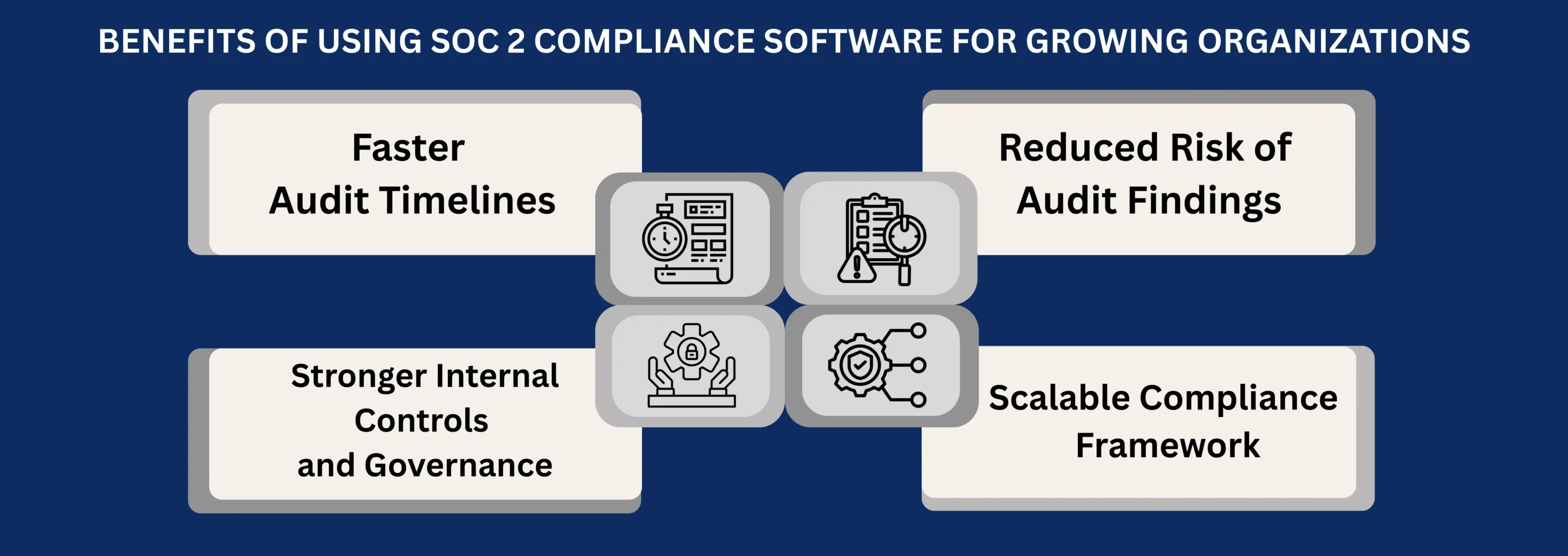
- ✓Vendor Assurance, U.S. Market Access, and Procurement Qualification
- ✓Third-Party Risk Management Credibility and Ongoing Oversight
SOC 2 Certification Requirements and Evaluation Criteria
SOC 2 certification requirements are defined by the AICPA Trust Services Criteria and the attestation standards governing the examination. Organizations pursuing SOC 2 Certification in Madrid must demonstrate that their control environment meets specific criteria across the selected TSC categories, with evidence documented and available for auditor review.
The requirements are not prescriptive in terms of mandating specific technologies or vendor products. Rather, the TSC define outcomes that controls must achieve, and organizations have flexibility in how they implement controls to satisfy those outcomes — subject to the auditor’s independent evaluation of whether the implemented controls are designed and operating effectively.
Documentation requirements for SOC 2 compliance in Madrid cover several categories of evidence that the Licensed CPA Firm reviews during the examination. Policies and procedures must be formally documented, approved, and communicated to relevant personnel. Risk assessment records must demonstrate that the organization has identified, evaluated, and addressed risks to the systems within the examination scope.
Access control documentation — including provisioning records, periodic access reviews, and termination procedures — must provide an auditable trail demonstrating that logical access to systems is granted only to authorized individuals and reviewed regularly. Change management records must show that changes to in-scope systems are authorized, tested, and documented prior to implementation in production environments.
Evidence standards in a SOC 2 examination require that documentation be contemporaneous — created at the time controls are executed, not reconstructed after the fact. This is a critical distinction. Organizations that establish controls but fail to document their execution during the observation period will have insufficient evidence for the Licensed CPA Firm to conclude that those controls operated effectively.
Audit log retention, incident response documentation, vulnerability management records, and vendor management evidence must all be maintained systematically throughout the observation period. For Madrid-based organizations preparing for a SOC 2 audit, evidence collection infrastructure — including log management systems, ticketing platforms, and document management controls — must be operational at the start of the observation period, not constructed retroactively.
Technical control requirements under the SOC 2 Trust Services Criteria address the specific security configurations, monitoring capabilities, and access management mechanisms that the auditor evaluates during the examination. For the Security (Common Criteria) category, technical controls include multi-factor authentication for privileged access, encryption of data in transit and at rest, intrusion detection and monitoring capabilities, vulnerability scanning and patch management processes, and incident detection and response mechanisms.
These controls must be implemented within the defined scope of the SOC 2 examination and must generate evidence — in the form of configuration records, monitoring logs, and activity documentation — that the Licensed CPA Firm can review during the SOC 2 audit engagement in Madrid.
For the Availability TSC category, technical requirements include capacity monitoring, disaster recovery testing records, and incident management documentation demonstrating that system availability commitments are supported by operational controls. For Processing Integrity, evidence must demonstrate that data processing is complete, accurate, and authorized — typically supported by transaction logging, validation controls, and error detection mechanisms.
Confidentiality and Privacy TSC categories require evidence of data classification controls, encryption mechanisms, data retention and disposal procedures, and privacy notice compliance records. The totality of technical evidence across selected TSC categories forms the evidentiary basis for the Licensed CPA Firm’s attestation opinion in the final SOC 2 report.
- ✓Documentation Requirements and Evidence Standards
- ✓Technical Control Requirements Across TSC Categories
FAQ
▶
What is SOC 2 Certification and why is it relevant for Madrid-based organizations?
▶
What is the difference between SOC 2 Type 1 and SOC 2 Type 2?
▶
How long does a SOC 2 audit take for a Madrid-based organization?
▶
Which Trust Services Criteria categories are required for SOC 2 certification?
▶
How long is a SOC 2 attestation report valid?
▶
Who conducts a SOC 2 examination — and what qualifications are required?
▶
What industries in Madrid most commonly require SOC 2 certification?
▶
What is the difference between SOC 2 compliance and SOC 2 certification?
SOC 1 VS SOC 2: WHICH REPORT YOUR CUSTOMERS ACTUALLY ASK FOR
If you sell SaaS or provide outsourced services, you have likely been asked for a SOC report. However, the follow-up question is rarely easy to answer…
SOC 2 Certified: What Does It Mean for Your Business
For companies that handle sensitive data or run cloud-based services, the question “Can you provide your SOC 2 report?” carries enormous weight. Yet, …
HOW SOC 2 AUDITORS REVIEW EVIDENCE OVER TIME
Most businesses pursuing a SOC 2 report spend months building security controls but overlook a fundamental reality: SOC 2 auditors do not just verify …
Get In Touch
have a question? let us get back to you.