
SOC 2 Certification in Cambridge
SOC 2 examinations produce two distinct report types: SOC 2 Type 1 and SOC 2 Type 2. The report type determines the scope and depth of the auditor’s examination and the nature of the opinion expressed. Understanding the difference between these two report types is essential for Cambridge organizations determining which examination aligns with their customer requirements and operational readiness for the SOC 2 audit.
OUR CLIENTS










SOC 2 Certification in Cambridge — Independent CPA Firm Attestation
SOC 2 Certification in Cambridge is issued by a Licensed CPA Firm following an independent examination conducted under AICPA attestation standards AT-C Section 105 and AT-C Section 205. The SOC 2 examination evaluates whether an organization’s controls over security, availability, processing integrity, confidentiality, and privacy are designed and operating effectively against the AICPA Trust Services Criteria (TSC). The resulting SOC 2 attestation report is issued by the Licensed CPA Firm — not by the organization itself — and constitutes independent, evidence-based confirmation of control effectiveness.
Cambridge, Massachusetts, is one of the most concentrated technology and life sciences ecosystems in the United States. The city hosts an exceptional density of biotechnology and life sciences institutions, AI-driven deep tech companies, university spinouts from MIT and Harvard, SaaS platforms, cloud infrastructure providers, and research organizations that routinely handle sensitive customer, patient, or institutional data. For these organizations, SOC 2 Certification in Cambridge functions as the recognized mechanism for demonstrating to enterprise customers, institutional research partners, procurement committees, and regulated-sector clients that internal controls have been independently examined and verified — not merely self-declared.
SOC 2 is not a regulatory mandate enforced by a government body. It is a voluntary, audit-based attestation framework governed by the American Institute of Certified Public Accountants (AICPA). Organizations pursue SOC 2 examination primarily in response to enterprise vendor security review requirements, third-party risk management programs, financial sector procurement expectations, and international expansion into markets where independent security attestation is a baseline requirement. For Cambridge-based technology and biotech organizations competing for enterprise contracts, a current SOC 2 attestation report provides objective, auditor-issued evidence of control effectiveness — distinguishing the organization from those relying solely on self-completed security questionnaires.
The SOC 2 framework differs from other security certifications in a critical respect: it is not a pass/fail certification against a fixed checklist. The SOC 2 examination is scoped to the specific Trust Services Criteria relevant to the organization’s services and customer commitments. A SaaS provider in Kendall Square, for example, may scope its SOC 2 audit to the Security and Availability criteria, while a clinical data platform in the Cambridge biotech corridor may additionally include the Confidentiality and Privacy criteria. The Licensed CPA Firm conducting the SOC 2 audit determines the examination program based on the in-scope criteria, the organization’s system description, and the nature of the controls being evaluated. The SOC 2 attestation report issued at the conclusion of the examination communicates the auditor’s independent opinion on whether controls are suitably designed and, in the case of a Type 2 report, operating effectively over the defined observation period.
SOC 2 compliance, in the context of independent attestation, means that an organization’s controls have been examined and found to meet the applicable Trust Services Criteria — as determined by an independent Licensed CPA Firm. This is substantively different from an organization declaring itself compliant based on internal assessments or completed security questionnaires. The SOC 2 attestation issued by the CPA Firm carries evidential weight precisely because it represents an independent evaluation of control design and operating effectiveness. This evaluation is conducted through structured audit procedures including inquiry, observation, inspection of documentation, and re-performance testing. For Cambridge organizations operating in competitive enterprise markets, the distinction between independently verified attestation and self-declared compliance is central to the value of the SOC 2 examination.

Trust Services Criteria — The Framework Governing SOC 2 Examination
The AICPA Trust Services Criteria (TSC) define the control requirements against which a SOC 2 examination is conducted. The TSC comprises five categories: Security, Availability, Processing Integrity, Confidentiality, and Privacy. Organizations select the applicable criteria based on their service commitments, system descriptions, and contractual obligations. The Security criterion — also called the Common Criteria — is required in every SOC 2 examination. The remaining four criteria are included based on the scope of the engagement and the nature of information processed by the organization.
The Security criterion — designated CC in the TSC — addresses whether a system is protected against unauthorized access, both logical and physical. It encompasses access controls, encryption, monitoring, incident response, change management, and risk assessment procedures. Because the Security criterion forms the foundation of every SOC 2 audit, organizations that scope their examination to Security alone must still satisfy all Common Criteria control points before additional categories are evaluated. For Cambridge SaaS companies and cloud providers, the Security criterion typically represents the largest control domain evaluated during the SOC 2 audit — covering identity and access management, network security, endpoint protection, and vendor risk management over third-party service providers.
The Availability criterion addresses whether a system is available for operation and use as committed or agreed. This criterion applies to organizations whose customers depend on continuous or near-continuous access to the services provided — including cloud infrastructure providers, SaaS platforms, and clinical data systems. The Availability criterion evaluates controls related to performance monitoring, disaster recovery planning, backup procedures, and incident response processes that protect system uptime. For Cambridge technology companies whose service-level agreements include uptime commitments, inclusion of the Availability criterion in a SOC 2 examination provides auditor-verified confirmation that controls are designed and operating to support those commitments.
The Processing Integrity criterion evaluates whether a system processes information completely, accurately, timely, and only as authorized. This criterion is typically included in examinations for organizations that process financial transactions, execute automated workflows, or operate data transformation pipelines where accuracy and completeness of processing are directly tied to customer obligations. The Confidentiality criterion evaluates whether information designated as confidential is protected as committed or agreed — covering classification, access restrictions, encryption of data in transit and at rest, and procedures for the secure disposal of confidential information. Cambridge biotech and life sciences organizations that handle proprietary research data, clinical trial information, or partner-confidential datasets frequently include the Confidentiality criterion in their SOC 2 examination scope.
The Privacy criterion evaluates whether personal information is collected, used, retained, disclosed, and disposed of in conformity with the organization’s privacy notice and applicable privacy principles. This criterion aligns with the AICPA’s Generally Accepted Privacy Principles (GAPP) and is relevant to organizations processing personal data subject to privacy regulations including HIPAA, CCPA, or GDPR. For Cambridge-based AI companies and research institutions that process personal health information, genomic data, or behavioral datasets, inclusion of the Privacy criterion in the SOC 2 examination scope provides an independent auditor’s evaluation of whether privacy controls are functioning as described. The Privacy criterion does not substitute for regulatory compliance, but the SOC 2 attestation it produces carries significant weight in enterprise vendor assessments and institutional procurement reviews.
| Trust Services Criterion | Focus Area | Typical Applicability |
|---|---|---|
| Security (Common Criteria) | Logical and physical access, monitoring, incident response | Required in every SOC 2 examination |
| Availability | System uptime, disaster recovery, performance monitoring | SaaS, cloud providers, platforms with SLA commitments |
| Processing Integrity | Accuracy, completeness, timeliness of processing | Financial processing, data transformation, automated workflows |
| Confidentiality | Protection of confidential data, access restrictions, disposal | Biotech, life sciences, research data platforms |
| Privacy | Personal information lifecycle, consent, disclosure controls | AI, health data, platforms subject to HIPAA, CCPA, GDPR |
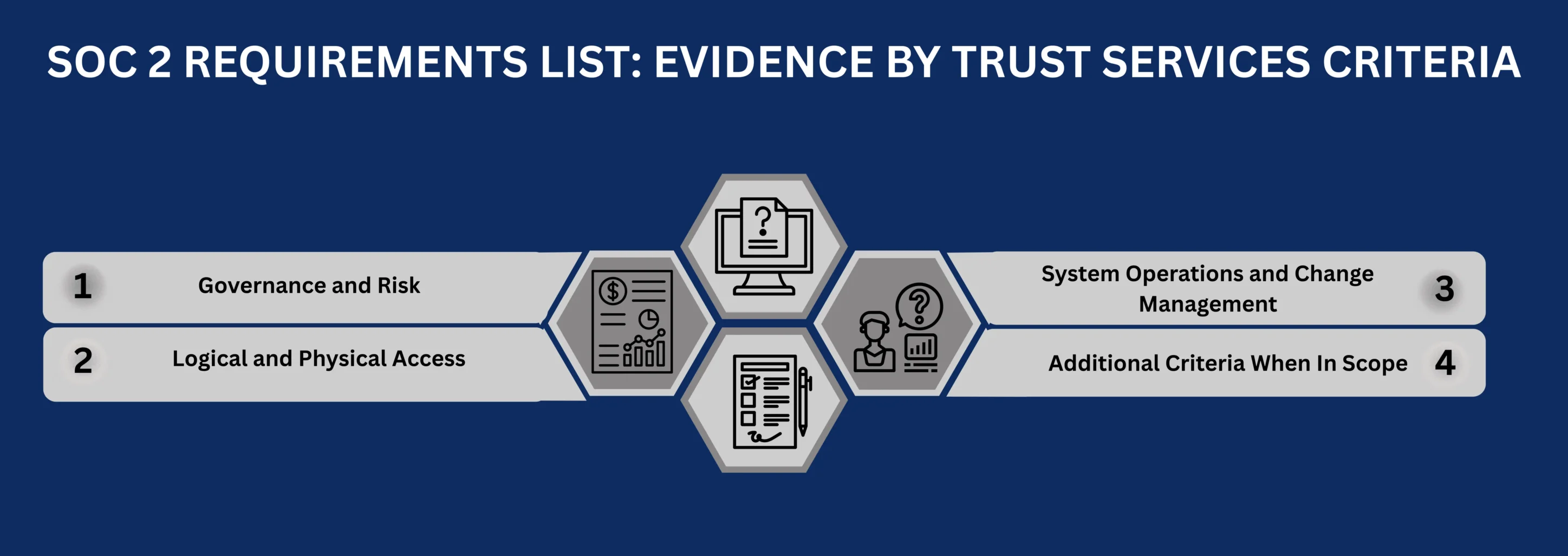
- ✓Security and Availability Criteria
- ✓Processing Integrity, Confidentiality, and Privacy Criteria
SOC 2 Type 1 and SOC 2 Type 2 Reports — Definitions and Differences
SOC 2 examinations produce two distinct report types: SOC 2 Type 1 and SOC 2 Type 2. The report type determines the scope and depth of the auditor’s examination and the nature of the opinion expressed. Understanding the difference between these two report types is essential for Cambridge organizations determining which examination aligns with their customer requirements and operational readiness for the SOC 2 audit.
SOC 2 Type 1 Report — Point-in-Time Design Evaluation
A SOC 2 Type 1 report evaluates the design of an organization’s controls at a specific point in time. The Licensed CPA Firm conducting the SOC 2 examination assesses whether the controls described in the organization’s system description are suitably designed to meet the applicable Trust Services Criteria as of the report date. A Type 1 report does not evaluate whether those controls operated effectively over a period of time — it addresses design only. This makes the Type 1 examination less resource-intensive than a Type 2 and can typically be completed more quickly once the organization’s system description and control documentation have been reviewed and confirmed to be accurate and complete.
For Cambridge technology startups and early-stage SaaS companies entering enterprise sales cycles for the first time, a SOC 2 Type 1 report can serve as an initial signal of control maturity while the organization builds the operating history required for a Type 2 examination. Many enterprise procurement programs will accept a Type 1 report as a preliminary assurance document, particularly when a Type 2 report is underway. However, a growing number of enterprise customers and institutional partners explicitly require a SOC 2 Type 2 report before proceeding with vendor approval, and a Type 1 alone may not satisfy those requirements. The Licensed CPA Firm issuing the report will clearly identify it as a Type 1 examination, and report recipients can distinguish it from a Type 2 based on its scope and the auditor’s opinion language.
SOC 2 Type 2 Report — Operating Effectiveness Over an Observation Period
A SOC 2 Type 2 report evaluates both the design and operating effectiveness of an organization’s controls over a defined observation period. The observation period is the span of time during which the Licensed CPA Firm examines evidence of control operation — typically a minimum of six months, with twelve months being the most commonly requested period by enterprise customers. During the observation period, the auditor collects and evaluates evidence that controls were not only suitably designed but consistently applied and functioning as described throughout the period under review. Evidence collection methods include inquiry, inspection of documentation and records, observation of control activities, and re-performance of selected control procedures.
The SOC 2 Type 2 report is the report type most frequently required by enterprise customers, regulated-sector clients, and institutional procurement programs. For Cambridge biotech organizations seeking contracts with pharmaceutical companies or academic medical centers — and for SaaS providers selling into financial services or healthcare markets — a current SOC 2 Type 2 report with a twelve-month observation period is typically the baseline expectation. The Type 2 SOC 2 attestation report includes the auditor’s opinion on both design and operating effectiveness, a description of the system, a description of the tests performed, and the results of those tests — including any exceptions identified. This level of detail allows report users to evaluate not just whether controls exist, but whether they functioned consistently over the period examined.
| Feature | SOC 2 Type 1 | SOC 2 Type 2 |
|---|---|---|
| Evaluation scope | Control design at a point in time | Control design and operating effectiveness over a period |
| Observation period | None — single date | Minimum 6 months; typically 12 months |
| Auditor opinion | Suitability of design | Suitability of design and operating effectiveness |
| Report contents | System description, design assessment | System description, tests performed, test results, exceptions |
| Market acceptance | Accepted as preliminary assurance | Required by most enterprise and regulated-sector customers |
SOC 2 Audit Process for Organizations in Cambridge
The SOC 2 audit process follows a structured examination methodology governed by AICPA attestation standards AT-C Section 105 and AT-C Section 205. For Cambridge-based organizations undergoing a SOC 2 examination, the process proceeds through defined stages — from scope definition through report issuance. Each stage involves specific activities conducted by the Licensed CPA Firm, with the organization providing access to documentation, systems, and personnel as required by the audit program.
The SOC 2 examination begins with scope definition, during which the Licensed CPA Firm and the organization establish the boundaries of the system under examination. The system description identifies the services included, the infrastructure components (cloud, on-premises, or hybrid), software applications, data categories processed, and the personnel involved in delivering the in-scope services. Scope definition also includes selection of the applicable Trust Services Criteria — Security and any additional criteria relevant to the organization’s service commitments. For Cambridge SaaS and cloud providers, the system scope typically encompasses production infrastructure, application layers, access management systems, and third-party service providers with a meaningful impact on the security or availability of the in-scope system.
Following scope definition, the Licensed CPA Firm develops the audit program — the structured set of examination procedures applied during the SOC 2 audit. The audit program specifies the nature, timing, and extent of testing for each control point within the applicable Trust Services Criteria. For a SOC 2 Type 2 examination, the audit program also defines the observation period dates and the evidence collection approach for each in-scope control. The audit program is specific to the organization’s system and control environment; it is not a standardized checklist applied uniformly across engagements. This individualized approach reflects the SOC 2 framework’s design as a principles-based examination rather than a prescriptive compliance checklist.
During the SOC 2 audit, the Licensed CPA Firm applies examination procedures to evaluate whether controls meet the applicable Trust Services Criteria. Examination procedures include inquiry of relevant personnel, inspection of policies and documented procedures, inspection of system configurations and logs, observation of control activities, and re-performance of selected control procedures to confirm that controls operate as described. For controls evaluated over the observation period in a Type 2 examination, the auditor selects samples from the period under review and examines evidence that each control was applied consistently. Evidence may include access log exports, change management tickets, system configuration screenshots, backup verification logs, and user access review records.
Where the auditor’s testing identifies a control that did not operate as described — whether due to a design gap or an operating failure during the observation period — the finding is documented as an exception in the SOC 2 audit report. Exceptions do not automatically result in an adverse opinion. The auditor evaluates the nature, frequency, and impact of exceptions in forming the SOC 2 attestation opinion. However, a pattern of exceptions across multiple control points, or a significant failure in a high-impact control area, may affect the overall opinion expressed in the report. For Cambridge organizations pursuing SOC 2 Certification in Cambridge for the first time, understanding the relationship between control evidence quality and the audit conclusion is essential to interpreting the examination process accurately.
At the conclusion of the SOC 2 examination, the Licensed CPA Firm issues the SOC 2 attestation report. For a Type 2 examination, the report includes: the independent service auditor’s report containing the auditor’s opinion; management’s description of the system; a description of the criteria applicable to the engagement; the auditor’s description of tests performed; and the results of those tests, including any exceptions identified. The report is addressed to the organization (the service organization) and is typically shared with customers and prospects under a non-disclosure agreement, as the report is a restricted-use document intended for specified parties with knowledge of the system and its controls. The attestation opinion expressed in the report reflects the Licensed CPA Firm’s independent conclusion based on the evidence examined during the SOC 2 audit.
| Audit Stage | Key Activities | Output |
|---|---|---|
| Scope Definition | Identify in-scope services, infrastructure, data, TSC selection | Defined system description and examination scope |
| Audit Program Determination | Develop testing procedures, define observation period for Type 2 | Structured audit program aligned to TSC |
| Evidence Collection | Inquiry, inspection, observation, re-performance of controls | Documented evidence for each in-scope control |
| Exception Review | Evaluate nature and impact of control failures identified during testing | Documented exceptions and auditor assessment |
| Report Issuance | Issue SOC 2 attestation report with independent auditor opinion | Final SOC 2 Type 1 or Type 2 attestation report |
- ✓Scope Definition and Audit Program Determination
- ✓Evidence Collection, Control Testing, and Examination Procedures
- ✓Report Issuance and Attestation Opinion
SOC 2 Certification Requirements — Controls, Documentation, and Evidence
SOC 2 examination requirements are defined by the AICPA Trust Services Criteria and the organization’s system description. Unlike prescriptive compliance frameworks that specify exact controls, SOC 2 evaluates whether an organization’s controls — whatever their specific form — meet the principles and requirements established by the applicable Trust Services Criteria. The Licensed CPA Firm evaluates both the design of controls (whether they are capable of meeting the criteria if operating as intended) and, in a Type 2 examination, the operating effectiveness of those controls over the observation period. Meeting these requirements is a prerequisite for achieving SOC 2 Certification in Cambridge.
For the SOC 2 examination, the organization must produce a management-prepared system description that accurately describes the services provided, the components of the system, the applicable Trust Services Criteria, and the controls in place to meet those criteria. The system description must be sufficiently detailed to allow the auditor to evaluate whether controls are suitably designed and to plan and execute the audit program. Supporting documentation typically includes information security policies, access management procedures, change management procedures, incident response plans, business continuity and disaster recovery plans, vendor management policies, and risk assessment documentation. The accuracy of the system description is itself subject to auditor evaluation — the Licensed CPA Firm assesses whether the description is fairly presented before the SOC 2 attestation report is issued.
For Cambridge organizations new to the SOC 2 compliance process, a common documentation challenge is ensuring that documented policies accurately reflect actual practices. The SOC 2 audit evaluates evidence of control operation against what is described in the system description and supporting policies. Where documented procedures describe controls that are not reflected in actual system configurations or operational records, the auditor will identify an exception. Organizations should ensure that their information security policies, access management procedures, and operational controls are consistent with both the system description submitted for examination and the evidence available in system logs, ticket systems, and configuration management records — prior to the audit commencement date.
The SOC 2 examination evaluates technical controls across several domains within the Common Criteria and any additional in-scope criteria. Key technical control areas examined include logical access controls (user provisioning, de-provisioning, role-based access, privileged access management), encryption of data in transit and at rest, network security controls (firewalls, intrusion detection, network segmentation), vulnerability management (scanning frequency, remediation tracking), change management controls (approval workflows, testing requirements, change logs), and monitoring and logging (security event logging, alerting, log retention). For each of these control areas, the auditor examines specific evidence — such as access provisioning records, encryption configuration documentation, firewall rule sets, vulnerability scan reports, change approval records, and security monitoring alert configurations — to assess design and operating effectiveness during the SOC 2 audit.
- ✓Logical access controls: user provisioning, de-provisioning, role-based access, multi-factor authentication
- ✓Encryption: data in transit (TLS) and data at rest for sensitive and confidential data categories
- ✓Network security: firewall configurations, network segmentation, intrusion detection systems
- ✓Vulnerability management: regular scanning, tracked remediation, risk-rated findings management
- ✓Change management: documented approval workflows, testing procedures, rollback controls
- ✓Security monitoring: event logging, log retention, alert configurations, incident response procedures
- ✓Vendor management: third-party risk assessments, service provider security reviews
- ✓Business continuity and disaster recovery: documented plans, tested backup and recovery procedures
- ✓Documentation and Policy Requirements
- ✓Technical Control Requirements and Evidence Standards
Who Needs SOC 2 Certification in Cambridge?
SOC 2 Certification in Cambridge is most in demand among organizations that store, process, or transmit customer data on behalf of other businesses or institutions. Cambridge’s technology and life sciences ecosystem generates a diverse range of organizations for which SOC 2 attestation is either a market expectation or an explicit vendor approval requirement. The following sectors represent the primary categories of Cambridge-based organizations pursuing SOC 2 examination.
SaaS Companies, Cloud Providers, and Technology Startups
Cambridge technology companies — including SaaS platforms, cloud service providers, managed service providers (MSPs), and developer tool companies — face consistent demand for SOC 2 Certification in Cambridge from enterprise customers. When a Cambridge SaaS company enters a procurement process with an enterprise financial institution, healthcare system, or large enterprise in any sector, the vendor’s security posture is evaluated as part of third-party risk management. A current SOC 2 Type 2 report satisfies a significant portion of the vendor security questionnaire requirements and accelerates the procurement approval process. For Cambridge SaaS companies targeting mid-market or enterprise customers domestically or internationally, SOC 2 attestation is frequently the threshold requirement for initiating substantive commercial discussions.
Managed service providers and IT service companies operating in Cambridge that manage infrastructure, security operations, or data processing for client organizations are also frequent SOC 2 examination candidates. These organizations process or have access to client data and systems, placing them directly within the third-party risk management scope of their clients’ security programs. A SOC 2 Type 2 report for an MSP confirms to client organizations that the MSP’s controls over the shared responsibility environment are independently verified — a requirement that many enterprise clients have codified in their vendor agreements. Cambridge MSPs serving healthcare or financial services clients are particularly likely to receive explicit SOC 2 requirements from those clients as a condition of contract renewal or new engagement.
Biotech, Life Sciences, and AI Organizations in Cambridge
Cambridge biotech and life sciences organizations increasingly encounter SOC 2 attestation requirements from pharmaceutical partners, clinical research organizations (CROs), academic medical centers, and government research funders. Cambridge’s concentration of biotechnology companies — spanning genomics, clinical informatics, drug discovery platforms, and digital health — means that many organizations in this sector operate data platforms that process sensitive clinical, patient, or proprietary research data on behalf of institutional partners. For these organizations, a SOC 2 examination scoped to include the Security, Confidentiality, and Privacy criteria provides institutional partners with independent verification of the controls protecting sensitive data. This level of assurance goes beyond what self-completed security questionnaires or internal attestations can provide.
Cambridge technology companies operating in the artificial intelligence and deep tech space face a distinct set of SOC 2 compliance drivers. Cambridge AI companies frequently process large volumes of customer data to train, validate, and operate machine learning models. Enterprise customers evaluating AI vendors apply rigorous third-party risk management review to these organizations, given the sensitivity of the data processed and the potential impact of model errors or data exposure. A SOC 2 Type 2 report for a Cambridge AI company provides enterprise customers with independent auditor confirmation that the controls governing data ingestion, processing, storage, and access have been evaluated against the Trust Services Criteria and found to be operating effectively over the examination period.
Research Institutions, University Spinouts, and Data-Handling Organizations
Cambridge’s unique position as home to MIT, Harvard University, and a dense network of affiliated research institutions means that a significant number of technology-based spinout companies emerge from academic research environments each year. These organizations often begin commercializing technology with existing institutional data partnerships and then encounter enterprise security requirements as they scale. SOC 2 examination becomes relevant for research spinouts when they transition from academic data-sharing agreements — which typically rely on institutional oversight — to commercial contracts with enterprise customers who require independent vendor security attestation. The SOC 2 Certification framework provides a structured pathway for these organizations to demonstrate control maturity to commercial partners without requiring compliance with sector-specific regulatory frameworks that may not yet apply to their operations.
Observation Period, Report Validity, and Ongoing SOC 2 Compliance
Understanding the observation period and report validity framework is essential for Cambridge organizations managing SOC 2 compliance as an ongoing operational requirement rather than a one-time event. The SOC 2 attestation framework is structured around periodic examination cycles, and a lapsed or outdated report significantly reduces the assurance value of the attestation for enterprise customers and procurement committees.
Observation Period Definition and Duration Standards
The observation period in a SOC 2 Type 2 examination is the defined span of time during which the Licensed CPA Firm evaluates evidence of control operation. The AICPA does not mandate a specific observation period duration, but industry practice and enterprise customer expectations have established six months as the practical minimum and twelve months as the preferred standard. A twelve-month observation period provides enterprise customers with confidence that controls were consistently applied across all operational seasons — including periods of organizational change, system updates, and personnel transitions. Cambridge organizations that have previously completed a Type 1 examination typically proceed to a Type 2 examination with an observation period beginning after the Type 1 report date, allowing continuity between the two examination types.
The observation period start and end dates are stated explicitly in the SOC 2 Type 2 report and are reviewed by enterprise customers to confirm that the report covers a sufficiently recent period. Most enterprise procurement programs treat a SOC 2 Type 2 report as current for twelve months from the end of the observation period. After that point, organizations are expected to provide an updated report covering a more recent period. For Cambridge organizations managing annual SOC 2 examination cycles, aligning the observation period end date with commercial renewal timelines — such as the enterprise customer’s annual vendor review — ensures that a current report is available when it is most frequently requested.
Report Validity and Annual Examination Cycles
A SOC 2 attestation report does not have an official expiration date defined by AICPA standards, but it does have a practical currency window determined by enterprise market expectations. The twelve-month convention — under which a report covering an observation period ending more than twelve months prior is considered outdated — means that organizations must complete annual SOC 2 examination cycles to maintain a current attestation. Lapsing the examination cycle creates a gap in the organization’s attestation history that can raise questions during vendor security reviews, particularly if the gap coincides with a period of organizational or system change. For Cambridge SaaS companies with enterprise customers, maintaining an unbroken chain of annual SOC 2 Type 2 reports is a recognized practice for sustaining vendor approval status across multiple customer renewal cycles.
Why Cambridge Organizations Pursue SOC 2 Attestation — Demand Drivers
The demand for SOC 2 attestation among Cambridge technology and life sciences organizations is driven by a specific set of market and institutional pressures. Understanding these demand drivers allows organizations to evaluate when SOC 2 examination is strategically indicated and which report type and scope configuration best serves their customer and partner requirements.
Enterprise Vendor Security Reviews and Third-Party Risk Management
The most direct driver of SOC 2 Certification in Cambridge demand is the enterprise vendor security review process. Large enterprise customers — particularly those in financial services, healthcare, insurance, and government — maintain formal vendor risk management programs that require independent security attestation from all vendors with access to sensitive data or systems. When a Cambridge technology company is included in an enterprise vendor review, the procurement team’s security questionnaire will typically include a request for a current SOC 2 Type 2 report. Organizations that cannot provide a current report may be required to complete an extended due diligence process, accept additional contractual security obligations, or be disqualified from the procurement process entirely.
SOC 2 examination in Cambridge is also triggered by customer contract requirements. Enterprise contracts for SaaS, cloud, and data processing services increasingly include explicit language requiring the vendor to maintain a current SOC 2 Type 2 report and make it available to the customer upon request. For Cambridge organizations that have entered commercial agreements containing such requirements, the SOC 2 audit is not optional — it is a contractual obligation. Failure to maintain a current report may constitute a material breach of the service agreement, with potential consequences including contract termination or withholding of payment pending attestation. Annual SOC 2 examination cycles are the standard approach for maintaining compliance with these contractual obligations.
International Expansion and Cross-Border Vendor Assurance Requirements
Cambridge technology companies expanding into European, Asia-Pacific, or other international markets frequently encounter SOC 2 attestation requests from international enterprise customers who recognize the AICPA framework as a credible U.S.-based security attestation standard. While European customers may also request ISO 27001 certification or GDPR compliance documentation, SOC 2 Type 2 reports are increasingly recognized and accepted in international vendor security reviews — particularly when the buyer organization has U.S. operations or is familiar with U.S.-based attestation standards. For Cambridge SaaS companies with a global customer base, a SOC 2 Type 2 report serves as a portable assurance document that can be shared with customers in multiple jurisdictions without requiring separate examination processes for each market.
Benefits of SOC 2 Certification for Cambridge-Based Organizations
The benefits of SOC 2 Certification in Cambridge are grounded in the evidential weight that an independent attestation report carries in enterprise procurement, institutional partnerships, and vendor risk management contexts. The following benefits reflect the direct, verifiable outcomes associated with a completed SOC 2 examination conducted by a Licensed CPA Firm.
- ✓Independent verification of control effectiveness — the SOC 2 attestation report provides third-party evidence of control design and operating effectiveness, issued by a Licensed CPA Firm rather than the organization itself
- ✓Accelerated enterprise procurement — a current SOC 2 Type 2 report satisfies the security attestation requirements of most enterprise vendor review processes, reducing the due diligence cycle
- ✓Contractual compliance — organizations with SOC 2 attestation requirements in customer contracts maintain current reports that demonstrate ongoing adherence to agreed security standards
- ✓Competitive differentiation — Cambridge technology companies with current SOC 2 Type 2 reports can respond to enterprise security questionnaires more efficiently than competitors without independent attestation
- ✓Structured control evaluation — the SOC 2 audit process produces documented evidence of control testing that organizations can use to identify and address control gaps
- ✓International vendor assurance — SOC 2 Type 2 reports are recognized by international enterprise customers and can satisfy vendor security requirements in multiple markets
- ✓Institutional partnership eligibility — Cambridge biotech and research organizations with SOC 2 Certification meet the security assurance requirements of pharmaceutical, academic medical, and government research partners
For Cambridge technology companies, the SOC 2 attestation report functions as a market signal that the organization’s security controls have been independently evaluated and found to meet the applicable Trust Services Criteria. This signal is relevant not only in direct customer relationships but also in investor due diligence processes, where security posture is increasingly reviewed as an element of operational risk assessment. Venture-backed Cambridge startups that have completed a SOC 2 examination can provide investors with auditor-issued evidence of control maturity — a factor that may be evaluated during growth-stage and late-stage investment rounds. The SOC 2 attestation also provides a documented baseline against which future examination cycles can be compared, creating a historical record of control operation that has value in enterprise sales, M&A due diligence, and regulatory inquiry contexts.
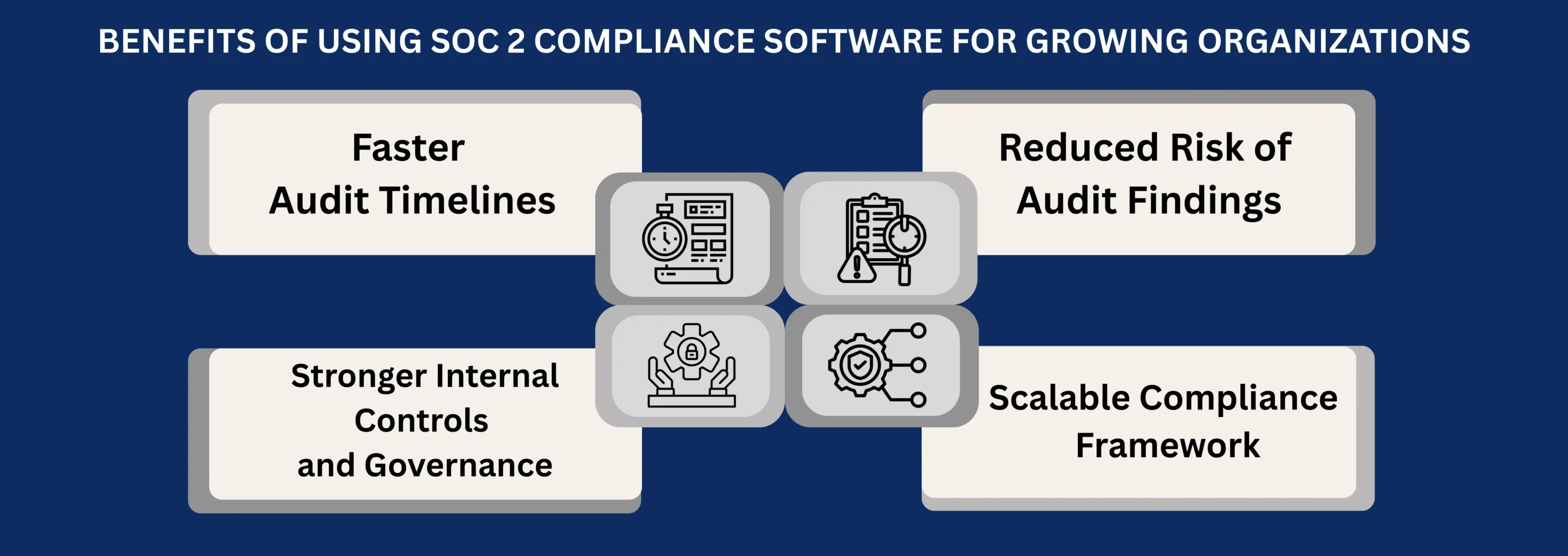
- ✓SOC 2 Attestation and Market Positioning for Cambridge Technology Companies
CertPro — Licensed CPA Firm Conducting SOC 2 Examinations in Cambridge
CertPro is a Licensed CPA Firm conducting independent SOC 2 examinations for organizations across Cambridge, Massachusetts, and the broader U.S. technology and life sciences market. As a Licensed CPA Firm, CertPro operates exclusively as an independent third-party auditor under AICPA attestation standards AT-C Section 105 and AT-C Section 205. CertPro does not provide advisory, consulting, implementation, or control design services — its sole function is the independent SOC 2 examination of organizational controls against the applicable AICPA Trust Services Criteria and the issuance of the resulting SOC 2 attestation report.
Independent Examination Methodology and CPA Firm Positioning
CertPro’s SOC 2 audit methodology is structured around the AICPA attestation standards and the Trust Services Criteria applicable to each engagement. The firm’s examination procedures are designed to produce audit evidence that is sufficient and appropriate to support the attestation opinion expressed in the SOC 2 report. For each SOC 2 audit in Cambridge, CertPro applies examination procedures including inquiry of relevant personnel, inspection of system configurations and documentation, observation of control activities, and re-performance of selected control procedures. The examination is planned and executed by licensed CPAs with experience in information technology environments, cloud infrastructure, and the specific control requirements of the AICPA Trust Services Criteria.
CertPro’s independent status as a Licensed CPA Firm is a foundational element of the SOC 2 attestation’s value. SOC 2 reports issued by non-CPA firms do not constitute AICPA-compliant attestations and are not recognized as equivalent by enterprise procurement programs or regulated-sector customers. For Cambridge organizations selecting an examination provider, confirming that the firm is a Licensed CPA Firm authorized to conduct attestation engagements under AICPA standards is a prerequisite for ensuring the resulting report will be accepted by enterprise customers, institutional partners, and regulated-sector clients. CertPro’s CPA firm status means that its SOC 2 attestation reports meet the independence, professional standards, and reporting format requirements of the AICPA framework — the same framework referenced in enterprise vendor security policies, regulated-sector procurement requirements, and international vendor assurance programs that recognize U.S.-based SOC 2 Certification standards.
FAQ
▶
What is SOC 2 Certification and how does it differ from SOC 2 compliance?
▶
What is the difference between SOC 2 Type 1 and SOC 2 Type 2 for Cambridge organizations?
▶
How long is the SOC 2 observation period?
▶
How long is a SOC 2 attestation report valid?
▶
Which Trust Services Criteria should Cambridge organizations include in their SOC 2 scope?
▶
Does SOC 2 examination apply to Cambridge biotech and life sciences organizations?
▶
Must the SOC 2 examination be conducted by a Licensed CPA Firm?
▶
What happens if exceptions are identified during the SOC 2 audit?
SOC 1 VS SOC 2: WHICH REPORT YOUR CUSTOMERS ACTUALLY ASK FOR
If you sell SaaS or provide outsourced services, you have likely been asked for a SOC report. However, the follow-up question is rarely easy to answer…
SOC 2 Certified: What Does It Mean for Your Business
For companies that handle sensitive data or run cloud-based services, the question “Can you provide your SOC 2 report?” carries enormous weight. Yet, …
HOW SOC 2 AUDITORS REVIEW EVIDENCE OVER TIME
Most businesses pursuing a SOC 2 report spend months building security controls but overlook a fundamental reality: SOC 2 auditors do not just verify …
Get In Touch
have a question? let us get back to you.