
SOC 2 is an independent attestation examination, not a certification program. Management defines the system, selects relevant Trust Services Categories, designs controls, and makes an assertion. An independent CPA evaluates that assertion against AICPA criteria and reports an opinion based on evidence.

Concern
Calling an organization “SOC 2 certified” can misstate what its report establishes. The report addresses a defined system, selected criteria, and a stated date or period. This is why understanding attestation vs certification matters.
Overview
SOC 2 is an attestation. A licensed CPA firm examines controls against the AICPA Trust Services Criteria under AICPA attestation standards (SSAE 18) and issues a report containing an opinion, management's assertion, a system description and test results. Certifications such as ISO 27001 are issued by accredited certification bodies against a fixed standard.
Solution
Management should describe its system and controls accurately. Readers should assess the report’s scope, criteria, period, opinion, and exceptions, rather than seek a pass or fail label.
Introduction
Customers often ask whether a service organization has achieved SOC 2 certification. The wording sounds familiar to organizations with an ISO/IEC 27001 certificate. Yet the engagements produce different outcomes. The attestation vs certification distinction affects management’s assertion and the CPA’s examination.
SOC 2 does not award certification for implementing a prescribed checklist. It provides an examination under the AICPA attestation framework. This distinction helps management describe its assurance. The attestation vs certification question also affects how customers interpret the report.
Attestation vs Certification: The Core Difference
The attestation vs certification difference comes down to who issues the result, against what, and in what form. A certification is a formal credential issued by an accredited certification body against a fixed, published standard, typically with a pass or fail outcome and a displayable certificate. An attestation is an independent practitioner's written conclusion about a subject matter, here a company's controls, measured against stated criteria.
SOC 2 is an attestation. The deliverable is a report, not a badge. Because the subject matter is judged against the AICPA Trust Services Criteria, which are principles-based, the organization selects controls suited to its environment and the service auditor evaluates them.
Generic definitions that treat attestation as simply verifying a document's authenticity miss this professional meaning. In SOC 2, attestation is a regulated engagement performed by an auditor under professional standards, with independence requirements and defined reporting.
How ISO/IEC 27001 differs
ISO/IEC 27001 specifies requirements for an information security management system (ISMS). Clauses 4–10 contain normative requirements that an organization seeking certification must meet. Annex A provides reference controls. The organization selects relevant controls through risk assessment and treatment and records them in its Statement of Applicability.
SOC 2 uses TSC as examination criteria, but they do not prescribe one control design for every organization. ISO certification assesses conformity; SOC 2 attestation results in an auditor’s opinion.
Certification compared with SOC 2 attestation
-
Issued by
Certification (e.g., ISO 27001): Accredited certification body
Attestation (SOC 2): Licensed CPA firm -
Measured against
Certification (e.g., ISO 27001): Fixed published standard
Attestation (SOC 2): AICPA Trust Services Criteria -
Outcome
Certification (e.g., ISO 27001): Pass or fail, certificate
Attestation (SOC 2): Professional opinion in a report -
Governing rules
Certification (e.g., ISO 27001): Accreditation and certification standards
Attestation (SOC 2): AICPA attestation standards (SSAE 18)
Who Defines the SOC 2 Scope and Controls?
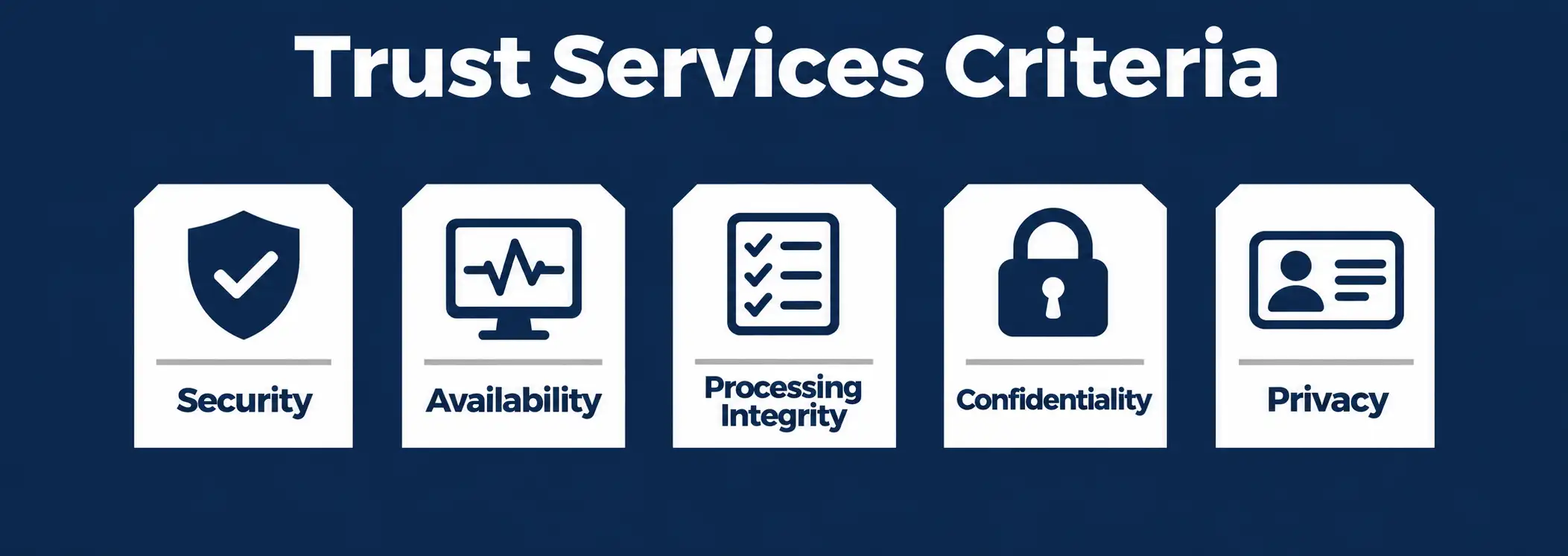
Management defines the system under examination. Its description identifies the services, infrastructure, software, people, procedures, data, locations, commitments, and system requirements. Management selects relevant Trust Services Categories. Security applies to every examination; Availability, Processing Integrity, Confidentiality, and Privacy remain optional.
Management designs controls to address the criteria. Examples include quarterly privileged-access reviews, monthly vulnerability assessments, or annual incident response exercises. Management sets operating frequency, not the auditor’s testing frequency.
Management’s decisions do not bind the auditor
The auditor evaluates whether the description and selected criteria provide an appropriate basis, and whether controls address the criteria. The auditor may identify omissions or seek clarification.
For SOC 2 attestation report interpretation, management defines and asserts; the auditor independently evaluates. Management does not dictate procedures or the opinion.
Why the Trust Services Criteria Allow Different Control Designs
The TSC includes the Common Criteria and four additional categories. The nine Common Criteria groups, CC1 through CC9, address control environment, communication, risk assessment, monitoring, and control activities. Security applies in every examination; the other categories depend on scope.
The criteria describe control objectives, not a universal technology checklist. CC6.1, for example, addresses logical access security. One organization may use a centralized identity provider, multifactor authentication, and role-based permissions; another may use a different architecture. The auditor evaluates whether the controls address the criterion, not the product. This is another practical point in attestation vs certification.
Points of Focus and implementation flexibility
Points of Focus explain aspects of a criterion for management to consider; they do not create separate mandatory criteria. The auditor still needs evidence and applies professional judgment to evaluate design and operation.
The attestation vs certification distinction allows different implementations, not different evaluation criteria. A SOC 2 attestation/examination evaluates controls against the described system and its requirements.
What the CPA’s Opinion Says and How Evidence Supports It
The auditor does not issue a pass or fail verdict. That difference defines attestation vs certification in practice. The opinion addresses the fairness of the system description, control suitability, and, for Type 2, operating effectiveness throughout the stated period.
Type 1 addresses the description and control design as of a specified date. Type 2 also addresses operating effectiveness over a period. The service auditor obtains sufficient appropriate evidence for reasonable assurance, not a security guarantee.
How the CPA tests controls
The auditor may use inquiry, inspection, observation, and reperformance. For example, the auditor may ask about a quarterly access review, inspect records and approvals, observe an activity, or reperform selected steps. Management sets control frequency; the auditor determines the nature, timing, and extent of testing, including sample selection.
For Type 2, a current dashboard alone may not demonstrate operation throughout the period. The auditor evaluates period evidence and considers each exception’s nature, cause, frequency, and effect on the criteria. A SOC 2 Attestation Report communicates the auditor’s evidence-based opinion.
Conclusion
The attestation vs certification distinction separates management’s responsibility from the auditor’s. Management describes its system, selects criteria, designs controls, and asserts. The auditor examines and expresses an evidence-based opinion.
Report users should ask what system, criteria, and period the report covers, what opinion the auditor expresses, and whether exceptions affect it. CertPro is an independent licensed CPA firm that conducts SOC 2 examinations under the AICPA attestation standards.