
A vendor risk analyst opens a SOC 2 report, skims to the end, and relaxes at the word unqualified. A few pages earlier, the same report disclosed that one terminated employee's access was not revoked on schedule. Both things are true at once, and knowing how they fit together is the actual skill this document requires.
A SOC 2 audit opinion is the auditor's formal conclusion on whether a service organization's controls were suitably designed and, for a Type 2 report, operated effectively across the review period. It is not a pass or fail grade, and SOC 2 does not issue a certificate. The opinion, and the exceptions that may sit alongside it, are what a vendor risk team is actually being asked to evaluate every time a SOC 2 report lands in their inbox.
This guide explains the four SOC 2 audit opinion types, what SOC 2 exceptions mean and do not mean, how the two interact, and how to read both like a vendor risk professional rather than skimming for a single reassuring word.
Concern
Vendor risk teams commonly misread SOC 2 reports in one of two directions: treating any exception as a disqualifying failure or treating an unqualified opinion as proof nothing went wrong. Neither is correct. A SOC 2 audit opinion can be unqualified even when the report lists real exceptions, and a qualified opinion does not necessarily mean the vendor is unsafe to use. Reading the opinion in isolation from the exceptions, or the reverse, produces bad vendor decisions in both directions.
Overview
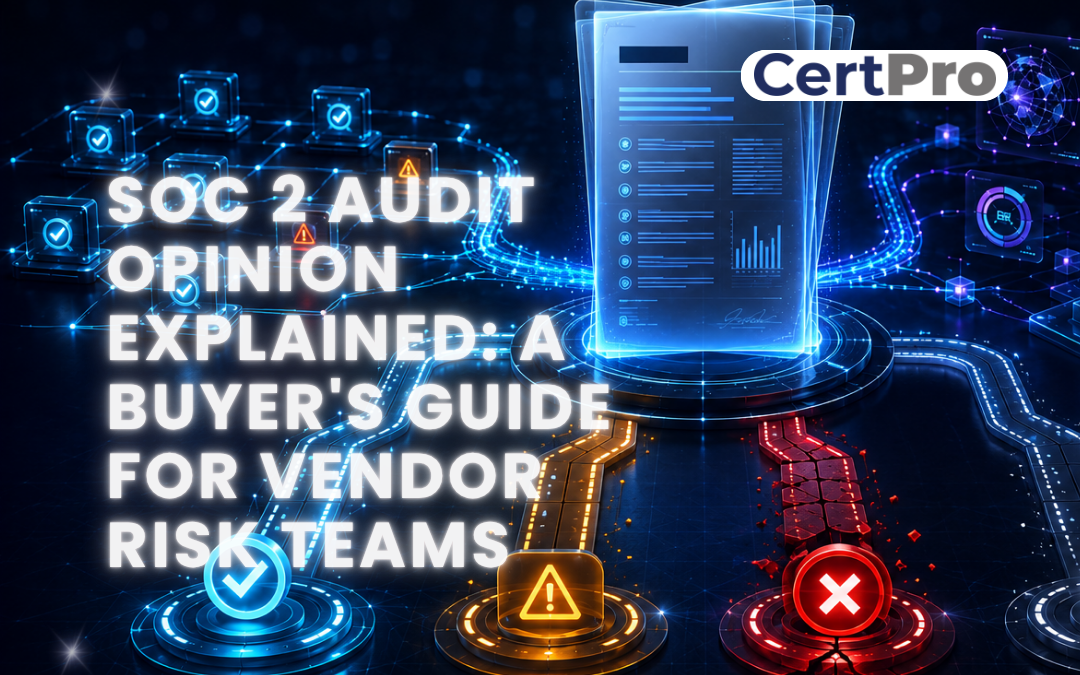
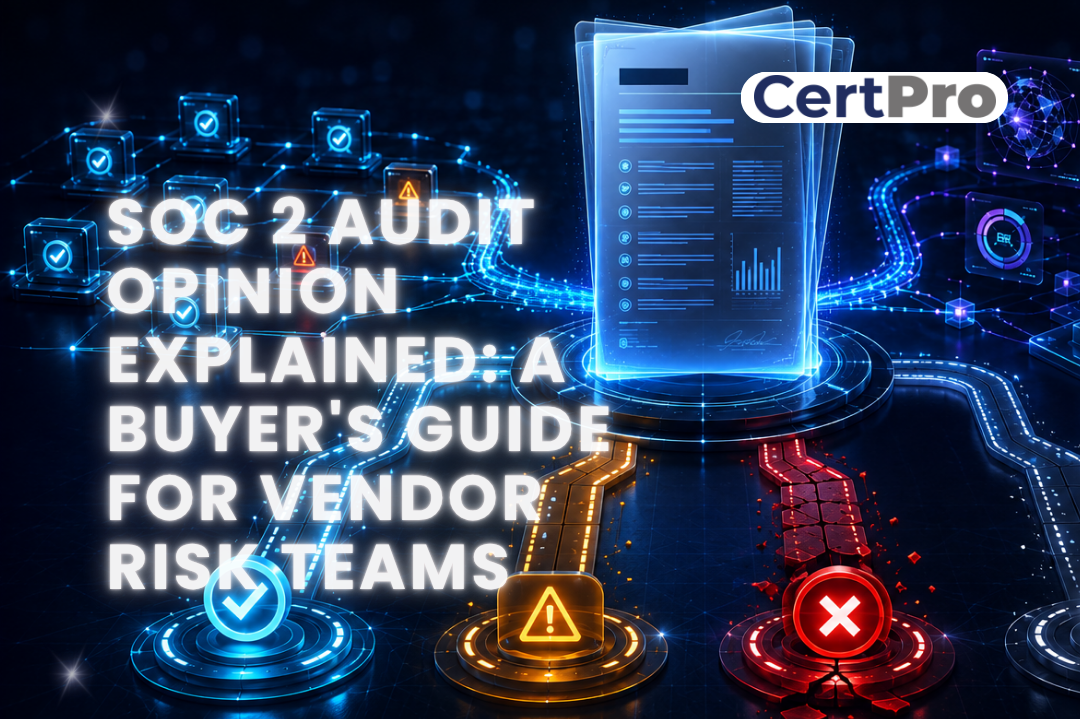
Auditors issue one of four SOC 2 audit opinion types: unqualified, qualified, adverse, or disclaimer. Unqualified is the clean, most common outcome. Qualified means specific exceptions were significant but not pervasive. Adverse means control failures were broad enough to undermine the whole environment. A disclaimer means the auditor could not gather enough evidence to conclude at all. SOC 2 exceptions are individual, documented control gaps evaluated for number, pervasiveness, and materiality before the auditor decides which opinion they justify.
Solution
Read a SOC 2 report by checking the opinion type first, then reading every exception individually rather than counting them, then evaluating management's response and remediation timeline, then confirming the report period and scope actually cover what you are buying. An unqualified opinion with a well-remediated exception is frequently a stronger signal than a suspiciously clean report with none.
What Is a SOC 2 Audit Opinion?
A SOC 2 audit opinion is the licensed CPA firm's professional conclusion, stated in the report itself, on whether the service organization's system description is fairly presented and its controls are suitably designed and, in a Type 2 engagement, operating effectively throughout the review period. It sits near the front of the report, and it is the single sentence every other page of evidence exists to support.
The framing that trips up first-time reviewers is the word audit. SOC 2 is not graded pass or fail, and there is no SOC 2 certificate to earn or lose. What the vendor receives is a SOC 2 audit report carrying an opinion, and that opinion can land in one of four places, only two of which represent genuinely bad news for a buyer evaluating the vendor.
The opinion is the conclusion of the same examination that produces the evidence covered in how SOC 2 auditors review evidence over time: populations tested, samples traced, deviations evaluated across the SOC 2 examination report period. The SOC 2 audit opinion is where that testing resolves into a single professional judgment a buyer can act on without redoing the audit themselves.
The Four SOC 2 Audit Opinion Types
Every SOC 2 audit opinion falls into one of four categories, and the differences between them turn on pervasiveness and materiality rather than the simple presence of a problem.
- Unqualified
The most favorable and by far the most common outcome. The auditor concludes the system description is fairly presented and controls are suitably designed and operating effectively, with no issues significant enough to qualify the conclusion. Critically, an unqualified opinion can still be issued alongside disclosed exceptions; if those exceptions are isolated and remediated, they do not necessarily rise to the level of qualifying the opinion.
- Qualified
Issued when the auditor finds one or more exceptions significant enough to affect part of the conclusion, but not pervasive across the whole control environment. The qualification is scoped: the rest of the report and its criteria still stand, and the auditor states specifically which control or criterion the qualification applies to.
- Adverse
A serious and comparatively rare outcome. The auditor concludes that, taken as a whole, controls did not meet the criteria: not an isolated gap, but deficiencies broad and material enough to undermine confidence in the environment generally. An adverse SOC 2 audit opinion should prompt direct questions to the vendor before any further reliance on the report.
- Disclaimer
The auditor could not obtain sufficient, appropriate evidence to reach a conclusion at all, often due to scope restrictions or an engagement cut short. A disclaimer does not necessarily mean the control environment is deficient; it means the auditor was not able to test enough to say either way, which is its own kind of red flag for a buyer.
What Are SOC 2 Exceptions?
A SOC 2 exception is any specific instance where a control was not designed correctly or did not operate as intended during the review period. It is tied to one control and one test, not to the organization's posture in general, and it is not automatically a failed audit; SOC 2 does not produce failed audits, only opinions.
Exceptions surface constantly in real engagements and coexist with unqualified opinions more often than buyers expect. A commonly cited illustration: an auditor samples twenty-five employees for security awareness training completion, finds one who missed the deadline, expands the sample to fifteen more, and finds no further misses. That single miss is disclosed as an exception against the relevant criterion. It does not, on its own, disturb an otherwise unqualified SOC 2 audit opinion.
What turns an exception, or a set of them, into a qualification is the auditor's judgment on three factors: how many controls are affected, whether the pattern is isolated or pervasive across the environment, and how material the underlying risk is to the criteria in scope. There is no fixed threshold; the standard explicitly leaves this to auditor judgment based on the specific engagement, which is exactly why reading the exception detail matters more than counting exceptions.
How to Read a SOC 2 Audit Opinion as a Vendor Risk Team
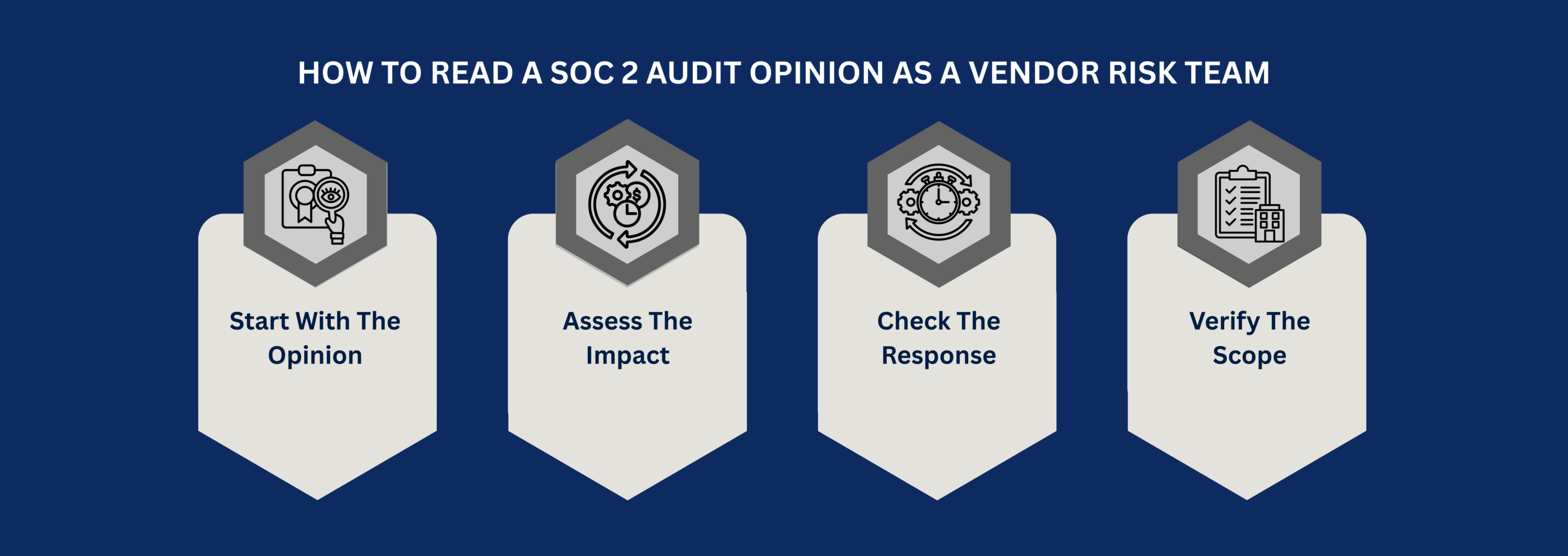
A good SOC 2 report review avoids two shortcuts: stopping at an unmodified opinion or treating every exception as disqualifying. A better review considers the opinion, exceptions, management response, and scope together.
- Start With The Opinion
Read the auditor's opinion first to establish the overall conclusion. Then review every disclosed exception. Each should identify the control tested, the procedure performed, the deviation found, and the relevant period. The Trust Services Criteria covered by the report show which area the exception affects, such as logical access, change management, or availability.
- Assess The Impact
Exception count matters less than the risk each exception creates. An isolated issue involving a low-risk control may carry less weight than one affecting access to sensitive data or a critical production system. Three minor exceptions can present less concern than a report with no exceptions but limited detail about controls relevant to your relationship.
- Check The Response
Read management's response alongside each exception. Look for a clear explanation of the issue, corrective action, and current status. A management response provides useful context, but it does not replace the auditor's independent evaluation. Repeated or unresolved exceptions across report periods deserve closer attention.
- Verify The Scope
An unmodified SOC 2 opinion applies only to the defined scope, period, and Trust Services Criteria. Check whether the report covers the product or service you use, the relevant examination period, and the criteria related to your data. The SOC 2 Type 2 report structure can help you verify these elements. A clean opinion on the wrong scope does not answer your vendor-risk question.
Who Needs a SOC 2 Report, and What They Should Take From the Opinion
Who needs a SOC 2 report? Enterprise buyers evaluating a vendor's data handling, procurement and vendor risk teams running due diligence before contract signature, security teams assessing third-party exposure, and the service organizations themselves seeking the attestation that satisfies all three audiences at once. Each reads the SOC 2 audit opinion for a slightly different purpose.
Buyers use the opinion and exceptions to decide whether a vendor clears their risk threshold, often alongside a structured security questionnaire that probes anything the report leaves ambiguous. Procurement teams use it to set contractual terms, sometimes requiring remediation evidence for open exceptions before renewal. And service organizations preparing for their own examination should understand that a well-managed exception process, not a zero-exception report, is usually the more credible outcome to aim for.
A structured vendor review process treats the SOC 2 audit opinion as one input among several: the opinion type, the exceptions and their remediation, the scope and period, and corroborating evidence such as penetration test summaries or contractual security terms. No single element, including a clean opinion, should stand alone as the entire vendor decision.
Conclusion
A SOC 2 audit opinion is a professional conclusion, not a verdict, and reading it well means resisting the instinct to treat it as a single word to scan for. Unqualified opinions coexist with real exceptions far more often than buyers assume, and the exceptions themselves, read individually, usually tell a more useful story than the opinion label alone.
The discipline that separates a strong vendor risk review from a rushed one is simple to state and easy to skip under deadline pressure: read the opinion type, read every exception in full, weigh pervasiveness and remediation over raw count, and confirm the scope actually covers what you are buying. Vendors that manage exceptions transparently are frequently the safer bet over vendors whose reports look suspiciously clean.
At CertPro, we issue SOC 2 audit opinions as a licensed CPA firm enrolled in the AICPA Peer Review Program, testing controls, evaluating exceptions individually against pervasiveness and materiality, and documenting remediation with the clarity that lets buyers make real decisions rather than guess at a label. For organizations preparing for their own examination, or vendor risk teams building a repeatable review process, our SOC 2 certification services and readiness support cover both sides of this report.