
SOC 2 Certification in Austin
SOC 2 Certification in Austin is a formal third-party attestation issued by a Licensed CPA Firm confirming that an organization’s information security controls meet the AICPA’s Trust Services Criteria. CertPro conducts SOC 2 audit engagements for Austin-based technology companies, SaaS providers, fintech firms, and cloud service organizations under AICPA attestation standards. Each SOC 2 audit evaluates both control design and operating effectiveness across defined audit periods, providing independent assurance that customers and enterprise buyers rely on.
OUR CLIENTS










What Is SOC 2 Certification?
SOC 2 Certification is a formal attestation issued by a Licensed CPA Firm confirming that a service organization’s controls relevant to security, availability, processing integrity, confidentiality, and privacy meet the criteria established by the American Institute of Certified Public Accountants (AICPA). Unlike self-assessments or vendor questionnaires, SOC 2 certification results from an independent examination conducted under AICPA attestation standards — specifically AT-C Section 205. The outcome is a formal CPA opinion on whether controls were suitably designed and, for a Type 2 report, operated effectively over a specified review period.
The SOC 2 framework was developed by the AICPA to address the growing need for independent security assurance in cloud computing and technology service environments. It applies to service organizations that store, process, or transmit customer data and that carry contractual or regulatory obligations related to data security. SOC 2 reports are widely recognized across the United States as the standard mechanism for demonstrating third-party validated security assurance to enterprise customers, institutional buyers, and regulated industries.
Trust Services Criteria: The Foundation of SOC 2 Examinations
The Trust Services Criteria (TSC) published by the AICPA form the evaluative framework for all SOC 2 examinations. The TSC are organized into five categories: Security, Availability, Processing Integrity, Confidentiality, and Privacy. Security — also referred to as the Common Criteria — is mandatory in every SOC 2 engagement. The remaining four categories are included based on the nature of the service organization’s commitments and the system components that support those commitments.
Each Trust Services Criterion specifies control objectives and points of focus that auditors evaluate during the SOC 2 audit. The Security criterion addresses logical and physical access controls, threat and vulnerability management, change management, risk assessment, and monitoring. Availability criteria evaluate system uptime commitments, disaster recovery, and incident response. Processing Integrity criteria assess whether systems process data completely, accurately, and on schedule. Confidentiality criteria address how sensitive information is identified, protected, and disposed of, while Privacy criteria align with AICPA privacy commitments and regulatory frameworks such as GDPR and CCPA.
SOC 2 Type 1 vs. SOC 2 Type 2: Key Differences
SOC 2 Type 1 reports assess whether controls were suitably designed and implemented as of a specific point in time. A Type 1 examination evaluates the design adequacy of controls relative to the Trust Services Criteria but does not assess operating effectiveness over time. Type 1 reports are often pursued by organizations that are new to SOC 2 certification or that need to demonstrate a baseline control environment to prospective customers while preparing for a full Type 2 examination.
SOC 2 Type 2 reports assess both the design and operating effectiveness of controls over a defined review period, typically six to twelve months. Type 2 examinations require auditors to perform control testing — including inquiry, observation, inspection of documentation, and re-performance — across multiple instances throughout the review period. Because Type 2 reports demonstrate sustained control performance rather than a single point-in-time snapshot, enterprise customers, regulated industries, and institutional buyers place significantly higher value on Type 2 SOC 2 attestation compared to Type 1.
| Attribute | SOC 2 Type 1 | SOC 2 Type 2 |
|---|---|---|
| Assessment Scope | Control design at a point in time | Control design and operating effectiveness over a defined period |
| Review Period | Single date | Typically 6–12 months |
| Testing Procedures | Design adequacy review | Control testing across multiple instances |
| Market Value | Baseline assurance | Preferred by enterprise and regulated industry buyers |
| Typical Use Case | Initial SOC 2 attestation or early-stage companies | Ongoing SOC 2 compliance and vendor qualification |
What SOC 2 Certification Means for a Company in Austin
SOC 2 Certification in Austin means that a Licensed CPA Firm has independently examined and attested to the operating effectiveness of an organization’s security and privacy controls under AICPA standards. It is not a self-declaration, a checklist completion, or the output of a compliance automation platform. It is a formal professional opinion rendered by a qualified CPA following a structured SOC 2 audit program. This distinction is critical: organizations that complete readiness exercises or automated scans without engaging a Licensed CPA Firm do not hold SOC 2 certification.
For Austin-based companies operating in competitive technology markets, holding a SOC 2 certification issued by a reputable Licensed CPA Firm signals that an independent professional has validated the organization’s control environment. This carries measurable weight in enterprise sales cycles, vendor qualification processes, and regulatory due diligence reviews. Austin’s rapid growth as a technology hub has created an environment where SOC 2 attestation is increasingly treated as a baseline qualification — not just a differentiator — in many B2B procurement contexts.

Introduction to SOC 2 Certification in Austin
Austin, Texas has emerged as one of the most active technology and innovation ecosystems in the United States. The city hosts a dense concentration of SaaS companies, cloud computing providers, semiconductor manufacturers, artificial intelligence startups, fintech organizations, cybersecurity firms, and regional headquarters of multinational technology enterprises. This technological density creates strong demand for independent security validation. SOC 2 Certification in Austin has become a standard requirement for B2B technology providers seeking to serve enterprise customers, financial institutions, healthcare organizations, and government contractors.
The Austin technology market is characterized by high-growth SaaS companies scaling their enterprise sales functions, fintech firms subject to financial regulatory oversight, AI and machine learning companies handling sensitive training data and model outputs, and cybersecurity vendors that must themselves demonstrate rigorous security practices. Across each of these segments, SOC 2 compliance in Austin is frequently cited as a prerequisite in procurement contracts, enterprise master service agreements, and regulated industry vendor qualification programs.
Austin’s Technology Ecosystem and SOC 2 Demand
Austin’s technology sector has experienced compounding growth across multiple consecutive years, driven by corporate relocations, venture capital investment, and the expansion of the University of Texas at Austin’s technology commercialization pipeline. Major technology enterprises — including Dell Technologies, Apple, Oracle, Tesla, Samsung, and Google — maintain significant operations in the Austin metropolitan area. These organizations enforce vendor security requirements that commonly include SOC 2 attestation as a condition of vendor qualification or contract renewal.
The fintech segment in Austin is particularly active, with payments processors, lending platforms, insurance technology companies, and investment management software providers operating under dual pressures: customer-driven demand for SOC 2 certification and regulatory frameworks that require documented information security controls. SOC 2 compliance in Austin’s fintech sector frequently intersects with PCI DSS, GLBA, and SOX IT general controls, making the scoping and execution of a SOC 2 audit in Austin a specialized discipline requiring auditors with relevant industry experience.
SOC 2 Certification for Austin SaaS Companies
SOC 2 certification that Austin SaaS companies pursue serves a specific function in enterprise sales cycles. Enterprise procurement teams routinely issue security questionnaires and require third-party audit reports before approving new vendors. A SOC 2 Type 2 report issued by a Licensed CPA Firm satisfies this requirement with a level of rigor that self-completed questionnaires cannot replicate. For Austin SaaS companies targeting mid-market and enterprise accounts, holding a current SOC 2 attestation materially reduces the sales cycle friction created by security review processes.
Austin SaaS providers that store customer data in cloud environments — particularly those using Amazon Web Services, Microsoft Azure, or Google Cloud Platform — must demonstrate that their application-layer and operational controls meet the Trust Services Criteria independently of the cloud infrastructure provider’s own certifications. Cloud providers’ infrastructure certifications, including their own SOC 2 reports, do not extend coverage to the SaaS provider’s controls. Each SaaS company must obtain its own SOC 2 certification to attest to controls within its defined system boundary.
SOC 2 Compliance for Austin Fintech and AI Organizations
SOC 2 compliance that Austin fintech organizations pursue extends beyond satisfying individual customer requirements. Fintech companies operating in payment processing, lending, or investment management handle personally identifiable financial data subject to federal and state regulatory requirements. A SOC 2 examination that includes the Privacy and Confidentiality Trust Services Criteria provides independent validation of controls protecting that data — informing both customer due diligence responses and regulatory examination responses.
Artificial intelligence companies in Austin face a distinct set of SOC 2 scoping considerations. AI organizations must define system boundaries that account for training data pipelines, model inference infrastructure, API access controls, and output logging mechanisms. The Security and Confidentiality Trust Services Criteria are typically most relevant for AI companies handling proprietary customer data or sensitive model inputs. Auditors conducting a SOC 2 audit for AI companies must assess logical access controls for model training environments, data ingestion processes, and API authentication mechanisms as components of the defined system.
Why SOC 2 Reports Matter for Austin Businesses
SOC 2 reports matter for Austin businesses because they provide independent, third-party evidence of control effectiveness that organizations cannot generate through internal documentation alone. A SOC 2 report issued by a Licensed CPA Firm carries professional credibility derived from the auditor’s independence, technical competence, and accountability under AICPA professional standards. This credibility directly addresses the information asymmetry problem in B2B technology markets: buyers cannot directly evaluate a vendor’s security controls, but they can evaluate the conclusions of an independent SOC 2 audit.
SOC 2 as a Formal Attestation, Not a Self-Assessment
SOC 2 attestation is fundamentally different from self-assessments, vendor security questionnaires, or automated compliance scans. Under AICPA attestation standards, a SOC 2 examination requires the practitioner to be independent of the subject organization, to apply professional judgment in designing the audit program, to gather sufficient and appropriate evidence, and to issue a formal written opinion on the subject matter. This professional opinion — the attestation — is what distinguishes SOC 2 certification from all other forms of security validation.
The AICPA’s attestation standards impose specific obligations on the Licensed CPA Firm conducting the SOC 2 examination, including requirements for auditor independence, documentation of the audit program, evidence retention, quality control review, and peer review of the firm’s attestation practice. These requirements create a structured accountability framework ensuring that the SOC 2 report represents a genuine independent evaluation rather than a commercially motivated validation. Organizations and their customers can rely on a SOC 2 attestation precisely because the issuing CPA Firm is bound by these professional obligations.
Why Security Control Implementation Alone Is Insufficient
Implementing security controls is not equivalent to holding SOC 2 certification. An organization may deploy firewalls, encrypt data at rest, enforce multi-factor authentication, and maintain written security policies — all without having those controls independently verified. SOC 2 certification proves that controls were not only designed and implemented, but that they operated effectively over time as tested by an independent examiner. This distinction is central to the value that enterprise customers and institutional buyers assign to a SOC 2 report.
Control failures frequently occur not at implementation but during operation — through inconsistent application, personnel changes, system updates, or process drift. A SOC 2 Type 2 audit examines whether controls functioned as designed across the entire review period, including during incidents, personnel transitions, and system changes. The auditor’s testing procedures are designed to detect instances where controls were not applied consistently, producing a more accurate assessment of the actual control environment than a one-time design review.
SOC 2 Certification and Third-Party Vendor Trust in Austin
Vendor risk management programs at Austin-based enterprises and their enterprise customers frequently require SOC 2 reports as the primary mechanism for third-party security validation. Organizations managing vendor portfolios cannot independently audit each vendor’s security controls, so they rely on SOC 2 reports from Licensed CPA Firms to provide standardized, professionally verified assessments of vendor control environments. SOC 2 Certification in Austin enables local companies to satisfy vendor qualification requirements from customers operating in financial services, healthcare, government contracting, and other regulated sectors.
Third-party vendor trust built through SOC 2 attestation has measurable commercial implications for Austin companies. Enterprise procurement processes that previously required months of security review can be accelerated when a vendor presents a current SOC 2 Type 2 report. The report transfers the burden of security verification from the buyer’s internal team to the Licensed CPA Firm that conducted the SOC 2 audit, enabling the buyer to rely on professional attestation rather than conducting its own technical assessment of each vendor’s environment.
SOC 2 Examinations by a Licensed CPA Firm in Austin
SOC 2 examinations in Austin are conducted exclusively by Licensed CPA Firms operating under AICPA attestation standards. The requirement for CPA licensure is not a market convention — it is a professional and regulatory requirement that defines the validity of the SOC 2 report. Only a Licensed CPA Firm can issue an opinion under AT-C Section 205, the attestation standard governing SOC 2 audit engagements. Organizations that obtain security assessments from non-CPA technology consultants, cybersecurity firms, or compliance platforms do not receive a SOC 2 report; they receive a security assessment or readiness evaluation with no attestation value under AICPA standards.
Auditor Independence Requirements in SOC 2 Engagements
Auditor independence is a foundational requirement of SOC 2 examinations. Under AICPA ethics standards, a Licensed CPA Firm conducting a SOC 2 audit must be independent of the subject organization — meaning the firm must not have financial interests, business relationships, or employment relationships that could impair its objectivity. Independence requirements apply to the engagement team and, in certain circumstances, to the firm as a whole. Organizations must evaluate auditor independence before engaging a CPA Firm for a SOC 2 examination.
Independence requirements also restrict the types of services a Licensed CPA Firm can provide to a SOC 2 audit client. A CPA Firm that designs or implements an organization’s controls cannot independently attest to those same controls. This restriction prevents the auditor from auditing its own work, which would compromise the independence and objectivity that give the SOC 2 attestation its professional value. Austin organizations must therefore engage separate firms for control design activities and for SOC 2 audit engagements when both services are needed.
AICPA Standards Governing SOC 2 Audit Engagements
SOC 2 examinations are governed by AT-C Section 205 (Examination Engagements) of the AICPA’s Statements on Standards for Attestation Engagements (SSAEs). This standard specifies the practitioner’s responsibilities in planning and performing the SOC 2 audit, obtaining evidence, evaluating results, and forming a conclusion. It also governs the form and content of the practitioner’s report, including the required elements of the opinion paragraph, the description of the subject matter, and the identification of the responsible party.
The AICPA’s Guide: Reporting on Controls at a Service Organization Relevant to Security, Availability, Processing Integrity, Confidentiality, or Privacy (the SOC 2 Guide) provides detailed implementation guidance for Licensed CPA Firms conducting SOC 2 examinations. This guide specifies the structure of the SOC 2 report, including required sections: management’s assertion, the system description, the applicable Trust Services Criteria, the auditor’s testing procedures and results, and the auditor’s opinion. Auditors in Austin conducting SOC 2 audit engagements must structure their reports in accordance with this guidance to produce a fully compliant SOC 2 report.
Peer Review and Quality Control in SOC 2 Audit Firms
Licensed CPA Firms conducting SOC 2 examinations are subject to the AICPA’s peer review program, which requires periodic independent review of the firm’s attestation practice. Peer reviewers evaluate whether the firm’s quality control system and individual engagements comply with applicable professional standards. The AICPA issued updated peer review guidance specifically addressing SOC 2 audit engagements in response to quality risks associated with the use of compliance automation platforms. Organizations engaging SOC 2 audit firms in Austin should verify that the firm participates in the AICPA peer review program and maintains a satisfactory peer review rating.
SOC 2 Engagement Scope in Austin
Defining the engagement scope is the foundational step in every SOC 2 examination. The scope determines which systems, processes, and controls are included in the examination, which Trust Services Criteria apply, and what constitutes the defined system boundary for purposes of the auditor’s evaluation. Scope decisions directly affect the complexity of the SOC 2 audit, the depth of control testing required, and the relevance of the resulting report to customers and other relying parties. A precisely defined scope ensures the report accurately reflects the control environment relevant to the organization’s service commitments.
Defining the System Boundary for SOC 2 Examinations
The system boundary in a SOC 2 examination defines the infrastructure, software, people, procedures, and data included in the scope of the audit. The boundary must encompass all components relevant to the security, availability, processing integrity, confidentiality, or privacy commitments the organization makes to its customers. Components outside the system boundary are not evaluated by the auditor and are not covered by the SOC 2 report. Auditors and management must agree on the system boundary before the examination begins.
For Austin-based cloud companies, the system boundary typically includes the application layer, data storage environments, network security infrastructure, identity and access management systems, change management processes, and operational monitoring capabilities. Infrastructure components provided by third-party cloud providers — such as AWS, Azure, or GCP — that the service organization relies upon may be addressed through subservice organization carve-out or inclusive method disclosures in the SOC 2 report, depending on the extent of the organization’s reliance on those components.
Selecting Applicable Trust Services Criteria
The selection of applicable Trust Services Criteria is driven by the nature of the service organization’s commitments to its customers and the types of risks those customers face. Security (Common Criteria) is required in every SOC 2 examination. Availability criteria are appropriate when customers rely on the system’s uptime and operational continuity — common for SaaS platforms with service level agreements. Processing Integrity criteria apply when the completeness and accuracy of data processing are central to the service, such as for payment processors, data analytics platforms, and automated workflow systems.
Confidentiality criteria are appropriate when the organization handles information that customers designate as confidential, such as intellectual property, business data, or commercially sensitive information. Privacy criteria apply when the organization collects, uses, retains, discloses, and disposes of personal information in connection with its services. Austin organizations in healthcare technology, human resources software, and consumer data analytics frequently include both Confidentiality and Privacy criteria to address the full spectrum of data protection commitments made to their customers.
Subservice Organizations and Complementary User Entity Controls
Many Austin service organizations rely on third-party subservice providers — including cloud infrastructure providers, co-location data centers, and third-party identity management systems — to deliver their services. The SOC 2 report must address how these subservice organizations are handled within the scope of the examination. The carve-out method excludes the subservice organization’s controls from the scope of the SOC 2 audit and notes the reliance on those controls in the report description. The inclusive method incorporates the subservice organization’s controls within the scope and requires auditors to test those controls directly.
Complementary User Entity Controls (CUECs) are controls that the service organization’s system description identifies as necessary for customers (user entities) to implement in order to achieve the applicable Trust Services Criteria alongside the service organization’s own controls. Austin SaaS providers commonly include CUECs addressing customer responsibility for user access management, configuration of security settings within the customer’s tenant, and monitoring of customer-side security events. Customers relying on the SOC 2 report must evaluate whether they have implemented the CUECs to determine whether the report’s conclusions are relevant to their specific deployment.
Requirements for SOC 2 Certification
SOC 2 certification requires organizations to demonstrate a structured and documented control environment that addresses the applicable Trust Services Criteria. The requirements span documentation, technical controls, operational processes, human resource practices, and governance structures. Meeting these requirements is not a one-time exercise. SOC 2 compliance demands that controls be maintained and operated consistently throughout the audit period, with evidence generated in the normal course of business operations rather than assembled retroactively.
Documentation requirements for SOC 2 examinations include written information security policies covering all relevant control domains, documented procedures for key operational processes, formalized risk assessment documentation, vendor management records, incident response plans, records of incident response activities, change management records, business continuity and disaster recovery plans, and access control documentation including user provisioning and de-provisioning records. All documents must be current, approved by appropriate authority, and accessible for auditor review.
Evidence collection is continuous throughout the SOC 2 Type 2 review period. Auditors examine logs, tickets, reports, approvals, and records generated during the audit period to verify that controls operated as designed. Organizations must maintain systems-generated logs, access reviews, vulnerability scan reports, penetration testing results, security awareness training completion records, and board or management committee meeting minutes reflecting security governance activities. The quality and completeness of evidence collected during the audit period directly affects the auditor’s ability to issue an unqualified opinion.
Technical control requirements for SOC 2 examinations under the Security (Common Criteria) category include logical access controls enforcing role-based access and least privilege principles, multi-factor authentication for access to production systems and sensitive data, encryption of data at rest and in transit, network security controls including firewalls and intrusion detection systems, vulnerability management programs with defined scan frequencies and remediation timelines, and security monitoring with defined detection and response procedures.
Change management controls are specifically evaluated in SOC 2 examinations because unauthorized or uncontrolled changes represent a significant threat to system security and availability. Auditors examine whether changes to production systems are authorized, tested, and reviewed before deployment, whether emergency changes are controlled and documented, and whether the change management process includes rollback procedures. Austin technology companies that operate continuous delivery pipelines must demonstrate that automated deployment processes include appropriate approval gates and that all changes are tracked and auditable.
Governance requirements for SOC 2 examinations address the organizational structures and oversight mechanisms that support a functioning control environment. These include a defined organizational structure with clear reporting lines for security responsibilities, board or senior management oversight of security risk, a designated security or compliance function with defined responsibilities, a formal risk assessment process conducted at defined intervals, vendor risk management processes that evaluate the security of third-party providers, and an internal audit or monitoring function that evaluates control performance and identifies deficiencies.
- ✓Written information security policies covering all applicable Trust Services Criteria domains
- ✓Documented risk assessment process with defined frequency and scope
- ✓Logical access controls enforcing least privilege and role-based access
- ✓Multi-factor authentication for production system and sensitive data access
- ✓Encryption of data at rest and in transit using industry-standard protocols
- ✓Change management controls with authorization, testing, and approval requirements
- ✓Vulnerability management program with defined scan frequency and remediation timelines
- ✓Incident response plan with documented procedures and post-incident review records
- ✓Security awareness training program with completion tracking
- ✓Vendor risk management process evaluating third-party security controls
- ✓Business continuity and disaster recovery plans with defined recovery objectives
- ✓Ongoing monitoring and logging of security events with defined review procedures
- ✓Documentation Requirements for SOC 2 Examinations
- ✓Technical Control Requirements
- ✓Governance and Organizational Requirements
How SOC 2 Examinations Work in Austin
SOC 2 examinations in Austin follow a structured methodology aligned with AICPA attestation standards. The process encompasses scope definition, audit program development, evidence gathering, control testing, identification and evaluation of exceptions, and issuance of the attestation report. Each phase of the SOC 2 audit is conducted by the Licensed CPA Firm’s engagement team and is subject to the firm’s internal quality control review procedures. Understanding this examination workflow enables Austin organizations to allocate internal resources effectively and maintain audit readiness throughout the review period.
Audit Program Development and Planning
The audit program for a SOC 2 examination specifies the testing procedures, sample sizes, evidence types, and evaluation criteria the auditor applies to each applicable Trust Services Criterion. Program development begins with the auditor obtaining an understanding of the organization’s system, including its infrastructure, software, people, procedures, and data components. The auditor uses this understanding to identify the controls relevant to the applicable criteria and to design testing procedures proportionate to the risk and complexity of each control area.
Sample sizes in SOC 2 Type 2 testing are determined by the auditor based on the frequency of the control and the level of assurance required. Controls that operate daily require larger samples than controls that operate monthly or quarterly. For example, a user access review control that operates monthly over a twelve-month period would require the auditor to examine multiple instances, including documentation of review activities, evidence of management approval, and records of any access changes resulting from the review.
Control Testing Procedures in SOC 2 Audits
Control testing procedures in SOC 2 audits include inquiry, observation, inspection of documentation, and re-performance. Inquiry involves asking personnel responsible for controls to describe their operation and any deviations. Observation involves the auditor directly witnessing a control in operation. Inspection involves reviewing documents, system records, logs, and reports that provide evidence of control operation. Re-performance involves the auditor independently executing a control procedure to verify that it produces the expected result.
For automated controls — such as system-enforced access restrictions, automated log generation, or configuration-enforced encryption — auditors typically combine inspection of configuration settings with re-performance procedures to verify that the automated control functions as configured. For manual controls — such as periodic access reviews, vulnerability remediation approvals, or security incident escalations — auditors inspect records of the control’s operation and may interview personnel to corroborate the documentary evidence. Austin organizations with mature control environments maintain documentation artifacts throughout the SOC 2 audit period that directly support each testing procedure.
Nonconformity Evaluation and Report Issuance
When testing identifies instances where a control did not operate as designed, the auditor evaluates whether the deviation constitutes an exception and, if so, whether the exception rises to the level of a deficiency that affects the auditor’s opinion. Not all control deviations result in a qualified opinion. Auditors consider the nature, frequency, and impact of deviations in forming their conclusions. Minor isolated deviations that do not affect the overall conclusion may be noted in the report’s testing results section without affecting the auditor’s opinion, while pervasive or material deviations may result in a qualified or adverse opinion.
The SOC 2 report issued by the Licensed CPA Firm contains the auditor’s opinion, management’s system description, the applicable Trust Services Criteria, a description of the auditor’s testing procedures and results, and any exceptions identified during testing. The report is addressed to the service organization and is typically shared with specified user entities — customers and their auditors — under a confidentiality agreement. SOC 2 audit reports issued for Austin organizations are restricted-use documents distributed only to specified parties, not public disclosures.
Steps for Obtaining SOC 2 Certification in Austin
Obtaining SOC 2 Certification in Austin involves a defined sequence of activities spanning organizational preparation, auditor engagement, active examination, and report issuance. The process for a SOC 2 Type 2 certification typically spans nine to eighteen months from initial engagement through report issuance, depending on the organization’s control maturity, the scope of applicable Trust Services Criteria, and the length of the review period. The following steps describe the standard process followed in SOC 2 audit engagements conducted under AICPA standards.
- Scope Definition: Identify the system boundary, applicable Trust Services Criteria, and the review period in collaboration with the Licensed CPA Firm.
- System Description Preparation: Management prepares a written description of the system, including its infrastructure, software, people, procedures, and data components, for inclusion in the SOC 2 report.
- Audit Program Determination: The Licensed CPA Firm develops the testing program specifying the procedures, sample sizes, and evidence requirements for each applicable criterion.
- Control Environment Assessment: The auditor obtains an understanding of the organization’s controls and evaluates their design relative to the applicable Trust Services Criteria.
- Type 1 Assessment (if applicable): For organizations pursuing a Type 1 report first, the auditor issues an opinion on control design as of the specified date before the Type 2 review period commences.
- Review Period Operations: The organization operates controls throughout the defined review period, generating evidence of control operation in the normal course of business.
- Evidence Collection and Fieldwork: The Licensed CPA Firm collects and tests evidence of control operation, conducting inquiry, observation, inspection, and re-performance procedures.
- Exception Identification and Evaluation: The auditor evaluates any identified control deviations and determines their effect on the SOC 2 examination conclusions.
- Draft Report Review: Management reviews the draft SOC 2 report, including the accuracy of the system description and testing result descriptions, prior to finalization.
- Attestation Report Issuance: The Licensed CPA Firm issues the final SOC 2 attestation report, including the auditor’s opinion, testing procedures, results, and any identified exceptions.
- Report Distribution: The organization distributes the SOC 2 report to specified user entities — customers and their auditors — under applicable confidentiality terms.
- Annual Recertification: To maintain current SOC 2 certification status, organizations must complete annual audit cycles, with each new review period commencing at the conclusion of the prior period.
The standard timeline for a SOC 2 Type 2 certification encompasses the review period itself — typically six to twelve months — plus the time required for planning, fieldwork, and report issuance. Organizations that choose a six-month review period can typically complete the full cycle, from engagement commencement to report issuance, within eight to ten months. Organizations choosing a twelve-month review period require twelve to fifteen months for the full cycle. Planning activities and control environment assessment conducted prior to the review period commencement add additional time that Austin organizations must account for in their certification planning.
Austin organizations that need to satisfy customer SOC 2 requirements within a specific timeframe must plan engagement commencement accordingly. Organizations that delay engagement until a customer contract requires a SOC 2 report often face compressed timelines that cannot be accelerated without compromising examination quality. Licensed CPA Firms cannot shorten the review period without reducing the evidential basis for operating effectiveness conclusions. A SOC 2 Type 2 report with a thirty-day review period provides insufficient evidence of sustained control performance and is unlikely to satisfy customer or regulatory reliance requirements.
SOC 2 certification is not a one-time achievement. Organizations must complete annual SOC 2 audit cycles to maintain a current attestation. Each annual cycle produces a new SOC 2 report covering the subsequent review period, ensuring that customers and relying parties have access to a current assessment of the organization’s control environment. A SOC 2 report that is more than twelve months old is generally considered stale by enterprise customers and may not satisfy vendor qualification requirements that specify current SOC 2 certification status.
Annual recertification also serves an internal governance function for Austin organizations. The recurring SOC 2 audit cycle creates a structured mechanism for identifying control deficiencies, evaluating the impact of system changes on the control environment, and confirming that personnel responsible for controls understand and consistently apply defined procedures. Organizations that treat the annual SOC 2 audit as a continuous operational program — rather than a point-in-time project — develop more mature and resilient control environments over successive audit cycles.
- ✓Timeline for SOC 2 Type 2 Certification
- ✓Annual Recertification and Ongoing SOC 2 Compliance
What Does SOC 2 Certification Mean for Austin Organizations
SOC 2 Certification in Austin means that a Licensed CPA Firm has independently examined and attested that an organization’s controls were suitably designed and — in the case of a Type 2 report — operated effectively over a defined period. It is not a self-declaration or a checklist completion. It is a formal third-party attestation under AICPA standards that carries professional credibility derived from the auditor’s independence, technical competence, and accountability under applicable professional standards. This distinction is especially significant in Austin’s competitive technology market, where enterprise buyers, regulated industry customers, and institutional investors apply increasing scrutiny to vendor security practices.
SOC 2 Certification and Enterprise Sales in Austin
Enterprise sales cycles for Austin technology companies frequently stall during security review phases when vendors cannot produce adequate evidence of control effectiveness. A SOC 2 Type 2 report issued by a Licensed CPA Firm provides procurement teams with a structured, independently verified assessment that satisfies security review requirements without requiring the buyer to conduct its own technical evaluation. Austin companies that hold current SOC 2 certification typically experience shorter security review cycles and higher conversion rates in enterprise sales processes compared to companies that rely solely on security questionnaire responses.
The value of SOC 2 certification in enterprise sales extends beyond individual customer relationships. A current SOC 2 report functions as a reusable security credential that can be provided to multiple customers simultaneously, reducing the cumulative burden of responding to security questionnaires from multiple enterprise accounts. Austin SaaS companies with active enterprise customer portfolios report that their SOC 2 report is the single most frequently requested security document, with demand increasing as customers formalize their vendor risk management programs.
SOC 2 Certification and Regulatory Alignment for Austin Companies
SOC 2 certification for Austin companies in regulated industries provides a structured mechanism for demonstrating compliance with information security governance requirements that parallel the Trust Services Criteria. While SOC 2 is not itself a regulatory standard, its control framework addresses security domains — access control, change management, risk assessment, incident response, and data protection — that are also addressed by regulatory frameworks including HIPAA Security Rule requirements, PCI DSS technical controls, the NIST Cybersecurity Framework, and Texas state cybersecurity requirements applicable to businesses operating in regulated sectors.
Austin organizations in healthcare technology must demonstrate HIPAA-aligned security controls to their covered entity customers. SOC 2 examinations that include the Security and Privacy Trust Services Criteria address many of the same control domains as HIPAA’s administrative, physical, and technical safeguards. While a SOC 2 report is not a substitute for HIPAA compliance, it provides a documented, independently verified assessment of controls that directly supports an organization’s HIPAA compliance program and satisfies customer due diligence requirements from covered entity clients.
SOC 2 Certification vs. ISO 27001: Selecting the Right Framework
SOC 2 certification and ISO 27001 certification serve similar but distinct purposes, and Austin organizations should select based on their customer base and market requirements. SOC 2 is the preferred framework for organizations serving U.S.-based customers — particularly in technology, financial services, and healthcare sectors — where AICPA-standard attestation reports are the accepted mechanism for vendor security assurance. ISO 27001 provides broader international recognition and is preferred by organizations with significant European or Asia-Pacific customer concentrations. Many Austin technology companies with global enterprise customers pursue both SOC 2 certification and ISO 27001.
| Dimension | SOC 2 Certification | ISO 27001 Certification |
|---|---|---|
| Governing Body | AICPA (American Institute of CPAs) | ISO/IEC (International Organization for Standardization) |
| Geographic Focus | Primarily U.S.-centric | Global recognition |
| Report Type | Attestation report issued by a Licensed CPA Firm | Certificate issued by an accredited certification body |
| Control Evaluation | Tests specific controls based on Trust Services Criteria and service commitments | Audits the ISMS against ISO 27001 clauses and Annex A controls |
| Renewal Frequency | Annual SOC 2 audit cycle | Three-year certification with annual surveillance audits |
Benefits of SOC 2 Reports for Austin Businesses
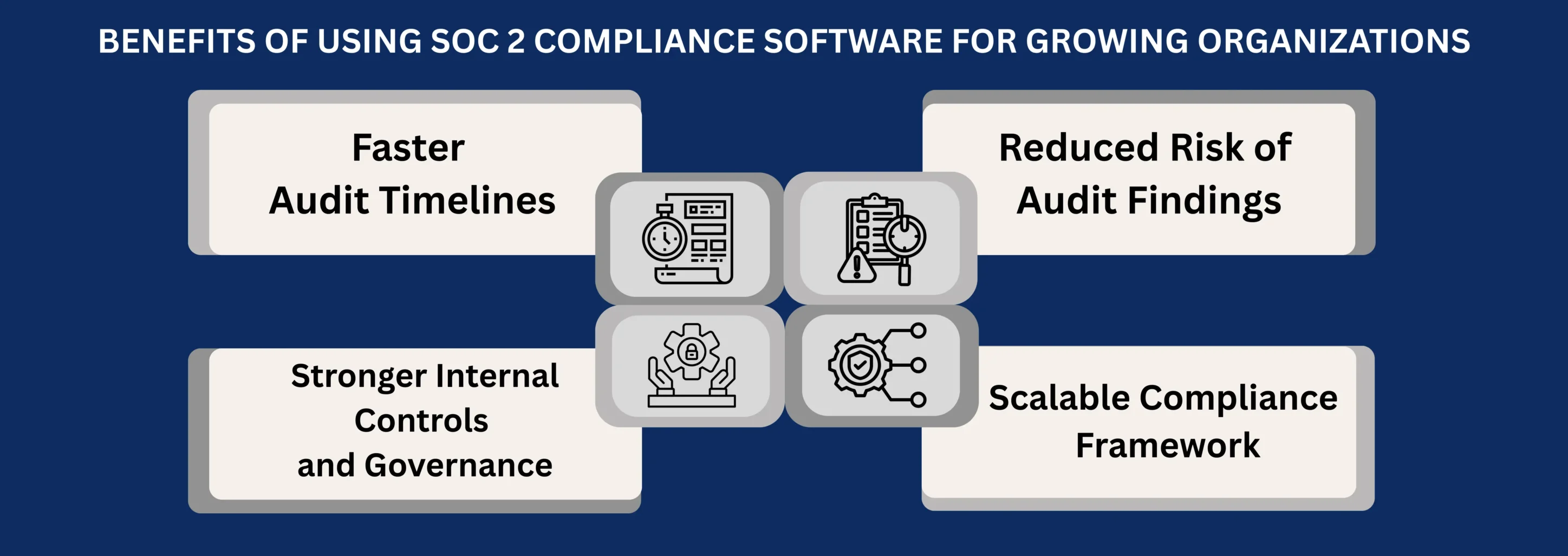
SOC 2 reports deliver measurable operational and commercial benefits to Austin-based organizations that extend well beyond satisfying individual customer security requirements. The structured examination process produces an independent assessment of control effectiveness that organizations can use to identify and remediate deficiencies, demonstrate security governance to investors and boards, accelerate enterprise sales processes, and satisfy vendor qualification requirements from regulated industry customers. The benefits of SOC 2 compliance that Austin organizations realize are both external — improved customer trust and market access — and internal — stronger control environments and reduced operational risk.
- ✓Independent validation of control effectiveness that satisfies enterprise customer security review requirements
- ✓Accelerated vendor qualification processes with major technology enterprises operating in Austin
- ✓Reusable SOC 2 attestation credential that reduces the cumulative burden of responding to multiple customer security questionnaires
- ✓Documented evidence of security governance that supports investor due diligence and M&A processes
- ✓Identification of control deficiencies through structured auditor testing before those deficiencies result in security incidents
- ✓Alignment with U.S. regulatory security requirements in healthcare, financial services, and government contracting sectors
- ✓Competitive differentiation in enterprise markets where SOC 2 certification is a qualification criterion
- ✓Demonstrated commitment to sustained data protection that builds long-term customer trust
- ✓Structured framework for annual security governance review through the recurring SOC 2 audit cycle
- ✓Support for cyber liability insurance underwriting processes where insurers request evidence of security controls
Austin cybersecurity companies face a unique credibility requirement: organizations selling security products and services to enterprise customers must themselves operate at a demonstrably high security standard. Holding a current SOC 2 Type 2 attestation addresses this requirement by providing independent verification of the cybersecurity company’s own control environment. Enterprise and government customers evaluating cybersecurity vendors frequently request SOC 2 reports as part of their vendor qualification processes, treating the absence of a current SOC 2 certification as a negative signal in competitive evaluations.
Cloud computing companies in Austin benefit from SOC 2 certification by addressing the shared responsibility model concern that arises when enterprise customers evaluate cloud deployments. When a cloud provider holds a current SOC 2 Type 2 report covering the Security and Availability criteria, customers can rely on that report as evidence that the provider’s infrastructure and operational controls meet professional standards. This reduces the customer’s due diligence burden and accelerates enterprise adoption of Austin-based cloud platforms in regulated industry segments.
SOC 2 Type 2 compliance delivers security improvements that extend beyond the audit report itself. The examination process requires controls to function consistently over time, creating organizational discipline around access management, change control, vulnerability remediation, and incident response. Teams responsible for security controls develop stronger operational practices because those practices are subject to independent testing during the SOC 2 audit. Control deficiencies identified by auditors during testing are addressed and resolved, improving the organization’s actual security posture rather than just its documented one.
Austin technology companies that have completed multiple annual SOC 2 audit cycles typically report measurable improvements in their security metrics across successive cycles — including reductions in vulnerability remediation time, improvements in access review completion rates, and fewer control exceptions identified during audit testing. These improvements reflect the operational discipline that the recurring examination process instills in security and operations teams, creating a continuous improvement dynamic that benefits both the organization’s customers and its own risk profile.
- ✓SOC 2 Benefits for Austin Cybersecurity and Cloud Companies
- ✓Stronger Data Security Through the SOC 2 Audit Process
SOC 2 Certification Cost in Austin
The factors that influence the scope and complexity of a SOC 2 examination also determine the resources required to complete it. Organizations considering SOC 2 Certification in Austin should understand the variables that affect examination complexity, including the number of applicable Trust Services Criteria, the breadth of the defined system boundary, the maturity of the existing control environment, and the length of the review period. Each of these factors affects the depth of the SOC 2 audit program and the volume of evidence required to support the auditor’s conclusions.
Factors Affecting SOC 2 Examination Complexity
Organizations with simple control environments — a single cloud-hosted application, a small workforce, limited data types, and a defined security architecture — require less extensive SOC 2 audit programs than large enterprises with complex multi-system environments, multiple data centers, large user populations, and diverse service offerings. The number of applicable Trust Services Criteria directly affects examination scope: adding Availability, Confidentiality, or Privacy criteria to the mandatory Security criterion increases the number of controls evaluated and the volume of testing required.
Control environment maturity significantly affects the efficiency of SOC 2 examination execution. Organizations with well-documented controls, consistent evidence generation practices, and experienced personnel who understand examination requirements can provide auditors with complete, organized evidence packages that facilitate efficient testing. Organizations with immature documentation practices, inconsistent control operation, or limited audit support capabilities require more auditor time to obtain sufficient evidence. Investing in control maturity and evidence organization prior to the audit period produces meaningful examination efficiency benefits.
SOC 2 Type 1 vs. Type 2 Resource Considerations
SOC 2 Type 1 examinations are generally less resource-intensive than Type 2 examinations because they assess control design at a point in time rather than operating effectiveness over a period. Type 1 engagements do not require auditors to perform multi-instance testing of operational controls, which reduces the volume of evidence required and the scope of the audit program. For organizations new to SOC 2 certification, a Type 1 report provides a structured starting point that establishes the system description, identifies the applicable Trust Services Criteria, and produces an initial auditor opinion on control design before the Type 2 review period commences.
Small and early-stage Austin companies can obtain SOC 2 certification through a structured approach that aligns the examination scope with the organization’s current control environment maturity. Beginning with a focused Type 1 examination covering the Security criteria provides an initial attestation with manageable resource requirements, while establishing the foundation for an expanded SOC 2 Type 2 examination covering additional criteria in subsequent audit cycles. This phased approach enables organizations to enter the SOC 2 certification process without deferring engagement until a fully mature control environment is in place.
Why Austin Businesses Engage CertPro for SOC 2 Examinations
CertPro is a Licensed CPA Firm that conducts SOC 2 examinations under AICPA attestation standards for organizations across Austin and the broader Texas technology market. CertPro’s SOC 2 practice is staffed by CPAs with specialized expertise in information technology auditing, Trust Services Criteria evaluation, and the control environments of cloud-native SaaS companies, fintech organizations, AI platforms, and cybersecurity providers. Each SOC 2 audit engagement is conducted with strict adherence to auditor independence requirements, professional standards, and the AICPA’s quality control requirements for attestation practices.
CertPro’s SOC 2 Examination Methodology
CertPro’s SOC 2 examination methodology follows the AICPA’s prescribed examination framework, encompassing scope definition, audit program development, fieldwork and evidence collection, exception evaluation, quality control review, and attestation report issuance. Each engagement is led by a licensed CPA with direct responsibility for the examination opinion and is subject to the firm’s internal quality control review before the report is issued. The firm’s examination programs are tailored to the specific control environments and risk profiles of the industries it serves, including cloud-native architectures and continuous delivery pipelines.
CertPro’s SOC 2 audit practice in Austin, Texas operates with a structured fieldwork approach that minimizes disruption to client operations while maintaining the rigor required to issue a professional attestation opinion. Evidence collection is organized around defined request lists aligned to the audit program, enabling client teams to prepare materials systematically. Testing procedures are executed against defined sample sets with clear documentation of testing results, exceptions, and auditor conclusions — producing a transparent and defensible attestation record that supports both the current SOC 2 report and future examination cycles.
Industry Expertise in Austin’s Technology Sectors
CertPro’s SOC 2 examination practice serves Austin companies across multiple technology sectors, including SaaS platforms, cloud infrastructure providers, fintech applications, AI and machine learning companies, healthcare technology providers, cybersecurity organizations, and semiconductor design firms. Each sector presents distinct control environment characteristics that affect SOC 2 scoping and testing program design. CertPro’s auditors bring sector-specific knowledge to each engagement, identifying the controls most relevant to the organization’s service commitments and designing testing procedures appropriate to the technical architecture being evaluated.
For Austin tech companies in the artificial intelligence sector seeking SOC 2 certification, CertPro’s auditors apply examination procedures tailored to AI-specific control considerations — including data pipeline access controls, model training environment security, API authentication and authorization controls, output logging and audit trail requirements, and third-party data processor oversight. These specialized examination areas reflect the unique risk profile of AI organizations and ensure that the SOC 2 report accurately reflects the control environment of AI platforms handling sensitive customer data and proprietary model assets.
CertPro’s Engagement Process for Austin Organizations
CertPro’s engagement process for SOC 2 examinations in Austin begins with an initial discussion to understand the organization’s service model, customer requirements, and control environment scope. Following this, the firm proposes an engagement structure specifying the applicable Trust Services Criteria, the proposed system boundary, the review period, and the examination timeline. Upon engagement acceptance, CertPro’s licensed CPAs initiate scope documentation, SOC 2 audit program development, and the preliminary evidence collection activities required to launch the examination.
Throughout the examination period, CertPro maintains structured communication with the organization’s designated audit coordinator, providing clear evidence request lists, timely responses to questions about evidence requirements, and interim updates on the status of testing activities. Upon completion of fieldwork, the firm conducts an internal quality control review of the draft SOC 2 report before presenting it to management for accuracy review of the system description. The final attestation report is issued following management’s written assertion and the completion of the firm’s quality review process.
Engage CertPro for SOC 2 Examinations in Austin
Austin organizations seeking SOC 2 Certification in Austin from a Licensed CPA Firm with specialized technology sector expertise can engage CertPro for SOC 2 examinations conducted under AICPA attestation standards. CertPro conducts SOC 2 Type 1 and SOC 2 Type 2 audit engagements for SaaS companies, cloud providers, fintech organizations, AI platforms, cybersecurity firms, and other technology service providers operating in Austin and across Texas. The firm’s examination practice is subject to the AICPA peer review program and maintains strict auditor independence from all examination clients.
Organizations that are new to SOC 2 certification or that are transitioning from a prior audit firm can initiate discussions with CertPro to understand the examination scope, timeline, and process for their specific control environment. CertPro’s licensed CPAs are available to evaluate the applicable Trust Services Criteria, discuss system boundary considerations, and explain the Type 1 and Type 2 SOC 2 audit process for organizations at any stage of their SOC 2 attestation program. Engaging a Licensed CPA Firm early in the planning process enables organizations to align their internal control operations with examination requirements and avoid delays in report issuance.
FAQ
▶
What is SOC 2 compliance refers to having security controls in place?
▶
What does SOC 2 certification mean for a company in Austin?
▶
How long does a SOC 2 Type 2 audit take in Austin?
▶
Who can issue a SOC 2 report in Austin?
▶
What is the difference between SOC 2 certified and SOC 2 compliant?
▶
Which Trust Services Criteria should Austin companies include in their SOC 2 scope?
▶
Can small Austin companies obtain SOC 2 certification?
▶
How often must Austin companies renew SOC 2 certification?
SOC 1 VS SOC 2: WHICH REPORT YOUR CUSTOMERS ACTUALLY ASK FOR
If you sell SaaS or provide outsourced services, you have likely been asked for a SOC report. However, the follow-up question is rarely easy to answer…
Read More →

AICPA Issues New Guidance for Peer Reviewers Evaluating SOC 2 Engagements
AICPA SOC 2 guidance has been issued to help peer reviewers identify quality risks associated with SOC 2 engagements as the use of compliance automati…
SOC 2 Certified: What Does It Mean for Your Business
For companies that handle sensitive data or run cloud-based services, the question “Can you provide your SOC 2 report?” carries enormous weight. Yet, …
Read More →
Get In Touch
have a question? let us get back to you.