
Third-party vendors have become an essential part of modern business operations. They process data, access business systems, support critical services, and integrate with enterprise environments. However, every new vendor also introduces new security, compliance, and operational risks. If a vendor's controls fail, your organization may still face the business, regulatory, and reputational consequences.
A vendor risk assessment helps organizations understand and manage these risks before they become security incidents. A structured assessment evaluates a vendor's security posture through objective evidence before access is granted and continues to monitor risk throughout the business relationship. Without this discipline, vendor reviews can become a checklist exercise that relies on documented assurances instead of verified controls.
This guide explains what a vendor risk assessment is, the five-step process for conducting one, how to evaluate vendor evidence with an auditor's mindset, and how the results support enterprise risk management instead of becoming another compliance record.

Concern
Many organizations rely heavily on vendor security questionnaires during a vendor risk assessment. While questionnaires provide useful information, they reflect what vendors report about their controls. Without independent verification, organizations may overlook security gaps until a business, compliance, or operational issue emerges.
Overview
A structured vendor risk assessment follows five essential steps. First, define the vendor's access to data and business systems. Next, assign a risk tier to determine the assessment depth. Then, collect security evidence, including vendor questionnaires and independent assurance reports. After that, verify the evidence before making a risk decision. Finally, document the outcome, assign risk owners, and review the vendor regularly throughout the relationship.
Solution
Shift the focus of every vendor risk assessment from documented assurances to verified evidence. Evaluate security reports, review the scope of independent assessments, and compare vendor responses with supporting documentation. Apply security requirements based on the vendor's risk tier, and integrate assessment results into enterprise risk management so vendor risks remain visible, measurable, and actionable.
What Is a Vendor Risk Assessment?
A vendor risk assessment is a structured process for evaluating the security, compliance, operational, and financial risks a vendor introduces before and throughout a business relationship. It examines the data a vendor can access, the systems it can interact with, the effectiveness of its security controls, and the potential impact on your organization if those controls fail.
A third-party risk assessment follows the same principles but applies to any external party. A vendor risk assessment focuses specifically on suppliers that provide products or services. Both are part of a broader third-party risk management program, which includes vendor inventories, risk tiering, contract management, continuous monitoring, and offboarding.
A strong vendor risk assessment goes beyond collecting questionnaire responses. It verifies security controls through objective evidence, documents the risk decision, and defines security requirements that continue throughout the business relationship. This approach helps organizations manage vendor risk as business relationships, technologies, and threats evolve.
The Vendor Risk Assessment Process: Five Steps
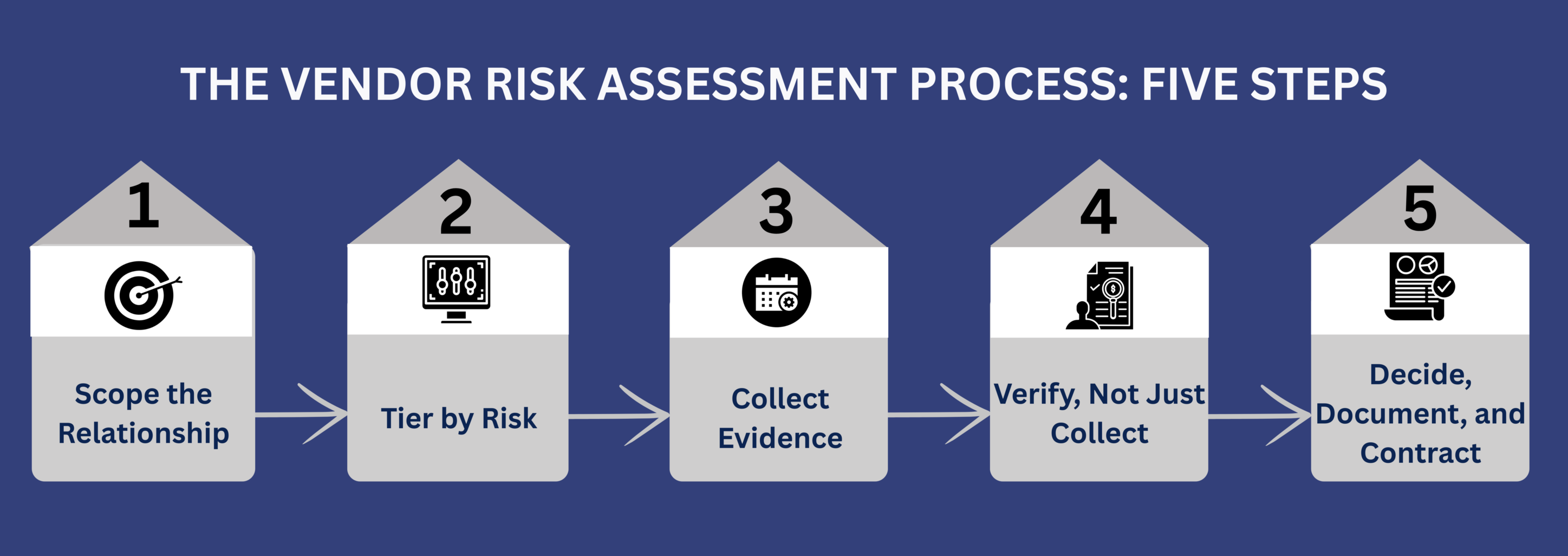
The process below reflects how mature risk teams run assessments that survive both audits and incidents.
Step 1: Scope the Relationship
Define what the vendor will actually access and do: data categories, system connections, integration depth, and the business processes that depend on the service. Scoping errors cascade; a vendor assessed as a low-risk tool provider while quietly holding production database credentials is the classic pre-incident finding.
Step 2: Tier by Risk
Assessment depth should match exposure. Vendors with regulated data access, deep integration, or operational criticality warrant full-depth review; low-risk vendors get a proportionate lighter pass. Tiering keeps the vendor risk assessment program sustainable at scale.
Step 3: Collect Evidence
Issue a vendor security questionnaire scoped to the tier, and request independent artifacts alongside it: SOC 2 Type II reports, ISO 27001 certificates with scope statements, recent penetration test summaries, and insurance certificates. The questionnaire maps the vendor's claims; the artifacts are what make those claims testable.
Step 4: Verify, Not Just Collect
Verification is where most programs thin out and where the vendor risk assessment earns its keep. Match questionnaire answers against the independent evidence. Check certificate validity against the issuing body's register. Confirm the SOC 2 report covers the service being purchased, not a different product line. For critical vendors, hold a technical session with the vendor's security team and walk through the controls that matter most to your exposure.
Step 5: Decide, Document, and Contract
Convert findings into a documented risk decision: accept, accept with conditions, remediate before onboarding, or decline. Conditions belong in the contract, including breach notification timelines, audit rights, subcontractor approval, certification maintenance, and data return at termination. A finding that never reaches the contract is an observation, not a control.
Vendor Security Review: Evidence That Actually Verifies
A vendor security review is the evidence evaluation stage of a vendor risk assessment. It examines the documents and records a vendor provides to demonstrate the effectiveness of its security controls. However, not all evidence carries the same level of assurance. The value of each artifact depends on how it was produced and whether it can be independently verified.
- Evidence Quality
Independent audit reports and certifications generally provide stronger assurance because qualified third parties evaluate the controls. Penetration test reports, system-generated configurations, and technical demonstrations also provide valuable evidence. Vendor security questionnaires and public security statements help explain the vendor's security practices, but they should support the assessment rather than serve as the primary source of assurance.
- Evidence Verification
A vendor security questionnaire still plays an important role. It helps identify areas for further review, documents the vendor's security practices, and highlights topics that require clarification. However, a strong vendor risk assessment always validates those responses against objective evidence. This approach provides a more accurate view of the vendor's security posture and supports informed risk decisions.
SOC 2 Vendor Management: Reading the Report Like an Auditor
SOC 2 vendor management means using a vendor's SOC 2 report as assessment evidence rather than a compliance checkbox. Reviewing the report carefully helps organizations understand how the vendor's controls operate and whether they align with business and security requirements. Four areas deserve the closest attention.
- Report Coverage
Start by reviewing the report type and reporting period. A Type II report provides stronger assurance because it evaluates how controls operated over time. Also, confirm the report is recent enough to reflect the vendor's current control environment.
- Scope Validation
Review the system description to verify that the report covers the service you plan to use. Confirm that the infrastructure, processes, and Trust Services Criteria align with the data and services the vendor will handle.
- Control Exceptions
Read the auditor's opinion and every reported exception. Pay close attention to findings related to access management, change management, and security operations. These areas often require additional clarification before making a risk decision.
- Dependency Review
Identify any subservice organizations that are excluded from the report. These providers may introduce additional risks that require separate evaluation as part of the vendor risk assessment.
- Shared Responsibilities
Finally, review the Complementary User Entity Controls (CUECs). These controls define the responsibilities your organization must perform for the vendor's controls to operate effectively. Assign an internal owner to each applicable control before relying on the report as assessment evidence.
Connecting Vendor Risk Assessment to Enterprise Risk Management
Vendor findings create value only when they support better risk decisions. Enterprise risk management provides that structure. Material vendor risks should enter the organization's risk register, where leadership can evaluate them alongside other business, operational, and security risks. This approach helps organizations prioritize remediation and make informed decisions based on overall risk exposure.
- Scheduled Reviews
A vendor risk assessment reflects a vendor's risk at a specific point in time. However, vendors continue to evolve after the assessment. Review critical vendors regularly and perform additional assessments whenever significant changes occur, such as security incidents, ownership changes, new subcontractors, expanded data access, or major service updates.
- Continuous Monitoring
Risk does not pause between assessment cycles. Continuous monitoring helps organizations identify changes that may affect a vendor's security posture. Security notifications, breach monitoring, certificate tracking, and other monitoring activities provide earlier visibility into emerging risks and support faster response.
- Portfolio Visibility
Individual vendor assessments reveal the risks associated with a single vendor. However, enterprise risk management also requires a portfolio view. Organizations should identify shared dependencies, common service providers, and concentration risks across the vendor ecosystem. This broader perspective helps reduce systemic risk and supports more informed governance decisions.
Conclusion
Third-party involvement in security incidents continues to grow as organizations expand their reliance on SaaS platforms, cloud providers, AI services, and outsourced operations. Organizations that keep vendor risk under control treat vendor risk assessment as an ongoing governance process rather than a procurement exercise. They verify evidence, validate security claims, document risk decisions, establish contractual safeguards, and reassess vendors whenever significant changes occur.
This approach delivers value beyond reducing third-party risk. It creates the documented evidence expected during customer due diligence, supports compliance with frameworks such as SOC 2 and ISO 27001, and demonstrates that vendor oversight operates as an active control rather than a periodic checklist. A mature vendor risk assessment program protects the organization while providing objective evidence of effective governance.
At CertPro, we conduct SOC 2 examinations as a licensed CPA firm and assess supplier-related controls during ISO 27001 audits. Our experience reviewing the evidence that customers and procurement teams rely on provides a practical perspective on what constitutes credible third-party assurance. Organizations that maintain documented vendor assessments, evaluate independent assurance reports, and retain objective evidence are better positioned to demonstrate effective vendor governance during audits and customer security reviews.