
ISO 42001 Certification in Auckland
ISO 42001 Certification in Auckland is delivered by CertPro, a Licensed CPA firm and independent third-party audit and certification body. CertPro conducts structured ISO 42001 audits across Auckland’s technology, financial services, healthcare, and enterprise sectors. Organizations that demonstrate full conformance with ISO/IEC 42001:2023 requirements receive internationally recognized AI Management System (AIMS) certificates. CertPro’s ISO 42001 audit programme is purpose-built for Auckland’s growing AI-active business community.
OUR CLIENTS






What Is ISO 42001?
ISO 42001 is the internationally recognized standard for Artificial Intelligence Management Systems (AIMS), published in 2023 by the International Organization for Standardization and the International Electrotechnical Commission under the joint technical committee ISO/IEC JTC 1/SC 42. The standard establishes a structured governance framework that organizations developing, deploying, or operating AI systems must satisfy to achieve certification. ISO 42001 Certification applies to any organization that interacts with AI systems, regardless of industry sector, organizational size, or geographic location.
Definition and Institutional Scope of ISO 42001
ISO/IEC 42001:2023 defines the requirements for establishing, implementing, maintaining, and continually improving an AI Management System within the context of an organization. The standard is auditable — conformance is determined through independent third-party evaluation rather than self-declaration. This distinguishes ISO 42001 from general AI ethics frameworks or voluntary codes of conduct, which carry no external verification or certificate issuance. ISO 42001 Certification in Auckland is achieved only when an accredited certification body such as CertPro conducts a formal ISO 42001 audit and confirms that the organization’s AIMS meets the full scope of the standard’s requirements.
The standard was developed by ISO/IEC JTC 1/SC 42, the subcommittee responsible for AI standards within the joint ISO and IEC technical committee. Its development reflects the global recognition that AI systems introduce specific governance challenges — including algorithmic bias, opacity, data misuse, and unintended consequences — that require a systematic management approach beyond what existing quality or information security standards address. ISO 42001 provides the authoritative benchmark for AI accountability, trustworthiness, and responsible deployment at the organizational level.
ISO 42001 and the ISO High-Level Structure
ISO 42001 is structured in alignment with the ISO High-Level Structure (HLS), formerly known as Annex SL. This common architecture — used across ISO 9001, ISO 27001, ISO 14001, and other management system standards — enables organizations to integrate ISO 42001 into existing management system frameworks without duplicating policies, procedures, or governance roles. The HLS organizes requirements into clauses covering organizational context, leadership, planning, support, operations, performance evaluation, and improvement. These clauses form the backbone of the AIMS governance model. For Auckland-based organizations already holding ISO 27001 or ISO 9001 certifications, integration with ISO 42001 is structurally straightforward, with shared policy frameworks, risk registers, and internal audit programmes applicable across systems.
The alignment with ISO HLS means that ISO 42001 compliance documentation, management review processes, and corrective action mechanisms can be harmonized with existing certified management systems. Organizations operating an integrated management system benefit from consolidated audit scheduling, unified document control, and streamlined surveillance activities. CertPro’s ISO 42001 audit programme accounts for existing certifications when scoping the audit, reducing duplication while maintaining the integrity of independent evaluation across each standard.
Distinction from AI Ethics Frameworks
ISO 42001 is not an AI ethics framework, a voluntary pledge, or a self-assessment checklist. It is a formal management system standard with defined clauses, normative requirements, and mandatory audit evidence. Organizations pursuing ISO AIMS certification must demonstrate conformance through documented policies, objective evidence, and live operational controls — all evaluated by an independent auditor. This formal structure differentiates ISO 42001 from initiatives such as AI ethics principles published by technology companies, government AI strategies, or industry association codes of conduct. ISO 42001 Certification carries legal weight, contractual recognition, and procurement value that voluntary frameworks simply cannot provide.

ISO 42001 AI Management System (AIMS) Framework
The AI Management System (AIMS) defined by ISO 42001 is a structured organizational governance system designed to manage the risks, responsibilities, and operational requirements associated with artificial intelligence throughout its full lifecycle. The AIMS framework covers the entire spectrum of AI interaction — from initial scoping and design through to deployment, monitoring, incident management, and continual improvement. ISO AIMS certification confirms that an organization has established, implemented, and maintains this system in a manner that satisfies all normative requirements of the standard.
Organizational Context and Leadership Requirements
The AIMS framework begins with organizational context. This clause requires the organization to identify internal and external factors affecting AI governance, determine the needs and expectations of interested parties — including regulators, customers, employees, and affected communities — and define the scope of the AI Management System. For Auckland-based organizations, the organizational context clause requires explicit consideration of New Zealand’s regulatory environment. This includes the Privacy Act 2020, sector-specific obligations, and any applicable international AI governance requirements relevant to the organization’s operating markets.
Leadership requirements under ISO 42001 mandate that top management demonstrate commitment to the AIMS by establishing an AI governance policy, assigning clear roles and responsibilities for AI oversight, and integrating AIMS objectives into the organization’s strategic direction. The standard requires evidence of leadership engagement — not merely delegation — meaning that governance structures, accountability frameworks, and AI policy decisions must be traceable to senior leadership. This clause is evaluated during the CertPro ISO 42001 audit through document review, leadership interviews, and examination of governance records.
Planning, Risk Assessment, and AI Objectives
The planning clause of ISO 42001 requires organizations to conduct a structured AI risk assessment that identifies risks and opportunities associated with each AI system within the defined scope. This risk assessment is not generic enterprise risk management — it is specifically calibrated to address AI-specific risk dimensions, including algorithmic bias, model drift, data quality failures, unintended AI outputs, and loss of human oversight. Organizations must document risk treatment plans, assign ownership of AI risks, and establish measurable AI governance objectives monitored against defined performance indicators.
AI objectives established under the planning clause must be specific, measurable, and aligned with the organization’s AI governance policy. They must also address how the organization intends to achieve those objectives — including required resources, responsibilities, timelines, and evaluation methods. The planning process produces a documented AI risk register and an AI objectives framework, both subject to audit review. For ISO 42001 compliance in Auckland, planning documentation must reflect the specific AI systems in scope and the risk profile relevant to the organization’s sector and operational environment.
Operations, Support, and Performance Evaluation
The operations clause governs how AI systems are designed, developed, deployed, monitored, and decommissioned within the AIMS. It requires documented operational controls for each stage of the AI lifecycle — including data governance procedures, model testing protocols, bias assessment mechanisms, transparency and explainability requirements, and human oversight controls. The support clause addresses the competence of personnel involved in AI governance, the adequacy of training programmes, and the integrity of document management and communication processes. These operational and support elements form the largest body of audit evidence in a CertPro ISO 42001 audit.
Performance evaluation under ISO 42001 requires the organization to monitor, measure, analyse, and evaluate AIMS performance against defined criteria. This includes internal audit activities — conducted independently of the areas being audited — and management review meetings at which top management evaluates AIMS performance, resource adequacy, and the need for system changes. The improvement clause requires the organization to respond to nonconformities with documented corrective actions, conduct root cause analysis, and demonstrate continual improvement in AIMS effectiveness over time. These cycles of evaluation and improvement are central to the ongoing validity of ISO AIMS certification.
ISO 42001 Certification Requirements
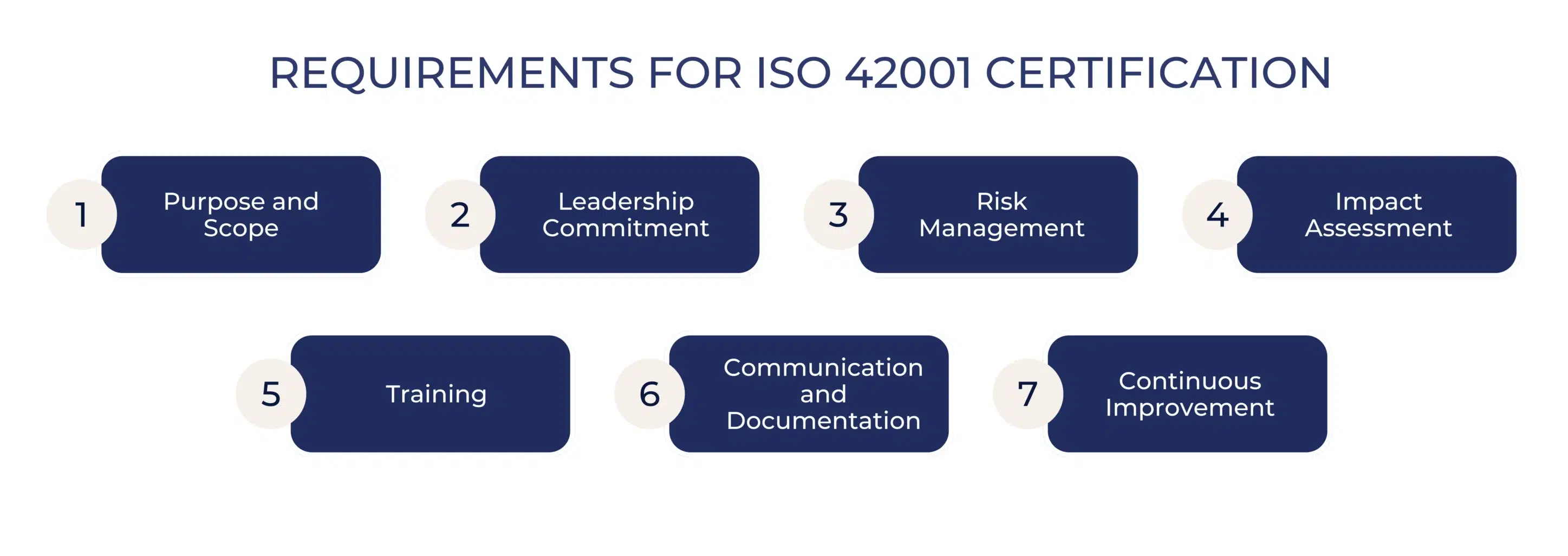
ISO 42001 Certification requires organizations to satisfy a defined set of normative requirements spanning governance, documentation, risk management, operational control, and continual improvement. These requirements apply to all organizations within the defined certification scope — whether they develop AI internally, procure AI from third-party vendors, or deploy AI systems in client-facing applications. The following requirements are assessed during the CertPro ISO 42001 audit for Auckland-based organizations pursuing ISO 42001 compliance.
- ✓Documented AI governance policy approved by top management and communicated across the organization
- ✓Defined scope of the AI Management System, specifying which AI systems, processes, and organizational units are included
- ✓Structured AI risk assessment process identifying and evaluating risks associated with each AI system in scope
- ✓AI risk treatment plan with documented controls, ownership, and implementation timelines
- ✓Assigned roles and responsibilities for AI governance, including an accountable AI governance function
- ✓Data governance procedures covering data sourcing, quality, labelling, retention, and access control
- ✓Transparency and explainability mechanisms enabling the organization to explain AI system outputs to affected parties
- ✓Human oversight controls ensuring that AI decisions subject to significant impact can be reviewed and overridden by authorized personnel
- ✓Incident management procedures for detecting, reporting, investigating, and resolving AI-related incidents
- ✓Internal audit programme covering all AIMS clauses on a defined schedule
- ✓Management review process evaluating AIMS performance and strategic alignment at planned intervals
- ✓Continual improvement programme with documented corrective actions and effectiveness verification
ISO 42001 compliance requires a comprehensive set of documented information serving as objective evidence of AIMS conformance. Mandatory documented information under the standard includes the AI governance policy, the AIMS scope definition, AI risk assessment and risk treatment records, AI objectives and performance monitoring results, competence evidence for personnel with AI governance roles, records of internal audits and management reviews, and corrective action records. Document control procedures must govern the creation, approval, versioning, distribution, and retention of all AIMS documentation — ensuring current versions are accessible to relevant personnel and that obsolete documents are prevented from unintended use.
For Auckland-based organizations undergoing ISO 42001 assessment, documentation quality is a primary determinant of audit outcome. Auditors examine whether documented information accurately reflects operational reality — that is, whether controls described in policy documents are demonstrably implemented in practice. Gaps between documented controls and operational evidence constitute nonconformities. CertPro’s ISO 42001 audit process conducts a Stage 1 documentation review prior to the Stage 2 operational audit, enabling the organization to address documentation gaps before the on-site evaluation phase begins.
Technical requirements for ISO 42001 certification cover the operational controls applied to AI systems throughout their lifecycle. Organizations must establish controls for AI system design and development — including requirements for training data governance, model validation, bias testing, and performance benchmarking before deployment. Post-deployment controls must address ongoing monitoring of AI system behaviour, detection of model drift or performance degradation, and defined thresholds for human intervention. Where AI systems process personal data, technical controls must satisfy both ISO 42001 requirements and applicable data protection obligations, including those under New Zealand’s Privacy Act 2020.
Supply chain governance is an increasingly significant technical requirement under ISO 42001, particularly for Auckland organizations that procure AI capabilities from third-party vendors, cloud AI platforms, or open-source model providers. The standard requires organizations to assess the AI governance practices of suppliers whose AI components fall within the AIMS scope, establish contractual requirements for AI-related transparency and incident notification, and maintain records of supplier evaluation. This supply chain requirement reflects the reality that AI system risk extends beyond the organization’s direct development activities to encompass the entire AI value chain.
- ✓Documentation Requirements for ISO 42001 Compliance
- ✓Technical and Operational Control Requirements
ISO 42001 Certification Process in Auckland
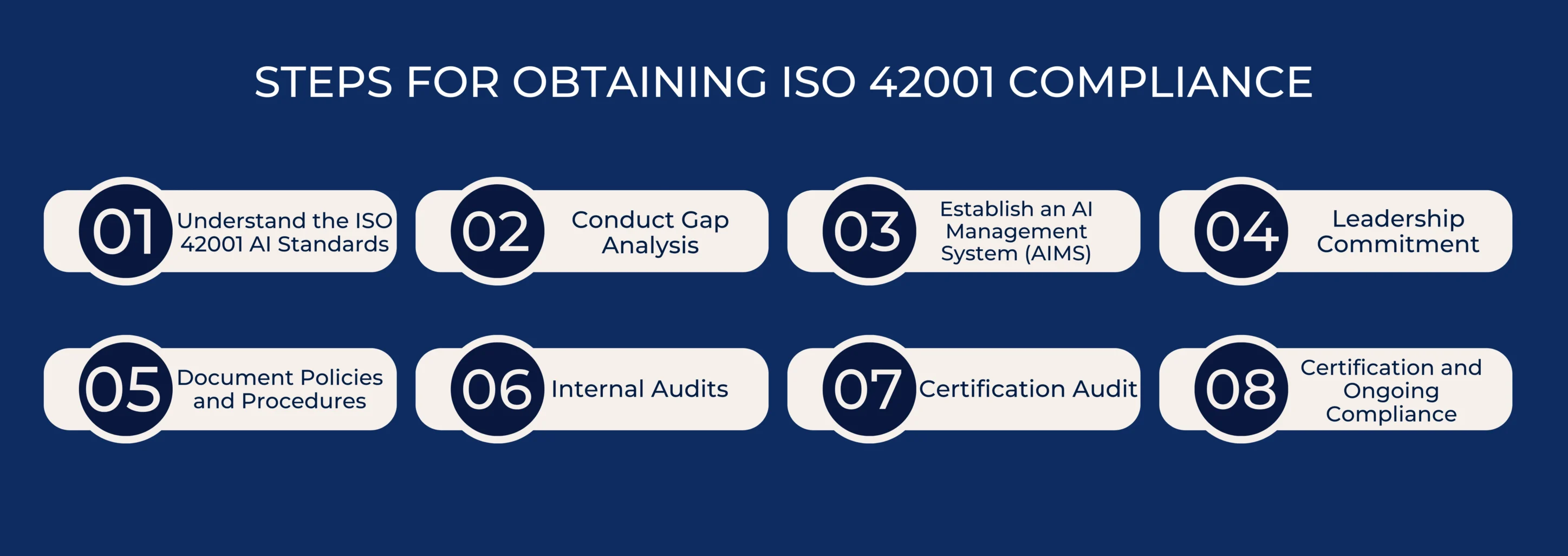
The ISO 42001 Certification process in Auckland follows a structured audit programme conducted by CertPro as an independent third-party certification body. The process delivers objective, evidence-based confirmation that an organization’s AI Management System conforms to ISO/IEC 42001:2023 across all applicable clauses. The certification cycle encompasses application and scoping, Stage 1 documentation audit, Stage 2 operational audit, findings review, certification decision, certificate issuance, and ongoing surveillance — all within a three-year certification cycle.
Application and Scope Definition: The certification process begins with the organization submitting an application to CertPro and defining the scope of the ISO 42001 audit. The scope statement specifies which AI systems, organizational units, processes, and geographic locations fall within the AIMS certification boundary. Accurate scope definition is critical — an overly narrow scope may exclude material AI activities, while an overly broad scope may increase audit complexity unnecessarily. CertPro conducts a pre-audit scope review to confirm that the proposed scope is complete, accurate, and audit-ready before proceeding.
Stage 1 Documentation Review: The Stage 1 audit consists of a structured review of the organization’s AIMS documentation. CertPro auditors examine the AI governance policy, scope statement, risk assessment records, AI objectives documentation, operational procedure documents, and evidence of internal audit and management review activities. The Stage 1 audit determines whether the documented AIMS is sufficiently developed to proceed to the Stage 2 operational audit. Findings are communicated to the organization, with major gaps requiring resolution before Stage 2 commences. Minor observations from Stage 1 are carried forward for verification during Stage 2.
Stage 2 Operational Audit: The Stage 2 audit is the primary ISO 42001 assessment, conducted on-site at the organization’s Auckland premises or remotely depending on the nature of AI systems in scope and the organization’s operational setup. CertPro auditors evaluate the implementation and operational effectiveness of AIMS controls across all clauses of ISO/IEC 42001:2023. Audit methods include personnel interviews, observation of AI governance activities, sampling of operational records, review of incident logs and corrective action records, and testing of documented control procedures against operational evidence. The Stage 2 audit generates a detailed audit report covering conformities, observations, minor nonconformities, and major nonconformities.
Nonconformity Review and Corrective Actions: Where the Stage 2 audit identifies nonconformities, the organization must submit a corrective action plan within a defined timeframe — typically 30 days for major nonconformities and 90 days for minor nonconformities. CertPro reviews the corrective action plan and, where necessary, conducts a follow-up audit to verify effective implementation. Major nonconformities must be resolved before the certification decision is made. Minor nonconformities may be closed through documented corrective actions verified at the next scheduled audit. The nonconformity resolution process is fully documented and forms part of the certification file.
Certification Decision: Following successful resolution of all nonconformities, CertPro’s certification committee conducts an independent review of the audit report and corrective action evidence. The certification decision is made by personnel who were not involved in the audit itself, maintaining independence of the certification decision from the audit function. A positive certification decision results in the issuance of an ISO 42001 certificate covering the defined scope, valid for three years from the date of issue. The certificate identifies the organization, the defined scope, the standard version, and the certification body.
Surveillance Audits and Recertification: ISO 42001 certification is maintained through annual surveillance audits conducted in Year 1 and Year 2 of the certification cycle. Surveillance audits focus on continued conformance in key AIMS areas, progress on continual improvement activities, and any changes to the organization’s AI systems or governance arrangements since the previous audit. At the end of the three-year cycle, a full recertification audit renews the ISO 42001 certificate. Continuous certification status depends on satisfactory surveillance audit outcomes and timely corrective action on any findings.
| Certification Stage | Activity | Typical Duration |
|---|---|---|
| Application & Scoping | Scope definition, application review, pre-audit preparation | 1–2 weeks |
| Stage 1 Audit | Documentation review and readiness assessment | 1–3 days |
| Stage 2 Audit | Operational audit across all AIMS clauses | 2–5 days |
| Nonconformity Resolution | Corrective action submission and verification | 30–90 days |
| Certification Decision & Issuance | Independent committee review, certificate issuance | 1–2 weeks |
- ✓Stage 1: Application, Scoping, and Documentation Audit
- ✓Stage 2: Operational Audit and Findings Review
- ✓Certification Decision, Certificate Issuance, and Surveillance
ISO 42001 Benefits for Auckland Businesses
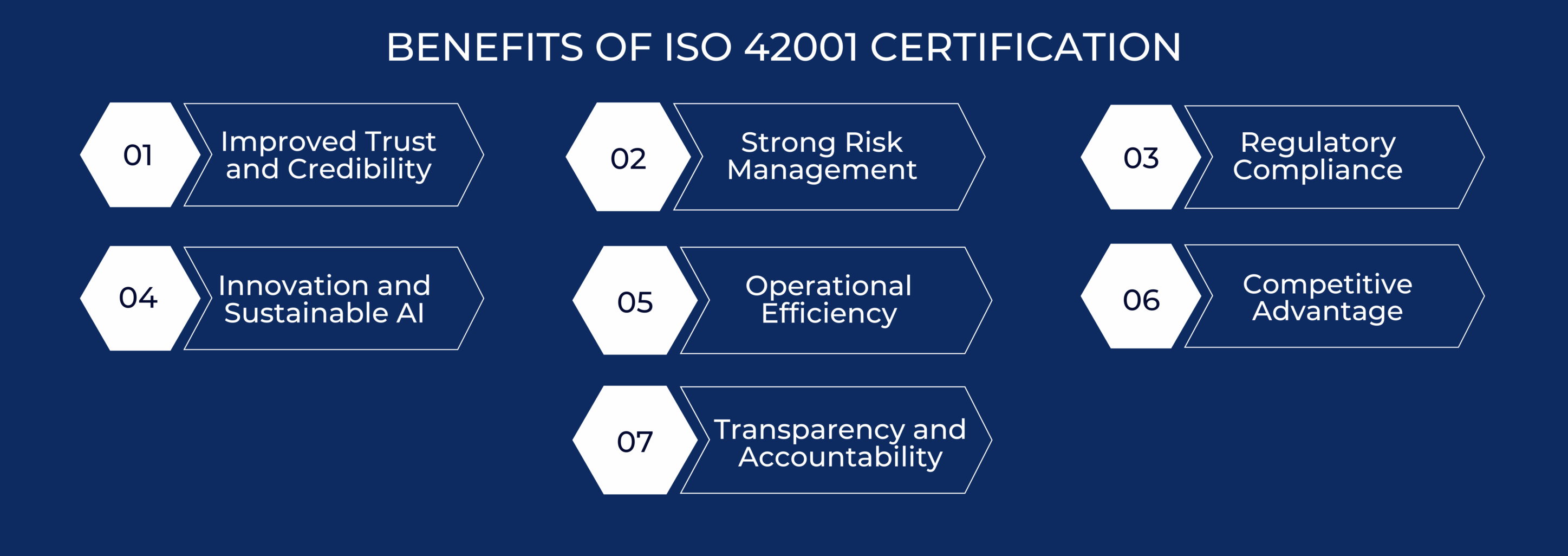
ISO 42001 Certification in Auckland delivers measurable and documented business value across governance, market positioning, regulatory alignment, and operational risk management. For Auckland’s technology-intensive and export-oriented business community, the certification provides a recognized, internationally transferable credential that signals responsible AI governance to clients, regulators, investors, and business partners. The following benefits are directly attributable to achieving and maintaining ISO 42001 Certification.
- ✓Demonstrated commitment to responsible AI governance through independent third-party certification, providing credible evidence to customers, regulators, and procurement authorities
- ✓Structured AI risk management framework that systematically identifies, evaluates, and controls AI-specific risks across the organization’s AI portfolio
- ✓Alignment with international AI governance standards, enabling Auckland businesses to meet procurement and regulatory requirements in markets including the EU, UK, and North America
- ✓Enhanced organizational trust and transparency through documented AI policies, human oversight controls, and accountability mechanisms
- ✓Reduced exposure to reputational, regulatory, and legal risks associated with uncontrolled AI deployment
- ✓Integration compatibility with existing ISO 27001 and ISO 9001 certifications, enabling unified management system governance
- ✓Competitive differentiation in sectors where AI governance is an emerging procurement criterion, including financial services, healthcare, government, and professional services
- ✓Improved internal AI governance discipline through structured audit cycles, management review processes, and continual improvement requirements
- ✓Readiness for evolving regulatory requirements, including New Zealand’s Privacy Act 2020 and international AI governance frameworks aligned with ISO 42001 principles
- ✓Access to international markets and government contracts that require ISO 42001 compliance or equivalent AI governance certification
ISO AIMS certification provides Auckland businesses with a tangible competitive advantage in markets where AI governance has become a procurement prerequisite. Enterprise clients, government agencies, and regulated industry buyers increasingly require formal AI governance evidence as part of vendor qualification processes. ISO 42001 Certification in Auckland delivers that evidence in a standardized, auditable, and internationally recognized form that self-assessment questionnaires or internal AI policies cannot replicate. For Auckland-based SaaS companies, fintech firms, and AI developers targeting international markets, ISO 42001 Certification serves as a market-entry credential — particularly for clients in the European Union where the EU AI Act is reshaping procurement expectations — and in regulated sectors across the UK, Australia, and North America.
The certification also carries significant internal governance value that translates into operational efficiency and risk reduction. Organizations that implement and maintain an ISO 42001-conformant AIMS report improved clarity in AI accountability structures, faster incident detection and resolution, and more consistent AI system performance outcomes. The discipline imposed by the AIMS framework — including formal risk assessment, documented control ownership, and periodic management review — produces governance structures that reduce the frequency and severity of AI-related incidents, with associated cost savings in incident response, regulatory engagement, and reputational management.
ISO 42001 compliance directly reduces the exposure of Auckland businesses to AI-related governance failures. The standard’s requirements for human oversight mechanisms, bias assessment, incident management, and continual improvement create systematic controls that reduce the probability and impact of AI system failures, discriminatory outputs, or data governance breaches. Organizations holding ISO 42001 Certification are better positioned to demonstrate due diligence to regulators — including the Office of the Privacy Commissioner of New Zealand — in the event of an AI-related incident. They can produce documented evidence of established governance controls, systematic risk assessment, and structured corrective action processes.
- ✓Competitive and Commercial Value of ISO AIMS Certification
- ✓Risk Reduction and Regulatory Positioning
Auckland Business Context and AI Governance Landscape
Auckland is New Zealand’s primary business, technology, and financial services hub, hosting the largest concentration of corporate headquarters, technology companies, fintech operators, and multinational subsidiaries in the country. The city’s growing digital infrastructure — including substantial cloud computing investment, expanding data center capacity, and a maturing AI startup ecosystem — makes it the natural epicenter of commercial AI adoption in New Zealand. This concentration of AI-active businesses makes ISO 42001 Certification in Auckland both commercially significant and increasingly operationally necessary for organizations seeking to govern their AI deployments responsibly and competitively.
Auckland’s AI-Active Sectors and Certification Relevance
Auckland’s financial services sector — including banking institutions, insurance companies, and the substantial fintech community concentrated around the city’s technology precincts — represents one of the most active AI adoption environments in New Zealand. ISO 42001 Certification in Auckland for financial services organizations demonstrates a governance commitment that addresses the Reserve Bank of New Zealand’s evolving operational risk expectations and the Financial Markets Authority’s transparency requirements for AI-driven financial decision-making. ISO 42001 compliance for Auckland fintech companies positions them as governance-credible operators in international partnerships and investor due diligence processes.
Auckland’s technology sector — encompassing SaaS companies, AI development firms, enterprise software providers, and technology-enabled professional services organizations — represents the broadest constituency for ISO 42001 Certification in Auckland. Technology firms embedding AI capabilities into their products or platforms face increasing client scrutiny regarding AI governance practices. The ISO 42001 audit enables Auckland technology companies to provide clients with independently verified evidence of responsible AI governance, satisfying due diligence requirements in enterprise sales cycles and government procurement processes. Auckland’s healthcare sector, logistics operators, and professional services firms are also strong ISO 42001 assessment candidates as AI adoption accelerates across these industries.
AI Governance Expectations in the Auckland Market
AI governance expectations in the Auckland market are evolving rapidly, driven by regulatory developments, enterprise procurement requirements, and growing public awareness of AI-related risks. New Zealand’s government has signalled increasing engagement with AI governance through policy frameworks, and the Office of the Privacy Commissioner has actively addressed AI-related privacy risks under the Privacy Act 2020. Auckland businesses operating in regulated sectors face sector-specific expectations regarding AI transparency, fairness, and accountability that align directly with the requirements of ISO 42001. Organizations that undertake ISO 42001 assessment in Auckland position themselves at the forefront of the governance curve in a market where formal AI certification remains a differentiating credential.
Demand for ISO 42001 Certification in Auckland is also driven by the city’s trade relationships and the international operations of Auckland-headquartered companies. Businesses exporting technology services or AI-enabled products to the European Union face requirements under the EU AI Act, which identifies ISO 42001 alignment as a relevant conformity indicator for certain AI system categories. Similarly, Auckland businesses with UK, US, or Australian clients encounter AI governance requirements in enterprise contracts that ISO 42001 Certification satisfies. The international transferability of this certification makes it a strategic investment for Auckland’s globally connected business community.
ISO 42001 and New Zealand Regulatory Alignment
ISO 42001 Certification in Auckland operates within New Zealand’s evolving regulatory framework for data governance, privacy, and AI accountability. While New Zealand does not currently have standalone AI-specific legislation equivalent to the EU AI Act, Auckland organizations using AI systems are subject to a comprehensive set of existing legal obligations that ISO 42001 directly supports. Understanding the relationship between ISO 42001 compliance and New Zealand’s regulatory environment is essential for Auckland businesses evaluating the certification’s regulatory value.
Privacy Act 2020 and the Office of the Privacy Commissioner
New Zealand’s Privacy Act 2020 establishes binding obligations on organizations that collect, store, use, and disclose personal information — obligations that apply directly to AI systems processing personal data in automated or semi-automated ways. The Act’s Information Privacy Principles require that personal information be used only for the purpose for which it was collected, that individuals have access to information held about them, and that organizations implement reasonable security safeguards. ISO 42001’s data governance requirements — covering data sourcing, labelling, quality controls, access restrictions, and retention policies — are structurally aligned with these Privacy Act obligations, enabling organizations to use AIMS documentation as evidence of Privacy Act compliance posture.
The Office of the Privacy Commissioner has published guidance addressing AI-related privacy risks, including concerns about automated decision-making, profiling, and the use of biometric data. ISO 42001’s requirements for transparency, explainability, and human oversight directly address the Commissioner’s articulated expectations regarding AI accountability. Auckland organizations that hold ISO 42001 Certification and can demonstrate a conformant AIMS are better positioned to respond to Privacy Commissioner inquiries, demonstrate due diligence following a privacy incident involving AI, and satisfy the accountability principle under the Privacy Act 2020 that requires organizations to evidence compliance with their privacy obligations.
Alignment with International AI Governance Frameworks
ISO 42001 is designed to align with international AI governance frameworks, including the OECD AI Principles, the EU AI Act’s risk-based governance framework, the NIST AI Risk Management Framework (AI RMF), and the UK AI Governance Framework. This alignment means that Auckland organizations achieving ISO 42001 Certification simultaneously build governance structures that satisfy or support compliance with international AI regulatory requirements applicable to their export markets or international operations. The standard’s requirements for risk-based AI governance, transparency, accountability, and continual improvement reflect the common governance themes underpinning AI regulations across jurisdictions.
For Auckland-based organizations operating in markets subject to the EU AI Act — particularly those whose AI systems fall into the Act’s high-risk category — ISO 42001 Certification provides a structured governance foundation aligned with the Act’s requirements for risk management systems, data governance documentation, transparency measures, and human oversight mechanisms. While ISO 42001 Certification is not itself a legal sufficiency determination under the EU AI Act, it provides auditable evidence of governance maturity that informs conformity assessment processes. ISO AIMS certification pursued by Auckland organizations thus serves multiple regulatory alignment functions simultaneously.
Relationship Between ISO 42001 and ISO 27001
ISO 42001 and ISO 27001 — the international standard for Information Security Management Systems — share complementary governance objectives and are structurally compatible through the ISO High-Level Structure. For Auckland organizations already certified to ISO 27001, the transition to an integrated AIMS and ISMS framework under ISO 42001 is facilitated by shared policy structures, risk assessment methodologies, document control systems, and internal audit programmes. ISO 27001 controls addressing data classification, access management, incident response, and supplier security evaluation directly support ISO 42001 requirements for data governance, human oversight, incident management, and supply chain AI governance. CertPro conducts integrated audits for organizations holding both certifications, reducing audit burden while maintaining the independence and rigour of evaluation under each standard.
Why CertPro for ISO 42001 Certification in Auckland
CertPro is a Licensed CPA firm operating as an independent third-party audit and certification body for ISO 42001 in Auckland. CertPro’s ISO 42001 audit programme is grounded in institutional independence, deep technical expertise in AI governance standards, and a structured certification methodology that delivers objective, evidence-based outcomes. The following characteristics define CertPro’s position as the preferred certification body for ISO 42001 Certification in Auckland.
Licensed CPA Firm and Independent Certification Body
CertPro’s status as a Licensed CPA firm provides a foundational layer of professional accountability and independence that underpins the credibility of its certification decisions. As an independent third-party certification body, CertPro maintains strict separation between its audit and certification functions and any advisory or implementation activities. This ensures that the certification decision reflects objective evaluation of evidence — not the outcome of a consultancy engagement. This independence is a prerequisite for the integrity of ISO 42001 Certification and is the factor that makes CertPro’s certificates recognized and credible across client, regulatory, and procurement contexts in Auckland and internationally.
CertPro’s audit teams for ISO 42001 in Auckland combine expertise in AI governance standards, management system auditing, data governance, and the specific regulatory and sectoral context of New Zealand’s business environment. Auditors hold recognized qualifications in management system auditing and maintain current technical knowledge of AI governance developments — including emerging regulatory frameworks and updates to the ISO/IEC 42001 standard. This combination of technical AI governance expertise and professional audit discipline ensures that every ISO 42001 audit conducted by CertPro is thorough, technically accurate, and procedurally sound.
Fixed Pricing, Transparency, and Audit Integrity
CertPro’s ISO 42001 certification pricing for Auckland organizations is structured on a fixed-fee basis, providing complete cost transparency from application through certificate issuance. Fixed pricing eliminates the uncertainty of time-and-materials billing models and enables Auckland businesses to budget accurately for ISO 42001 Certification. There are no hidden fees, no scope creep charges, and no financial incentives that could compromise the independence of the certification decision. CertPro’s pricing model reflects the scope of the organization’s AI Management System — determined by the number of AI systems in scope, organizational size, and audit complexity — and is communicated in full prior to audit commencement.
The integrity of CertPro’s ISO 42001 audit process is maintained through a documented conflict-of-interest policy, segregation of audit and certification decision-making functions, and regular internal review of audit quality. CertPro does not provide AI governance consulting, system implementation services, or pre-audit preparation training to organizations it certifies — preserving the clean independence boundary that gives ISO 42001 Certification its market credibility. Auckland organizations that engage CertPro receive an audit conducted by an independent body whose sole interest is accurate, evidence-based conformance evaluation.
Sector Coverage and Auckland Market Expertise
CertPro’s ISO 42001 audit programme in Auckland covers all sectors where AI systems are deployed, including financial services, technology, healthcare, logistics, professional services, education, and government. Sector-specific audit expertise ensures that CertPro auditors understand the AI governance context relevant to each organization’s industry — including applicable regulatory expectations, common AI application types, and sector-specific risk profiles. ISO 42001 audits for Auckland financial services organizations are conducted with awareness of Reserve Bank and FMA regulatory context. ISO 42001 compliance audits for Auckland healthcare organizations reference health data governance requirements and patient safety obligations. This sector-aware approach produces more accurate, contextually relevant findings and certification outcomes.
ISO 42001 Certification Cost in Auckland
The cost of ISO 42001 Certification in Auckland is determined by a structured set of factors reflecting the scope and complexity of the organization’s AI Management System and audit requirements. CertPro provides fixed, transparent pricing for ISO 42001 audits, enabling Auckland organizations to plan and budget for certification without exposure to variable cost uncertainty. Understanding the primary cost determinants allows organizations to approach ISO 42001 Certification with accurate financial expectations from the outset.
Primary Cost Determinants for ISO 42001 Certification
The principal factors influencing the cost of ISO 42001 Certification for Auckland organizations include the number and complexity of AI systems within the defined certification scope, organizational size, the number of personnel involved in AI governance activities, the geographic spread of operations included in the audit scope, the maturity of existing management system documentation, and whether ISO 42001 is being pursued as a standalone certification or as an extension of an existing ISO 27001 or ISO 9001 certified management system. Organizations with a narrowly scoped AI Management System — such as a technology startup with a single AI product — will incur lower audit costs than a large enterprise with multiple AI systems deployed across complex operational environments.
CertPro’s fixed pricing structure covers Stage 1 documentation audit, Stage 2 operational audit, nonconformity review, certification decision, and certificate issuance within the initial certification fee. Annual surveillance audit fees are quoted separately and are similarly fixed based on audit scope. Recertification audit fees at the end of the three-year cycle are confirmed in advance. This transparent pricing model gives Auckland organizations full visibility of the total cost of ISO 42001 Certification across the three-year certification cycle from the outset, enabling accurate multi-year governance budget planning.
Cost Efficiency of Integrated Management System Audits
Auckland organizations that hold existing ISO certifications — particularly ISO 27001 or ISO 9001 — can achieve cost efficiency through integrated audit programmes that combine ISO 42001 assessment with surveillance or recertification audits for existing certifications. Integrated audits conducted by CertPro reduce total audit duration, minimize business disruption associated with multiple separate audit visits, and leverage shared documentation and governance structures to reduce overall audit effort. Cost savings from integrated auditing are passed through to the organization in reduced total audit fees, making ISO 42001 Certification a commercially efficient addition for organizations with established ISO management systems.
| Organization Type | AI Systems in Scope | Indicative Audit Duration |
|---|---|---|
| Small technology firm (single AI product) | 1–2 AI systems | 3–5 audit days total |
| Mid-size SaaS or fintech company | 3–5 AI systems | 5–8 audit days total |
| Large enterprise (multiple AI deployments) | 6+ AI systems | 8–15 audit days total |
| Integrated audit (ISO 42001 + ISO 27001) | Combined scope | Variable — reduced vs. separate audits |
ISO 42001 Certification Steps
Organizations pursuing ISO 42001 Certification in Auckland follow a defined sequence of preparation and audit activities. The numbered steps below describe the complete certification journey — from initial preparation through certificate issuance and ongoing maintenance of ISO 42001 compliance.
- Identify all AI systems within the organization and determine which will be included within the ISO 42001 certification scope, documenting the rationale for scope inclusions and exclusions
- Establish the AIMS governance structure, including appointment of AI governance roles, establishment of top management accountability, and formal adoption of an AI governance policy
- Conduct a structured AI risk assessment for each AI system in scope, documenting identified risks, likelihood and impact evaluations, and selected risk treatment controls
- Develop and implement documented operational controls across the AI lifecycle — covering data governance, model development, bias assessment, deployment controls, monitoring, and incident management
- Establish the internal audit programme and conduct the first internal AIMS audit, documenting findings and initiating corrective actions for identified nonconformities
- Conduct a management review of AIMS performance, reviewing risk assessment outcomes, internal audit results, AI objectives progress, and continual improvement activities
- Submit the ISO 42001 certification application to CertPro, agree the audit scope and schedule, and prepare documentation for Stage 1 review
- Complete the CertPro Stage 1 documentation audit, review findings, and address any major documentation gaps before Stage 2
- Undergo the CertPro Stage 2 operational audit across all AIMS clauses, and respond to audit findings with documented corrective actions
- Receive the ISO 42001 certification decision and certificate issuance upon satisfactory resolution of all nonconformities
- Maintain ongoing AIMS conformance through annual surveillance audits, continual improvement activities, and management review cycles throughout the three-year certification period
Secure Your ISO 42001 Certification in Auckland with CertPro
ISO 42001 Certification in Auckland represents a substantive governance commitment — an independently verified declaration that an organization’s AI systems are governed through a structured, risk-based, and continually improving management system that meets the requirements of the international standard. For Auckland businesses operating in an environment of accelerating AI adoption and evolving governance expectations, ISO 42001 Certification provides the credibility, accountability, and regulatory alignment that responsible AI governance demands.
CertPro, as a Licensed CPA firm and independent ISO 42001 certification body, conducts structured, evidence-based ISO 42001 audits across Auckland’s full range of AI-active sectors. CertPro’s fixed-price, transparent audit programme delivers internationally recognized ISO AIMS certification through a rigorous, impartial evaluation process. Auckland organizations seeking ISO 42001 Certification are invited to contact CertPro to initiate the scoping and application process and confirm their path to certified AI Management System conformance.
FAQ
▶
What is ISO 42001 Certification?
▶
Which Auckland businesses need ISO 42001 Certification?
▶
How long does the ISO 42001 audit process take in Auckland?
▶
How does ISO 42001 relate to New Zealand’s Privacy Act 2020?
▶
What is the difference between ISO 42001 and ISO 27001?
▶
What does the ISO 42001 audit examine?
▶
Does ISO 42001 apply to organizations using third-party AI tools?
▶
How does CertPro conduct ISO 42001 audits for Auckland organizations?
ISO 42001 CERTIFIED: WHY AI GOVERNANCE CERTIFICATION IS BECOMING A BOARD-LEVEL REQUIREMENT
AI is now an inevitable component of major business activities in the current corporate world. To elaborate, it is now part of product design, custome…

MindSec Launches AI Compliance for Law 25 & ISO 42001
Excerpt from Barchart Article, Published on December 3, 2025 Today, Canadian organizations face increasing pressure to comply with stringent privacy a…

UNDERSTANDING ISO 42001: A GUIDE FOR RESPONSIBLE AI MANAGEMENT SYSTEMS
The invention of artificial intelligence (AI) has changed the operational processes of many industries. However, the rapid growth of technology increa…
Get In Touch
have a question? let us get back to you.