
Every effective AI governance program begins with one fundamental question: what AI systems does the organization actually use? Before organizations can assess risks, assign ownership, establish oversight, or apply governance controls, they need complete visibility into their AI landscape. Without that visibility, governance becomes inconsistent, accountability weakens, and unmanaged AI systems can operate outside established processes.
AI inventory management provides that visibility. It creates a structured AI inventory register that documents every AI system, model, and agent along with its business purpose, owner, risk classification, lifecycle status, and supporting evidence. Under ISO/IEC 42001, this AI governance inventory forms the foundation of the Artificial Intelligence Management System (AIMS). Every governance activity begins with knowing which AI systems exist and how they are managed.
This guide explains what AI inventory management involves, what an audit-ready AI inventory should contain, how to build an effective AI system inventory from discovery through ongoing maintenance, and how the register supports AI governance controls and AI monitoring throughout the AI lifecycle.

Concern
AI adoption is growing faster than AI governance. Organizations continue to deploy AI systems, AI agents, and AI-powered services across business functions. Without effective AI inventory management, many of these systems remain outside formal governance. As a result, organizations may struggle to demonstrate accountability during audits, regulatory reviews, or customer due diligence.
Overview
An audit-ready AI inventory records every AI system in a centralized AI inventory register. It should include internal AI tools, customer-facing AI, embedded AI capabilities, foundation models, and third-party AI services. Each record should document the system's purpose, owner, risk classification, lifecycle status, data access, model dependencies, and supporting governance evidence. This AI governance inventory becomes the foundation for consistent oversight and supports the AI governance controls defined within an AI Management System.
Solution
Treat AI inventory management as a continuous governance process rather than a one-time exercise. Discover every AI system, including shadow AI, classify risk, assign ownership, and maintain complete governance records. Integrate the register with change management and AI monitoring so it reflects operational changes over time. A well-maintained AI system inventory provides the evidence needed to support governance, audits, and informed business decisions.
What Is AI Inventory Management?
AI inventory management is the continuous process of discovering, documenting, classifying, and maintaining a complete record of every AI system an organization develops, deploys, or uses. It covers AI models, AI agents, AI features embedded in business applications, and third-party AI services. The result is a centralized AI inventory register that supports governance, accountability, and informed decision-making across the AI lifecycle.
The concept closely follows the principles behind what is inventory management system practices in traditional operations. An effective inventory management system helps organizations understand what assets they have, where those assets exist, who owns them, and when changes occur. AI inventory management applies the same principle to AI systems. However, AI systems require additional governance because they evolve over time, interact with data, and may influence business decisions after deployment.
The structure will feel familiar to organizations that already maintain asset inventories for ISO 27001, HIPAA, or SOC 2. An AI governance inventory builds on the same foundations of discovery, ownership, classification, and periodic review. It extends those practices by recording AI-specific information such as model dependencies, data lineage, autonomy level, lifecycle status, and impact assessment records. These details transform an AI system inventory into an audit-ready AI inventory that supports effective AI governance controls and ongoing AI monitoring.
Why the AI Inventory Register Anchors ISO 42001
An AI inventory register is one of the first records reviewed during an ISO 42001 audit because it establishes the scope of the Artificial Intelligence Management System (AIMS). The requirements defined in the ISO 42001 controls and clauses depend on a complete inventory of AI systems. Risk assessments, human oversight, lifecycle governance, and monitoring can only be applied when every AI system is identified and recorded. An unregistered AI system operates outside formal governance and introduces unnecessary business and compliance risks.
This is why AI inventory management forms the foundation of an effective AIMS. During an audit, organizations should be able to trace every entry in the AI inventory register to its risk classification, ownership, impact assessment, governance records, and AI monitoring activities. An audit-ready AI inventory creates this evidence trail and demonstrates that governance processes operate consistently across the AI lifecycle.
The same principle supports regulatory compliance. Organizations cannot classify AI systems, assign governance responsibilities, or apply appropriate controls until they know which AI systems they operate. A well-maintained AI governance inventory provides that visibility. It also supports broader AI governance, regulatory obligations, and enterprise oversight by creating a single, reliable source of information for every AI system within the organization.
What an Audit-Ready AI Inventory Must Record
An audit-ready AI inventory records enough information about every AI system for an independent assessor to understand what it does, what it accesses, who is accountable for it, and where the supporting evidence resides. In AI inventory management, the AI inventory register is complete only when each of these questions can be answered for every entry. The following fields form the foundation of an effective AI governance inventory and are commonly reviewed during an ISO 42001 audit.
System Identification
- System name, unique identifier, and business purpose in clear, plain language
- System category, such as an internal AI tool, customer-facing AI, embedded product AI, foundation model, or third-party AI service
- Model dependencies, including foundation models, model versions, and hosting arrangements
Risk Classification
- Risk classification with the assessment criteria and assessment date
- Data categories the system accesses, processes, or generates, including regulated or sensitive data
- Level of autonomy, such as assistive AI, human-approved actions, or autonomous execution
Ownership and Lifecycle
- Named system owner with technical and business contacts
- Lifecycle status, including proposed, development, deployed, suspended, or retired, with relevant dates
- Links to impact assessments, governance records, and AI monitoring evidence
- Supplier reference for third-party AI systems linked to the organization's vendor register
Two characteristics distinguish an effective AI system inventory from one that quickly becomes outdated.
Evidence Traceability
Every field should link to the supporting artifact instead of repeating its contents. This approach strengthens traceability and allows auditors to verify information directly from the source.
Continuous Maintenance
Every entry should include a review date and remain current as the AI environment changes. AI inventory management is an ongoing governance process. An audit-ready AI inventory reflects the organization's current AI landscape rather than a snapshot captured at a single point in time.
Building the AI Governance Inventory: Discovery to Maintenance
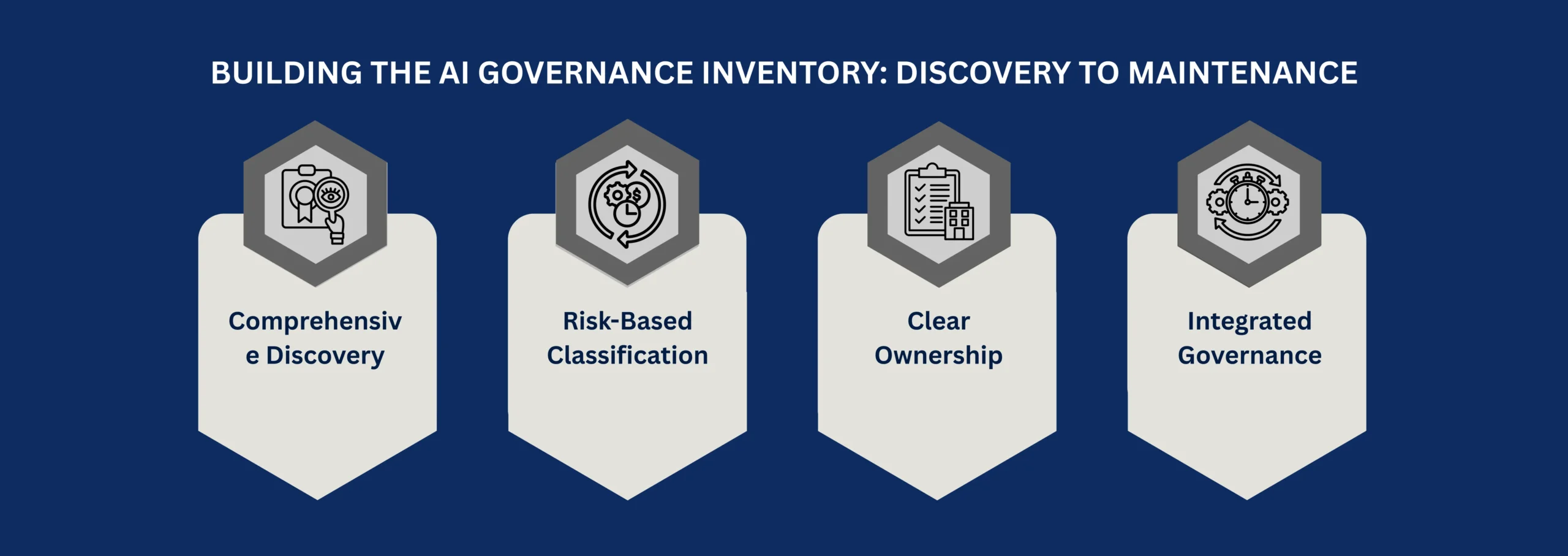
An AI governance inventory is built through four continuous activities: discover AI systems, classify risk, assign ownership, and integrate the register into everyday business processes. Together, these activities keep the AI inventory register accurate and current. AI inventory management succeeds when these steps become part of normal operations rather than a one-time project.
- Comprehensive Discovery
Discovery should extend beyond AI systems formally deployed by IT. Business teams often enable AI capabilities within existing SaaS platforms, employees adopt AI tools independently, and developers integrate AI agents into business applications. A structured discovery process should identify both approved and unregistered AI systems, including shadow AI, before they create governance gaps.
- Risk-Based Classification
Every identified AI system should enter the AI inventory register with a documented risk classification. The assessment should consider business impact, data sensitivity, level of autonomy, and potential operational or regulatory risks. A consistent AI risk assessment process helps organizations apply governance requirements uniformly across similar AI systems.
- Clear Ownership
Every entry in the AI governance inventory should have a named business owner responsible for its governance throughout the AI lifecycle. Ownership should remain current as responsibilities change, and regular governance reviews should confirm that every AI system has an accountable owner. Entries without active ownership should be treated as governance findings that require prompt attention.
- Integrated Governance
An audit-ready AI inventory should evolve as the organization changes. Connect AI inventory management to procurement, development, deployment, change management, and retirement processes so the AI system inventory updates automatically as new AI systems are introduced, modified, or retired. Combined with ongoing AI monitoring, this approach keeps the register aligned with the organization's current AI environment and supports continuous AI governance controls.
AI Governance Controls and AI Monitoring: Keeping the Register Alive
An AI governance inventory delivers value only when it stays current. AI governance controls provide the structure that keeps the AI inventory register accurate throughout the AI lifecycle. Impact assessments, human oversight, access governance, periodic reviews, and change management all depend on the register to identify where governance applies. In return, these controls generate the evidence that supports an audit-ready AI inventory. Together, they create a continuous governance cycle.
- Governance Controls
AI governance controls transform the AI inventory register into an operational governance tool. They verify that risk classifications remain appropriate, ownership stays current, approvals are documented, and governance requirements continue to match how each AI system operates. Without these controls, the register quickly becomes outdated and loses its value as an authoritative governance record.
- Continuous AI Monitoring
AI monitoring keeps the register aligned with operational reality after deployment. Performance changes, unusual behavior, security incidents, expanded use cases, or changes in business purpose should trigger a review of the related inventory entry. Effective AI inventory management connects these monitoring activities directly to the AI system inventory, allowing governance records to evolve alongside the AI systems they represent.
- Ongoing Governance
An audit-ready AI inventory requires continuous maintenance rather than periodic updates before an audit. Organizations should regularly review ownership, validate high-risk systems, and update entries whenever significant operational or business changes occur. A comprehensive review of the AI governance inventory should also support management reviews, helping leadership maintain visibility into the AI systems operating across the organization.
Conclusion
Every effective AI governance program depends on one foundational record: the AI inventory register. Risk assessments, human oversight, AI governance controls, and AI monitoring all rely on knowing which AI systems exist and how they are governed. AI inventory management provides that visibility. It transforms the register into a trusted source of information that supports accountability, consistent governance, and informed decision-making across the AI lifecycle.
An audit-ready AI inventory delivers value far beyond an audit. It helps organizations maintain a complete view of their AI systems, respond confidently to customer due diligence, support regulatory obligations, and demonstrate that AI governance operates through objective evidence. When the register stays aligned with everyday business processes, it becomes a living governance record instead of a static compliance document.
At CertPro, we conduct ISO 42001 assessments and ISO 42001 certification audits worldwide as a licensed CPA firm. Our auditors begin by reviewing the AI inventory register, tracing entries to governance records, impact assessments, ownership, and AI monitoring evidence. A complete and well-maintained register provides the objective evidence needed to demonstrate that an organization's AI Management System operates consistently in practice.