
Software delivery has accelerated significantly across the technology sector. Development teams now merge code multiple times each day. However, speed without governance creates security exposure that auditors increasingly examine. Continuous integration sits at the center of that examination.
When auditors review a SOC 2 or ISO 27001 environment today, they no longer stop at perimeter controls and access management. They look deeper. In simple words, they examine the build pipeline, the development workflow, and the security controls embedded within development and release processes.
This shift reflects how modern software delivery actually operates. Continuous integration has become a standard practice for technology organizations, but its governance implications remain widely misunderstood. Many organizations build fast. Fewer build securely. Even fewer can prove it to an auditor.
What follows is a structured examination of how auditors evaluate security controls within CI environments, what evidence they expect, and what development security practices hold up under audit scrutiny.

Concern
Continuous integration pipelines introduce security risks that traditional compliance frameworks are not fully designed to address. When development teams merge code frequently without embedded security controls, vulnerabilities enter production quickly. Auditors now examine CI/CD environments as part of SOC 2, ISO 27001, and DevSecOps compliance reviews. Organizations that cannot produce evidence of security controls within their CI/CD workflows face control deficiencies, remediation requirements, and increased audit scrutiny.
Overview
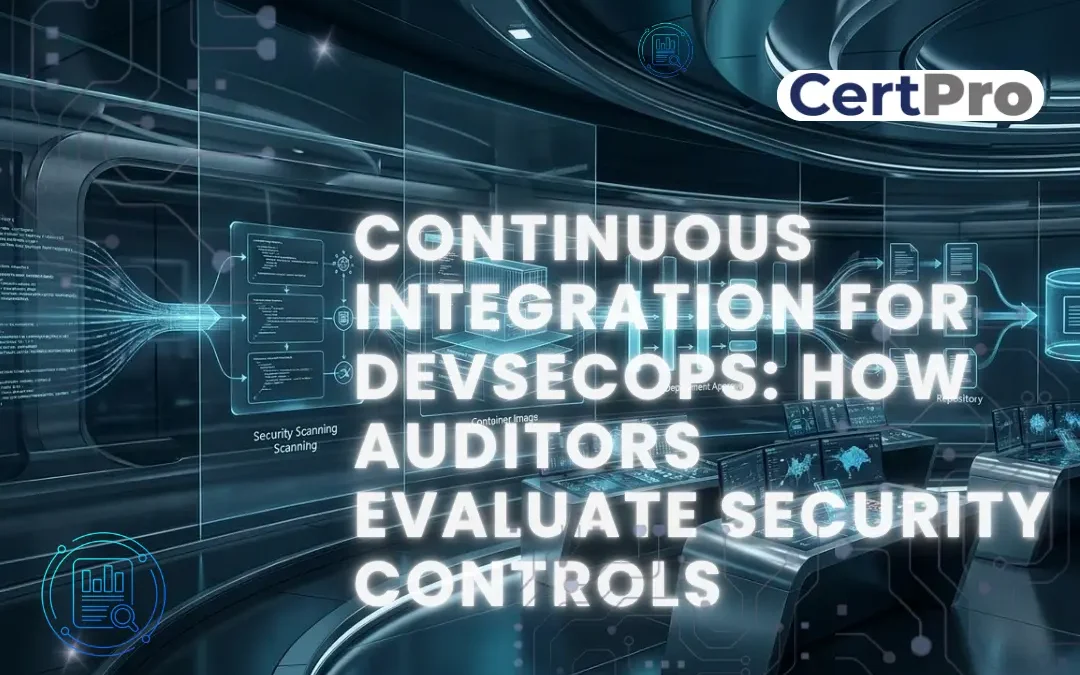
Auditors evaluating CI pipeline environments assess whether security is embedded into the pipeline rather than applied after deployment. They examine static code analysis, dependency scanning, secret detection, access controls on build systems, and approval gates before deployment. Evidence expectations include pipeline configuration records, scan outputs, remediation logs, and change approval documentation. Auditors also evaluate how organizations use CI CD security tools to enforce controls consistently across development environments.
Solution
Organizations should embed development security controls directly into their CI/CD workflows. This includes automated scanning at every commit, enforced approval gates before deployment, secret management controls, and audit trail generation from pipeline tools. Organizations that maintain structured, evidence-generating CI CD pipelines accelerate audits, reduce findings, and demonstrate mature development security governance.
What Does Continuous Integration Mean in a DevSecOps Environment
To understand what auditors evaluate, it helps to answer a foundational question: what does CI actually mean in modern governance and delivery practice?
Continuous integration is a practice where developers frequently merge code changes into a shared repository. Each merge triggers an automated build and test sequence. The goal is to detect integration issues early, reduce manual effort, and accelerate delivery cycles.
In a DevSecOps context, the practice extends beyond build automation. It becomes the primary mechanism for enforcing security controls throughout the development lifecycle. Security checks run automatically at every commit. Vulnerabilities are flagged before they reach staging or production environments.
This is a meaningful operational shift. Traditional development security applied controls at the end of the development cycle. DevSecOps moves those controls earlier, embedding them directly into the build pipeline. When organizations fully understand what does continuous integration mean from a governance perspective, the answer includes not just automation, but accountability.
The Security Implications of Frequent Code Merges
Frequent code merges create frequent security exposure points. Every commit is an opportunity for a vulnerability to enter the codebase. Without automated security controls in the build pipeline, organizations depend on manual reviews that are inconsistent, slow, and difficult to evidence during audits.
Auditors understand this dynamic well. They examine whether security controls operate at the commit level, not just at deployment. Organizations that treat the CI pipeline purely as a speed tool, without embedded governance controls, consistently struggle during compliance reviews.
How Auditors Evaluate Security Controls in Continuous Integration Pipelines
When auditors evaluate continuous integration environments, they follow a structured evidence review. They do not simply confirm that a CI pipeline exists. Moreover, they verify whether security controls are embedded, operational, and consistently enforced across the development environment.
Security in CI CD Pipelines: What Evidence Auditors Request
Security in CI CD pipelines is evaluated through both documentation review and operational testing. Auditors typically request:
- Pipeline configuration files showing security scan integration
- Static application security testing (SAST) reports from recent builds
- Software composition analysis (SCA) outputs confirming dependency scanning
- Secret detection scan results
- Access control records for build systems and repositories
- Deployment approval logs confirming change management controls
Each item connects a security control to documented evidence. Auditors do not accept verbal assurances. They trace controls through the continuous integration pipeline from commit to deployment.
Furthermore, auditors also evaluate whether security in CI CD pipelines is consistent across all environments. A control that runs in staging but not in production creates a significant governance gap. For instance, a scan that flags vulnerabilities without triggering a remediation workflow does not satisfy audit expectations.
CI CD Security Tools and Audit Validation
CI CD security tools form the operational backbone of a defensible build environment. Auditors evaluate not just whether organizations use these tools but also whether they are configured correctly, run consistently, and generate audit-ready outputs. Commonly evaluated CI CD security tools include the following:
- Static application security testing (SAST) tools
- Dependency and software composition analysis (SCA) scanners
- Secret detection and credential exposure monitoring tools
- Container and image security scanning platforms
- Infrastructure-as-code (IaC) security validation tools
Auditors verify that these tools produce timestamped, immutable outputs. They also check whether critical findings trigger mandatory remediation before any deployment proceeds.
Continuous Integration vs Continuous Deployment: Governance Distinctions
Organizations often use CI and continuous deployment interchangeably, but the governance implications differ significantly. Understanding continuous integration vs continuous deployment helps organizations map the right controls to the right pipeline stage.
To elaborate, CI focuses on merging, building, and validating code changes. Whereas continuous deployment automates the release of validated code to production environments. Security controls must exist at both stages, but the audit evidence requirements differ between them.
For continuous integration, auditors expect evidence of code validation, security scanning, and build integrity controls. On the other hand, for continuous deployment, auditors focus on deployment approval workflows, environment segregation, and rollback capabilities.
Auditors reviewing CI/CD governance often identify a common gap. Organizations embed security controls in the build stage but apply minimal controls at the deployment stage. This creates a governance break that compliance reviews consistently surface.
Benefits of Continuous Integration in DevSecOps
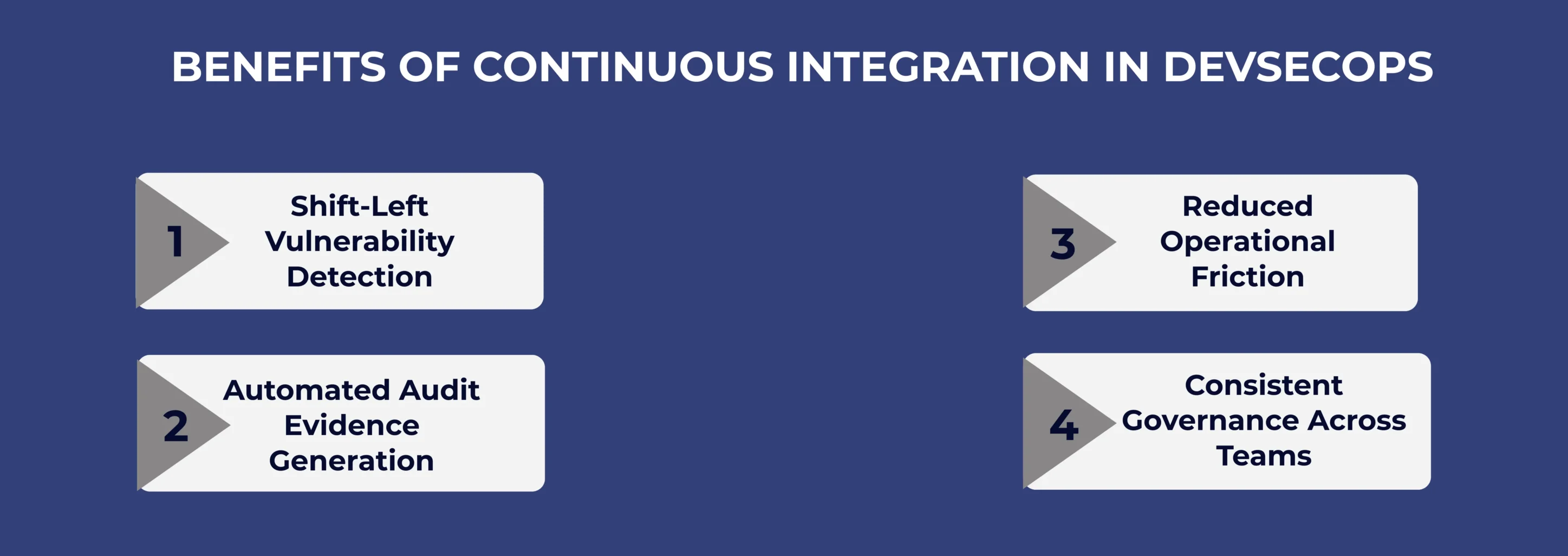
In this section, let's understand the potential benefits of implementing continuous integration into the DevSecOps model. It goes beyond IT efficiency and directly impacts audit readiness, operational resilience, and enterprise trust.
-
Shift-Left Vulnerability Detection
CI pipelines help organizations identify vulnerabilities early in the development lifecycle. Automated scans run during every build and immediately detect insecure dependencies, coding flaws, and configuration weaknesses. As a result, developers can remediate issues during the same sprint in which they appear. Early remediation reduces production risk, lowers security debt, and improves outcomes during SOC 2 and ISO 27001 assessments.
-
Automated Audit Evidence Generation
One of the most important advantages of continuous integration in DevSecOps environments is automatic evidence creation. Build logs, scan reports, approval histories, and deployment records are continuously generated as part of normal development operations. Teams no longer need to reconstruct evidence manually before audits. Instead, auditors can review timestamped, system-generated records that support independent validation of security and change management controls.
-
Reduced Operational Friction
Fixing vulnerabilities during development is significantly less expensive than resolving them after deployment. Continuous security testing inside CI/CD workflows reduces emergency remediation work and minimizes delays caused by late-stage security findings. At the same time, automated evidence collection removes much of the manual effort associated with audit preparation.
-
Consistent Governance Across Teams
Organizations with multiple development teams often struggle with inconsistent security practices. CI pipelines with embedded controls enforce standardized policies across products, environments, and regions. Policy-as-code approaches apply the same security requirements to every commit, creating a uniform governance structure that auditors can verify directly through pipeline configurations and system records.
Development Security Controls That Support Audit Readiness
Development security is not a single control. It is a governance discipline that spans the entire software delivery lifecycle. Organizations that build CI pipelines as a development security framework, rather than purely as a delivery mechanism, build more defensible compliance postures.
Effective development security within continuous integration environments requires:
- Defined security requirements at the design stage
- Automated security scanning at every code commit
- Enforced approval gates before code merges into protected branches
- Segregation of duties between developers and deployment approvers
- Documented remediation workflows for identified vulnerabilities
Organizations that implement tools for continuous integration with embedded security controls generate audit evidence naturally. Pipeline logs, scan reports, and approval records all become audit artifacts without requiring separate documentation effort.
When auditors assess development security maturity, they compare documented policies against operational evidence. Organizations that embed controls into CI pipelines consistently outperform those that rely on manual security checks applied outside the pipeline.
Building Long-Term Audit Readiness in CI Environments
Audit readiness in CI environments is not achieved through last-minute preparation. It results from building CI pipelines that generate governance evidence as a natural output of daily operations. Organizations should ensure that:
- Every build produces a security scan record
- Every deployment requires documented approval
- Access to pipeline configurations is restricted and logged
- Vulnerability remediation timelines are tracked and evidenced
- Pipeline changes are subject to change management controls
Tools for continuous integration that enforce these requirements reduce the gap between development operations and audit expectations significantly.
Conclusion
Continuous integration is no longer viewed solely as a software delivery practice. In modern enterprise environments, it has become part of the organization's governance, security, and audit posture.
Auditors increasingly evaluate whether CI environments generate reliable evidence, enforce security controls consistently, and maintain operational integrity under real development conditions. As a result, organizations must treat build pipelines as governed systems rather than isolated engineering workflows.
Teams that mature successfully in this area integrate security controls early, automate evidence generation, validate remediation before deployment, and maintain clear separation between integration, testing, approval, and release authority. They also recognize that audit defensibility depends less on documented intent and more on operational consistency.
The broader shift is clear. Development velocity alone no longer defines software maturity. Governance visibility, control reliability, and evidence integrity now shape how enterprises evaluate trust in modern software delivery environments.