
Concern
SaaS companies face legal, operational, and revenue risks when GDPR basics are unclear. Weak consent, scattered data, poor vendor oversight, and missing audit evidence slow sales, harm trust, and increase regulatory exposure. Every EU or UK user triggers compliance obligations.
Overview
GDPR basics define how SaaS platforms handle personal data. Companies act as controllers for their own operations and processors for customers. Key principles include lawfulness, purpose limitation, data minimization, accuracy, storage limits, security, and accountability. Clear policies, DSAR workflows, vendor agreements, and regular monitoring reduce risk.
Solution
CertPro CPA LLC provides independent verification of GDPR compliance. As a licensed CPA firm enrolled in the AICPA Peer Review Program, CertPro assesses your systems and controls. This gives SaaS companies credible proof of compliance for buyers, audits, and regulatory purposes.
What GDPR Basics Mean For SaaS Businesses
GDPR basics apply when your SaaS product handles the personal data of people in the EU or the UK. That's the line. From there, things get real fast. You need to know what data you touch and what role you play in handling it.
In a SaaS setup, personal data shows up everywhere. Think of customer profiles with names and emails. Billing records with payment details. Support tickets that carry user issues and sometimes sensitive context. Usage logs that track behavior inside your app. Marketing data from campaigns. Even your internal HR tools store employee data.
Now, roles matter. A controller decides why and how data gets used. A processor follows instructions and handles data for someone else. Most SaaS companies do both. You process customer data inside your platform. At the same time, you control data for your own marketing, billing, and hiring.
GDPR requirements kick in when EU or UK users interact with your product. It covers data from apps, websites, APIs, and support tools. It also applies when data moves across borders. Having a clear understanding of GDPR basics also matters for revenue. Enterprise buyers ask for proof. They want contracts, security controls, and clear privacy practices. Weak privacy signals slow deals or stop them cold.
Key GDPR Principles That Every SaaS Firm Must Know
The GDPR's seven principles guide every decision you make about data. They act like guardrails for your product, your team, and your growth. When teams ignore them, problems show up fast. Deals stall. Audits drag. Trust drops.
Start with lawfulness, fairness, and transparency. You need a clear legal basis for every data action. Consent, contract, or legitimate interest must be defined. Then explain it in plain language. Users expect to know what you collect and why.
Purpose limitation keeps your data use focused. Collect data for a defined reason. Stick to it. Product teams often expand tracking over time. That drift creates risk.
Data minimisation pushes discipline. Collect what your product needs to work well. Extra data feels useful in the moment. It creates exposure later.
Accuracy matters more than teams think. Outdated records break workflows and harm user trust. Clean data supports better decisions.
Storage limitation sets boundaries. Define how long you keep data. Remove it when it no longer serves a purpose. Long retention without reason raises red flags in audits.
Integrity and confidentiality focus on protection. Use access controls, encryption, and monitoring. These controls reduce breach risk and show maturity.
Finally, accountability ties everything together. Document your decisions. Keep records of policies, controls, and actions. This evidence answers hard questions during audits and builds confidence with customers.
GDPR Requirements SaaS Companies Need In Place
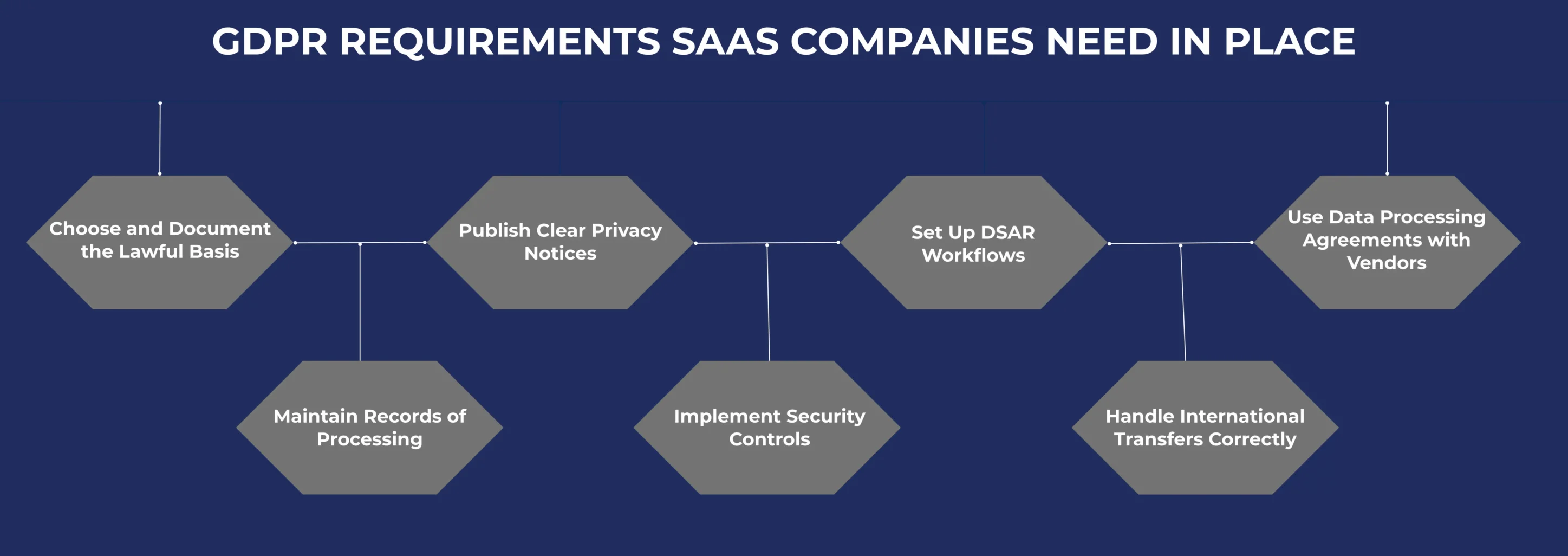
A SaaS company needs working systems, not just policies, to meet GDPR expectations. GDPR basics become real when teams define how data flows, who owns it, and how it stays protected. Strong execution reduces audit pressure and builds buyer trust.
- Choose and Document the Lawful Basis
Every data activity needs a clear legal reason. Map each use case to consent, contract, legal obligation, or legitimate interest. Write it down and keep it consistent across systems. Teams often collect data for product analytics without defining a basis. That gap creates friction during audits and slows enterprise deals.
- Publish Clear Privacy Notices
Your privacy notice should answer simple questions: what data do you collect, why, who receives it, how long you keep it, and whether you transfer it across borders. Keep the language clear. Buyers and regulators read this closely.
- Set Up DSAR Workflows
Users have rights, and they will use them. Build workflows for access, correction, deletion, restriction, portability, and objection. Define timelines and owners. A delayed response creates legal risk and damages trust.
- Use Data Processing Agreements with Vendors
Your vendors handle your risk. Put Data Processing Agreements in place for hosting, analytics, email, support tools, and payments. Review them regularly. One weak vendor can expose your entire stack.
- Implement Security Controls
Use access controls, encryption, logging, and monitoring. Build incident handling into daily operations. Security proves that GDPR basics translate into real protection.
- Handle International Transfers Correctly
Use Standard Contractual Clauses and check adequacy decisions where applicable. Review transfer risks when data moves across regions. This step protects global SaaS operations from regulatory issues.
Step-By-Step GDPR Compliance Guide For 2026
A practical SaaS roadmap turns GDPR basics into daily operations. Teams need clarity, ownership, and repeatable steps. This path keeps audits predictable and deals moving.
- Step 1: Map all personal data — track where it enters, is stored, accessed, and leaves your system.
- Step 2: Classify roles and processing activities — define controller vs. processor responsibilities.
- Step 3: Confirm the lawful basis for each use case — product delivery, billing, support, marketing, and analytics.
- Step 4: Update legal documents — refresh your privacy policy, cookie notice, DPA, and vendor terms.
- Step 5: Build data subject request workflows — create a simple flow for intake, identity check, response, and logging.
- Step 6: Strengthen security and incident response — apply access control, encryption, backups, and recovery.
- Step 7: Review retention and deletion — define rules for account closure, inactive data, and backups.
- Step 8: Train teams and assign ownership — align product, engineering, support, sales, and marketing.
- Step 9: Review vendors and subprocessors — run due diligence, check DPAs, and review security.
- Step 10: Monitor and recheck quarterly — review policies, logs, audits, and changes as your product evolves.
Common GDPR Mistakes SaaS Companies Must Avoid
Most GDPR failures in SaaS come from weak documentation, poorly designed consent, and gaps in vendor oversight. These missteps not only invite regulatory fines but also slow down deals with enterprise customers.
Assuming GDPR Does Not Apply: Some SaaS companies assume GDPR only matters for EU-based businesses. Reality hits when they serve EU or UK users through apps, APIs, or websites. Even a small EU customer base can trigger full compliance obligations.
Weak Consent and Cookie Practices: Pre-ticked boxes, vague language, and buried consent forms confuse users. Enterprises expect clarity. Consent should be explicit, easy to withdraw, and well recorded.
Ignoring Subprocessor Risk: Every SaaS vendor — from analytics tools to payment processors — extends your GDPR obligations. Missing or outdated Data Processing Agreements can make you liable for third-party mistakes.
Lack of Audit Evidence: Regulators and auditors require proof. Logs, policies, and training records are your defense. Without evidence, even a small oversight becomes a major finding.
No Incident Response Plan: Delayed breach reporting amplifies both fines and reputational damage. A clear playbook with assigned roles ensures quick action when incidents occur.
Conclusion
GDPR basics are no longer a side task for SaaS teams. They affect deals, product trust, vendor risk, and how buyers judge your company. When your privacy story is unclear, the costs appear quickly: slower sales cycles, extra security reviews, weakened customer trust, and avoidable legal exposure.
CertPro CPA LLC helps technology organizations take control of GDPR compliance. As a licensed CPA firm enrolled in the AICPA Peer Review Program, CertPro conducts audits and attestation engagements in line with global standards. We identify where personal data resides, clarify your role, pinpoint weak controls, and show what evidence buyers and auditors expect. For SaaS companies still trying to piece together GDPR basics across product, security, legal, and sales, every delay can cost revenue and increase risk.