
Internal audits fail for a predictable reason, and it is rarely the absence of controls. It is rarely a missing ISO 27001 audit evidence checklist item nobody could have anticipated, either. It is the absence of proof. A control that runs but leaves no record is, for audit purposes, indistinguishable from a control that never ran at all.
This is why an ISO 27001 audit evidence checklist is one of the most practical tools an ISMS team can maintain. Clause 9.2 requires internal audits, and those audits work the same way the certification body's assessments do: the auditor selects samples, requests records, and traces each control from its documented requirement to the evidence of its operation. What gets found depends almost entirely on what evidence exists.
This guide provides a complete ISO 27001 audit evidence checklist organized the way auditors actually work through it, explains how evidence gets sampled and tested during internal audits, and shows how the same evidence base carries forward into the certification audit.

Concern
Teams preparing for internal audits often focus on writing documentation while neglecting the operational records that prove controls ran. Auditors sample leavers, incidents, changes, and suppliers, and reconstructed or undated evidence collapses under that method. Without an ISO 27001 audit evidence checklist, the gaps surface during the audit itself, when the options are limited to accepting findings or attempting reconstructions that experienced auditors treat with skepticism.
Overview
Audit evidence falls into two groups. Mandatory ISMS evidence documents cover the scope statement, policy, risk assessment and treatment, Statement of Applicability, objectives, competence records, monitoring results, internal audit records, and management review minutes. Operational evidence proves Annex A controls functioned: access reviews, training completions, incident records, change tickets, vulnerability remediation, supplier reviews, and backup tests. Quality matters as much as existence: records must be dated, attributable, and generated by the systems where work happens.
Solution
Work the ISO 27001 audit evidence checklist continuously rather than before audits. Map every applicable control to the record it should produce, assign each record an owner, automate collection where systems allow, and verify quarterly that evidence is accumulating with correct dates. Internal audits then confirm a state that already exists, and the certification audit samples from the same evidence pool without a preparation scramble.
Why Control Evidence Decides ISO 27001 Audit Outcomes
ISO 19011, the guideline standard for auditing management systems, defines audit evidence as records, statements of fact, or other information that is relevant to the audit criteria and verifiable. Every word of that definition carries weight in practice. Relevant means the record connects to a specific requirement. Verifiable means the auditor can confirm it independently, without relying on what the team says happened.
Strong evidence shares three properties. It is dated, so it demonstrates when the control operated and shows accumulation across the period rather than a spike before the audit. It is attributable, identifying who performed the action and under what authority. And it is system-generated where possible, exported from the platforms where work happens, because records assembled manually after the fact carry less weight and invite deeper sampling.
Weak evidence has recognizable signatures too: screenshots without timestamps, spreadsheets edited the week before the audit, approvals recorded in chat messages that cannot be retrieved, and policies whose review dates never change. An ISO 27001 audit evidence checklist exists precisely to replace these patterns with records that survive independent verification.
How ISO 27001 Auditors Sample and Test Evidence
ISO 27001 auditors test evidence through tracing, not through reading documentation front to back. During an ISO 27001 internal audit, the auditor selects a sample, such as five employees who left during the period, and follows each case through the full chain: the offboarding ticket, the access revocation record, the asset return confirmation, and the timing of each step against the policy's stated deadline. One broken link in one sampled case becomes a finding.
The same tracing method applies across every area of the ISO 27001 audit evidence checklist. For incidents, the auditor picks entries from the register and follows them to response records and lessons learned. For changes, sampled tickets must show approval before implementation. For suppliers, sampled vendors must have current certificates, contracts with security clauses, and review records. For training, sampled joiners must show completion within the required window.
This is why coverage matters more than volume. A thick evidence folder that misses the leaver from March fails the sample; a lean, complete evidence base passes it. The ISO 27001 audit evidence checklist below is structured around what gets sampled, so completeness is checked against the auditor's method rather than the size of the archive.
The ISO 27001 Audit Checklist
This ISO 27001 audit evidence checklist is organized into the two groups auditors work through: the mandatory ISMS evidence documents required by Clauses 4 through 10, and the operational records that prove Annex A controls functioned across the period.
Mandatory ISMS Evidence Documents (Clauses 4 to 10)
These records anchor every ISO 27001 audit evidence checklist; their absence is a finding by itself. The full set is covered in our guide to mandatory documents for ISO 27001, and the audit-critical items are:
- ISMS scope statement, current and consistent with actual operations
- Information security policy, approved, version-controlled, and communicated
- Risk assessment methodology, results, and risk treatment plan with owners
- Statement of Applicability matching the current certificate version, with justifications
- Security objectives with measurement results (Clause 6.2)
- Competence and training records for personnel in ISMS roles (Clause 7.2)
- Monitoring and measurement results (Clause 9.1)
- Internal audit program, reports, and findings (Clause 9.2)
- Management review minutes with required inputs, decisions, and sign-off (Clause 9.3)
- Nonconformity and corrective action records with root cause and verification (Clause 10.2)
Operational Evidence for Annex A Controls
The operational half of the ISO 27001 evidence list maps to the control areas auditors sample most heavily. Each item should exist as dated, exportable records:
Access and identity:
- Quarterly access review exports with reviewer sign-off and remediation of flagged accounts
- Provisioning and deprovisioning records for sampled joiners, movers, and leavers
- Privileged access approvals and periodic revalidation
People and awareness:
- Security awareness training completions, including onboarding within the required window
- Screening records for new hires in scope
Operations and technology:
- Change tickets showing approval before implementation for sampled changes
- Vulnerability scan reports with remediation tracked against defined timelines
- Logging and monitoring evidence, including alert reviews and escalations
- Backup execution records and restoration test results at the stated frequency
Incidents and suppliers:
- Incident register with response records and lessons learned for sampled events
- Supplier register with risk tiers, current certificates, contracts with security clauses, and review records for critical vendors
Two habits keep this ISO 27001 evidence list reliable. First, record the source system and export path next to each item, so evidence can be produced in minutes during the audit. Second, note the expected date pattern, such as quarterly for access reviews or per-event for incidents, because a gap in the date sequence is the first thing a sampling auditor notices.
Using the ISO 27001 Audit Evidence Checklist Before Certification
The ISO 27001 certification audit tests the same evidence base the internal audit does, with higher stakes and an external sampler. Stage 1 reviews the mandatory documentation for completeness and consistency. Stage 2 tests operational evidence, and certification bodies generally expect around three months of accumulated records before Stage 2 can proceed.
Running the ISO 27001 audit evidence checklist through an internal audit first converts unknown gaps into managed corrective actions. The sequencing matters: the internal audit must conclude early enough for findings to close, and its results must feed the management review, because the certification auditor reads that sequence as proof the ISMS governs itself.
The evidence bar also rises at each stage of the cycle. At the initial ISO 27001 certification audit, three months of records may suffice. At surveillance, the auditor expects a full year of continuous accumulation, and date clustering in the weeks before the visit is read for exactly what it is.
ISO 27001 Readiness Assessment: Building a Strong Security Posture Early
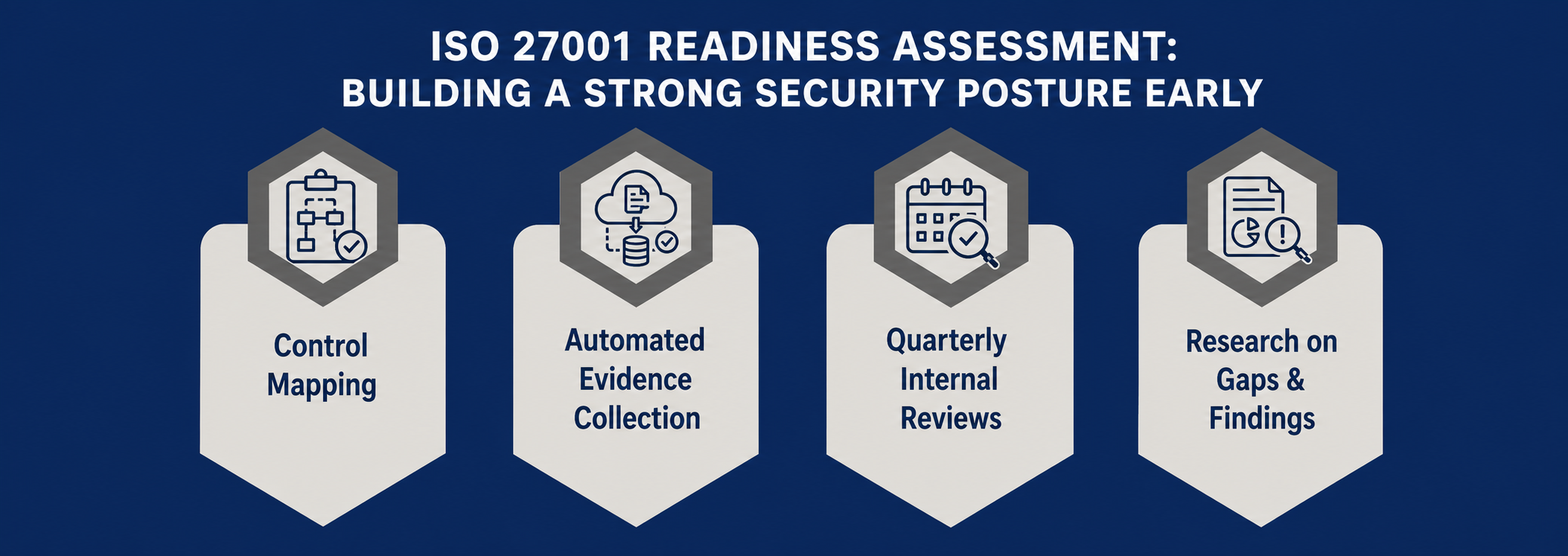
An ISO 27001 readiness assessment evaluates how far the current state sits from certifiable, and evidence is where most of the distance hides. A structured ISO 27001 gap assessment should therefore test not only whether controls exist but whether each one produces a dated record, because the gap between running a control and proving it ran is the gap that surfaces at Stage 2.
- Control Mapping
For every applicable control in the Statement of Applicability, define the record it should produce, the system that produces it, and the owner responsible. This mapping turns the ISO 27001 audit evidence checklist from a static document into an operating instrument.
- Automated Evidence Collection
Identity platforms export access reviews. Ticketing systems hold change approvals. Training platforms log completions. Evidence that accumulates automatically is dated, attributable, and immune to the pre-audit scramble.
- Quarterly Internal Reviews
A short quarterly pass through the checklist catches a stalled export or a lapsed review while the fix is simple. Pairing this with the broader ISO 27001:2022 implementation checklist keeps evidence habits aligned with the wider ISMS build.
- Research on Gaps & Findings
When an internal audit surfaces a gap, the corrective action should fix both the control and the record it failed to leave. Programs that close findings this way watch their ISO 27001 audit evidence checklist shorten in practice, because fewer items need manual attention each cycle.
Conclusion
Auditors do not certify intentions. They certify what the evidence supports, sampled case by case and period by period. An ISO 27001 audit evidence checklist, mapped to the controls in the Statement of Applicability and maintained throughout the year, helps organizations demonstrate conformity through objective evidence rather than last-minute preparation.
The same discipline carries through the certification cycle. Evidence generated during normal operations supports internal audits, management reviews, certification audits, and surveillance audits from a single, continuously maintained evidence base. Organizations that operate this way typically spend less time gathering documentation and more time demonstrating that their Information Security Management System is functioning effectively.
At CertPro, we conduct independent ISO 27001 certification audits worldwide as a licensed CPA firm. Our auditors evaluate objective evidence, trace controls to the applicable ISO/IEC 27001 requirements, classify nonconformities based on audit evidence, and verify corrective actions before findings are closed. Every audit engagement follows a structured, evidence-based methodology aligned with ISO/IEC 27001:2022 and ISO 19011, with certification decisions made by an IAF-accredited certification body.