
ISO 27001 Certification in Bristol
CertPro is a Licensed CPA Firm delivering ISO 27001 Certification in Bristol through structured, audit-driven evaluation of Information Security Management Systems. Certification is issued exclusively upon successful completion of a formal ISO 27001 audit conducted against ISO/IEC 27001:2022 requirements. CertPro operates under accredited certification body standards, serving Bristol-based organisations across financial services, technology, aerospace, and public sector industries.
OUR CLIENTS










What Is ISO 27001 Certification?
ISO 27001 Certification is a formal, third-party attestation confirming that an organisation’s Information Security Management System (ISMS) conforms to the requirements of ISO/IEC 27001:2022. Certification is not a self-declaration — it is issued only by an accredited certification body following a successful ISO 27001 audit. The certificate provides documented evidence that an organisation has systematically identified information security risks, implemented appropriate controls, and established a framework for continuous improvement. ISO 27001 Certification in Bristol is increasingly demanded by clients, regulators, and procurement authorities as credible evidence of information security governance.
Definition: ISO 27001 and the ISMS
ISO 27001 is the internationally recognised standard for establishing, implementing, maintaining, and continually improving an Information Security Management System (ISMS). An ISMS is a documented framework of policies, procedures, controls, and processes that collectively govern how an organisation protects the confidentiality, integrity, and availability of information assets. The standard is published jointly by the International Organization for Standardization (ISO) and the International Electrotechnical Commission (IEC). The most current version is designated ISO/IEC 27001:2022, which superseded the 2013 edition. The transition deadline to the 2022 version is 31 October 2025, as mandated by accredited certification bodies globally. All organisations currently holding certificates issued under the 2013 standard must complete their transition by this date.
The ISMS defined under ISO 27001 is not a single technology solution — it is a systematic management framework. It requires organisations to define the scope of the ISMS, conduct a structured information security risk assessment, select controls from Annex A of ISO/IEC 27001:2022, and produce a Statement of Applicability (SoA) documenting which controls apply and why. The SoA is a mandatory ISMS document and a primary artefact reviewed during the ISO 27001 audit. Clauses 4 through 10 of the standard define the management system requirements, while Annex A provides 93 controls across four themes — Organisational, People, Physical, and Technological. Conformance with both the clauses and selected Annex A controls is required for certification.
ISO 27001 Certification Versus ISO 27001 Compliance
ISO 27001 compliance refers to the internal state of conformance with the standard’s requirements. An organisation achieves ISO 27001 compliance when its ISMS satisfies all applicable clauses and controls, as documented through policies, risk treatment plans, and operational records. ISO 27001 Certification, by contrast, is the formal external recognition of that compliance state. It is awarded by an accredited third-party certification body following a successful ISO 27001 audit. Compliance is a necessary precondition for certification, but compliance alone does not constitute certification. Organisations that claim ISO 27001 compliance without a certificate from an accredited body do not hold ISO 27001 Certification in the formal sense recognised by international trade, procurement, and regulatory frameworks.
For Bristol-based businesses operating in regulated sectors — including financial services under FCA oversight, health information under NHS data governance frameworks, and public sector contracts under government procurement rules — ISO 27001 Certification carries significantly greater weight than internal compliance declarations. Procurement frameworks such as the Cabinet Office Supplier Pre-Qualification Questionnaire (PQQ), and frameworks used by major Bristol-headquartered FTSE-listed companies, commonly require certified conformance rather than self-attested compliance. ISO 27001 audit outcomes, documented in formal audit reports, provide the independent evidence base that underpins certification decisions.
Key Definitions for ISO 27001 Certification
| Term | Definition |
|---|---|
| ISO 27001 | The international standard specifying requirements for an Information Security Management System (ISMS), published as ISO/IEC 27001:2022. |
| ISMS | Information Security Management System — the framework of policies, controls, and processes that governs organisational information security. |
| ISO 27001 Audit | A formal, structured evaluation of an ISMS by an accredited auditor to determine conformance with ISO/IEC 27001:2022 requirements. |
| ISO 27001 Compliance | The internal state of conformance with all applicable ISO 27001 clauses and Annex A controls, as documented in the ISMS. |
| ISO 27001 Certification | The formal certificate issued by an accredited certification body confirming ISMS conformance following a successful audit. |

ISO 27001 Certification in Bristol: Local Context and Regulatory Environment
Bristol is one of the United Kingdom’s most significant regional economies, with a diverse industrial base spanning financial services, aerospace and defence, digital technology, creative industries, and higher education. The city hosts the UK headquarters of major financial institutions and technology companies, several of which are FTSE-listed or hold contracts with UK government departments. This concentration of regulated, data-intensive businesses makes ISO 27001 Certification in Bristol a critical operational and commercial requirement — not merely an optional standard. Bristol’s digital economy, supported by significant data centre infrastructure and a growing fintech cluster, generates and processes substantial volumes of sensitive personal and commercial data subject to the UK GDPR and the Data Protection Act 2018.
Bristol’s Financial Services and Fintech Sector
ISO 27001 Certification for Bristol financial services organisations is driven by FCA regulatory expectations, client due diligence requirements, and the sensitivity of financial data processed in the city. Bristol’s financial services sector includes banking operations, insurance underwriting, asset management, and a growing fintech ecosystem centred around the Bristol Temple Quarter Enterprise Zone. Fintech companies handle payment data, customer financial records, and open banking integrations that require demonstrable information security controls. ISO 27001 compliance is widely adopted by Bristol fintech organisations as a baseline standard, with certification frequently required to onboard institutional clients or participate in regulated payment networks. The FCA’s Operational Resilience Policy Statement (PS21/3) reinforces the need for documented, tested information security controls of the kind assessed during an ISO 27001 audit.
Bristol-based financial services firms holding ISO 27001 Certification in Bristol demonstrate to the Financial Conduct Authority, institutional counterparties, and retail clients that information assets are protected under a formally audited management system. The ISO 27001 audit evaluates not only technical controls — such as access management, encryption, and network security — but also organisational controls including information security policies, supplier management, and incident response procedures. For Bristol financial services businesses subject to CASS (Client Asset Sourcebook) and SYSC (Senior Management Arrangements, Systems and Controls) requirements, ISO 27001 controls provide documented evidence of systematic risk management that aligns with regulatory obligations.
Bristol Technology Companies and Digital Infrastructure
ISO 27001 Certification for Bristol technology companies has become a standard requirement for software providers, managed service providers (MSPs), cloud service operators, and digital agencies operating in the city. Bristol’s technology sector — spanning the M32 corridor and areas including Aztec West and Stoke Gifford — includes significant operations in cybersecurity, software development, data analytics, and IT infrastructure. Technology companies holding ISO 27001 Certification are well-positioned to supply services to regulated industries, including financial services, healthcare, and government, where third-party information security requirements are mandated. Bristol’s data centre operators, providing colocation, cloud, and hybrid infrastructure services across the South West, face specific scrutiny around physical and environmental controls, backup and recovery procedures, and access governance — all evaluated during the ISO 27001 audit.
Bristol Aerospace Sector and ISO 27001
Bristol aerospace sector organisations face specific information security obligations arising from the classified and export-controlled nature of aerospace and defence data. Bristol is home to major aerospace manufacturers and their supply chains, including facilities at Filton, which has historically been central to UK aerospace development. Companies handling export-controlled technical data under ITAR (International Traffic in Arms Regulations) or EAR (Export Administration Regulations), or managing UK Ministry of Defence contracts, face information security requirements that align directly with ISO 27001 controls. Cyber Essentials Plus — required for MoD contracts — is often supplemented by ISO 27001 Certification to demonstrate a more comprehensive ISMS. ISO 27001 Certification in Bristol for aerospace businesses provides the structured documentation and audit evidence required to satisfy MoD supplier assurance expectations.
ICO Enforcement and GDPR Obligations in Bristol
The Information Commissioner’s Office (ICO) is the UK’s data protection supervisory authority with enforcement jurisdiction over all Bristol-based organisations processing personal data. ISO 27001 compliance provides Bristol organisations with a structured approach to meeting UK GDPR obligations under the Data Protection Act 2018. ICO enforcement actions consistently demonstrate that inadequate information security controls — particularly around access management, data encryption, and incident response — attract significant financial penalties. Article 32 of the UK GDPR requires organisations to implement appropriate technical and organisational measures to protect personal data. ISO 27001 controls provide a documented, audited framework for satisfying this requirement. Organisations holding ISO 27001 Certification in Bristol can demonstrate to the ICO that information security has been formally assessed and continuously monitored — a relevant mitigating factor in the event of a personal data breach.
ISO 27001 Requirements: Clauses and Controls
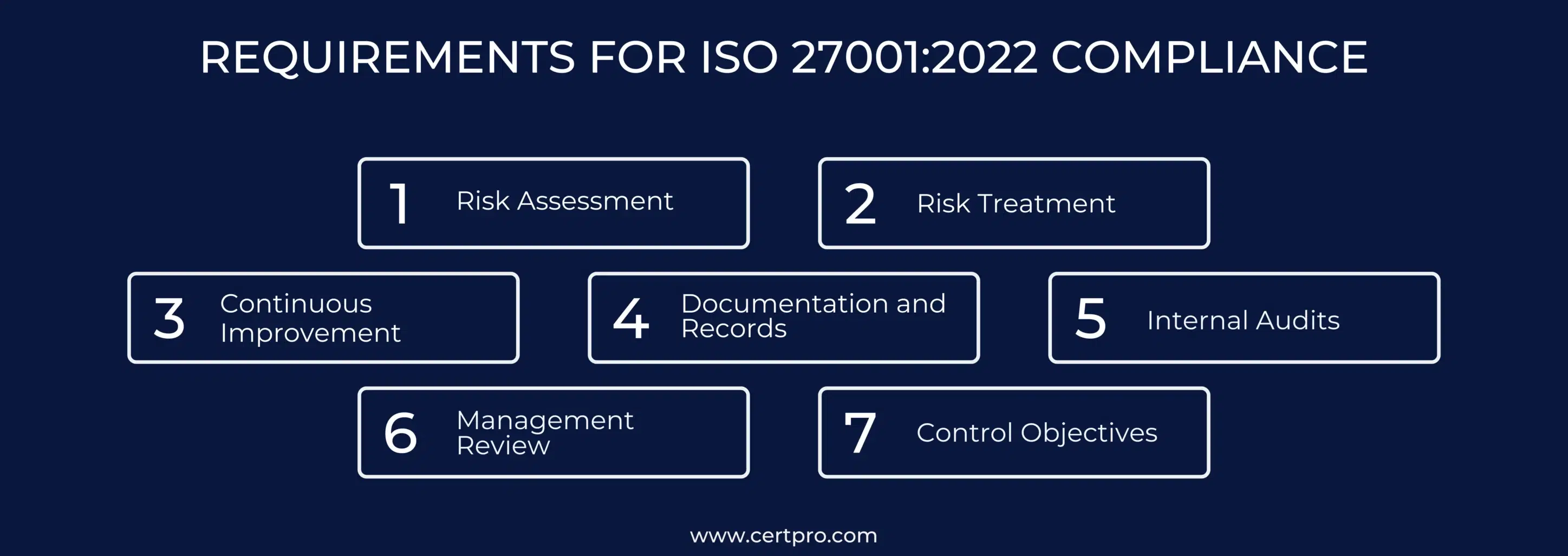
ISO/IEC 27001:2022 is structured around ten clauses and an Annex A containing 93 controls. Clauses 1 through 3 provide scope, normative references, and definitions. Clauses 4 through 10 contain the mandatory requirements for the ISMS. All clause requirements are mandatory for certification — organisations cannot exclude any clause from scope. Annex A controls are selected based on the results of the risk assessment, with justifications for inclusion or exclusion documented in the Statement of Applicability. ISO 27001 Certification requires conformance with all applicable clause requirements and all controls included in the SoA. The ISO 27001 audit evaluates both clause conformance and control implementation, assessed against the documented risk treatment decisions in the organisation’s risk treatment plan.
Clause 4 (Context of the Organisation) requires organisations to identify internal and external issues relevant to information security, determine the needs and expectations of interested parties, and define the ISMS scope. The scope definition is a foundational document that determines the boundaries of the ISO 27001 audit. Clause 5 (Leadership) requires top management commitment, the establishment of an information security policy, and the assignment of roles and responsibilities. Clause 6 (Planning) mandates a structured risk assessment methodology, a risk treatment plan, and documented information security objectives. Clause 7 (Support) covers competence, awareness, communication, and documented information requirements. Clause 8 (Operation) requires the organisation to implement and control all processes needed to meet information security requirements. Clause 9 (Performance Evaluation) mandates internal audit, management review, and monitoring of ISMS performance. Clause 10 (Improvement) requires corrective action processes and continual improvement of the ISMS.
ISO 27001 Certification requires the production and maintenance of specific documented information as mandated by the standard. Mandatory documents include: the ISMS scope document; the information security policy; the information security risk assessment methodology and results; the risk treatment plan; the Statement of Applicability; information security objectives and plans for achieving them; evidence of competence for personnel in information security roles; results of monitoring, measurement, analysis, and evaluation; the internal audit programme and completed reports; management review records; and records of nonconformities and corrective actions. These documents form the primary evidence base reviewed during the Stage 1 ISO 27001 audit. Incomplete or inconsistent documentation is a common source of nonconformities at Stage 1 and must be resolved before the Stage 2 audit commences.
In addition to mandatory documents, organisations pursuing ISO 27001 Certification in Bristol typically maintain a suite of supporting policies and procedures that operationalise Annex A controls. These include access control policies, asset management registers, incident response procedures, business continuity and disaster recovery plans, supplier security assessment records, and physical security logs. While these documents are not individually mandated by the standard, their absence would indicate that corresponding Annex A controls have not been implemented — resulting in audit nonconformities. The ISO 27001 audit examines both the existence and the operational effectiveness of these documents. Documents must reflect actual organisational practice, not merely aspirational statements.
ISO/IEC 27001:2022 reorganised the previous 114 controls across 14 domains (from the 2013 edition) into 93 controls across four themes. Organisational controls (37 controls) include information security policies, roles and responsibilities, threat intelligence, and supplier relationships. People controls (8 controls) address screening, terms of employment, information security awareness, and disciplinary processes. Physical controls (14 controls) cover physical security perimeters, clear desk policies, equipment maintenance, and secure disposal of assets. Technological controls (34 controls) encompass user endpoint devices, privileged access rights, secure authentication, cryptography, network security, and software development security. Eleven controls in the 2022 edition are new additions not present in the 2013 standard — including controls for threat intelligence, cloud service information security, ICT readiness for business continuity, and physical security monitoring. Organisations transitioning from ISO/IEC 27001:2013 must update their Statement of Applicability to reflect the revised control set.
- ✓Defined ISMS scope document with clear boundaries and exclusion justifications
- ✓Information security policy approved by top management
- ✓Completed information security risk assessment using a documented methodology
- ✓Risk treatment plan with control selections referenced to Annex A
- ✓Statement of Applicability (SoA) documenting all 93 Annex A controls
- ✓Documented information security objectives with measurable targets
- ✓Evidence of internal audit programme with completed audit reports
- ✓Management review records demonstrating top management engagement
- ✓Corrective action records for all identified nonconformities
- ✓Supplier security assessment records for all material third-party relationships
- ✓Mandatory Clause Requirements
- ✓Documentation Requirements for ISO 27001 Certification
- ✓Annex A Controls in ISO/IEC 27001:2022
ISO 27001 Certification Process: Step-by-Step
The ISO 27001 certification process follows a structured sequence of stages governed by ISO/IEC 17021-1 (requirements for bodies providing audit and certification of management systems) and ISO/IEC 27006, which prescribes requirements for bodies auditing and certifying information security management systems. Each stage produces documented outputs that feed into subsequent stages, culminating in a formal certification decision by the certification body. ISO 27001 Certification in Bristol follows the same internationally standardised process applicable in any jurisdiction. All audits are conducted by CertPro’s qualified ISO 27001 lead auditors against the ISO/IEC 27001:2022 standard.
Stage 1 of the ISO 27001 audit is a documentation review and scope confirmation audit conducted at the organisation’s premises or remotely. During Stage 1, the auditor evaluates the ISMS scope, the information security policy, the risk assessment methodology and results, the Statement of Applicability, and the completeness of mandatory documented information. Stage 1 determines whether the ISMS is sufficiently developed to proceed to Stage 2. Findings are classified as major nonconformities (which prevent Stage 2 progression until resolved), minor nonconformities (which must be addressed before or during Stage 2), or observations (noted for improvement but not blocking). The Stage 1 audit report provides a formal summary of findings and confirms the Stage 2 audit programme.
Stage 2 is the certification audit — a comprehensive on-site or hybrid evaluation of the ISMS’s operational effectiveness. The Stage 2 ISO 27001 audit examines whether the controls documented in the Statement of Applicability are implemented, operational, and effective in practice. Auditors conduct interviews with staff across relevant functions, review operational records (such as access logs, incident records, training completion records, and supplier assessment reports), and observe physical and technical controls in operation. The audit evaluates conformance with all applicable clauses of ISO/IEC 27001:2022 and all controls included in the SoA. Nonconformities identified at Stage 2 must be addressed through documented corrective actions — typically within 90 days for major nonconformities — before the certification decision is made.
The duration of the Stage 2 audit is determined by the size of the organisation, the complexity of the ISMS scope, the number of sites included, and the number of users within scope. ISO/IEC 27006 provides minimum audit day requirements based on user numbers, which all certification bodies must apply. For a Bristol-based technology company with 50 users in scope, a Stage 2 audit typically requires 3 to 5 audit-days. For a larger financial services organisation with 500 users and multiple Bristol locations, the combined audit programme may extend to 8 to 12 audit-days across Stage 1 and Stage 2. CertPro’s audit planning team determines the programme based on the application information provided at the time of certification enquiry.
Following completion of Stage 2 and resolution of all nonconformities, the audit team submits a formal recommendation to the certification body’s certification decision function. The certification decision is made by an individual or panel independent of the audit team, in accordance with ISO/IEC 17021-1 impartiality requirements. Upon a positive certification decision, an ISO 27001 certificate is issued confirming that the named ISMS, within the defined scope, conforms to ISO/IEC 27001:2022. The certificate is valid for three years and is maintained through annual surveillance audits in years one and two of the certification cycle. The three-year cycle concludes with a recertification audit, which re-evaluates the full ISMS to renew the certificate for a further three years.
ISO 27001 Certification is maintained through a structured three-year certification cycle that includes annual surveillance audits. Surveillance audits are conducted in years one and two and are typically narrower in scope than the initial certification audit. They focus on areas of the ISMS identified as requiring monitoring, changes to the ISMS since the previous audit, and the continued operation of key controls. Surveillance audits confirm that the ISMS remains effective and that the organisation continues to address nonconformities and drive continual improvement as required by Clause 10. Failure to maintain the ISMS, address nonconformities within agreed timescales, or cooperate with the surveillance audit programme can result in suspension or withdrawal of the ISO 27001 certificate.
- Application and certification agreement — organisation submits ISMS scope, size, and application details to CertPro
- Audit programme determination — CertPro calculates audit duration per ISO/IEC 27006 and issues the audit plan
- Stage 1 audit — documentation review and ISMS scope confirmation audit conducted by a qualified lead auditor
- Stage 1 findings review — nonconformities classified and corrective action timelines agreed
- Stage 2 certification audit — on-site or hybrid evaluation of ISMS operational effectiveness
- Nonconformity resolution — organisation submits corrective action evidence within agreed timeframes
- Certification decision — independent review of audit findings and recommendation
- Certificate issuance — ISO 27001 certificate issued for a three-year validity period
- Year 1 surveillance audit — focused review confirming continued ISMS conformance
- Year 2 surveillance audit — further monitoring audit confirming ongoing effectiveness
- Recertification audit — full ISMS re-evaluation to renew the certificate for a further three-year cycle

- ✓Stage 1: Scope Definition and ISMS Documentation Review
- ✓Stage 2: Certification Audit
- ✓Certification Decision and Certificate Issuance
- ✓Surveillance Audits and Recertification
ISO 27001 Audit: Scope, Stages, and Evaluation Methodology
The ISO 27001 audit is the formal, structured evaluation process conducted by an accredited certification body to determine whether an organisation’s ISMS conforms to ISO/IEC 27001:2022. It is a prerequisite for certification issuance — no ISO 27001 certificate can be issued without a completed and satisfactory audit. CertPro’s ISO 27001 audit methodology is based on ISO 19011 (guidelines for auditing management systems) and the specific requirements of ISO/IEC 27006. Audits are conducted by qualified ISO 27001 lead auditors who hold recognised auditor qualifications and have demonstrated sector-specific competence relevant to the organisation under audit.
Audit Scope Determination
The scope of the ISO 27001 audit is determined by the ISMS scope document produced by the organisation. The ISMS scope defines the boundaries and applicability of the ISMS, including the organisational units, locations, assets, and processes covered by the management system. For Bristol-based organisations with multi-site operations — for example, a financial services firm with offices in Bristol city centre, Bristol Temple Meads, and a secondary location in Bath — the audit scope must address all in-scope sites. The audit programme is adjusted to reflect the number of sites, the nature of activities at each, and the risk profile of information assets at each location. Exclusions from the ISMS scope must be documented and justified; unjustified exclusions constitute an audit nonconformity.
Audit Evidence and Nonconformity Classification
ISO 27001 audit evidence is collected through three primary methods: document review, interviews with personnel, and observation of processes and controls. Document review examines mandatory ISMS documentation, operational records, and control implementation evidence. Interviews are conducted with staff at all relevant levels — from top management to operational personnel — to verify that information security policies and procedures are understood and applied in practice. Observation involves the auditor directly examining physical controls (such as server room access restrictions), technical controls (such as firewall configurations and access control settings), and operational processes (such as onboarding and offboarding procedures). The auditor records all findings against specific ISO/IEC 27001:2022 clauses and Annex A controls.
Audit nonconformities are classified into two categories under ISO 19011 and ISO/IEC 17021-1. A major nonconformity is a failure to satisfy a requirement of the standard that significantly affects the ISMS’s ability to achieve its intended outcomes — for example, the absence of a completed risk assessment, no internal audit programme, or a critical control gap in a high-risk area. A minor nonconformity is a failure that does not significantly affect overall ISMS performance but represents a departure from a specific requirement — for example, incomplete training records for a small number of personnel, or an access control policy not reviewed within the required timeframe. Observations are opportunities for improvement that do not constitute nonconformities but are noted in the audit report for the organisation’s attention.
ISO 27001 Audit Bristol: Sector-Specific Competence
Conducting an ISO 27001 audit for Bristol organisations across different sectors requires auditors with relevant sector competence. CertPro’s lead auditors assigned to Bristol engagements hold demonstrated competence in the sectors most prevalent in the Bristol economy — including financial services, information technology, aerospace, and healthcare information management. Sector competence matters because the risk profile of an ISMS, the nature of information assets, and the regulatory environment differ significantly between a Bristol fintech startup processing payment data and a Bristol aerospace manufacturer handling export-controlled technical documentation. The ISO 27001 audit programme is tailored to reflect these sector-specific risk factors, ensuring that control evaluation is proportionate to the actual threat landscape faced by each organisation under audit.
ISO 27001 Compliance: Regulatory Alignment for Bristol Businesses
ISO 27001 compliance provides Bristol-based organisations with a documented, auditable framework for meeting obligations under multiple regulatory and legal regimes simultaneously. The relationship between ISO 27001 compliance and specific regulatory requirements is explicit and well-documented. ISO 27001 maps directly to the technical and organisational measure requirements of UK GDPR Article 32, to the operational resilience and systems and controls requirements of FCA handbooks, and to the information security expectations of government procurement frameworks including Cyber Essentials and the Government Security Classifications Policy. Established ISO 27001 compliance enables structured regulatory mapping, reducing the overhead of demonstrating conformance with multiple overlapping requirements.
GDPR and UK Data Protection Compliance
The UK GDPR, as retained and amended by the Data Protection Act 2018, requires all organisations processing personal data to implement appropriate technical and organisational security measures (Article 32). These measures must be proportionate to the risk presented by processing operations, taking into account the state of the art, implementation costs, and the likelihood and severity of risk to data subjects. ISO 27001 compliance provides a structured approach to satisfying Article 32 by requiring a formal risk assessment, the selection of proportionate controls, and documented monitoring of control effectiveness. An organisation holding ISO 27001 Certification can demonstrate to the ICO that its information security measures have been independently audited and found conformant — providing a strong evidentiary basis in the event of an ICO investigation or personal data breach notification.
Bristol businesses processing special category personal data — including health information, financial data, or data relating to criminal convictions — face heightened Article 32 obligations and the possibility of ICO enforcement with penalties of up to £17.5 million or 4% of global annual turnover. ISO 27001 Certification in Bristol for organisations processing special category data provides a credible, independently verified demonstration of security measures. The ICO’s enforcement guidance recognises this as a relevant mitigating factor. The ICO’s regulatory guidance on security explicitly references the use of appropriate industry standards — including ISO 27001 — as evidence of compliance with the security principle under UK data protection law.
FCA Regulatory Alignment for Bristol Financial Services
The Financial Conduct Authority’s SYSC handbook requires FCA-authorised firms to establish, implement, and maintain adequate risk management systems, including operational risk controls. ISO 27001 compliance implemented by Bristol financial services firms provides a documented management system for information security risk that is directly aligned with SYSC 7 (risk management) and SYSC 13 (operational risk: management framework) requirements. The FCA’s Operational Resilience Policy (PS21/3) requires firms to identify important business services, map supporting resources, and set impact tolerances — processes that rely on the information asset register, business impact analysis, and business continuity controls documented within an ISO 27001-compliant ISMS. FCA-supervised Bristol firms holding ISO 27001 Certification are well-positioned to demonstrate operational resilience compliance to supervisors.
Government Procurement and ISO 27001 Certification
Bristol businesses supplying services to UK government departments and public bodies are increasingly required to demonstrate ISO 27001 compliance as a condition of contract award. The UK government’s Cyber Essentials scheme provides a baseline requirement for all suppliers handling government data, but contracts involving more sensitive data processing — particularly those touching Official-Sensitive or higher classifications — typically require ISO 27001 Certification. Bristol’s public sector supply chain, which includes suppliers to NHS trusts, local authority digital services, and central government departments, is subject to these requirements. ISO 27001 Certification in Bristol for public sector suppliers enables participation in a broader range of government procurement frameworks and reduces the time and cost associated with responding to individual supplier information security questionnaires.
ISO 27001 Cost in Bristol: Structure and Factors
ISO 27001 cost is a structured combination of certification body fees, audit resource costs, and internal organisational investment in ISMS development and operation. The ISO 27001 certification cost Bristol organisations face is influenced by multiple factors, including the size and complexity of the organisation, the scope of the ISMS, the number of sites, the sector, and the maturity of existing information security controls. CertPro provides transparent, fixed-fee certification pricing based on the parameters submitted at the time of application, in accordance with the audit day requirements prescribed by ISO/IEC 27006. All fees are disclosed in the certification agreement prior to audit commencement — there are no hidden costs in CertPro’s pricing structure.
Direct Certification Costs
The direct costs of ISO 27001 certification comprise certification body fees, which include the Stage 1 audit fee, the Stage 2 certification audit fee, annual surveillance audit fees, and the recertification audit fee at the end of the three-year certification cycle. These fees are calculated based on the number of audit days required, which is determined by the number of users within the ISMS scope. For a small Bristol-based technology company with 10 to 50 users, the initial certification audit (Stage 1 plus Stage 2) typically requires 3 to 5 audit days, with direct certification costs in the range of £3,000 to £8,000. For a medium-sized financial services firm with 100 to 500 users, the combined Stage 1 and Stage 2 audit may require 6 to 10 audit days, with direct costs in the range of £7,000 to £15,000. Annual surveillance audit costs are typically 30 to 50 percent of the initial certification audit cost.
Factors Affecting ISO 27001 Certification Cost Bristol
Several factors affect the total ISO 27001 certification cost Bristol organisations will incur over the three-year certification cycle. The number of sites within the ISMS scope is a primary cost driver, as each additional site requires additional audit days. The complexity of the technical environment — for example, organisations with extensive cloud infrastructure, multiple interconnected systems, or bespoke software development — increases audit duration compared to simpler IT environments. Sector-specific requirements, such as those applicable to financial services or aerospace, may require auditors with specialist competence, which can affect day rates. The maturity of existing information security controls at the time of initial certification also affects total cost, as a more mature ISMS will generally require fewer audit days to evaluate comprehensively.
Indirect costs associated with ISO 27001 certification include the internal staff time invested in developing and maintaining the ISMS, the cost of technology tools or platforms used to manage ISMS documentation and controls, and the cost of information security awareness training for staff. For Bristol organisations that already operate documented security policies and procedures — for example, those already compliant with Cyber Essentials Plus or those with existing data protection management frameworks — the internal investment required to achieve ISO 27001 compliance is typically lower than for organisations starting from scratch. ISO 27001 cost should always be evaluated against the commercial value of certification: access to new markets, contract wins requiring certified status, and reduced cyber insurance premiums are tangible financial benefits that offset the investment in certification.
| Organisation Size (Users) | Estimated Initial Audit Days | Estimated Certification Cost Range | Annual Surveillance Cost Range |
|---|---|---|---|
| 1 – 50 users | 3 – 5 audit days | £3,000 – £8,000 | £1,500 – £3,500 |
| 51 – 200 users | 5 – 8 audit days | £6,000 – £12,000 | £2,500 – £5,000 |
| 201 – 500 users | 8 – 12 audit days | £10,000 – £18,000 | £4,000 – £8,000 |
| 500+ users | 12+ audit days | £15,000+ | £6,000+ |
Return on Investment from ISO 27001 Certification
ISO 27001 cost must be evaluated in the context of the financial benefits and risk reductions that certification delivers. ISO 27001 Certification in Bristol enables organisations to qualify for procurement opportunities that require certified status — in some sectors, this can represent millions of pounds in contract value. Cyber insurance premiums are often reduced for certified organisations, as insurers recognise the lower risk profile associated with a formally audited ISMS. The cost of a single significant data breach — including ICO regulatory penalties, legal costs, customer notification, business disruption, and reputational damage — typically far exceeds the total cost of a three-year ISO 27001 certification cycle. Bristol businesses in competitive sectors where ISO 27001 Certification differentiates suppliers also benefit from higher win rates in competitive procurement processes.
Benefits of ISO 27001 Certification for Bristol Businesses
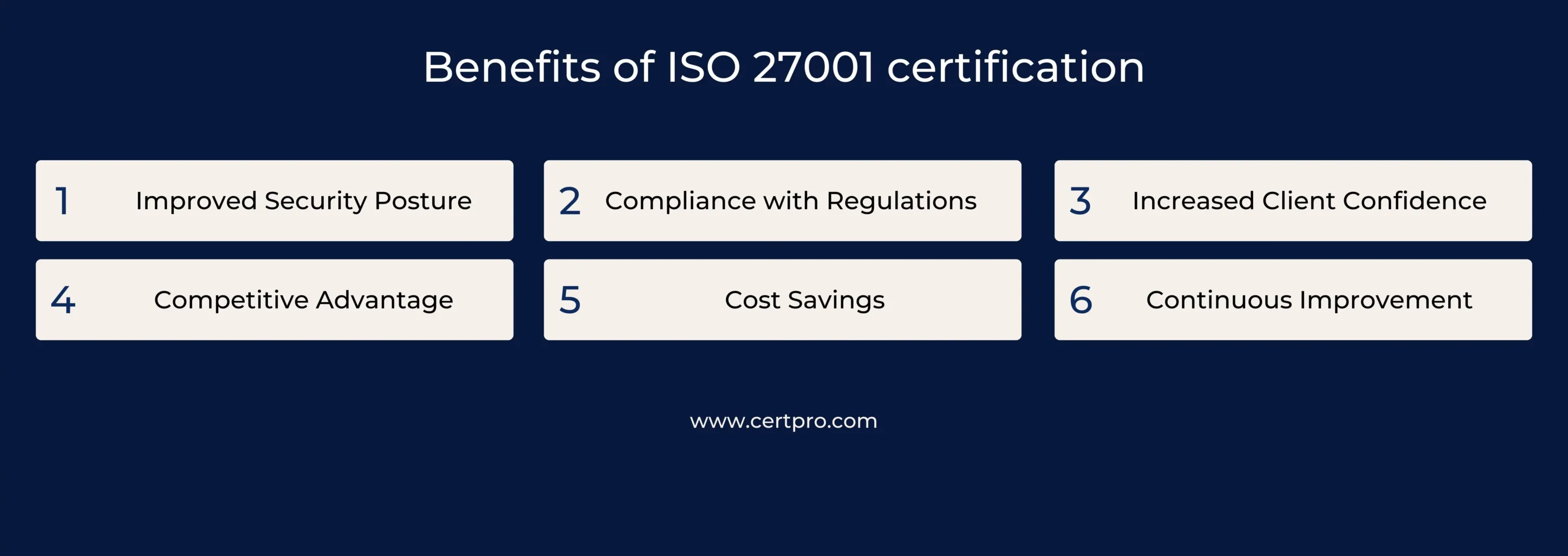
ISO 27001 Certification delivers measurable operational, commercial, and regulatory benefits to Bristol-based organisations across all sectors. The benefits extend beyond improved information security posture to encompass commercial advantages, enhanced regulatory standing, and operational efficiency gains. Bristol businesses operating in competitive, data-intensive industries face increasing scrutiny from clients, insurers, regulators, and counterparties regarding their information security governance. ISO 27001 Certification in Bristol provides independently verified evidence of robust information security management that satisfies this scrutiny across multiple stakeholder groups simultaneously.
ISO 27001 Certification is increasingly a minimum requirement — rather than a differentiator — in many Bristol market sectors. Technology companies supplying to financial services, healthcare, or government clients in Bristol are routinely required to demonstrate ISO 27001 Certification as a condition of supplier onboarding. The certification eliminates or substantially reduces the time and cost associated with responding to individual client information security questionnaires, as the ISO 27001 certificate provides accepted third-party evidence of control conformance. For Bristol businesses competing for contracts with FTSE-listed companies or public sector bodies, ISO 27001 Certification can be the decisive factor in supplier selection where multiple vendors compete on similar price and capability grounds.
ISO 27001 Certification for Bristol companies also opens access to international markets, particularly in sectors where the standard is recognised as a global baseline for information security assurance. European Union procurement frameworks, Middle Eastern government contracts, and US enterprise procurement processes increasingly accept or require ISO 27001 Certification as evidence of information security governance. Bristol companies with international growth ambitions — particularly in the technology, financial services, and aerospace sectors — benefit from the global recognition of ISO 27001 Certification as a commercially valuable differentiator in international sales processes.
ISO 27001 Certification requires the systematic identification and assessment of information security risks, the selection of proportionate controls, and the ongoing monitoring of control effectiveness. This structured approach to information security risk management produces tangible operational benefits: clearer accountability for information assets, documented processes for managing access rights and user provisioning, established incident response procedures, and tested business continuity and disaster recovery plans. Bristol organisations that have achieved ISO 27001 Certification report improved internal visibility of their information asset inventory, better understanding of their supplier risk landscape, and more effective management of information security incidents. The formal internal audit programme required by Clause 9 of ISO/IEC 27001:2022 creates a structured mechanism for identifying and addressing control weaknesses before they are exploited or result in regulatory violations.
ISO 27001 compliance maps to multiple regulatory and legal obligations faced by Bristol businesses, providing an efficient mechanism for managing overlapping requirements. The UK GDPR Article 32 technical and organisational measures requirement, the NIS Regulations 2018 security requirements for operators of essential services and digital service providers, the FCA’s SYSC operational risk requirements, and the NHS Data Security and Protection Toolkit requirements all align with ISO 27001 controls. Organisations holding ISO 27001 Certification in Bristol can use their ISMS documentation and audit reports as evidence of regulatory compliance, reducing the cost and effort of responding to regulator enquiries and satisfying periodic compliance assessments. The documented continual improvement process required by ISO 27001 also ensures that controls are updated as the regulatory and threat landscape evolves.
- ✓Independent, third-party verified evidence of information security governance
- ✓Eligibility for procurement frameworks requiring ISO 27001 Certification
- ✓Reduced cyber insurance premiums reflecting lower assessed risk
- ✓Mitigation of ICO regulatory penalties through demonstrated security measures
- ✓Streamlined response to client and counterparty due diligence questionnaires
- ✓Structured framework for managing information security risk across the organisation
- ✓Documented incident response and business continuity capabilities
- ✓Improved supplier risk management through formal supply chain security requirements
- ✓Global market access in jurisdictions requiring ISO 27001 Certification
- ✓Continual improvement mechanism ensuring controls remain effective over time
- ✓Commercial and Competitive Advantages
- ✓Operational and Risk Management Benefits
- ✓Regulatory and Legal Benefits
ISO 27001 Certification Requirements: A Structured Overview
The requirements for ISO 27001 Certification are defined in ISO/IEC 27001:2022 and apply universally to all organisations seeking certification, regardless of size, sector, or geography. To receive ISO 27001 Certification in Bristol or any other location, an organisation must establish a conformant ISMS, operate it for a sufficient period to generate evidence of operation (typically at least three months), complete at least one internal audit cycle, conduct at least one management review, and successfully complete Stage 1 and Stage 2 ISO 27001 audits conducted by an accredited certification body. The following overview covers the principal requirements against which the ISO 27001 audit evaluates organisational conformance.
ISO/IEC 27001:2022 Clause 5 requires demonstrated commitment from top management to the ISMS. The ISO 27001 audit evaluates this through examination of the information security policy (which must be approved and signed by top management), management review records (demonstrating that senior leadership regularly reviews ISMS performance), and the assignment of information security roles and responsibilities to named individuals. Top management must ensure that information security objectives are established, that the ISMS is integrated into the organisation’s strategic planning process, and that adequate resources are provided for ISMS operation and improvement. In Bristol organisations with complex governance structures — such as financial services firms with Board-level risk oversight or aerospace companies with divisional management — the ISO 27001 audit will specifically examine how ISMS governance operates within the existing corporate governance framework.
ISO 27001 Certification requires a formally documented information security risk assessment conducted using a consistent, repeatable methodology. The risk assessment must identify risks associated with the loss of confidentiality, integrity, and availability of information within the ISMS scope. Each identified risk must be assessed for likelihood and impact, resulting in a risk level that drives the risk treatment decision. The risk treatment plan documents the response to each identified risk — whether to apply controls from Annex A, accept the risk, avoid the risk, or transfer the risk (for example, through insurance). The Statement of Applicability must reference the risk treatment plan and document the rationale for including or excluding each of the 93 Annex A controls. The ISO 27001 audit specifically examines the logical consistency between risk assessment results, risk treatment decisions, and the controls selected in the SoA.
ISO/IEC 27001:2022 Clause 9.2 requires organisations to conduct internal audits of the ISMS at planned intervals. The internal audit programme must cover all ISMS clauses and all in-scope controls over the audit cycle, with criteria, scope, methods, and frequency defined in a documented programme. Internal auditors must be objective and impartial with respect to the areas they audit. Findings must be reported to relevant management and documented, and nonconformities identified must be addressed through corrective action. Clause 9.3 requires top management to review the ISMS at planned intervals using defined input information, including internal audit results, information security performance metrics, and changes affecting the ISMS. Management review outputs must include decisions on continual improvement opportunities and resource needs. The absence of documented internal audits or management reviews is classified as a major nonconformity in the ISO 27001 audit.
- ✓Leadership and Governance Requirements
- ✓Risk Assessment and Treatment Requirements
- ✓Internal Audit and Management Review Requirements
ISO 27001 Certification in Bristol: Sector-Specific Applications
ISO 27001 Certification in Bristol is applied across a diverse range of sectors, each with specific information security risk profiles and regulatory obligations. The universal applicability of the standard means that the ISMS framework can be tailored to the specific context of each organisation, with the risk assessment and control selection process driving a bespoke set of implemented controls that reflect the actual threat landscape faced. While the certification requirements are identical for all organisations, the practical implementation of the ISMS and the focus of the ISO 27001 audit differ significantly between sectors. The following section outlines how ISO 27001 Certification applies to the principal sectors of the Bristol economy.
ISO 27001 for Bristol Healthcare and NHS Organisations
Healthcare organisations in Bristol — including NHS trusts, private healthcare providers, and health technology companies supplying to NHS bodies — face specific information security obligations arising from the sensitivity of patient data and the requirements of the NHS Data Security and Protection Toolkit (DSPT). The DSPT is an annual self-assessment framework requiring NHS organisations and their suppliers to demonstrate information governance and security standards. ISO 27001 Certification substantially overlaps with DSPT requirements and provides an independently audited evidence base for many DSPT assertions. Bristol NHS trusts and their technology suppliers holding ISO 27001 Certification can use the certification as evidence satisfying multiple DSPT requirements, reducing the annual DSPT completion burden while delivering a higher level of assurance than self-assessment alone.
ISO 27001 for Bristol Legal and Professional Services
Bristol’s legal sector — which includes major national law firms, regional practices, and specialist barristers’ chambers — handles highly sensitive client data subject to solicitor-client privilege, legal professional privilege, and significant data protection obligations. The Solicitors Regulation Authority (SRA) and Bar Standards Board (BSB) both have data security expectations for regulated legal professionals, and the Law Society has published guidance recommending ISO 27001 as a benchmark for law firm information security. Law firms in Bristol handling major commercial transactions, litigation, or regulatory matters for FTSE-listed clients may be required by those clients to demonstrate ISO 27001 Certification as a condition of instruction. ISO 27001 Certification in Bristol for legal and professional services firms provides client-facing assurance that confidential matter information is protected under a formally audited management system.
ISO 27001 for Bristol Educational Institutions
Bristol’s higher education sector — including the University of Bristol, the University of the West of England (UWE Bristol), further education colleges, and independent schools — processes substantial volumes of personal data relating to students, staff, and research participants. Universities conducting research funded by UK Research and Innovation (UKRI) or by international funders are subject to research data management obligations that increasingly require demonstrable information security governance. ISO 27001 Certification enables Bristol educational institutions to demonstrate systematic information security management to funding bodies, regulatory authorities, and international research partners. The ISO 27001 audit of an educational institution evaluates controls relevant to the specific risks of the academic environment, including research data management, student records protection, and the security of shared academic IT infrastructure.
CertPro: ISO 27001 Certification Services in Bristol
CertPro is a Licensed CPA Firm delivering ISO 27001 Certification in Bristol through a structured, accredited audit process conducted by qualified lead auditors. CertPro’s ISO 27001 certification service is anchored in the requirements of ISO/IEC 17021-1 and ISO/IEC 27006, ensuring that all certifications issued carry the accreditation status required for recognition by clients, regulators, and procurement bodies. ISO 27001 Certification in Bristol issued by CertPro is recognised by the UK Accreditation Service (UKAS) and its international equivalents under the IAF Multilateral Recognition Arrangement (MLA), providing global validity. CertPro maintains a panel of ISO 27001 lead auditors with sector competence across the principal industries of the Bristol economy, including financial services, technology, aerospace, healthcare, and legal services.
CertPro’s Accredited Certification Process
CertPro’s ISO 27001 certification process is strictly audit-framed. CertPro does not provide management system implementation, advisory services, or consulting. CertPro’s role is exclusively that of an accredited certification body: conducting objective, impartial audits of ISMS documentation and operational controls, issuing findings reports, and making certification decisions based on audit evidence. This strict separation of certification and advisory activities is a fundamental requirement of ISO/IEC 17021-1, which prohibits certification bodies from certifying management systems they have been involved in developing. CertPro’s Bristol-based certifications are conducted by auditors who have had no prior involvement in the organisation’s ISMS development, maintaining the independence and objectivity required for accredited ISO 27001 Certification.
CertPro’s ISO 27001 Audit Bristol Team
CertPro’s qualified lead auditors assigned to Bristol engagements hold certifications from recognised professional bodies, including CQI/IRCA (International Register of Certificated Auditors) and equivalent accreditation bodies. Lead auditors are selected based on demonstrated sector competence, familiarity with the Bristol regulatory environment, and auditing experience with organisations of comparable size and complexity. CertPro’s Bristol audit team maintains current knowledge of ICO enforcement trends, FCA operational resilience expectations, and the specific procurement requirements of major Bristol-based clients. This sector-specific competence ensures that the ISO 27001 audit is relevant to the actual risk environment faced by the organisation, rather than a generic compliance exercise disconnected from operational context.
Why Choose CertPro for ISO 27001 Certification in Bristol
CertPro is selected by Bristol organisations for ISO 27001 Certification for several substantive reasons. CertPro’s status as a Licensed CPA Firm with accredited certification body status provides the formal authority required for certification issuance that is globally recognised. CertPro’s fixed-fee, transparent pricing structure removes uncertainty from ISO 27001 cost planning, allowing Bristol organisations to budget with precision. Audit timelines are structured to minimise disruption to operational activities, with scheduling coordinated to align with the organisation’s business calendar. CertPro’s post-certification support — including structured surveillance audit planning and clear nonconformity tracking — ensures that ISO 27001 Certification in Bristol is maintained throughout the three-year certification cycle without lapse or suspension. CertPro’s depth of experience in the Bristol market means that audit programmes reflect genuine sector risk, producing certifications that carry substantive assurance value.
- ✓Licensed CPA Firm with accredited certification body status recognised by UKAS and IAF MLA
- ✓Qualified ISO 27001 lead auditors with demonstrated Bristol sector competence
- ✓Fixed-fee, transparent ISO 27001 cost structure with no hidden charges
- ✓Audit timelines structured in accordance with ISO/IEC 27006 requirements
- ✓Strict impartiality — no advisory or implementation services that could compromise audit independence
- ✓Sector-specific audit programmes for financial services, technology, aerospace, healthcare, and legal sectors
- ✓Structured three-year surveillance and recertification programme
- ✓ISO 27001 certificates recognised globally under IAF Multilateral Recognition Arrangement
ISO 27001 Certification: Transition to ISO/IEC 27001:2022
All organisations currently certified to ISO/IEC 27001:2013 must transition to ISO/IEC 27001:2022 by 31 October 2025. After this date, certificates issued under the 2013 standard will no longer be valid. Organisations will be required to hold a certificate issued under the 2022 version to claim ISO 27001 Certification. Bristol organisations with existing 2013 certificates must plan and execute their transition before this deadline to avoid a gap in certification status that could affect procurement eligibility, regulatory standing, or client contract compliance. The transition involves updating the Statement of Applicability to reflect the 2022 control set, updating relevant ISMS policies and procedures to address new or modified controls, and completing a transition audit conducted by the certification body to confirm conformance with the updated standard.
Key Changes in ISO/IEC 27001:2022
ISO/IEC 27001:2022 introduced several substantive changes from the 2013 edition that affect both ISMS clause requirements and the Annex A control set. At the clause level, the 2022 edition updated clause 6.3 (planning of changes), which now explicitly requires that changes to the ISMS be managed in a planned manner. At the Annex A level, the 2022 edition reorganised 114 controls across 14 domains into 93 controls across four themes — merging some controls, modifying others, and introducing 11 entirely new controls. These new controls address threat intelligence (5.7), information security for use of cloud services (5.23), ICT readiness for business continuity (5.30), physical security monitoring (7.4), configuration management (8.9), information deletion (8.10), data masking (8.11), data leakage prevention (8.12), web filtering (8.23), and secure coding (8.28). Bristol organisations transitioning to the 2022 standard must assess these new controls within their risk assessment and update their SoA accordingly.
Transition Audit Process
The transition audit for ISO 27001 Certification in Bristol — from the 2013 to the 2022 standard — is conducted by the certification body as part of the next scheduled surveillance or recertification audit. Where the transition deadline falls before the next scheduled surveillance audit, an additional transition audit must be arranged. The transition audit evaluates conformance with the changes introduced in the 2022 edition — specifically, the updated clause requirements and the new and modified Annex A controls. Organisations must demonstrate that their ISMS has been updated to reflect the 2022 control structure, that the Statement of Applicability has been revised, and that any newly applicable controls have been implemented and are operational. CertPro’s transition audit programme for Bristol clients is structured to minimise audit burden while ensuring full conformance with the updated standard requirements.
FAQ
▶
What is ISO 27001 Certification and who issues it?
▶
How long does it take to achieve ISO 27001 Certification in Bristol?
▶
What does the ISO 27001 audit involve?
▶
What is the ISO 27001 cost for Bristol businesses?
▶
Does ISO 27001 Certification satisfy UK GDPR requirements?
▶
How is ISO 27001 Certification maintained after initial certification?
▶
Is ISO 27001 Certification required for Bristol government contracts?
▶
What is the deadline for transitioning to ISO/IEC 27001:2022?
Multi-Framework Compliance Guide: Best Practices and Strategies
Most compliance teams aren’t managing one framework. They’re managing three, four, sometimes five — simultaneously. A SaaS company selling to enterpri…
HOW COMPLIANCE AUDIT SOFTWARE IMPROVES AUDIT READINESS
Today, most companies deal with a growing number of compliance regulations. From data privacy standards to security frameworks like SOC 2 and ISO 2700…

THE ROLE OF GRC IN ISO 27001, SOC 2, AND OTHER FRAMEWORKS
The term GRC stands for Governance Risk and Compliance. It’s a system of integrated and centralized approaches used by organizations. This system comb…
Get In Touch
have a question? let us get back to you.