
ISO 27001 Certification in Edinburgh
CertPro is a Licensed CPA Firm delivering independent ISO 27001 certification audits to organisations across Edinburgh. Operating under accredited audit frameworks, CertPro evaluates Information Security Management Systems against ISO/IEC 27001:2022 requirements, issues formal attestations upon successful ISO 27001 audit completion, and conducts surveillance audits throughout the certification cycle. Our scope of services is strictly limited to certification audit and evaluation activities.
OUR CLIENTS










What Is ISO 27001 Certification?
ISO 27001 Certification is a formal, third-party attestation issued by an accredited certification body. It confirms that an organisation’s Information Security Management System (ISMS) meets the requirements defined in ISO/IEC 27001:2022. Internationally recognised, the certification demonstrates that an organisation has established, implemented, maintained, and continually improved a structured system for managing information security risks.
ISO 27001 Certification in Edinburgh is increasingly demanded by public sector bodies, financial institutions, and technology companies as evidence of rigorous information security governance. Achieving this certification signals to clients, regulators, and partners that your organisation takes data security seriously.
The ISO/IEC 27001:2022 Standard Framework
ISO/IEC 27001:2022 is the current version of the standard, superseding ISO/IEC 27001:2013. The 2022 revision introduced significant structural changes, reducing the total number of Annex A controls from 114 to 93. These are now organised across four thematic domains: Organisational Controls (37 controls), People Controls (8 controls), Physical Controls (14 controls), and Technological Controls (34 controls).
Organisations certified under the 2013 version must transition to the 2022 standard by 31 October 2025, as established by international accreditation bodies. For ISO 27001 compliance, Edinburgh organisations must reflect this updated control set within their Statement of Applicability and all supporting documentation.
The standard is structured around the Plan-Do-Check-Act (PDCA) cycle and follows the High Level Structure (HLS) shared by ISO management system standards. Clauses 4 through 10 define mandatory requirements covering context of the organisation, leadership commitment, planning, support, operation, performance evaluation, and continual improvement. Each clause must be addressed in full for ISO 27001 certification to be granted.
Annex A provides a reference set of information security controls that organisations map against identified risks through a formal risk assessment and treatment process. This structured approach ensures that control selection is driven by evidence rather than assumption.
The Statement of Applicability in Certification Audits
The Statement of Applicability (SoA) is a mandatory document within the ISO 27001 audit framework. It records which Annex A controls have been selected or excluded, the justification for each decision, and the implementation status of each applicable control. During the ISO 27001 audit, the SoA serves as a primary audit evidence document, enabling the auditor to verify that the organisation’s control selection is directly traceable to its risk assessment outcomes.
A well-constructed SoA demonstrates the logical link between identified information security risks and the controls deployed to treat them, forming the backbone of a credible certification submission.
The SoA must be kept current and accessible for both internal reviews and external audit activities. When controls are excluded, organisations must provide documented justification demonstrating that associated risks are either not applicable or addressed through alternative means.
Certification auditors assess the completeness and consistency of the SoA against operational evidence, making it one of the most scrutinised documents in the ISO 27001 audit process. For Edinburgh organisations subject to GDPR and sector-specific regulatory requirements, the SoA frequently incorporates controls addressing data protection obligations alongside core information security risks.
Certification Versus Internal Compliance Activities
ISO 27001 certification and ISO 27001 compliance are distinct but related concepts. ISO 27001 compliance refers to an organisation’s internal conformance with the standard’s requirements, which can be achieved and maintained without formal third-party certification. Certification, by contrast, is an independent verification of that compliance. It is conducted by an accredited certification body and results in a formal certificate valid for three years, subject to annual surveillance audits.
Many Edinburgh organisations pursue ISO 27001 Certification in Edinburgh specifically because procurement contracts, regulated sector requirements, or client due diligence processes require third-party verified attestation rather than self-declared compliance.
The certification audit is a structured evaluation process that examines documented evidence, interviews personnel, and tests operational controls against the requirements of ISO/IEC 27001:2022. The auditor’s role is to evaluate conformance, not to advise on implementation. Nonconformities identified during the ISO 27001 audit must be addressed by the organisation before certification can be issued.
The separation between the audit function and any implementation activity is a fundamental principle of audit independence and is rigorously maintained in accredited certification programmes. CertPro, as a Licensed CPA Firm, operates exclusively within this audit and evaluation capacity.

Why Edinburgh Organisations Require ISO 27001 Certification
Edinburgh occupies a distinctive position in the UK economy as both a major financial centre and a rapidly growing technology hub. The city hosts the headquarters of significant financial institutions, asset managers, insurance groups, and a burgeoning fintech sector concentrated around areas such as Edinburgh’s financial district and technology parks.
This economic profile creates a high concentration of organisations handling sensitive client data, regulated financial information, and critical digital infrastructure — all of which require demonstrable information security governance. ISO 27001 Certification in Edinburgh has become a baseline expectation across these sectors, and demand continues to grow as supply chain security requirements tighten.
Financial Services and Regulated Sector Requirements
Edinburgh’s financial services sector — including major banks, investment firms, and insurance companies — operates under regulatory frameworks that explicitly reference information security management as a supervisory requirement. The Financial Conduct Authority (FCA) and Prudential Regulation Authority (PRA) expect regulated firms to maintain robust cyber and information security controls.
ISO 27001 certification that Edinburgh financial services organisations pursue provides structured evidence that these controls are independently verified and meet internationally recognised standards. For firms operating under PRA supervision, demonstrated alignment with ISO 27001 also supports compliance with operational resilience requirements introduced under PS6/21.
Edinburgh’s asset management sector, which manages billions in assets under management including for FTSE-listed entities, faces particular scrutiny from institutional clients and counterparties regarding information security practices. ISO 27001 certification provides a recognised, independently audited basis for responding to client due diligence questionnaires and third-party risk assessments.
Firms that hold ISO 27001 certification demonstrate to institutional investors and regulated counterparties that their ISMS has been evaluated by an accredited body against a globally recognised standard. This significantly reduces the burden of repetitive client-side security assessments.
Technology Companies and ISO 27001 Compliance Edinburgh
ISO 27001 certification that Edinburgh technology companies pursue has become a commercial prerequisite for accessing enterprise and public sector contracts. Edinburgh’s technology sector spans software development, cybersecurity services, data analytics, and cloud infrastructure, with significant clusters including Edinburgh Park and the city’s expanding university-linked innovation ecosystem.
Technology companies seeking to supply services to NHS Scotland, Scottish Government, or large financial institutions are routinely required to demonstrate ISO 27001 certification as part of procurement qualification criteria. ISO 27001 compliance that Edinburgh technology organisations must maintain is increasingly verified through formal audit attestation rather than self-declaration.
For ISO 27001 compliance, Edinburgh fintech companies benefit from a structured framework for managing information security risks associated with payment processing, open banking APIs, and digital identity services. The Financial Conduct Authority’s regulatory sandbox and broader fintech regulatory environment in the UK expects participant organisations to demonstrate mature information security governance.
ISO 27001 certification provides fintech organisations with an independently verified basis for demonstrating this maturity to regulators, banking partners, and enterprise customers — supporting both regulatory approval processes and commercial scale-up activities.
GDPR, ICO Enforcement, and Information Security Certification Edinburgh
The Information Commissioner’s Office (ICO) enforces UK GDPR across Scotland, including Edinburgh, and has issued significant fines to organisations that failed to implement appropriate technical and organisational measures for protecting personal data. While ISO 27001 certification does not provide automatic GDPR compliance, the standard’s control framework directly addresses the technical and organisational security measures required under Article 32 of UK GDPR.
Information security certification that Edinburgh organisations obtain through ISO 27001 provides documented evidence of a systematic approach to information security risk management. This is directly relevant to demonstrating compliance with data protection law in the event of an ICO investigation or data breach notification.
Edinburgh organisations operating in healthcare, legal services, and public administration handle categories of personal data that attract heightened regulatory scrutiny under UK GDPR. NHS Scotland, Edinburgh City Council, and Scottish legal firms all process significant volumes of sensitive personal data under frameworks that require demonstrable security governance.
ISO 27001 certification provides these organisations with a recognised, independently audited information security framework that supports both ICO compliance obligations and sector-specific regulatory requirements. This includes those applicable under the Network and Information Systems (NIS) Regulations for operators of essential services.
ISO 27001 Certification Requirements for Edinburgh Organisations
ISO 27001 certification is granted to organisations that have established, implemented, and demonstrated conformance with a documented Information Security Management System aligned to ISO/IEC 27001:2022. Meeting certification requirements demands a structured, evidence-based approach to information security governance.
The requirements span documentation, risk management, operational controls, and management system performance evaluation. Each requirement category must be addressed with documented evidence that is presented to and evaluated by the certification auditor. Understanding these requirements in advance helps Edinburgh organisations prepare effectively and avoid common nonconformities.
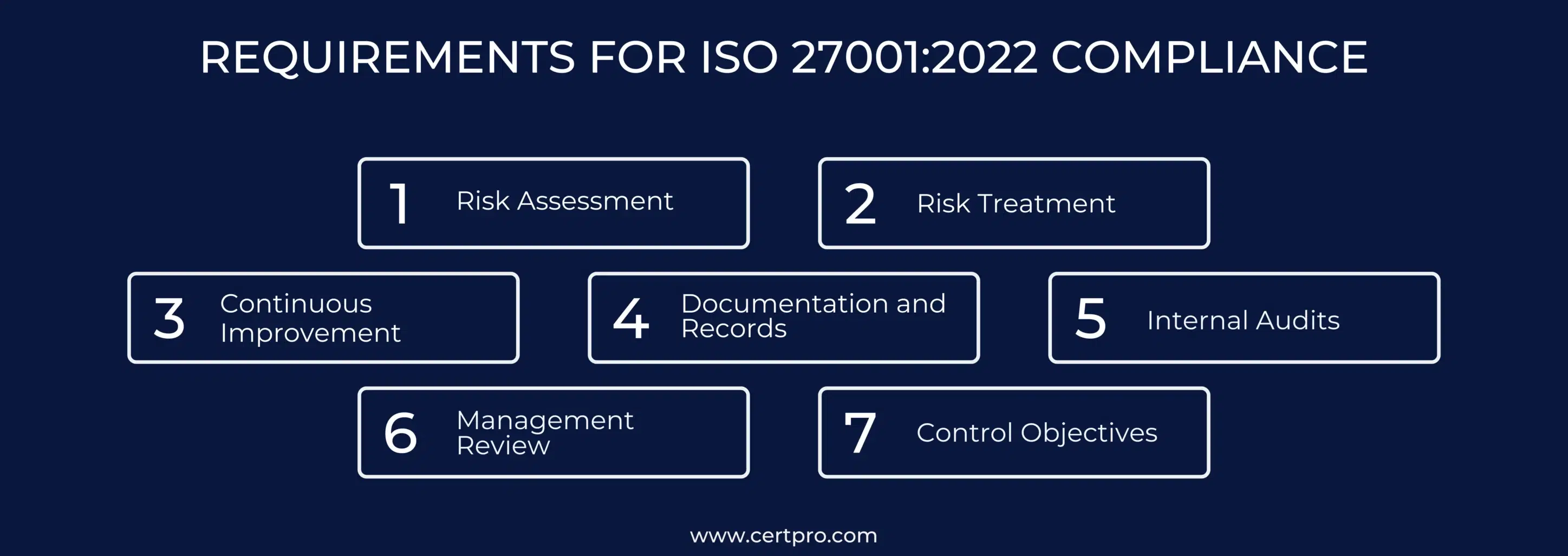
ISO 27001 requires organisations to maintain a defined set of mandatory documented information as evidence of ISMS conformance. Mandatory documentation includes the ISMS scope document, information security policy, risk assessment methodology and results, risk treatment plan, Statement of Applicability, information security objectives, competence records, documented procedures for operational controls, internal audit programme and results, management review records, and records of nonconformities and corrective actions.
Each document must be controlled, version-managed, and accessible to auditors during the certification audit. Incomplete or inconsistent documentation is one of the most common causes of nonconformities identified during the ISO 27001 audit process.
Beyond mandatory documents, organisations typically maintain additional documented information to support operational control implementation and demonstrate evidence of monitoring and measurement activities. This includes records of access reviews, asset inventories, supplier security assessments, incident logs, business continuity test results, and awareness training records.
The volume and nature of supporting documentation varies with organisational size and ISMS scope, but all documentation must be proportionate to the complexity of information security risks being managed. Edinburgh organisations subject to multiple regulatory frameworks often maintain documentation structures that cross-reference ISO 27001 requirements against GDPR obligations and sector-specific regulatory controls simultaneously.
Risk assessment is the methodological foundation of an ISO 27001-conformant ISMS. ISO/IEC 27001:2022 Clause 6.1.2 requires organisations to define and apply a documented risk assessment process that identifies information security risks, analyses their likelihood and potential impact, and evaluates them against defined risk acceptance criteria. The risk assessment must be repeatable and produce consistent, comparable results.
Organisations must demonstrate that identified risks directly inform control selection within the Statement of Applicability, establishing a traceable chain from risk identification through to control implementation and residual risk acceptance.
The risk treatment plan documents how each identified risk will be addressed. It identifies the specific controls or treatment options selected (treat, tolerate, transfer, or terminate), the persons responsible for implementation, and target completion timelines. Risk owners must formally accept residual risks following treatment.
The certification auditor evaluates whether the risk assessment methodology is sound, whether the risk treatment plan is complete, and whether documented evidence demonstrates that treatment activities have been executed. For Edinburgh organisations with complex digital supply chains or multi-cloud infrastructure, the risk assessment must explicitly address third-party and technology-specific risks to achieve ISO 27001 compliance.
Technical controls required under ISO/IEC 27001:2022 Annex A address a comprehensive range of information security domains. Organisations must implement controls across access management, cryptography, physical security, operations security, communications security, system acquisition and development, and supplier relationships.
The 2022 revision introduced five new controls not present in the 2013 standard, including threat intelligence (5.7), information security for use of cloud services (5.23), ICT readiness for business continuity (5.30), web filtering (8.23), and secure coding (8.28). Organisations seeking ISO 27001 Certification in Edinburgh must evaluate all 93 controls for applicability and implement those selected in the Statement of Applicability with documented evidence of operation.
- ✓Defined ISMS scope document aligned to organisational context and boundaries
- ✓Information security policy approved and communicated by senior management
- ✓Documented risk assessment methodology with repeatable, comparable results
- ✓Complete Statement of Applicability covering all 93 ISO/IEC 27001:2022 Annex A controls
- ✓Risk treatment plan with assigned owners, timelines, and residual risk acceptance
- ✓Internal audit programme with completed audit records and findings
- ✓Management review records demonstrating leadership engagement with ISMS performance
- ✓Documented corrective action process with evidence of nonconformity closure
- ✓Competence and awareness records for all personnel with ISMS responsibilities
- ✓Operational procedures for implemented Annex A controls with supporting evidence of execution
- ✓Documentation Requirements
- ✓Risk Assessment and Treatment Requirements
- ✓Technical and Operational Control Requirements
The ISO 27001 Certification Process: Stage-by-Stage Audit Framework
The ISO 27001 certification process follows a structured, multi-stage audit framework defined by accreditation body requirements. Each stage has specific objectives, inputs, and outputs that must be completed sequentially before certification can be issued. Understanding this process enables Edinburgh organisations to prepare accurately for each evaluation stage and maintain appropriate documentation and operational evidence throughout the certification cycle.
The process described here applies to initial certification. Surveillance and recertification audits follow related but abbreviated procedures that focus on continued conformance and any changes to the ISMS environment.
The Stage 1 audit is the initial evaluation conducted by the certification body. During this stage, the lead auditor reviews the organisation’s ISMS documentation to assess whether the documented system is sufficiently developed and aligned to ISO/IEC 27001:2022 requirements to proceed to Stage 2. The auditor evaluates the ISMS scope, information security policy, risk assessment methodology, Statement of Applicability, and all key mandatory documents.
The Stage 1 audit identifies any areas where the documented ISMS is incomplete or where significant gaps exist that would prevent successful Stage 2 evaluation. Addressing these gaps promptly is essential to keeping the ISO 27001 certification timeline on track.
The output of the Stage 1 audit is a written report detailing the auditor’s findings, including any areas of concern or documentation deficiencies that must be addressed before the Stage 2 audit proceeds. Organisations are typically given a defined period to address Stage 1 findings. The Stage 1 audit also establishes the audit plan for Stage 2, including the audit scope, sampling approach, and personnel to be interviewed.
For Edinburgh organisations with complex ISMS scopes covering multiple business units or technology environments, the Stage 1 audit is particularly important in confirming that scope boundaries are clearly defined and that documentation adequately covers all in-scope areas.
The Stage 2 audit is the substantive evaluation of the ISMS’s operational effectiveness. The auditor examines whether the controls documented in the Statement of Applicability are actually implemented and operating as described. This involves reviewing operational records, interviewing personnel at various organisational levels, testing control outputs, and evaluating whether the ISMS is producing the intended information security outcomes.
The Stage 2 audit assesses conformance with all clauses of ISO/IEC 27001:2022 and evaluates the effectiveness of implemented Annex A controls relevant to the organisation’s risk profile. It is the most comprehensive element of the ISO 27001 audit process.
Nonconformities identified during the Stage 2 audit are classified as major or minor. A major nonconformity indicates a systematic failure or absence of a required element of the ISMS and must be closed before certification can be issued. A minor nonconformity indicates an isolated failure or incomplete implementation that does not prevent the ISMS from achieving its intended outcomes, but must be addressed within a defined timeframe after certification.
The auditor documents all findings in a detailed audit report, which forms the basis of the certification decision made by the certification body’s independent review function. The ISO 27001 audit that Edinburgh organisations undergo concludes at Stage 2 with the auditor’s recommendation to the certification body.
Following successful completion of the Stage 2 audit with no unresolved major nonconformities, the certification body conducts an independent technical review of the audit report. Upon satisfactory review, the ISO 27001 certificate is issued. The certificate identifies the organisation, the certified ISMS scope, the standard version (ISO/IEC 27001:2022), the certification body, the accreditation body, and the certificate validity period of three years from the date of issue.
The certificate is publicly listed on the certification body’s register, enabling clients, counterparties, and regulators to verify its authenticity and current validity with ease.
Certification is maintained through annual surveillance audits conducted in the first and second years of the three-year certification cycle. Surveillance audits are shorter than the initial certification audit and focus on verifying that the ISMS continues to operate effectively, that corrective actions from previous audits have been implemented, and that any significant organisational changes have been reflected in updated ISMS documentation and controls.
At the end of the three-year cycle, a recertification audit of similar scope to the initial Stage 2 audit is required to renew the certificate for a further three years. Continuous ISO 27001 compliance that Edinburgh organisations must demonstrate through this ongoing audit cycle is a defining feature of accredited certification programmes.
| Audit Stage | Primary Objective | Key Outputs |
|---|---|---|
| Stage 1 Documentation Audit | Evaluate ISMS documentation completeness against ISO/IEC 27001:2022 requirements | Stage 1 findings report, Stage 2 audit plan |
| Stage 2 Operational Audit | Evaluate operational effectiveness of implemented ISMS and Annex A controls | Nonconformity findings, audit report, certification recommendation |
| Surveillance Audit (Year 1 & 2) | Verify continued ISMS conformance and corrective action closure | Surveillance audit report, continued certification confirmation |
| Recertification Audit (Year 3) | Full re-evaluation of ISMS conformance for certificate renewal | Recertification recommendation, renewed three-year certificate |
| Special Audit | Evaluate significant organisational changes impacting ISMS scope | Scope amendment or suspension recommendation |

- ✓Stage 1 Audit: Documentation and Readiness Evaluation
- ✓Stage 2 Audit: Operational Conformance Evaluation
- ✓Certification Decision, Issuance, and Surveillance Cycle
ISO 27001 Cost in Edinburgh: Factors and Considerations
ISO 27001 cost is a primary consideration for Edinburgh organisations evaluating the certification programme. The total cost of ISO 27001 certification encompasses multiple distinct components, and accurate budgeting requires understanding how each cost driver applies to the specific organisation.
Contrary to simplified cost estimates, the ISO 27001 certification cost that Edinburgh organisations face varies substantially based on organisational size, ISMS scope, operational complexity, existing information security maturity, and the selected certification body. CertPro does not publish fixed pricing for certification audits, as audit fee determination requires a scope assessment specific to each organisation.
Certification Body Audit Fees
Certification body audit fees represent the direct cost of the formal ISO 27001 audit conducted by the accredited certification body. These fees are calculated based on the number of audit days required, which is determined by the organisation’s size (typically measured by number of employees within scope), the complexity of the ISMS scope, the number of sites included in the certification, and the nature of in-scope information processing activities.
For small Edinburgh organisations with a focused ISMS scope, audit fees for Stage 1 and Stage 2 combined may begin from several thousand pounds. For larger organisations or those with complex multi-site or multi-system scopes, audit fees can reach tens of thousands of pounds for the initial certification audit alone.
Annual surveillance audit fees are typically lower than initial certification audit fees, reflecting the reduced audit duration and narrower evaluation scope. Recertification audit fees are broadly comparable to the initial Stage 2 audit fees. Organisations should factor ongoing surveillance and recertification costs into their three-year total cost of ownership for ISO 27001 certification.
Certification body fees also vary between accredited bodies. Edinburgh organisations are advised to obtain comparable quotes from multiple UKAS-accredited or internationally recognised accredited certification bodies when assessing ISO 27001 certification cost Edinburgh market rates.
Internal Resource and Technology Investment Costs
Beyond audit fees paid to the certification body, the total ISO 27001 cost includes significant internal resource investments. Organisations must allocate staff time for ISMS development, documentation, training, internal auditing, management review activities, and ongoing operational control execution. For organisations establishing an ISMS from a lower baseline of information security maturity, the internal resource investment can represent the largest single component of overall ISO 27001 cost.
Edinburgh organisations with constrained internal information security expertise frequently invest in specialist recruitment or training to develop the internal competency required to build and maintain a certifiable ISMS.
Technology investments required to implement selected Annex A controls represent a further component of ISO 27001 cost. Controls requiring investment in security information and event management (SIEM) platforms, identity and access management (IAM) systems, data loss prevention (DLP) tools, vulnerability management scanners, or secure development tooling all contribute to the overall cost profile.
The extent of technology investment depends on the organisation’s existing security tool estate and the gap between current capabilities and the controls required by the risk treatment plan. Edinburgh organisations operating cloud-native or hybrid infrastructure environments may face different technology investment requirements compared to those with traditional on-premises deployments.
ISO 27001 Certification Cost Edinburgh: Key Cost Factors
| Cost Component | Primary Determinants | Relative Impact |
|---|---|---|
| Certification body audit fees | Organisation size, ISMS scope complexity, number of sites, audit days | High |
| Internal staff time and resource | ISMS baseline maturity, documentation scope, internal audit requirements | High |
| Technology and tooling investment | Control gaps, existing security tool estate, cloud vs. on-premises environment | Medium to High |
| Training and competency development | Number of personnel with ISMS responsibilities, existing information security qualifications | Medium |
| Annual surveillance and recertification | Ongoing audit fees, continued internal resource allocation, control maintenance | Medium (recurring) |
Benefits of ISO 27001 Certification for Edinburgh Businesses
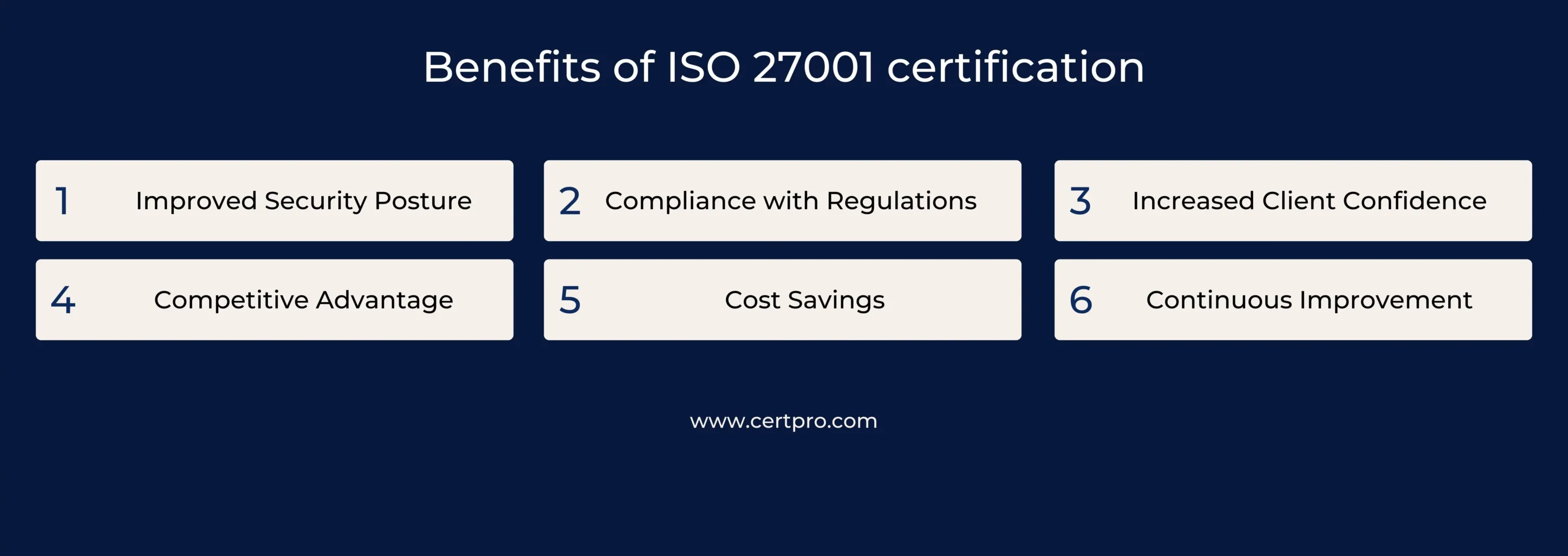
ISO 27001 Certification in Edinburgh delivers measurable benefits across commercial, regulatory, operational, and reputational dimensions. The certification’s value extends beyond the formal certificate itself, encompassing the systematic improvements to information security governance that the certification process drives.
Edinburgh organisations operating in competitive, regulated, or data-intensive sectors gain concrete advantages from certification that translate directly into commercial outcomes and reduced operational risk.
ISO 27001 certification functions as a commercial differentiator and procurement enabler for Edinburgh organisations supplying services to enterprise clients, financial institutions, and public sector bodies. Scottish Government procurement frameworks, NHS Scotland supplier qualification requirements, and private sector enterprise procurement processes increasingly specify ISO 27001 certification as a mandatory or scored criterion in supplier evaluation.
Organisations holding current ISO 27001 certification can evidence their information security governance through a verified, independently audited attestation rather than completing multiple client-side security questionnaires — reducing the administrative burden of sales and procurement processes significantly.
For Edinburgh’s financial services and fintech organisations, ISO 27001 certification facilitates access to banking partnerships, payment network participation, and regulated sector contracts where counterparty information security due diligence requirements are stringent. Certification also provides a basis for demonstrating third-party risk management maturity to regulated clients, supporting the client’s own regulatory obligations around supply chain security governance.
In competitive tender processes, ISO 27001 certification for Edinburgh companies provides a scored advantage over non-certified competitors and can be the determining factor in contract award decisions where security governance capability is weighted in evaluation criteria.
The structured risk management framework embedded in ISO 27001 certification drives systematic identification and treatment of information security risks before they materialise as incidents. Organisations that have implemented a certifiable ISMS typically demonstrate lower rates of significant information security incidents than those operating without a structured framework. The standard’s requirements for continuous monitoring, internal auditing, and management review create ongoing mechanisms for identifying and addressing emerging risks.
For Edinburgh organisations handling regulated data, reducing the frequency and severity of information security incidents directly reduces regulatory exposure and associated financial and reputational costs.
ISO 27001 compliance requirements include mandatory incident management procedures and business continuity planning, both of which directly improve an organisation’s capability to detect, respond to, and recover from information security incidents. The standard requires organisations to document their incident response process, maintain records of incidents and actions taken, and use incident data to drive continual improvement of the ISMS.
Edinburgh organisations that have achieved and maintained ISO 27001 certification are better positioned to manage the operational, legal, and regulatory consequences of information security incidents — including the 72-hour breach notification obligation under UK GDPR to the ICO.
ISO 27001 certification provides Edinburgh organisations with a documented, independently verified framework that maps against multiple regulatory obligations simultaneously. The standard’s Annex A controls address technical and organisational security measures relevant to UK GDPR Article 32, NIS Regulations, FCA cybersecurity expectations, and sector-specific frameworks applicable to Scottish public bodies.
Organisations that can demonstrate ISO 27001 certification in response to regulatory inquiries or investigations benefit from the recognised status of the standard as evidence of systematic information security governance. While certification does not guarantee regulatory immunity, it provides substantive evidence of due diligence in information security risk management.
- ✓Independently verified evidence of information security management system conformance for procurement qualification
- ✓Reduced administrative burden in responding to client and counterparty security due diligence requests
- ✓Systematic risk identification and treatment reducing exposure to information security incidents
- ✓Regulatory alignment with UK GDPR, NIS Regulations, and FCA cybersecurity expectations
- ✓Demonstrated business continuity and incident response capability under independently audited controls
- ✓Competitive differentiation in Scottish public sector, financial services, and enterprise procurement
- ✓Improved supplier and third-party risk management through Annex A supply chain security controls
- ✓Structured framework for continual improvement of information security governance
- ✓Internationally recognised certification accepted across EU, North American, and Asia-Pacific markets
- ✓Reduced cyber insurance premiums available to organisations demonstrating certified security governance
- ✓Commercial and Procurement Advantages
- ✓Risk Reduction and Incident Response Capability
- ✓Regulatory Alignment and Penalty Avoidance
ISO 27001 Consulting Edinburgh: Understanding the Audit-Only Boundary
ISO 27001 consulting in Edinburgh and ISO 27001 certification in Edinburgh are distinct service categories performed by different types of organisations. Certification is performed exclusively by accredited certification bodies operating under internationally recognised accreditation standards. Consulting and implementation activities are performed by separate organisations that advise clients on ISMS design and control implementation.
The independence requirement in certification standards strictly prohibits accredited certification bodies from providing implementation or advisory services to organisations they certify, preserving audit objectivity and the integrity of the certification programme.
CertPro operates as a Licensed CPA Firm delivering ISO 27001 certification audit services. CertPro’s scope of engagement is strictly limited to certification audit and evaluation activities: conducting Stage 1 and Stage 2 audits, evaluating ISMS conformance against ISO/IEC 27001:2022 requirements, issuing certification decisions, and conducting surveillance and recertification audits.
CertPro does not deliver implementation activities, design ISMS documentation, select or configure security controls, or provide compliance advice. Edinburgh organisations seeking ISO 27001 implementation support should engage qualified information security professionals separately from and independently of their chosen certification body.
Selecting an Accredited ISO 27001 Certification Body
Edinburgh organisations seeking ISO 27001 certification should verify that their chosen certification body holds current accreditation from a recognised national accreditation body. In the United Kingdom, the United Kingdom Accreditation Service (UKAS) is the national accreditation body for certification bodies conducting ISO 27001 audits. UKAS-accredited certification ensures that the certification body’s audit processes, auditor competencies, and certification decisions are independently evaluated and meet internationally recognised accreditation standards.
Certificates issued by UKAS-accredited bodies carry the UKAS accreditation mark and are globally recognised through mutual recognition agreements between national accreditation bodies.
When evaluating certification bodies for ISO 27001 Certification in Edinburgh, organisations should consider sector-specific auditor competency — particularly for financial services, healthcare, or technology sectors where domain knowledge enhances the quality of the audit evaluation. Edinburgh organisations should also consider the certification body’s geographic coverage, auditor availability in Scotland, and experience with multi-site or cloud-hosted ISMS environments.
The certification body’s public register should be reviewed to confirm that existing certified organisations in comparable sectors retain active certificates, indicating effective ongoing certification programme management.
ISO 27001 Implementation in Edinburgh: Preparing for Certification Audit
ISO 27001 implementation that Edinburgh organisations undertake prior to engaging a certification body involves establishing all ISMS components required to demonstrate conformance during the Stage 1 and Stage 2 audits. Effective implementation is the organisation’s responsibility and is entirely separate from the certification audit process.
The quality and completeness of implementation directly determines audit outcomes. Organisations that enter the Stage 2 audit with incomplete documentation, untested controls, or unresolved risk treatment activities face a significantly higher risk of receiving major nonconformity findings that delay certification.
Defining ISMS Scope and Organisational Context
ISMS scope definition is the foundational activity in ISO 27001 implementation. The scope document identifies the organisational boundaries, information assets, processes, physical locations, and technology systems included within the ISMS. ISO/IEC 27001:2022 Clause 4 requires organisations to understand their internal and external context, identify interested parties and their information security requirements, and define the ISMS scope in terms that clearly establish what is and is not included.
Scope definition decisions directly affect audit effort, certification body fees, and the range of controls that must be implemented. Edinburgh organisations commonly define ISMS scopes around specific service lines, business units, or technology environments to achieve certification while managing implementation complexity.
Edinburgh’s financial services organisations frequently define ISMS scopes around their digital banking platforms, client data management systems, or regulated trading environments. Technology companies commonly scope their ISMS around product development and delivery environments, cloud infrastructure, and client data processing systems. Public sector bodies in Edinburgh may scope their ISMS around citizen-facing digital services or specific administrative functions handling sensitive personal data.
In all cases, the scope must be sufficiently broad to include the primary information security risks the organisation faces. Artificially narrow scopes that exclude significant information assets are likely to be challenged during the Stage 1 audit.
Internal Audit Programme Requirements
ISO/IEC 27001:2022 Clause 9.2 requires organisations to conduct internal audits at planned intervals to evaluate whether the ISMS conforms to the organisation’s own requirements and to the standard’s requirements, and whether the ISMS is effectively implemented and maintained. Internal audits must be conducted by personnel who are independent of the activities being audited, ensuring objectivity in the evaluation.
Internal audit findings must be reported to management and used to drive corrective actions where nonconformities are identified. The internal audit programme — including planned audit schedules, completed audit records, findings, and corrective actions — is reviewed during the external certification audit as evidence of the organisation’s self-evaluation capability.
For Edinburgh organisations with limited internal information security audit resource, establishing a credible internal audit programme is one of the more challenging implementation activities. The organisation must either develop internal auditor competency or engage qualified internal auditors through appropriate arrangements. Internal auditors must be competent in both ISO 27001 requirements and the specific information security technologies and processes within the ISMS scope.
The certification auditor evaluates not only whether internal audits were conducted but whether the audit evidence demonstrates genuine, objective evaluation of ISMS conformance rather than a superficial documentation review exercise.
Management Review and Leadership Engagement
ISO/IEC 27001:2022 Clause 9.3 requires organisations to conduct management reviews of the ISMS at planned intervals. Management reviews must evaluate the continued suitability, adequacy, and effectiveness of the ISMS based on inputs including internal and external audit results, security incident data, risk assessment outcomes, performance measurement results, and changes in the organisational context that may affect information security.
Outputs of management reviews must include decisions and actions related to continual improvement opportunities and resource requirements. Management review records are a primary evidence source during the certification audit, demonstrating that senior leadership is actively engaged in ISMS governance rather than delegating responsibility entirely to the information security team.
ISO 27001 Certification in Edinburgh: Sector-Specific Applications
ISO 27001 Certification in Edinburgh is relevant across all industry sectors but carries particular significance where information security risks are elevated, regulatory requirements are stringent, or client due diligence requirements are formalised. Edinburgh’s diverse economic base means that ISO 27001 certification applications span financial services, technology, public sector, legal services, healthcare, energy, and professional services.
Each sector presents distinct information security risk profiles and regulatory contexts that shape how the ISMS is designed, what controls are prioritised, and how certification evidence is structured.
Financial Services and Fintech
Edinburgh’s position as the UK’s second-largest financial centre — hosting major banks including the Royal Bank of Scotland and several global asset managers — creates a substantial market for ISO 27001 certification among financial services organisations and their technology suppliers. ISO 27001 certification that Edinburgh financial services institutions pursue provides a structured framework that supports alignment with FCA operational resilience requirements, PRA cyber resilience expectations, and the Bank of England’s CBEST threat intelligence-led assessment framework.
For regulated firms, the documented risk assessment and control framework within an ISO 27001-certified ISMS supports the mapping of information security controls against the FCA’s Systems and Controls (SYSC) requirements.
ISO 27001 compliance that Edinburgh fintech companies operating in the payments, digital banking, and wealthtech sectors must maintain is particularly demanding. Payment card data security requirements under PCI DSS overlap significantly with ISO 27001 controls, and organisations holding both certifications benefit from a unified security control framework that satisfies multiple standards simultaneously.
Edinburgh’s fintech sector, supported by organisations such as FinTech Scotland and the wider Scottish financial services ecosystem, has adopted ISO 27001 certification as a baseline security governance standard that enables fintech companies to access enterprise banking partnerships and regulated client relationships.
Technology Companies and Managed Service Providers
Edinburgh’s growing technology sector includes software companies, managed service providers (MSPs), cybersecurity firms, and data analytics organisations — all of which handle client data and operate IT environments that represent significant information security risks. ISO 27001 certification that Edinburgh technology companies obtain provides third-party verified assurance to their clients that information entrusted to the technology provider is managed under an independently audited security framework.
For MSPs and cloud service providers operating Edinburgh data centres or providing cloud-hosted services to Edinburgh organisations, ISO 27001 certification supports client confidence in the security of outsourced IT environments and facilitates the transfer of relevant ISMS evidence to clients for their own compliance purposes.
Edinburgh’s academic and research sector, including the University of Edinburgh and its technology commercialisation activities, increasingly engages with ISO 27001 certification for research data management, clinical trial data systems, and commercially sensitive intellectual property protection environments. Research organisations handling data subject to national security classifications or pharmaceutical industry data governance requirements find ISO 27001 certification provides a structured framework that satisfies both contractual security requirements from industry partners and the increasingly formalised information security governance expectations of research funding bodies.
Public Sector and Critical National Infrastructure
Scottish Government bodies, Edinburgh City Council, and other public sector organisations in Edinburgh are subject to the Scottish Public Finance Manual, the Public Services Network (PSN) Code of Connection, and the Cyber Essentials Plus requirements applicable to public bodies. ISO 27001 certification provides a comprehensive information security management framework that goes beyond the scope of Cyber Essentials and addresses the broader governance, risk management, and compliance requirements applicable to public bodies handling citizen data and operating critical digital services.
Organisations operating under NIS Regulations as operators of essential services in sectors such as energy, transport, or water are required to implement appropriate and proportionate security measures, for which ISO 27001 provides a recognised and well-established reference framework.
ISO 27001 Audit Process: What Edinburgh Organisations Are Evaluated On
The ISO 27001 audit evaluates conformance across all clauses of ISO/IEC 27001:2022 and the applicable Annex A controls identified in the organisation’s Statement of Applicability. Understanding what auditors evaluate enables Edinburgh organisations to prepare appropriate evidence and ensure that implemented controls are documented and operational in a form that can be verified during the audit.
The evaluation is objective and evidence-based: auditor conclusions are drawn from documentary evidence, personnel interviews, and direct observation of operational processes and technical controls. There is no substitute for genuine, well-evidenced ISMS implementation.
The ISO 27001 audit evaluates each of the mandatory clauses (4 through 10) of ISO/IEC 27001:2022 in sequence. Clause 4 (Context of the Organisation) examination covers whether the organisation has documented its internal and external context, identified relevant interested parties, and defined an appropriate ISMS scope. Clause 5 (Leadership) evaluation examines management commitment evidence, including the information security policy, assignment of roles and responsibilities, and evidence of senior leadership engagement in ISMS governance activities. Clause 6 (Planning) evaluation examines the risk assessment process, risk treatment plan, information security objectives, and their alignment with organisational strategy.
Clause 7 (Support) evaluation examines resource provision, competence records, awareness activities, communication processes, and documented information control. Clause 8 (Operation) evaluation examines implementation of the risk treatment plan, operational control execution, and management of changes and externally provided processes. Clause 9 (Performance Evaluation) examines monitoring and measurement activities, internal audit programme evidence, and management review records.
Clause 10 (Improvement) examines nonconformity management, corrective action records, and evidence of continual improvement activities. Each clause evaluation draws on specific types of documentary and operational evidence that organisations must maintain well in advance of the ISO 27001 audit.
Annex A control evaluation during the Stage 2 audit examines whether each control included in the Statement of Applicability is implemented as documented and operating effectively. The auditor selects a sample of controls for detailed evaluation based on the organisation’s risk profile and the areas of greatest significance identified during the Stage 1 audit.
Evidence for Annex A controls must demonstrate both that the control is in place (implementation evidence) and that it is functioning as intended (operational effectiveness evidence). Access review logs, firewall rule sets, encryption configuration records, vulnerability scan results, supplier security assessment records, and incident response test records are all examples of operational evidence that auditors examine during the ISO 27001 audit process.
- Define ISMS scope with documented organisational context, interested parties, and boundaries
- Conduct a formal risk assessment using a documented, repeatable methodology aligned to ISO/IEC 27001:2022 Clause 6.1
- Develop a risk treatment plan mapping identified risks to selected Annex A controls or alternative treatment options
- Complete the Statement of Applicability covering all 93 Annex A controls with implementation status and justifications
- Implement selected controls with documented procedures and accumulate operational evidence of control execution
- Establish internal audit programme, conduct initial internal audits, and document findings and corrective actions
- Conduct management review with documented inputs, outputs, and decisions aligned to Clause 9.3 requirements
- Engage an accredited certification body and submit to Stage 1 documentation review
- Address Stage 1 findings and confirm Stage 2 audit readiness with complete operational evidence
- Undergo Stage 2 operational audit, close any nonconformities identified, and receive certification decision
- ✓Clause-by-Clause Evaluation Framework
- ✓Annex A Control Evaluation and Evidence Requirements
FAQ
▶
What is ISO 27001 Certification and why does it matter for Edinburgh organisations?
▶
How long does the ISO 27001 certification process take in Edinburgh?
▶
What is the ISO 27001 cost for Edinburgh organisations?
▶
What is the difference between ISO 27001 compliance and ISO 27001 certification?
▶
What does the ISO 27001 audit in Edinburgh involve?
▶
How many controls are required for ISO 27001 certification under the 2022 standard?
▶
Does ISO 27001 certification satisfy GDPR requirements for Edinburgh organisations?
▶
How long is an ISO 27001 certificate valid and what is required to maintain it?
Multi-Framework Compliance Guide: Best Practices and Strategies
Most compliance teams aren’t managing one framework. They’re managing three, four, sometimes five — simultaneously. A SaaS company selling to enterpri…
HOW COMPLIANCE AUDIT SOFTWARE IMPROVES AUDIT READINESS
Today, most companies deal with a growing number of compliance regulations. From data privacy standards to security frameworks like SOC 2 and ISO 2700…

THE ROLE OF GRC IN ISO 27001, SOC 2, AND OTHER FRAMEWORKS
The term GRC stands for Governance Risk and Compliance. It’s a system of integrated and centralized approaches used by organizations. This system comb…
Get In Touch
have a question? let us get back to you.