
ISO 27001 Certification in India
ISO 27001:2022 specifies a defined set of documents and records that organizations must maintain as evidence of ISMS operation. These mandatory documents are non-negotiable and must be available in verifiable form during certification audits. The absence of any mandatory document constitutes a nonconformity that prevents certification issuance until resolved.
OUR CLIENTS










What Is ISO 27001 Certification?
ISO/IEC 27001 is an international standard published jointly by the International Organization for Standardization (ISO) and the International Electrotechnical Commission (IEC). The standard specifies requirements for establishing, implementing, maintaining, and continually improving an Information Security Management System (ISMS). ISO 27001 certification is issued following a third-party conformity audit conducted by an accredited certification body — it is not a self-declaration or internal compliance activity. The current active version is ISO 27001:2022, which supersedes the 2013 edition and introduces an updated control set across four Annex A domains.
The ISMS framework established under ISO 27001 governs the confidentiality (information is accessible only to authorized individuals), integrity (information remains accurate and unaltered by unauthorized parties), and availability (information and systems are accessible when required) of an organization’s information assets — collectively known as the CIA triad. ISO 27001 applies to all types of information assets, including digital records, physical documents, software, hardware, and human knowledge. The standard is sector-agnostic and applicable to organizations of all sizes, from early-stage startups to large multinational enterprises operating across India.
ISO 27001 certification differs from general compliance activities in a fundamental way: certification requires an independent, accredited third-party audit body to evaluate whether an organization’s ISMS conforms to all mandatory clauses (Clauses 4 through 10) of the standard. A successful audit results in the issuance of a formal certificate, valid for three years, subject to annual surveillance audits. Organizations that merely document policies or complete internal checklists without a third-party audit do not hold ISO 27001 certification. CertPro, a Licensed CPA Firm, conducts ISO 27001 certification audits across India, evaluating ISMS conformity in accordance with the 2022 version of the standard.

Why ISO 27001 Certification Matters for Indian Businesses
India’s Position in the Global Information Security Landscape
India is the world’s largest IT and technology outsourcing hub, with thousands of IT services firms, software development companies, business process outsourcing (BPO) organizations, and SaaS providers serving global clients across North America, Europe, and the Asia-Pacific region. This dominant position in global technology delivery creates a specific, high-stakes demand for ISO 27001 certification. International clients — particularly those headquartered in the European Union, the United States, and the United Kingdom — routinely mandate ISO 27001 certification as a contractual prerequisite for vendors handling their data. Without a valid ISO 27001 certificate, Indian IT organizations risk disqualification from enterprise procurement processes, government IT contracts, and regulated-sector partnerships.
India’s cyber threat environment has intensified significantly over the past decade. The Indian Computer Emergency Response Team (CERT-In) reports thousands of cybersecurity incidents annually, spanning ransomware attacks, data breaches, phishing campaigns, and advanced persistent threats targeting financial services, healthcare, and critical infrastructure. ISO 27001 certification in India provides organizations with a structured, risk-based framework to identify, assess, and treat information security risks systematically — moving beyond reactive incident response toward a proactive, governance-driven security posture. Certification demonstrates to regulators, clients, and business partners that an organization’s information security controls have been independently verified against an internationally recognized standard.
Regulatory and Legal Drivers in India
The Digital Personal Data Protection Act (DPDPA) 2023 establishes legally enforceable obligations for data fiduciaries operating in India, requiring organizations to implement reasonable security safeguards to protect personal data. ISO 27001 certification provides a documented, audited control framework that directly addresses DPDPA security obligations. Similarly, the Reserve Bank of India (RBI) IT Framework for Banks and the Securities and Exchange Board of India (SEBI) Cybersecurity and Cyber Resilience Framework impose information security requirements on regulated financial institutions. ISO 27001 compliance maps to these regulatory controls, enabling certified organizations to demonstrate alignment with multiple regulatory obligations through a single, unified ISMS framework.
CERT-In’s 2022 cybersecurity directions mandate that organizations report cybersecurity incidents within six hours of detection and maintain detailed logs for 180 days. ISO 27001’s incident management and logging controls — specifically controls within the Technology domain of ISO 27001:2022 — align directly with these CERT-In requirements. Indian organizations that hold ISO 27001 certification are better positioned to demonstrate CERT-In compliance, as their incident response, monitoring, and logging procedures have been independently verified by an accredited audit body. The intersection of ISO 27001 with Indian regulatory frameworks makes certification not merely a market differentiator but increasingly a compliance necessity for organizations operating in regulated sectors.
Competitive Advantage in Global Markets
ISO 27001 certification delivers measurable competitive advantages for Indian organizations competing in global markets. Enterprise procurement teams at multinational corporations use ISO 27001 certification as a baseline vendor qualification criterion, particularly in sectors such as financial services, healthcare IT, and defense. Indian IT services firms and SaaS providers that hold a valid ISO 27001 certificate can participate in procurement processes that are inaccessible to uncertified competitors. Certification also reduces the frequency and depth of client-initiated security audits, as the ISO 27001 certificate serves as independent assurance that the vendor’s security controls have already been evaluated by a qualified third party.
For Indian startups and SMEs targeting European Union clients, ISO 27001 certification provides a practical pathway to demonstrate GDPR alignment, as the standard’s controls map directly to GDPR’s Article 32 technical and organizational security measures. This alignment reduces the compliance burden for Indian organizations serving EU-based clients, enabling them to leverage a single certification framework to satisfy both ISO 27001 audit requirements and client-imposed GDPR security obligations. Indian data center operators, cloud service providers, and managed security service providers similarly use ISO 27001 certification to differentiate their offerings in competitive tender processes where security credentials are formally evaluated.
ISO 27001 Requirements in India
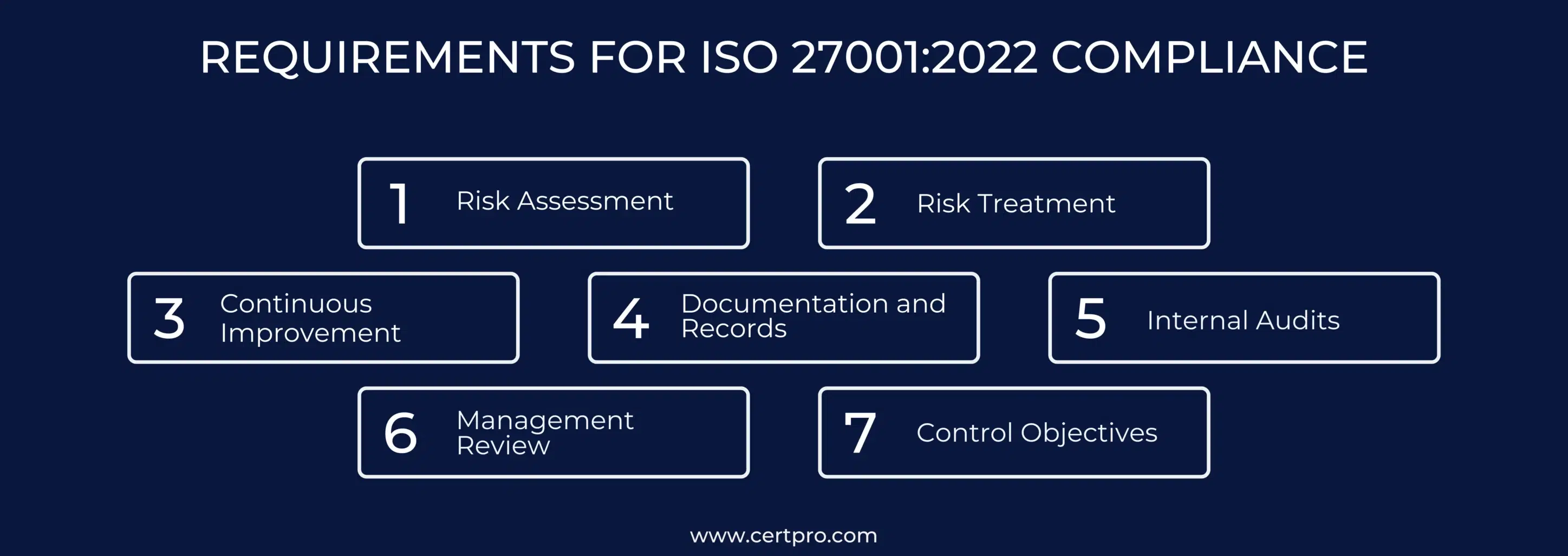
ISO 27001:2022 establishes mandatory requirements in Clauses 4 through 10. Every clause is obligatory — organizations cannot exclude any clause from their certification scope. Clause 4 requires organizations to define the internal and external context of their ISMS, identify interested parties, and determine the ISMS scope. Clause 5 establishes leadership obligations, including the requirement for top management to demonstrate commitment to the ISMS through defined roles, responsibilities, and an explicit information security policy. Clause 6 addresses planning, requiring a formal risk assessment process, risk treatment plan, and measurable information security objectives. Together, Clauses 4 through 6 form the strategic foundation of the ISMS.
Clause 7 specifies support requirements: competence, awareness, communication, and documented information. Organizations must demonstrate that personnel with ISMS responsibilities possess the necessary skills and that security awareness training is conducted systematically. Clause 8 governs operational execution, including the requirement to conduct and document a formal information security risk assessment and implement the risk treatment plan. Clause 9 requires performance evaluation through internal audits, management reviews, and monitoring of ISMS effectiveness. Clause 10 mandates continual improvement, requiring organizations to address nonconformities, implement corrective actions, and demonstrate that the ISMS evolves in response to changing risk conditions. All ten clauses must be evidenced through documented records available for inspection during the certification audit.
ISO 27001:2022 Annex A contains 93 controls organized across four domains: Organizational Controls (37 controls), People Controls (8 controls), Physical Controls (14 controls), and Technology Controls (34 controls). The 2022 update reduced the control count from 114 controls across 14 domains in the 2013 version and introduced 11 new controls addressing areas such as threat intelligence, cloud service security, data masking, and ICT readiness for business continuity. Organizations are not required to implement all 93 controls — instead, they must complete a Statement of Applicability (SoA), which documents which controls are applicable to their ISMS scope, which are implemented, and which are excluded with documented justification. The SoA is a mandatory document that auditors review during the certification audit.
| Annex A Domain | Number of Controls | Key Focus Areas |
|---|---|---|
| Organizational Controls | 37 | Policies, risk management, supplier relationships, incident management |
| People Controls | 8 | Screening, training, disciplinary process, remote working |
| Physical Controls | 14 | Physical security perimeters, equipment maintenance, secure disposal |
| Technology Controls | 34 | Access control, cryptography, logging, vulnerability management, cloud security |
ISO 27001:2022 specifies a defined set of documents and records that organizations must maintain as evidence of ISMS operation. These mandatory documents are non-negotiable and must be available in verifiable form during certification audits. The absence of any mandatory document constitutes a nonconformity that prevents certification issuance until resolved.
- ✓ISMS Scope document defining the boundaries and applicability of the management system
- ✓Information Security Policy approved and communicated by top management
- ✓Information Security Risk Assessment methodology and results
- ✓Information Security Risk Treatment Plan with control selection rationale
- ✓Statement of Applicability (SoA) documenting all Annex A controls and their applicability status
- ✓Information Security Objectives with measurable targets and monitoring methods
- ✓Evidence of competence and training records for personnel with ISMS responsibilities
- ✓Internal audit program and results of conducted internal audits
- ✓Management review records demonstrating periodic ISMS evaluation by leadership
- ✓Records of nonconformities identified and corrective actions taken
- ✓Mandatory Clause Requirements (Clauses 4–10)
- ✓Annex A Controls in ISO 27001:2022
- ✓Mandatory Documentation Requirements
ISO 27001 Certification Process in India
The ISO 27001 certification process in India follows a structured, sequential pathway from initial ISMS design through third-party audit and formal certificate issuance. The process typically spans six to twelve months for organizations beginning without a pre-existing security management framework, though this timeline varies based on organization size, operational complexity, and the current maturity of existing security controls. Organizations with established IT governance frameworks — such as those already aligned with NIST CSF or ISO 9001 — may complete the process in a compressed timeframe due to reusable control documentation and existing management system infrastructure. The certification process culminates in a two-stage audit conducted by an accredited certification body such as CertPro.
- Define ISMS Scope: The organization formally defines the boundaries of its ISMS, specifying which business units, locations, processes, information assets, and technologies fall within certification scope. The scope document is reviewed and approved by top management.
- Conduct Information Security Risk Assessment: The organization identifies all information assets within scope, assesses threats and vulnerabilities affecting each asset, evaluates the likelihood and impact of potential security incidents, and assigns risk ratings to determine which risks require treatment.
- Develop Risk Treatment Plan and Select Controls: Based on risk assessment results, the organization selects appropriate controls from ISO 27001:2022 Annex A and any additional controls required by regulatory or contractual obligations. The risk treatment plan documents control ownership, implementation timelines, and residual risk acceptance.
- Implement ISMS Controls and Documentation: Selected controls are implemented across the organization, supported by the mandatory documentation set including the Information Security Policy, Statement of Applicability, and operational procedures. Personnel are trained on their ISMS responsibilities.
- Conduct Internal Audit: The organization performs a formal internal audit of its ISMS, evaluating conformity with all ISO 27001:2022 mandatory clauses and the controls declared applicable in the Statement of Applicability. Internal audit findings are recorded and nonconformities are addressed through corrective actions.
- Conduct Management Review: Top management reviews the ISMS, evaluating internal audit results, security performance metrics, risk treatment status, and opportunities for improvement. Management review records are documented as mandatory evidence for the certification audit.
- Stage 1 Certification Audit (Documentation Review): CertPro auditors conduct a Stage 1 audit, reviewing the organization’s ISMS documentation to confirm that mandatory documents exist, are complete, and demonstrate readiness for the Stage 2 audit. Stage 1 findings are communicated to the organization prior to scheduling Stage 2.
- Stage 2 Certification Audit (Conformity Assessment): CertPro auditors conduct an on-site Stage 2 audit, evaluating the effective implementation and operation of the ISMS across the defined scope. Auditors interview personnel, inspect records, test controls, and assess conformity with all mandatory clauses and applicable Annex A controls.
- Nonconformity Resolution: Any major or minor nonconformities identified during the Stage 2 audit must be resolved through documented corrective actions before the certification decision is finalized. Major nonconformities require evidence of resolution; minor nonconformities may be accepted with a corrective action plan.
- Certificate Issuance: Following successful completion of the Stage 2 audit and resolution of nonconformities, CertPro issues the ISO 27001:2022 certificate. The certificate is valid for three years from the date of issuance.
- Annual Surveillance Audits: Surveillance audits are conducted annually during the three-year certificate validity period to confirm that the ISMS continues to operate effectively and that no significant changes have compromised conformity.
- Recertification Audit: At the end of the three-year cycle, a full recertification audit is conducted to renew the ISO 27001 certificate for a subsequent three-year period.

- ✓Overview of the Certification Journey
- ✓Step-by-Step Certification Process
ISO 27001 Audit in India
Stage 1 Audit: Documentation and Readiness Review
The ISO 27001 Stage 1 audit, also referred to as the documentation review or desktop audit, is the first formal evaluation conducted by the accredited certification body. During Stage 1, CertPro auditors review the organization’s ISMS documentation to verify that all mandatory documents required by ISO 27001:2022 are present, complete, and internally consistent. Auditors assess the adequacy of the ISMS scope, the Information Security Policy, the risk assessment methodology, the Statement of Applicability, and the internal audit records. Stage 1 is primarily an administrative evaluation — auditors are confirming that the documented ISMS is sufficiently developed to proceed to Stage 2 operational testing.
Stage 1 audit findings are classified into observations, opportunities for improvement, and nonconformities. A significant number of Stage 1 nonconformities — particularly if they indicate that mandatory clauses are undocumented or that the ISMS scope is unclear — may result in the Stage 2 audit being postponed until the deficiencies are resolved. The Stage 1 audit typically takes one to two days for a mid-sized Indian organization, with the duration scaling based on the complexity of the ISMS scope. Following Stage 1, CertPro provides a formal Stage 1 audit report that identifies any areas requiring attention before Stage 2 proceeds.
Stage 2 Audit: Conformity Assessment
The ISO 27001 Stage 2 audit is the principal conformity assessment, conducted on-site at the organization’s facilities within the defined certification scope. CertPro auditors evaluate whether the ISMS is not only documented but effectively implemented and operationally active. Stage 2 activities include structured interviews with personnel across relevant roles (IT, HR, operations, management), review of operational records and logs, inspection of physical security controls, technical testing of access control and monitoring systems, and sampling of control evidence across all applicable Annex A controls declared in the Statement of Applicability. The audit duration for a mid-sized Indian IT organization typically ranges from two to five days.
Stage 2 nonconformities are classified as major or minor. A major nonconformity indicates a systematic failure of a mandatory clause requirement or a significant gap in an applicable Annex A control — major nonconformities must be fully resolved before the certificate can be issued. A minor nonconformity indicates an isolated deviation that does not constitute a systemic failure — minor nonconformities require a corrective action plan to be submitted and accepted by CertPro, but do not necessarily prevent certificate issuance. Following successful Stage 2 completion and nonconformity resolution, CertPro’s certification decision is documented and the ISO 27001:2022 certificate is formally issued to the organization.
Internal Audit Requirements
ISO 27001 Clause 9.2 requires organizations to conduct internal audits at planned intervals to evaluate whether the ISMS conforms to the organization’s own requirements and the requirements of the standard, and whether the ISMS is effectively implemented and maintained. Internal audits must be conducted by personnel who are independent of the activities being audited — meaning the individual responsible for implementing a particular control cannot serve as the internal auditor for that same control. Internal auditors must be competent, possessing knowledge of ISO 27001 requirements and audit techniques. Internal audit records, including the audit program, individual audit reports, and nonconformity logs, are mandatory documents reviewed during the Stage 1 and Stage 2 certification audits.
Surveillance and Recertification Audits
Following initial certificate issuance, ISO 27001 certification in India operates on a three-year cycle with annual surveillance audits. Surveillance audits are conducted in Year 1 and Year 2 of the certificate validity period. These audits are narrower in scope than the initial Stage 2 audit — surveillance auditors focus on verifying that the ISMS continues to operate effectively, that corrective actions from previous audits have been implemented, and that significant organizational changes have not compromised ISMS conformity. Organizations that undergo major changes — such as mergers, acquisitions, significant expansion of IT infrastructure, or entry into new markets — must notify CertPro, as such changes may trigger an unscheduled surveillance audit or scope review.
The recertification audit, conducted in Year 3, is a comprehensive reassessment equivalent in scope to the original Stage 2 audit. Recertification evaluates the entire ISMS against current ISO 27001:2022 requirements, including any updates or changes to the standard since the previous certification cycle. Organizations must complete recertification before the existing certificate expires to maintain continuous certification status. A lapse in certification — caused by failure to complete recertification on time or by certificate suspension following serious nonconformities — requires the full certification process to be repeated. Transition to ISO 27001:2022 from the 2013 version was required by October 31, 2025, as mandated by international accreditation bodies.
ISO 27001 Compliance in India
Mapping ISO 27001 to Indian Regulatory Frameworks
ISO 27001 compliance in India intersects with multiple domestic regulatory frameworks, and organizations that achieve ISO 27001 certification establish a documented control baseline that maps directly to several Indian statutory and regulatory requirements. The Digital Personal Data Protection Act (DPDPA) 2023 requires data fiduciaries to implement reasonable security safeguards to prevent personal data breaches. ISO 27001’s risk-based control framework — encompassing access control, encryption, incident management, and data handling procedures — directly addresses DPDPA security obligations. An ISO 27001-certified organization can demonstrate DPDPA technical compliance through its independently audited ISMS documentation, reducing regulatory examination risk and strengthening its position before the Data Protection Board of India.
The Reserve Bank of India (RBI) Master Direction on Information Technology Governance, Risk, Controls and Assurance Practices imposes comprehensive information security requirements on scheduled commercial banks, urban cooperative banks, and non-banking financial companies. ISO 27001’s control domains — including asset management, access control, cryptography, supplier security, and incident management — align with RBI’s IT governance requirements. Similarly, the SEBI Cybersecurity and Cyber Resilience Framework mandates that market intermediaries implement specific cybersecurity controls. ISO 27001 certification provides SEBI-regulated entities with a structured, audited framework for demonstrating cybersecurity governance, reducing the compliance burden of responding to individual SEBI cybersecurity directives.
CERT-In Directions and ISO 27001 Alignment
CERT-In’s April 2022 cybersecurity directions require all service providers, intermediaries, data centers, body corporates, and government organizations operating in India to implement specific incident reporting, log retention, and vulnerability management measures. ISO 27001:2022 Technology Controls directly address these requirements: Control 8.15 (Logging) requires the creation and protection of event logs that record user activities, exceptions, and security events — aligning with CERT-In’s 180-day log retention mandate. Control 8.16 (Monitoring activities) requires organizations to monitor networks, systems, and applications for anomalous behavior. Control 5.25 (Assessment and decision on information security events) governs incident classification and reporting — aligning with CERT-In’s six-hour incident reporting requirement for critical incidents.
ISO 27001 compliance also supports alignment with the National Cyber Security Policy and the Ministry of Electronics and Information Technology (MeitY) guidelines for electronic service delivery. Indian government contractors and IT suppliers to public sector undertakings (PSUs) increasingly face mandatory or preferred ISO 27001 certification requirements in government tender specifications. The alignment between ISO 27001’s ISMS framework and Indian regulatory requirements creates a compounding compliance benefit: a single certified ISMS can simultaneously satisfy multiple regulatory obligations, reducing the cost and complexity of maintaining separate compliance programs for each individual regulatory mandate.
| Indian Regulation | Key Security Requirement | Relevant ISO 27001:2022 Controls |
|---|---|---|
| DPDPA 2023 | Reasonable security safeguards for personal data | A.5.34, A.8.10, A.8.11, A.8.12 |
| RBI IT Framework | IT governance, access control, incident management | A.5.15, A.5.24, A.8.2, A.8.3 |
| SEBI Cyber Resilience Framework | Cybersecurity governance and control implementation | A.5.1, A.5.23, A.8.7, A.8.19 |
| CERT-In Directions 2022 | Incident reporting, log retention, vulnerability management | A.5.25, A.8.8, A.8.15, A.8.16 |
Industries Requiring ISO 27001 Certification in India
Technology and Digital Services Sectors
India’s technology sector encompasses a diverse range of organizations for which ISO 27001 certification is either contractually mandated or a de facto market requirement. IT services and software development companies serving Fortune 500 clients, European enterprises, or US financial institutions face direct contractual requirements for ISO 27001 certification as a condition of vendor approval. SaaS providers hosting client data — whether in India-based data centers or on international cloud platforms — must demonstrate that their data processing environments meet internationally recognized security standards. ISO 27001 certification provides SaaS companies with a verifiable, independent assurance statement that satisfies enterprise client security due diligence requirements without requiring each client to conduct individual security assessments.
Business Process Outsourcing (BPO) and Knowledge Process Outsourcing (KPO) organizations in India handle substantial volumes of sensitive client data, including personally identifiable information, financial records, and health information. These organizations are prime targets for cyberattacks due to their access to high-value data across multiple client environments. ISO 27001 certification in the BPO/KPO sector demonstrates to global clients that the outsourcing organization maintains a certified ISMS with independently verified controls for data segregation, access restriction, physical security, and personnel vetting. Data center operators — including colocation facilities and managed hosting providers — also require ISO 27001 certification to satisfy the security due diligence requirements of enterprise and government tenants.
Financial Services and Healthcare Sectors
Fintech companies, payment processors, digital lenders, and insurance technology (InsurTech) organizations operating in India face overlapping regulatory pressures from the RBI, SEBI, and IRDAI. ISO 27001 certification provides fintech firms with a structured information security governance framework that satisfies multiple regulatory security requirements through a single audited management system. Banks and non-banking financial companies (NBFCs) that rely on third-party IT vendors for core banking systems, payment processing, or cloud infrastructure increasingly require those vendors to hold ISO 27001 certification as a supply chain security control. The RBI’s guidelines on outsourcing of IT services explicitly require financial institutions to assess the information security practices of their IT service providers.
Healthcare IT organizations — including hospital information system vendors, telemedicine platforms, electronic health record providers, and health data analytics companies — process sensitive patient information subject to the DPDPA 2023 and sector-specific health data regulations. ISO 27001 certification provides healthcare IT organizations with a documented, audited framework for protecting patient data confidentiality, ensuring system availability for clinical operations, and maintaining data integrity for medical records. Indian pharmaceutical companies engaged in clinical research and drug development also use ISO 27001 certification to satisfy the data security requirements of international regulatory bodies such as the US FDA and the European Medicines Agency when sharing clinical trial data across borders.
Additional Sectors with ISO 27001 Requirements
- ✓E-commerce platforms: Organizations processing payment card data and customer personal information require ISO 27001 certification to satisfy PCI DSS alignment requirements and international marketplace vendor qualification criteria.
- ✓Government IT suppliers and system integrators: Central and state government procurement frameworks increasingly specify ISO 27001 certification as a mandatory vendor qualification requirement for IT projects above defined contract values.
- ✓Telecommunications companies: Telecom operators handling subscriber data and critical communications infrastructure use ISO 27001 certification to demonstrate compliance with TRAI security directives and to satisfy enterprise client security requirements.
- ✓Educational technology (EdTech) platforms: EdTech companies handling student data and online examination systems require robust information security governance, with ISO 27001 certification increasingly expected by institutional clients.
- ✓Legal and professional services firms: Law firms, accounting firms, and consulting organizations handling confidential client information use ISO 27001 certification to demonstrate information security governance to regulated-sector clients.
- ✓Defense and aerospace contractors: Organizations engaged in defense procurement and aerospace development projects require ISO 27001 certification as a baseline security requirement for government contract eligibility.
- ✓Logistics and supply chain companies: Digital logistics platforms and supply chain management systems handling commercial data for multinational clients face ISO 27001 certification requirements from global enterprise customers.
- ✓Media and entertainment technology: Streaming platforms and digital content companies handling subscriber data and intellectual property use ISO 27001 certification to demonstrate data protection governance.
ISO 27001 Certification Cost in India
Primary Cost Determinants
ISO 27001 certification cost in India varies significantly based on a combination of organizational and audit scope factors. The certification audit fee charged by the certification body represents one component of the total cost, but organizations must also account for internal resource costs, documentation development, technical control implementation, training, and ongoing surveillance audit fees across the three-year certification cycle. Cost estimation requires a detailed assessment of the specific organization’s characteristics — a startup with 30 employees and a single-location ISMS scope incurs substantially different costs than a large IT services firm with 5,000 employees and multiple delivery centers across India.
The key factors that directly influence ISO 27001 certification cost in India include: organization size (measured by headcount and revenue), the number of physical locations and data processing sites within the certification scope, the complexity of the IT infrastructure and application landscape, the current maturity of existing information security controls (organizations with well-developed security programs incur lower remediation costs), the number of Annex A controls declared applicable in the Statement of Applicability, and the geographic distribution of operations. Organizations that define a narrowly scoped ISMS — focusing on a specific business unit or product line rather than the entire organization — can manage certification costs while still obtaining a valid ISO 27001 certificate for the defined scope.
Cost Components Across the Certification Lifecycle
| Cost Component | Description | Applicability |
|---|---|---|
| Certification Audit Fees | Stage 1 and Stage 2 audit fees charged by the certification body, based on audit days required | All organizations |
| Surveillance Audit Fees | Annual surveillance audit fees for Year 1 and Year 2 of the three-year certificate cycle | All certified organizations |
| Recertification Audit Fees | Full scope recertification audit at end of three-year cycle | All certified organizations |
| Technical Control Implementation | Costs for deploying security tools, systems, and infrastructure to meet Annex A control requirements | Organizations with existing control gaps |
| Training and Competency Development | Internal audit training, ISMS awareness programs, and security role-specific training costs | All organizations |
Indian organizations should evaluate ISO 27001 certification cost in the context of return on investment. The cost of a single significant data breach — including incident response, regulatory penalties under the DPDPA 2023, client notification obligations, reputational damage, and potential contract termination by affected clients — substantially exceeds the total cost of achieving and maintaining ISO 27001 certification over a three-year cycle. Furthermore, ISO 27001 certification frequently enables organizations to win contracts that are unavailable to uncertified competitors, creating direct revenue impact that offsets certification expenditure. Organizations serving international clients may also realize cost savings by reducing the frequency of client-imposed security assessments, which carry their own direct and indirect costs.
ISO 27001 Certification for Specific Indian Business Contexts
Startups and Small-to-Medium Enterprises
Indian technology startups and SMEs pursuing ISO 27001 certification face distinct considerations compared to large enterprises. Startups often lack dedicated information security personnel, established security policies, or formal risk management processes — meaning the ISMS must be built from foundational elements before certification is achievable. However, startups have an advantage in scope control: a startup with a focused product or service line can define a tightly scoped ISMS that covers its core operations and data processing activities without requiring enterprise-scale documentation. This focused approach reduces certification timeline and cost while delivering a valid ISO 27001 certificate that satisfies the requirements of enterprise clients and investors evaluating the startup’s security posture.
For Indian SMEs, ISO 27001 certification frequently serves as the primary mechanism for accessing export markets and international client relationships that would otherwise be inaccessible. An SME IT services firm holding ISO 27001 certification can compete directly with larger organizations in procurement processes where the certificate serves as the baseline security qualification requirement. Investors — including venture capital firms, private equity investors, and international strategic partners — increasingly evaluate ISO 27001 certification status as part of technical due diligence for Indian technology companies, recognizing that certified organizations have independently verified information security governance that reduces investment risk.
Large Enterprises and Multinational Corporations in India
Large Indian IT services organizations — including those ranked among India’s top software exporters — typically pursue ISO 27001 certification across multiple delivery centers and business units, requiring a multi-site certification program with coordinated audit schedules across different geographic locations. Multi-site certifications require the certification body to audit a representative sample of locations in each certification cycle, with the sampling methodology documented in the audit program. For multinational corporations (MNCs) with India operations, ISO 27001 certification of the India entity must align with the parent organization’s global certification program, which may operate under a different accreditation body or certification scope framework.
Large enterprises in India also face the challenge of integrating ISO 27001 certification with other management system certifications they may hold, such as ISO 9001 (Quality Management), ISO 20000-1 (IT Service Management), or ISO 22301 (Business Continuity Management). Integrated management systems allow organizations to combine audit activities, share documentation, and align management review processes across multiple standards — reducing the administrative overhead of maintaining separate certification programs. CertPro’s audit teams assess integrated management systems, evaluating conformity with multiple ISO standards within a single coordinated audit program where applicable, while maintaining the distinct certification decision for each standard.
ISO 27001 and Cloud Computing in India
Cloud Security and ISMS Scope Definition
The widespread adoption of cloud computing across Indian organizations creates specific ISO 27001 scoping and control challenges. When an organization uses cloud services — whether Infrastructure as a Service (IaaS), Platform as a Service (PaaS), or Software as a Service (SaaS) — the ISMS scope must explicitly address cloud-hosted information assets and the controls that apply to them. ISO 27001:2022 introduces a dedicated control for cloud service security: Control A.5.23 (Information security for use of cloud services) requires organizations to establish and manage information security requirements for cloud service acquisition, use, management, and exit. Organizations using cloud services from providers such as AWS, Microsoft Azure, Google Cloud, or Indian cloud providers such as Tata Communications and Yotta must document cloud-specific controls in their Statement of Applicability.
A critical consideration for Indian organizations using cloud services is the shared responsibility model: cloud service providers are responsible for the security of the cloud infrastructure, while the customer organization is responsible for the security of data and applications deployed within the cloud environment. ISO 27001 certification for cloud-dependent organizations must demonstrate that the organization’s ISMS explicitly addresses its responsibilities under the shared responsibility model, including identity and access management, data encryption, logging and monitoring configuration, and cloud-specific incident response procedures. The RBI’s cloud computing guidelines for the financial sector impose additional requirements on cloud data residency and data sovereignty that must be reflected in the ISMS scope and controls for regulated financial entities operating in India.
ISO 27017 and ISO 27018 as Complementary Standards
Indian cloud service providers and cloud-dependent organizations frequently pursue complementary cloud security standards alongside ISO 27001. ISO/IEC 27017:2015 provides guidelines for information security controls applicable to cloud services, extending the ISO 27001 framework with cloud-specific control guidance for both cloud service providers and cloud service customers. ISO/IEC 27018:2019 establishes a code of practice for protection of personally identifiable information (PII) in public clouds, directly relevant to Indian cloud providers subject to DPDPA 2023 obligations. While ISO 27017 and ISO 27018 do not produce standalone certifications independently, they are commonly assessed as extensions of an ISO 27001 ISMS audit, providing additional assurance to cloud clients regarding provider-specific security governance.
How CertPro Delivers ISO 27001 Certification in India
CertPro’s Institutional Position and Audit Capabilities
CertPro is a Licensed CPA Firm that conducts ISO 27001 certification audits for organizations across India. CertPro’s audit teams comprise information security professionals with specialized expertise in risk assessment, ISMS design evaluation, Annex A control testing, and regulatory compliance mapping. CertPro conducts ISO 27001 certification audits in accordance with ISO 27001:2022, ISO 19011 (Guidelines for Auditing Management Systems), and IAF/ISO 17021-1 requirements for certification bodies. CertPro delivers ISO 27001 certification services across all major Indian cities including Bengaluru, Mumbai, Delhi-NCR, Hyderabad, Chennai, Pune, Ahmedabad, and Kolkata, as well as remote and hybrid audit delivery for organizations with distributed operations.
CertPro’s audit methodology for ISO 27001 in India encompasses the complete certification lifecycle: Stage 1 documentation review, Stage 2 conformity assessment, nonconformity management, certification decision, annual surveillance audits, and recertification. CertPro auditors evaluate ISMS conformity with particular attention to India-specific risk factors, including regulatory requirements under DPDPA, CERT-In, RBI, and SEBI frameworks, and the specific threat landscape facing Indian IT and financial services organizations. CertPro issues ISO 27001:2022 certificates following successful completion of the conformity audit and nonconformity resolution, with certificates registered in CertPro’s publicly accessible certification registry.
Sector-Specific Audit Expertise
CertPro’s auditors possess industry-specific expertise across the Indian sectors most actively pursuing ISO 27001 certification. For IT services and SaaS organizations, CertPro auditors evaluate cloud security controls, software development lifecycle security practices, and third-party supplier security management. For fintech and financial services organizations, CertPro auditors assess ISMS conformity against the background of RBI and SEBI regulatory requirements, ensuring that the certification audit addresses the specific control expectations of India’s financial sector regulators. For healthcare IT organizations, CertPro auditors evaluate patient data protection controls, medical device security, and clinical system availability requirements alongside core ISMS conformity criteria.
CertPro’s pan-India service delivery model enables organizations with multi-location operations to engage a single certification body for coordinated multi-site audits, ensuring consistent audit standards and simplified certificate management across all locations. For Indian subsidiaries of multinational corporations, CertPro coordinates with parent organization certification bodies to align audit schedules and scope definitions where applicable. CertPro’s certification decisions are documented in formal audit reports that provide detailed evidence of ISMS conformity assessment, creating an authoritative record that organizations can present to clients, regulators, and business partners as evidence of independent security certification.
FAQ
▶
Common Questions About ISO 27001 Certification in India
▶
What is the validity period of ISO 27001 certification?
▶
Can ISO 27001 certification be revoked?
HOW COMPLIANCE AUDIT SOFTWARE IMPROVES AUDIT READINESS
Today, most companies deal with a growing number of compliance regulations. From data privacy standards to security frameworks like SOC 2 and ISO 2700…

THE ROLE OF GRC IN ISO 27001, SOC 2, AND OTHER FRAMEWORKS
The term GRC stands for Governance Risk and Compliance. It’s a system of integrated and centralized approaches used by organizations. This system comb…
HOW TO PREPARE FOR A MULTI-STANDARD AUDIT (SOC 2, ISO 27001, HIPAA) WITHOUT OVERLAPPING EFFORTS
The current regulatory landscape is no less than a proving ground for global businesses. Organizations are struggling to comply with the complex regul…
Get In Touch
have a question? let us get back to you.