
ISO 27001 Certification in London
ISO 27001 Certification Definition: ISO 27001 is an internationally recognised standard that specifies requirements for an Information Security Management System (ISMS). It provides a systematic framework for organisations to identify, assess, and treat information security risks — ensuring that information assets, including digital data, physical records, and intellectual property, are protected through verified controls. ISO 27001 certification is granted when an independent audit confirms full conformance to the standard’s mandatory clauses and applicable Annex A controls.
OUR CLIENTS










ISO 27001 Certification in London: An Introduction
ISO 27001 Certification in London represents the formal recognition that an organisation’s Information Security Management System (ISMS) conforms to the requirements of the ISO/IEC 27001:2022 international standard. This certification is issued following a structured, independent audit conducted by an accredited certification body. London — as one of the world’s foremost financial and technology centres — hosts thousands of organisations that process sensitive data daily. This makes ISO 27001 certification a critical operational and regulatory benchmark for businesses of all sizes operating in the capital.
The ISO/IEC 27001:2022 standard is published by the International Organization for Standardization (ISO) and the International Electrotechnical Commission (IEC). It defines the criteria for establishing, implementing, maintaining, and continually improving an ISMS. The 2022 revision introduced 93 Annex A controls organised across four control themes: Organisational Controls, People Controls, Physical Controls, and Technological Controls — replacing the 114 controls across 14 domains present in the 2013 version. The transition deadline for existing 2013 certificates is 31 October 2025, as established by accreditation and certification bodies globally.
For organisations seeking ISO 27001 certification in London, the standard applies uniformly regardless of sector, size, or data type. Whether the applicant is a FTSE 100 financial institution in Canary Wharf, a fintech startup in the City of London, a healthcare provider, a legal firm, or a technology company in the Silicon Roundabout corridor, the requirements of ISO/IEC 27001:2022 remain consistent. The ISO 27001 audit conducted by CertPro — as a Licensed CPA Firm — assesses conformance to these requirements through documentary review and evidence-based testing of implemented controls.
Definition of ISO 27001 and the ISMS Framework
ISO 27001 Certification Definition: ISO 27001 is an internationally recognised standard that specifies requirements for an Information Security Management System (ISMS). It provides a systematic framework for organisations to identify, assess, and treat information security risks — ensuring that information assets, including digital data, physical records, and intellectual property, are protected through verified controls. ISO 27001 certification is granted when an independent audit confirms full conformance to the standard’s mandatory clauses and applicable Annex A controls.
The ISMS framework under ISO/IEC 27001:2022 is structured around the Plan-Do-Check-Act (PDCA) model, ensuring that information security management is a continually improving process rather than a one-time exercise. The standard’s mandatory clauses — Clauses 4 through 10 — define the organisational context, leadership commitment, planning, support, operational requirements, performance evaluation, and improvement mechanisms that an ISMS must demonstrate. These clauses form the non-negotiable audit evaluation criteria. Every organisation that achieves ISO 27001 certification must demonstrate full conformance to all of them.
Annex A of the standard provides a reference set of 93 information security controls. Unlike Clauses 4–10, Annex A controls are not all mandatory by default. Instead, organisations produce a Statement of Applicability (SoA) that declares which controls are applicable to their context, which are implemented, and which are excluded — along with justifications for any exclusions. During the ISO 27001 audit, auditors examine whether the SoA accurately reflects the organisation’s risk treatment decisions and whether applicable controls are effectively implemented and evidenced.
The Role of ISO 27001 Compliance in London’s Business Ecosystem
ISO 27001 compliance in London is increasingly a baseline expectation across key sectors. The Information Commissioner’s Office (ICO) — which enforces the UK General Data Protection Regulation (UK GDPR) and the Data Protection Act 2018 — has consistently cited inadequate information security controls as a primary cause of reportable data breaches. London organisations subject to ICO enforcement actions face significant financial penalties: up to £17.5 million or 4% of global annual turnover under UK GDPR provisions. ISO 27001 compliance provides a documented, audited control framework that maps directly to ICO security expectations, offering measurable protection against regulatory risk.
Beyond regulatory obligations, ISO 27001 compliance in London carries significant commercial weight. London’s position as Europe’s leading financial centre means that procurement processes for financial institutions, insurance companies, and professional services firms routinely include ISO 27001 certification as a supplier qualification requirement. Banks regulated by the Prudential Regulation Authority (PRA) and the Financial Conduct Authority (FCA) frequently mandate that third-party technology and data service providers hold valid ISO 27001 certification as a condition of engagement. For London technology companies and fintech firms, certification is therefore both a risk management instrument and a powerful commercial enabler.
Mandatory Clauses Versus Annex A Controls
| ISO 27001 Component | Type | Audit Evaluation Approach |
|---|---|---|
| Clauses 4–10 (Core Requirements) | Mandatory — all must be demonstrated | Documentary review and evidence testing of all clauses |
| Annex A Controls (93 controls) | Applicable as determined by risk assessment and SoA | SoA review, control testing for applicable controls |
| Statement of Applicability (SoA) | Mandatory document | Reviewed for completeness, accuracy, and justification of exclusions |
| Risk Assessment & Treatment Plan | Mandatory process | Evaluated for methodology, coverage, and risk treatment decisions |
| Internal Audit Programme | Mandatory process | Reviewed for frequency, scope, objectivity, and documented outputs |
The distinction between mandatory clauses and Annex A controls is a critical concept for organisations preparing for an ISO 27001 audit in London. Clause 6.1.3 specifically requires organisations to determine which Annex A controls are necessary to treat identified risks, and to document this determination in the SoA. An ISO 27001 audit conducted by CertPro evaluates whether the organisation’s SoA is consistent with its risk assessment outputs, and whether the selected controls are implemented to the standard required by the organisation’s own policies and procedures. Discrepancies between documented controls and actual implementation constitute nonconformities that must be resolved before ISO 27001 certification can be issued.

Why ISO 27001 Certification Matters for London Organisations
London’s status as a global hub for finance, professional services, technology, and healthcare creates a uniquely demanding information security environment. ISO 27001 certification in London provides organisations with a verified, internationally recognised mechanism to demonstrate that their information security practices meet rigorous independent standards. The certification serves simultaneously as a risk management tool, a regulatory compliance instrument, and a commercial differentiator in London’s highly competitive procurement landscape — making it a strategic priority for organisations across all sectors.
Regulatory Alignment: UK GDPR, FCA, and ICO Requirements
ISO 27001 certification provides London organisations with a structured mechanism for mapping information security controls to their regulatory obligations under UK GDPR, the Data Protection Act 2018, and FCA operational resilience requirements. Article 32 of UK GDPR requires organisations to implement appropriate technical and organisational measures to ensure a level of security appropriate to the risk — a requirement that ISO 27001’s risk-based ISMS framework directly addresses. The ICO’s enforcement guidance specifically references technical controls, access management, encryption, and incident response procedures that align with ISO 27001 Annex A control categories.
For London financial services organisations regulated by the FCA, the PS21/3 operational resilience policy statement requires firms to identify important business services, set impact tolerances, and test their ability to remain within those tolerances. ISO 27001’s controls around business continuity (Annex A 5.30), incident management (Annex A 5.24–5.28), and information security risk assessment provide documented evidence that supports FCA operational resilience submissions. London fintech companies regulated under the Electronic Money Regulations or the Payment Services Regulations similarly benefit from the structured control documentation that ISO 27001 compliance in London provides.
The ICO has the authority to audit organisations processing personal data under the Data Protection Act 2018. Organisations holding valid ISO 27001 certification present auditors with documented evidence of systematic security controls, risk assessments, and management reviews — all of which demonstrate proactive compliance rather than reactive remediation. ICO enforcement actions in London have resulted in substantial fines for organisations lacking documented security frameworks. ISO 27001 certification provides an independently verified record of due diligence that is directly relevant to ICO enforcement assessments.
Commercial and Procurement Advantages in the London Market
ISO 27001 certification for London companies operating in financial services, legal, consulting, and technology sectors frequently determines eligibility for major procurement contracts. The UK Government’s G-Cloud framework and Crown Commercial Service supplier agreements include ISO 27001 certification as a standard security assurance requirement for technology suppliers. London’s major banks — including those headquartered in Canary Wharf and the Square Mile — maintain vendor risk management programmes that require third-party ISO 27001 certification as a prerequisite for data processing agreements and supplier onboarding.
For London technology companies seeking contracts with enterprise clients, ISO 27001 certification eliminates a significant friction point in the sales process. Rather than completing lengthy security questionnaires for each prospective client — a process that can extend commercial negotiations by weeks or months — certified organisations provide their ISO 27001 certificate and Statement of Applicability as standardised evidence of security posture. This accelerates contract execution and reduces the administrative burden on both the supplier and the client’s procurement and legal teams, delivering a clear operational advantage.
Sector-Specific Relevance: Financial Services, Fintech, and Healthcare
ISO 27001 certification for London financial services organisations is particularly critical given the volume and sensitivity of financial data processed daily. London hosts the UK headquarters of all four major clearing banks, hundreds of investment management firms, and the London Stock Exchange — collectively processing billions of financial transactions per day. ISO 27001 certification for these organisations provides an audited control framework covering data encryption, access management, third-party risk, and incident response that meets both regulatory and client expectations for information security assurance.
ISO 27001 compliance within London’s fintech sector is equally essential. London’s fintech ecosystem — centred on areas such as Shoreditch, Canary Wharf, and the City — includes over 1,600 active fintech companies as of recent industry counts. These organisations typically handle payment data, personal financial information, and open banking data under PSD2 frameworks, all of which require robust security controls. ISO 27001 certification provides fintech companies with the structured security evidence required by FCA authorisation processes, open banking directory membership, and enterprise client due diligence reviews.
Requirements for ISO 27001 Certification
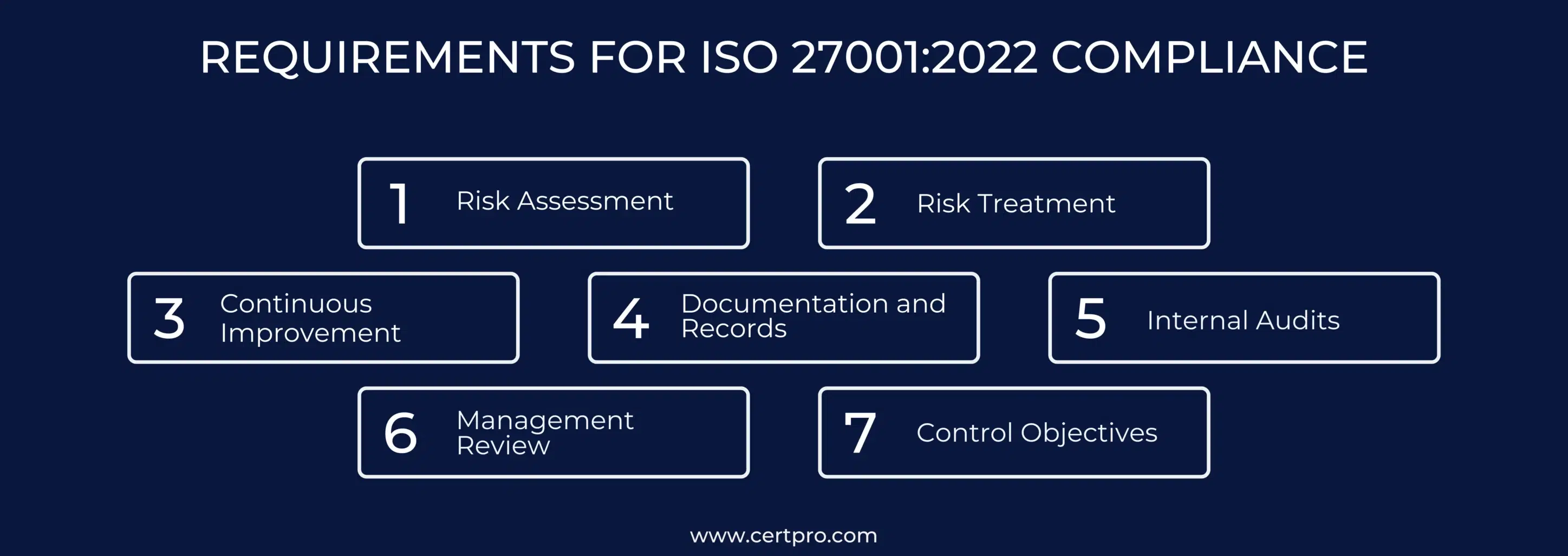
The requirements for ISO 27001 certification are defined in ISO/IEC 27001:2022 and are evaluated through a structured audit process. Organisations seeking ISO 27001 certification must demonstrate conformance to Clauses 4 through 10 — the standard’s mandatory requirements — and must produce a compliant Statement of Applicability that accurately reflects their risk treatment decisions and applicable Annex A controls. The following subsections describe the principal documentation, technical, and management system requirements evaluated during an ISO 27001 audit in London.
ISO/IEC 27001:2022 mandates a specific set of documented information that organisations must produce and maintain. These documents form the primary evidence base for the ISO 27001 audit and must be current, controlled, and accessible for examiner review. The standard distinguishes between documents — such as policies, procedures, and plans that define how the ISMS operates — and records, such as logs, reports, and meeting minutes that provide evidence of operational activity. Both categories are evaluated during the audit, and the absence of required documented information constitutes a nonconformity.
- ✓ISMS Scope Document — defining the boundaries and applicability of the Information Security Management System
- ✓Information Security Policy — approved by top management and communicated across the organisation
- ✓Information Security Risk Assessment Methodology — documented approach for identifying, analysing, and evaluating risks
- ✓Risk Assessment Report — output of the risk assessment process, identifying risks and their evaluated levels
- ✓Risk Treatment Plan — defining selected treatment options, responsible owners, and implementation timelines
- ✓Statement of Applicability (SoA) — listing all 93 Annex A controls with applicability determinations and justifications
- ✓Information Security Objectives and Plans — measurable objectives aligned to the ISMS policy
- ✓Competence and Awareness Records — evidence of training, qualifications, and security awareness activities
- ✓Internal Audit Programme and Audit Reports — documented evidence of internal audits conducted
- ✓Management Review Records — minutes and outputs from periodic management review meetings
The Statement of Applicability is the single most critical document evaluated during an ISO 27001 audit. It must reference all 93 controls listed in Annex A of ISO/IEC 27001:2022, state whether each control is applicable or not applicable, provide justification for any exclusions, and confirm whether applicable controls are currently implemented. The SoA must be consistent with the outputs of the risk assessment and risk treatment plan. Auditors examine this consistency in detail to ensure that the organisation has not excluded controls that are required by its risk profile or contractual obligations.
The technical requirements of ISO 27001 certification are defined through the risk treatment process and the applicable Annex A controls selected in the SoA. While the standard does not prescribe specific technologies, it requires that technical controls be appropriate to the risks identified, documented in procedures and configurations, and evidenced through operational records. Common technical control areas evaluated during an ISO 27001 audit for London organisations include: access control and identity management, network security and segmentation, cryptography and encryption key management, vulnerability management, security monitoring and log management, and secure software development practices.
London organisations operating cloud infrastructure — whether hosted in UK-based data centres or through hyperscale providers such as AWS London (eu-west-2), Microsoft Azure UK South, or Google Cloud London (europe-west2) — must address cloud-specific security controls within their ISMS. ISO/IEC 27001:2022 introduced new control categories relevant to cloud environments, including Control 5.23 (Information security for use of cloud services), which requires organisations to establish and communicate policies for cloud service acquisition, use, management, and exit. The ISO 27001 audit evaluates whether cloud security controls are documented, implemented, and monitored in accordance with the organisation’s cloud usage profile.
ISO/IEC 27001:2022 Clause 5 places explicit requirements on top management — defined as the person or group of people who directs and controls the organisation at the highest level. Top management must demonstrate leadership and commitment to the ISMS by establishing an information security policy, ensuring that ISMS objectives are aligned with the organisation’s strategic direction, providing the necessary resources, and participating in management reviews. During the ISO 27001 audit, auditors interview senior management representatives and review management review records to verify that these requirements are genuinely fulfilled rather than nominally documented.
The internal audit requirement under Clause 9.2 is frequently misunderstood by organisations new to ISO 27001 certification. The standard requires that internal audits be conducted at planned intervals to confirm whether the ISMS conforms to the organisation’s own requirements and the requirements of ISO/IEC 27001:2022, and whether the ISMS is effectively implemented and maintained. Internal audits must be conducted by persons other than those whose own work is being audited — a requirement for objectivity that presents a practical challenge for smaller London organisations. This is typically addressed through cross-functional audit arrangements or the engagement of qualified external auditors.
- ✓Documentation Requirements
- ✓Technical and Operational Control Requirements
- ✓Management System and Leadership Requirements
The ISO 27001 Audit Process: Stage 1 and Stage 2
The ISO 27001 audit process for initial certification is conducted in two formal stages: the Stage 1 documentation audit and the Stage 2 conformance audit. Both stages are conducted by a licensed certification body such as CertPro, which operates as a Licensed CPA Firm delivering independent audit services. The total audit duration and the interval between stages depends on the size, complexity, and scope of the organisation’s ISMS. For London organisations, the certification audit is typically completed within three to six months from initial engagement — depending on the organisation’s level of ISMS maturity at the point of audit commencement.
The Stage 1 audit is a documentary review conducted to determine whether the organisation’s ISMS documentation meets the requirements of ISO/IEC 27001:2022 and whether the organisation is ready to proceed to the Stage 2 conformance audit. During Stage 1, auditors review the ISMS scope document, the information security policy, the risk assessment and treatment documentation, the Statement of Applicability, and the internal audit programme. Auditors also review the organisation’s defined ISMS objectives and evaluate whether measurement and monitoring processes are documented and operational.
The Stage 1 audit produces a formal report identifying areas of conformance and any significant gaps or concerns that must be addressed before Stage 2 can proceed. Issues identified at Stage 1 are classified as either major nonconformities — requiring resolution before Stage 2 — or observations that warrant attention but do not prevent progression. The interval between Stage 1 and Stage 2 is typically a minimum of four weeks for smaller organisations, and longer for complex, multi-site ISMS implementations. During this interval, organisations address Stage 1 findings and ensure that the ISMS is fully operational and generating evidence across all applicable control areas.
The Stage 2 audit is the principal conformance assessment in which auditors evaluate the implementation and effectiveness of the organisation’s ISMS controls. This stage involves on-site or remote audit sessions during which auditors conduct interviews with key personnel, observe operational processes, and examine evidence of control operation across the ISMS scope. Control testing during the Stage 2 ISO 27001 audit focuses on verifying that applicable Annex A controls are not only documented but actively implemented and generating evidence of operation — for example, access review records, vulnerability scan reports, security awareness training completion records, and incident log entries.
Stage 2 audit findings are categorised as major nonconformities, minor nonconformities, or observations. A major nonconformity represents a complete failure to implement a required element of the ISMS or the absence of a mandatory control, and must be resolved before ISO 27001 certification can be issued. A minor nonconformity represents a partial implementation gap that does not preclude certification but must be addressed within an agreed timeframe — typically 90 days. Observations are noted improvement opportunities that do not affect the certification decision. CertPro issues a formal nonconformity report detailing all findings, evidence references, and required corrective actions.
Following successful completion of the Stage 2 audit and resolution of any major nonconformities, the certification decision is made by a certification panel independent of the audit team. This separation of the audit function from the certification decision is a mandatory requirement under ISO/IEC 17021-1 — the standard governing the operation of management system certification bodies. The certification panel reviews the audit report, the evidence of corrective actions for any nonconformities, and the auditor’s recommendation before issuing the formal certification decision.
Upon a positive certification decision, CertPro issues an ISO 27001 certificate specifying the certified organisation’s name, the scope of certification, the applicable standard (ISO/IEC 27001:2022), the certificate issue date, and the certificate expiry date. ISO 27001 certificates are valid for three years from the date of issue, subject to satisfactory completion of annual surveillance audits in years one and two, and a recertification audit in year three. The certificate is registered in CertPro’s publicly accessible certification register, providing clients, regulators, and stakeholders with verifiable certification status.
Surveillance audits are conducted annually during the three-year certification cycle to verify that the organisation’s ISMS continues to conform to ISO/IEC 27001:2022 requirements and remains effectively implemented. Surveillance audits are smaller in scope than the initial Stage 2 audit — focusing on key ISMS processes, any areas of concern from previous audits, changes to the organisation or its context that may affect the ISMS, and the organisation’s internal audit and management review processes. Surveillance audits are a mandatory condition of maintaining valid ISO 27001 certification; failure to complete one within the required timeframe results in certificate suspension.
The recertification audit, conducted in the third year of the certificate cycle, is a full re-evaluation of the ISMS equivalent in scope to the original Stage 2 audit. The recertification process examines the performance of the ISMS over the entire three-year certification period, reviews the cumulative outputs of internal audits and management reviews, and evaluates the organisation’s progress in addressing any nonconformities or observations identified during surveillance audits. Successful recertification results in the issuance of a new three-year ISO 27001 certificate, resetting the surveillance audit cycle.

- ✓Stage 1 Audit: Documentation and Scope Review
- ✓Stage 2 Audit: Conformance Testing and Control Evaluation
- ✓Certification Decision and Issuance
- ✓Surveillance Audits and Recertification
Steps to Obtain ISO 27001 Certification in London
The following structured process describes the sequence of activities required for an organisation to achieve ISO 27001 certification in London. Each step represents a defined phase with specific outputs that feed into subsequent phases. This approach supports systematic ISMS development and ensures that the organisation’s documentation and evidence are aligned with ISO/IEC 27001:2022 audit requirements before the formal certification audit commences.
- Establish Leadership Commitment and Define ISMS Scope — Secure top management commitment, allocate resources, and document the ISMS scope defining which business units, locations, processes, and information assets are included.
- Conduct an Information Security Risk Assessment — Identify information assets, threats, and vulnerabilities; assess the likelihood and impact of identified risks using a documented methodology; evaluate risk levels against defined acceptance criteria.
- Develop the Risk Treatment Plan — Select risk treatment options (accept, transfer, mitigate, or avoid) for each identified risk; map treatment decisions to applicable Annex A controls; assign ownership and target completion dates.
- Produce the Statement of Applicability — Document the applicability of all 93 Annex A controls; record justifications for any excluded controls; confirm implementation status for all applicable controls.
- Establish ISMS Policies, Procedures, and Controls — Develop and approve the information security policy and supporting procedure documents; implement technical and organisational controls in accordance with the risk treatment plan.
- Implement Competence, Training, and Awareness Programmes — Ensure all personnel with ISMS responsibilities are competent; deliver information security awareness training; document training completion records.
- Operate the ISMS and Generate Operational Evidence — Run the ISMS across the defined scope, generating records of control operation including access reviews, vulnerability scans, incident logs, and supplier assessments.
- Conduct Internal Audits — Execute the internal audit programme, covering all ISMS processes and applicable controls; document findings, nonconformities, and corrective actions.
- Perform Management Review — Convene a management review meeting with top management to evaluate ISMS performance, review audit results, assess risk treatment effectiveness, and set improvement objectives.
- Engage CertPro for ISO 27001 Audit — Submit ISMS documentation for Stage 1 audit; address Stage 1 findings; proceed to Stage 2 conformance audit; resolve nonconformities; receive formal ISO 27001 certification decision.
The timeline for completing these steps and achieving ISO 27001 certification in London varies based on the organisation’s starting maturity, size, and complexity. London organisations with existing information security programmes or prior ISO 9001 certification experience may complete the process in four to six months. Organisations with limited existing security documentation or complex multi-site ISMS scopes may require nine to twelve months. The ISO 27001 audit conducted by CertPro is scheduled after all prerequisite steps are complete and the ISMS has been operational for a sufficient period — typically a minimum of three months — to generate the evidence required for Stage 2 assessment.
ISO 27001 Certification Cost in London
ISO 27001 cost in London is determined by several distinct factors that vary by organisation. Understanding the cost structure allows London organisations to accurately budget for certification and to evaluate the total investment required across the three-year certificate cycle. The principal cost components associated with ISO 27001 certification cost in London include certification audit fees, internal resource costs, and any technology or tooling investments required to implement the ISMS controls identified in the risk treatment plan.
Factors Influencing ISO 27001 Certification Cost
The ISO 27001 cost for a given organisation is primarily influenced by the size and complexity of the ISMS scope, the number of employees within scope, the number of physical locations included, and the complexity of the technology environment covered by the ISMS. Certification audit fees are typically calculated based on the number of audit days required to adequately evaluate the ISMS — a figure derived from the organisation’s employee count within scope and the complexity of the audit environment, following the guidelines in IAF MD 5 (Issue 4), which provides mandatory guidance on audit time determination for management system certification.
For a small London technology company with 25 employees and a single-site ISMS scope, the certification audit fee for the initial Stage 1 and Stage 2 combined typically ranges from £4,000 to £8,000. For a medium-sized London financial services firm with 200 employees and a multi-department ISMS scope, audit fees typically range from £10,000 to £18,000 for the initial certification cycle. Large organisations with complex, multi-site ISMS implementations may incur audit fees in excess of £25,000 for initial ISO 27001 certification. These ranges reflect certification audit fees only and do not include internal resource costs or technology investment.
Full Cost Components Across the Certification Lifecycle
| Cost Component | Description | Indicative Range (London) |
|---|---|---|
| Stage 1 & Stage 2 Certification Audit Fees | Fees charged by the certification body for the initial two-stage audit process | £4,000 – £25,000+ |
| Annual Surveillance Audit Fees (Years 1 & 2) | Reduced-scope annual audits to maintain certificate validity | £2,000 – £10,000 per year |
| Year 3 Recertification Audit Fees | Full re-evaluation audit equivalent to initial Stage 2 | £3,500 – £20,000 |
| Internal Resource Costs | Staff time for ISMS development, documentation, training, and audit management | Variable — typically significant for ISMS build phase |
| Technology and Tooling Investments | Security tools required to implement ISMS controls (e.g., SIEM, access management, vulnerability scanning) | Variable — depends on existing security infrastructure |
Internal resource costs frequently represent the largest component of the total ISO 27001 cost for London organisations, particularly during the ISMS development phase. Organisations that assign dedicated internal resources to ISMS development — including a qualified Information Security Manager or equivalent — will incur significant staff time costs that must be factored into the overall investment assessment. For London organisations where senior personnel command premium salary rates, the internal cost of developing a comprehensive ISMS can substantially exceed the external audit fee. This underscores the importance of realistic budget planning for organisations undertaking ISO 27001 implementation in London.
Return on Investment: Cost Versus Commercial Value
The commercial return on ISO 27001 certification investment for London organisations is typically assessed across three dimensions: direct revenue enablement, regulatory cost avoidance, and operational risk reduction. In terms of direct revenue enablement, ISO 27001 certification unlocks access to procurement frameworks and client contracts that require it as a qualification criterion. For a London technology company winning a single enterprise contract requiring ISO 27001 certification, the contract value will in most cases substantially exceed the total three-year certification cost — making it a commercially rational investment for firms targeting enterprise clients in financial services, healthcare, or the public sector.
Regulatory cost avoidance represents the second dimension of ROI. ICO enforcement fines for UK GDPR violations attributable to inadequate information security have ranged from tens of thousands to millions of pounds for London organisations. The demonstrable due diligence represented by ISO 27001 certification — an independently audited, documented ISMS — is relevant to ICO enforcement discretion assessments and can materially reduce the scale of financial penalties where a security incident occurs. The ISO 27001 cost is therefore also appropriately assessed against the potential cost of regulatory non-compliance in a city where ICO enforcement activity has been consistently significant.
Benefits of ISO 27001 Certification for London Businesses
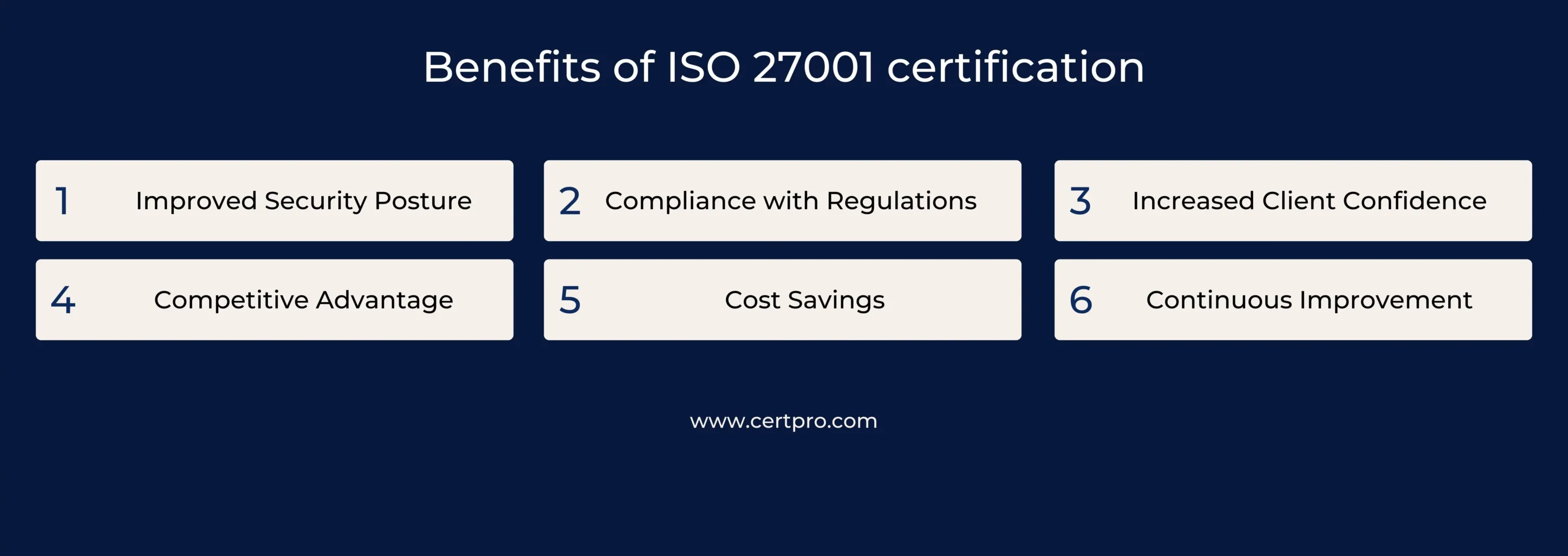
ISO 27001 certification delivers a range of documented, measurable benefits to London organisations across all sectors. These benefits extend beyond information security risk reduction to encompass regulatory positioning, commercial advantage, operational resilience, and stakeholder confidence. The following list identifies the principal benefits of ISO 27001 certification for London companies — each of which can be directly linked to the standard’s audit requirements and the ISMS controls implemented in pursuit of certification.
- ✓Independently Verified Security Posture — certification provides stakeholders with independently audited evidence of information security controls, replacing self-assertion with third-party verification
- ✓UK GDPR and ICO Compliance Support — documented ISMS controls map directly to UK GDPR Article 32 technical and organisational security requirements, supporting ICO compliance demonstrations
- ✓FCA Operational Resilience Alignment — ISMS controls support FCA PS21/3 requirements for important business service identification, impact tolerance setting, and incident management
- ✓Access to Enterprise Procurement Frameworks — ISO 27001 certification qualifies London organisations for G-Cloud, NHS Digital frameworks, and major financial institution supplier programmes
- ✓Reduction in Client Security Questionnaire Burden — ISO 27001 certificate and SoA replace individual security questionnaires in procurement processes, accelerating contract execution
- ✓Structured Information Security Risk Management — the ISMS risk assessment and treatment process provides a repeatable, documented methodology for identifying and addressing security risks
- ✓Incident Response Capability — ISMS controls including Annex A 5.24–5.28 require documented incident management procedures that improve the organisation’s ability to detect, respond to, and recover from security incidents
- ✓Staff Security Awareness and Culture — mandatory competence and awareness requirements under Clause 7.2–7.3 drive systematic security training that reduces human error as a security risk factor
- ✓Competitive Differentiation in London’s Market — in a competitive landscape where clients increasingly demand security assurance, ISO 27001 certification distinguishes certified organisations from non-certified competitors
- ✓Continuous Improvement Framework — the PDCA model and annual surveillance audit cycle ensure that the ISMS evolves in response to changing threats, regulatory requirements, and business changes
ISO 27001 certification requires organisations to address information security aspects of business continuity through Annex A control 5.30 (ICT readiness for business continuity). This control requires organisations to plan, implement, verify, and review ICT continuity measures to ensure the availability of information and other associated assets during disruption. For London organisations — particularly those subject to FCA operational resilience requirements — the business continuity controls implemented as part of ISO 27001 certification provide a documented foundation for demonstrating ICT resilience to regulators and clients.
London’s position as a global financial centre means that IT system disruptions have immediate commercial and reputational consequences. The incident management and business continuity controls required for ISO 27001 certification ensure that certified organisations maintain documented procedures for detecting, containing, and recovering from security incidents — including ransomware attacks, data breaches, and system outages that have increasingly affected London financial institutions and professional services firms. Annual surveillance audits verify that these procedures remain current, tested, and effective, providing ongoing assurance of operational resilience.
ISO/IEC 27001:2022 significantly strengthened requirements related to supplier and third-party security through Annex A controls 5.19–5.22, which address information security in supplier relationships, supplier agreements, ICT supply chain security, and monitoring of supplier services. For London financial services organisations with complex third-party ecosystems — including cloud providers, payment processors, data analytics firms, and outsourced technology services — the structured supplier security assessment process required for ISO 27001 certification provides a documented framework for managing third-party risk effectively.
The FCA’s SS2/21 operational resilience supervisory statement and the Bank of England’s outsourcing and third-party risk management supervisory statement both emphasise the importance of robust third-party risk management for regulated financial firms. ISO 27001 certification for London financial services organisations provides audited evidence that supplier security requirements are documented in contractual agreements, that supplier security performance is monitored, and that third-party access to the organisation’s information assets is appropriately controlled — all aligning with FCA supervisory expectations.
- ✓Operational Resilience and Business Continuity Benefits
- ✓Third-Party and Supply Chain Risk Management
ISO 27001 Certification for London’s Financial and Technology Sectors
London’s dual identity as a global financial centre and a leading technology hub creates a distinct demand profile for ISO 27001 certification that reflects the city’s specific regulatory environment, client expectations, and risk landscape. ISO 27001 consultants and certified auditors serving London must demonstrate familiarity with the intersection of information security management and sector-specific regulatory requirements — from FCA authorisation criteria to NHS Digital Data Security and Protection Toolkit requirements — that characterise London’s complex compliance environment.
London Financial Services: Regulatory Overlay and Certification Value
The London financial services sector operates under one of the world’s most demanding regulatory frameworks for information security. Beyond UK GDPR and FCA operational resilience requirements, financial institutions in London are subject to the Bank of England’s CBEST intelligence-led cyber security assessment framework, the FCA’s CBEST and STAR-FS frameworks, and — for internationally active institutions — additional requirements from the European Banking Authority (EBA) Guidelines on ICT and Security Risk Management. ISO 27001 certification for London financial services firms does not replace these sector-specific frameworks but provides a foundational security management system on which more specialised requirements can be layered.
For London’s challenger banks, payment institutions, and e-money institutions — all regulated by the FCA and increasingly by the PRA — ISO 27001 certification is frequently cited as a factor in FCA authorisation assessments. The FCA’s Threshold Conditions for authorisation include requirements for adequate resources, including systems and controls. The FCA’s Senior Managers and Certification Regime (SM&CR) places personal accountability on Senior Managers for operational risk and information security failures. ISO 27001 certification provides Senior Managers with documented evidence that their organisation’s ISMS meets an internationally recognised standard, directly supporting the SM&CR accountability framework.
London Technology Companies: ISO 27001 Certification as a Growth Enabler
ISO 27001 certification for London technology companies is increasingly the standard security credential required by SaaS, cloud infrastructure, and managed service providers seeking enterprise clients. London’s technology sector — from East London’s Tech City to the growing tech clusters in King’s Cross, Southwark, and London Bridge — is characterised by companies that process client data as a core element of their service delivery. For these organisations, ISO 27001 certification provides clients with assurance that data is handled under a certified, audited security management system — particularly valued by financial services and healthcare clients with stringent data security requirements.
The UK Government’s G-Cloud 13 framework — through which public sector organisations including NHS trusts, local authorities, and central government departments procure cloud technology services — requires suppliers to complete a Security, Privacy, Accessibility, Commercial, Social Value, and Technical assessment. ISO 27001 certification is the recognised security standard for G-Cloud suppliers and is specified as the minimum security requirement for many public sector procurement categories. London technology companies targeting public sector revenue streams require ISO 27001 certification as a fundamental precondition for market access — a critical consideration given the concentration of government departments and NHS bodies across Greater London.
ISO 27001 and Cyber Essentials: Understanding the Relationship
London organisations frequently ask how ISO 27001 certification relates to the UK Government’s Cyber Essentials and Cyber Essentials Plus schemes. Cyber Essentials is a UK Government-backed certification scheme that focuses on five foundational technical controls: firewalls, secure configuration, user access control, malware protection, and patch management. It provides a baseline technical security certification and is required for all UK Government contracts involving the handling of personal data or the provision of certain technical products or services. ISO 27001 certification is a significantly more comprehensive standard — encompassing management system requirements, risk management, and a broad range of organisational and technical controls — and is therefore a more demanding and internationally recognised credential than Cyber Essentials.
For London organisations, the relationship between Cyber Essentials and ISO 27001 is typically additive rather than substitutional. Many London companies achieve Cyber Essentials or Cyber Essentials Plus as a first step, then progress to ISO 27001 certification to meet more demanding client requirements or to address regulatory expectations beyond those covered by the Cyber Essentials technical controls. The five Cyber Essentials technical control areas are covered within ISO 27001’s Annex A control set — meaning that organisations with Cyber Essentials certification already have evidence of some Annex A control implementation that can be incorporated into their ISO 27001 ISMS documentation and audit evidence.
ISO 27001 Certification in London: Annex A Controls and the 2022 Update
ISO/IEC 27001:2022 introduced significant changes to the Annex A control set that all London organisations seeking or maintaining ISO 27001 certification must understand. The 2022 version restructured the control set from 114 controls across 14 domains (as in ISO/IEC 27001:2013) to 93 controls across 4 control themes. This restructuring merged duplicate controls, simplified the control architecture, and introduced 11 new controls addressing emerging security challenges — including cloud security, threat intelligence, and data masking. Organisations holding 2013-version certificates must transition to the 2022 standard by 31 October 2025.
The Four Annex A Control Themes in ISO/IEC 27001:2022
| Control Theme | Control Numbers | Number of Controls | Focus Areas |
|---|---|---|---|
| Organisational Controls | 5.1 – 5.37 | 37 controls | Policies, roles, responsibilities, risk management, supplier relationships, compliance |
| People Controls | 6.1 – 6.8 | 8 controls | Screening, employment terms, awareness, training, disciplinary process, remote working |
| Physical Controls | 7.1 – 7.14 | 14 controls | Physical security perimeters, equipment, cabling, storage media, clear desk |
| Technological Controls | 8.1 – 8.34 | 34 controls | Access control, cryptography, network security, vulnerability management, secure coding, cloud services |
The 11 new controls introduced in ISO/IEC 27001:2022 address security domains not explicitly covered in the 2013 version, reflecting the evolution of the threat landscape and the growing prevalence of cloud-based and remote-working environments. These new controls — including Threat Intelligence (5.7), Information Security for Use of Cloud Services (5.23), ICT Readiness for Business Continuity (5.30), Physical Security Monitoring (7.4), Configuration Management (8.9), Information Deletion (8.10), Data Masking (8.11), Data Leakage Prevention (8.12), Monitoring Activities (8.16), Web Filtering (8.23), and Secure Coding (8.28) — are particularly relevant to London technology companies, financial services organisations, and cloud service providers whose security environments have evolved significantly since 2013.
Transition Requirements for Existing ISO 27001:2013 Certificate Holders
London organisations holding ISO/IEC 27001:2013 certificates must complete their transition to ISO/IEC 27001:2022 by 31 October 2025. After this date, all 2013-version certificates will be withdrawn, and organisations will need to hold a valid 2022-version certificate to demonstrate current ISO 27001 certification. The transition audit evaluates whether the organisation has updated its ISMS documentation and controls to reflect the 2022 standard’s requirements — including the revised Annex A control set, an updated SoA reflecting the 2022 control structure, and any new documentation required by the updated clause requirements.
The transition audit is typically conducted at the time of the next scheduled surveillance or recertification audit, combined with an assessment of the 2022-specific changes. Organisations that have already mapped their existing controls to the 2022 control structure, updated their SoA, and addressed the 11 new control areas will find the transition audit straightforward. Organisations that have deferred transition work may face more significant audit scrutiny if they approach the October 2025 deadline unprepared. CertPro conducts transition audits for London organisations as part of scheduled surveillance and recertification visits, minimising disruption to ongoing operations.
CertPro’s ISO 27001 Certification Audit Services in London
CertPro is a Licensed CPA Firm delivering ISO 27001 certification audit services exclusively — not advisory, consulting, or implementation services. As an independent certification body, CertPro evaluates organisations’ ISMS against ISO/IEC 27001:2022 requirements and issues formal certification decisions based on objective, evidence-based audit findings. CertPro’s ISO 27001 audit services in London are delivered by qualified auditors with sector-specific experience across financial services, technology, healthcare, legal services, and the public sector — the principal industries concentrated in London’s diverse business ecosystem.
Audit Methodology and Independence
CertPro’s ISO 27001 audit methodology is structured in accordance with ISO/IEC 17021-1 (Requirements for bodies providing audit and certification of management systems) and ISO/IEC 27006-1 (Requirements for bodies providing audit and certification of information security management systems). These standards govern the competence, consistency, and impartiality requirements that certification bodies must meet to issue credible ISO 27001 certificates. CertPro’s audit team operates under a formal impartiality policy that prevents auditors from certifying organisations for which they have previously provided advisory or implementation services — maintaining the independence essential to certification integrity.
CertPro’s ISO 27001 audit process produces a structured, documented audit report for each stage of the certification process. Stage 1 audit reports provide a detailed assessment of ISMS documentation completeness and readiness for Stage 2 evaluation. Stage 2 audit reports present findings across all evaluated clauses and control areas, categorised by conformance status and supported by specific evidence references. Nonconformity reports include the precise requirement that has not been met, the objective evidence of the nonconformity, and the auditor’s determination of major or minor classification. This structured documentation supports the organisation’s corrective action process and provides a clear record for the certification panel’s review.
Sector Expertise Across London’s Key Industries
CertPro’s ISO 27001 audit teams serving London clients include auditors with demonstrated sector-specific competence in the industries that dominate London’s economy. For ISO 27001 audit engagements in London’s financial services sector, CertPro assigns auditors familiar with FCA regulatory requirements, payment card industry security standards, and the specific data processing environments characteristic of banking, insurance, and investment management operations. This sector expertise ensures that audit evaluations are contextually relevant — auditors understand the specific risks, regulatory overlays, and control environments that London financial services organisations operate within.
For ISO 27001 certification engagements with London technology companies, CertPro’s auditors bring experience evaluating cloud-native architectures, DevSecOps environments, SaaS platforms, and agile development practices — the technology delivery models that characterise London’s tech sector. The 2022 standard’s new controls for secure coding (8.28), configuration management (8.9), and cloud services (5.23) are evaluated by auditors who understand modern software development and cloud deployment practices. This technical competence ensures that audit findings are practically grounded and that the certification decision accurately reflects the security posture of technology-intensive organisations.
Remote and Hybrid Audit Delivery Options
CertPro delivers ISO 27001 audit services in London through both on-site and remote audit modalities, in accordance with IAF MD 4 (Use of Information and Communication Technology for Auditing/Assessment Purposes). For Stage 1 documentary audits, remote delivery via secure document sharing and video conference is standard practice and does not reduce audit quality. For Stage 2 conformance audits, the delivery modality is determined by the audit programme — with on-site visits required where physical security controls, equipment assessments, or controlled environment observations are part of the audit scope, as is typical for organisations with significant physical infrastructure or data centre operations.
Achieve ISO 27001 Certification in London with CertPro
CertPro is the recognised choice for organisations seeking ISO 27001 certification in London through a rigorous, independent, and professionally conducted audit process. As a Licensed CPA Firm, CertPro delivers ISO 27001 certification exclusively through structured audit evaluation — not advisory services or implementation support. This independence is fundamental to the credibility and internationally recognised status of CertPro-issued ISO 27001 certificates, which are accepted by London’s financial institutions, government bodies, and enterprise clients as authoritative evidence of information security management system conformance.
ISO 27001 Certification in London represents a significant and measurable investment in information security governance, regulatory positioning, and commercial credibility. The certification process conducted by CertPro provides London organisations with a structured, evidence-based evaluation of their ISMS against the ISO/IEC 27001:2022 standard — producing a formal certification decision and certificate that is valid, verifiable, and recognised across international markets. For organisations in London’s financial services, technology, healthcare, legal, and public sector industries, ISO 27001 certification is both a risk management imperative and a commercial necessity in an environment where clients, regulators, and partners demand independently verified security assurance.
To initiate the ISO 27001 audit process with CertPro, London organisations are invited to contact the CertPro certification team to discuss their ISMS scope, timeline requirements, and audit programme. CertPro’s audit management team will review the organisation’s context, determine the appropriate audit day requirement in accordance with IAF MD 5, and provide a formal audit programme proposal covering Stage 1, Stage 2, and the three-year surveillance cycle. CertPro’s structured approach to ISO 27001 certification in London delivers clear timelines, transparent cost structures, and professionally documented audit outcomes — supporting both certification achievement and ongoing ISO 27001 compliance management for your organisation.
FAQ
▶
What is ISO 27001 Certification and what does it certify?
▶
How long does the ISO 27001 audit process take for a London organisation?
▶
What is the ISO 27001 cost for a London-based company?
▶
Is ISO 27001 certification required for London financial services companies?
▶
What is the difference between ISO 27001 and Cyber Essentials for London organisations?
▶
How does ISO 27001 compliance support UK GDPR obligations in London?
▶
What are the surveillance audit requirements after ISO 27001 certification is achieved?
▶
Can ISO 27001 certification cover multiple London office locations?
Multi-Framework Compliance Guide: Best Practices and Strategies
Most compliance teams aren’t managing one framework. They’re managing three, four, sometimes five — simultaneously. A SaaS company selling to enterpri…
HOW COMPLIANCE AUDIT SOFTWARE IMPROVES AUDIT READINESS
Today, most companies deal with a growing number of compliance regulations. From data privacy standards to security frameworks like SOC 2 and ISO 2700…

THE ROLE OF GRC IN ISO 27001, SOC 2, AND OTHER FRAMEWORKS
The term GRC stands for Governance Risk and Compliance. It’s a system of integrated and centralized approaches used by organizations. This system comb…
Get In Touch
have a question? let us get back to you.