
ISO 42001 Certification in Dublin
CertPro is a Licensed CPA Firm conducting independent ISO 42001 certification audits for organizations in Dublin. Engagements evaluate AI Management System (AIMS) controls against ISO/IEC 42001:2023 requirements, covering governance structures, risk treatment, lifecycle oversight, transparency obligations, and accountability mechanisms across AI-driven operations in the Dublin enterprise and technology sector.
OUR CLIENTS






Audit and Certification Services by CertPro for ISO 42001 in Dublin
CertPro delivers independent, third-party ISO 42001 certification audits for organizations operating across Dublin’s technology, financial services, healthcare, and enterprise sectors. As a Licensed CPA Firm, CertPro conducts structured evaluation engagements against ISO/IEC 42001:2023 — the internationally recognized standard for Artificial Intelligence Management Systems. Each ISO 42001 audit engagement is scoped to the specific AI systems, governance structures, and operational contexts of the client organization. This approach ensures that certification outcomes reflect genuine conformance rather than procedural compliance alone.
Dublin has emerged as one of Europe’s foremost technology hubs, hosting European headquarters for global cloud providers, major fintech platforms, SaaS organizations, and multinational enterprises. This concentration of AI-driven operations places Dublin organizations at the intersection of significant regulatory scrutiny — including obligations under GDPR, evolving EU AI Act requirements, and international expectations for responsible AI governance. ISO 42001 certification in Dublin provides a structured, auditable framework through which organizations can demonstrate that their AI systems are governed, monitored, and controlled in alignment with global best practices.
CertPro’s certification engagements are conducted by qualified auditors with direct experience evaluating AI management systems across complex enterprise environments. Audit activities include documentation review, control testing, evidence evaluation, and nonconformity assessment. The certification decision is made independently, based on audit findings and objective evidence gathered throughout the engagement. Organizations that achieve ISO 42001 certification in Dublin receive a formal attestation documenting the scope, audit methodology, and conformance determination.
CertPro’s Institutional Audit Framework for AI Management Systems
CertPro’s ISO 42001 audit framework is structured around the complete lifecycle of an AI Management System — from initial scoping and policy documentation through to operational control testing and ongoing surveillance. Each engagement begins with a clearly defined scope that identifies the AI systems, organizational units, and governance processes subject to audit. This scoping activity ensures that the certification boundary accurately reflects the organization’s AI operations and that audit resources are directed toward the highest-risk areas of the AIMS.
Audit findings are documented in structured nonconformity reports that distinguish between major nonconformities — which prevent certification — and minor nonconformities or observations that require documented corrective action plans. CertPro’s institutional audit framework is designed to provide organizations with clear, actionable findings that support continuous improvement of the AI Management System. At the same time, it maintains the independence and objectivity required of a Licensed CPA Firm conducting third-party ISO 42001 certification assessments.
Sector Coverage Across Dublin’s AI-Driven Industries
Dublin’s diverse industrial landscape means that ISO 42001 audit engagements must be adapted to the specific AI use cases and regulatory environments of each sector. In financial services and fintech, audit activities focus on algorithmic decision-making controls, model risk management, and regulatory accountability under Central Bank of Ireland oversight. In cloud and SaaS organizations, audit scope typically encompasses AI service delivery pipelines, data processing controls, and customer transparency obligations. Healthcare organizations deploying AI in diagnostic or clinical support systems require evaluation of patient safety controls, data protection measures, and clinical governance integration within the AIMS.
Enterprise technology organizations and multinational companies operating Dublin regional headquarters face additional complexity in scoping ISO 42001 audits across cross-border AI deployments. CertPro’s audit methodology accommodates multi-site and multi-jurisdiction engagements, ensuring that certification scope accurately reflects the full extent of AI governance responsibilities. This sector-informed approach to ISO 42001 certification in Dublin ensures that audit outcomes are meaningful, defensible, and aligned with the operational realities of each client organization.

What Is ISO 42001 Certification?
ISO 42001 is the internationally recognized standard for Artificial Intelligence Management Systems, published by the International Organization for Standardization as ISO/IEC 42001:2023. The standard establishes requirements for organizations to build, implement, maintain, and continually improve an AI Management System (AIMS) — a structured set of policies, processes, controls, and governance mechanisms. These mechanisms are designed to ensure that AI systems are developed and operated responsibly, ethically, and in alignment with applicable legal and regulatory obligations.
ISO AIMS certification — a widely used shorthand for ISO 42001 AI Management System certification — represents independent, third-party confirmation that an organization’s AIMS has been evaluated by a qualified certification body and found to conform to the requirements of ISO/IEC 42001:2023. Unlike self-assessments or internal audits, ISO AIMS certification carries the weight of external verification. It provides stakeholders, customers, regulators, and business partners with objective assurance that the organization’s AI governance controls are operating as intended.
Core Components of an AI Management System Under ISO 42001
An AI Management System under ISO/IEC 42001:2023 consists of several integrated components that collectively govern how an organization identifies, evaluates, controls, and monitors AI-related risks and impacts. The standard requires organizations to establish a clear AI policy articulating their commitments to responsible AI use. Organizations must also define governance roles and responsibilities for AI oversight, and implement risk assessment processes that systematically identify potential harms, biases, and unintended consequences of AI systems across their operational lifecycle.
The AIMS framework also requires documented processes for AI system design and development controls, supplier and third-party AI governance, operational monitoring and performance evaluation, incident management, and continual improvement. For organizations pursuing ISO 42001 certification in Dublin, these components must be implemented with sufficient rigor to withstand independent audit scrutiny. CertPro’s ISO 42001 assessment activities evaluate whether each AIMS component is not only documented but operationally effective — confirming that controls function as designed and that governance mechanisms produce measurable outcomes.
ISO 42001 and Its Relationship to Other Management System Standards
ISO/IEC 42001:2023 shares the High Level Structure (HLS) common to other ISO management system standards, including ISO 27001 for information security management and ISO 31000 for risk management. This structural alignment means that organizations already certified to ISO 27001 can leverage existing policy frameworks, audit procedures, and review processes when building their AIMS — significantly reducing duplication of effort. For Dublin organizations that hold multiple ISO certifications, ISO 42001 compliance can be integrated into an existing integrated management system architecture with minimal additional overhead.
The relationship between ISO 42001 and the EU AI Act is particularly relevant for Dublin organizations. ISO 42001 provides a recognized management system framework that can support conformance with the EU AI Act’s governance requirements — particularly for organizations deploying high-risk AI systems as defined under the Act. ISO 42001 compliance also reinforces GDPR accountability obligations by establishing documented controls over automated decision-making, data quality in AI training datasets, and transparency in AI-generated outputs. Organizations that achieve ISO 42001 certification in Dublin are therefore better positioned to demonstrate regulatory accountability across multiple overlapping legal frameworks.
ISO 42001 Certification Versus ISO 42001 Assessment
It is important to distinguish between an ISO 42001 assessment and full ISO 42001 certification. An ISO 42001 assessment typically refers to an evaluation of an organization’s AIMS against the requirements of ISO/IEC 42001:2023, conducted to identify gaps, measure conformance, or support internal governance decisions. Assessment activities may be conducted as part of a pre-certification evaluation or as a standalone engagement for organizations that require objective evidence of their AI governance maturity without pursuing formal third-party certification.
ISO 42001 certification, by contrast, is a formal third-party process conducted by an accredited or licensed certification body that results in the issuance of a certification document confirming conformance to the standard. CertPro conducts both ISO 42001 assessment engagements and full certification audits, depending on the scope and objectives defined by each client organization. For organizations in Dublin seeking to meet contractual, regulatory, or stakeholder requirements for certified AI governance, the full ISO 42001 certification pathway provides the highest level of independent assurance available.
Why ISO 42001 Certification in Dublin Is Essential for AI-Driven Organizations
Dublin’s position as a leading European technology and financial services hub means that organizations based in the city face elevated expectations around AI governance and responsible technology deployment. As the European headquarters for many of the world’s largest technology companies, Dublin is subject to intense regulatory scrutiny from the European Commission, the Data Protection Commission of Ireland, the Central Bank of Ireland, and AI-specific oversight bodies established under the EU AI Act. ISO 42001 certification in Dublin provides organizations with a recognized, independently verified framework for demonstrating compliance with these evolving requirements.
Unchecked AI adoption creates material risks for organizations across Dublin’s key industries. In financial services, algorithmic bias in credit scoring or fraud detection systems can expose organizations to regulatory penalties and reputational damage. In healthcare, AI-assisted diagnostic tools require rigorous validation and oversight to ensure patient safety. In enterprise technology, AI systems that process personal data at scale must operate within documented governance frameworks to satisfy GDPR accountability requirements. ISO 42001 compliance provides the structured controls necessary to manage these risks systematically and demonstrate accountability to external stakeholders.
Regulatory Drivers for ISO 42001 Certification in the Dublin Market
The EU AI Act, which entered into force in August 2024 and is being phased in through 2026, establishes legally binding requirements for organizations that develop or deploy AI systems in the European Union. High-risk AI applications — including those used in financial services, healthcare, employment, and critical infrastructure — face mandatory conformity assessment requirements, documentation obligations, and ongoing monitoring mandates. For Dublin organizations operating in these sectors, ISO 42001 certification in Dublin provides a recognized governance framework that supports conformity assessment activities under the EU AI Act and demonstrates proactive regulatory accountability.
GDPR’s accountability principle, codified in Article 5(2), requires organizations to demonstrate compliance with data protection obligations — including those arising from automated decision-making systems governed by Articles 22 and 13–14. ISO 42001 compliance directly supports GDPR accountability by establishing documented controls over AI data inputs, model validation, and output transparency. The Data Protection Commission of Ireland has consistently emphasized accountability as a core enforcement priority, making ISO AIMS certification an increasingly relevant risk management tool for Dublin organizations that process personal data through AI systems.
Commercial and Competitive Drivers for AI Governance Certification
Beyond regulatory compliance, ISO 42001 certification in Dublin delivers significant commercial advantages in an increasingly competitive technology market. Enterprise procurement processes across the EU and internationally are beginning to include AI governance certification requirements in vendor qualification criteria. Organizations that have achieved ISO 42001 certification can demonstrate their AI governance credentials in competitive tender processes — reducing friction in enterprise sales cycles and differentiating their offerings from uncertified competitors.
For Dublin-based SaaS providers, fintech platforms, and AI solution vendors, ISO 42001 certification also serves as a trust signal to international customers and investors who require independent assurance of responsible AI practices. As AI governance becomes a board-level concern — driven by reputational risk, investor ESG expectations, and customer due diligence requirements — organizations that have invested in ISO AIMS certification are better positioned to demonstrate the governance maturity that sophisticated stakeholders now expect from technology and data-driven enterprises.
AI Governance as a Board-Level Priority in Dublin Enterprises
Leading business publications have documented the shift in AI governance from a technical function to a board-level strategic responsibility. Dublin enterprises — particularly those listed on international exchanges or operating within regulated industries — face growing expectations from non-executive directors, audit committees, and institutional investors for demonstrated AI risk management frameworks. ISO 42001 audit Dublin engagements provide boards with independent, third-party evidence that management’s AI governance controls are operationally effective. This level of assurance cannot be replicated by internal reports or self-attestations alone.
The elevation of AI governance to board-level priority is also reflected in regulatory expectations. The Central Bank of Ireland’s Consumer Protection Outlook and Financial Stability reports have increasingly referenced AI-related risks as material concerns for regulated entities. Organizations that have achieved ISO 42001 certification in Dublin can demonstrate to their boards, regulators, and investors that AI risks are being managed within a structured, internationally recognized framework — providing the governance accountability that board members and audit committees require.
Requirements for ISO 42001 Certification
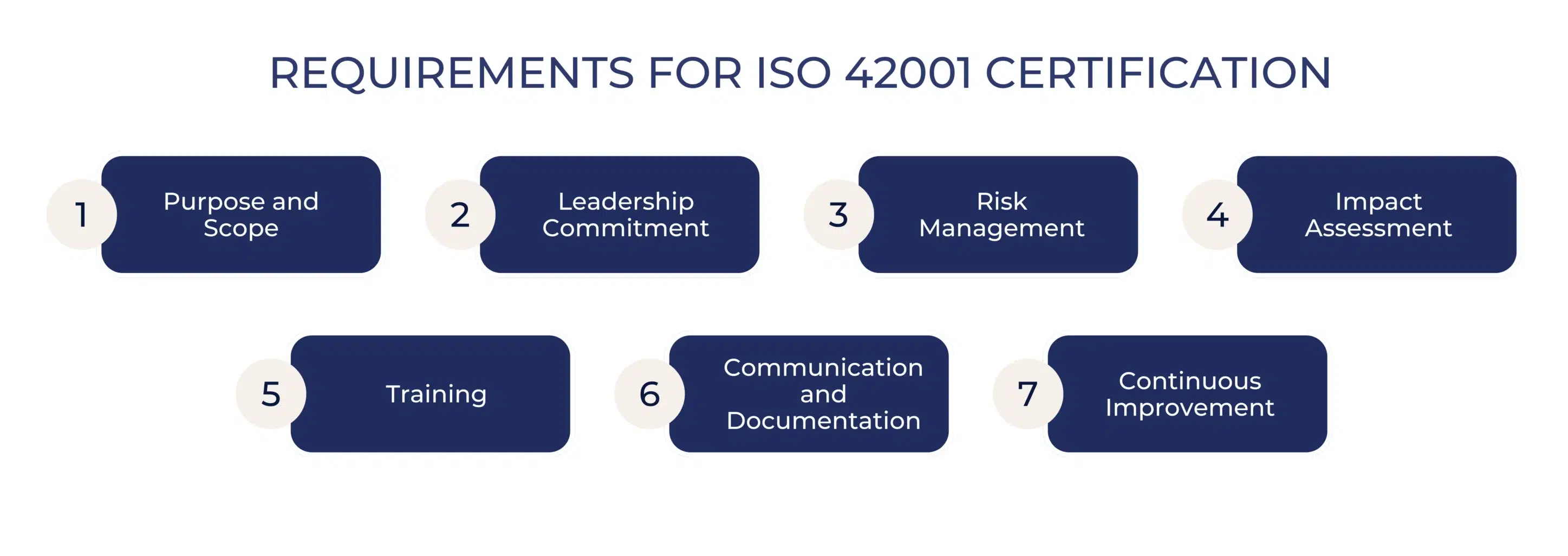
Achieving ISO 42001 certification in Dublin requires organizations to satisfy a comprehensive set of documented, operational, and governance requirements defined in ISO/IEC 42001:2023. These requirements span the full AIMS lifecycle — from initial context analysis and scope definition through to operational controls, performance evaluation, and continual improvement processes. Understanding these requirements in detail is essential for organizations preparing to undergo a certification audit, as each requirement must be evidenced through documentation, records, and observable operational practices.
ISO/IEC 42001:2023 requires organizations to establish and maintain a defined set of documented information that supports the operation and effectiveness of the AIMS. Core documentation requirements include a formal AI policy endorsed by top management, a documented scope statement defining the boundaries of the AIMS, an AI risk assessment methodology and documented risk register, and records of management review activities. All documentation must be controlled, version-managed, and accessible to relevant personnel throughout the organization.
For Dublin organizations, documentation requirements extend to records of AI system inventories, lifecycle documentation for each AI system within scope, training and competence records for personnel involved in AI governance, and records of supplier and third-party AI governance evaluations. During an ISO 42001 audit, CertPro evaluates whether documented information is complete, current, and reflective of actual operational practices — identifying gaps between documented procedures and observed controls as potential nonconformities requiring corrective action.
ISO 42001 places explicit requirements on top management to demonstrate leadership and commitment to the AIMS. Management must establish the AI policy, ensure that AIMS objectives align with the organization’s strategic direction, assign governance roles and responsibilities with clear accountability, and ensure that adequate resources are available to maintain and improve the AIMS. Evidence of management commitment is assessed during the ISO 42001 audit through interviews with senior leadership, review of management review records, and examination of resource allocation decisions.
Governance requirements under ISO 42001 also encompass the establishment of an AI governance committee or equivalent oversight body. This body must have defined responsibilities for approving AI system deployments, reviewing risk assessments, and monitoring AIMS performance. For Dublin organizations operating under regulated frameworks, these governance requirements align closely with existing board-level risk management expectations — enabling integration of AI governance into established enterprise risk management structures rather than requiring parallel or duplicative governance arrangements.
A systematic AI risk assessment process is a core requirement of ISO/IEC 42001:2023. Organizations must define and implement a documented methodology for identifying AI-related risks across the full lifecycle of each AI system — from design and development through deployment, operation, and decommissioning. Risk assessment activities must consider potential harms to individuals, groups, and society, including bias and discrimination, privacy violations, safety failures, and loss of human oversight. Risk assessments must be conducted at defined intervals and whenever significant changes to AI systems occur.
Risk treatment plans must document the controls selected to address identified risks, the rationale for control selection, and the residual risk levels following control implementation. During an ISO 42001 assessment, CertPro evaluates the completeness and rigor of risk assessment records, the appropriateness of risk treatment decisions, and the effectiveness of implemented controls. Organizations that cannot demonstrate a systematic, documented approach to AI risk assessment and treatment will receive nonconformity findings that must be addressed before ISO 42001 certification can be awarded.
ISO 42001 requires organizations to establish operational controls across the complete lifecycle of AI systems within scope of the AIMS. Lifecycle oversight requirements include controls at the design and specification stage to ensure alignment with ethical AI principles and risk treatment plans, validation and testing controls prior to deployment, access management and change control processes during operation, and structured decommissioning procedures when AI systems are retired. These operational controls must be documented, implemented, and evidenced through records that demonstrate consistent application across the organization.
- ✓Documented AI policy endorsed by top management with defined scope and objectives
- ✓AI system inventory covering all systems within the AIMS certification boundary
- ✓Systematic AI risk assessment methodology with documented risk register and treatment plans
- ✓Governance structure with defined roles, responsibilities, and accountability mechanisms
- ✓Operational controls across the full AI system lifecycle from design to decommissioning
- ✓Supplier and third-party AI governance evaluation processes and records
- ✓Performance monitoring and measurement processes with defined metrics and review cycles
- ✓Internal audit program with documented findings and corrective action tracking
- ✓Management review process with records demonstrating top management oversight
- ✓Continual improvement processes with documented improvement actions and outcomes
- ✓Documentation and Policy Requirements
- ✓Governance and Leadership Requirements
- ✓AI Risk Assessment and Treatment Requirements
- ✓Operational Controls and Lifecycle Oversight Requirements
How to Get ISO 42001 Certification in Dublin
Obtaining ISO 42001 certification in Dublin involves a structured sequence of activities that begins with organizational preparation and culminates in a formal third-party certification audit conducted by CertPro. The certification pathway requires organizations to build and operationalize their AIMS in conformance with ISO/IEC 42001:2023 requirements, conduct internal audits to validate AIMS effectiveness, and then engage CertPro to perform the independent Stage 1 and Stage 2 certification audits. Organizations that demonstrate conformance across all applicable requirements receive a formal certification attestation confirming their ISO 42001 compliance.
The first step in the certification process is to establish a clear inventory of all AI systems operated, developed, or procured by the organization — including AI tools embedded in enterprise software, machine learning models used for operational decisions, and AI-powered customer-facing applications. This inventory forms the foundation of the AIMS scope definition. Organizations must also conduct a context analysis to identify internal and external factors that affect AI governance requirements, including regulatory obligations, stakeholder expectations, and organizational risk appetite. CertPro’s ISO 42001 audit Dublin engagements begin with a review of these foundational elements to confirm that the certification scope is appropriately defined and that the AIMS covers all material AI operations.
Building and Operationalizing the AI Management System
Once the AIMS scope and context analysis are established, organizations must build the governance structures, policies, and operational controls required by ISO/IEC 42001:2023. This involves drafting and implementing the AI policy, establishing the governance committee or oversight body, conducting initial AI risk assessments across all systems in scope, and implementing risk treatment controls. Operational procedures for AI system design, development, deployment, monitoring, and incident management must be documented and communicated to all relevant personnel throughout the organization.
Training and competence requirements must be addressed by ensuring that personnel with AI governance responsibilities have the knowledge and skills required to fulfill their roles effectively. This includes training on the AI policy, risk assessment procedures, incident reporting processes, and the specific AI systems they oversee. Records of training activities and competence evaluations must be maintained as documented information. For Dublin organizations with distributed teams or international operations, competence management across multiple locations is a specific focus area during ISO 42001 certification assessments.
Internal Audit and Management Review Before Certification
Before engaging CertPro for the formal certification audit, organizations must complete at least one full cycle of internal AIMS audit activity. Internal audits must cover the full scope of the AIMS, evaluate conformance to all applicable ISO/IEC 42001:2023 requirements, and produce documented findings including any identified nonconformities. Internal audit records, corrective action plans, and evidence of corrective action completion must all be available for review during the CertPro ISO 42001 certification audit.
Management review must also be completed prior to the Stage 2 certification audit. The review must consider audit findings, changes in the internal and external context of the organization, AI risk assessment outcomes, performance measurement results, and resource adequacy. Records of the management review — including decisions made and actions assigned — must be maintained. CertPro’s ISO 42001 audit evaluates management review records to confirm that top management is actively engaged in AIMS oversight and that the review process drives meaningful improvement actions rather than serving as a procedural exercise.
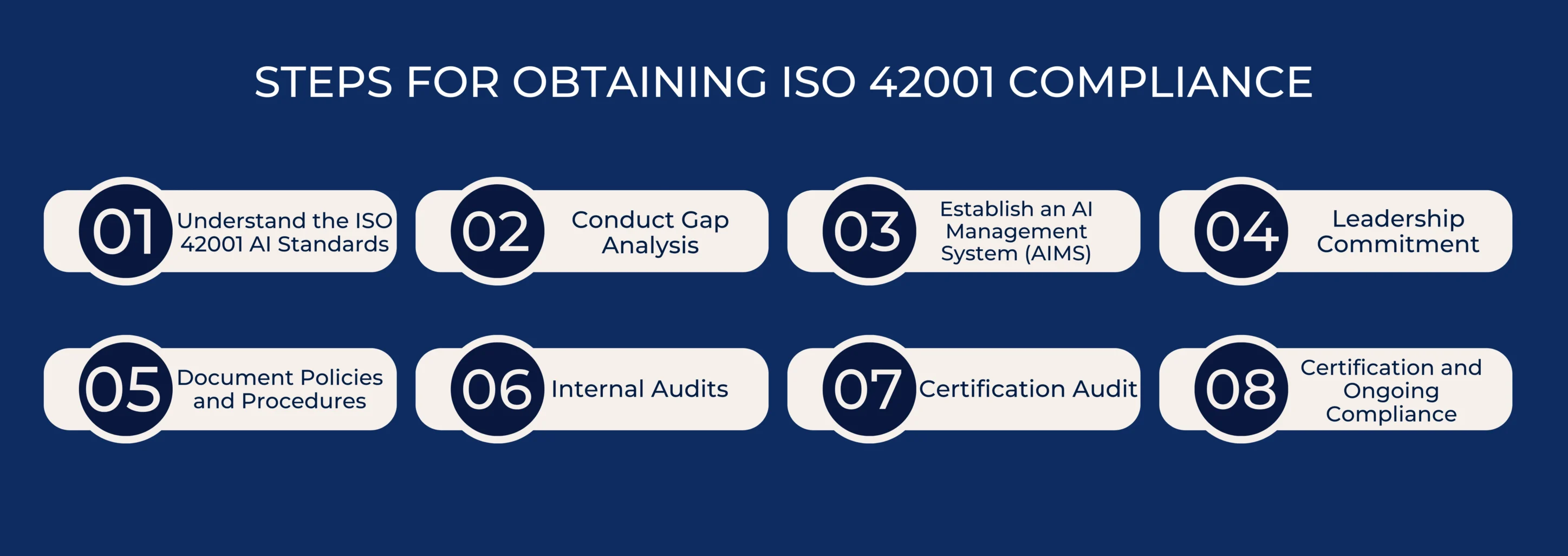
Steps for ISO 42001 Certification
CertPro’s ISO 42001 certification process follows a structured, multi-stage audit methodology designed to provide comprehensive, independent evaluation of an organization’s AI Management System. Each stage has specific objectives, activities, and outcomes that collectively build toward the certification decision. Understanding this structured process enables Dublin organizations to engage effectively with the certification audit and ensure that they are adequately prepared at each stage of the ISO 42001 audit journey.
- Scope Definition: CertPro and the client organization formally define the certification boundary, identifying AI systems, organizational units, and processes included within the AIMS scope. The scope statement must accurately reflect the organization’s AI operations and governance responsibilities.
- Audit Program Determination: CertPro establishes the audit program, defining audit objectives, criteria, methods, and timelines. The audit program is proportionate to the complexity of the organization’s AI systems and the breadth of the AIMS scope.
- Stage 1 Audit: CertPro conducts a documentation review and AIMS readiness evaluation. The Stage 1 audit assesses whether the organization’s documented AIMS is sufficiently developed to proceed to Stage 2, and identifies any significant gaps that must be addressed.
- Stage 2 Audit: CertPro conducts the on-site conformance audit, evaluating the implementation and operational effectiveness of AIMS controls through document review, interviews, observation of processes, and evidence testing across all areas within scope.
- Control Testing: CertPro tests the effectiveness of key AI governance controls, including risk assessment processes, lifecycle controls, monitoring mechanisms, and incident management procedures, using sampling methodologies appropriate to the control environment.
- Nonconformity Review: CertPro documents all identified nonconformities, categorized as major or minor, and communicates findings to the organization. Organizations must submit corrective action plans addressing all nonconformities before ISO 42001 certification can proceed.
- Certification Decision: CertPro’s independent certification panel reviews audit findings, nonconformity records, and corrective action evidence to reach a certification decision. The decision is made objectively, based solely on audit evidence.
- Issuance of Attestation: Upon a positive certification decision, CertPro issues a formal ISO 42001 certification attestation documenting the certified scope, audit methodology, and certification validity period.
- Surveillance Audits: CertPro conducts annual surveillance audits to verify that the AIMS remains operational and continues to conform to ISO/IEC 42001:2023 requirements throughout the three-year certification cycle.
- Recertification: At the end of the three-year certification cycle, CertPro conducts a full recertification audit to evaluate AIMS conformance and renew the ISO 42001 certification for an additional three-year period.
The Stage 1 audit is a structured review of the organization’s AIMS documentation and overall readiness to proceed to the Stage 2 conformance audit. During Stage 1, CertPro evaluates whether the AIMS scope is clearly and appropriately defined, whether the AI policy addresses all required elements, whether the risk assessment methodology is documented and fit for purpose, and whether the organization’s governance structures align with ISO/IEC 42001:2023 requirements. Stage 1 findings identify significant gaps that must be addressed before the Stage 2 audit commences.
Stage 1 audit activities typically take one to two days for organizations of moderate complexity, though larger organizations or those with complex multi-system AI deployments may require extended evaluation. The output of the Stage 1 audit is a formal report documenting readiness findings, any significant gaps identified, and recommendations for proceeding to Stage 2. Organizations are typically given a defined period — usually four to eight weeks — to address any significant issues identified during Stage 1 before the Stage 2 ISO 42001 audit is scheduled.
The Stage 2 audit is the primary conformance evaluation, during which CertPro assesses the operational effectiveness of the AIMS by reviewing implemented controls, testing evidence of control operation, and interviewing personnel at multiple levels of the organization. Stage 2 audit activities include review of AI risk assessment records and treatment plan implementation, observation of operational controls and monitoring processes, testing of incident management records and response procedures, and evaluation of management review and internal audit outcomes.
For ISO 42001 certification Dublin engagements, Stage 2 audits are typically conducted at the organization’s Dublin premises, though remote or hybrid audit methodologies may be used for specific documentation review activities. The duration of the Stage 2 audit is determined by the AIMS scope and the number of AI systems covered, with typical engagements ranging from two to five audit days. Following Stage 2, CertPro issues a detailed audit report documenting all findings, nonconformities, and the basis for the ISO 42001 certification recommendation.
- ✓Stage 1 Audit: Documentation and Readiness Evaluation
- ✓Stage 2 Audit: Operational Conformance Evaluation
ISO 42001 Certification Cost in Dublin
The cost of ISO 42001 certification in Dublin is determined by several key variables, including the size of the organization, the number and complexity of AI systems within the certification scope, the maturity of existing governance controls, and the number of sites or locations included within the AIMS boundary. CertPro provides transparent, fixed-scope pricing for ISO 42001 certification audit engagements, with fees calculated based on a detailed scoping assessment that considers these variables and ensures that audit time is allocated appropriately to the complexity of the engagement.
For small and medium-sized enterprises deploying a limited number of AI systems, ISO 42001 certification costs are typically more accessible than those for large multinational organizations with complex, multi-system AI deployments. Organizations that have already invested in ISO 27001 certification or other ISO management system frameworks may benefit from reduced audit effort in areas where controls and documentation can be shared across management systems — potentially reducing overall ISO 42001 certification costs without compromising audit quality.
Cost Factors for ISO 42001 Certification Engagements
| Cost Factor | Impact on Engagement Cost | Notes |
|---|---|---|
| Number of AI systems in scope | High — directly drives audit day requirements | Each AI system requires lifecycle and control evaluation |
| Organization size and complexity | High — larger organizations require extended audit programs | Employee count, revenue, and operational complexity are considered |
| Existing ISO management system certifications | Moderate reduction — shared controls reduce audit effort | ISO 27001 integration provides greatest overlap with AIMS requirements |
| Multi-site or international operations | Significant increase — each site may require audit activities | Remote audit methodologies can reduce travel-related costs |
| AIMS maturity at time of engagement | Moderate — mature systems require less remediation time | Immature systems may require additional audit cycles |
Ongoing certification costs include annual surveillance audit fees and the recertification audit conducted at the end of the three-year certification cycle. Surveillance audits are typically shorter in duration than the initial certification audit, as they focus on verifying continued ISO 42001 compliance in key areas rather than conducting a comprehensive evaluation of all AIMS requirements. Organizations should budget for surveillance audit fees as part of their ongoing compliance program, alongside internal resource costs for maintaining AIMS documentation, conducting internal audits, and managing the management review process.
Return on Investment from ISO 42001 Certification
When evaluating ISO 42001 certification costs, Dublin organizations should consider the return on investment generated by certified AI governance. Regulatory penalties for GDPR violations involving AI systems can reach up to 4% of global annual turnover under Article 83(5) — significantly exceeding typical certification costs. Reputational damage from AI-related incidents, including algorithmic bias scandals, data breaches involving AI systems, or governance failures exposed in regulatory investigations, can impose costs far greater than the investment required to establish and certify an effective AIMS.
Commercial benefits of ISO 42001 certification also contribute to a positive return on investment. Organizations that have achieved ISO AIMS certification in Dublin may gain access to enterprise procurement opportunities that require certified AI governance — potentially generating new revenue streams that justify certification investment. For organizations operating in regulated industries, ISO 42001 certification may also reduce the cost and frequency of regulatory examinations by demonstrating to supervisory authorities that robust, independently verified AI governance controls are in place.
Benefits of ISO 42001 Certification
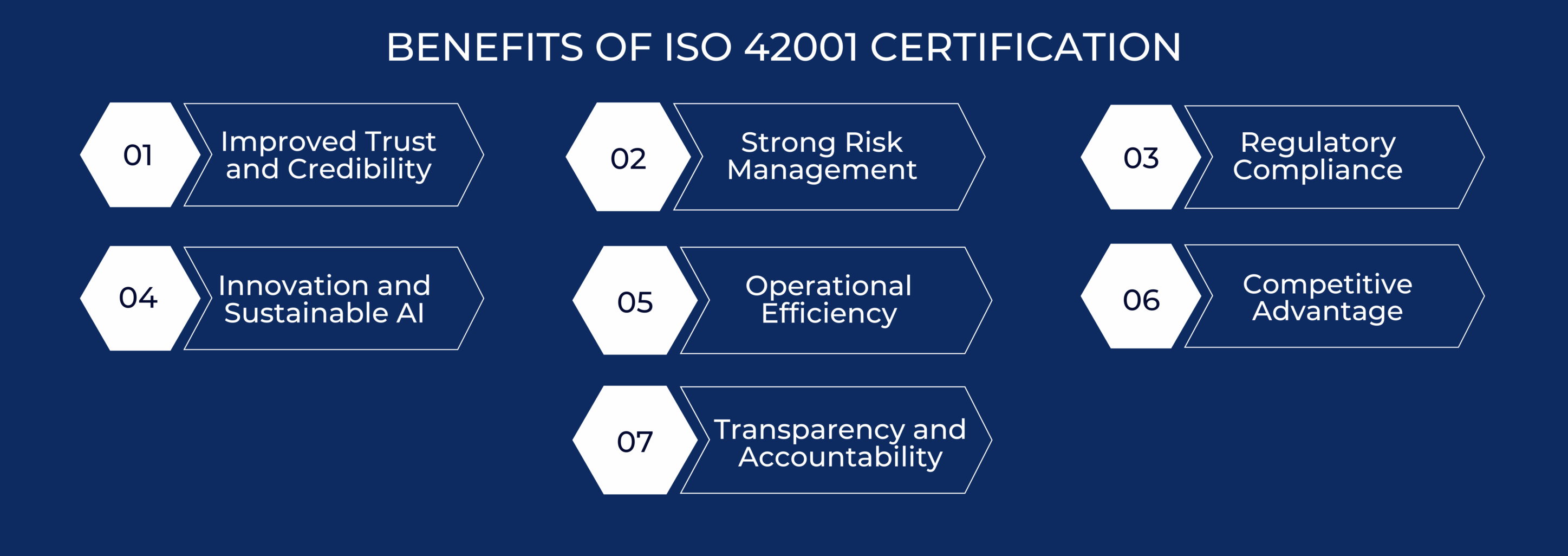
Securing ISO 42001 certification in Dublin delivers a range of strategic, operational, and regulatory benefits that extend well beyond the certification document itself. The process of building and auditing an AIMS creates organizational capabilities for systematic AI risk management, governance accountability, and continual improvement that strengthen overall AI operations. These capabilities support long-term responsible AI deployment and are realized not only at the point of certification but continue to accumulate as the AIMS matures alongside the organization’s AI landscape.
- ✓Independent verification of AI governance controls through third-party certification audit, providing objective assurance to regulators, customers, and investors
- ✓Structured framework for identifying, assessing, and treating AI-related risks across the full system lifecycle, reducing the likelihood of AI-related incidents and failures
- ✓Enhanced regulatory positioning under GDPR, the EU AI Act, and sector-specific AI governance requirements applicable to Dublin’s financial services and healthcare sectors
- ✓Competitive differentiation in enterprise procurement processes where certified AI governance is required or preferred by sophisticated buyers
- ✓Improved organizational trust and stakeholder confidence through transparent, independently verified AI governance practices
- ✓Integration with existing ISO management systems including ISO 27001 and ISO 31000, enabling efficient governance across overlapping risk domains
- ✓Reduction of regulatory examination burden through demonstrated adherence to internationally recognized AI governance standards
- ✓Strengthened supplier and third-party AI governance through systematic evaluation requirements embedded in the AIMS framework
- ✓Board-level assurance on AI risk management through structured management review and independent ISO 42001 audit findings
- ✓Foundation for ongoing AI ethics and responsible AI programs aligned with EU and international regulatory expectations
ISO 42001 compliance provides a documented, independently verified basis for demonstrating regulatory accountability across multiple overlapping legal frameworks relevant to Dublin organizations. GDPR’s accountability obligations under Article 5(2), automated decision-making transparency requirements under Article 22, and data protection by design mandates under Article 25 are all directly supported by AIMS controls that establish documented oversight of AI data processing activities. For organizations subject to Data Protection Commission of Ireland examinations or enforcement actions, ISO 42001 certification provides objective evidence of governance investment that regulators can verify and acknowledge.
Under the EU AI Act, organizations deploying high-risk AI systems must implement quality management systems with requirements that closely parallel those of ISO 42001. Organizations that have achieved ISO 42001 certification are therefore well-positioned to demonstrate conformity with EU AI Act quality management obligations — potentially reducing the cost and complexity of EU AI Act compliance programs. The alignment between ISO 42001 and the EU AI Act’s governance requirements makes ISO AIMS certification a strategically valuable investment for Dublin organizations anticipating increased regulatory scrutiny as EU AI Act obligations come into full force through 2025 and 2026.
Beyond regulatory and commercial benefits, ISO 42001 certification delivers tangible operational improvements by establishing systematic processes for AI system oversight and continuous improvement. Organizations that implement an AIMS typically report improvements in AI incident detection and response times, as structured monitoring and escalation processes ensure that AI performance issues are identified and addressed promptly. Documented AI lifecycle controls also reduce the risk of unauthorized AI system deployments — a common source of governance failures in organizations without formal AIMS frameworks.
The AIMS internal audit requirement drives continuous improvement by systematically identifying gaps between documented procedures and operational practices — ensuring that governance controls remain current and effective as AI systems evolve and new capabilities are deployed. For Dublin organizations operating in rapidly evolving technology environments, this built-in mechanism for governance refreshment is particularly valuable. It ensures that the AIMS keeps pace with the organization’s AI adoption trajectory, rather than becoming a static compliance artifact that fails to reflect current AI operations.
- ✓Regulatory and Legal Risk Reduction Through ISO 42001 Compliance
- ✓Operational Benefits of Systematic AI Governance
Why Choose CertPro for ISO 42001 Certification in Dublin?
CertPro distinguishes itself as the preferred certification body for ISO 42001 certification in Dublin through its institutional positioning as a Licensed CPA Firm, its sector-specific audit expertise across Dublin’s key industries, and its commitment to delivering independent, objective certification outcomes that provide genuine assurance value. CertPro’s certification engagements are conducted by qualified auditors with direct experience in AI governance, technology risk management, and regulatory compliance — ensuring that ISO 42001 audit activities are focused on areas of material risk rather than procedural formality.
Unlike organizations that offer combined consulting and certification services, CertPro maintains strict independence between its audit activities and any advisory functions. This independence is fundamental to the value of ISO 42001 certification — stakeholders can place greater reliance on a certification issued by an independent, licensed firm than on attestations from organizations whose revenue models create potential conflicts of interest. CertPro’s certification outcomes are based solely on audit evidence and objective assessment of conformance to ISO/IEC 42001:2023 requirements.
Licensed CPA Firm Expertise in AI Governance Auditing
CertPro’s status as a Licensed CPA Firm brings the rigor, professional standards, and accountability frameworks of the CPA profession to ISO 42001 certification engagements. CPA professional standards require auditors to maintain independence, exercise professional skepticism, and apply systematic audit methodologies — standards that are directly applicable to and beneficial in ISO management system certification contexts. This professional foundation ensures that CertPro’s ISO 42001 certification outcomes are defensible, credible, and worthy of stakeholder reliance.
CertPro’s audit team combines CPA-trained auditors with technical specialists in AI systems, machine learning governance, and data management — providing the multidisciplinary expertise required to evaluate complex AI governance environments. This combination of financial audit rigor and technical AI expertise enables CertPro to conduct ISO 42001 audits that go beyond documentation review to assess the substantive effectiveness of AI governance controls in real operational environments. For Dublin organizations with sophisticated AI deployments, this depth of audit capability is essential to obtaining ISO 42001 certification that provides genuine assurance value.
Sector-Specific ISO 42001 Audit Capabilities in Dublin
CertPro has developed sector-specific ISO 42001 audit capabilities tailored to Dublin’s key industries, including financial services and fintech, cloud and SaaS, healthcare and life sciences, and enterprise technology. Each sector presents distinct AI use cases, regulatory overlays, and governance challenges that require auditors to bring relevant domain knowledge to the evaluation. CertPro’s financial services audit team understands the regulatory expectations of the Central Bank of Ireland and the European Banking Authority regarding algorithmic models and AI-driven financial decisions. Its technology sector team is experienced in evaluating AI governance across cloud-native and SaaS environments with distributed, scalable AI architectures.
This sector specificity enables CertPro to conduct ISO 42001 certification for Dublin companies in a manner that reflects the actual risk landscape of each organization’s industry, rather than applying generic audit procedures that may not address the most material AI governance risks. CertPro’s familiarity with Dublin’s regulatory environment — including GDPR enforcement patterns, Central Bank supervisory expectations, and Health Service Executive AI governance requirements — ensures that ISO 42001 certification engagements are aligned with the specific compliance context in which Dublin organizations operate.
Fixed Pricing and Transparent Engagement Terms
CertPro provides fixed, transparent pricing for ISO 42001 certification audit engagements, determined through a structured scoping process that evaluates organizational complexity, AIMS scope, and audit day requirements before fees are confirmed. Fixed pricing gives Dublin organizations certainty over certification costs and eliminates the risk of scope creep or unexpected additional charges that can arise with time-and-materials engagement models. This pricing transparency supports effective budget planning for ISO 42001 compliance programs and enables clear return on investment calculations from the outset.
CertPro’s engagement terms include clearly defined deliverables at each stage of the certification process — including Stage 1 audit reports, Stage 2 audit findings, nonconformity documentation, and the formal ISO 42001 certification attestation. Service level commitments for report delivery and certification decision timelines provide Dublin organizations with predictable certification pathways that can be integrated into regulatory reporting cycles, contract timelines, and investor due diligence processes.
ISO 42001 Compliance and the Dublin Regulatory Environment
Dublin’s regulatory environment presents a complex, layered set of obligations for organizations deploying AI systems. As Ireland’s capital and primary financial center, Dublin is home to organizations supervised by the Central Bank of Ireland, the Data Protection Commission, the Competition and Consumer Protection Commission, and — for organizations within the scope of the EU AI Act — EU-level AI supervisory authorities. ISO 42001 compliance provides a cross-cutting governance framework that addresses the AI governance dimensions of obligations arising across these multiple regulatory domains simultaneously.
GDPR and ISO 42001 Compliance Alignment
The Data Protection Commission of Ireland is one of Europe’s most active GDPR supervisory authorities, having issued landmark enforcement decisions against major technology companies headquartered in Dublin. GDPR obligations that directly intersect with AI governance include Article 5(1)(a) lawfulness and fairness requirements for automated processing, Article 13–14 transparency obligations for automated decision-making, Article 22 restrictions on solely automated decisions with significant effects, and Article 35 Data Protection Impact Assessment requirements for high-risk AI processing activities.
ISO 42001 compliance supports satisfaction of these GDPR obligations by requiring organizations to document the purposes and legal bases for AI data processing, implement controls over automated decision-making, conduct structured risk assessments of AI processing activities, and maintain transparency mechanisms that enable individuals to understand AI-based decisions that affect them. For Dublin organizations subject to DPC oversight, ISO 42001 certification provides documented, independently verified evidence of AI data governance that can support accountability demonstrations in regulatory examinations or enforcement proceedings.
EU AI Act Compliance Considerations for Dublin Organizations
The EU AI Act establishes a risk-based regulatory framework for AI systems, classifying them as unacceptable risk, high-risk, limited risk, or minimal risk based on their intended use and potential impact. High-risk AI systems — including those used in credit scoring, employment screening, healthcare diagnostics, critical infrastructure management, and law enforcement — face mandatory requirements for quality management systems, technical documentation, conformity assessment, post-market monitoring, and human oversight. ISO 42001 certification provides a recognized quality management framework that addresses many of these mandatory requirements effectively.
For Dublin organizations deploying high-risk AI systems, proactive ISO 42001 certification positions them to demonstrate EU AI Act compliance readiness as enforcement obligations take effect. The EU AI Act’s Article 9 quality management system requirements align closely with ISO 42001’s AIMS requirements — meaning that organizations certified to ISO 42001 can leverage their existing AIMS documentation and controls to support EU AI Act conformity assessment activities. ISO 42001 audit Dublin engagements conducted by CertPro specifically evaluate the AIMS against requirements relevant to EU AI Act compliance positioning, providing dual-use assurance value for organizations navigating both frameworks simultaneously.
Financial Services AI Governance Requirements in Dublin
Dublin’s financial services sector — encompassing banks, insurance companies, investment firms, payment institutions, and fintech platforms — is subject to specific AI governance expectations from the Central Bank of Ireland and European supervisory authorities including the EBA, EIOPA, and ESMA. The European Banking Authority’s Guidelines on Internal Governance and its Framework on Responsible, Inclusive Fintech explicitly reference AI governance requirements, including model risk management, explainability, and fairness. ISO 42001 certification for Dublin financial services organizations provides an independently verified governance framework that demonstrates alignment with these sector-specific expectations.
The Digital Operational Resilience Act (DORA), which applies to financial entities operating in the EU from January 2025, includes requirements for ICT risk management that encompass AI systems used in critical financial functions. ISO 42001 compliance contributes to DORA adherence by establishing documented governance and risk management controls for AI systems that support critical business processes. Dublin financial services organizations that have achieved ISO 42001 certification are therefore better positioned to demonstrate DORA compliance in areas where AI systems form part of the ICT infrastructure subject to DORA’s risk management requirements.
Secure Your ISO 42001 Certification in Dublin with CertPro
Achieving ISO 42001 certification in Dublin represents a strategic commitment to responsible AI governance that positions organizations for sustained regulatory compliance, commercial differentiation, and stakeholder trust in an increasingly AI-regulated environment. CertPro’s independent certification audit services provide the objective, third-party assurance that regulators, customers, investors, and business partners require — delivered through a structured, transparent engagement process by a Licensed CPA Firm with demonstrated expertise in AI management system evaluation.
From the initial ISO 42001 assessment through to Stage 1 and Stage 2 certification audits, nonconformity resolution, and ongoing surveillance, CertPro’s engagement methodology is designed to deliver credible, defensible certification outcomes that stand up to regulatory scrutiny and provide genuine governance assurance. Organizations in Dublin’s technology, financial services, healthcare, and enterprise sectors that are ready to demonstrate their AI governance credentials through independent certification are invited to engage CertPro to initiate their ISO 42001 certification program.
ISO 42001 certification Dublin engagements with CertPro begin with a structured scoping assessment that defines the certification boundary, evaluates organizational complexity, and establishes an audit program proportionate to the scope and nature of the organization’s AI operations. Fixed pricing is confirmed following the scoping assessment, providing complete cost transparency before the engagement commences. Organizations seeking to begin their ISO 42001 certification process are encouraged to contact CertPro to schedule an initial scoping discussion and receive a formal engagement proposal.
FAQ
▶
What is ISO 42001 certification and why is it relevant for Dublin organizations?
▶
How long does an ISO 42001 audit in Dublin typically take?
▶
What is the difference between ISO 42001 assessment and full certification?
▶
Which Dublin organizations need ISO 42001 certification?
▶
How does ISO 42001 compliance support GDPR obligations for Dublin organizations?
▶
Can ISO 42001 certification be integrated with existing ISO 27001 certification?
▶
How does ISO 42001 certification benefit Dublin startups and scale-ups?
▶
What happens during ISO 42001 surveillance audits?
ISO 42001 CERTIFIED: WHY AI GOVERNANCE CERTIFICATION IS BECOMING A BOARD-LEVEL REQUIREMENT
AI is now an inevitable component of major business activities in the current corporate world. To elaborate, it is now part of product design, custome…

MindSec Launches AI Compliance for Law 25 & ISO 42001
Excerpt from Barchart Article, Published on December 3, 2025 Today, Canadian organizations face increasing pressure to comply with stringent privacy a…

UNDERSTANDING ISO 42001: A GUIDE FOR RESPONSIBLE AI MANAGEMENT SYSTEMS
The invention of artificial intelligence (AI) has changed the operational processes of many industries. However, the rapid growth of technology increa…
Get In Touch
have a question? let us get back to you.