
ISO 42001 Certification in Mumbai
CertPro is a Licensed CPA Firm conducting ISO 42001 certification audits for organizations in Mumbai that develop, deploy, or use artificial intelligence systems. ISO 42001 Certification in Mumbai is evaluated against the requirements of ISO/IEC 42001:2023, the internationally recognized standard for Artificial Intelligence Management Systems (AIMS). CertPro’s ISO 42001 audit scope encompasses documentation review, control evaluation, and conformance verification across all applicable AI system boundaries — delivering independent, evidence-based certification decisions that organizations, regulators, and clients can rely on.
OUR CLIENTS









What Is ISO 42001?
ISO/IEC 42001:2023 is the internationally recognized standard specifying requirements for an Artificial Intelligence Management System (AIMS). Published jointly by the International Organization for Standardization (ISO) and the International Electrotechnical Commission (IEC) in 2023, ISO 42001 is the first global standard dedicated exclusively to governing how organizations manage AI responsibly through a documented management system framework. ISO 42001 Certification in Mumbai applies to any organization — regardless of size, sector, or geographic location — that develops, provides, or uses AI-based products or services. Achieving ISO 42001 compliance signals a documented, auditable commitment to responsible AI governance.
Definition and Scope of ISO 42001
ISO 42001 establishes requirements that enable organizations to identify, assess, treat, and monitor AI-specific risks across the full lifecycle of AI systems — from design and development through deployment, monitoring, and decommissioning. The standard adopts the Plan-Do-Check-Act (PDCA) cycle familiar from ISO 9001 and ISO 27001, structured through Annex SL’s High-Level Structure (HLS). This architectural alignment means organizations already certified under ISO 27001 (information security) or ISO 9001 (quality management) can integrate ISO 42001 requirements without constructing an entirely separate management system, reducing implementation effort significantly.
The standard’s scope is explicitly broad: it applies to AI systems used in automated decision-making, natural language processing, computer vision, predictive analytics, recommendation engines, and any other AI-enabled process that carries organizational or societal impact. In Mumbai’s economy — where AI is embedded in credit scoring, fraud detection, medical imaging, supply chain optimization, and customer experience management — ISO 42001 Certification in Mumbai provides a structured mechanism to demonstrate that AI systems are governed with accountability, transparency, and ethical rigor.
How ISO 42001 Differs from ISO 27001 and Other Standards
ISO 27001 governs information security management — protecting data confidentiality, integrity, and availability across information assets. ISO 42001 governs AI-specific risks, ethics, transparency, bias mitigation, and the governance of AI decision-making systems. The two standards are complementary: ISO 27001 addresses the security of data used by AI systems, while ISO 42001 addresses the management and accountability of the AI systems themselves. Organizations in Mumbai’s financial services and healthcare sectors frequently pursue both certifications to demonstrate a comprehensive governance posture across data security and AI accountability.
ISO 42001 also differs from ISO 31000 (risk management) and ISO 9001 (quality management) by introducing AI-specific concepts such as impact assessment for AI systems, AI system lifecycle management, and explicit requirements for addressing algorithmic bias and explainability. Where ISO 31000 provides general risk management principles, ISO 42001 operationalizes those principles specifically for AI governance contexts. This distinction is critical for Mumbai organizations seeking ISO 42001 certification that directly addresses AI regulatory expectations from bodies such as RBI, SEBI, and India’s evolving AI governance framework.
| Standard | Governance Domain | AI-Specific Controls | Applicability |
|---|---|---|---|
| ISO 42001:2023 | AI Management System (AIMS) | Yes — AI lifecycle, bias, explainability | AI developers, providers, and users |
| ISO 27001:2022 | Information Security Management | Partial — data security only | All organizations handling information |
| ISO 9001:2015 | Quality Management | No | Product and service quality contexts |
| ISO 31000:2018 | Risk Management | No | General organizational risk frameworks |
Structural Origins and Regulatory Alignment of ISO 42001
ISO 42001 was developed by ISO/IEC JTC 1/SC 42, the subcommittee dedicated to Artificial Intelligence, reflecting years of international deliberation on how to bring AI systems under a coherent, auditable management framework. The standard aligns structurally with the EU AI Act’s risk categorization principles and GDPR‘s accountability requirements, making it a globally portable certification that supports regulatory compliance across jurisdictions. For Mumbai-based organizations operating in international markets or subject to cross-border data governance requirements, ISO 42001 compliance provides a recognized framework that speaks to regulators worldwide — and positions certified organizations as trusted participants in the global responsible AI economy.

ISO 42001 and the AI Management System (AIMS) Framework
The Artificial Intelligence Management System (AIMS) established by ISO 42001 is a structured organizational system for setting AI governance policies, assigning AI-specific roles and responsibilities, conducting AI risk and impact assessments, and maintaining documented evidence of AI system controls. AIMS is not a software platform or technical architecture — it is a management framework that governs how an organization makes decisions about AI systems, monitors their performance, and responds to incidents or failures. Understanding AIMS is foundational to pursuing ISO 42001 certification effectively.
Core Components of the AIMS Framework
The AIMS framework under ISO 42001 consists of interconnected components that together form a complete governance architecture for AI systems. The foundational layer is organizational context — understanding the internal and external factors that influence how AI is deployed, who the affected stakeholders are, and what the organization’s objectives for AI use are. Above this sits a leadership and policy layer, where top management commits to AI governance through a formal AI policy, assigns accountable roles such as an AI Officer or equivalent, and ensures that AI governance objectives are integrated into organizational strategy.
The operational layer of AIMS encompasses AI system lifecycle management — planning and controlling AI development, deployment, monitoring, and retirement. This includes conducting AI impact assessments that evaluate potential harms to individuals, communities, and society; establishing controls for data quality, model validation, and algorithmic fairness; and maintaining documented records that auditors can review for conformance. For Mumbai fintech organizations using AI in loan origination or credit risk scoring, this operational layer directly governs the fairness and accountability of AI-driven financial decisions — making ISO 42001 assessment a strategically valuable exercise.
AI Risk and Impact Assessment in AIMS
ISO 42001 requires organizations to conduct systematic AI risk assessments and AI impact assessments as part of AIMS operation. AI risk assessment identifies technical and operational risks associated with AI system failure — including model drift, adversarial attacks, data poisoning, and unintended outcomes. AI impact assessment evaluates the broader societal and ethical implications of AI system decisions, particularly where AI affects access to financial services, healthcare, employment, or other critical life domains. These assessments must be documented, reviewed at defined intervals, and updated whenever AI systems are modified.
In Mumbai’s healthcare sector, AI-driven diagnostic tools require impact assessments that address clinical accuracy, equitable performance across patient demographics, and accountability when AI recommendations are incorrect. In the logistics sector, AI-driven route optimization and demand forecasting systems require risk assessments covering operational failure modes and supply chain resilience. The ISO 42001 assessment framework provides a structured, repeatable methodology for conducting these evaluations consistently — and documenting them in a manner that satisfies both internal governance requirements and external ISO 42001 audit scrutiny.
AIMS Performance Evaluation and Continual Improvement
ISO 42001 mandates that organizations monitor, measure, analyze, and evaluate AIMS performance against defined objectives. Internal audits of the AIMS must be conducted at planned intervals to verify that the management system conforms to both the organization’s own requirements and the requirements of ISO 42001. Management reviews — conducted by top leadership — must assess AIMS effectiveness and drive decisions about resource allocation, policy updates, and improvement actions. This continual improvement cycle distinguishes a certified AIMS from a static compliance checklist, ensuring that AI governance evolves as AI systems and their operating environments change over time.
ISO 42001 Certification Requirements
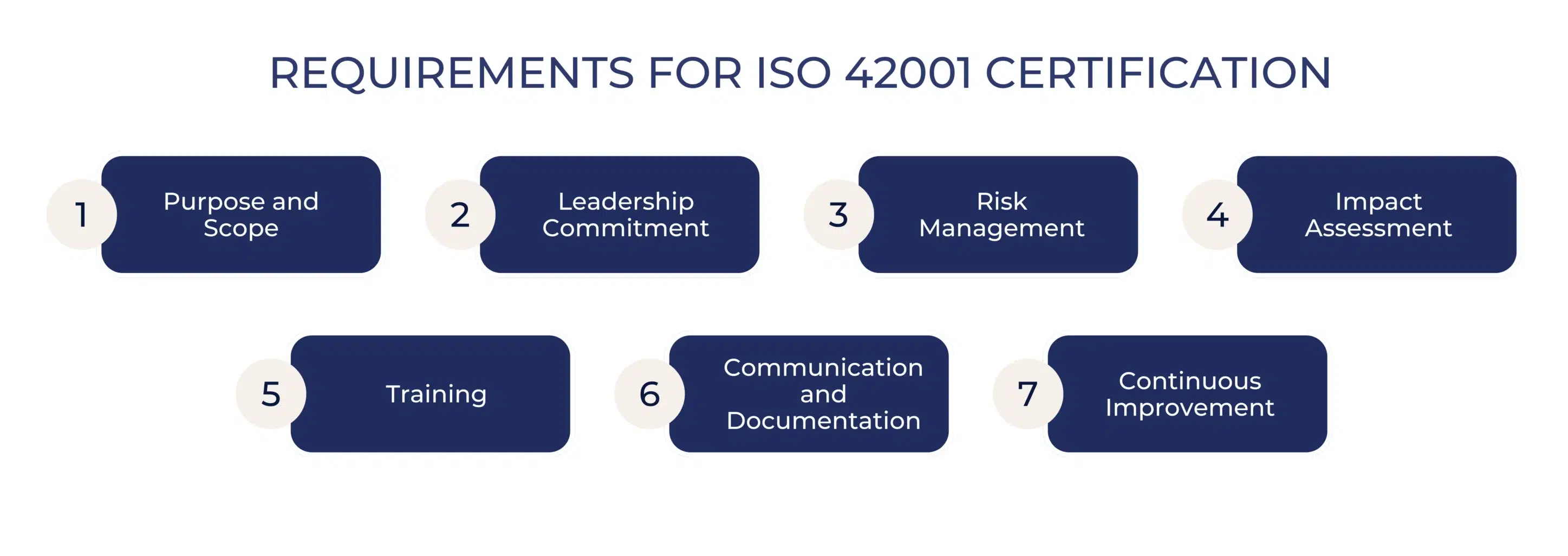
ISO 42001 Certification requires organizations to demonstrate conformance with the standard’s clauses through documented evidence reviewed during a formal audit. The standard is structured across ten clauses — Clauses 1–3 covering scope and terms, and Clauses 4–10 containing the certifiable requirements — plus normative Annex A, which provides AI-specific controls. ISO 42001 compliance is verified when an accredited certification body such as CertPro, a Licensed CPA Firm, determines through Stage 1 and Stage 2 audits that the AIMS meets all mandatory requirements. Meeting these requirements fully is the foundation of ISO 42001 Certification in Mumbai.
ISO 42001 requires organizations to maintain specific documented information as evidence of AIMS implementation and operation. Mandatory documentation includes an AI Policy approved by top management; an AI objectives register defining measurable targets for responsible AI use; an AI system inventory documenting all in-scope AI systems with their purpose, risk classification, and lifecycle stage; AI risk assessment records; AI impact assessment reports; documented evidence of internal AIMS audits; and records of management reviews. This documented information forms the primary evidence base reviewed during an ISO 42001 audit conducted by CertPro.
Documentation must be controlled — meaning organizations must establish procedures for document creation, review, approval, version control, and retention. For Mumbai organizations with complex AI ecosystems spanning multiple departments, subsidiaries, or cloud environments, documentation control requires systematic records management across all AIMS-relevant business units. Organizations pursuing ISO 42001 Certification in Mumbai should ensure that documentation is accessible, consistent, and maintained in a format that supports both day-to-day governance and periodic ISO 42001 audit review.
Beyond documentation, ISO 42001 imposes substantive technical and operational requirements. Organizations must establish data governance controls that address data quality, data provenance, and data representativeness for AI training datasets. Model governance requirements include validation processes that test AI model performance, accuracy, and fairness before deployment — as well as ongoing monitoring processes that detect model drift or performance degradation in production. Organizations must also establish incident management procedures for AI-specific failures, including unintended outputs, discriminatory decisions, or security compromises affecting AI systems.
Annex A of ISO 42001 provides 38 controls organized across domains including AI policy, internal organization, resources for AI systems, assessing AI system impacts, AI system lifecycle, and responsible AI supply chain. While Annex A controls are reference controls — not all will apply to every organization — the Statement of Applicability (SoA) for ISO 42001 requires organizations to document which controls are applicable, which are implemented, and the justification for any exclusions. CertPro’s ISO 42001 audit evaluates the SoA and tests the implementation and operating effectiveness of all applicable Annex A controls as part of the conformance assessment.
ISO 42001 places explicit requirements on top management. Organizational leadership must demonstrate visible commitment to AIMS by approving the AI policy, ensuring AIMS objectives are compatible with the organization’s strategic direction, directing resources to AIMS implementation, and participating in management reviews. This requirement reflects the standard’s recognition that AI governance cannot be delegated entirely to technical teams — it demands organizational accountability at the executive level. For Mumbai’s large conglomerates and listed companies where AI governance is increasingly subject to board-level scrutiny, this leadership requirement aligns ISO 42001 certification with existing corporate governance frameworks and investor expectations.
- ✓Formal AI Policy approved and communicated by top management
- ✓AI objectives register with measurable responsible AI targets
- ✓Comprehensive AI system inventory covering all in-scope AI applications
- ✓AI risk assessment records updated at defined review intervals
- ✓AI impact assessment reports for high-risk AI systems
- ✓Statement of Applicability (SoA) documenting Annex A control decisions
- ✓Internal AIMS audit program and documented audit results
- ✓Management review records demonstrating executive oversight
- ✓Data governance controls addressing training data quality and provenance
- ✓AI incident management procedures and incident response records
- ✓Documentation Requirements
- ✓Technical and Operational Requirements
- ✓Leadership and Governance Requirements
ISO 42001 Certification Process
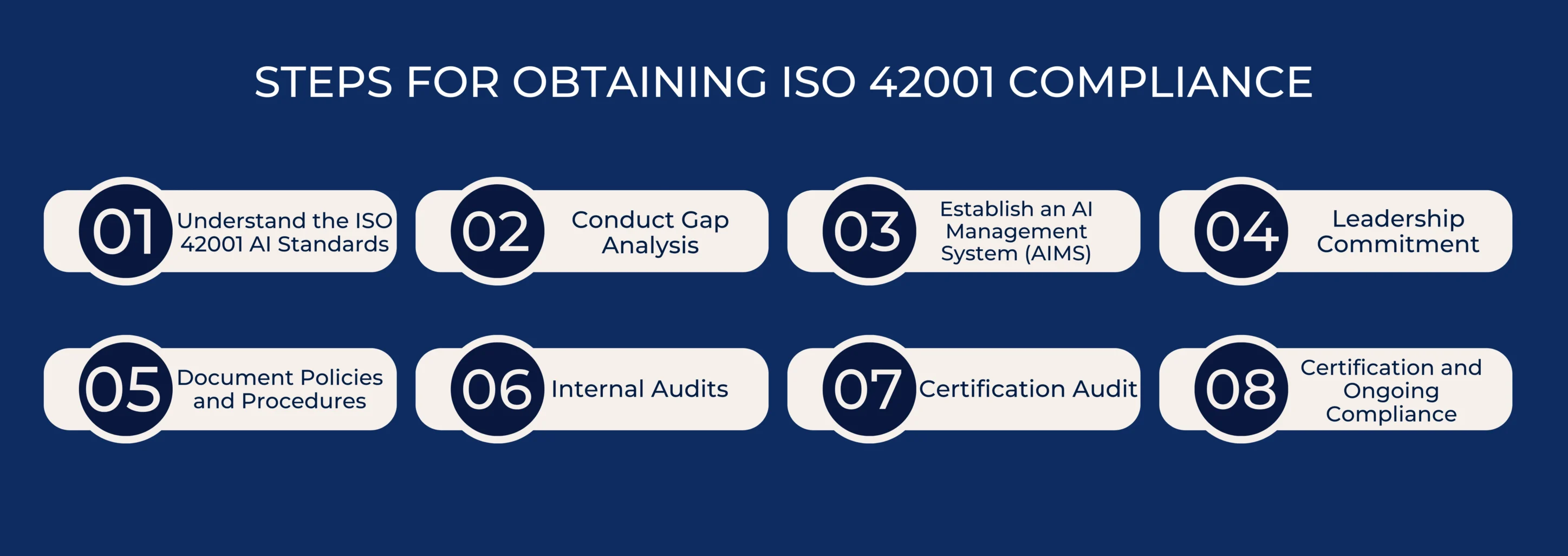
The ISO 42001 certification process follows a structured sequence of evaluation stages conducted by CertPro as a Licensed CPA Firm. ISO 42001 Certification in Mumbai is achieved when an organization successfully completes all mandatory audit stages and demonstrates conformance to the standard’s requirements. The process is audit-driven — each stage produces documented findings that inform the next, culminating in a certification decision supported by objective evidence. Understanding each stage helps Mumbai organizations plan their ISO 42001 compliance journey with realistic timelines and resource commitments.
The Stage 1 audit — also called the documentation review or desk audit — assesses whether the organization’s AIMS documentation meets ISO 42001 requirements and whether the organization is ready for a Stage 2 field audit. During Stage 1, CertPro auditors review the AI Policy, AI system inventory, risk and impact assessment records, Statement of Applicability, and all other mandatory documented information. Stage 1 also confirms the defined AIMS scope — identifying the organizational boundaries, AI systems, and business processes included within the certification perimeter.
Stage 1 findings identify major gaps in documentation that must be addressed before Stage 2 can proceed. For Mumbai organizations with large AI portfolios spanning multiple business lines — such as a bank using AI simultaneously for credit scoring, fraud detection, and customer service — Stage 1 scope definition is a critical step that determines the depth and duration of the Stage 2 audit. CertPro’s Stage 1 report documents all findings and establishes the detailed audit program for Stage 2, ensuring that the ISO 42001 audit proceeds efficiently and without scope ambiguity.
The Stage 2 audit is the formal conformance assessment — conducted on-site or remotely — that evaluates whether the AIMS is implemented, operational, and effective. CertPro auditors interview personnel, observe AI governance processes, review operational records, and test a sample of Annex A controls to determine whether implemented controls are functioning as documented. Stage 2 audit findings are classified as major nonconformities (requirements not met), minor nonconformities (partial conformance), or observations (opportunities for improvement that do not constitute nonconformity).
Major nonconformities identified during Stage 2 must be resolved through documented corrective actions before ISO 42001 certification can be issued. Minor nonconformities require corrective action plans that are reviewed at the first surveillance audit. The Stage 2 audit report documents all evidence reviewed, all findings raised, and the auditor’s conformance determination. CertPro’s certification decision is made independently by a review function separate from the audit team, ensuring that the ISO 42001 certification decision is based solely on objective audit evidence.
Upon successful completion of Stage 2 and resolution of any major nonconformities, CertPro issues the ISO 42001 certificate valid for a three-year certification cycle. Surveillance audits are conducted annually — typically at 12-month and 24-month intervals — to verify that the AIMS continues to operate effectively and that any previously identified nonconformities have been resolved. Surveillance audits are narrower in scope than the initial certification audit but must cover a representative sample of AIMS processes and Annex A controls to maintain ISO 42001 compliance status.
Recertification is conducted at the end of the three-year certification cycle, involving a comprehensive reassessment of the full AIMS scope. Recertification audits evaluate AIMS effectiveness over the entire certification period — reviewing how the organization has managed AI risks, responded to incidents, updated its AI systems, and driven continual improvement. For Mumbai organizations whose AI portfolios evolve rapidly — particularly in fintech and healthcare where AI models are frequently retrained or replaced — the recertification audit provides an important checkpoint on organizational AI governance maturity and the continued validity of ISO 42001 Certification.
- AIMS Scope Definition: Identify organizational boundaries, AI systems, and processes within the certification perimeter
- AI System Inventory and Risk Classification: Document all in-scope AI systems and classify each by risk level and potential impact
- AI Risk and Impact Assessment: Conduct documented assessments for all in-scope AI systems per ISO 42001 requirements
- AIMS Documentation Development: Prepare AI Policy, SoA, objectives register, and all mandatory documented information
- Internal AIMS Audit: Conduct internal audit of the AIMS against ISO 42001 requirements and document findings
- Management Review: Top management reviews AIMS performance, objectives, and resource adequacy before external audit
- Stage 1 Audit (CertPro): Documentation review confirming AIMS readiness for Stage 2
- Stage 2 Audit (CertPro): On-site conformance assessment including control testing and personnel interviews
- Nonconformity Resolution: Address all major nonconformities identified during Stage 2 with documented corrective actions
- Certification Decision and Issuance: CertPro issues ISO 42001 certificate upon confirmed conformance
- Annual Surveillance Audits: Year 1 and Year 2 surveillance audits verifying continued AIMS effectiveness
- Recertification Audit: Full AIMS reassessment at end of three-year certification cycle
- ✓Stage 1: Scope Definition and Documentation Review
- ✓Stage 2: AIMS Implementation Audit and Control Testing
- ✓Certification Issuance, Surveillance, and Recertification
Benefits of ISO 42001 Certification for Mumbai Businesses
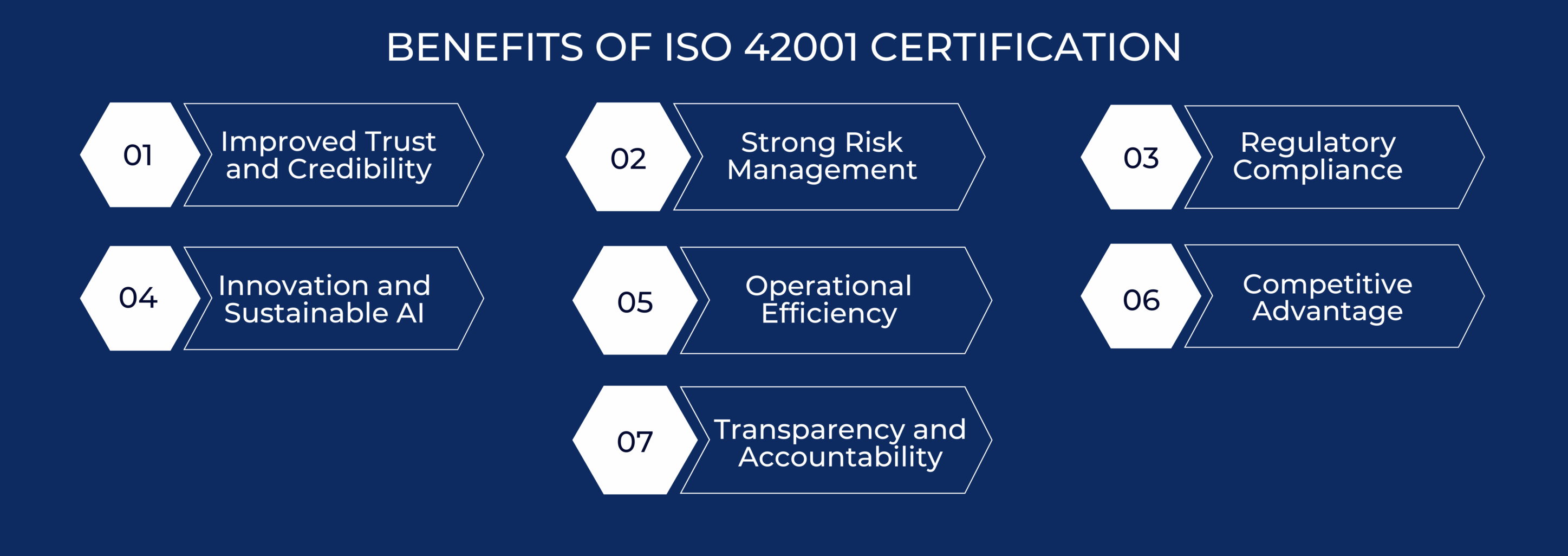
ISO 42001 Certification in Mumbai delivers measurable benefits across operational, regulatory, reputational, and competitive dimensions. As Mumbai’s businesses deepen AI integration across financial services, healthcare, logistics, and media, the ability to demonstrate certified AI governance has become a substantive competitive advantage — not merely a compliance exercise. Organizations that achieve ISO 42001 Certification signal to clients, regulators, and investors that their AI systems are governed with documented accountability and international-standard rigor, reinforcing trust at every stakeholder level.
ISO 42001 certification requires organizations to establish systematic AI risk management processes that identify, assess, and treat AI risks before they materialize into operational failures or regulatory incidents. This proactive risk identification reduces the probability of costly AI system failures — such as biased credit decisions that expose financial institutions to regulatory penalties, or erroneous medical AI recommendations that create clinical liability. For Mumbai’s BFSI sector, where AI is increasingly embedded in core lending and investment processes, documented AI risk controls reduce the operational risk exposure associated with model failures or adversarial manipulation.
Operational benefits also include improved internal governance clarity. AIMS implementation requires organizations to define clear roles and responsibilities for AI governance, eliminating ambiguity about who is accountable for AI system decisions. This role clarity accelerates incident response when AI systems produce unexpected outputs and supports faster regulatory reporting when AI-related issues require disclosure. Mumbai organizations operating AI at enterprise scale — including large conglomerates managing AI across dozens of business units — benefit from the structural discipline that AIMS implementation imposes on AI governance coordination across organizational boundaries.
ISO 42001 compliance provides a structured framework that maps to emerging AI regulatory requirements from RBI, SEBI, and India’s Digital Personal Data Protection Act (DPDPA) 2023. Organizations that have implemented AIMS controls are better positioned to respond to regulatory inquiries, complete regulatory assessments, and demonstrate responsible AI use during supervisory reviews. RBI’s guidelines on AI and machine learning in credit and risk management — and SEBI’s expectations for algorithmic trading governance — both align with AIMS control domains, meaning ISO 42001 certified organizations can reference their AIMS documentation directly in regulatory submissions without duplicating compliance effort.
ISO 42001 Certification in Mumbai provides a verifiable, internationally recognized signal of responsible AI governance that differentiates certified organizations from competitors. For Mumbai’s IT companies, fintech startups, and enterprise technology providers competing for global contracts, ISO 42001 certification is increasingly requested in vendor qualification processes — particularly by European clients subject to the EU AI Act or by multinational corporations enforcing global AI governance standards. Responsible AI certification in Mumbai positions organizations as trusted AI providers in procurement evaluations, partnership discussions, and investor due diligence processes where governance credibility is a decisive factor.
- ✓Documented AI risk identification and treatment reducing operational AI failures
- ✓Structured incident response framework for AI system malfunctions or adverse outputs
- ✓Clear organizational accountability for AI governance decisions
- ✓Alignment with RBI, SEBI, and DPDPA regulatory expectations for AI use
- ✓Internationally recognized certification supporting global contract qualification
- ✓Enhanced client and investor confidence in organizational AI governance
- ✓Competitive differentiation in procurement processes requiring responsible AI evidence
- ✓Structured continual improvement cycle maintaining AIMS effectiveness over time
- ✓Reduced insurance and liability risk through documented AI control frameworks
- ✓Stakeholder trust built on third-party verified AI governance standards
- ✓Operational and Risk Management Benefits
- ✓Regulatory and Compliance Benefits
- ✓Reputational and Competitive Benefits
ISO 42001 in Mumbai’s Business Context
Mumbai’s position as India’s financial capital — and its concentration of BFSI institutions, technology companies, and global enterprise headquarters — makes it one of the highest-priority markets for ISO 42001 Certification in India. The city’s AI adoption trajectory, accelerated by large-scale fintech investment, smart infrastructure initiatives, and enterprise digital transformation, has created a business environment where AI governance is rapidly shifting from an internal best-practice concern to an external regulatory and commercial requirement. ISO 42001 Certification in Mumbai is increasingly the mechanism through which organizations demonstrate that their AI systems meet these expectations.
ISO 42001 Certification for Mumbai’s BFSI Sector
ISO 42001 certification helps Mumbai financial services organizations — including banks, NBFCs, insurance companies, and stock exchanges — address a rapidly expanding set of AI governance obligations. Mumbai’s BFSI sector uses AI across credit underwriting, fraud detection, anti-money laundering (AML) transaction monitoring, customer onboarding, and algorithmic trading. Each of these AI applications carries distinct risk profiles that must be documented, assessed, and controlled under an AIMS. RBI’s increased focus on AI explainability in lending decisions and SEBI’s scrutiny of algorithmic trading systems make AIMS certification a governance investment with direct regulatory value for Mumbai’s financial institutions pursuing ISO 42001 compliance.
ISO 42001 certification also benefits Mumbai fintech companies — from early-stage AI lending platforms to established payment infrastructure providers — that face particular pressure to demonstrate responsible AI governance as they scale. Fintech organizations operating at the intersection of financial services and technology are subject to both financial sector regulation (RBI, IRDAI) and emerging technology governance expectations. ISO 42001 Certification in Mumbai provides fintech companies with a structured, audit-verified governance framework that satisfies both regulatory expectations and the due diligence requirements of institutional investors and banking partners.
ISO 42001 Certification for Mumbai IT Companies and Technology Providers
ISO 42001 certification for Mumbai IT companies that build, sell, or deploy AI-powered software products positions them to serve clients in regulated industries that require supply chain AI governance assurance. Under ISO 42001 Annex A, organizations are required to assess the AI governance practices of their AI supply chain — meaning that a Mumbai bank or hospital using a third-party AI platform may require that platform vendor to demonstrate AIMS conformance. ISO 42001 certification for Mumbai technology providers therefore creates both a compliance necessity and a commercial opportunity: certified AI vendors gain preferential positioning in enterprise procurement processes where responsible AI governance is a qualifying criterion.
AI Adoption in Mumbai’s Healthcare, Logistics, and Media Sectors
Beyond financial services and technology, Mumbai’s healthcare organizations are deploying AI in medical imaging analysis, clinical decision support, patient risk stratification, and hospital operations management. AI management system certification for Mumbai healthcare providers ensures that AI systems influencing clinical decisions are governed with documented accountability, bias assessment, and outcome monitoring. Mumbai’s logistics sector — which underpins India’s largest port operations and one of the country’s most complex urban supply chains — uses AI for demand forecasting, route optimization, and warehouse automation, all requiring documented risk management under an AIMS framework aligned with ISO 42001 assessment standards.
ISO 42001 and Indian Regulatory Alignment
India’s regulatory landscape for AI governance is evolving rapidly, and ISO 42001 compliance provides Mumbai organizations with a recognized framework that aligns with current and anticipated Indian regulatory requirements. The Digital Personal Data Protection Act (DPDPA) 2023 establishes obligations for organizations that process personal data — including personal data used to train or operate AI systems. ISO 42001’s data governance controls directly address data quality, data provenance, and data lifecycle management requirements that intersect with DPDPA obligations for data principals’ rights and data fiduciary accountability, making ISO 42001 Certification a dual-purpose governance investment for Mumbai organizations.
DPDPA 2023 and ISO 42001 Compliance Intersection
The Digital Personal Data Protection Act (DPDPA) 2023 requires data fiduciaries to implement appropriate technical and organizational measures to protect personal data — a requirement that applies directly to personal data used in AI training datasets and to personal data processed by AI inference systems. ISO 42001 compliance addresses DPDPA requirements through AIMS controls for data governance, purpose limitation, data minimization, and consent management in AI contexts. Organizations that have implemented AIMS controls can map those controls to DPDPA obligations, reducing the compliance burden of addressing two regulatory frameworks independently and streamlining audit preparation.
DPDPA also introduces accountability obligations for automated decision-making — including the right of data principals to seek information about automated decisions that affect them. ISO 42001’s requirements for AI explainability and transparency directly support DPDPA compliance by requiring organizations to document how AI systems make decisions and to establish mechanisms for communicating AI decision rationale to affected individuals. For Mumbai’s financial services organizations where automated credit decisions affect millions of customers, this intersection of ISO 42001 and DPDPA compliance is operationally significant and increasingly scrutinized by regulators.
RBI, SEBI, and Sector-Specific AI Governance Expectations
The Reserve Bank of India (RBI) has published guidelines addressing the use of AI and machine learning in banking and financial services — covering model risk management, algorithmic lending, and the explainability of AI-driven credit decisions. SEBI has issued guidelines on algorithmic trading that require documented controls for algorithm testing, risk management, and real-time monitoring. The ISO 42001 assessment framework maps directly to these sector-specific expectations: AIMS controls for model validation, monitoring, and incident response address the technical requirements embedded in RBI and SEBI guidance, providing a structured mechanism for satisfying regulatory expectations through certified AI governance processes.
India’s National Strategy for Artificial Intelligence (NSAI) and the Ministry of Electronics and Information Technology (MeitY) AI frameworks both emphasize responsible, trustworthy AI as a national priority. ISO 42001 Certification aligns with these national objectives, positioning certified Mumbai organizations as contributors to India’s responsible AI ecosystem. As MeitY’s AI governance frameworks mature and sector regulators formalize AI governance requirements, ISO 42001 certified organizations will be better positioned to demonstrate conformance with evolving Indian regulatory standards — leveraging their existing AIMS documentation and ISO 42001 audit records as evidence of sustained responsible AI governance.
Why CertPro for ISO 42001 Certification in Mumbai
CertPro is a Licensed CPA Firm conducting ISO 42001 certification audits with institutional independence, audit rigor, and alignment to accredited certification body requirements. ISO 42001 Certification in Mumbai issued by CertPro is underpinned by a structured audit methodology developed specifically for AI management system evaluation — not adapted from general management consulting practice. CertPro’s certification decisions are made by qualified ISO 42001 lead auditors who evaluate conformance based on objective documentary evidence and control testing results, not self-assessments or management representations alone. This approach ensures that every ISO 42001 certificate issued reflects genuine AIMS conformance.
Institutional Audit Methodology and Independence
CertPro’s ISO 42001 audit methodology is designed to evaluate AIMS conformance with the same rigor applied to financial statement audits — with documented audit programs, evidence collection procedures, finding classification protocols, and independent certification review. CertPro maintains a strict separation between audit activities (which produce findings and recommendations) and the certification decision (which is made by a review function independent of the audit team). This independence is fundamental to the credibility of ISO 42001 certificates issued by CertPro and is consistent with international accreditation requirements for certification bodies conducting ISO 42001 assessments.
CertPro’s ISO 42001 audit teams in Mumbai include lead auditors with domain expertise across the industries where AI is most heavily deployed — financial services, healthcare, logistics, and technology. This domain depth enables CertPro auditors to evaluate AI risk assessments and impact assessments with a genuine understanding of the specific AI applications, data environments, and regulatory contexts relevant to each client organization. ISO 42001 certification conducted by auditors lacking this domain expertise may produce technically correct findings that are nonetheless operationally disconnected from the realities of the client’s AI environment — undermining the practical value of the certification process.
E-E-A-T Signals and Certification Credibility
CertPro’s experience conducting ISO 42001 assessments across Mumbai’s diverse AI deployment environments — spanning BFSI, healthcare, retail technology, and enterprise software — provides the depth of institutional knowledge required to evaluate AIMS conformance at scale. CertPro’s audit track record encompasses organizations ranging from early-stage AI startups to large conglomerate enterprises managing AI portfolios across multiple subsidiaries and geographies. This experience means that CertPro auditors can calibrate ISO 42001 audit intensity and scope to the actual complexity of each client’s AI environment, producing audit outcomes that reflect genuine conformance evaluation rather than formulaic checklist review.
Transparent Process and Fixed Pricing Positioning
CertPro’s ISO 42001 certification services in Mumbai are structured with transparent scope definitions and fixed pricing that reflects the audit scope determined during initial engagement — not open-ended billing that expands with scope creep. The certification engagement structure is defined upfront: Stage 1 audit scope, Stage 2 audit duration, surveillance audit schedule, and the certification decision timeline are all established before audit work commences. This pricing transparency aligns with CertPro’s positioning as a Licensed CPA Firm that values institutional accountability in all aspects of its ISO 42001 certification operations.
ISO 42001 Certification Cost in Mumbai
The cost of ISO 42001 assessment and certification in Mumbai varies based on factors including organizational size, the number and complexity of in-scope AI systems, the geographic scope of AIMS (single location versus multi-site), and the maturity of existing AI governance documentation at the time of engagement. CertPro structures ISO 42001 certification pricing transparently, with costs determined by audit scope and duration rather than by open-ended consulting arrangements — ensuring that Mumbai organizations can plan their ISO 42001 compliance investment with confidence.
Factors Influencing ISO 42001 Certification Cost
The primary cost driver for ISO 42001 Certification in Mumbai is the number of distinct AI systems within the certification scope. Each in-scope AI system requires documented risk assessment, impact assessment, and control evaluation — meaning organizations with ten AI systems require substantially more ISO 42001 audit effort than those with two or three. A Mumbai bank certifying its AIMS across credit AI, fraud detection AI, and customer service AI systems will require a more extensive audit program than a logistics company certifying a single route optimization AI system. AI system complexity — including whether systems use proprietary models, third-party AI platforms, or hybrid architectures — also affects audit depth and therefore overall cost.
Organizational size and documentation maturity also influence ISO 42001 certification cost. Organizations that already have mature risk management, data governance, and internal audit functions — as is common among Mumbai’s larger BFSI institutions — may require less time to establish AIMS documentation and controls, reducing the pre-audit preparation investment. Conversely, organizations building AI governance infrastructure from a low-maturity baseline will require more extensive documentation development before Stage 1 audit can proceed. Multi-site Mumbai organizations — such as those with AI operations across Bandra Kurla Complex, Lower Parel, and suburban technology parks — may also require multi-site audit arrangements that affect overall ISO 42001 certification cost.
| Organization Type | Typical AI System Scope | Estimated Audit Duration | Cost Indicator |
|---|---|---|---|
| Small AI startup or technology company | 1–3 AI systems, single location | 2–3 audit days | Lower range |
| Mid-size fintech or healthcare organization | 3–8 AI systems, 1–2 locations | 4–6 audit days | Mid range |
| Large BFSI or enterprise conglomerate | 8+ AI systems, multi-site | 7–12+ audit days | Higher range |
| Multi-national with Mumbai AI operations | Complex, cross-border AI scope | Custom audit program | Scope-dependent |
Return on Investment from ISO 42001 Certification
The return on investment from ISO 42001 Certification in Mumbai extends well beyond direct cost avoidance. Organizations that achieve certification reduce the probability of regulatory penalties associated with uncontrolled AI failures — penalties that in financial services contexts can significantly exceed certification costs. Certified organizations also gain access to client procurement opportunities that require ISO 42001 as a qualifying criterion — opportunities that would otherwise be closed to non-certified competitors. For Mumbai’s IT companies pursuing contracts with global enterprise clients or European organizations subject to the EU AI Act, ISO 42001 certification can be the decisive differentiating factor in competitive bid processes where all other qualifications are equivalent.
Secure ISO 42001 Certification in Mumbai with CertPro
ISO 42001 Certification in Mumbai represents a strategic investment in documented, verifiable AI governance that delivers regulatory alignment, competitive differentiation, and institutional stakeholder confidence. As Mumbai’s AI economy deepens and regulatory expectations for responsible AI governance intensify, ISO 42001 certified organizations are positioned at the governance frontier — with documented AIMS controls, certified audit evidence, and a continuously improving AI governance framework that evolves alongside the AI landscape. Securing ISO 42001 Certification in Mumbai today means building the governance infrastructure that tomorrow’s regulatory and commercial environments will require.
CertPro conducts ISO 42001 certification audits in Mumbai with institutional rigor, domain expertise across Mumbai’s key AI-intensive industries, and a structured ISO 42001 audit methodology that produces certification decisions grounded in objective evidence. CertPro’s status as a Licensed CPA Firm ensures that ISO 42001 Certification in Mumbai is delivered with the independence and accountability that organizations, regulators, and clients require from a credible certification body. Organizations seeking to initiate an ISO 42001 audit, complete an ISO 42001 assessment, or obtain full ISO 42001 certification may engage CertPro through the contact channels provided on this page to confirm scope, timeline, and certification requirements applicable to their specific AI systems and organizational context.
FAQ
▶
Q: What is ISO 42001 Certification and who needs it in Mumbai?
▶
Q: How long does it take to achieve ISO 42001 Certification in Mumbai?
▶
Q: What does an ISO 42001 audit by CertPro evaluate?
▶
Q: Which industries in Mumbai benefit most from ISO 42001 Certification?
▶
Q: How does ISO 42001 relate to India’s DPDPA 2023?
▶
Q: Can an organization already certified to ISO 27001 integrate ISO 42001 more easily?
▶
Q: What is the validity period of an ISO 42001 certificate issued by CertPro?
▶
Q: How does CertPro’s ISO 42001 assessment differ from a self-assessment?

MindSec Launches AI Compliance for Law 25 & ISO 42001
Excerpt from Barchart Article, Published on December 3, 2025 Today, Canadian organizations face increasing pressure to comply with stringent privacy a…

UNDERSTANDING ISO 42001: A GUIDE FOR RESPONSIBLE AI MANAGEMENT SYSTEMS
The invention of artificial intelligence (AI) has changed the operational processes of many industries. However, the rapid growth of technology increa…
ENSURING AI DATA PRIVACY COMPLIANCE WITH ISO 42001
According to Stanford’s AI report, the private AI investment in the U.S. alone reached more than $109 billion last year, which is equal to 12 times th…
Get In Touch
have a question? let us get back to you.