
ISO 42001 Certification in Pune
To achieve ISO 42001 Certification in Pune, organizations must demonstrate conformance with all applicable requirements of ISO/IEC 42001:2023 through documented evidence evaluated during the CertPro audit engagement. The requirements span organizational governance, documented procedures, operational controls, performance monitoring, and continual improvement. The following core conformance obligations must be satisfied before ISO 42001 certification can be issued.
OUR CLIENTS










What Is ISO 42001 and Why It Matters for Pune Organizations
ISO 42001 Certification in Pune is the internationally recognized credential issued to organizations that have established, implemented, maintained, and continually improved an Artificial Intelligence Management System (AIMS) in accordance with ISO/IEC 42001:2023. Published by the International Organization for Standardization and the International Electrotechnical Commission in 2023, ISO 42001 is the first global standard specifically designed to govern the responsible development, deployment, and operational management of AI technologies. CertPro, a Licensed CPA Firm, delivers ISO 42001 certification services in Pune through structured, evidence-based audit engagements that evaluate organizational conformance against the standard’s requirements.
An Artificial Intelligence Management System (AIMS) is a structured framework of policies, processes, controls, and governance mechanisms that an organization establishes to manage AI-related risks, obligations, and impacts. ISO 42001 certification confirms that an organization’s AIMS meets the standard’s requirements through independent third-party audit. This certification is an auditable, evidence-based credential issued by accredited certification bodies — not a self-declaration, a consulting outcome, or a vendor assessment. Organizations in Pune that achieve ISO 42001 certification demonstrate measurable accountability for the AI systems they build, integrate, or operate.
Pune’s technology and IT ecosystem encompasses SaaS companies, AI startups, automotive technology firms, financial technology providers, and a rapidly expanding network of Global Capability Centers (GCCs) operated by multinational enterprises. These organizations build, procure, and deploy AI systems across core business functions — including customer service automation, fraud detection, predictive maintenance, hiring, credit scoring, and clinical decision support. Each application carries inherent AI risks such as algorithmic bias, data privacy violations, lack of explainability, inadequate human oversight, and governance failures. ISO 42001 compliance directly addresses these risks through a structured, auditable management system.
ISO 42001 as the First International AI Governance Standard
ISO/IEC 42001:2023 establishes requirements for organizations to develop AI governance structures that address the unique characteristics of AI systems — including adaptive behavior, data dependency, and opacity in decision-making. The standard defines roles and responsibilities for AI system owners, data stewards, and governance committees. It mandates systematic identification of AI-related risks, assessment of AI system impacts on individuals and society, and implementation of proportionate controls. ISO 42001 certification confirms that these structures exist, function as designed, and are subject to continual improvement — all verified through independent audit by a qualified certification body such as CertPro.
The standard is built on the ISO High Level Structure (HLS), also known as Annex SL — the common framework shared by ISO 27001, ISO 9001, ISO 22301, and other leading management system standards. This architectural alignment means that Pune organizations already holding ISO 27001 or ISO 9001 certifications can integrate ISO 42001 requirements into their existing management system infrastructure. Shared elements include organizational context, leadership commitment, documented policies, internal audit programs, management review, and nonconformity management. This overlap reduces duplication and enables efficient multi-standard certification programs.
Relevance to Pune’s AI-Driven Technology Sector
Pune ranks among India’s fastest-growing technology centers, with a strong concentration of software product companies, AI research labs, engineering service providers, and enterprise technology deployments. ISO 42001 Certification in Pune is driven by both client requirements and regulatory expectations. Global enterprise clients increasingly require their Pune-based technology vendors and GCC partners to demonstrate certified AI governance frameworks as a condition of contract award or renewal. ISO 42001 certification provides that demonstration through an independent, accredited audit process — distinct from internal policy documentation or vendor questionnaire responses.
ISO 42001 certification pursued by Pune IT companies also addresses India’s evolving regulatory landscape. The Digital Personal Data Protection (DPDP) Act, 2023, establishes obligations for data fiduciaries and processors — many of whom operate AI systems that collect, process, and act upon personal data. ISO 42001 compliance provides a systematic framework for managing personal data within AI pipelines, aligning organizational practices with DPDP Act obligations and reducing regulatory exposure. For Pune fintech and healthtech companies operating under sector-specific AI guidelines, ISO 42001 certification further signals alignment with global best practices for responsible AI governance.
Why ISO 42001 Certification Matters for Pune Businesses
The business case for ISO 42001 Certification in Pune is grounded in measurable risk reduction, regulatory alignment, and competitive differentiation. Pune-based organizations that develop or deploy AI systems face an expanding array of governance obligations — from client contractual requirements to national data protection law to sector-specific AI risk guidelines. ISO 42001 compliance provides the structured, auditable management system that satisfies these obligations through documented evidence rather than self-attestation. CertPro conducts ISO 42001 audit engagements in Pune that produce independent conformance findings, giving organizations and their stakeholders a credible basis for evaluating AI governance maturity.
Addressing AI Risk Across Pune’s Industry Sectors
ISO 42001 certification is pursued by Pune tech startups and established technology firms for structurally distinct reasons. AI startups operating in Pune’s Hinjewadi, Magarpatta, and Baner technology corridors require ISO 42001 certification to qualify for enterprise client engagements — particularly with multinational organizations that mandate certified AI governance as a supplier requirement. Established IT services companies in Pune require ISO 42001 certification to retain and grow accounts with global financial institutions, healthcare systems, and government agencies that are introducing AI governance mandates into procurement frameworks. In both cases, ISO 42001 certification functions as a credentialed proof point, not a marketing claim.
Pune’s automotive technology sector — which includes engineering design centers and embedded AI system developers supporting major vehicle manufacturers — faces AI governance requirements tied to functional safety, algorithmic transparency, and human-machine interaction standards. An ISO 42001 AI management system implemented by Pune automotive firms addresses governance of AI in driver assistance systems, predictive diagnostics, and manufacturing quality control. The standard requires documented AI risk assessments, defined human oversight mechanisms, and evidence of systematic bias monitoring — all audit-verifiable requirements that CertPro evaluates during the ISO 42001 certification engagement.
Global Capability Centers and ISO 42001 Compliance Obligations
Global Capability Centers in Pune — operated by multinational corporations across banking, insurance, pharmaceuticals, and retail — are increasingly subject to group-level AI governance mandates that require locally certified AIMS frameworks. ISO 42001 assessments conducted for Pune GCC operations confirm that local AI development and deployment activities conform to the parent organization’s global AI governance standards and to ISO/IEC 42001:2023 requirements. This certification enables GCC leadership to provide board-level assurance to parent company governance committees, regulators, and external auditors that Pune-based AI operations are conducted within a certified, controlled management system.
ISO 42001 compliance implemented by Pune GCC teams also addresses supply chain AI governance — a growing concern as multinational enterprises face regulatory pressure under the EU AI Act, which imposes obligations on organizations that place AI systems in the EU market regardless of where those systems are developed. Pune-based development teams building AI products or components for EU-facing applications require demonstrable governance frameworks that satisfy EU AI Act transparency, documentation, and risk management requirements. ISO 42001 certification provides the internationally recognized governance credential that supports this regulatory alignment effectively.
Competitive Differentiation Through Certified AI Governance
ISO 42001 certification achieved by Pune software companies provides a verifiable competitive differentiator in markets where AI governance credibility influences procurement decisions. Unlike internal policies or marketing communications, ISO 42001 certification is validated through independent third-party audit and issued by an accredited certification body. This distinction matters: procurement teams at enterprise clients, government agencies, and regulated industry organizations evaluate supplier AI governance through audit-verified credentials rather than self-reported documentation. ISO 42001 Certification in Pune positions local organizations to compete credibly for high-value contracts that require demonstrated AI management system conformance.
ISO 42001 Requirements Overview
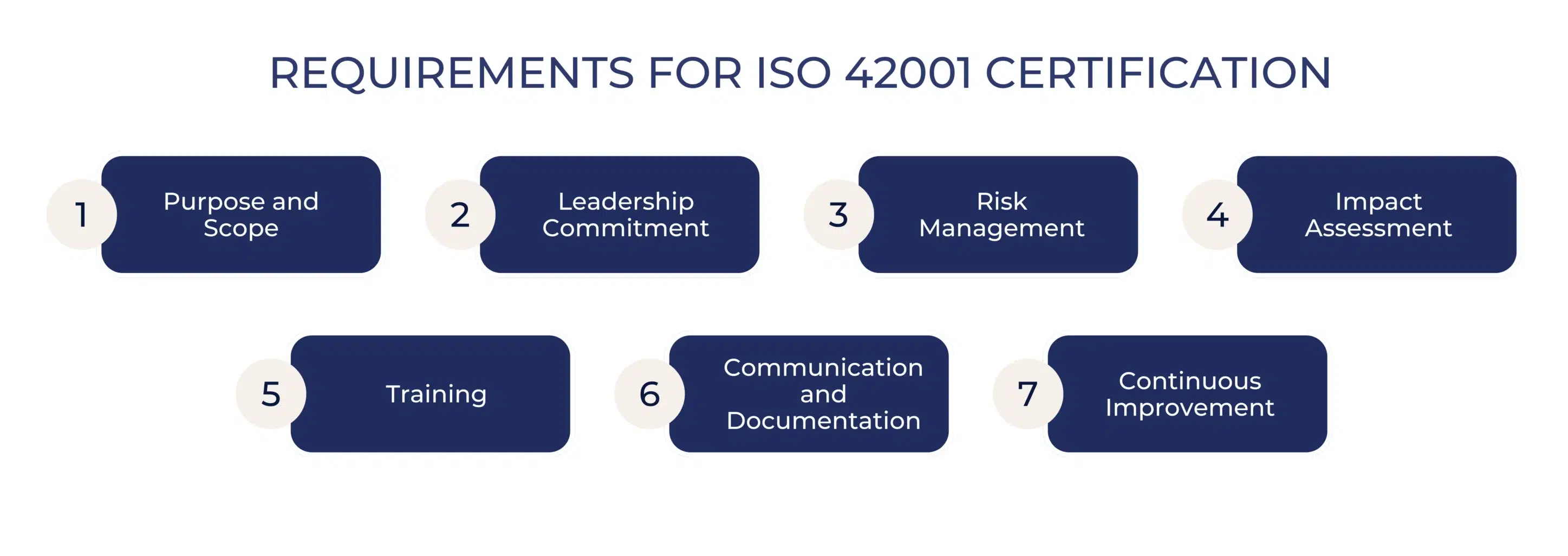
ISO 42001 Certification in Pune requires organizations to satisfy requirements spanning ten clauses of the standard. Clauses 4 through 10 contain the normative AIMS requirements. The standard also includes normative Annex A, which specifies a reference control set of AI-specific controls organized across eight control domains, and informative annexes providing guidance on applying controls for organizations in AI provider and AI user roles. ISO 42001 compliance requires documented evidence of conformance across all applicable clauses and controls. Audit findings from CertPro’s certification engagement assess this evidence systematically and comprehensively.
Clause 4 (Context of the Organization) requires organizations to identify internal and external issues relevant to their AI management system, determine the needs and expectations of interested parties, and define the AIMS scope. For Pune-based organizations, scope definition encompasses the specific AI systems, data processes, and business functions within the AIMS boundary — a critical determination that shapes the entire certification engagement. Clause 5 (Leadership) mandates top management commitment, assignment of AI governance roles, and establishment of an AI policy reflecting the organization’s principles for responsible AI use. CertPro evaluates leadership accountability through interviews, documentation review, and governance record examination.
Clause 6 (Planning) requires systematic AI risk assessment, AI impact assessment, and definition of AIMS objectives. ISO 42001’s AI impact assessment requirement is distinct from conventional risk management — it requires organizations to evaluate broader societal, ethical, and individual impacts of AI system outputs, not merely operational or financial risks. Clause 7 (Support) addresses resource allocation, competence requirements for AI governance roles, awareness programs, communication protocols, and documented information management. Documented information under ISO 42001 includes AI system inventories, risk assessment records, impact assessment reports, control implementation evidence, and audit records — all examined by CertPro during the ISO 42001 audit.
Clause 8 (Operation) contains the most extensive requirements, covering AI system design and development processes, data governance for training and validation datasets, testing and validation procedures, deployment controls, and production monitoring of AI system behavior. Organizations must document AI development lifecycles, define acceptance criteria for AI system performance, implement data quality and representativeness controls, and establish mechanisms for detecting and responding to AI system failures or unexpected behaviors. ISO 42001 compliance requires operational procedures that translate governance policies into verifiable, audit-evidenced practices — not aspirational statements.
Clause 9 (Performance Evaluation) mandates monitoring and measurement of AIMS performance, internal audit programs, and management review. Internal audits must be conducted by competent auditors who evaluate conformance of AI governance practices against the standard’s requirements and the organization’s own AIMS documentation. Management review requires top management to assess AIMS performance data, audit findings, and the changing AI risk landscape — generating documented decisions and action items. Clause 10 (Improvement) requires systematic nonconformity management, root cause analysis, corrective action implementation, and continual improvement based on performance data and audit findings.
| Annex A Control Domain | Key Focus Areas | Applicability |
|---|---|---|
| Policies for AI | AI use policies, ethical principles, prohibited uses | All organizations |
| Internal organization | Roles, responsibilities, governance structures for AI | All organizations |
| Resources for AI systems | Compute, data, human expertise governance | AI providers and users |
| AI system impact assessment | Societal, ethical, individual impact evaluation | All organizations |
| AI system lifecycle | Design, development, deployment, decommission controls | AI providers primarily |
- ✓Clause Structure and Core Requirements
- ✓Operational and Performance Requirements
- ✓Annex A Control Domains for AI Management
AI Management System (AIMS) Framework Under ISO 42001
An AI Management System (AIMS) under ISO 42001 is a structured, documented, and auditable organizational framework that governs all activities related to the development, procurement, deployment, operation, and decommissioning of AI systems. The AIMS is not a technology platform or software tool — it is the totality of governance structures, documented procedures, assigned responsibilities, performance monitoring mechanisms, and continual improvement processes that ensure responsible AI management. ISO 42001 Certification in Pune confirms that an organization’s AIMS conforms to the standard’s requirements through independent third-party audit.
Governance and Accountability Structures
The AIMS governance structure under ISO 42001 requires explicit accountability for AI systems at multiple organizational levels. Top management is responsible for establishing and communicating the AI policy, allocating AIMS resources, and demonstrating leadership commitment through documented decisions and governance actions. AI system owners are accountable for specific AI applications within the AIMS scope — covering risk assessment, impact assessment, control implementation, and performance monitoring for their assigned systems. AI governance committees oversee cross-functional AI risk decisions, approve high-risk AI deployments, and review AIMS performance at defined intervals.
Accountability documentation under the AIMS includes defined role descriptions for all AI governance positions, authority matrices specifying approval requirements for AI system changes and deployments, and records of governance decisions. CertPro’s ISO 42001 audit evaluates accountability structures through organizational charts, role documentation, governance meeting minutes, and decision records. Audit findings assess whether accountability assignments are appropriate, understood by role holders, and operationally effective — not merely formally documented. For Pune organizations with matrix management structures common in GCCs and IT services firms, demonstrating clear AI accountability across reporting lines is a critical audit consideration.
Risk Management Integration Within the AIMS
ISO 42001 requires a systematic AI risk management process that identifies, analyzes, evaluates, and treats risks associated with AI systems throughout their lifecycle. AI risks addressed under the standard include bias and fairness risks, data risks from poor-quality or unrepresentative training data, transparency risks, security risks such as adversarial attacks or data poisoning, operational risks from unexpected AI behavior in production, and compliance risks from regulatory non-conformance. The risk management process must be documented, repeatable, and reviewed periodically as AI systems and their operating environments evolve.
ISO 42001 compliance requires risk treatment decisions to be documented with rationale, approved by appropriate governance authorities, and implemented through verifiable controls. Risk treatment options include avoiding the AI risk by discontinuing a particular application, reducing the risk through technical or procedural controls, transferring the risk through contractual arrangements, or accepting the risk with documented management approval. The AIMS must include mechanisms for monitoring treatment effectiveness and detecting new or changed risks requiring reassessment. CertPro’s ISO 42001 assessment evaluates the completeness, rigor, and operational effectiveness of the organization’s AI risk management process through document review, process walkthroughs, and evidence examination.
Transparency and Explainability Requirements
Transparency is a foundational principle of ISO 42001, reflected in requirements for AI system documentation, stakeholder communication, and explainability of AI-generated decisions. The standard requires organizations to maintain documentation covering AI system purpose, capabilities, limitations, training data characteristics, performance metrics, and known failure modes. This documentation must be sufficient to enable stakeholders — including affected individuals, clients, regulators, and auditors — to understand how AI systems function and how decisions are reached. For Pune-based organizations providing AI-powered services to clients, transparency documentation serves as both a contractual and regulatory obligation.
ISO 42001 Certification Process in Pune
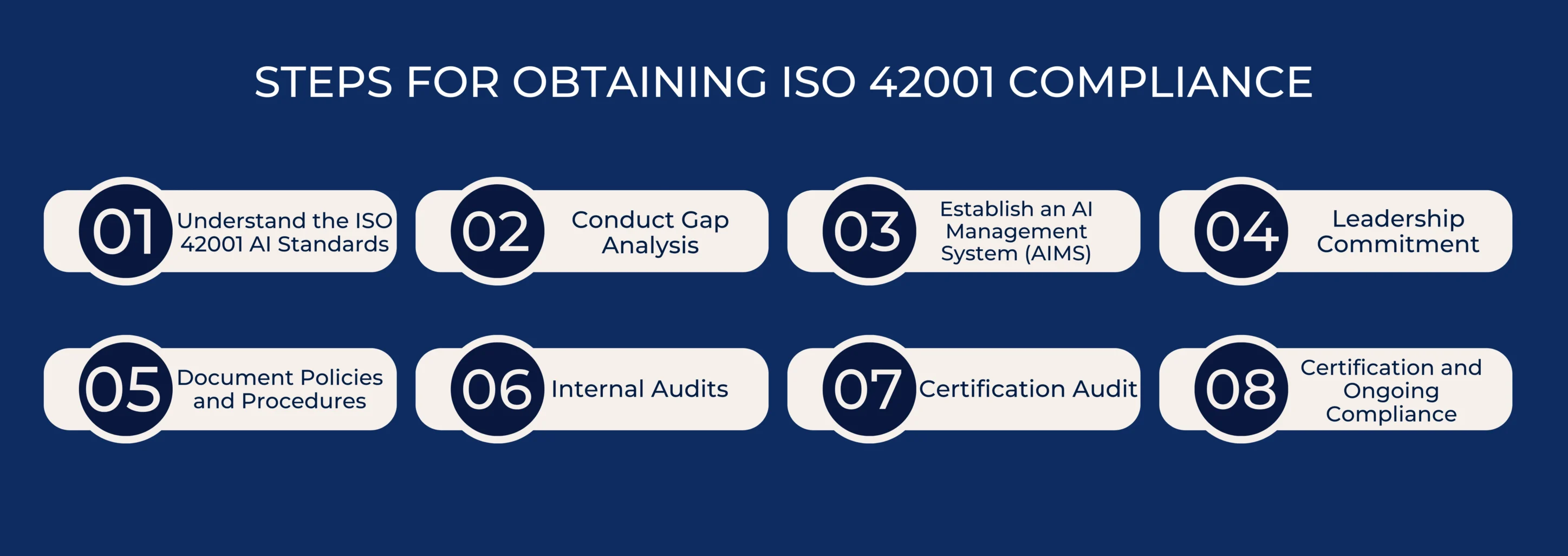
The ISO 42001 certification process in Pune follows a defined, structured sequence of stages — progressing from scope definition through audit engagement to certificate issuance and ongoing surveillance. CertPro conducts each stage as a distinct, evidence-based evaluation activity. The certification process is not a consulting engagement. CertPro evaluates organizational conformance against ISO 42001 requirements through independent audit, generates documented findings, and issues certification upon confirmed conformance. The following steps describe the complete ISO 42001 certification process as conducted by CertPro for Pune-based organizations.
- Scope Definition: The organization defines the boundary of its AIMS, identifying which AI systems, business functions, locations, and organizational units fall within the certification scope. CertPro reviews the proposed scope for completeness and alignment with ISO 42001 requirements before commencing the audit program.
- Audit Program Determination: CertPro establishes the audit program based on the defined scope, organizational size, AI system complexity, and risk profile. The audit program specifies audit stages, timing, auditor assignments, and evidence collection methods.
- Stage 1 Audit (Documentation Review): CertPro auditors conduct a systematic review of the organization’s AIMS documentation — including the AI policy, risk assessment records, impact assessment reports, procedures, and internal audit records — to assess readiness for Stage 2 audit. Stage 1 findings identify areas requiring attention before Stage 2 proceeds.
- Stage 2 Audit (Conformance Assessment): CertPro auditors conduct on-site or remote audit of the organization’s AIMS implementation, evaluating whether documented procedures are effectively implemented, controls are functioning as intended, and governance mechanisms operate as described. Stage 2 generates audit findings categorized as conformances, minor nonconformities, or major nonconformities.
- Nonconformity Review and Corrective Action: Organizations address audit findings through documented root cause analysis and corrective action plans. CertPro evaluates the adequacy of corrective actions before the certification decision is made. Major nonconformities must be resolved and verified before certification is issued.
- Certification Decision: CertPro’s certification decision authority reviews the complete audit record — including Stage 1 findings, Stage 2 findings, and corrective action outcomes — and makes an independent certification decision. This decision is separate from the audit team to ensure objectivity.
- Issuance of ISO 42001 Certificate: Upon a positive certification decision, CertPro issues the ISO 42001 certificate specifying the organization name, certified AIMS scope, certification standard (ISO/IEC 42001:2023), certificate validity period (three years), and issuing certification body details.
- Surveillance Audits: CertPro conducts annual surveillance audits during the three-year certification cycle to verify continued conformance of the AIMS to ISO 42001 requirements. Surveillance audits evaluate AIMS performance, management review outcomes, internal audit results, and continual improvement activities.
- Recertification Audit: At the end of the three-year certification cycle, CertPro conducts a full recertification audit to renew the ISO 42001 certificate. The recertification audit evaluates the continued suitability, adequacy, and effectiveness of the AIMS over the certification period.
The timeline for achieving ISO 42001 Certification in Pune varies based on organizational size, the number and complexity of AI systems within scope, the maturity of existing governance frameworks, and whether the organization holds prior management system certifications such as ISO 27001 or ISO 9001. Organizations with mature existing management systems and documented AI governance practices typically complete the certification process within three to six months. Organizations establishing AIMS structures for the first time typically require six to twelve months from initial scope definition to certificate issuance. CertPro provides transparent timeline estimates based on audit program determination findings.
| Certification Stage | Typical Duration | Key Deliverable |
|---|---|---|
| Scope Definition & Audit Program | 2–4 weeks | Agreed audit scope and program document |
| Stage 1 Audit (Documentation Review) | 1–2 weeks | Stage 1 audit report with findings |
| Corrective Action Period (if required) | 4–8 weeks | Documented corrective actions and evidence |
| Stage 2 Audit (Conformance Assessment) | 2–5 days | Stage 2 audit report with conformance findings |
| Certification Decision & Issuance | 2–3 weeks | ISO 42001 certificate issued |
ISO 42001 compliance requires organizations to maintain a defined set of documented information that serves as audit evidence during the certification engagement. Required documentation includes the AI policy, AIMS scope document, AI risk assessment records, AI impact assessment reports, AI system inventory and classification records, documented objectives and performance targets, competence records for AI governance roles, awareness training records, communication records, documented operational procedures for AI lifecycle management, internal audit programs and reports, management review records, nonconformity and corrective action records, and documented information required by applicable Annex A controls. CertPro’s ISO 42001 audit systematically examines this documentation for completeness, accuracy, and operational alignment.
Documentation quality is a critical determinant of audit efficiency and certification outcomes. Documentation that reflects actual organizational practices — rather than aspirational policies — enables auditors to verify conformance efficiently and reduces the likelihood of major nonconformity findings. Organizations preparing for an ISO 42001 audit in Pune should ensure that documented procedures are current, accessible to relevant personnel, reviewed and approved by designated authorities, and supported by implementation evidence such as completed checklists, meeting minutes, approval records, and monitoring reports. CertPro’s Stage 1 audit specifically evaluates documentation adequacy and identifies gaps before Stage 2 audit commences.
- ✓Typical Timeline for ISO 42001 Certification in Pune
- ✓Documentation Requirements for ISO 42001 Audit
Requirements for ISO 42001 Certification
To achieve ISO 42001 Certification in Pune, organizations must demonstrate conformance with all applicable requirements of ISO/IEC 42001:2023 through documented evidence evaluated during the CertPro audit engagement. The requirements span organizational governance, documented procedures, operational controls, performance monitoring, and continual improvement. The following core conformance obligations must be satisfied before ISO 42001 certification can be issued.
- ✓Defined and documented AIMS scope that clearly specifies which AI systems, organizational units, and locations are covered by the certification
- ✓Documented AI policy approved by top management, stating the organization’s principles for responsible AI use, ethical commitments, and AIMS objectives
- ✓Completed AI risk assessment for all AI systems within scope, with documented risk treatment decisions and implementation evidence
- ✓Completed AI impact assessment evaluating societal, ethical, and individual impacts of AI systems, with documented findings and management decisions
- ✓Comprehensive AI system inventory identifying all AI applications within scope with classification by risk level, purpose, and deployment context
- ✓Defined and documented AI governance roles with assigned responsibilities, documented competence requirements, and evidence of role holder qualifications
- ✓Operational procedures for AI system development, procurement, deployment, monitoring, and decommissioning aligned with AIMS requirements
- ✓Internal audit program with completed audit reports demonstrating periodic evaluation of AIMS conformance against ISO 42001 requirements
- ✓Management review records demonstrating top management evaluation of AIMS performance, audit findings, and decisions for continual improvement
- ✓Documented nonconformity and corrective action records showing systematic response to AIMS failures and preventive improvement activities
ISO 42001 compliance requires technical governance controls for AI systems that address data management, model development, testing, deployment, and monitoring. Data governance requirements include documented data sourcing procedures, data quality assessment processes, data representativeness evaluation for training datasets, data provenance records, and data handling procedures aligned with applicable privacy regulations including India’s DPDP Act. Model development requirements include documented design decisions, hyperparameter selection rationale, validation procedures, bias testing results, and performance benchmark records. These technical requirements must be supported by audit-verifiable evidence — documentation alone is insufficient without corresponding implementation records.
Deployment and monitoring requirements under ISO 42001 include documented deployment authorization processes with defined approval criteria, production monitoring procedures specifying metrics, thresholds, and escalation protocols, incident response procedures for AI system failures or unexpected behaviors, and periodic performance reviews comparing actual AI system behavior against defined acceptance criteria. Human oversight mechanisms must be documented and operational — particularly for high-risk AI applications where automated decisions affect individuals. CertPro evaluates technical governance controls through process walkthroughs, system demonstrations, log reviews, and examination of monitoring records during the ISO 42001 audit engagement.
- ✓Technical Requirements for AI System Governance
Benefits of ISO 42001 Certification for Pune Organizations
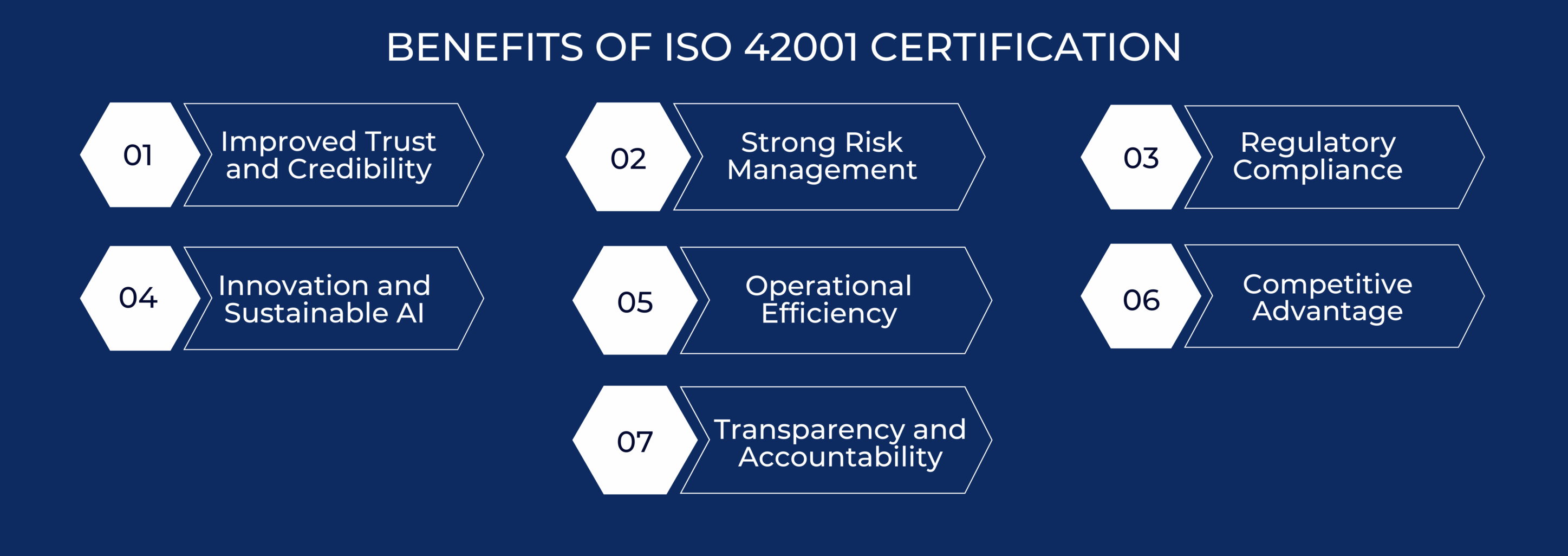
ISO 42001 assessment and certification in Pune deliver quantifiable benefits across operational, regulatory, reputational, and competitive dimensions. These benefits accrue to organizations that treat the AIMS as an operational management system rather than a documentation exercise. The certification process drives genuine governance improvements that produce measurable outcomes. CertPro’s ISO 42001 audit engagements in Pune consistently identify governance gaps that, when addressed through the certification process, result in improved AI risk management, reduced regulatory exposure, and stronger stakeholder confidence in AI system governance.
ISO 42001 compliance provides Pune organizations with a documented, audited framework for managing AI regulatory obligations. India’s Digital Personal Data Protection Act, 2023, imposes obligations on data fiduciaries and processors — including requirements for purpose limitation, data minimization, accuracy, and security safeguards. ISO 42001’s data governance controls and AI impact assessment requirements directly support DPDP Act compliance by establishing systematic processes for evaluating and managing personal data risks within AI pipelines. Organizations holding ISO 42001 certification can demonstrate to DPDP regulators that their AI-related data processing activities are governed by a certified management system.
For Pune organizations with operations or clients in jurisdictions subject to the EU AI Act, ISO 42001 certification provides documented evidence of AI risk management practices aligned with EU AI Act requirements for high-risk AI systems. The EU AI Act mandates risk management systems, data governance practices, transparency documentation, human oversight mechanisms, and accuracy standards — all addressed by ISO 42001’s AIMS requirements. ISO 42001 certification does not constitute EU AI Act compliance, but it provides the governance infrastructure that supports regulatory conformance across multiple jurisdictions simultaneously, reducing the compliance burden for Pune-based organizations serving global markets.
ISO 42001 certification for Pune companies creates direct commercial advantages in tender evaluations, client onboarding processes, and contract negotiations. Enterprise procurement teams in financial services, healthcare, government, and technology sectors increasingly evaluate supplier AI governance credentials as part of third-party risk management programs. ISO 42001 certification provides a standardized, independently verified credential that satisfies supplier AI governance questionnaires, enables qualification for AI-focused procurement frameworks, and reduces the administrative burden of individual client AI governance assessments. For Pune-based IT services companies and SaaS providers competing for global accounts, ISO 42001 certification accelerates the sales cycle by pre-qualifying AI governance credentials.
ISO 42001 certification achieved by Pune fintech companies is particularly valuable in regulated financial services markets, where regulators in India and internationally are issuing AI governance guidance aligned with international standards including ISO 42001. Reserve Bank of India guidelines on responsible AI in financial services, SEBI’s evolving AI governance framework, and IRDAI’s guidance on AI in insurance all emphasize governance principles that ISO 42001 certification demonstrates. Fintech companies holding ISO 42001 Certification in Pune can reference their certified AIMS in regulatory submissions, client due diligence responses, and board-level AI risk reporting.
Beyond external credentialing, ISO 42001 certification drives internal operational improvements that enhance AI system reliability, reduce incident rates, and strengthen organizational AI governance culture. The AIMS framework requires systematic AI risk identification and treatment, which surfaces governance gaps that organizations may not have previously recognized — including undocumented AI applications, unmanaged training data risks, and absent human oversight mechanisms for high-stakes AI decisions. Addressing these gaps through the certification process reduces the likelihood of AI-related incidents including regulatory violations, discriminatory AI outputs, security breaches through AI systems, and reputational damage.
- ✓Structured AI governance framework that reduces ad hoc, inconsistent AI management practices across development teams
- ✓Documented AI risk assessments and impact assessments that support informed management decisions about AI system deployments
- ✓Clear accountability structures that ensure AI governance responsibilities are assigned, understood, and operationally effective
- ✓Systematic monitoring of AI system performance that enables early detection of bias drift, accuracy degradation, and operational failures
- ✓Defined incident response procedures for AI system failures that reduce response time and limit organizational impact
- ✓Competence frameworks for AI governance roles that build organizational capability and reduce key-person dependency
- ✓Integration with existing ISO 27001 and ISO 9001 management systems, reducing governance overhead through shared processes and documentation
- ✓Documented evidence base that supports regulatory inquiries, client audits, and board-level AI governance reporting
- ✓Continual improvement mechanisms that evolve the AIMS in response to changing AI technology, regulatory requirements, and operational experience
- ✓Enhanced stakeholder confidence — from clients, investors, regulators, and employees — in the organization’s AI governance maturity
- ✓Regulatory Risk Reduction and Compliance Benefits
- ✓Commercial and Competitive Advantages
- ✓Operational and Organizational Benefits
ISO 42001 Compliance and Regulatory Alignment
ISO 42001 compliance provides Pune organizations with a comprehensive governance framework that aligns with India’s emerging AI regulatory landscape and international AI governance developments. The standard’s requirements anticipate the governance obligations that AI regulations worldwide are imposing — risk management, transparency, accountability, human oversight, and data governance — enabling organizations to satisfy multiple regulatory frameworks through a single, certified management system. CertPro’s ISO 42001 audit evaluates whether the organization’s AIMS is structured to address both current and reasonably foreseeable regulatory obligations relevant to its AI activities.
Alignment with India’s Digital Personal Data Protection Act
India’s Digital Personal Data Protection Act, 2023, establishes legal obligations for data fiduciaries — organizations that determine the purpose and means of processing personal data — and data processors acting on their behalf. For Pune-based organizations operating AI systems that process personal data of Indian citizens, the DPDP Act creates enforceable obligations including lawful basis for processing, purpose limitation, data minimization, accuracy obligations, storage limitation, security safeguards, and data breach notification requirements. ISO 42001’s data governance controls, AI impact assessment requirements, and security management provisions directly support DPDP Act compliance by embedding these obligations into the organization’s documented AIMS procedures.
The DPDP Act’s consent management requirements are particularly relevant for AI systems that collect and process personal data for model training or inference. ISO 42001 compliance requires organizations to document data sourcing procedures, evaluate data representativeness and quality, and maintain records of data governance decisions — all of which support DPDP Act compliance by ensuring that personal data used in AI systems is processed with appropriate lawful basis and in accordance with documented procedures. ISO 42001 certification does not substitute for DPDP Act legal compliance analysis, but the certified AIMS framework makes compliance demonstrable and auditable.
Global AI Regulatory Trends and ISO 42001 Positioning
Global AI regulation is accelerating across major markets relevant to Pune’s technology sector. The EU AI Act — which entered into force in August 2024 and applies progressively through 2027 — imposes risk-based governance obligations on AI systems placed in the EU market, including systems developed in Pune for European clients. The United States AI Executive Order (October 2023) and subsequent agency guidance establish AI governance expectations for federal contractors and regulated industries. The United Kingdom’s pro-innovation AI regulation approach includes sector-specific AI governance principles applied through existing regulatory frameworks. ISO 42001 Certification in Pune positions organizations to demonstrate governance alignment across these multiple regulatory contexts through a single internationally recognized standard.
ISO 42001 shares structural alignment with emerging AI regulatory frameworks because the standard was developed with awareness of global regulatory trends. Its risk-based approach mirrors the EU AI Act’s risk classification structure. Transparency and documentation requirements align with AI regulatory disclosure obligations across jurisdictions. Human oversight requirements correspond to regulatory mandates for meaningful human control over consequential AI decisions. For Pune organizations building global AI products or providing AI-enabled services to international clients, ISO 42001 compliance provides a documented governance foundation that reduces the effort required to demonstrate regulatory alignment across multiple markets.
Integration with ISO 27001 and ISO 9001 for Multi-Standard Compliance
ISO 42001 integrates naturally with ISO 27001 (Information Security Management Systems) and ISO 9001 (Quality Management Systems) through the shared ISO High Level Structure. Pune organizations holding ISO 27001 certification can extend their existing information security management infrastructure to encompass AI-specific security controls, leveraging established risk management processes, documented information controls, internal audit programs, and management review cycles. ISO 27001’s information security controls address AI-specific security risks — including model confidentiality, adversarial attack prevention, data pipeline security, and AI system access controls — providing a complementary control layer to ISO 42001’s AI governance requirements.
ISO 9001 quality management principles align with ISO 42001’s requirements for AI system validation, performance monitoring, and continual improvement. Pune organizations holding ISO 9001 certification can map AI system development and deployment processes into their existing quality management framework, using established nonconformity management, corrective action, and management review processes to satisfy ISO 42001 operational requirements. CertPro’s multi-standard certification approach enables Pune organizations to pursue integrated ISO 42001, ISO 27001, and ISO 9001 certification programs that share audit activities, documentation reviews, and management processes — reducing the total cost and organizational burden of maintaining multiple certifications.
Cost of ISO 42001 Certification in Pune
The cost of ISO 42001 assessment and certification in Pune is determined by several factors including organizational size, the number and complexity of AI systems within the certification scope, geographic distribution of operations, maturity of existing management systems, and the audit intensity required to evaluate conformance. CertPro offers transparent, fixed-price certification engagements for ISO 42001 in Pune, providing organizations with cost certainty from the outset of the certification program. Fixed pricing eliminates the variable cost uncertainty associated with time-and-materials engagement models and enables organizations to budget certification costs accurately within their annual governance investment plans.
Factors Influencing ISO 42001 Certification Cost
Organizational size — measured by the number of employees involved in AI governance activities within the certification scope — is the primary cost driver for ISO 42001 certification in Pune. Larger organizations with more complex governance structures, more AI systems within scope, and more personnel requiring audit interaction require proportionally greater audit time and resources. The complexity of AI systems within scope also influences cost. Organizations operating sophisticated machine learning models, large language model applications, or AI systems with significant individual impact require more intensive audit evaluation than those using simple rule-based automation or off-the-shelf AI tools.
Organizations that already hold ISO 27001 or ISO 9001 certification benefit from reduced ISO 42001 certification costs due to the integration opportunities provided by the ISO High Level Structure. Shared management system infrastructure — documented information controls, internal audit processes, management review procedures, nonconformity management — reduces the incremental documentation and process implementation required for ISO 42001, allowing CertPro to conduct more efficient combined audit programs. Organizations seeking ISO 42001 certification as a standalone initial certification, without prior management system experience, typically incur higher costs due to the need to establish AIMS infrastructure from the foundational level.
CertPro’s Transparent Fixed-Price Certification Model
CertPro’s fixed-price ISO 42001 certification engagements for Pune organizations provide complete cost transparency from initial scoping through certificate issuance. The fixed price encompasses Stage 1 audit (documentation review), Stage 2 audit (conformance assessment), nonconformity review, certification decision, and certificate issuance. Surveillance audit costs for the two annual surveillance visits within the three-year certification cycle are separately quoted at the outset of the certification program, enabling organizations to plan the total three-year certification investment. CertPro does not charge additional fees for audit travel within Pune or for standard certification administration activities.
Why CertPro for ISO 42001 Certification in Pune
CertPro is a Licensed CPA Firm that conducts ISO 42001 certification audits for organizations across Pune and India. CertPro’s positioning as a certification body — not a consulting or advisory firm — ensures that ISO 42001 audit engagements in Pune are conducted with the independence, objectivity, and professional rigor required by accreditation standards. Organizations, clients, and regulators relying on CertPro-issued ISO 42001 certificates can be confident that each credential reflects genuine conformance. CertPro’s auditors evaluate conformance against ISO 42001 requirements through evidence-based assessment, generating findings that reflect actual organizational governance maturity rather than aspirational capability claims.
Audit Expertise and Technical Competence
CertPro’s ISO 42001 audit team in Pune combines expertise in AI governance, information security, quality management, and risk management with deep knowledge of ISO/IEC 42001:2023 requirements and audit methodology. ISO 42001 audit requires auditors who understand AI system architecture, machine learning development practices, data governance, and algorithmic risk — not merely management system documentation. CertPro’s auditors engage with AI system owners, data scientists, engineering teams, and governance committees during Stage 2 audit to evaluate whether AIMS requirements are operationally embedded in actual AI development and deployment practices, not merely documented in procedures that staff do not follow.
CertPro’s familiarity with Pune’s technology sector enables audit teams to contextualize ISO 42001 requirements within the specific AI applications, development methodologies, and governance structures common to Pune-based IT services companies, SaaS providers, GCCs, fintech firms, and AI startups. This sector knowledge ensures that audit findings are practically grounded and that the certification process produces outcomes relevant to the organization’s actual AI governance context. CertPro’s ISO 42001 assessment engagements in Pune are calibrated to the sector-specific risk profiles and governance structures of each organization — rather than applying a generic audit template.
Independence and Objectivity in Certification Decisions
CertPro’s certification decision process is structurally independent from audit execution — the certification decision is made by a separate decision authority who reviews the complete audit record but did not participate in audit fieldwork. This separation of functions is required by accreditation standards and ensures that certification decisions are based on objective evaluation of audit evidence rather than commercial or relational considerations. Organizations, clients, regulators, and other stakeholders relying on CertPro-issued ISO 42001 certificates can be confident that the certification reflects independent, evidence-based conformance evaluation conducted by a Licensed CPA Firm operating under accreditation requirements.
Local Presence and Sector-Specific Capability in Pune
CertPro’s local presence in Pune enables efficient, responsive certification service delivery for organizations across Pune’s major technology corridors including Hinjewadi IT Park, Magarpatta Cybercity, Baner, Aundh, and Viman Nagar. Local audit capability reduces logistical complexity for on-site Stage 2 audit engagements and enables CertPro to schedule audit activities with minimal disruption to organizational operations. CertPro’s understanding of Pune’s business environment, regulatory context, and technology sector characteristics informs the audit approach and ensures that findings are relevant to the specific governance challenges Pune-based organizations face when managing AI systems within India’s evolving regulatory framework.
ISO 42001 Assessment and Certification Services by CertPro for Pune
CertPro’s ISO 42001 assessment and certification services in Pune encompass the complete certification lifecycle — from initial scope determination through annual surveillance audits and recertification. CertPro conducts ISO 42001 assessments that evaluate organizational conformance against all applicable requirements of ISO/IEC 42001:2023, generating documented audit findings that form the basis for certification decisions. CertPro’s certification services are designed for organizations that have established or are establishing AIMS frameworks and seek independent, accredited certification to demonstrate conformance to clients, regulators, and other stakeholders.
ISO 42001 audit engagements conducted by CertPro in Pune cover all applicable AIMS requirements and Annex A controls within the agreed certification scope. Audit coverage includes governance structures and accountability mechanisms, documented AI policy and AIMS scope, AI risk assessment and risk treatment records, AI impact assessment reports, AI system inventories and classification records, operational controls for AI lifecycle management, data governance procedures and evidence, internal audit records and management review outcomes, nonconformity and corrective action records, and evidence of continual improvement activities. Each audit finding is categorized and documented with sufficient detail to enable the organization to understand the nature of any nonconformity and the evidence basis for the finding.
CertPro’s Certification Services for Specific Pune Sectors
CertPro provides ISO 42001 certification services tailored to the governance characteristics and AI risk profiles of specific Pune technology sectors. For Pune IT services companies and software development organizations, CertPro’s audit approach addresses AI system development lifecycle governance, third-party AI component management, client data processing obligations, and software supply chain AI governance. For Pune-based GCCs, audit coverage encompasses parent company AI governance mandate alignment, local AI development governance, and cross-border data transfer considerations for AI training and inference activities. For Pune fintech and AI product companies, CertPro’s ISO 42001 assessment addresses sector-specific AI risk classifications, regulatory alignment requirements, and AI system explainability obligations relevant to financial services applications.
Secure ISO 42001 Certification in Pune with CertPro
ISO 42001 Certification in Pune is the internationally recognized credential that confirms an organization’s AI Management System conforms to ISO/IEC 42001:2023 requirements through independent, evidence-based audit. CertPro, a Licensed CPA Firm, conducts ISO 42001 certification audits for Pune-based organizations across all technology sectors — delivering structured, transparent, fixed-price certification engagements that produce credible, audit-verified conformance findings. CertPro’s ISO 42001 certification process evaluates governance structures, risk management practices, operational controls, and continual improvement mechanisms against the standard’s requirements, generating the independent assurance that stakeholders require when evaluating AI governance credentials.
Pune organizations that achieve ISO 42001 Certification in Pune through CertPro demonstrate to global clients, domestic regulators, and organizational stakeholders that their AI systems are governed by a certified, audited management system meeting the requirements of the world’s first international AI governance standard. ISO 42001 Certification positions organizations to compete effectively in global technology markets, satisfy regulatory expectations under India’s DPDP Act and international AI frameworks, and build the stakeholder confidence that responsible AI deployment requires. CertPro’s certification engagements deliver this credential through a rigorous, independent ISO 42001 audit process that reflects the institutional authority of a Licensed CPA Firm committed to evidence-based certification excellence.
FAQ
▶
What is ISO 42001 certification and why does it matter for Pune businesses?
▶
Which Pune organizations need ISO 42001 certification?
▶
How long does the ISO 42001 certification process take in Pune?
▶
What does the ISO 42001 audit process involve?
▶
How does ISO 42001 compliance relate to India’s DPDP Act?
▶
Can ISO 42001 be integrated with existing ISO 27001 or ISO 9001 certifications?
▶
How long is the ISO 42001 certificate valid?
▶
What is the difference between ISO 42001 certification and ISO 42001 compliance?

MindSec Launches AI Compliance for Law 25 & ISO 42001
Excerpt from Barchart Article, Published on December 3, 2025 Today, Canadian organizations face increasing pressure to comply with stringent privacy a…

UNDERSTANDING ISO 42001: A GUIDE FOR RESPONSIBLE AI MANAGEMENT SYSTEMS
The invention of artificial intelligence (AI) has changed the operational processes of many industries. However, the rapid growth of technology increa…
ENSURING AI DATA PRIVACY COMPLIANCE WITH ISO 42001
According to Stanford’s AI report, the private AI investment in the U.S. alone reached more than $109 billion last year, which is equal to 12 times th…
Get In Touch
have a question? let us get back to you.