
SOC 2 Certification in Adelaide
SOC 2 Certification in Adelaide is conducted by a Licensed CPA Firm as an independent third-party examination under AICPA attestation standards AT-C 105 and AT-C 205. The examination evaluates whether an organization’s controls satisfy the AICPA Trust Services Criteria (TSC) across Security, Availability, Processing Integrity, Confidentiality, and Privacy. The resulting SOC 2 attestation report provides objective, evidence-based documentation of control effectiveness — recognized by enterprise buyers, U.S.-based clients, and regulated procurement processes worldwide.
OUR CLIENTS










SOC 2 Certification for Adelaide-Based Technology and Financial Organizations
SOC 2 Certification in Adelaide is conducted by a Licensed CPA Firm as an independent third-party examination under AICPA attestation standards AT-C 105 and AT-C 205. The examination evaluates whether an organization’s controls satisfy the AICPA Trust Services Criteria (TSC) across Security, Availability, Processing Integrity, Confidentiality, and Privacy. The resulting SOC 2 attestation report provides objective, evidence-based documentation of control effectiveness — recognized by enterprise buyers, U.S.-based clients, and regulated procurement processes worldwide.
Adelaide’s economy encompasses a distinctive mix of industries that position it at the center of Australia’s defense technology and advanced manufacturing landscape. The city is home to major defense contractors and shipbuilding programs, space industry firms, healthcare and medical research institutions, agricultural technology companies, and a rapidly expanding ecosystem of SaaS providers and cloud service organizations.
Each of these sectors generates, processes, or stores sensitive customer and operational data subject to U.S. cybersecurity standards, privacy regulations, and third-party risk management frameworks. SOC 2 Certification in Adelaide addresses those requirements by providing independently verified evidence of control effectiveness — not merely self-attested claims of security posture.
Organizations in Adelaide that supply technology services, software platforms, data processing capabilities, or managed services to U.S.-headquartered enterprises increasingly encounter SOC 2 attestation requirements embedded in vendor security review programs, enterprise procurement checklists, and contractual due diligence processes.
Defense technology firms engaged in international supply chains, SaaS companies expanding into North American markets, cloud service providers hosting regulated workloads, and healthcare IT organizations subject to cross-border data agreements all operate in environments where SOC 2 compliance in Adelaide is a baseline expectation — not merely a differentiator. The SOC 2 examination evaluates controls across defined Trust Services Categories and produces a formal attestation report that procurement teams, legal departments, and information security reviewers can rely upon as structured evidence of a service organization’s control environment.
SOC 2 attestation in Adelaide is available in two report types. A SOC 2 Type 1 audit in Adelaide evaluates the design and implementation of controls at a specific point in time, confirming that controls are suitably designed to meet the applicable Trust Services Criteria. A SOC 2 Type 2 audit in Adelaide evaluates both the design and operating effectiveness of controls across a defined observation period — typically six to twelve months.
Type 2 reports carry greater evidential weight in enterprise procurement because they document how controls operated consistently over time, not merely whether they existed on a single assessment date. Both report types are issued under AICPA attestation standards and signed by a Licensed CPA Firm, establishing the independence and professional accountability that distinguish SOC 2 attestation from self-certification or internal compliance assessments.
The scope of a SOC 2 examination in Adelaide is defined by the service organization’s system description. This document outlines the boundaries of the system under examination, the Trust Services Categories applied, and the specific services covered by the report. Organizations select the Trust Services Categories relevant to their service commitments and customer contractual obligations.
Security — the Common Criteria — is mandatory in every SOC 2 engagement. Additional categories such as Availability, Processing Integrity, Confidentiality, and Privacy are included when relevant to the organization’s service model and customer expectations. The scope definition is foundational to the examination: it determines the controls subject to testing, the evidence collected, and the assertions documented in the final attestation report. SOC 2 Certification in Adelaide therefore reflects the specific control environment and service commitments of each individual organization — not a generic compliance template applied uniformly across sectors.

SOC 2 Certification Audit Process for Organizations in Adelaide
The SOC 2 audit process in Adelaide follows a structured sequence governed by AICPA attestation standards AT-C 105 and AT-C 205. Each stage produces documented outputs that form the basis of the final attestation report. The process begins with scope definition, proceeds through documentation review, control testing, and evidence evaluation, and concludes with the issuance of a signed attestation report by the Licensed CPA Firm.
Understanding these distinct stages and their outputs enables service organizations to engage effectively with the SOC 2 examination process and provide the evidence required at each step.
Scope definition is the first formal stage of the SOC 2 audit process. The service organization documents the system under examination — including the infrastructure components, software, people, procedures, and data that support delivery of the in-scope service. The Licensed CPA Firm reviews the system description to confirm it accurately represents the service organization’s environment and identifies the Trust Services Categories applicable to the engagement.
The audit program is then determined based on the selected categories, the organization’s control environment, and the nature of services provided. For Adelaide organizations operating across multiple delivery platforms — such as cloud-hosted SaaS combined with on-premise components — the scope definition must account for all system elements that affect the Trust Services Criteria being evaluated. Incomplete or inaccurate scope documentation is among the most common sources of examination findings, making this stage foundational to a well-structured SOC 2 audit in Adelaide.
Stage 1 of the SOC 2 audit consists of a structured review of the service organization’s documentation against the applicable Trust Services Criteria. The Licensed CPA Firm examines policies, procedures, system documentation, control inventories, and the system description to evaluate whether the organization has documented controls that address each applicable criteria point.
This stage identifies whether the control environment is sufficiently documented to proceed to control testing. For a SOC 2 Type 1 audit in Adelaide, the Stage 1 review directly informs the assessment of control design suitability. For a SOC 2 Type 2 engagement, Stage 1 establishes the control baseline that will be tested for operating effectiveness across the observation period. Observations from Stage 1 are documented and addressed before the examination advances to evidence collection and control testing — ensuring the audit program reflects the actual state of the organization’s control environment at the start of the review period.
Control testing is the core of the SOC 2 examination. The Licensed CPA Firm collects and evaluates evidence demonstrating how each in-scope control operated during the observation period. Evidence types include system-generated logs, access control records, change management documentation, incident response records, vendor assessments, configuration reports, and personnel training records.
Each control is evaluated against the applicable Trust Services Criteria to determine whether it operated effectively throughout the review period. Exceptions or nonconformities identified during testing are documented in the examination findings. Following the completion of control testing and resolution of any outstanding evidence items, the Licensed CPA Firm issues the signed SOC 2 attestation report — documenting the auditor’s opinion on whether the service organization’s controls were suitably designed (Type 1) or operated effectively (Type 2) in relation to the applicable Trust Services Criteria.
| Audit Stage | Key Activities | Output |
|---|---|---|
| Scope Definition | System description review, Trust Services Category selection, audit program determination | Defined examination scope and audit program |
| Stage 1 Documentation Review | Policy and procedure review, control inventory evaluation, system description assessment | Documentation findings and control baseline |
| Observation Period (Type 2) | Control operation monitoring across 6–12 months, evidence collection and testing | Control testing workpapers and evidence files |
| Control Testing | Evaluation of control design (Type 1) or operating effectiveness (Type 2) against TSC | Examination findings and nonconformity documentation |
| Attestation Issuance | Auditor opinion formulation, report drafting, Licensed CPA Firm sign-off | Signed SOC 2 attestation report |
- ✓Scope Definition and Audit Program Determination
- ✓Stage 1 Documentation Review and Readiness Assessment
- ✓Control Testing, Evidence Collection, and Attestation Issuance
Trust Services Criteria and SOC 2 Compliance Requirements in Adelaide
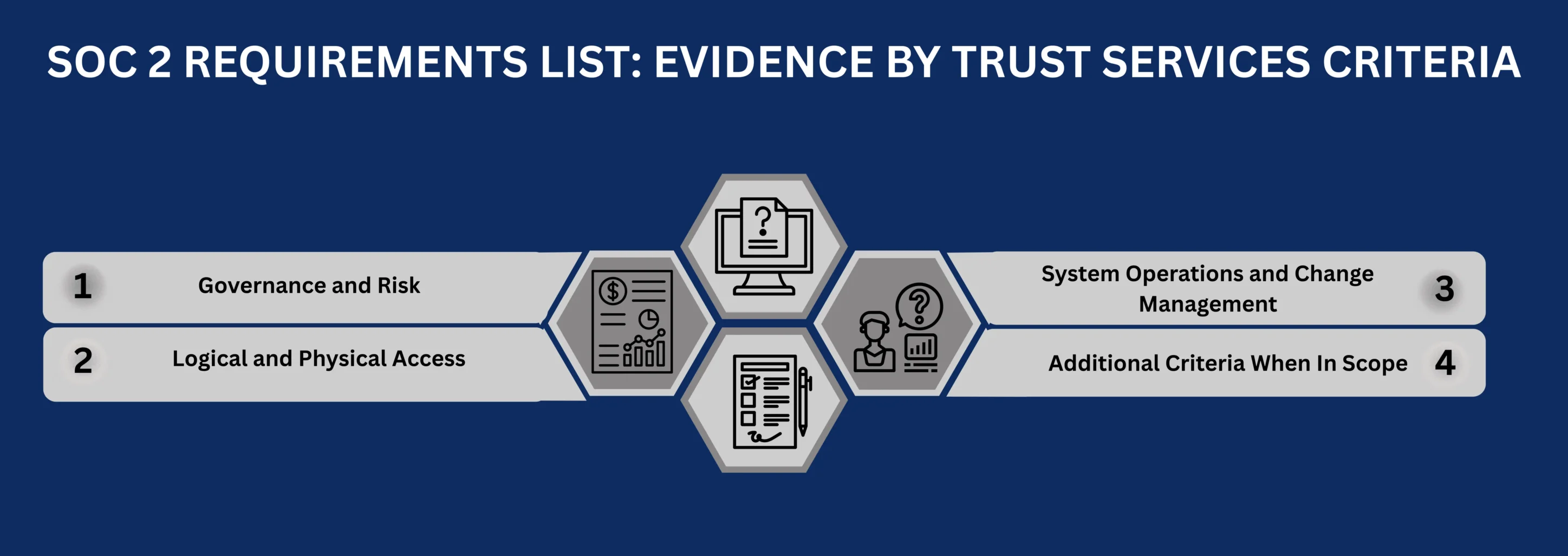
SOC 2 compliance in Adelaide is evaluated against the AICPA Trust Services Criteria, which define the control objectives and specific criteria points that service organizations must address within their examined control environment. The Trust Services Criteria are organized into five categories, each addressing a distinct dimension of data security, system reliability, and information handling.
Understanding which categories apply to an organization’s services is essential to defining the SOC 2 examination scope and structuring the control environment subject to audit review.
The Security category — also referred to as the Common Criteria — is mandatory in every SOC 2 examination. It evaluates controls protecting information and systems against unauthorized access, unauthorized disclosure, and damage. The Common Criteria encompass logical access controls, physical security, change management, risk assessment, monitoring, and incident response.
The Availability category addresses whether systems and data are available for operation and use as committed in service agreements. This category is particularly relevant to Adelaide organizations providing cloud platforms, SaaS applications, and managed services where uptime commitments form part of customer contracts. The Processing Integrity category evaluates whether system processing is complete, valid, accurate, timely, and authorized — a requirement commonly encountered in fintech, payments processing, and data management platforms.
The Confidentiality category addresses controls protecting information designated as confidential, including data classification, access restriction, and disposal procedures. The Privacy category evaluates the collection, use, retention, disclosure, and disposal of personal information in accordance with the organization’s privacy notice and applicable privacy regulations.
SOC 2 compliance is assessed through evidence-based evaluation — not self-attestation. The Licensed CPA Firm examines documentation, system outputs, and operational records to determine whether each control addresses the applicable criteria point and, in a Type 2 engagement, whether it operated consistently throughout the observation period.
Controls must be both suitably designed and operating effectively to satisfy the Trust Services Criteria. Design suitability means the control, if operating as intended, would address the criteria point. Operating effectiveness means the control actually functioned as designed during the review period, as evidenced by observable artifacts. For Adelaide organizations in defense technology, healthcare IT, or SaaS sectors, the control environment typically spans identity and access management, encryption standards, vendor risk management, change management procedures, business continuity controls, and personnel security practices — all of which are subject to evidentiary review during the SOC 2 examination.
- ✓The Five Trust Services Categories
- ✓Evidence-Based Control Evaluation and Scope Boundaries
SOC 2 Type 1 vs. SOC 2 Type 2 Reports: Key Differences for Adelaide Organizations
Adelaide organizations pursuing SOC 2 attestation must select between a Type 1 and Type 2 report based on their customer requirements, procurement timelines, and readiness to sustain an observation period. The two report types serve different evidentiary purposes and carry different weights in enterprise vendor review processes. Understanding this distinction enables service organizations to align their SOC 2 strategy with their specific market and contractual obligations.
SOC 2 Type 1: Point-in-Time Design Assessment
A SOC 2 Type 1 audit in Adelaide assesses whether an organization’s controls are suitably designed to meet the applicable Trust Services Criteria as of a specific date. The Licensed CPA Firm evaluates the control design and implementation at that point in time and issues an opinion on whether the controls, as documented and implemented, address each applicable criteria point. The Type 1 report does not assess how controls operated over time — it is a design-focused evaluation.
Organizations commonly pursue a Type 1 examination when entering the SOC 2 process for the first time, when a customer requires immediate attestation evidence within a procurement timeline that does not accommodate a full observation period, or when the organization has recently implemented its control environment and requires independent confirmation of design suitability before commencing a Type 2 observation period. A Type 1 report provides structured attestation evidence but is generally understood by enterprise buyers to represent an earlier stage of maturity than a Type 2 report.
SOC 2 Type 2: Operating Effectiveness Over an Observation Period
A SOC 2 Type 2 audit in Adelaide evaluates both the design and operating effectiveness of controls across a defined observation period, typically spanning six to twelve months. The Licensed CPA Firm collects evidence demonstrating how each in-scope control functioned throughout that period — not merely whether it was in place at a single point in time.
The Type 2 report carries substantially greater evidential weight in enterprise procurement because it documents consistent, sustained control operation rather than a snapshot assessment. U.S.-based enterprise clients, financial sector procurement teams, and technology vendor review programs generally require Type 2 reports as the standard for third-party vendor security assurance. For Adelaide organizations in SaaS, cloud services, defense technology supply chains, and healthcare IT — where ongoing relationships with U.S. clients depend on vendor security validation — the SOC 2 Type 2 audit represents the benchmark attestation standard. Annual renewal of the Type 2 examination maintains the currency of the attestation and confirms ongoing control effectiveness to clients and procurement stakeholders.
| Feature | SOC 2 Type 1 | SOC 2 Type 2 |
|---|---|---|
| Assessment Focus | Control design and implementation at a point in time | Control design and operating effectiveness over a defined period |
| Observation Period | None — single date assessment | Typically 6–12 months |
| Evidential Weight | Design confirmation | Sustained operational evidence |
| Enterprise Acceptance | Accepted as initial attestation evidence | Standard requirement for ongoing vendor approval |
| Report Validity | Point-in-time; does not carry forward | Covers the defined review period; renewed annually |
Why Adelaide Organizations Pursue SOC 2 Certification
SOC 2 Certification in Adelaide is pursued for a range of distinct reasons tied to the city’s specific industry profile and the international commercial relationships its organizations maintain. Adelaide’s concentration of defense technology contractors, space and advanced manufacturing firms, healthcare research institutions, and SaaS providers places its organizations at the intersection of Australian regulatory expectations and U.S. third-party risk management requirements.
SOC 2 Certification for Adelaide companies reflects the convergence of those requirements into a single, independently verified attestation — one that satisfies the evidentiary standards of enterprise procurement processes on both sides of the Pacific.
Defense Technology, Space, and Advanced Manufacturing Sectors
Adelaide is Australia’s defense industry capital, hosting major naval shipbuilding programs, defense electronics firms, and aerospace contractors that supply technology and services to international defense primes and U.S. government-linked procurement chains. Organizations in these sectors that process, transmit, or store controlled technical information, system design data, or sensitive operational records frequently encounter SOC 2 attestation requirements embedded in prime contractor vendor security review programs.
Defense technology companies in Adelaide pursuing subcontractor relationships with U.S. defense primes — or supplying software and managed services to defense programs — encounter SOC 2 audit requirements as a component of supply chain risk management assessments. Space industry organizations, advanced manufacturing firms, and aerospace technology companies operating in Adelaide’s technology precinct face similar requirements when engaging with international partners, space agencies, or commercial satellite operators that mandate independent third-party security attestation as a condition of vendor qualification.
SaaS, Cloud Services, and Healthcare Technology
Adelaide’s SaaS and cloud services ecosystem has expanded significantly, with technology startups, scale-up platforms, and established managed service providers seeking to grow internationally — particularly into U.S. markets where SOC 2 compliance in Adelaide is a baseline vendor qualification requirement. U.S. enterprise buyers routinely require SOC 2 Type 2 reports before contracting with Australian SaaS vendors, especially those handling customer data, providing cloud-hosted business applications, or delivering managed infrastructure services.
Healthcare technology organizations and medical research institutions in Adelaide face similar requirements when engaging with U.S.-based health systems, clinical research organizations, or pharmaceutical companies that apply HIPAA-aligned vendor security standards to their supply chains. In these contexts, a current SOC 2 attestation report is the primary mechanism through which an Adelaide organization demonstrates to international clients that its control environment has been independently verified by a Licensed CPA Firm operating under AICPA professional standards — not merely described in self-prepared security documentation.
Benefits of SOC 2 Certification for Adelaide-Based Organizations
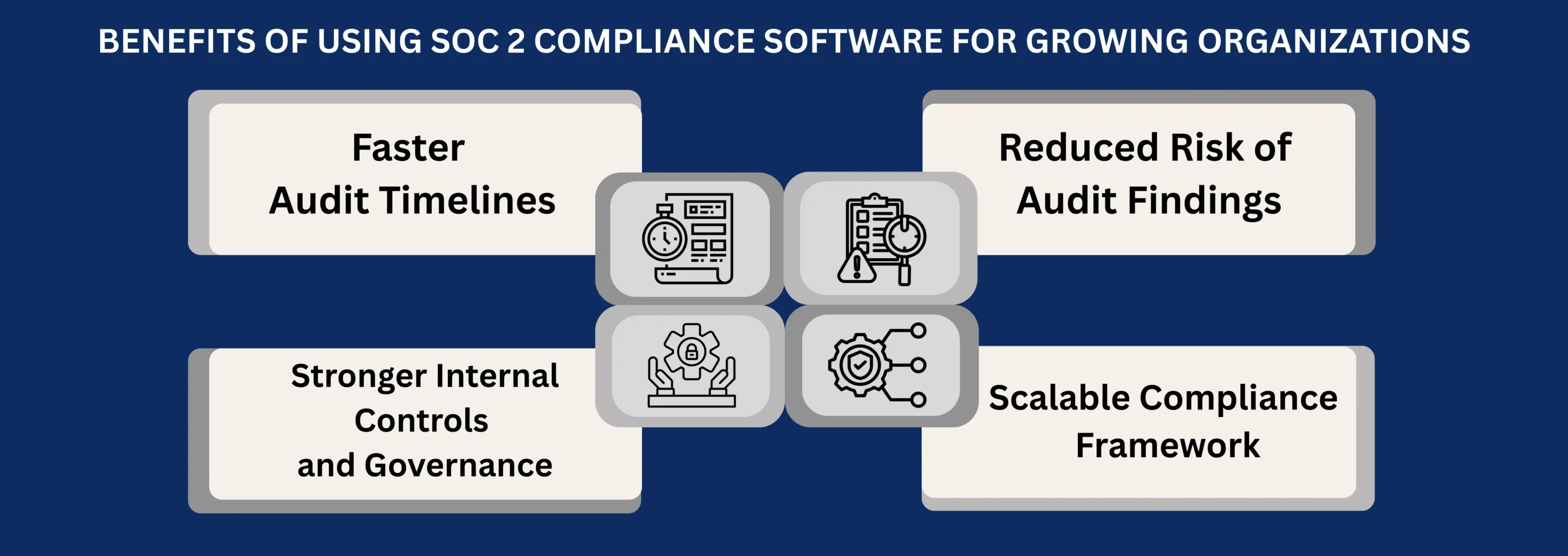
SOC 2 Certification in Adelaide produces concrete, measurable outcomes for organizations operating in sectors where independent security attestation is an enterprise procurement expectation. The benefits extend across vendor qualification processes, customer contracting cycles, internal control governance, and competitive positioning in U.S. and international markets. The following benefits are specific to the attestation outcome — the independently signed SOC 2 report — rather than to any preparatory activities preceding the examination.
- ✓Independent verification of control effectiveness by a Licensed CPA Firm under AICPA attestation standards, providing objective evidence that satisfies enterprise procurement security reviews
- ✓Structured SOC 2 attestation report accepted by U.S.-based enterprise buyers, financial sector clients, and regulated procurement processes as a primary vendor security assurance document
- ✓Demonstrated SOC 2 compliance with the AICPA Trust Services Criteria across Security, Availability, Processing Integrity, Confidentiality, and Privacy — the specific dimensions evaluated in enterprise vendor risk assessments
- ✓Accelerated vendor qualification timelines: organizations holding a current SOC 2 Type 2 report can respond to security questionnaires with documented attestation evidence, reducing procurement friction
- ✓Ongoing surveillance through annual Type 2 examination renewal, maintaining the currency of the attestation and confirming sustained control effectiveness to clients and stakeholders
- ✓Competitive differentiation in markets where SOC 2 Certification for Adelaide companies is a qualification threshold — not merely a preference — for enterprise contract awards
- ✓Documented control environment that provides internal governance visibility across access management, change management, incident response, and risk assessment functions
- ✓Recognition in defense technology supply chain risk management programs, health sector vendor reviews, and SaaS enterprise security questionnaire processes that cite SOC 2 attestation as the accepted verification standard
SOC 2 Examination Scope, Report Validity, and Ongoing Compliance
The SOC 2 examination in Adelaide produces a formal attestation report that documents the auditor’s findings across the defined scope and review period. Understanding the scope boundaries, report validity period, and ongoing compliance requirements enables Adelaide organizations to maintain current attestation status and consistently meet customer expectations.
Report Validity and Annual Renewal
A SOC 2 Type 2 report covers a defined observation period — typically twelve months for mature programs — and is valid for that period only. Enterprise buyers, procurement teams, and vendor security reviewers generally consider a SOC 2 report current when it covers a review period ending within the preceding twelve months. Reports older than twelve months are frequently considered stale and may require supplemental evidence or a bridge letter from the Licensed CPA Firm to satisfy procurement requirements.
Organizations in Adelaide that maintain ongoing relationships with U.S. enterprise clients must manage their SOC 2 examination renewal schedule to ensure continuous attestation coverage without gaps. Annual renewal of the SOC 2 Type 2 audit confirms that controls have continued to operate effectively across successive review periods, demonstrating a sustained commitment to control standards rather than a one-time examination event. Organizations should plan their renewal examination to commence before the current report period expires, maintaining uninterrupted attestation coverage for client review processes.
Scope Changes, Subservice Organizations, and Report Boundaries
The SOC 2 examination scope is defined by the service organization’s system description and must accurately reflect the boundaries of the system under audit. Changes to the technology environment, service delivery model, infrastructure providers, or control structure during or after an examination period may require scope adjustments in subsequent audits.
Organizations that rely on subservice providers — such as cloud infrastructure platforms, data center operators, or third-party software vendors — must address how those subservice relationships affect the control environment. The Licensed CPA Firm applies either the inclusive method — where subservice organization controls are included in the examination scope — or the carve-out method — where subservice organization controls are excluded and the report explicitly identifies reliance on those providers.
For Adelaide organizations using major cloud platforms as infrastructure foundations for SaaS or managed service offerings, the carve-out method is standard practice. The SOC 2 report explicitly notes reliance on the cloud provider’s complementary controls. Clients reviewing the SOC 2 report should be directed to the complementary subservice organization controls section to understand the complete control framework.
Adelaide’s Industry Sectors and SOC 2 Audit Requirements
SOC 2 audit requirements in Adelaide vary by industry sector, service model, and customer contractual obligations. Adelaide’s diverse economy spans sectors with distinct data processing profiles and varying exposure to U.S. cybersecurity, privacy, and vendor assurance expectations. The following sector-specific overview identifies the primary SOC 2 compliance drivers relevant to Adelaide’s major industry clusters.
Technology companies, SaaS platform operators, and managed service providers in Adelaide represent the largest and fastest-growing segment of organizations pursuing SOC 2 Certification in Adelaide. These organizations typically process customer data across cloud-hosted environments, provide software services accessed remotely by enterprise clients, or deliver managed IT, security, or infrastructure services under ongoing service agreements.
U.S. enterprise clients — including financial services firms, healthcare organizations, and technology companies — embed SOC 2 Type 2 report requirements into their vendor security programs as a standard procurement condition. SaaS vendors in Adelaide pursuing U.S. market expansion routinely encounter SOC 2 compliance requirements during enterprise sales processes, where procurement teams require a current SOC 2 attestation before approving new vendor contracts. The SOC 2 examination for technology organizations evaluates controls across the full Common Criteria plus additional categories relevant to service commitments — most commonly Availability and Confidentiality — reflecting customer expectations around platform uptime and data protection.
Healthcare technology organizations, medical research institutions, and clinical data management companies in Adelaide that engage with U.S.-based health systems, pharmaceutical companies, or clinical research organizations face SOC 2 attestation requirements aligned with HIPAA-influenced vendor security frameworks. While SOC 2 is not a HIPAA-specific standard, U.S. health sector procurement programs widely accept a SOC 2 Type 2 report as evidence of a vendor’s control effectiveness in protecting health-related and personally identifiable data.
Agricultural technology companies — an emerging Adelaide sector supporting precision agriculture, supply chain data platforms, and agri-tech SaaS services — encounter similar requirements when supplying digital platforms to international food production companies or commodity trading firms with U.S. operations. For both sectors, the Privacy Trust Services Category is often included in the SOC 2 examination scope alongside Security and Confidentiality, reflecting the nature of personal and operational data processed and the privacy expectations of international enterprise clients.
- ✓Technology, SaaS, and Managed Service Providers
- ✓Healthcare, Medical Research, and Agricultural Technology
FAQ
▶
What is SOC 2 Certification in Adelaide?
▶
What is the difference between a SOC 2 Type 1 and Type 2 audit in Adelaide?
▶
Who can conduct a SOC 2 audit in Adelaide?
▶
Which Trust Services Categories apply to SOC 2 compliance in Adelaide?
▶
How long does a SOC 2 Type 2 observation period last for Adelaide organizations?
▶
How long is a SOC 2 attestation report valid?
▶
Is SOC 2 certification different from SOC 2 compliance?
▶
What types of Adelaide organizations typically require SOC 2 attestation?
SOC 1 VS SOC 2: WHICH REPORT YOUR CUSTOMERS ACTUALLY ASK FOR
If you sell SaaS or provide outsourced services, you have likely been asked for a SOC report. However, the follow-up question is rarely easy to answer…
SOC 2 Certified: What Does It Mean for Your Business
For companies that handle sensitive data or run cloud-based services, the question “Can you provide your SOC 2 report?” carries enormous weight. Yet, …
HOW SOC 2 AUDITORS REVIEW EVIDENCE OVER TIME
Most businesses pursuing a SOC 2 report spend months building security controls but overlook a fundamental reality: SOC 2 auditors do not just verify …
Get In Touch
have a question? let us get back to you.