
SOC 2 Certification in Baltimore
The SOC 2 audit process for Baltimore organizations follows a structured sequence of examination stages governed by AICPA attestation standards. Each stage involves defined activities, evidence requirements, and professional judgments by the Licensed CPA Firm. The process applies uniformly regardless of the organization’s size, sector, or technology environment. The specific controls evaluated and the depth of testing reflect the system scope, TSC categories selected, and the observation period defined for the engagement.
OUR CLIENTS










SOC 2 Certification for Baltimore-Based Financial, Healthcare, and Technology Organizations
SOC 2 Certification in Baltimore is conducted by a Licensed CPA Firm under AICPA attestation standards. It provides independently verified evidence that an organization’s controls over security, availability, processing integrity, confidentiality, and privacy meet the requirements of the Trust Services Criteria. Baltimore-based organizations across cybersecurity, healthcare, government contracting, SaaS, and cloud services pursue SOC 2 attestation to satisfy enterprise vendor due diligence, regulatory expectations, and contractual security requirements. Whether your organization is seeking a first-time SOC 2 examination or maintaining annual attestation status, the process is governed by the same professional standards applied by Licensed CPA Firms nationwide.
Baltimore’s Cybersecurity, Healthcare, and Technology Ecosystem
Baltimore occupies a distinctive position within the United States technology and cybersecurity landscape. Its proximity to Fort Meade, the National Security Agency, and the U.S. Cyber Command establishes a concentration of cybersecurity expertise, cleared contractors, and defense technology organizations unmatched outside the Washington D.C. metropolitan corridor. This environment generates sustained demand for rigorous, independently verified security attestations.
Organizations operating in this ecosystem frequently encounter procurement requirements that explicitly reference SOC 2 Certification in Baltimore as a baseline condition for vendor approval. This is especially true where sensitive government, defense, or classified-adjacent data is involved. The practical effect is that SOC 2 certification has become less a differentiator and more a threshold requirement for doing business in Baltimore’s technology sector.
Beyond defense and cybersecurity, Baltimore hosts a substantial healthcare and biotechnology sector anchored by institutions such as Johns Hopkins Medicine, the University of Maryland Medical System, and a network of research hospitals and pharmaceutical organizations. These institutions and their technology vendors face structured data protection obligations under HIPAA and associated state-level privacy frameworks.
SaaS providers, cloud service providers, and managed service organizations serving Baltimore’s healthcare ecosystem regularly encounter customer contract requirements that specify SOC 2 attestation as a condition of data processing agreements. The city’s higher education institutions, financial services firms, and insurance organizations further contribute to a layered regulatory environment in which SOC 2 compliance Baltimore serves as a recognized standard for third-party assurance.
Independent Licensed CPA Firm as Certification Body
SOC 2 examination engagements are conducted exclusively by Licensed CPA Firms holding active licensure under applicable state boards of accountancy and operating in conformance with AICPA professional standards. This requirement is not merely procedural. It reflects the attestation nature of SOC 2, which is a formal expression of professional opinion on control effectiveness — not a checklist assessment or vendor self-certification.
The Licensed CPA Firm functions as an independent certification body, evaluating control design and operating effectiveness against the Trust Services Criteria without prior involvement in control design, implementation, or remediation at the subject organization. This independence is a fundamental requirement of AICPA attestation standards and is what distinguishes a SOC 2 report from internal assessments or questionnaire-based reviews.
For Baltimore organizations selecting an attestation provider, the Licensed CPA Firm’s independence, AICPA membership, peer review status, and demonstrated experience with the Trust Services Criteria are the primary qualification criteria. The firm must maintain objectivity throughout the SOC 2 audit and issue its opinion based exclusively on evidence gathered during the examination.
Firms that also provide readiness consulting, control design, or implementation services to the same client present independence concerns that may affect report acceptability in enterprise procurement processes. Organizations seeking SOC 2 Certification in Baltimore should verify that the selected CPA firm maintains a clear separation between attest and non-attest activities before engaging.
AICPA Trust Services Criteria and Applicable Attestation Standards
The AICPA Trust Services Criteria (TSC) form the evaluative framework for every SOC 2 examination. The TSC is organized into five categories: Security (Common Criteria), Availability, Processing Integrity, Confidentiality, and Privacy. Security is mandatory in every SOC 2 engagement; the remaining four categories are selected based on the nature of the service organization’s commitments to customers and the applicable system description.
The AICPA issues the TSC under the auspices of its Assurance Services Executive Committee, and the criteria are periodically updated to reflect evolving control environments and technology risks. SOC 2 examinations are conducted under AT-C Section 205 (Examination Engagements) of the AICPA’s Statements on Standards for Attestation Engagements (SSAE 18), which governs the CPA firm’s responsibilities, evidence standards, and reporting obligations throughout the engagement.
Baltimore organizations operating in regulated sectors — including those subject to FISMA, FedRAMP, HIPAA, Maryland’s Personal Information Protection Act, or federal contractor security requirements — frequently align the TSC scope of their SOC 2 examination with specific regulatory obligations. Security controls evaluated under the Common Criteria map directly to control domains referenced in frameworks such as NIST SP 800-53 and NIST CSF, creating structured overlap that enables organizations to use SOC 2 attestation evidence across multiple compliance contexts.
The SOC 2 examination Baltimore organizations pursue is therefore not solely a vendor assurance instrument. It also serves as documented evidence of control effectiveness within broader compliance programs managed by internal audit, legal, and risk management functions.

What Is SOC 2 Certification?
SOC 2 Certification is the outcome of a formal examination engagement conducted by a Licensed CPA Firm. It results in an independent attestation report expressing a professional opinion on whether a service organization’s controls are suitably designed and — in the case of a Type 2 report — operating effectively over a defined observation period.
The term “certification” is used colloquially in the market. Technically, the AICPA refers to the output as a SOC 2 attestation report issued under examination standards. The distinction matters: SOC 2 is not a pass/fail certification issued by a standards body, but a formal professional opinion issued by a Licensed CPA Firm following a structured SOC 2 examination of control evidence. Understanding this distinction helps Baltimore organizations set accurate expectations when communicating their compliance posture to customers and regulators.
SOC 2 Type 1 vs. Type 2 Reports
SOC 2 examinations produce one of two report types, each serving a distinct purpose and addressing different evidence horizons. A Type 1 report expresses an opinion on whether the service organization’s controls are suitably designed as of a specific point in time. It does not evaluate whether those controls operated effectively over a period.
A Type 2 report expresses an opinion on both the suitability of control design and the operating effectiveness of controls over an observation period — typically a minimum of six months, and commonly extending to twelve months. Type 2 reports are the predominant format demanded by enterprise customers, financial institutions, government contractors, and regulated organizations in Baltimore’s procurement processes. They provide evidence of sustained control performance rather than a snapshot of documentation, which is why most procurement programs treat the Type 2 report as the applicable standard.
| Report Type | Evaluation Focus | Time Horizon | Common Use Case |
|---|---|---|---|
| SOC 2 Type 1 | Control design suitability | Point in time | Initial vendor qualification, first-year attestation for Baltimore organizations |
| SOC 2 Type 2 | Design and operating effectiveness | Minimum 6-month period | Enterprise procurement, regulated sector requirements in Baltimore |
| SOC 2 + HIPAA | TSC controls plus HIPAA criteria | Typically 12 months | Healthcare technology vendors, Baltimore health systems |
| SOC 2 + CSF | TSC aligned with NIST CSF | Varies by engagement scope | Government contractors, defense technology organizations near Fort Meade |
Trust Services Criteria Categories
The five Trust Services Criteria categories define the scope of evaluation in every SOC 2 examination. Security (the Common Criteria) addresses logical and physical access controls, risk management, monitoring, change management, and incident response — and is included in every SOC 2 engagement regardless of other scope selections.
Availability addresses whether the system is available for operation and use as committed in service level agreements. Processing Integrity evaluates whether system processing is complete, valid, accurate, timely, and authorized. Confidentiality addresses whether information designated as confidential is protected in accordance with the organization’s commitments. Privacy evaluates the collection, use, retention, disclosure, and disposal of personal information in accordance with the organization’s privacy notice and applicable privacy frameworks.
Baltimore organizations selecting TSC categories for their SOC 2 examination should base the scope decision on their system description, customer commitments, and contractual obligations — not on minimizing the scope of the engagement. SaaS providers serving healthcare organizations typically include Security and Availability at minimum, with Confidentiality and Privacy added where patient or regulated data is processed.
Cloud service providers serving government contractors commonly include Security, Availability, and Confidentiality. Financial technology organizations and payment processors frequently include Security, Availability, and Processing Integrity to address transaction accuracy and completeness. The Licensed CPA Firm evaluates all selected criteria categories against documented controls during the SOC 2 audit Baltimore engagement, and scope gaps identified late in the process can extend timelines or affect report completeness.
SOC 2 Compliance vs. SOC 2 Certification
SOC 2 compliance refers to an organization’s internal state of adherence to the Trust Services Criteria — the maintenance of controls, policies, and procedures that satisfy TSC requirements. SOC 2 Certification, by contrast, refers to the independently verified attestation that those controls exist and operate as described, as determined by a Licensed CPA Firm following a formal examination.
An organization may be internally compliant without having obtained independent attestation. However, it cannot represent itself as SOC 2 certified without a current SOC 2 attestation report issued by a Licensed CPA Firm. Enterprise customers, government agencies, and regulated institutions in Baltimore and nationally increasingly require the attestation report rather than self-declared compliance statements. The report provides a documented, evidence-based, professionally verified basis for third-party reliance that internal compliance programs simply cannot replicate.
SOC 2 Certification Audit Process in Baltimore
The SOC 2 audit process for Baltimore organizations follows a structured sequence of examination stages governed by AICPA attestation standards. Each stage involves defined activities, evidence requirements, and professional judgments by the Licensed CPA Firm. The process applies uniformly regardless of the organization’s size, sector, or technology environment. The specific controls evaluated and the depth of testing reflect the system scope, TSC categories selected, and the observation period defined for the engagement.
The SOC 2 examination begins with the definition of scope, which establishes the boundaries of the system subject to examination, the TSC categories included, and the observation period for Type 2 engagements. The system description — prepared by management of the service organization — identifies the infrastructure, software, data, people, and procedures that comprise the in-scope system.
The Licensed CPA Firm reviews the system description for completeness and accuracy as part of the examination, because the opinion expressed in the SOC 2 report is anchored to the system as described. Inaccurate or incomplete system descriptions are a common cause of qualified opinions in SOC 2 attestation engagements and represent a formal finding that must be addressed before report issuance.
For Baltimore organizations with complex technology environments — including hybrid cloud architectures, subservice organizations, and federated identity systems — the scoping phase requires careful delineation of boundaries. Subservice organizations (third-party vendors that perform functions relevant to the in-scope controls) must be addressed through either carve-out or inclusive presentations. Each approach carries distinct implications for the scope of the examination and the reliance that report users may place on the controls described.
The Licensed CPA Firm documents the scope determination and applies it consistently throughout the SOC 2 audit Baltimore engagement. Organizations that take scoping decisions seriously at the outset typically avoid costly scope revisions and delays during the examination phase.
The SOC 2 examination proceeds through two primary evaluation phases. In the initial phase, the Licensed CPA Firm reviews documentation supporting the control environment. This includes policies, procedures, system configurations, access control matrices, risk assessments, vendor management records, and change management documentation. This phase evaluates control design — whether the controls, if operating as described, would be sufficient to meet the applicable Trust Services Criteria points of focus. Evidence of design is assessed against TSC requirements, and the firm identifies areas where documented controls are absent, incomplete, or insufficiently specific to satisfy the criteria.
In the operating effectiveness phase — applicable to Type 2 engagements — the Licensed CPA Firm tests controls over the observation period using procedures including inquiry, observation, inspection of evidence, and re-performance. The firm selects samples from the observation period sufficient to support conclusions about consistent control operation.
Evidence gathered includes user access provisioning and deprovisioning records, change management tickets, vulnerability scan outputs, security monitoring logs, incident response records, and vendor review documentation. The breadth and depth of testing reflects the risk associated with each control area and the TSC requirements applicable to the scope. Deviations from expected control operation identified during testing are documented and evaluated for their effect on the SOC 2 audit opinion.
Control deviations and exceptions identified during the SOC 2 examination are documented in the report, with the Licensed CPA Firm evaluating whether each exception is isolated or indicative of a systemic control failure. The nature, frequency, and cause of exceptions inform the type of opinion issued — unqualified (clean), qualified, or adverse.
Exceptions do not automatically result in a qualified opinion. The firm applies professional judgment to determine whether the overall control environment, considering all evidence gathered, supports an unqualified opinion. Management of the service organization is provided an opportunity to respond to identified exceptions before the report is finalized.
The SOC 2 attestation report is issued to management and, for Type 2 engagements, covers the full observation period specified in the scope. The report includes the service auditor’s opinion, the system description prepared by management, the description of tests performed and results of testing, and any identified exceptions. SOC 2 reports are not public documents — they are confidential professional reports shared with customers and prospects under nondisclosure agreements.
Baltimore organizations that complete the SOC 2 examination receive a report valid for the period covered. Most enterprise customers expect annual renewal to maintain current attestation status. Annual SOC 2 audit cycles are the standard expectation in vendor management programs operated by financial institutions, healthcare organizations, and government agencies in the Baltimore market.
| Audit Stage | Key Activities | Output |
|---|---|---|
| Scoping and System Description | Define system boundaries, select TSC categories, establish observation period for Baltimore SOC 2 engagement | Agreed scope documentation, system description review |
| Control Design Evaluation | Review policies, procedures, configurations, and control documentation against Trust Services Criteria | Design assessment findings, identified gaps in documentation |
| Operating Effectiveness Testing | Inquiry, inspection, observation, re-performance over observation period | Test results, identified exceptions, deviation analysis |
| Nonconformity Review | Evaluate exceptions, apply professional judgment, incorporate management response | Exception documentation, opinion determination |
| Report Issuance | Finalize opinion, issue SOC 2 attestation report to Baltimore organization management | Signed SOC 2 Type 1 or Type 2 attestation report |
- ✓Scoping and System Description Review
- ✓Stage 1 and Stage 2 Examination Activities
- ✓Nonconformity Review, Report Issuance, and Observation Period
Why Organizations in Baltimore Pursue SOC 2 Certification
Demand for SOC 2 Certification in Baltimore is driven by a combination of enterprise procurement requirements, regulatory expectations, and sector-specific contractual obligations. Together, these factors make independent attestation a functional requirement for organizations seeking access to enterprise, government, and regulated-sector customer relationships. The Baltimore market’s concentration of cybersecurity, healthcare, defense, and financial services organizations creates a procurement environment where SOC 2 attestation is evaluated as a baseline security assurance standard — not a differentiating credential.
Enterprise Vendor Security Reviews and Procurement Requirements
Baltimore’s enterprise organizations — including large financial institutions, hospital networks, research universities, and federal agencies — operate structured vendor management programs that require third-party security attestations before onboarding new technology vendors. A SaaS provider seeking to deliver services to a Baltimore-area health system, for example, will typically encounter a vendor security review process that specifically requests a current SOC 2 Type 2 report covering Security and, where patient data is processed, Privacy and Confidentiality.
Without a current SOC 2 attestation, the vendor must respond to security questionnaires, submit to customer-led audits, or accept limitations on data access. All of these create friction in the sales and contracting process that SOC 2 Certification in Baltimore resolves systematically — replacing repetitive questionnaire cycles with a single, independently verified attestation report.
The financial services sector in Baltimore — encompassing regional banks, insurance companies, asset managers, and fintech organizations — applies particularly structured vendor due diligence standards derived from federal banking guidance, OCC bulletins, and state regulatory expectations. SOC 2 compliance Baltimore serves as the recognized assurance standard for technology vendors serving these institutions. Vendor risk management teams use the SOC 2 report as primary evidence of control effectiveness rather than supplemental documentation.
Organizations that have completed SOC 2 certification for Baltimore companies report materially shorter vendor approval timelines and reduced due diligence friction compared to those relying on questionnaire responses or internal security documentation alone.
Defense Contracting and Government Sector Requirements
Baltimore’s proximity to Fort Meade, the NSA, and numerous federal agency headquarters creates a substantial population of defense technology organizations and government contractors that handle controlled unclassified information, federal contract information, and sensitive but unclassified data under NIST SP 800-171 and CMMC frameworks. While CMMC and FedRAMP have their own certification pathways, SOC 2 attestation serves as a complementary control assurance mechanism for commercial cloud products and SaaS platforms used in adjacent, non-classified federal contracting environments.
Many prime contractors in the Baltimore area require their subcontractors and technology vendors to maintain current SOC 2 Type 2 reports as a contractual security baseline — particularly where systems store or process government-related data outside classified environments. In this context, SOC 2 Certification in Baltimore functions as both a commercial sales requirement and a defense supply chain compliance mechanism.
SOC 2 audit firm Baltimore engagements in the defense and government sector context frequently address the Security TSC’s Common Criteria in depth, including logical access controls, multi-factor authentication, privileged access management, system monitoring, and incident response procedures — all of which align with controls evaluated under NIST SP 800-53 and CMMC Level 2.
Organizations that maintain SOC 2 attestation in parallel with CMMC or FedRAMP programs can use the SOC 2 report to satisfy commercial customer assurance requirements while pursuing government certification through separate pathways. The SOC 2 examination Baltimore process for these organizations requires particular attention to subservice organization relationships involving cloud infrastructure providers, managed security services, and identity management platforms.
SaaS and Cloud Provider Market Expansion
Baltimore’s growing ecosystem of SaaS providers, cloud service organizations, and managed service providers increasingly encounters SOC 2 requirements as they expand beyond local markets into national and international enterprise sales channels. SOC 2 certification Baltimore financial services-focused technology companies report that the attestation report is routinely requested at the RFP stage by enterprise financial institutions. Its absence results in disqualification from formal procurement processes regardless of the vendor’s technical capabilities.
For Baltimore-based technology startups and growth-stage companies targeting enterprise customers, obtaining SOC 2 Certification is frequently identified as a prerequisite for enterprise market access rather than a post-sales compliance activity. Completing the SOC 2 audit before entering enterprise sales cycles eliminates a common stall point in contract negotiations and accelerates time-to-revenue with regulated-sector customers.
SOC 2 Certification Requirements for Baltimore Organizations
SOC 2 Certification requirements are defined by the AICPA Trust Services Criteria and the attestation standards governing the examination engagement. Organizations pursuing SOC 2 Certification in Baltimore must satisfy documentation requirements, maintain an operational control environment covering the in-scope TSC categories, and engage an independent Licensed CPA Firm to conduct the examination. Requirements apply equally to Type 1 and Type 2 engagements, with Type 2 adding the requirement for an observation period during which controls must operate consistently and continuously.
Organizations subject to SOC 2 examination must maintain documented policies and procedures covering the TSC areas in scope for the engagement. At minimum, documentation addressing information security policy, access control policy, risk assessment process, incident response procedures, change management process, and vendor management framework is required for Security (Common Criteria) examinations.
Organizations including Availability in scope must additionally document backup and recovery procedures, system redundancy configurations, and service availability monitoring processes. Confidentiality scope requires documented data classification, data handling, and data disposal procedures. Privacy scope requires a complete privacy notice and documented procedures for personal information collection, use, retention, disclosure, and disposal aligned with applicable privacy commitments.
Documentation must not only exist — it must accurately reflect the controls in operation within the organization’s environment. The Licensed CPA Firm conducting the SOC 2 audit evaluates whether documented procedures match observed practices. Inconsistencies between documentation and actual operations are identified as exceptions in the examination and must be addressed before an unqualified opinion can be issued.
Baltimore organizations with mature IT governance frameworks — including those operating under ISO 27001 or NIST CSF — typically have existing documentation that satisfies many TSC requirements. However, the specific format and content requirements of the SOC 2 system description may require supplemental documentation to address service commitments and system boundaries unique to the SOC 2 examination structure.
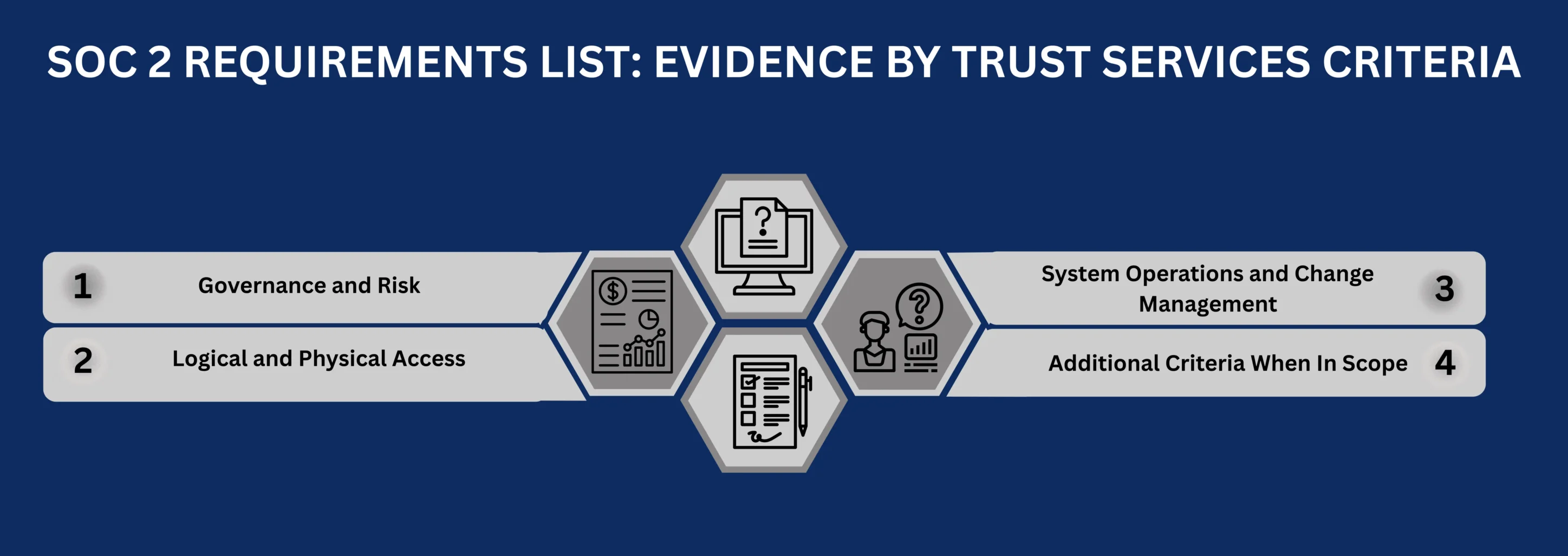
- ✓Security (Common Criteria): Logical access controls, multi-factor authentication, privileged access management, vulnerability management, security monitoring, incident response, change management, and risk assessment processes.
- ✓Availability: System redundancy, backup and recovery procedures, capacity monitoring, availability monitoring and alerting, and documented service level commitments.
- ✓Processing Integrity: Input validation controls, processing accuracy monitoring, error handling procedures, output reconciliation, and documented processing commitments.
- ✓Confidentiality: Data classification framework, encryption of data in transit and at rest, access restrictions on confidential data, and documented data retention and disposal procedures.
- ✓Privacy: Privacy notice documentation, personal data inventory, consent management, data subject request procedures, data retention schedules, and third-party data sharing controls.
- ✓Common to all categories: Documented risk assessment process, vendor management program, security awareness training records, and evidence retention practices supporting the SOC 2 observation period.
SOC 2 Type 2 examinations require controls to operate continuously and consistently throughout the observation period, which is defined in the scope agreement between the service organization and the Licensed CPA Firm. The minimum observation period recognized in AICPA guidance is six months. Twelve-month periods are the standard expectation in most Baltimore enterprise procurement contexts, as they provide the broadest evidence base for report reliance.
During the observation period, the service organization must maintain control operation without material lapses, document control activities with sufficient evidence to support auditor testing, and retain records sufficient for the Licensed CPA Firm to sample and evaluate during the examination phase. Gaps in evidence retention are among the most common causes of exceptions in SOC 2 Type 2 engagements and are avoidable with proper preparation.
Evidence required for Type 2 testing includes system-generated logs, access provisioning and deprovisioning records, change management tickets, security scan reports, patch management records, incident response documentation, backup completion logs, and vendor review records dated within the observation period.
Baltimore organizations with automated control monitoring tools — including security information and event management (SIEM) platforms, identity governance systems, and cloud security posture management tools — are typically better positioned to produce consistent, time-stamped evidence across the observation period than those relying on manual record-keeping. The Licensed CPA Firm selects samples from the observation period based on professional judgment about the risk level and frequency of each control activity.
- ✓Documentation and Control Environment Requirements
- ✓Technical Control Requirements by TSC Category
- ✓Observation Period and Evidence Requirements for Type 2
Benefits of SOC 2 Certification for Baltimore-Based Organizations
SOC 2 Certification delivers documented, independently verified evidence of control effectiveness that supports multiple organizational objectives simultaneously. For Baltimore organizations operating in competitive enterprise markets, the SOC 2 attestation report functions as a structured assurance instrument that addresses customer security questionnaires, satisfies vendor management program requirements, and provides documented evidence for regulatory and contractual compliance purposes — all through a single, independently verified examination engagement.
The primary benefit of SOC 2 Certification is the independently verified attestation that the organization’s controls are designed and operating effectively in accordance with the Trust Services Criteria. This verification — conducted by a Licensed CPA Firm with no financial interest in the outcome — provides a level of assurance that internal assessments, self-certification questionnaires, and compliance automation platform outputs cannot replicate.
Enterprise customers, financial institutions, and government agencies that accept SOC 2 reports as evidence of control effectiveness do so because the report reflects professional audit judgment applied to actual control evidence — not management representations of compliance status. The SOC 2 attestation Baltimore organizations obtain through this examination process carries the credibility of AICPA professional standards and the accountability of licensed professional practice.
Third-party validation through SOC 2 attestation also provides meaningful internal benefits to Baltimore organizations. The examination process requires management to produce and maintain evidence of control operation, which creates structured accountability for control owners, drives consistent documentation practices, and identifies operational control gaps before they become material audit findings.
Organizations that complete annual SOC 2 audit cycles typically develop more mature control environments over time. Each examination cycle reinforces evidence retention disciplines and highlights areas where control documentation or operation can be strengthened. This internal maturity effect is a documented secondary benefit of ongoing SOC 2 compliance Baltimore programs that many organizations cite as equally valuable to the report itself.
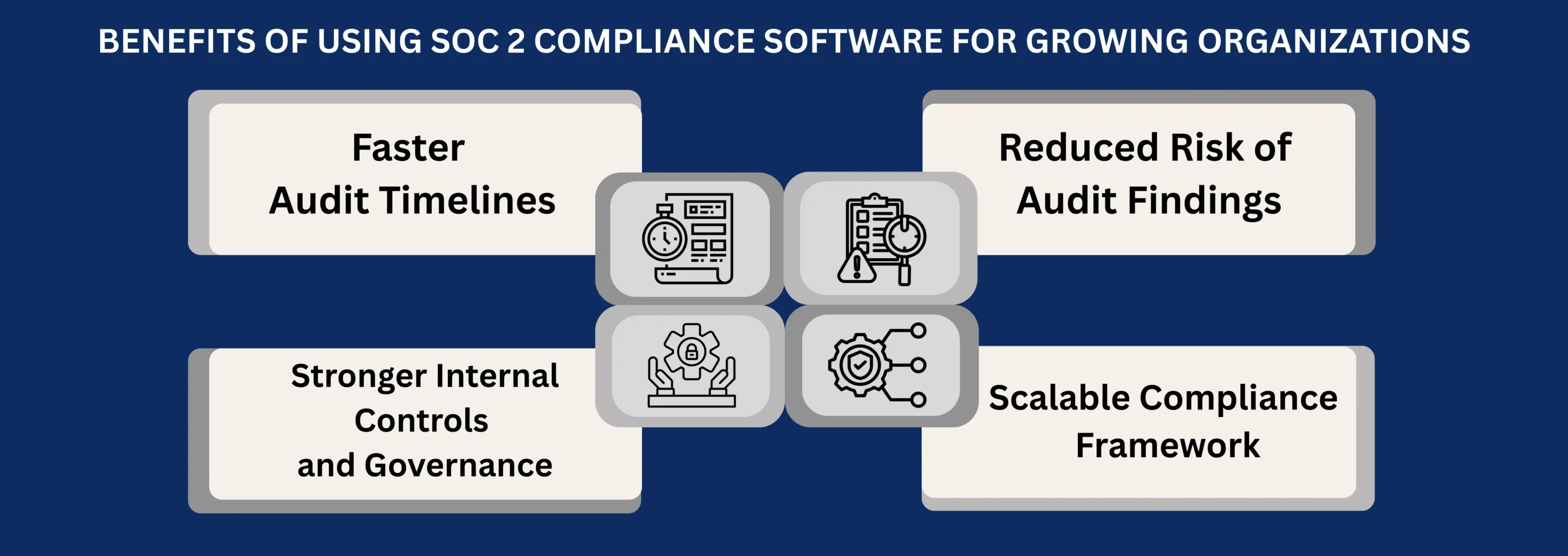
- ✓Documented evidence of control effectiveness accepted by enterprise vendor management programs in Baltimore’s financial services, healthcare, and government sectors.
- ✓Reduction in customer-led security audits and questionnaire burden, as SOC 2 reports satisfy the evidence requirements of most standard vendor assessment programs.
- ✓Accelerated vendor onboarding timelines with enterprise customers that operate SOC 2-based vendor qualification criteria.
- ✓Support for international SaaS expansion, as SOC 2 attestation is recognized by enterprise buyers across North America, Europe, and Asia-Pacific as a U.S.-standard control assurance framework.
- ✓Structured evidence base for regulatory examinations, internal audit programs, and board-level security reporting.
- ✓Competitive positioning in procurement processes where SOC 2 Certification in Baltimore serves as a qualifying threshold criterion for vendor consideration.
- ✓Annual examination cycles that maintain current attestation status and meet the renewal expectations of financial sector, healthcare, and government procurement programs in Baltimore.
- ✓Documented control effectiveness evidence that supports cyber insurance applications and underwriting review processes.
SOC 2 Certification aligns with risk management frameworks and regulatory expectations applicable to Baltimore organizations across multiple sectors. The Security (Common Criteria) evaluation addresses controls directly relevant to HIPAA Security Rule requirements for healthcare technology vendors, NIST SP 800-53 controls for federal contractor environments, and Maryland’s Personal Information Protection Act data security requirements.
Organizations that maintain current SOC 2 attestation can reference the examination report as documented evidence of control effectiveness in regulatory examinations, audit committee presentations, and board-level risk reporting. This provides structured documentation that meets the evidentiary standards expected by regulators and internal governance bodies — a particularly important consideration for Baltimore organizations that operate under multiple overlapping regulatory frameworks simultaneously.
The SOC 2 examination process also supports organizational risk management by creating a structured, recurring assessment of the control environment conducted by an independent professional with specialized knowledge of control evaluation methodologies. Unlike periodic internal assessments or one-time third-party reviews, the annual SOC 2 audit cycle provides continuous assurance that the control environment remains effective as technology, personnel, and threat landscapes evolve.
For Baltimore organizations that operate at the intersection of cybersecurity and regulated data — including those serving both federal agencies and commercial healthcare customers — the SOC 2 attestation report serves as a foundational document in their third-party risk management and vendor assurance programs.
- ✓Verified Control Effectiveness and Third-Party Validation
- ✓Market Access and Enterprise Procurement Recognition
- ✓Regulatory and Risk Management Alignment
Sectors in Baltimore Seeking SOC 2 Certification
SOC 2 Certification in Baltimore addresses the assurance requirements of a diverse cross-section of technology-dependent organizations. The city’s economic structure — anchored by defense and intelligence community contracting, healthcare and biomedical research, financial services, higher education, and a growing technology startup ecosystem — produces distinct SOC 2 demand profiles across multiple sectors. Each sector carries sector-specific TSC scope preferences and procurement expectations that shape how the SOC 2 examination is scoped and what the resulting report must demonstrate.
Healthcare, Biotech, and Life Sciences Organizations
Baltimore’s healthcare and biomedical sector — encompassing Johns Hopkins Medicine, the University of Maryland Medical System, MedStar Health, and a network of pharmaceutical and clinical research organizations — generates structured demand for SOC 2 attestation from the technology vendors, SaaS platforms, and cloud service providers that support their operations. Healthcare technology vendors that store, process, or transmit protected health information (PHI) on behalf of Baltimore health systems encounter vendor security requirements that specify SOC 2 Type 2 reports covering Security, Confidentiality, and Privacy as a minimum assurance baseline.
Electronic health record integrators, clinical decision support platforms, and population health analytics providers serving Baltimore healthcare institutions are among the most frequent pursuers of SOC 2 certification Baltimore healthcare sector engagements. For these vendors, the SOC 2 audit is not a discretionary compliance exercise — it is a prerequisite for maintaining customer relationships with major health systems.
Biotechnology and life sciences organizations in Baltimore — including those conducting clinical trials, genomic research, and pharmaceutical development — handle patient-derived data, research data subject to FDA regulations, and intellectual property data requiring structured confidentiality controls. Technology platforms serving these organizations, including clinical data management systems, laboratory information management systems, and research collaboration platforms, are increasingly required to provide SOC 2 attestation reports as evidence of control effectiveness for institutional research compliance programs.
The SOC 2 compliance Baltimore life sciences sector increasingly treats attestation as a baseline vendor qualification requirement rather than a supplemental assurance mechanism. This shift reflects growing awareness among research institutions that unverified vendor security representations create material risk in regulated research environments.
Financial Services, Fintech, and Insurance Organizations
Baltimore’s financial services sector includes regional banking institutions, insurance carriers, asset management firms, and a growing concentration of fintech organizations. SOC 2 compliance Baltimore fintech organizations pursue attestation to satisfy the vendor management requirements of bank and insurance partners, demonstrate compliance with federal financial regulatory expectations, and establish credibility in enterprise financial services sales processes.
The Office of the Comptroller of the Currency (OCC) and Federal Reserve guidance on third-party risk management explicitly references independent attestation reports as preferred evidence of vendor control effectiveness. This drives Baltimore financial technology vendors to obtain SOC 2 Certification as a functional requirement for banking relationships. Financial services technology vendors commonly include Security, Availability, and Processing Integrity in their SOC 2 scope to address transaction accuracy and system reliability commitments relevant to banking and payment processing relationships.
Cybersecurity Firms, SaaS Providers, and Managed Service Organizations
Baltimore’s cybersecurity industry — anchored by the ecosystem surrounding Fort Meade, the NSA, and the U.S. Cyber Command — includes numerous commercial cybersecurity firms, managed detection and response providers, threat intelligence platforms, and security operations center (SOC) vendors. These organizations frequently encounter SOC 2 audit Baltimore requirements from enterprise and government customers who recognize the apparent irony of engaging a cybersecurity vendor that cannot produce its own independent security attestation.
Cybersecurity firms pursuing SOC 2 Certification in Baltimore typically demonstrate mature control environments but must still submit to the formal examination process to produce a report that satisfies professional attestation standards. Internal security expertise does not substitute for independent CPA firm examination — a point that enterprise procurement teams and government vendor qualification programs enforce consistently.
Scope, Independence, and Certification Decision Framework
The SOC 2 certification decision is made by the Licensed CPA Firm based exclusively on evidence gathered during the examination, evaluated against the applicable Trust Services Criteria points of focus. The certification decision framework is structured to ensure independence, objectivity, and professional accountability at every stage of the engagement — from scope definition through report issuance. Understanding how this framework operates helps Baltimore organizations prepare effectively and set realistic expectations for the examination process.
Evidence-Based Assessment and Professional Judgment
The SOC 2 examination is an evidence-based assessment in which the Licensed CPA Firm evaluates documented control evidence against defined criteria — not management representations of compliance. Every conclusion expressed in the SOC 2 attestation report must be supported by audit evidence gathered during the engagement, including documentation reviewed, inquiries made, observations conducted, and re-performance procedures applied.
Professional judgment is applied by the examiner in selecting the nature, timing, and extent of testing procedures; evaluating the sufficiency and appropriateness of evidence gathered; and determining whether identified exceptions rise to the level of qualifications in the opinion. This evidence-based framework is what gives the SOC 2 attestation its credibility as an assurance instrument in enterprise procurement and regulatory contexts across the Baltimore market.
The certification decision framework for SOC 2 does not involve a committee vote, a scoring model, or a points-based threshold. The Licensed CPA Firm issues one of three opinion types: unqualified (controls are suitably designed and, for Type 2, operating effectively with no material exceptions), qualified (controls are suitably designed and operating effectively except for specifically identified exceptions), or adverse (controls are not suitably designed or operating effectively).
The opinion type directly affects the report’s utility in procurement contexts. Enterprise customers and regulated institutions in Baltimore and nationally rely on unqualified opinions as a basis for vendor approval. Qualified opinions require additional evaluation of the specific exceptions and their impact on the customer’s risk assessment before approval decisions are made.
Subservice Organizations and Carve-Out vs. Inclusive Presentations
Many Baltimore organizations rely on third-party vendors — cloud infrastructure providers, identity management platforms, managed security service providers, and data center operators — to perform functions relevant to their in-scope control environment. The SOC 2 examination framework addresses these subservice organization relationships through two presentation methods.
The carve-out method excludes subservice organization controls from the scope of the examination, requiring the service organization’s system description to identify functions performed by subservice organizations and requiring report users to obtain and review the subservice organization’s own SOC 2 report. The inclusive method incorporates subservice organization controls into the scope of the examination, requiring the Licensed CPA Firm to gather and evaluate evidence from the subservice organization directly. Baltimore organizations with complex vendor ecosystems should evaluate both options carefully during the scoping phase of their SOC 2 audit engagement.
Report Validity, Maintenance, and Recertification
SOC 2 attestation reports do not carry an indefinite validity period. The report covers the specific observation period defined in its scope and reflects the control environment as examined during that period. Enterprise customers and vendor management programs that rely on SOC 2 reports typically require reports dated within the preceding twelve months to consider them current for vendor qualification purposes.
Organizations that allow their SOC 2 attestation to lapse — by not completing annual examination cycles — may find that their reports are rejected by customer vendor management programs as outdated. This can require accelerated examination engagement to restore current status at significant cost and disruption. SOC 2 Certification in Baltimore is therefore a recurring annual commitment rather than a one-time achievement, and organizations must plan examination timelines to ensure report currency aligns with customer and contractual requirements throughout the year.
FAQ
▶
What is SOC 2 certification?
▶
Who needs SOC 2 certification?
▶
How long does SOC 2 certification take?
▶
What are the benefits of SOC 2 certification?
▶
What is the cost of SOC 2 certification?
▶
How do I prepare for SOC 2 certification?
▶
What happens after SOC 2 certification?
▶
How long does the SOC 2 certification process take?
SOC 1 VS SOC 2: WHICH REPORT YOUR CUSTOMERS ACTUALLY ASK FOR
If you sell SaaS or provide outsourced services, you have likely been asked for a SOC report. However, the follow-up question is rarely easy to answer…
SOC 2 Certified: What Does It Mean for Your Business
For companies that handle sensitive data or run cloud-based services, the question “Can you provide your SOC 2 report?” carries enormous weight. Yet, …
HOW SOC 2 AUDITORS REVIEW EVIDENCE OVER TIME
Most businesses pursuing a SOC 2 report spend months building security controls but overlook a fundamental reality: SOC 2 auditors do not just verify …
Get In Touch
have a question? let us get back to you.