
SOC 2 Certification in Barcelona
The SOC 2 audit process for organizations in Barcelona follows a structured examination methodology governed by AICPA attestation standards AT-C Section 105 and AT-C Section 205. Each stage involves defined activities, documented evidence collection, and formal evaluation outputs. The process applies uniformly across all industry sectors, though the scope of Trust Services Criteria examined and the observation period for Type 2 reports are determined based on each organization’s service commitments and data processing environment.
OUR CLIENTS










SOC 2 Certification for Barcelona-Based Financial and Technology Organizations
SOC 2 Certification in Barcelona is conducted by a Licensed CPA Firm as an independent third-party examination under AICPA attestation standards AT-C Section 105 and AT-C Section 205. The examination evaluates an organization’s internal controls against the AICPA Trust Services Criteria (TSC), producing a formal SOC 2 attestation report recognized in enterprise procurement, vendor due diligence, and regulated financial sector contexts. CertPro operates exclusively as an independent certification and attestation body — not as an advisory, consulting, or implementation firm — ensuring the integrity and objectivity of every SOC 2 examination it conducts.
Barcelona’s Technology and SaaS Ecosystem
Barcelona is one of Southern Europe’s most concentrated technology and innovation centers, anchored by the 22@ innovation district — a purpose-built technology hub hosting over 1,500 companies ranging from early-stage startups to multinational corporations. The city serves as a global focal point for mobile and telecommunications technology, drawing international attention through the annual Mobile World Congress (MWC), the world’s largest mobile technology exhibition.
This concentration of mobile-first companies, SaaS providers, cloud infrastructure firms, and digital media organizations creates substantial demand for SOC 2 Certification in Barcelona. These organizations routinely process, store, and transmit sensitive customer data on behalf of enterprise clients headquartered in the United States and other jurisdictions with rigorous vendor assurance requirements.
Barcelona’s e-commerce sector — supported by platforms and logistics technology companies — along with its growing fintech ecosystem concentrated near the financial corridors of Passeig de Gràcia and the broader Eixample area, further intensifies demand for independent third-party SOC 2 attestation. Organizations in these sectors encounter SOC 2 compliance requirements as explicit conditions in enterprise procurement processes, U.S. client contracts, and vendor security review frameworks.
Independent Certification by a Licensed CPA Firm
SOC 2 examinations are conducted exclusively by Licensed CPA Firms authorized under AICPA professional standards. This requirement distinguishes SOC 2 attestation from self-assessments, questionnaire-based vendor reviews, and ISO certifications issued by accredited certification bodies.
Under AT-C Section 205, the practitioner — a Licensed CPA Firm — issues a formal attestation report expressing an opinion on whether an organization’s controls satisfy the applicable Trust Services Criteria. CertPro operates within this framework as an independent third-party examination body. The independence requirement is foundational: CertPro does not advise organizations on control design, does not implement security programs, and does not offer remediation or consulting services.
The SOC 2 audit in Barcelona conducted by CertPro produces an objective, evidence-based attestation report that enterprise clients, regulated financial institutions, and U.S.-based procurement teams can rely upon for vendor due diligence. The institutional credibility of a SOC 2 attestation report derives directly from the independence of the Licensed CPA Firm issuing it and the rigor of the examination methodology applied.
SOC 2 Attestation vs. Self-Assessment
SOC 2 attestation differs fundamentally from self-declared compliance or internal security assessments. Organizations that complete internal reviews, vendor questionnaires, or self-certification exercises produce documentation reflecting only their own evaluation of their controls — without independent verification by a qualified external examiner.
A formal SOC 2 examination conducted by a Licensed CPA Firm produces a third-party attestation report in which the practitioner expresses an independent opinion on control design and, in the case of a Type 2 report, operating effectiveness over a defined observation period. Enterprise clients and regulated financial institutions in Barcelona’s procurement ecosystem specifically require third-party SOC 2 attestation reports — not self-assessments — when evaluating technology vendors, cloud service providers, and SaaS organizations.
The SOC 2 examination process subjects an organization’s controls to evidence-based testing, inquiry procedures, observation, and inspection activities that a self-assessment cannot replicate. Only a formal SOC 2 attestation issued by a Licensed CPA Firm satisfies the independent verification requirements imposed by enterprise procurement frameworks and U.S. cybersecurity due diligence standards.

What Is SOC 2 Certification?
SOC 2 Certification is a formal attestation issued by a Licensed CPA Firm confirming that an organization’s internal controls satisfy the AICPA Trust Services Criteria relevant to the security, availability, processing integrity, confidentiality, or privacy of the systems used to process customer data. The term “SOC 2 certified” reflects the outcome of a structured SOC 2 examination — a professional attestation engagement governed by AICPA standards — rather than a self-declared compliance status.
SOC 2 Certification is distinct from regulatory compliance frameworks: it is not mandated by law but is widely required by enterprise clients, regulated financial institutions, and U.S.-based procurement teams as a condition of vendor engagement. For technology organizations operating in Barcelona’s competitive market, achieving SOC 2 Certification in Barcelona is increasingly a prerequisite for entering U.S. enterprise sales cycles.
Trust Services Criteria: The Evaluative Foundation
The Trust Services Criteria (TSC) are developed and maintained by the AICPA and form the evaluative foundation of every SOC 2 examination. The TSC comprise five categories: Security (the Common Criteria, mandatory for all SOC 2 reports), Availability, Processing Integrity, Confidentiality, and Privacy. Security is the only mandatory criterion; the remaining four are selected based on the organization’s service commitments and the nature of the data it processes.
Each criterion contains a set of point-of-focus requirements and illustrative controls that auditors use to evaluate whether an organization’s controls are suitably designed and, for a Type 2 examination, operating effectively over a defined period. For Barcelona-based SaaS and cloud service providers, the Security and Availability criteria are most frequently included in scope. Fintech and e-commerce organizations handling personal data commonly extend scope to include the Privacy and Confidentiality criteria.
The Trust Services Criteria framework enables the SOC 2 examination to be scoped precisely to an organization’s service profile and data processing environment — making it a flexible yet rigorous standard for SOC 2 Certification in Barcelona across diverse industry sectors.
SOC 2 Type 1 and Type 2 Reports
SOC 2 examinations produce two types of reports, each serving a distinct purpose. A SOC 2 Type 1 report — formally a SOC 2 Type I certification in Barcelona — evaluates whether an organization’s controls are suitably designed as of a specific point in time. It does not assess whether those controls have operated effectively over a sustained period.
A SOC 2 Type 2 report — formally a SOC 2 Type II certification in Barcelona — evaluates both the design and the operating effectiveness of controls over a defined observation period, typically a minimum of six months. Enterprise clients and regulated procurement frameworks generally require a Type 2 report because it provides evidence that controls have functioned consistently over time, not merely that they were appropriately designed on the date of examination.
Organizations pursuing SOC 2 Certification in Barcelona for fintech clients, U.S. enterprise accounts, or cloud infrastructure agreements will typically need a Type 2 report to satisfy procurement requirements. A Type 1 report may be appropriate for organizations pursuing initial certification or establishing a baseline prior to a Type 2 examination cycle.
| Report Type | Evaluation Scope | Observation Period | Common Use Case |
|---|---|---|---|
| SOC 2 Type 1 | Control design as of a point in time | None — single date assessment | Initial SOC 2 certification; baseline establishment |
| SOC 2 Type 2 | Control design and operating effectiveness | Minimum 6 months (typically 6–12 months) | Enterprise procurement; regulated vendor reviews |
| SOC 2 + Privacy | Security plus Privacy TSC criteria | Defined observation period | Fintech, e-commerce, and healthcare SaaS providers |
| SOC 2 + Availability | Security plus Availability TSC criteria | Defined observation period | Cloud infrastructure and managed service providers |
SOC 2 Certification Audit Process for Organizations in Barcelona
The SOC 2 audit process for organizations in Barcelona follows a structured examination methodology governed by AICPA attestation standards AT-C Section 105 and AT-C Section 205. Each stage involves defined activities, documented evidence collection, and formal evaluation outputs. The process applies uniformly across all industry sectors, though the scope of Trust Services Criteria examined and the observation period for Type 2 reports are determined based on each organization’s service commitments and data processing environment.
The SOC 2 audit in Barcelona conducted by CertPro proceeds through a defined sequence of examination stages. The process begins with scope definition, during which the applicable Trust Services Criteria, system boundaries, and observation period (for Type 2 examinations) are formally established. The audit program is then determined, identifying specific control objectives, testing procedures, and evidence requirements applicable to the defined scope.
Stage 1 activities involve a review of the organization’s system description, control documentation, and structural design of controls against the applicable TSC. Stage 2 activities — required for Type 2 reports — involve substantive testing of control operating effectiveness through inspection of records, observation of processes, inquiry of personnel, and re-performance of selected control activities over the observation period.
Evidence collected during testing is evaluated against the Trust Services Criteria point-of-focus requirements, and any identified control deficiencies or nonconformities are documented and communicated to the organization. The SOC 2 examination concludes with a formal certification committee review and the issuance of the SOC 2 attestation report expressing the Licensed CPA Firm’s opinion on control design and, where applicable, operating effectiveness.
| Audit Stage | Key Activities | Output |
|---|---|---|
| Scope Definition | Determine applicable TSC, system boundaries, observation period | Formal scope document |
| Audit Program Determination | Identify control objectives, testing procedures, evidence requirements | Audit program and testing plan |
| Stage 1 — Documentation Review | Review system description, control documentation, structural design | Control design assessment |
| Stage 2 — Control Testing | Inspection, observation, inquiry, re-performance over observation period | Evidence portfolio and testing results |
| Nonconformity Review | Evaluate deficiencies, communicate findings, assess impact | Nonconformity report |
| Certification Decision | Independent committee review of examination evidence and findings | SOC 2 attestation report |
The observation period is a critical element of the SOC 2 Type 2 examination. AICPA standards require a minimum observation period of six months for a Type 2 report, though twelve-month periods are common in enterprise procurement contexts where clients require evidence of sustained control effectiveness across a full annual cycle.
The observation period begins when the organization’s controls are operational under the defined scope and concludes at the report’s period end date. SOC 2 attestation reports issued following a Type 2 examination are considered current for approximately twelve months from the report’s period end date.
Organizations maintaining continuous SOC 2 compliance in Barcelona are expected to complete annual examination cycles to produce renewed attestation reports. This ensures that enterprise clients and regulated procurement teams always have access to current, valid evidence of control effectiveness. The expectation of annual renewal reflects the ongoing nature of SOC 2 compliance — it is not a one-time certification but a continuous demonstration of control operation across defined periods.
- ✓Examination Stages and Structured Methodology
- ✓Observation Period and Report Validity
Why Organizations in Barcelona Pursue SOC 2 Certification
Demand for SOC 2 Certification in Barcelona is driven by a combination of enterprise procurement requirements, U.S. client expectations, financial sector vendor assurance frameworks, and the competitive positioning needs of technology organizations seeking to expand into regulated markets. The specific demand drivers vary by sector: SaaS providers face contractual requirements from U.S. enterprise clients, fintech organizations encounter financial institution vendor risk management expectations, and cloud infrastructure providers must satisfy both enterprise and regulatory procurement standards.
Enterprise Vendor Security Reviews and U.S. Market Access
Barcelona-based technology organizations seeking contracts with U.S. enterprise clients routinely encounter SOC 2 attestation as a non-negotiable vendor security requirement. U.S. enterprises — particularly in financial services, healthcare, retail, and professional services sectors — require third-party vendors and SaaS providers to produce current SOC 2 Type 2 reports as a condition of procurement. This requirement reflects the U.S. enterprise risk management framework, under which organizations must conduct formal vendor due diligence and obtain documented evidence of third-party control effectiveness.
A Barcelona SaaS provider seeking to close enterprise contracts with U.S. financial institutions, for example, will typically be required to submit a current SOC 2 Type 2 report during the vendor security review process. Without a formal SOC 2 attestation, Barcelona-based technology organizations frequently face extended procurement timelines, additional security questionnaire burdens, or outright exclusion from vendor shortlists.
SOC 2 compliance that Barcelona organizations pursue is therefore a market access requirement as much as a security demonstration. It is the credential that enables entry into U.S. enterprise procurement processes and accelerates contract execution with regulated enterprise clients.
Financial Sector Procurement and Fintech Vendor Assurance
Barcelona’s fintech ecosystem — encompassing payment technology firms, lending platforms, digital banking infrastructure providers, and regtech organizations — faces vendor assurance requirements from both U.S. financial institutions and European banks with U.S. regulatory exposure. Financial institutions subject to U.S. federal banking regulations, including those imposed by the OCC, FDIC, and Federal Reserve, are required to conduct third-party risk management assessments of technology vendors and service providers.
These assessments routinely include requirements for current SOC 2 Type 2 reports as evidence of control effectiveness in security, availability, and, where applicable, processing integrity. SOC 2 Certification in Barcelona for fintech organizations therefore directly addresses the vendor risk management requirements imposed by regulated financial institution clients.
The SOC 2 attestation report provides financial institution procurement teams with documented, independent evidence that a fintech vendor’s controls have been evaluated by a Licensed CPA Firm against the AICPA Trust Services Criteria — satisfying the third-party verification requirements embedded in their own regulatory frameworks.
SOC 2 Compliance Requirements and Certification Scope in Barcelona
SOC 2 compliance requirements are defined by the AICPA Trust Services Criteria and the specific scope of criteria selected for examination. The scope of a SOC 2 certification in Barcelona is not standardized across all organizations — it is determined by the nature of the services provided, the categories of data processed, and the control commitments made to customers through service agreements and system descriptions. Understanding these scope variables is essential for organizations planning their first SOC 2 audit or expanding an existing SOC 2 examination program.
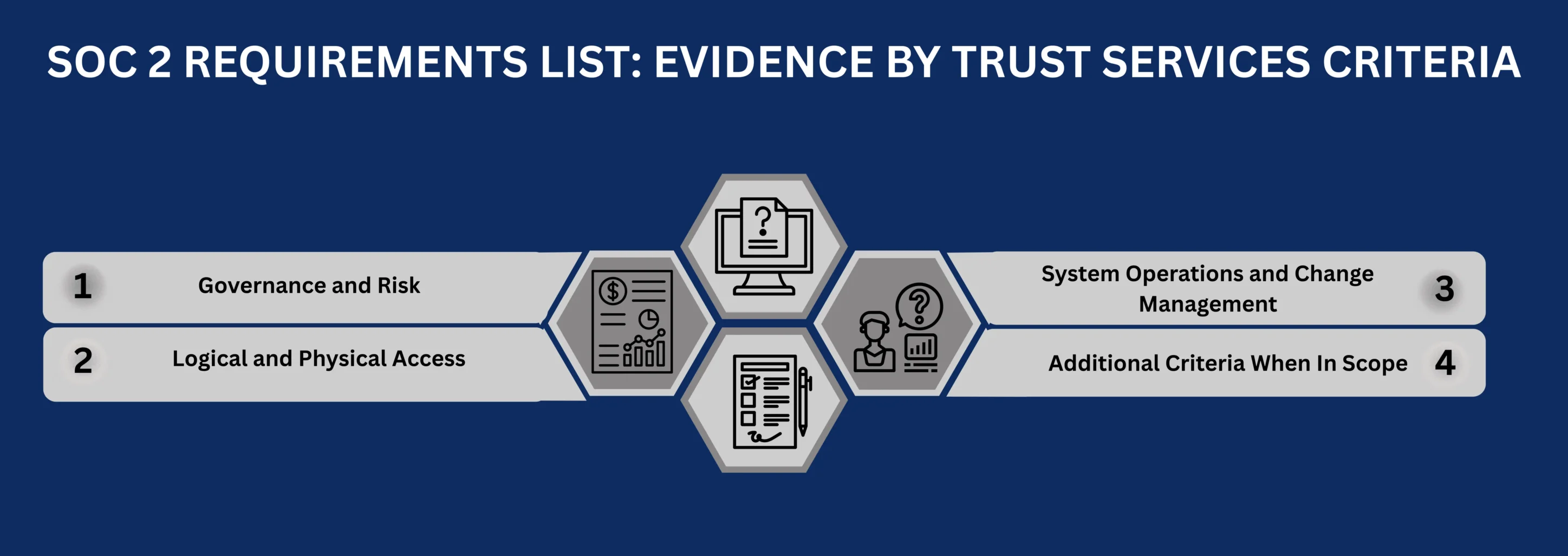
The SOC 2 examination evaluates both the design and, for Type 2 reports, the operating effectiveness of controls within the defined scope. Control design assessment examines whether an organization’s controls are structured to achieve the applicable Trust Services Criteria objectives. Operating effectiveness assessment — conducted during Stage 2 of the SOC 2 audit — evaluates whether those controls have functioned as designed across the observation period.
Evidence collection is a central activity of the SOC 2 audit process. Auditors collect evidence through multiple procedures: inspection of documentation (policies, system configurations, access logs, incident records, change management records), observation of control execution, inquiry of personnel responsible for control operation, and, where applicable, re-performance of control activities.
The quality, completeness, and consistency of evidence collected during the SOC 2 examination directly determines the basis for the examiner’s opinion. Organizations subject to a SOC 2 audit in Barcelona are expected to maintain documentation and records throughout the observation period that support evidence collection — not to prepare documentation in anticipation of the audit, but to operate controls in a manner that generates contemporaneous evidence of their execution.
The system description is a formal document prepared by the organization under examination that defines the boundaries of the system in scope for the SOC 2 examination. It describes the infrastructure, software, data, people, and procedures that together constitute the system used to process customer data. The system description also identifies the service commitments and system requirements relevant to the examination, including the applicable Trust Services Criteria and the controls designed to meet those criteria.
Auditors evaluate the completeness and accuracy of the system description as part of the SOC 2 examination — an incomplete or inaccurate system description may result in qualification of the examiner’s opinion. For Barcelona-based organizations with complex multi-cloud environments, distributed engineering teams, or third-party subservice organizations (such as cloud infrastructure providers or data processing subcontractors), the system description must accurately reflect the in-scope system boundaries. It must also identify any complementary user entity controls (CUECs) or complementary subservice organization controls (CSOCs) relied upon by the examined organization.
Nonconformities identified during the SOC 2 examination are documented and communicated to the organization as part of the formal examination process. The nature and significance of identified deficiencies inform the examiner’s opinion expressed in the final attestation report. A SOC 2 attestation report may express an unqualified opinion (where controls satisfy the applicable Trust Services Criteria), a qualified opinion (where certain criteria are not met or evidence is insufficient for specific control areas), or an adverse opinion (where controls fail to satisfy the applicable criteria in material respects).
The certification decision is made independently by CertPro’s examination team and certification committee, based solely on the evidence collected during the SOC 2 examination and its evaluation against the Trust Services Criteria. The organization under examination does not influence the certification decision. This independence is fundamental to the value of SOC 2 attestation in Barcelona — the report reflects an objective, evidence-based assessment by a Licensed CPA Firm, not a consensus or negotiated outcome.
- ✓Control Environment and Evidence Requirements
- ✓System Description and Scope Boundaries
- ✓Nonconformity Review and Independent Certification Decision
Industry Sectors in Barcelona Seeking SOC 2 Certification
SOC 2 Certification in Barcelona is pursued across a wide range of technology and financial services sectors, each with distinct data processing profiles, customer contractual requirements, and enterprise procurement expectations. The following sectors represent the primary demand base for SOC 2 attestation that Barcelona organizations encounter in their commercial operations.
- ✓SaaS Providers: Barcelona-based software-as-a-service companies processing customer data on behalf of U.S. and European enterprise clients require SOC 2 Type 2 reports as a standard vendor security credential.
- ✓Cloud Service Providers: Infrastructure-as-a-service and platform-as-a-service organizations hosting customer workloads and sensitive data are evaluated under SOC 2 Security and Availability criteria.
- ✓Fintech and Payment Technology Firms: Payment processors, digital lending platforms, and financial data aggregators serving regulated financial institution clients require SOC 2 attestation to satisfy third-party vendor risk management requirements.
- ✓E-Commerce Platforms and Digital Marketplaces: Barcelona’s e-commerce sector includes platforms processing consumer payment data and personal information, creating demand for SOC 2 Security, Confidentiality, and Privacy examinations.
- ✓Digital Media and Content Technology Companies: Media technology organizations managing digital rights, audience data, and content delivery systems encounter SOC 2 requirements from enterprise media clients and platform partners.
- ✓Mobile and Telecommunications Technology Firms: Organizations connected to Barcelona’s MWC ecosystem — including mobile application developers and telecommunications software providers — face SOC 2 requirements from carrier and enterprise clients.
- ✓Managed Service Providers (MSPs): IT managed service organizations providing infrastructure monitoring, security operations, and data management services to enterprise clients require SOC 2 attestation to demonstrate control effectiveness.
- ✓Scale-Up Organizations: Barcelona technology scale-ups expanding into U.S. markets or securing institutional investment face SOC 2 compliance requirements as part of enterprise customer onboarding and due diligence processes.
Benefits of SOC 2 Certification for Barcelona-Based Organizations
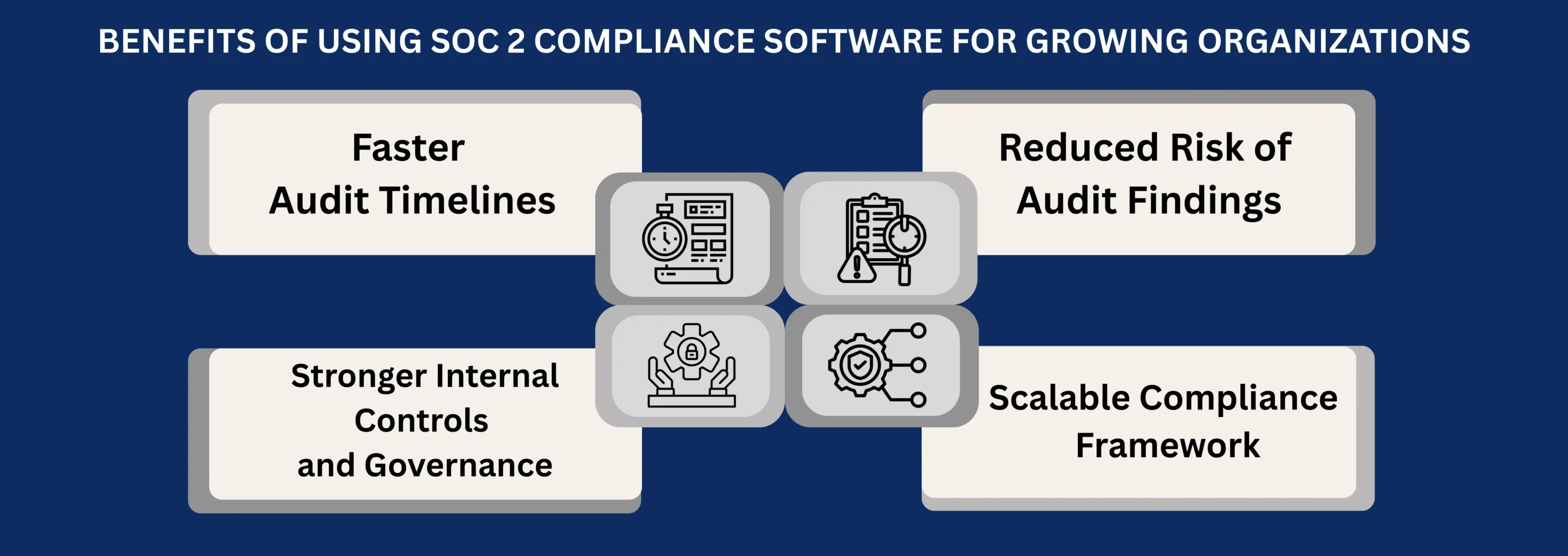
SOC 2 Certification for Barcelona companies produces demonstrable, independently verified outcomes across enterprise procurement, vendor risk management, client trust, and organizational control maturity. The benefits outlined below reflect the direct outcomes of a completed SOC 2 examination and attestation — not anticipated or projected results — and apply to organizations across all sectors actively pursuing SOC 2 compliance in Barcelona.
The primary benefit of SOC 2 Certification in Barcelona is the production of an independently verified attestation report that satisfies enterprise procurement requirements without requiring repeated security questionnaire completion or bespoke vendor audits. Enterprise clients — particularly those headquartered in the United States — rely on current SOC 2 Type 2 reports as a standardized evidence artifact in their third-party risk management programs.
A Barcelona-based SaaS organization holding a current SOC 2 Type 2 report can present that report in response to multiple concurrent enterprise vendor security reviews. This reduces the administrative burden of individual client security assessments and accelerates procurement timelines. The attestation report provides a structured, formally documented record of control design and operating effectiveness that procurement teams, legal reviewers, and information security officers can evaluate against their own vendor risk criteria.
This standardization of evidence reduces friction in enterprise sales processes and removes a common obstacle to contract execution with U.S. enterprise clients — making SOC 2 Certification in Barcelona a direct enabler of commercial growth.
SOC 2 compliance in Barcelona is maintained through annual examination cycles, each producing a renewed attestation report covering a defined observation period. This ongoing examination structure provides organizations with continuous evidence of control effectiveness — not a single point-in-time snapshot — and satisfies enterprise client expectations for up-to-date vendor security documentation.
Organizations that maintain annual SOC 2 examination cycles demonstrate to their client base that controls are not merely designed appropriately but have operated consistently across successive annual periods. This continuity of attestation builds a documented history of control performance that strengthens client confidence and supports renewal of enterprise contracts subject to annual vendor review requirements.
The annual SOC 2 audit cycle also functions as a structured mechanism for identifying and addressing control deficiencies before they result in material incidents or customer-impacting failures — reinforcing the operational value of the SOC 2 attestation process beyond its role as a procurement credential.
- ✓Independently verified evidence of control design and operating effectiveness, satisfying enterprise procurement requirements without bespoke audits.
- ✓Formal SOC 2 attestation report recognized in U.S. enterprise vendor due diligence processes and financial sector third-party risk management frameworks.
- ✓Documented basis for SOC 2 compliance in Barcelona through annual examination cycles producing renewed attestation reports.
- ✓Structured evaluation of controls against AICPA Trust Services Criteria, identifying control deficiencies before they result in material incidents.
- ✓Competitive positioning in U.S. enterprise and regulated financial sector markets requiring current SOC 2 Type 2 reports from technology vendors.
- ✓Reduction in administrative burden from security questionnaires and bespoke client audits through standardized SOC 2 attestation report presentation.
- ✓Demonstrated organizational maturity in data security, availability, and privacy control management relevant to scale-up and institutional investment contexts.
- ✓Verifiable basis for ongoing SOC 2 compliance monitoring through defined observation periods and annual examination cycles.
- ✓Independent Verification and Enterprise Procurement Recognition
- ✓Ongoing Surveillance and Continuous Control Demonstration
SOC 2 Examination Barcelona: Control Testing and Evidence Collection
The SOC 2 examination conducted by a Licensed CPA Firm involves systematic control testing and evidence collection activities that form the evidentiary basis for the examiner’s attestation opinion. Understanding the specific nature of these activities enables organizations subject to a SOC 2 audit in Barcelona to maintain operational practices that generate the contemporaneous evidence required for a rigorous and complete examination.
Evidence Collection Procedures and Testing Methods
SOC 2 auditors employ four primary evidence collection procedures: inspection, observation, inquiry, and re-performance. Inspection involves examination of documentation, records, and system configurations — including access control policies, change management logs, incident response records, vendor contracts, encryption configurations, and audit trail records. Observation involves direct assessment of control execution activities, such as reviewing how access provisioning requests are processed or how change management approval workflows operate.
Inquiry involves structured questioning of personnel responsible for control execution, management, and oversight. Re-performance involves independently executing a control activity — such as re-running an access review or validating a backup restoration procedure — to confirm that the documented process produces the expected outcome.
For a SOC 2 examination in Barcelona, the combination of these four procedures across the observation period generates a comprehensive evidence portfolio that supports the examiner’s opinion. The specific controls tested, and the frequency and sampling methodology applied, are determined by the audit program developed during the examination planning stage.
Common Criteria and Trust Services Criteria Testing Areas
The Common Criteria (CC) — the mandatory Security criterion of the Trust Services Criteria — encompasses nine control categories tested in every SOC 2 examination. These categories cover the control environment (CC1), communication and information (CC2), risk assessment (CC3), monitoring activities (CC4), control activities including logical and physical access (CC5 and CC6), system operations (CC7), change management (CC8), and risk mitigation (CC9).
For Barcelona-based technology organizations, control testing under the Common Criteria typically involves evaluation of access management systems, multi-factor authentication configurations, encryption standards for data at rest and in transit, vulnerability management programs, security incident detection and response procedures, and vendor management controls.
When additional Trust Services Criteria are included in scope — such as Availability for cloud service providers or Privacy for organizations processing personal data — the SOC 2 examination extends to include testing of specific controls relevant to those criteria. This may include capacity monitoring, service level agreement compliance mechanisms, and personal data handling and retention controls.
SOC 2 Attestation Barcelona: Report Structure and Ongoing Compliance
The SOC 2 attestation report issued by CertPro as a Licensed CPA Firm following examination of Barcelona-based organizations follows a defined AICPA-prescribed structure. Understanding the components of the attestation report enables organizations and their clients to accurately interpret the examiner’s opinion and assess the scope and conclusions of the SOC 2 examination.
Structure of the SOC 2 Attestation Report
A SOC 2 attestation report comprises several defined sections: the Independent Service Auditor’s Report (the formal opinion section authored by the Licensed CPA Firm), management’s assertion (a formal declaration by the organization’s management regarding the completeness and accuracy of the system description and the effectiveness of controls), the system description (describing the in-scope system’s infrastructure, software, people, data, and procedures), and the description of tests of controls and results (detailing the specific control testing procedures performed and their outcomes).
For Type 2 reports, the tests of controls section provides the most substantive evidence for enterprise clients — it documents precisely which controls were tested, the testing procedures applied, the frequency of testing, and the results of each test. Qualified opinions may include an explanation of specific control deficiencies or scope limitations.
The SOC 2 attestation report is typically shared under a non-disclosure or confidentiality agreement between the examined organization and its enterprise clients, reflecting its status as a formal audit document containing sensitive operational information. This controlled distribution is standard practice for SOC 2 attestation Barcelona organizations share with procurement and security review teams.
Maintaining SOC 2 Compliance Through Annual Examination Cycles
SOC 2 compliance is not a one-time achievement but an ongoing organizational commitment maintained through annual examination cycles. A SOC 2 attestation report covers a defined period — typically twelve months for mature organizations maintaining established control environments — and is considered current for approximately twelve months following the report’s period end date.
Organizations in Barcelona maintaining SOC 2 compliance are expected to initiate their next examination cycle before the current report’s validity period expires. This ensures continuous attestation coverage without gaps that could disrupt enterprise vendor review timelines or trigger additional procurement scrutiny.
Annual SOC 2 audit cycles also provide organizations with structured mechanisms for evaluating control changes, addressing identified deficiencies, and incorporating new systems or service offerings into the defined scope. SOC 2 attestation that Barcelona organizations maintain across successive annual cycles creates a documented history of control performance — strengthening client confidence and demonstrating sustained organizational commitment to data security and operational reliability.
FAQ
▶
What is SOC 2 Certification in Barcelona and who issues it?
▶
What is the difference between SOC 2 Type 1 and Type 2 certification in Barcelona?
▶
Which Trust Services Criteria are most commonly included in SOC 2 examinations for Barcelona organizations?
▶
How long does a SOC 2 examination take for organizations in Barcelona?
▶
How long is a SOC 2 attestation report valid?
▶
Is SOC 2 certification required for Barcelona fintech companies serving U.S. financial institutions?
▶
What is the difference between SOC 2 compliance and SOC 2 certification?
▶
Can a Barcelona organization use subservice organizations in its SOC 2 scope?
SOC 1 VS SOC 2: WHICH REPORT YOUR CUSTOMERS ACTUALLY ASK FOR
If you sell SaaS or provide outsourced services, you have likely been asked for a SOC report. However, the follow-up question is rarely easy to answer…
SOC 2 Certified: What Does It Mean for Your Business
For companies that handle sensitive data or run cloud-based services, the question “Can you provide your SOC 2 report?” carries enormous weight. Yet, …
HOW SOC 2 AUDITORS REVIEW EVIDENCE OVER TIME
Most businesses pursuing a SOC 2 report spend months building security controls but overlook a fundamental reality: SOC 2 auditors do not just verify …
Get In Touch
have a question? let us get back to you.