
SOC 2 Certification in Brisbane
SOC 2 compliance is evaluated against the AICPA Trust Services Criteria, which define the control objectives and criteria points that service organizations’ controls must address. Understanding the key concepts and terminology of the SOC 2 examination framework is important for Brisbane service organizations preparing system descriptions, managing evidence collection, and engaging effectively with the examination process.The following section defines core SOC 2 concepts as they apply during an independent SOC 2 attestation engagement conducted by a Licensed CPA Firm.
OUR CLIENTS










SOC 2 Attestation for Brisbane and Queensland Service Organizations
SOC 2 Certification in Brisbane is conducted by CertPro, a Licensed CPA Firm performing independent SOC 2 attestation engagements for service organizations across Brisbane and Queensland. SOC 2 is an attestation report issued under AICPA standards AT-C 105 and AT-C 205 — not an ISO-style certificate — following an independent examination of a service organization’s controls relevant to one or more Trust Services Criteria (TSC). The resulting report provides an auditor’s opinion on whether a service organization’s controls are suitably designed and, for Type II examinations, whether those controls operated effectively over a defined period.
A foundational distinction governs every SOC 2 engagement: the service organization is solely responsible for designing, implementing, and operating its own controls. CertPro’s responsibility is to independently examine and report on those controls. This separation of responsibilities is not a formality — it is the structural basis upon which the SOC 2 attestation report derives its credibility and usefulness to relying parties, including customers, enterprise procurement teams, and third-party risk managers.
CertPro issues no advisory, implementation, or readiness services. The firm’s role is strictly that of an independent examiner operating in full accordance with AICPA attestation standards.
Brisbane’s technology and financial services ecosystem has expanded substantially, driven by growth in SaaS, cloud infrastructure, fintech, health technology, cybersecurity, AI platforms, telecommunications, and professional services. Many of these organizations store, process, or transmit customer data as a core part of their service delivery.
Enterprise customers — particularly those in regulated sectors such as banking, healthcare, and government — routinely require SOC 2 attestation reports as a condition of vendor onboarding, contract renewal, and ongoing third-party risk management. SOC 2 compliance is increasingly treated as a baseline security assurance standard in Queensland’s enterprise and public sector procurement environment.
SOC 2 attestation engagements are structured around the AICPA’s five Trust Services Criteria categories: Security, Availability, Processing Integrity, Confidentiality, and Privacy. Security — also referred to as the Common Criteria — is mandatory in every SOC 2 engagement. The remaining four criteria are included based on the nature of the services provided and the commitments made to user entities.
CertPro evaluates which criteria are applicable based on the service organization’s system description, service commitments, and system requirements. The scope of the engagement is defined before audit procedures commence, and the system description — prepared by management — forms the foundation of the examination.
Brisbane and Queensland organizations across a broad range of industries are subject to SOC 2 examination requests: software and SaaS providers, managed service providers, cloud platforms, data hosting organizations, healthcare technology firms, logistics and transport technology providers, education technology companies, fintech platforms, advanced manufacturing systems providers, mining and resources technology operators, energy and utilities data platforms, agriculture and agribusiness technology organizations, tourism and hospitality technology providers, and government technology contractors.
Each of these organizations that provides a system or service involving customer data processing may be required by user entities to produce a SOC 2 attestation report as evidence of control effectiveness. CertPro conducts independent SOC 2 examinations for organizations across all of these sectors, operating as a Licensed CPA Firm with the authority to issue AICPA-standard SOC 2 attestation reports.

What Is SOC 2 Certification?
SOC 2 Certification — more precisely termed SOC 2 attestation — is an independent examination conducted by a Licensed CPA Firm in accordance with AICPA attestation standards AT-C 105 and AT-C 205. The examination evaluates the design and, for Type II reports, the operating effectiveness of a service organization’s controls relevant to the AICPA Trust Services Criteria.
The output is an attestation report containing the auditor’s opinion, not a certificate issued by a certification body. This distinction is technically and commercially significant: a SOC 2 report conveys an independent auditor’s concluded opinion supported by evidence, whereas an ISO-style certificate conveys conformity to a standard. Understanding this difference is essential for Brisbane organizations evaluating their security assurance options.
SOC 2 Type I vs. SOC 2 Type II Examination
A SOC 2 Type I examination evaluates whether a service organization’s controls are suitably designed as of a specific point in time. The auditor assesses the control design against the applicable Trust Services Criteria and issues an opinion on whether, at the report date, the controls were designed appropriately to meet the criteria.
A SOC 2 Type II examination covers a defined review period — typically six to twelve months — and evaluates both the suitability of control design and the operating effectiveness of those controls throughout the period. Type II reports are generally required by enterprise customers and regulated-sector procurement processes because they provide evidence of sustained control operation rather than a snapshot of design.
For Brisbane-based organizations pursuing SOC 2 Certification in Brisbane for the first time, a Type I examination is sometimes completed before a Type II engagement commences, as it establishes a documented baseline of control design. However, many relying parties — particularly financial institutions, enterprise software buyers, and government technology procurement panels — require a Type II report before approving a vendor.
The decision between Type I and Type II is driven by user entity requirements, the maturity of the service organization’s control environment, and the intended distribution of the report. CertPro conducts both SOC 2 Type I and SOC 2 Type II audit engagements in Brisbane under AICPA attestation standards.
Trust Services Criteria and Applicable Categories
The AICPA Trust Services Criteria (TSC) define the control objectives and criteria points against which a service organization’s controls are evaluated during a SOC 2 examination. The five TSC categories are: Security (mandatory for all SOC 2 engagements), Availability, Processing Integrity, Confidentiality, and Privacy.
The Security criteria — also referred to as the Common Criteria — address logical and physical access controls, risk management, monitoring, change management, and incident response. Availability criteria address system uptime and performance commitments. Processing Integrity criteria address the completeness, accuracy, timeliness, and authorization of system processing. Confidentiality and Privacy criteria address the protection of confidential information and personal data respectively.
| TSC Category | Scope Focus | Typical Applicability |
|---|---|---|
| Security (Common Criteria) | Logical and physical access, risk management, monitoring, change management | All SOC 2 engagements — mandatory |
| Availability | System uptime, performance commitments, disaster recovery | SaaS, cloud platforms, managed services, hosting providers |
| Processing Integrity | Completeness, accuracy, and timeliness of processing | Transaction processors, payment platforms, data pipelines |
| Confidentiality | Protection of confidential information | Professional services, data analytics, enterprise software |
| Privacy | Collection, use, retention, and disposal of personal data | Health technology, HR platforms, consumer-facing systems |
The System Description and Management Assertions
A SOC 2 examination requires that management of the service organization prepare a system description — a written representation of the system in scope. This includes the types of services provided, the principal service commitments and system requirements, the components of the system (infrastructure, software, people, procedures, and data), and the controls implemented to meet the applicable Trust Services Criteria.
Management also prepares a written assertion accompanying the system description, asserting that the description is fairly presented and that the controls are suitably designed (Type I) or both suitably designed and operating effectively (Type II). The auditor’s examination procedures then evaluate whether management’s assertions are supported by objective evidence.
SOC 2 Certification Audit Process for Organizations in Brisbane
The SOC 2 audit process in Brisbane follows a structured sequence governed by AICPA attestation standards AT-C 105 and AT-C 205. Each stage of the engagement involves specific examination activities, evidence collection procedures, and auditor evaluations. The process is distinct from ISO certification audit cycles and does not involve a two-stage management system audit.
Instead, the SOC 2 examination focuses on the service organization’s controls relevant to the applicable Trust Services Criteria and the auditor’s independent evaluation of those controls against the criteria points. Each stage builds toward an objective, evidence-based auditor’s opinion.
The SOC 2 engagement begins with scope definition. During this phase, CertPro reviews the service organization’s system description, identifies the applicable Trust Services Criteria categories, and determines the boundaries of the system under examination. The audit program is developed based on the services provided, the components of the system in scope, the control activities described by management, and the risk profile of the engagement.
For Brisbane service organizations, the scope definition process also accounts for any subservice organizations — third-party providers whose services form part of the in-scope system. CertPro determines whether subservice organizations are included using the carve-out or inclusive method. This scoping decision directly affects the examination procedures and the structure of the final SOC 2 attestation report.
Once the scope and applicable criteria are confirmed, CertPro develops the audit program specifying the nature, timing, and extent of procedures to be performed. For a SOC 2 Type II audit engagement in Brisbane, the audit program identifies the controls to be tested, the testing procedures to be applied, the population periods for attribute sampling, and the criteria points each control is intended to address.
Testing procedures include inquiry, inspection, observation, reperformance, system queries, configuration reviews, log analysis, and sampling. The audit program is the foundation of the examination and ensures that all applicable criteria points receive sufficient evidential coverage.
Control testing is the core activity of the SOC 2 examination. CertPro applies multiple testing procedures to evaluate whether controls were suitably designed (Type I) and whether they operated effectively throughout the review period (Type II). Testing procedures include inquiry of relevant personnel, inspection of documents and records, observation of control activities, reperformance of control procedures, system queries and configuration reviews, log analysis, and attribute sampling from defined populations.
Each testing procedure generates evidence that is documented in the audit workpapers. The combination of procedures applied to each control is determined by the nature of the control, its frequency of operation, and the risk of material misstatement associated with the criteria point it addresses.
Exceptions identified during control testing — instances where a control did not operate as described — are documented and evaluated. Not every exception results in a qualified opinion. The auditor considers the nature, frequency, and effect of exceptions on the overall control objective.
Where exceptions are identified, CertPro evaluates whether compensating controls exist and whether the deviation is isolated or indicative of a systemic control failure. The treatment of exceptions and their effect on the auditor’s opinion is governed by AICPA attestation standards and professional judgment. This rigorous SOC 2 compliance examination process is designed to produce an objective, evidence-based opinion that relying parties can rely upon with confidence.
At the conclusion of the SOC 2 examination, CertPro issues an attestation report containing the auditor’s opinion on management’s assertions. The report includes: the independent service auditor’s report, management’s assertion, the system description prepared by management, and the description of tests of controls and results (for Type II reports).
The auditor’s opinion may be unmodified (controls are suitably designed and, for Type II, operated effectively), qualified (one or more exceptions affect specific criteria), adverse (controls are not suitably designed or did not operate effectively), or a disclaimer of opinion (insufficient evidence). The report also identifies any Complementary User Entity Controls (CUECs) and, where applicable, Complementary Subservice Organization Controls (CSOCs) where subservice organizations are carved out.
| Audit Stage | Key Activities | Output |
|---|---|---|
| Engagement Scoping | System description review, TSC selection, subservice organization determination | Defined scope, applicable criteria, engagement letter |
| Audit Program Development | Control identification, testing procedure design, population definition, sampling methodology | Audit program document |
| Evidence Collection | Inquiry, inspection, observation, reperformance, system queries, log analysis, sampling | Documented audit evidence and workpapers |
| Exception Evaluation | Exception identification, root cause review, compensating control assessment | Exception log and auditor evaluation |
| Report Issuance | Opinion formulation, report drafting, management assertion review, final issuance | SOC 2 attestation report (Type I or Type II) |
- ✓Engagement Scoping and Audit Program Determination
- ✓Evidence Collection and Control Testing Procedures
- ✓Auditor’s Report, Opinion Types, and Report Issuance
Why Organizations in Brisbane Pursue SOC 2 Certification
SOC 2 Certification in Brisbane is pursued by service organizations in response to direct customer requirements, enterprise vendor security assessment processes, financial sector procurement obligations, and the expanding expectations of regulated-industry buyers across Queensland and nationally. Brisbane’s technology ecosystem — encompassing fintech, SaaS, cloud, health technology, AI, cybersecurity, and professional services — serves a customer base that includes Australian banks, health funds, government agencies, and large enterprise organizations.
Many of these buyers apply structured third-party risk management frameworks that require independent security assurance from vendors. A current SOC 2 attestation report is frequently the most direct way to satisfy these requirements.
Enterprise Vendor Security Reviews and Financial Sector Procurement
Brisbane’s financial services and fintech sector is one of the primary demand drivers for SOC 2 attestation engagements. Banks, credit unions, insurance organizations, superannuation funds, and financial planning firms operating in Queensland increasingly require technology vendors and SaaS providers to produce SOC 2 Type II reports as part of vendor due diligence.
This requirement reflects the Australian Prudential Regulation Authority’s (APRA) CPS 234 obligations on regulated entities to assess the security capabilities of material service providers. SOC 2 Certification in Brisbane — particularly for fintech organizations — is directly relevant to satisfying these procurement and risk management requirements, as it provides an independent, AICPA-standard assessment of the vendor’s security controls.
Beyond financial services, Brisbane’s enterprise technology procurement environment increasingly treats SOC 2 compliance as a baseline requirement across sectors including telecommunications, energy, healthcare, education, and government technology. Large enterprise organizations operating in Queensland apply vendor risk management frameworks that include security questionnaire review, contractual security obligations, and independent audit report requirements.
A SOC 2 attestation report issued by a Licensed CPA Firm satisfies these requirements more effectively than self-assessment questionnaires or internal audit reports, because it reflects independent third-party examination and an auditor’s concluded opinion on control effectiveness.
International SaaS Expansion and Cross-Border Requirements
Brisbane-based SaaS and cloud organizations expanding into North American, European, and Asia-Pacific markets encounter SOC 2 attestation requirements as a standard condition of enterprise sales and distribution partnership agreements. US-based enterprise customers in particular regard SOC 2 Type II reports as a baseline security assurance requirement.
SOC 2 audit engagements conducted by CertPro in Brisbane produce reports that meet AICPA attestation standards and are directly recognized in international enterprise procurement contexts. For Brisbane software organizations seeking to expand into regulated international markets, a SOC 2 attestation report issued by a US-licensed CPA firm is frequently the most efficient pathway to satisfying security due diligence requirements imposed by prospective customers.
SOC 2 Certification Requirements and Scope for Brisbane Service Organizations
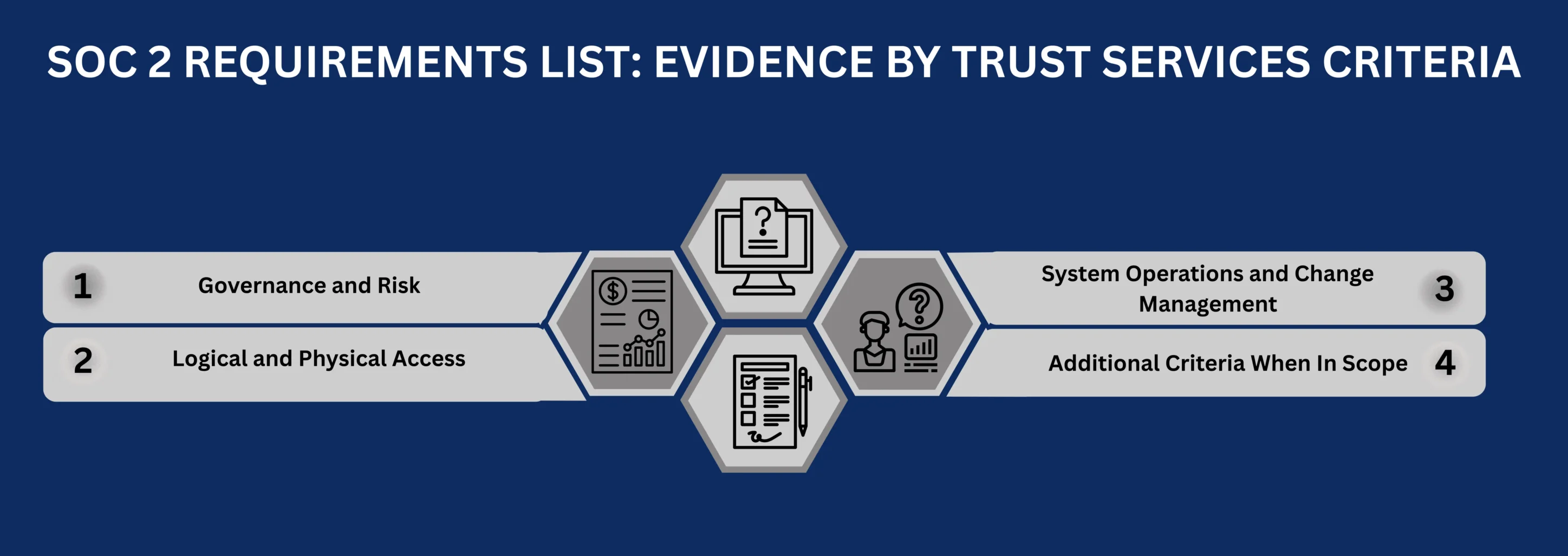
SOC 2 Certification requirements are not defined by a fixed control standard that organizations implement. Instead, the requirements are defined by the applicable Trust Services Criteria, the service organization’s system description, and the service commitments and system requirements the organization has made to user entities. The service organization is responsible for designing and operating controls that meet the criteria points; the auditor examines those controls to determine whether they do so.
This distinction between a compliance standard and an examination framework is central to understanding what SOC 2 compliance involves for Brisbane organizations seeking independent attestation.
Management of the service organization is required to prepare a system description that fairly presents the system in scope. The system description must address: the types of services provided; the principal service commitments and system requirements; the components of the system, including infrastructure, software, people, procedures, and data; and the controls implemented to meet the applicable Trust Services Criteria.
Supporting documentation examined during the SOC 2 audit typically includes information security policies, access control procedures, change management procedures, incident response plans, risk assessment records, vendor management frameworks, business continuity and disaster recovery plans, and evidence of control operation such as system-generated logs, configuration screenshots, approval records, and training completion records.
For Brisbane organizations subject to Australian privacy law obligations under the Privacy Act 1988, the Privacy category of the Trust Services Criteria may be relevant where the in-scope system collects, uses, retains, or discloses personal information. In such cases, the system description must address the organization’s privacy notice and commitment, consent practices, data subject rights procedures, data retention and disposal practices, and de-identification controls.
Where the Privacy category is included in the SOC 2 scope, examination procedures address these controls in addition to the Security Common Criteria, and the auditor’s report reflects the expanded scope of the examination.
Many Brisbane service organizations rely on subservice organizations — third-party providers such as cloud infrastructure platforms (AWS, Azure, Google Cloud), colocation data centres, identity providers, and payment processors — whose services form part of the in-scope system. The SOC 2 examination must address how these subservice organizations are handled.
Under the carve-out method, subservice organizations are excluded from the examination scope and the system description discloses the controls expected to be performed by those subservice organizations (Complementary Subservice Organization Controls, or CSOCs). Under the inclusive method, the subservice organization’s controls are included in the examination scope, requiring additional audit procedures. CertPro determines the appropriate method based on the system description and the materiality of the subservice organization’s role.
Complementary User Entity Controls (CUECs) are controls that the service organization’s system description identifies as expected to be implemented by user entities to achieve the stated control objectives. CUECs are a standard component of SOC 2 reports and are reviewed by user entity auditors assessing the service organization’s controls.
For Brisbane technology organizations serving enterprise customers, clearly defined and proportionate CUECs reduce friction in user entity auditor reviews. Where a service organization uses a subservice organization that has its own SOC 2 report, bridge letters may be obtained to cover periods not addressed by the subservice organization’s report, maintaining continuous coverage for the service organization’s review period.
SOC 2 reports are restricted-use reports intended for specified parties: the service organization, user entities of the service organization’s system during the review period, and the auditors of those user entities. Distribution of a SOC 2 report to parties outside these specified groups is governed by AICPA standards and should be carefully managed.
SOC 2 reports do not have a fixed expiry date defined by a standards body, but market practice treats a report as current for twelve months from the report date. After twelve months, relying parties typically require a more recent report. This means that SOC 2 attestation is effectively an annual cycle for organizations maintaining active customer relationships. CertPro conducts annual SOC 2 examination engagements in Brisbane for organizations maintaining ongoing attestation cycles.
- ✓Documentation Requirements and System Description Preparation
- ✓Subservice Organizations, CUECs, and Complementary Controls
- ✓Report Distribution, Validity, and Ongoing Examination Cycles
Benefits of SOC 2 Certification for Brisbane-Based Organizations
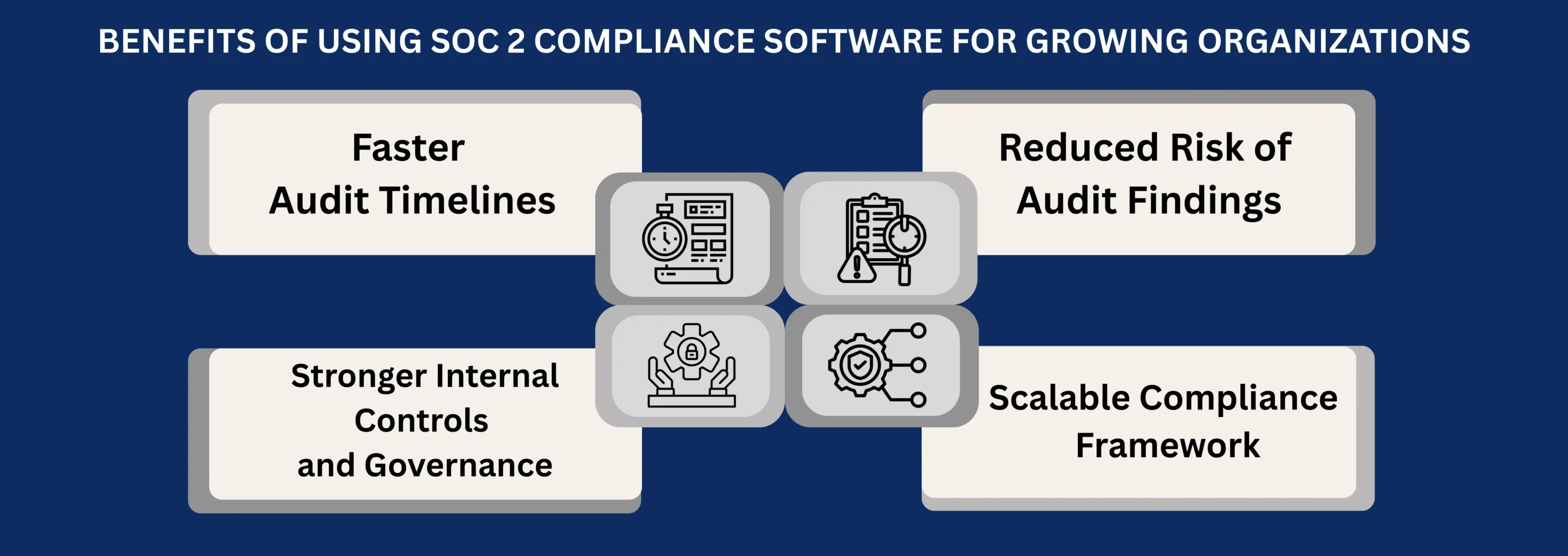
SOC 2 Certification in Brisbane provides service organizations with independently verified evidence of control effectiveness that is directly applicable to enterprise procurement, customer due diligence, and vendor risk management requirements. The benefits of a SOC 2 attestation report extend across customer acquisition, contract maintenance, regulatory posture, and operational risk visibility.
The following benefits are grounded in the nature of the independent examination and the institutional weight of a Licensed CPA Firm attestation. Each benefit reflects the real-world outcomes that Brisbane organizations experience when they obtain and maintain a current SOC 2 report.
- ✓Independent verification of control design and operating effectiveness against AICPA Trust Services Criteria, providing relying parties with an objective basis for assessing vendor security posture
- ✓Satisfaction of enterprise and financial sector vendor onboarding requirements, reducing the time and friction associated with security questionnaire processes and customer due diligence reviews
- ✓Recognition in Australian and international procurement processes, including APRA-regulated entity vendor assessments and US enterprise sales cycles requiring SOC 2 Type II reports
- ✓Structured audit methodology that identifies control exceptions and operational gaps through objective testing, providing management with evidence-based insight into control performance
- ✓Demonstration of accountability and transparency in data handling practices to customers, partners, and regulatory stakeholders across Brisbane and Queensland
- ✓Competitive differentiation in Brisbane’s SaaS, fintech, cloud, health technology, and professional services markets where SOC 2 attestation is increasingly treated as a baseline security standard
- ✓Annual examination cycles that provide ongoing assurance of control effectiveness and support continuous improvement of the control environment through documented exception analysis
- ✓Support for international market expansion by producing reports recognized by enterprise buyers in North America, the United Kingdom, and other markets where SOC 2 attestation is a standard procurement requirement
SOC 2 and ISO 27001 are frequently compared by Brisbane organizations evaluating security assurance frameworks. ISO 27001 is a management system certification issued by accredited certification bodies following conformity assessment against the ISO/IEC 27001 standard. SOC 2 is an attestation report issued by a Licensed CPA Firm following an independent examination of controls against the AICPA Trust Services Criteria.
ISO 27001 certification confirms that an organization’s Information Security Management System conforms to the standard’s requirements. SOC 2 attestation reports provide an auditor’s opinion on specific controls relevant to defined Trust Services Criteria. The two frameworks are not mutually exclusive and are frequently held concurrently by Brisbane technology organizations serving both Australian and international enterprise markets.
The commercial and market contexts differ significantly. ISO 27001 certification is globally recognized and is commonly required in European, Middle Eastern, and Asia-Pacific procurement contexts. SOC 2 attestation is the dominant standard in North American enterprise technology procurement and is increasingly required by Australian financial institutions, government technology panels, and large enterprise organizations evaluating technology vendors.
Brisbane organizations with customers or expansion targets in both regions frequently maintain both an ISO 27001 certificate and a current SOC 2 Type II report. The decision regarding which framework to prioritize is determined by the customer base and contractual requirements of the individual service organization, not by inherent superiority of one framework over the other.
- ✓SOC 2 vs. ISO 27001: Structural and Commercial Differences
Industries and Sectors in Brisbane Seeking SOC 2 Certification
SOC 2 audit engagements in Brisbane are conducted across a wide range of industries in which service organizations store, process, or transmit customer data as part of their core service delivery. Brisbane’s diversified economy encompasses technology, financial services, health, resources, energy, education, logistics, and government sectors — each of which generates demand for SOC 2 attestation from different directions.
Some of this demand is driven by customer requirements, some by the regulatory environment, and some by international market obligations. Understanding which factors apply to your organization helps determine the appropriate scope and timing for a SOC 2 engagement.
Technology, SaaS, Cloud, and Fintech Organizations
Brisbane’s technology sector includes a significant concentration of SaaS providers, cloud platforms, cybersecurity firms, AI technology organizations, and fintech operators. SOC 2 Certification in Brisbane for fintech organizations is directly relevant to satisfying requirements imposed by banking sector customers under APRA CPS 234, as well as the expectations of international financial services buyers.
SaaS organizations serving enterprise customers across Australia routinely face SOC 2 report requests during vendor onboarding and annual contract renewal cycles. Cloud infrastructure and managed service providers are frequently required to produce SOC 2 Type II reports covering the Security and Availability criteria as part of data hosting and processing agreements with enterprise clients.
Cybersecurity and AI technology organizations in Brisbane operate in sectors where trust and independent assurance are foundational to customer acquisition. A SOC 2 attestation report from a Licensed CPA Firm provides an objective basis for prospective customers to assess the security posture of a cybersecurity or AI platform vendor.
For AI organizations processing customer data as part of model training, inference, or analytics workflows, the Processing Integrity and Confidentiality Trust Services Criteria are frequently relevant in addition to the mandatory Security criteria. The SOC 2 examination provides an independent evaluation of whether controls addressing these criteria are appropriately designed and operating effectively.
Healthcare, Education, Mining, Energy, and Government Technology
Health technology organizations in Brisbane — including electronic health record platforms, telehealth providers, clinical data analytics firms, and health information exchanges — process sensitive personal health information and are subject to requirements under the Privacy Act 1988 and the My Health Records Act 2012. SOC 2 compliance examinations for these organizations typically include the Privacy and Confidentiality Trust Services Criteria in addition to Security.
Education technology organizations serving universities, school systems, and vocational education providers similarly handle sensitive student data and face SOC 2 report requirements from institutional procurement processes. Mining and resources technology, energy and utilities data platforms, agriculture technology, logistics and transport technology, and government technology contractors in Queensland are increasingly required to produce SOC 2 attestation reports as part of infrastructure and data services contracts.
SOC 2 Compliance: Key Concepts and Examination Terminology
SOC 2 compliance is evaluated against the AICPA Trust Services Criteria, which define the control objectives and criteria points that service organizations’ controls must address. Understanding the key concepts and terminology of the SOC 2 examination framework is important for Brisbane service organizations preparing system descriptions, managing evidence collection, and engaging effectively with the examination process.
The following section defines core SOC 2 concepts as they apply during an independent SOC 2 attestation engagement conducted by a Licensed CPA Firm.
Control Objectives, Control Activities, and Risk Management
Control objectives in a SOC 2 context are the overall goals that controls are designed to achieve — for example, ensuring that logical access to systems is restricted to authorized individuals. Control activities are the specific policies, procedures, and mechanisms implemented by the service organization to achieve those objectives.
During the SOC 2 examination, CertPro evaluates whether the control activities described in the system description are appropriately designed to meet the criteria points of the applicable Trust Services Criteria, and whether they operated as described throughout the review period. Risk management is addressed as a component of the Security Common Criteria, which require the service organization to have a risk assessment process that identifies threats to the achievement of its service commitments and system requirements.
For Brisbane organizations, risk management frameworks examined during a SOC 2 audit typically encompass threat identification, vulnerability assessment, likelihood and impact evaluation, risk treatment decisions, and periodic risk review processes. The SOC 2 examination does not prescribe a specific risk management methodology. Instead, the auditor evaluates whether the organization’s risk assessment process is capable of identifying and addressing risks relevant to the applicable Trust Services Criteria.
Organizations that maintain documented risk registers, treatment plans, and periodic review records provide a more readily examinable risk management environment, which supports the efficiency of the SOC 2 examination without affecting the independence of the auditor’s conclusions.
Inquiry, Inspection, Observation, Reperformance, and Sampling
The SOC 2 auditor applies multiple evidence-gathering procedures during the examination. Inquiry involves questioning relevant personnel about control design and operation. Inspection involves reviewing documents, records, configurations, and system-generated reports. Observation involves witnessing the performance of a control activity. Reperformance involves the auditor independently executing a control procedure to verify that it operates as described.
System queries and configuration reviews involve direct interrogation of systems and platforms to verify control settings. Log analysis involves reviewing system and access logs to test the operation of monitoring and access controls. Attribute sampling involves selecting a representative sample from a population of control instances — such as user access reviews or change management approvals — and testing each selected instance for evidence of control operation. Together, these procedures form the evidentiary basis of the SOC 2 compliance examination.
CertPro: Licensed CPA Firm Conducting SOC 2 Examinations in Brisbane
CertPro is a Licensed CPA Firm authorized to conduct independent SOC 2 attestation engagements in accordance with AICPA attestation standards AT-C 105 and AT-C 205. SOC 2 examinations must be conducted by a licensed CPA firm — this is a requirement of the AICPA framework, not merely a market convention.
Organizations that receive SOC 2 reports from parties that are not licensed CPA firms are not receiving a valid SOC 2 attestation report. CertPro’s status as a Licensed CPA Firm is the foundational credential that gives the SOC 2 Certification in Brisbane its institutional validity and market recognition with enterprise buyers, financial institutions, and government procurement panels.
Independent Examination and Auditor Responsibilities
CertPro’s role in every SOC 2 engagement is strictly that of an independent examiner. The firm designs and executes audit procedures, collects and evaluates evidence, assesses exceptions, and issues the auditor’s report and opinion. CertPro does not design, implement, operate, or remediate the service organization’s controls.
This independence is not merely a professional standard — it is the characteristic that makes the SOC 2 attestation report meaningful to relying parties. An examination conducted by a party that has been involved in designing or implementing the controls being examined cannot produce a credible independent opinion. CertPro maintains this independence across all SOC 2 audit engagements in Brisbane.
SOC 2 examination engagements conducted by CertPro in Brisbane are subject to AICPA quality control standards and peer review requirements applicable to CPA firms performing attestation engagements. The AICPA has issued specific guidance for peer reviewers evaluating SOC 2 engagements, reflecting the increasing use of compliance automation platforms and technology-enabled audit workflows in the SOC 2 space.
CertPro’s examination procedures are designed to meet these quality standards, ensuring that the resulting attestation reports satisfy the evidentiary requirements expected by sophisticated relying parties — including enterprise audit committees, financial institution vendor risk teams, and government technology procurement panels in Brisbane and Queensland.
Localized Procurement Scenario: Brisbane Enterprise Vendor Review
Consider a Brisbane-based SaaS organization providing workforce management software to Queensland government agencies and large enterprise employers across Australia. During a competitive procurement process, the government agency’s vendor risk management team requests a current SOC 2 Type II report covering the Security and Availability Trust Services Criteria, along with evidence that the report was issued by a Licensed CPA Firm.
The SOC 2 attestation report produced by CertPro — covering a twelve-month review period and issued under AICPA AT-C 205 — satisfies this requirement directly. The report’s independent auditor’s opinion provides the agency’s risk team with an objective basis for evaluating the vendor’s control environment without conducting their own on-site security assessment. This scenario illustrates how SOC 2 Certification in Brisbane functions as a procurement enabler in Queensland’s government technology and enterprise market.
FAQ
▶
What is SOC 2 certification and is it the same as ISO 27001?
▶
Who needs a SOC 2 examination in Brisbane?
▶
What is the difference between a SOC 2 Type I and SOC 2 Type II report?
▶
How long does a SOC 2 Type II audit in Brisbane take?
▶
Which Trust Services Criteria apply to my Brisbane organization?
▶
What is the difference between SOC 2 attestation and SOC 2 compliance?
▶
What are Complementary User Entity Controls (CUECs) in a SOC 2 report?
▶
How long is a SOC 2 attestation report valid?
SOC 1 VS SOC 2: WHICH REPORT YOUR CUSTOMERS ACTUALLY ASK FOR
If you sell SaaS or provide outsourced services, you have likely been asked for a SOC report. However, the follow-up question is rarely easy to answer…
SOC 2 Certified: What Does It Mean for Your Business
For companies that handle sensitive data or run cloud-based services, the question “Can you provide your SOC 2 report?” carries enormous weight. Yet, …
HOW SOC 2 AUDITORS REVIEW EVIDENCE OVER TIME
Most businesses pursuing a SOC 2 report spend months building security controls but overlook a fundamental reality: SOC 2 auditors do not just verify …
Get In Touch
have a question? let us get back to you.