
SOC 2 Certification in Dallas
CertPro is a Licensed CPA Firm conducting SOC 2 audits and attestation examinations for organizations in Dallas, Texas, under the AICPA Trust Services Criteria. We issue SOC 2 Type 1 and Type 2 reports following independent evaluation of security, availability, processing integrity, confidentiality, and privacy controls. Whether you are pursuing initial SOC 2 Certification in Dallas or maintaining annual attestation, CertPro delivers formally credentialed examinations accepted by enterprise customers and regulated industries.
OUR CLIENTS










What Is SOC 2 Certification?
SOC 2 Certification is a formal attestation issued exclusively by a Licensed CPA Firm following an independent examination conducted under the American Institute of Certified Public Accountants (AICPA) attestation standards, specifically AT-C Section 205. The examination evaluates whether an organization’s information systems and internal controls satisfy the AICPA Trust Services Criteria (TSC) across one or more of five defined categories: Security, Availability, Processing Integrity, Confidentiality, and Privacy. SOC 2 Certification in Dallas is recognized by enterprise customers, financial institutions, healthcare organizations, government contractors, and cloud service consumers as formal, independent evidence that an organization’s controls are suitably designed and operating effectively. Achieving SOC 2 attestation signals to the market that your organization has undergone rigorous, third-party-verified scrutiny of its control environment.
Definition and Scope of SOC 2
SOC 2 stands for System and Organization Controls 2. It is one of three SOC report frameworks defined by the AICPA. Unlike SOC 1, which focuses on financial reporting controls, SOC 2 addresses the security, operational reliability, and data handling practices of technology and service organizations. The scope of a SOC 2 examination is defined by the system boundaries established during audit planning. These boundaries identify the infrastructure, software, personnel, data, and procedures that fall within the auditor’s evaluation, forming the foundation of every SOC 2 audit engagement.
The AICPA Trust Services Criteria serve as the evaluative standard against which controls are measured during every SOC 2 examination. The Security category, formally referred to as the Common Criteria, is mandatory in every SOC 2 audit. Organizations may elect to include additional criteria categories based on the nature of their services, customer contractual requirements, and the data they process. A Dallas-based cloud service provider, for example, may include Availability and Confidentiality criteria in addition to Security to address customer uptime expectations and data protection obligations. This flexibility makes SOC 2 Certification in Dallas adaptable to a wide range of industries and service models.
SOC 2 Type 1 and SOC 2 Type 2 Reports
SOC 2 examinations produce two distinct report types. A SOC 2 Type 1 report evaluates the design and implementation of controls at a specific point in time. The auditor assesses whether controls are suitably designed to meet the applicable Trust Services Criteria as of a defined report date. A SOC 2 Type 2 report evaluates both the design and the operating effectiveness of controls over a defined observation period, typically spanning six to twelve months. The Type 2 report provides evidence that controls functioned consistently throughout the review period — not merely at a single moment in time.
Enterprise buyers, regulated industries, and sophisticated procurement processes typically require SOC 2 Type 2 attestation because it demonstrates sustained control operation rather than a point-in-time snapshot. SOC 2 Certification in Dallas for SaaS companies, fintech platforms, healthcare technology organizations, and managed service providers most commonly involves Type 2 examinations. This is driven by the expectations of their customer base and the contractual requirements embedded in enterprise agreements and vendor assurance programs. Understanding which report type is appropriate is one of the first decisions in any SOC 2 audit engagement.
The Five Trust Services Criteria Categories
The AICPA Trust Services Criteria are organized into five categories, each addressing a distinct dimension of system and data management. Security covers logical and physical access controls, change management, risk mitigation, and incident response. Availability addresses system uptime, performance monitoring, and disaster recovery controls. Processing Integrity evaluates whether system processing is complete, accurate, timely, and authorized. Confidentiality focuses on protecting information designated as confidential under agreements or policy. Privacy governs the collection, use, retention, disclosure, and disposal of personal information in accordance with the organization’s privacy notice and applicable regulations. Together, these five categories form the complete framework evaluated during every SOC 2 compliance examination.
| Trust Services Criteria | Primary Focus | Typical Applicability |
|---|---|---|
| Security (Common Criteria) | Access controls, risk management, incident response | All SOC 2 examinations — mandatory |
| Availability | System uptime, performance monitoring, disaster recovery | Cloud platforms, SaaS providers, data centers |
| Processing Integrity | Accurate, complete, and authorized data processing | Fintech, payment processors, data analytics firms |
| Confidentiality | Protection of confidential business information | Enterprise software, professional services |
| Privacy | Personal information collection, use, retention, and disposal | Healthcare tech, consumer platforms, HR systems |
Who Issues SOC 2 Reports?
SOC 2 reports are issued exclusively by Licensed CPA Firms that are registered and peer-reviewed in accordance with AICPA standards. Only a Certified Public Accountant with appropriate attestation authority can issue a SOC 2 opinion. Consulting firms, cybersecurity vendors, compliance software platforms, and IT advisory organizations do not possess the authority to issue SOC 2 attestation reports, regardless of the services they market. Organizations seeking SOC 2 Certification in Dallas must engage a Licensed CPA Firm to conduct the examination and issue the formal attestation report — there is no compliant alternative.
The SOC 2 attestation report contains the auditor’s opinion, a description of the system under examination, a description of applicable Trust Services Criteria, management’s assertion, and the auditor’s findings. For Type 2 reports, the document also includes a detailed description of the tests of controls performed and the results of those tests. This structure ensures that report recipients receive transparent, independently verified evidence of an organization’s control environment — making it one of the most trusted outputs of any SOC 2 audit engagement.

ENQUIRE NOW
Related Resources
Related Services in Dallas
SOC 2 Certification Audit Process in Dallas
The SOC 2 audit process in Dallas follows a structured methodology governed by AICPA attestation standards. Each stage of the examination is defined by specific evaluation activities, evidence collection procedures, and documentation requirements. Understanding the full SOC 2 audit process allows Dallas-based organizations to approach their examination with clarity — knowing what auditors evaluate, what evidence is required, and what the resulting report communicates to stakeholders. A well-prepared organization moves through this process more efficiently and with fewer findings.
Scope definition is the foundational stage of the SOC 2 audit process. During this stage, the auditor works with the organization to define the boundaries of the system under examination. System boundaries identify the infrastructure components, software applications, data stores, third-party service providers, and organizational units included in the examination. The scope determination also establishes which Trust Services Criteria categories apply based on the organization’s service commitments and the nature of the data processed. Accurate scope definition is critical to an efficient SOC 2 examination in Dallas.
Management is responsible for preparing the System Description — a formal document that describes the service organization’s system, the applicable Trust Services Criteria, and the controls management has implemented to meet those criteria. The auditor reviews the System Description for accuracy, completeness, and consistency with the defined system boundaries. Inaccuracies or omissions in the System Description can result in findings or qualifications in the auditor’s opinion. This stage establishes the entire framework for the subsequent SOC 2 examination and should be approached with careful attention to detail.
Following scope definition, the auditor develops an audit program that specifies the testing procedures to be applied to each control identified in the System Description. The audit program is tailored to the organization’s control environment, the applicable Trust Services Criteria, and the risk profile of the system under examination. Evidence collection methods include inquiry, observation, inspection of documentation, and re-performance of control procedures. The audit program determines the nature, timing, and extent of testing required to support the auditor’s opinion in the final SOC 2 attestation report.
For organizations pursuing a SOC 2 Type 1 examination, the auditor evaluates whether controls are suitably designed to meet the applicable Trust Services Criteria as of the report date. Design evaluation involves reviewing control documentation, policy frameworks, system configurations, and organizational procedures. The auditor determines whether the controls, if operating as intended, would be sufficient to satisfy the criteria. The Type 1 assessment does not involve testing of operating effectiveness over time — it is a focused, point-in-time design assessment that produces results more quickly than a Type 2 SOC 2 audit.
The SOC 2 Type 1 report is commonly pursued by organizations that are new to SOC 2 Certification in Dallas and wish to establish a documented baseline of their control environment before undertaking a Type 2 examination. The Type 1 report demonstrates to stakeholders that controls exist and are appropriately structured, providing initial assurance while the organization accumulates the observation period evidence required for a Type 2 report. Many Dallas technology startups and emerging SaaS platforms begin their SOC 2 compliance journey with a Type 1 examination before progressing to an annual Type 2 program.
The SOC 2 Type 2 examination requires the auditor to test the operating effectiveness of controls across a defined observation period. The standard observation period is twelve months; however, initial Type 2 examinations may cover a minimum of six months. During this period, the auditor collects and evaluates evidence demonstrating that controls functioned consistently and as described. Evidence types include system-generated logs, access review records, change management tickets, incident response documentation, backup verification records, and vendor management artifacts — all essential to a thorough SOC 2 audit in Dallas.
Control testing procedures vary by control type and the applicable Trust Services Criteria. Automated controls may be tested through inspection of system-generated logs and configuration settings. Manual controls are tested through inquiry combined with inspection of supporting documentation and, where applicable, re-performance. The auditor selects samples from the observation period to validate control operation. Sample sizes are determined based on risk assessment and the nature of the control being tested. Deviations identified during testing are documented and evaluated for materiality before the SOC 2 attestation report is finalized.
Following the completion of control testing, the auditor evaluates all findings to determine whether identified deviations constitute exceptions or nonconformities that affect the auditor’s opinion. Management is provided an opportunity to respond to findings and provide additional context or evidence. The auditor then issues the formal SOC 2 attestation report, which contains the auditor’s opinion, test results, and any exceptions noted. The opinion may be unqualified (clean), qualified, adverse, or a disclaimer of opinion, depending on the findings. An unqualified opinion is the standard objective for organizations pursuing SOC 2 Certification in Dallas.
- Scope Definition: Establish system boundaries, applicable Trust Services Criteria, and organizational units included in the SOC 2 examination
- System Description Review: Evaluate management’s System Description for accuracy, completeness, and consistency with defined boundaries
- Audit Program Development: Define testing procedures, evidence collection methods, and sample selection criteria for the SOC 2 audit
- Type 1 Design Evaluation: Assess whether controls are suitably designed to meet applicable Trust Services Criteria as of the report date
- Observation Period Monitoring: Collect and evaluate evidence of control operation across the defined review period (6–12 months for Type 2 SOC 2 examinations)
- Control Testing: Execute inquiry, observation, inspection, and re-performance procedures for each control in scope
- Findings Evaluation: Review identified deviations, assess materiality, and obtain management responses
- Report Issuance: Issue the formal SOC 2 attestation report containing the auditor’s opinion, system description, and test results
- Surveillance and Recertification: Conduct subsequent annual examinations to maintain current SOC 2 attestation status
- ✓Stage 1: Scope Definition and System Description Review
- ✓Stage 2: Audit Program Determination and Evidence Planning
- ✓Stage 3: Type 1 Assessment — Design Evaluation
- ✓Stage 4: Type 2 Assessment — Operating Effectiveness Testing
- ✓Stage 5: Nonconformity Review and Report Issuance
Benefits of SOC 2 Certification for Dallas-Based Organizations
SOC 2 Certification delivers measurable operational, commercial, and risk management benefits for organizations operating in Dallas. As the Dallas-Fort Worth metropolitan area continues to expand as a major technology and business hub, demand for independently verified security assurance has increased substantially. Enterprise customers, procurement teams, and regulated industry clients now routinely require SOC 2 attestation before entering vendor agreements. SOC 2 Certification in Dallas provides organizations with formal, auditor-verified evidence that satisfies third-party risk management requirements across a wide range of industries and customer segments.
Enterprise customers operating in Dallas and nationally require independent verification of vendor security controls before entering into service agreements or sharing sensitive data. SOC 2 compliance that Dallas-based organizations demonstrate through a formal attestation report eliminates the need for customer-conducted security assessments, questionnaire-based evaluations, and ad hoc audit requests. The SOC 2 report serves as a standardized, independently verified document that procurement teams, information security departments, and vendor risk management programs accept as evidence of control adequacy — streamlining the entire vendor approval process.
Dallas-based technology companies, managed service providers, and cloud platforms that hold a current SOC 2 Type 2 attestation report can respond to vendor due diligence requests efficiently and consistently. Rather than completing individually customized security questionnaires for each prospective customer, organizations distribute their SOC 2 report as a comprehensive, auditor-verified answer to standard vendor risk questions. This approach reduces sales cycle duration and procurement friction — particularly when engaging enterprise clients, financial services firms, and healthcare organizations with formal vendor assurance programs.
SOC 2 Certification in Dallas creates a verifiable differentiator in competitive procurement environments. When multiple vendors compete for enterprise contracts, the presence of a current SOC 2 Type 2 attestation report often serves as a qualifying criterion that determines which vendors advance in the selection process. Organizations without SOC 2 attestation may be excluded from consideration by enterprise buyers with mandatory vendor security requirements — regardless of the technical quality of their services or pricing competitiveness. Certification signals institutional maturity that non-certified competitors cannot match.
The Dallas technology sector includes a substantial concentration of enterprise software companies, fintech platforms, telecommunications providers, AI and machine learning firms, healthcare technology organizations, and data analytics businesses. Many serve customers in regulated industries such as banking, insurance, healthcare, and government, where SOC 2 attestation is a baseline expectation rather than an optional enhancement. Achieving SOC 2 Certification for Dallas companies in these sectors is effectively a prerequisite for meaningful participation in the enterprise market and positions organizations for sustained commercial growth.
The SOC 2 examination process requires organizations to document, implement, and consistently operate controls across the applicable Trust Services Criteria. This systematic approach to control management produces a structured internal control environment that reduces the probability of security incidents, data breaches, unauthorized access, and system failures. Organizations that have undergone SOC 2 audits in Dallas typically demonstrate stronger access management, more disciplined change control processes, and more consistent incident response procedures than organizations that have not been subject to independent examination. The operational improvements driven by SOC 2 compliance extend well beyond the audit itself.
- ✓Formal, independently verified evidence of control design and operating effectiveness accepted by enterprise customers and procurement teams
- ✓Elimination of redundant, customer-specific security questionnaires and ad hoc audit requests through distribution of the SOC 2 attestation report
- ✓Qualification for enterprise contracts in financial services, healthcare, government, and regulated industries that require SOC 2 attestation
- ✓Structured internal control environment documented against AICPA Trust Services Criteria, reducing security incident probability
- ✓Competitive differentiation in Dallas’s growing technology, SaaS, fintech, and cloud services market through SOC 2 Certification
- ✓Accelerated sales cycles with enterprise buyers who accept SOC 2 Type 2 reports in lieu of custom security assessments
- ✓Demonstrated SOC 2 compliance with AICPA standards, supporting broader regulatory and contractual obligations
- ✓Annual examination cycles that drive continuous improvement and control monitoring disciplines
- ✓Strengthened vendor management and third-party risk oversight through examination of subservice organizations
- ✓Independent auditor’s opinion that carries greater credibility than self-certification or internal security assessments
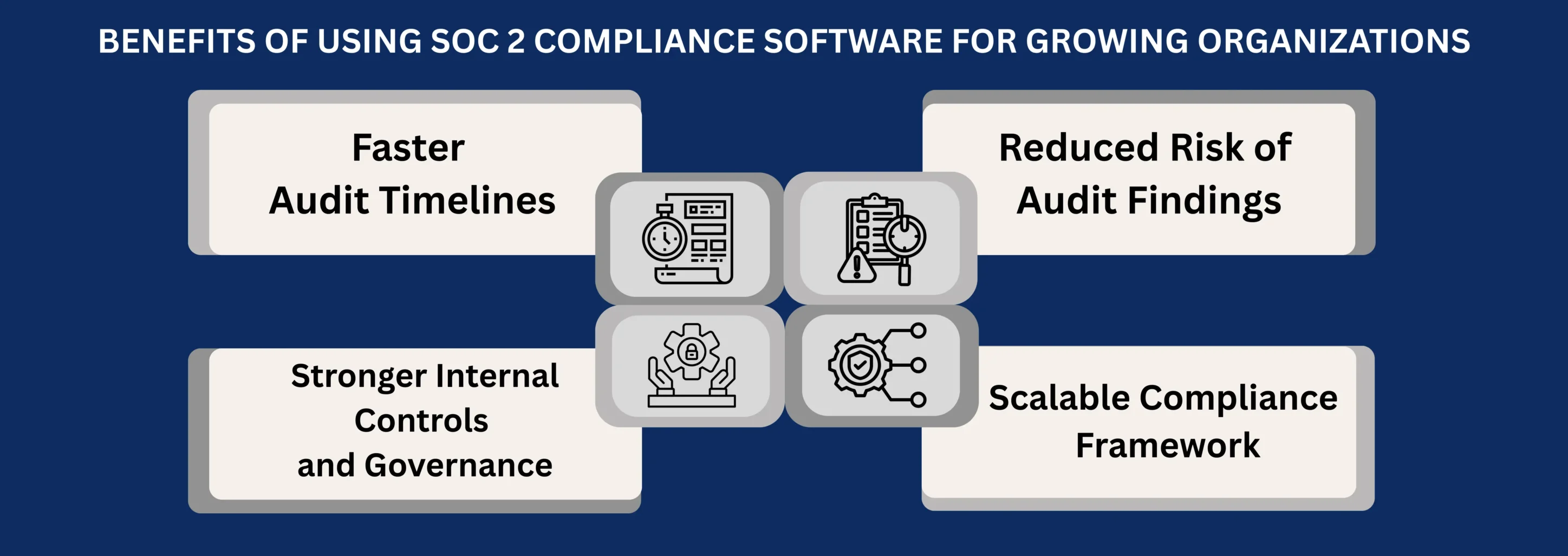
- ✓Customer Assurance and Vendor Risk Management
- ✓Competitive Differentiation in the Dallas Market
- ✓Internal Control Environment and Risk Reduction
Requirements for SOC 2 Certification in Dallas
SOC 2 Certification requires organizations to meet specific documentation, technical, and operational standards that auditors evaluate during the examination. These requirements are structured around the AICPA Trust Services Criteria and the organization’s System Description. Dallas organizations across all industries must satisfy these standards to support a clean auditor’s opinion upon completion of the SOC 2 audit. Preparing thoroughly across all three requirement areas — documentation, technical controls, and operations — is the most reliable path to an unqualified SOC 2 attestation.
Documentation requirements for SOC 2 Certification encompass the policies, procedures, standards, and records that form the evidentiary basis for the auditor’s evaluation. Organizations must maintain a formal System Description that accurately describes the services provided, the infrastructure and applications in scope, data flows, and the controls implemented to address each applicable Trust Services Criteria. Supporting documentation includes information security policies, access control procedures, change management workflows, risk assessment records, incident response plans, and business continuity documentation. Each of these materials will be reviewed during the SOC 2 examination fieldwork phase.
For SOC 2 Type 2 examinations, organizations must maintain records demonstrating that control procedures were executed consistently throughout the observation period. Examples include access provisioning and de-provisioning records, periodic access review completion records, change approval documentation, vulnerability assessment reports, backup verification logs, security awareness training completion records, and vendor assessment artifacts. Documentation must be retained in a manner that supports auditor inspection and sample selection across the full observation period — a critical requirement for any Dallas organization pursuing SOC 2 compliance at the Type 2 level.
Technical controls required for SOC 2 compliance span multiple domains, including access management, network security, encryption, monitoring, and vulnerability management. Access controls must enforce the principle of least privilege, implement multi-factor authentication for privileged and remote access, and include periodic user access reviews. Network controls must include logical separation of production and non-production environments, firewall configurations, and intrusion detection or prevention mechanisms. Encryption must be applied to data at rest and in transit using industry-standard algorithms. These technical safeguards are central to every SOC 2 audit evaluation.
Monitoring and logging controls are a critical technical requirement evaluated during the SOC 2 examination. Organizations must implement security information and event management (SIEM) capabilities or equivalent logging mechanisms that capture system access events, administrative actions, and security incidents. Log retention must be sufficient to support the observation period review. Vulnerability management programs must include regular scanning, defined remediation timelines tied to severity ratings, and documented evidence of remediation activities. These technical controls collectively form the backbone of the Security Trust Services Criteria evaluation in every SOC 2 audit in Dallas.
Operational requirements for SOC 2 Certification include the consistent execution of defined control procedures by personnel with appropriate roles and responsibilities. Organizations must demonstrate that personnel are aware of their security obligations through documented security awareness training programs. Background screening procedures for personnel with access to sensitive systems and data must be defined and consistently applied. Vendor and subservice organization management must include formal agreements, periodic assessments, and monitoring of service delivery against defined security requirements — all evaluated as part of the SOC 2 compliance review.
Risk management requirements include formal risk assessments at defined intervals, documentation of identified risks and mitigation strategies, and evidence of management review and acceptance of residual risk. Change management controls require that system changes be formally requested, reviewed, tested, and approved before deployment to production environments. Incident response controls require defined procedures for identifying, classifying, containing, investigating, and reporting security incidents — with evidence that these procedures were followed during any incidents occurring within the SOC 2 examination observation period.
- ✓Documentation Requirements
- ✓Technical Control Requirements
- ✓Operational and Organizational Requirements
SOC 2 Type I vs. SOC 2 Type II: Selecting the Right Audit for Dallas Organizations
The selection between a SOC 2 Type 1 and SOC 2 Type 2 examination depends on the organization’s maturity, customer requirements, and the timeline within which attestation is needed. Both report types involve a formal SOC 2 audit conducted by a Licensed CPA Firm and produce an auditor’s attestation report under AICPA standards. However, they address different questions and serve different purposes in vendor risk management and customer assurance contexts. Choosing the correct report type from the outset helps Dallas organizations meet stakeholder expectations without unnecessary delays or rework.
SOC 2 Type 1 — Point-in-Time Design Assessment
A SOC 2 Type 1 report addresses a single evaluative question: are the controls described in the System Description suitably designed to meet the applicable Trust Services Criteria as of the report date? The examination does not include testing of control operation over time. The auditor reviews control documentation, evaluates the logical design of control structures, and assesses whether the described controls — if operating as intended — would satisfy the criteria. Because it does not require an observation period, a Type 1 SOC 2 audit can typically be completed more quickly than a Type 2 examination.
SOC 2 Type 1 attestation is appropriate for organizations initiating their SOC 2 Certification program and needing to demonstrate control design to stakeholders before a full observation period has elapsed. Dallas technology startups, newly launched SaaS platforms, and organizations that recently restructured their control environment may pursue a Type 1 examination as a documented step toward Type 2 certification. Some customer contracts and procurement processes accept a Type 1 report for initial vendor approval, with a Type 2 report required upon annual renewal — making it a practical entry point for SOC 2 compliance in Dallas.
SOC 2 Type 2 — Operating Effectiveness Over Time
A SOC 2 Type 2 report addresses two evaluative questions: are controls suitably designed, and did they operate effectively throughout the observation period? The observation period must span a minimum of six months, with twelve months being the standard for mature examination programs. During the observation period, the auditor collects evidence of control operation through system-generated records, manual control documentation, and sampling of control executions. The Type 2 report includes the auditor’s detailed test descriptions and results, giving report recipients full transparency into the specific procedures performed and findings identified during the SOC 2 audit.
SOC 2 Type 2 attestation is the standard requirement for enterprise vendor approval across most industries. Financial services organizations in Dallas, healthcare systems, insurance companies, government contractors, and large enterprise technology buyers typically require current SOC 2 Type 2 reports as a condition of vendor engagement. The sustained evidence of control operation that a Type 2 report provides demonstrates institutional reliability — not just a moment-in-time capability — which is precisely why enterprise customers and regulated industries place greater value on it than a Type 1 report. For many Dallas organizations, annual Type 2 SOC 2 Certification is a non-negotiable market requirement.
| Criteria | SOC 2 Type 1 | SOC 2 Type 2 |
|---|---|---|
| Evaluation Focus | Control design as of report date | Control design and operating effectiveness over time |
| Observation Period | Point-in-time (no observation period) | Minimum 6 months; standard 12 months |
| Evidence Required | Policy documents, system configurations, design documentation | Ongoing operational records, logs, and samples across observation period |
| Customer Acceptance | Accepted for initial vendor approval by some buyers | Required by most enterprise, financial, and healthcare buyers |
| Typical Use Case | Initial SOC 2 program; newly implemented control environment | Mature programs; enterprise contract requirements; annual renewal |
SOC 2 Certification for Dallas Financial Services and Fintech Companies
Dallas is home to a significant concentration of financial services institutions, fintech companies, payment processors, insurance technology firms, and banking technology providers. The Dallas-Fort Worth area ranks among the top financial services markets in the United States, with major banks, credit unions, investment management firms, and insurance carriers headquartered or maintaining substantial operations in the region. SOC 2 Certification in Dallas for financial services organizations is driven by the intersection of customer expectations, regulatory frameworks, and contractual vendor assurance requirements specific to the financial sector — making it one of the most compliance-active markets in the country.
Financial Services Regulatory Context and SOC 2
Financial services organizations and their technology vendors in Dallas operate under federal and state regulatory frameworks that include requirements for vendor due diligence and third-party risk management. Regulatory guidance from the Office of the Comptroller of the Currency (OCC), the Federal Financial Institutions Examination Council (FFIEC), and the Consumer Financial Protection Bureau (CFPB) establishes expectations for financial institutions to assess and monitor the security controls of their technology service providers. SOC 2 attestation reports are accepted by financial institutions as formal evidence that technology vendors have undergone independent examination of their security and operational controls — satisfying FFIEC third-party risk management expectations.
SOC 2 compliance that Dallas fintech companies demonstrate through a Type 2 report directly addresses the security assurance expectations of bank partners, payment network participants, and enterprise financial services customers. Fintech platforms operating in payments, lending, wealth management, insurance, and digital banking must demonstrate that customer financial data is protected by independently verified controls. SOC 2 attestation provides this verification in a standardized format that financial services compliance teams, auditors, and regulatory examiners recognize and accept — making the SOC 2 audit an indispensable step for Dallas fintech market access.
Processing Integrity and Confidentiality for Financial Data
Financial services technology organizations frequently include Processing Integrity and Confidentiality Trust Services Criteria in their SOC 2 examinations in addition to the mandatory Security criteria. Processing Integrity is particularly relevant for payment processors, data analytics platforms, and trading systems where the accuracy, completeness, and timeliness of data processing directly affects financial outcomes for customers. Confidentiality criteria address the protection of proprietary financial data, customer account information, and transaction records that financial services organizations are contractually and legally obligated to protect. Including these additional criteria strengthens the scope and market relevance of any Dallas financial services SOC 2 audit.
SOC 2 Certification for Dallas Technology and SaaS Companies
The Dallas technology ecosystem encompasses a substantial number of SaaS companies, cloud service providers, AI and machine learning platforms, data center operators, telecommunications technology firms, cybersecurity companies, enterprise software vendors, and managed service providers. SOC 2 Certification in Dallas for technology and SaaS organizations represents both a commercial necessity for enterprise market access and a trust signal that differentiates established vendors from emerging competitors. In a crowded marketplace, SOC 2 attestation is one of the clearest indicators of organizational security maturity.
SaaS and Cloud Platform Examination Requirements
SaaS organizations and cloud service providers in Dallas typically scope their SOC 2 examinations to include Security and Availability Trust Services Criteria, reflecting the dual customer expectations of data protection and system reliability. Availability criteria evaluation assesses controls related to system uptime monitoring, capacity planning, disaster recovery, and performance management. SaaS platforms with enterprise customers operating under service level agreements must demonstrate that their availability controls are designed and operating effectively to support contracted uptime commitments — a core deliverable of any credible SOC 2 audit for cloud platforms.
Cloud infrastructure providers and managed service providers in Dallas must also address subservice organization considerations in their SOC 2 examinations. When a Dallas-based cloud platform relies on hyperscale infrastructure providers such as Amazon Web Services, Microsoft Azure, or Google Cloud Platform, the SOC 2 System Description must disclose the reliance on these subservice organizations and address how the organization’s controls complement those of the infrastructure provider. Auditors evaluate the complementary user entity controls and the scope of reliance on subservice organization SOC 2 reports — an important nuance in any cloud-focused SOC 2 compliance program.
AI, Data Analytics, and Healthcare Technology Organizations
Dallas has emerged as a significant center for artificial intelligence, machine learning, and advanced data analytics companies. AI platforms that process customer data, generate predictions using proprietary models, or provide data-driven insights to enterprise clients face heightened scrutiny from procurement teams regarding data handling, model integrity, and access controls. SOC 2 examination for AI and data analytics organizations often encompasses Processing Integrity and Privacy criteria in addition to Security, addressing the unique data handling and model governance requirements of these platforms. SOC 2 Certification in Dallas for AI companies is increasingly becoming an enterprise procurement requirement.
Healthcare technology organizations in Dallas — including electronic health record platforms, health information exchanges, revenue cycle management systems, and population health analytics providers — operate in an environment where HIPAA compliance and SOC 2 attestation are complementary assurance frameworks. While HIPAA establishes regulatory requirements for protected health information, SOC 2 attestation provides independent verification of the technical and operational controls that protect patient data. Healthcare organizations and their business associates increasingly require SOC 2 Type 2 reports from technology vendors as part of vendor risk management and HIPAA Business Associate Agreement oversight, reinforcing the importance of SOC 2 compliance for Dallas health tech firms.
Dallas Business Environment and SOC 2 Compliance Landscape
Dallas represents one of the largest and most diversified business markets in the United States. The Dallas-Fort Worth metropolitan area is home to more Fortune 500 and Fortune 1000 company headquarters than almost any other U.S. metropolitan area, creating a substantial base of enterprise organizations that require SOC 2 attestation from their technology vendors. The concentration of telecommunications carriers, aviation and logistics companies, energy sector technology firms, retail and e-commerce platforms, and professional services organizations generates broad, cross-industry demand for SOC 2 compliance in the Dallas market — and that demand continues to grow year over year.
Dallas as a Technology and Data Center Hub
The Dallas-Fort Worth area hosts one of the highest concentrations of data centers in North America, driven by favorable geographic conditions, access to reliable power infrastructure, fiber connectivity, and a large pool of technology talent. Colocation providers, hyperscale data center operators, and edge computing facilities in the Dallas market serve cloud service providers, enterprise organizations, and telecommunications carriers that require independently verified security and operational controls. SOC 2 attestation is a standard requirement for data center operators seeking colocation, managed hosting, and infrastructure service agreements with enterprise customers in this highly competitive market.
The telecommunications and technology services sector in Dallas includes major carriers, internet service providers, unified communications platforms, and managed network service providers. These organizations process substantial volumes of sensitive customer communication data, business records, and infrastructure access credentials. SOC 2 audit engagements for Dallas telecommunications organizations examine the security and confidentiality controls protecting customer data and the availability controls supporting network service reliability. Telecommunications customers increasingly include SOC 2 attestation requirements in enterprise service agreements, making SOC 2 compliance a commercial imperative for this sector.
Cybersecurity, Privacy, and Third-Party Risk Management in Texas
Texas has enacted the Texas Data Privacy and Security Act (TDPSA), which establishes privacy rights for Texas residents and obligations for organizations that collect, process, or share personal data. The TDPSA imposes requirements related to data minimization, purpose limitation, consumer rights, and data security that align with the Privacy and Security Trust Services Criteria in the SOC 2 framework. Organizations subject to the TDPSA that also maintain SOC 2 attestation benefit from an examination process that directly addresses privacy and security control requirements relevant to Texas regulatory obligations — creating meaningful synergy between SOC 2 compliance and state law adherence.
Third-party risk management programs maintained by Dallas enterprise organizations have become increasingly formalized, with dedicated vendor risk management teams, standardized vendor questionnaire processes, and defined security assessment requirements for technology providers. SOC 2 attestation that Dallas organizations provide through formal audit reports addresses the core requirements of enterprise vendor risk programs and reduces the assessment burden on both the vendor and the customer’s vendor risk management team. The SOC 2 report’s standardized structure allows vendor risk analysts to efficiently evaluate control adequacy without conducting independent technical assessments — a significant time and cost benefit for all parties involved.
SOC 2 Certification vs. Other Compliance Frameworks for Dallas Organizations
Dallas organizations frequently evaluate SOC 2 Certification in relation to other compliance frameworks and security standards, including ISO 27001, PCI DSS, HIPAA, FedRAMP, and NIST CSF. Each framework serves distinct purposes and addresses different stakeholder requirements. Understanding how SOC 2 differs from and complements other frameworks allows Dallas organizations to make informed decisions about their compliance and attestation programs — and to identify opportunities for leveraging overlapping control requirements across multiple frameworks simultaneously.
SOC 2 vs. ISO 27001
SOC 2 and ISO 27001 are both independent third-party assessments of an organization’s information security controls, but they differ in significant ways. SOC 2 is issued by a Licensed CPA Firm under AICPA attestation standards and produces a detailed report describing the organization’s system, the controls tested, the test procedures performed, and the auditor’s findings. ISO 27001 is a certification issued by an accredited certification body following an audit against the ISO/IEC 27001 standard, resulting in a certificate rather than a detailed report. SOC 2 is more common in the United States market, while ISO 27001 carries broader international recognition. For domestic enterprise sales, SOC 2 attestation is typically the more impactful credential.
Dallas organizations serving primarily U.S.-based enterprise customers in financial services, healthcare, SaaS, and technology sectors should prioritize SOC 2 attestation, as it aligns with the vendor assurance expectations of the U.S. market. Organizations with international customer bases or global enterprise contracts may pursue both SOC 2 and ISO 27001 to satisfy U.S.-centric and internationally focused requirements simultaneously. The control frameworks share meaningful overlap, and organizations maintaining one can often leverage existing documentation and control evidence for the other examination — reducing the incremental cost of achieving dual certification.
SOC 2 and PCI DSS for Payment-Focused Organizations
Organizations in Dallas that process payment card transactions must comply with the Payment Card Industry Data Security Standard (PCI DSS). PCI DSS is a mandatory compliance requirement enforced by payment card brands and acquirers, while SOC 2 is a voluntary attestation driven by customer and market expectations. PCI DSS focuses specifically on cardholder data environments, while SOC 2 examines the broader information security, availability, and data handling controls across the organization’s full system. Organizations in payments and fintech frequently maintain both PCI DSS compliance and SOC 2 attestation to satisfy the different requirements of their varied stakeholder groups — a dual-framework approach that is common across Dallas’s active fintech sector.
| Framework | Issuing Authority | Geographic Focus | Report Output | Primary Use Case |
|---|---|---|---|---|
| SOC 2 | Licensed CPA Firm (AICPA) | United States primary | Detailed attestation report | Vendor assurance, enterprise security verification, SOC 2 compliance |
| ISO 27001 | Accredited certification body | International | Certificate | Global enterprise, international procurement |
| PCI DSS | Qualified Security Assessor | Global (payment card) | Report on Compliance / SAQ | Payment card processing environments |
| FedRAMP | Third-Party Assessment Organization (3PAO) | U.S. Federal Government | Authorization to Operate | Cloud services for U.S. government agencies |
How to Achieve SOC 2 Certification in Dallas: Step-by-Step Process
Achieving SOC 2 Certification in Dallas involves a defined sequence of activities that culminate in the issuance of a formal attestation report by a Licensed CPA Firm. The process requires organizational commitment to control documentation, evidence collection, and consistent control operation across all applicable Trust Services Criteria. The following steps describe the path from initial examination engagement to report issuance for organizations pursuing a SOC 2 audit in Dallas — whether for the first time or as part of an ongoing annual program.
- Determine the applicable Trust Services Criteria categories based on the nature of services provided, customer contractual requirements, and data types processed
- Define system boundaries by identifying the infrastructure, applications, data flows, personnel, and third-party service providers within the SOC 2 examination scope
- Prepare the formal System Description documenting the organization’s system, controls implemented, and management’s assertion regarding SOC 2 compliance with applicable Trust Services Criteria
- Engage a Licensed CPA Firm to conduct the SOC 2 audit and issue the attestation report under AICPA AT-C Section 205
- Determine the report type (Type 1 or Type 2) and, for Type 2 SOC 2 examinations, establish the observation period start date
- Implement and operate internal controls consistently throughout the observation period, maintaining records that support auditor evidence collection
- Provide requested documentation, system access, and personnel interviews to the auditor during the SOC 2 examination fieldwork phase
- Review the draft attestation report, respond to any findings or management representation letters, and confirm System Description accuracy
- Receive the final SOC 2 attestation report and distribute it under non-disclosure agreements to customers, prospects, and stakeholders requiring vendor assurance
- Initiate the subsequent annual examination cycle to maintain current SOC 2 Certification status and satisfy ongoing customer contract requirements
The observation period for a SOC 2 Type 2 examination begins on the date the organization’s control environment is considered ready for ongoing evaluation and ends on the report date defined in the examination engagement. Organizations must maintain consistent control operation throughout the observation period, as the auditor will select evidence samples from across the full period. Gaps in control execution, undocumented control failures, or personnel changes that disrupt control continuity during the observation period can result in exceptions noted in the auditor’s SOC 2 attestation report — a situation every Dallas organization aims to avoid.
Dallas organizations with annual SOC 2 examination programs typically align their observation periods with calendar or fiscal year boundaries to facilitate efficient evidence collection and report issuance. Maintaining consistent observation period dates across annual examination cycles simplifies evidence management, facilitates report comparability for customers who review historical reports, and aligns the SOC 2 audit schedule with other annual compliance activities such as risk assessments, vendor reviews, and business continuity testing. Consistent scheduling also helps internal teams build sustainable control monitoring routines.
SOC 2 reports do not have a formal expiration date defined by AICPA standards; however, the market practice is that reports older than twelve months are considered stale and may not satisfy current vendor assurance requirements. Enterprise customers and vendor risk management programs typically require a current SOC 2 report dated within the preceding twelve months. Organizations that allow their SOC 2 attestation to lapse beyond twelve months may face vendor contract consequences, exclusion from procurement processes, or increased scrutiny from existing customers during contract renewals — reinforcing the importance of annual SOC 2 audit cycles for Dallas organizations.
Annual recertification requires organizations to conduct a new SOC 2 Type 2 examination covering the subsequent twelve-month observation period. Each annual examination produces a new attestation report that supersedes the previous report. Auditors conducting subsequent examinations evaluate whether controls have remained consistent, whether any significant changes to the system or control environment occurred during the period, and whether prior period findings have been addressed. Organizations must complete annual SOC 2 audit cycles to maintain current certified status and meet customer expectations for ongoing security assurance — a continuous commitment that reflects the operational discipline SOC 2 Certification in Dallas demands.
- ✓Observation Period Management for Type 2 Reports
- ✓SOC 2 Report Validity and Annual Recertification
Why Choose CertPro for SOC 2 Certification in Dallas
CertPro is a Licensed CPA Firm that conducts SOC 2 audits and attestation examinations under AICPA AT-C Section 205 for organizations across Dallas and the broader Texas market. The SOC 2 examination Dallas organizations complete with CertPro results in a formal attestation report issued by credentialed Certified Public Accountants with specialized expertise in the AICPA Trust Services Criteria. Our examiners bring deep knowledge of the technology, financial services, healthcare, and enterprise software sectors that define the Dallas market — ensuring every SOC 2 audit is conducted with sector-appropriate rigor and precision.
Licensed CPA Firm Authority and AICPA Standards
CertPro’s SOC 2 attestation authority derives from its status as a Licensed CPA Firm subject to AICPA peer review and professional standards. Only Licensed CPA Firms can issue SOC 2 reports under AICPA attestation standards — a critical distinction that sets formal SOC 2 Certification apart from unverified compliance claims. CertPro’s examiners are Certified Public Accountants with technical expertise in the Trust Services Criteria and the control frameworks applicable to cloud computing, SaaS, fintech, healthcare technology, and data center environments. The SOC 2 attestation reports issued by CertPro carry the institutional credibility of a Licensed CPA Firm opinion recognized by enterprise customers, regulated industries, and procurement professionals across Dallas and nationally.
Sector-Specific Examination Expertise
CertPro conducts SOC 2 examinations for organizations across Dallas’s diverse industry sectors, including SaaS and cloud platforms, fintech and payment processors, healthcare technology organizations, telecommunications technology firms, data center operators, AI and analytics companies, managed service providers, and enterprise software vendors. SOC 2 audit firms in Dallas that conduct examinations across multiple industry verticals develop examination programs informed by the technical control environments, subservice organization relationships, and regulatory contexts specific to each sector. CertPro applies this cross-sector SOC 2 examination experience to the evaluation of Trust Services Criteria controls in every client engagement — delivering results that reflect both audit rigor and industry relevance.
The SOC 2 examination process at CertPro is conducted exclusively by credentialed professionals with direct examination authority under AICPA standards. The examination methodology encompasses scope definition, audit program development, evidence collection, control testing, findings evaluation, and report issuance — all structured in alignment with AICPA AT-C Section 205 requirements. Organizations completing SOC 2 Certification in Dallas through CertPro receive a formal attestation report that meets the content and format requirements expected by enterprise customers, financial services organizations, healthcare systems, and vendor risk management programs throughout the United States.
FAQ
▶
What is SOC 2 Certification in Dallas?
▶
What is SOC 2 Certification and who issues it?
▶
How long does a SOC 2 audit take for a Dallas organization?
▶
What Trust Services Criteria should a Dallas SaaS company include?
▶
What is the difference between SOC 2 compliance and SOC 2 certification?
▶
How often must a SOC 2 examination be renewed?
▶
Is SOC 2 required for Dallas fintech companies?
▶
Can small Dallas businesses obtain SOC 2 Certification?
SOC 1 VS SOC 2: WHICH REPORT YOUR CUSTOMERS ACTUALLY ASK FOR
If you sell SaaS or provide outsourced services, you have likely been asked for a SOC report. However, the follow-up question is rarely easy to answer…

AICPA Issues New Guidance for Peer Reviewers Evaluating SOC 2 Engagements
AICPA SOC 2 guidance has been issued to help peer reviewers identify quality risks associated with SOC 2 engagements as the use of compliance automati…
SOC 2 Certified: What Does It Mean for Your Business
For companies that handle sensitive data or run cloud-based services, the question “Can you provide your SOC 2 report?” carries enormous weight. Yet, …
Get In Touch
have a question? let us get back to you.