
SOC 2 Certification in Hobart
SOC 2 Certification in Hobart is conducted by a Licensed CPA Firm as an independent third-party examination under AICPA attestation standards AT-C 105 and AT-C 205. The process produces a formal attestation report evaluated against the Trust Services Criteria, confirming whether an organization’s controls are suitably designed and operating effectively across security, availability, processing integrity, confidentiality, and privacy. This independent examination is the foundation of credible, enterprise-recognized SOC 2 compliance.
OUR CLIENTS










SOC 2 Certification for Hobart-Based Financial and Technology Organizations
SOC 2 Certification in Hobart is conducted by a Licensed CPA Firm as an independent third-party examination under AICPA attestation standards AT-C 105 and AT-C 205. The process produces a formal attestation report evaluated against the Trust Services Criteria, confirming whether an organization’s controls are suitably designed and operating effectively across security, availability, processing integrity, confidentiality, and privacy. This independent examination is the foundation of credible, enterprise-recognized SOC 2 compliance.
Hobart supports a distinct operational ecosystem encompassing aquaculture and marine science technology, agricultural technology, Antarctic and polar research institutions, tourism and hospitality technology platforms, and a growing concentration of SaaS providers, cloud service organizations, and managed service providers. Organizations across these sectors increasingly handle sensitive customer data subject to U.S. enterprise procurement standards and third-party risk management requirements.
SOC 2 Certification in Hobart addresses this need by delivering an independent, evidence-based attestation report recognized in international enterprise procurement processes, U.S.-centric vendor assurance reviews, and cross-border client due diligence evaluations. CertPro functions exclusively as an independent audit and attestation provider under AICPA standards — not as a consulting or implementation body.
Demand for SOC 2 Certification in Hobart has accelerated as organizations operating in marine science data platforms, polar research data repositories, aquaculture monitoring systems, and agricultural technology services expand into U.S. and global markets. Enterprises and institutions in these sectors routinely encounter procurement requirements that mandate an independently attested SOC 2 report before contracts are executed.
A SOC 2 attestation differs fundamentally from self-declaration or internal compliance documentation. It represents the outcome of a formal SOC 2 examination conducted by a Licensed CPA Firm, applying structured evidence collection, control testing, and professional judgment against the AICPA Trust Services Criteria. The resulting report is not an advisory deliverable — it is a professional attestation under formal standards that carries real weight in enterprise vendor due diligence and financial sector procurement reviews.
SOC 2 compliance in Hobart encompasses two principal report types: Type 1 and Type 2. A SOC 2 Type 1 audit in Hobart evaluates the design of controls at a specific point in time, establishing whether controls are suitably designed to meet the selected Trust Services Criteria. A SOC 2 Type 2 audit in Hobart extends this evaluation across a defined observation period — typically a minimum of six months — assessing both design and operational effectiveness of controls over time.
Both report types are produced through a formal SOC 2 examination conducted by a Licensed CPA Firm and carry distinct value in different procurement and vendor assurance contexts. Organizations new to SOC 2 Certification in Hobart frequently begin with a Type 1 report before progressing to the more comprehensive Type 2 attestation. The selection between report types depends on contractual requirements, customer expectations, and the maturity of the organization’s control environment.
Hobart-based organizations that deliver technology services, manage cloud infrastructure, or process customer data on behalf of U.S. or international enterprise clients are increasingly required to demonstrate SOC 2 compliance as a condition of doing business. Research institutions managing polar and Antarctic data sets, SaaS providers serving regulated industries, managed service providers supporting financial organizations, and aquaculture technology firms handling environmental and operational data all fall within the scope of organizations for which SOC 2 Certification in Hobart has become a baseline procurement expectation.
The SOC 2 attestation produced through a formal SOC 2 examination provides stakeholders with independent, evidence-backed confirmation of control effectiveness — something internal documentation and self-assessments simply cannot replicate.

What Is SOC 2 Certification?
Definition and Governing Framework
SOC 2 Certification is an independent attestation conducted by a Licensed CPA Firm under AICPA attestation standards AT-C 105 and AT-C 205. The examination evaluates a service organization’s controls against the AICPA Trust Services Criteria, which define specific control objectives across five categories: Security, Availability, Processing Integrity, Confidentiality, and Privacy.
Security — also referred to as the Common Criteria — is mandatory in every SOC 2 examination. The remaining four categories are selected based on the nature of services provided and the commitments made to customers. The output of the SOC 2 examination is a formal attestation report — not a certificate, a compliance badge, or an advisory document — issued under professional attestation standards and signed by a Licensed CPA Firm. This report communicates whether evaluated controls were suitably designed (Type 1) or both suitably designed and operating effectively over a defined period (Type 2).
Trust Services Criteria: The Evaluative Foundation
The Trust Services Criteria form the evaluative foundation of every SOC 2 audit. Developed and maintained by the AICPA, the TSC define the specific control requirements against which a service organization’s control environment is assessed. The Common Criteria (CC) encompass logical and physical access controls, system operations, change management, and risk mitigation.
Organizations pursuing SOC 2 Certification in Hobart select additional Trust Services Categories — Availability, Processing Integrity, Confidentiality, or Privacy — based on their service commitments, system descriptions, and contractual obligations with customers. Each selected category introduces additional criteria points that must be addressed through documented controls and supported by evidence collected during the SOC 2 examination. The criteria points within each category are specific, testable, and structured to enable objective evaluation by the Licensed CPA Firm conducting the audit.
| Trust Services Category | Scope | Applicability |
|---|---|---|
| Security (Common Criteria) | Logical and physical access, change management, risk mitigation, system operations | Mandatory for all SOC 2 examinations |
| Availability | System uptime, performance monitoring, disaster recovery controls | Applicable to SaaS, cloud, and MSP organizations |
| Processing Integrity | Completeness, accuracy, and timeliness of data processing | Applicable to data processing and transaction systems |
| Confidentiality | Protection of confidential information throughout its lifecycle | Applicable to organizations handling confidential client data |
| Privacy | Collection, use, retention, and disposal of personal information | Applicable when personal data is collected or processed |
SOC 2 Certification vs. SOC 2 Compliance: A Structural Distinction
SOC 2 compliance refers to an organization’s internal adherence to control requirements and operational standards aligned with the Trust Services Criteria. SOC 2 Certification — or more precisely, SOC 2 attestation — refers to the outcome of a formal SOC 2 examination conducted by a Licensed CPA Firm, in which the auditor issues a professional opinion on whether the organization’s controls meet the evaluated criteria.
The distinction is critical: SOC 2 compliance can be self-declared, but SOC 2 attestation requires independent examination and cannot be self-issued. Enterprise customers, U.S.-based procurement teams, and regulated institutions distinguish clearly between organizations that claim compliance and those that hold a current, independently attested SOC 2 report. For Hobart-based organizations competing in international markets, the difference between self-declared SOC 2 compliance and a formally attested SOC 2 examination report can directly determine procurement outcomes.
SOC 2 Certification Audit Process for Organizations in Hobart
The SOC 2 audit process for organizations in Hobart follows a structured sequence of evaluation stages conducted by the Licensed CPA Firm. Each stage applies professional audit methodology to assess the design and operation of controls against the selected Trust Services Criteria. The process begins with scope definition and progresses through evidence collection, control testing, and formal attestation.
The SOC 2 audit in Hobart does not involve consulting, remediation, or implementation activities. The Licensed CPA Firm functions exclusively in an independent examination capacity, evaluating the organization’s existing control environment against defined criteria. The process culminates in the issuance of a formal SOC 2 attestation report signed under AICPA attestation standards.
| Audit Stage | Key Activities | Output |
|---|---|---|
| Scope Definition | Identify in-scope systems, services, Trust Services Categories, and organizational boundaries | Defined audit scope and system description |
| Audit Program Determination | Establish criteria points, evidence requirements, and control testing approach | Structured audit program aligned to TSC |
| Stage 1 — Documentation Review | Assess system description accuracy, policy documentation, and control design | Readiness observations and Type 1 evaluation |
| Stage 2 — Control Testing | Test operating effectiveness of controls over the observation period through inquiry, inspection, and observation | Evidence-based control testing results |
| Nonconformity Review | Evaluate exceptions, deviations, and control failures identified during testing | Exception documentation and management responses |
| Attestation Report Issuance | Licensed CPA Firm issues formal SOC 2 attestation report under AT-C 205 | Signed SOC 2 Type 1 or Type 2 attestation report |
A SOC 2 Type 1 audit in Hobart evaluates the design of controls at a specific point in time. The Licensed CPA Firm assesses whether the controls described in the system description are suitably designed to meet the selected Trust Services Criteria as of the audit date. A SOC 2 Type 2 audit in Hobart extends the evaluation across a defined observation period — typically six to twelve months — and assesses both the design and the operating effectiveness of controls throughout that period.
The Type 2 report is significantly more rigorous because it requires evidence of consistent control operation across time, not just a demonstration of control existence on a single date. Enterprise customers, U.S. technology procurement teams, and regulated industry clients consistently require SOC 2 Type 2 reports because they demonstrate sustained control performance rather than a point-in-time snapshot.
Evidence collection is a structured and essential component of the SOC 2 examination. The Licensed CPA Firm collects evidence through four primary methods: inquiry (interviews with control owners), inspection (review of documentation, logs, and records), observation (direct review of system configurations and processes), and re-performance (independent replication of control procedures). Evidence must be sufficient, appropriate, and directly linked to the criteria points being evaluated.
For a SOC 2 Type 2 audit, evidence must span the full observation period to demonstrate consistency of control operation over time. Hobart-based organizations undergoing a SOC 2 audit are required to produce evidence from system access logs, change management records, incident response documentation, vendor risk assessments, and backup and recovery testing records, among other control areas. The quality and completeness of evidence directly influences the auditor’s conclusions in the final attestation report.
- ✓Structured Stages of the SOC 2 Examination
- ✓Type 1 vs. Type 2 Audit: Structural Differences
- ✓Evidence Collection and Observation Period
Why Organizations in Hobart Pursue SOC 2 Certification
Hobart’s Sector-Specific Demand Drivers
Hobart’s technology and research ecosystem generates distinct demand for SOC 2 Certification across multiple sectors. Aquaculture and marine science technology organizations process environmental monitoring data, biomass tracking systems, and sensor-generated operational data on behalf of enterprise aquaculture producers, research institutions, and government bodies. Antarctic and polar research institutions operating through Hobart — including organizations affiliated with the Australian Antarctic Division — manage sensitive scientific data sets subject to international data governance expectations.
Agricultural technology companies serving national and international agribusiness clients handle precision farming data, crop health records, and supply chain information. Tourism and hospitality technology platforms process customer payment information, booking records, and personal data. Each of these sectors has customers, partners, or institutional counterparts that apply U.S. procurement standards, making SOC 2 attestation in Hobart a material requirement in many commercial relationships.
U.S. Vendor Assurance and Enterprise Procurement Requirements
U.S.-based enterprise organizations routinely include SOC 2 attestation requirements in vendor contracts, supplier onboarding questionnaires, and third-party risk management programs. A Hobart-based SaaS provider seeking to onboard a U.S. technology company as a client will typically be required to produce a current SOC 2 Type 2 report before the contract is executed. Similarly, cloud service organizations and managed service providers in Hobart serving financial sector clients — whether in Australia or internationally — encounter SOC 2 compliance expectations as a baseline vendor qualification requirement.
The SOC 2 examination conducted in Hobart produces an attestation report that directly addresses these procurement requirements by providing independent, evidence-based confirmation of control effectiveness. Organizations that cannot produce a current SOC 2 attestation report frequently face extended vendor qualification processes or outright disqualification from enterprise contract opportunities.
Research Institutions and Cross-Border Data Governance
Antarctic and polar research institutions based in Hobart operate in a uniquely international context. Data generated through Antarctic research programs is shared with international scientific partners, government agencies, and academic institutions across the U.S., Europe, and the Asia-Pacific region. These international data-sharing arrangements increasingly incorporate vendor assurance and data governance requirements aligned with U.S. frameworks, including SOC 2 compliance.
Technology service providers supporting these research institutions — whether providing data storage, processing, visualization, or transmission services — may be required to demonstrate SOC 2 attestation as part of the institutional data governance framework. SOC 2 Certification in Hobart provides the independent verification needed to satisfy international data governance expectations without relying on self-declaration or internal policy documentation alone.
SOC 2 Certification Scope and Independent Decision Framework
Defining Audit Scope and System Description
The scope of a SOC 2 examination is defined by the service organization’s system description, which identifies the systems, infrastructure, software, people, and procedures involved in delivering the services covered by the audit. For Hobart-based organizations, the system description must accurately represent the boundaries of the in-scope environment, including cloud infrastructure, third-party subservice organizations, and any components shared across multiple services.
The Licensed CPA Firm evaluates the accuracy and completeness of the system description as a foundational element of the SOC 2 examination. If the system description misrepresents the scope or omits material components of the control environment, the auditor’s conclusions will reflect these limitations. Accurate scope definition is an organizational responsibility that directly affects the integrity of the SOC 2 audit outcome in Hobart.
Independent Certification Committee and Attestation Decision
The SOC 2 attestation decision is made independently by the Licensed CPA Firm based on the evidence collected during the examination. The auditor evaluates whether the controls described in the system description are suitably designed (Type 1) and, for Type 2 reports, whether they operated effectively throughout the observation period. The attestation report includes the auditor’s opinion, a description of the tests performed, the results of those tests, and any exceptions or deviations identified.
Exceptions identified during the SOC 2 audit do not automatically result in a qualified opinion. The auditor evaluates the nature, frequency, and impact of exceptions in the context of the overall control environment. The independence of the attestation decision is a defining characteristic of SOC 2 Certification: the opinion is formed without management influence and reflects the auditor’s professional judgment under AICPA attestation standards.
Report Validity, Maintenance, and Recertification
A SOC 2 attestation report does not carry permanent validity. SOC 2 Type 2 reports cover a defined observation period and are considered current for the twelve months following the end of that period. Enterprise customers and procurement teams expect organizations to maintain current SOC 2 attestation by completing annual audit cycles.
An organization that completed a SOC 2 Type 2 audit in Hobart covering a twelve-month observation period ending in June would be expected to initiate a subsequent audit to maintain uninterrupted attestation coverage. Gaps in attestation coverage — periods during which no current SOC 2 report is available — create procurement friction and may trigger third-party risk escalations from enterprise clients. SOC 2 Certification in Hobart therefore requires an ongoing commitment to annual examination cycles, not a one-time audit activity.
SOC 2 Certification Requirements for Hobart Organizations
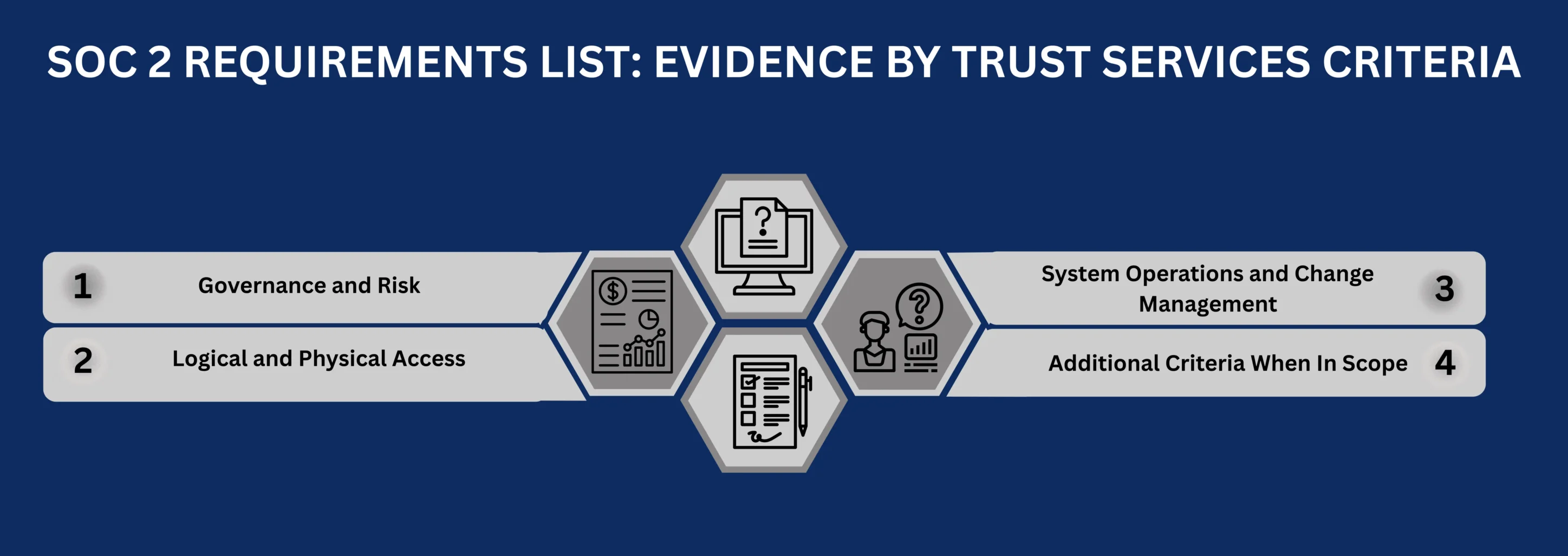
Organizations pursuing SOC 2 Certification in Hobart must establish a documented control environment that addresses the selected Trust Services Criteria. Documentation requirements include information security policies, access control procedures, change management policies, incident response plans, vendor management procedures, and risk assessment documentation. Each document must be current, approved by appropriate organizational authority, and operationally implemented.
Documentation that exists only on paper without evidence of implementation does not satisfy the criteria. The Licensed CPA Firm evaluates documentation as part of the Stage 1 examination, assessing whether the described controls are suitably designed to meet the criteria. For SOC 2 Type 2 audits, documentation must also demonstrate consistent application throughout the observation period, supported by records, logs, and approvals that confirm operational adherence.
- ✓Information security policy addressing access, risk, and incident management
- ✓Access control procedures governing user provisioning, modification, and revocation
- ✓Change management policy with documented approval and testing workflows
- ✓Incident response plan with defined escalation procedures and post-incident review
- ✓Vendor and subservice organization management procedures with risk assessments
- ✓Business continuity and disaster recovery documentation with tested recovery procedures
- ✓Risk assessment documentation identifying threats, vulnerabilities, and control responses
- ✓Logical and physical access review records demonstrating periodic access certification
Technical controls form a significant component of the SOC 2 examination for Hobart-based organizations. The Common Criteria require organizations to demonstrate controls over logical access — including multi-factor authentication, role-based access provisioning, and periodic access reviews. System monitoring controls must demonstrate that security events are logged, alerts are generated for anomalous activity, and logs are retained for defined periods.
Encryption controls must address data in transit and data at rest for sensitive information within the in-scope environment. Change management controls must demonstrate that system changes are authorized, tested, and documented before deployment. For organizations selecting the Availability category, technical controls must address system performance monitoring, redundancy configurations, and recovery time objectives. Each technical control must be supported by evidence — configuration screenshots, access logs, monitoring alerts, and change tickets — collected during the SOC 2 audit.
Most Hobart-based organizations delivering technology services rely on third-party subservice organizations — cloud infrastructure providers, data center operators, identity management platforms, or payment processors. The SOC 2 examination addresses subservice organizations through one of two approaches: the inclusive method, in which the subservice organization’s controls are included within the scope of the examination, or the carve-out method, in which the subservice organization’s controls are excluded from scope and addressed through complementary user entity controls.
The carve-out method is the most common approach and requires the service organization to obtain and review the subservice organization’s own SOC 2 report to validate the controls relied upon. The Licensed CPA Firm evaluates the organization’s vendor management procedures and the adequacy of controls over subservice organizations as part of the SOC 2 audit in Hobart.
- ✓Control Environment and Documentation Requirements
- ✓Technical Control Requirements
- ✓Subservice Organization Considerations
Benefits of SOC 2 Certification for Hobart-Based Organizations
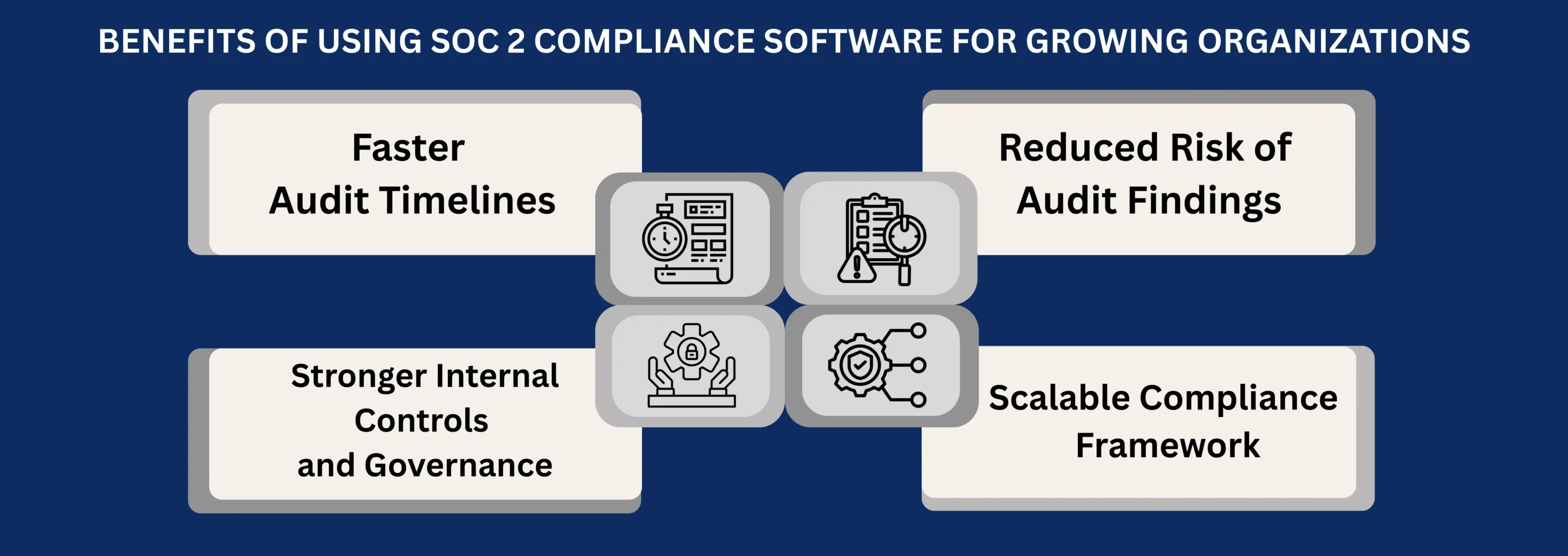
SOC 2 Certification in Hobart delivers measurable, demonstrable outcomes for organizations operating in technology, research, and data-intensive sectors. The benefits derive directly from the independent, evidence-based nature of the SOC 2 attestation and the formal recognition of SOC 2 reports in enterprise procurement and vendor assurance frameworks. For organizations competing in U.S. and international markets, these outcomes translate into tangible commercial advantages.
- ✓Independent verification of control design and operating effectiveness by a Licensed CPA Firm under AICPA attestation standards
- ✓Formal SOC 2 attestation report recognized in U.S. enterprise vendor assurance programs and third-party risk management frameworks
- ✓Accelerated vendor qualification processes with enterprise clients that require SOC 2 compliance documentation
- ✓Structured SOC 2 audit methodology that identifies control gaps through objective examination rather than self-assessment
- ✓Demonstration of sustained control performance over time through SOC 2 Type 2 attestation
- ✓Recognition in cross-border client due diligence evaluations relevant to Hobart-based organizations with international service delivery obligations
- ✓Ongoing compliance monitoring through annual SOC 2 examination cycles that maintain current attestation status
- ✓Competitive differentiation in markets where SOC 2 attestation distinguishes independently verified organizations from those relying on self-declared compliance
Enterprise procurement teams at U.S. technology companies, financial institutions, and regulated organizations do not accept self-declarations as evidence of security control effectiveness. They request SOC 2 attestation reports as part of structured vendor onboarding and third-party risk assessment processes. Hobart-based organizations that hold a current SOC 2 Type 2 attestation report can respond to these requests immediately, reducing the duration of vendor qualification cycles and eliminating the security questionnaire bottlenecks that frequently stall commercial negotiations.
The SOC 2 audit in Hobart produces a report that directly addresses the questions enterprise procurement teams ask — whether controls exist, whether they are designed appropriately, and whether they operated consistently over time. This evidence-based response replaces assertions with independently verified findings, which enterprise clients and regulated institutions treat as materially more credible than policy documentation or self-assessment outputs.
For aquaculture technology companies, marine science data platforms, and agricultural technology organizations based in Hobart, SOC 2 attestation serves as a recognized signal of data governance maturity in markets where such frameworks are not yet universally adopted. As these sectors expand into U.S. and European markets — where enterprise data governance expectations are more formalized — SOC 2 Certification becomes a distinguishing qualification that supports contract acquisition and institutional partnership development.
Antarctic and polar research data service providers similarly benefit from SOC 2 attestation in contexts where international scientific partners and government funding bodies apply vendor assurance requirements to technology service providers. The SOC 2 examination in Hobart demonstrates that an organization’s controls have been independently evaluated — not merely described — a distinction that carries material weight in institutional procurement and research partnership contexts.
- ✓Enterprise Sales and Procurement Acceleration
- ✓Sector-Specific Recognition for Hobart Industries
SOC 2 Certification in Hobart: Sectors and Use Cases
Technology, SaaS, and Cloud Service Organizations
SaaS providers and cloud service organizations based in Hobart represent the largest and most consistent source of demand for SOC 2 Certification. These organizations deliver software-based services to customers who rely on the organization’s infrastructure, applications, and data processing capabilities to meet their own operational requirements. Enterprise customers of SaaS platforms typically include SOC 2 Type 2 attestation requirements in their vendor agreements, and U.S.-based customers routinely require annual SOC 2 compliance verification as a contractual condition.
Managed service providers supporting financial organizations, healthcare institutions, or regulated technology companies encounter SOC 2 attestation requirements as a baseline qualification. The SOC 2 examination for these organizations typically encompasses the Security category at minimum, with many also selecting Availability, Confidentiality, and — where personal data is processed — Privacy.
Aquaculture, Marine Science, and Agricultural Technology
Aquaculture technology platforms operating from Hobart process environmental sensor data, biomass measurement records, feeding system logs, and water quality monitoring outputs on behalf of aquaculture producers. When these platforms serve enterprise producers with international operations or supply chain partners subject to U.S. procurement standards, SOC 2 attestation becomes a vendor qualification requirement.
Marine science technology organizations managing oceanographic data repositories, Antarctic monitoring systems, or polar research data platforms encounter similar requirements when partnering with international scientific institutions or government agencies. Agricultural technology companies handling precision farming data, crop analytics, and supply chain visibility data for enterprise agribusiness clients may face SOC 2 compliance expectations from multinational clients applying global data governance frameworks. SOC 2 Certification in Hobart provides all of these organizations with an independently attested report that satisfies these requirements.
Tourism, Hospitality, and Research Institutions
Tourism and hospitality technology platforms based in Hobart — including booking systems, property management software, and customer experience platforms — process personal data and payment information subject to privacy and security requirements. When these platforms serve enterprise hotel chains, international tourism operators, or hospitality groups with U.S. operations, SOC 2 attestation in Hobart may be required as part of the vendor qualification process.
Research institutions affiliated with the University of Tasmania, the Australian Antarctic Division, or international polar research programs that provide data services or technology platforms to external partners may also encounter SOC 2 compliance requirements in institutional partnership agreements. The Privacy and Confidentiality Trust Services Categories are particularly relevant for these organizations, given the nature of the personal and sensitive scientific data they handle.
SOC 2 Examination Hobart: Key Terminology and Structural Concepts
Attestation Standards and Professional Standards Governing SOC 2
The SOC 2 examination is governed by two AICPA attestation standards: AT-C Section 105 (Concepts Common to All Attestation Engagements) and AT-C Section 205 (Examination Engagements). These standards define the professional obligations of the Licensed CPA Firm conducting the SOC 2 audit, including independence requirements, evidence standards, report structure, and opinion formulation.
AT-C 105 establishes the conceptual framework for attestation engagements, including the requirement for the practitioner to be independent of the subject matter and to apply professional skepticism throughout the examination. AT-C 205 governs the specific procedures, reporting requirements, and opinion formulation applicable to examination engagements — the category to which SOC 2 reports belong. The SOC 2 attestation report issued under these standards carries professional authority that distinguishes it from internal audit reports, self-assessments, and third-party advisory assessments not conducted under AICPA attestation standards.
Complementary User Entity Controls and Shared Responsibility
SOC 2 attestation reports include a section addressing Complementary User Entity Controls (CUECs) — controls that the service organization’s system description assumes are implemented by the user entity (the customer) to achieve the stated control objectives. CUECs define the shared responsibility model between the service organization and its customers. For example, a SaaS provider may design its access control system to rely on customer administrators correctly configuring role-based access permissions — the CUEC requires the customer to perform this configuration.
The Licensed CPA Firm includes CUECs in the SOC 2 report to inform user entities of their responsibilities within the shared control environment. Customers reviewing a SOC 2 attestation report must evaluate not only the service organization’s controls but also whether their own implementation of the CUECs is adequate to achieve the combined control objectives.
FAQ
▶
What is SOC 2 certification?
▶
Who needs SOC 2 certification?
▶
How long does SOC 2 certification take?
▶
What are the benefits of SOC 2 certification?
▶
What is the cost of SOC 2 certification?
▶
How do I prepare for SOC 2 certification?
▶
What happens after SOC 2 certification?
▶
How long does the SOC 2 certification process take?
SOC 1 VS SOC 2: WHICH REPORT YOUR CUSTOMERS ACTUALLY ASK FOR
If you sell SaaS or provide outsourced services, you have likely been asked for a SOC report. However, the follow-up question is rarely easy to answer…
SOC 2 Certified: What Does It Mean for Your Business
For companies that handle sensitive data or run cloud-based services, the question “Can you provide your SOC 2 report?” carries enormous weight. Yet, …
HOW SOC 2 AUDITORS REVIEW EVIDENCE OVER TIME
Most businesses pursuing a SOC 2 report spend months building security controls but overlook a fundamental reality: SOC 2 auditors do not just verify …
Get In Touch
have a question? let us get back to you.