
SOC 2 Certification in Jacksonville
SOC 2 Certification in Jacksonville is conducted by a Licensed CPA Firm under AICPA attestation standards. Each engagement evaluates an organization’s control environment against the Trust Services Criteria (TSC). The process is governed by AT-C Section 205 (examination engagements) under SSAE 18. Jacksonville organizations that manage sensitive customer data, provide cloud-hosted services, or operate within regulated financial and healthcare supply chains require SOC 2 attestation to satisfy enterprise vendor due diligence and third-party risk management requirements.
OUR CLIENTS










SOC 2 Certification for Jacksonville-Based Financial and Technology Organizations
SOC 2 Certification in Jacksonville is conducted by a Licensed CPA Firm under AICPA attestation standards. Each engagement evaluates an organization’s control environment against the Trust Services Criteria (TSC). The process is governed by AT-C Section 205 (examination engagements) under SSAE 18. Jacksonville organizations that manage sensitive customer data, provide cloud-hosted services, or operate within regulated financial and healthcare supply chains require SOC 2 attestation to satisfy enterprise vendor due diligence and third-party risk management requirements.
Jacksonville ranks among the largest financial services centers in the southeastern United States. The city hosts major banking institutions, insurance carriers, logistics and port technology operators, healthcare organizations, and a rapidly expanding SaaS and cloud services ecosystem. This concentration of regulated industries and data-intensive operations has made SOC 2 Certification in Jacksonville an increasingly essential requirement. Organizations across these sectors use it to demonstrate verified control effectiveness to enterprise clients, procurement teams, and vendor risk management programs.
The Licensed CPA Firm performing a SOC 2 audit in Jacksonville functions exclusively as an independent examiner. Its role is to assess control design and operating effectiveness against the applicable Trust Services Criteria — Security, Availability, Processing Integrity, Confidentiality, and Privacy — and to issue a formal attestation report. The firm does not function as a consultant, implementer, or advisor. Each SOC 2 examination produces an independently verified report that organizations can present to clients, partners, and procurement authorities as objective evidence of their control environment.
The SOC 2 framework is defined by the American Institute of Certified Public Accountants (AICPA) and applies specifically to service organizations that store, process, or transmit customer data. For Jacksonville’s financial services firms, technology companies, and managed service providers, SOC 2 compliance addresses both client-facing assurance requirements and internal risk governance standards. The framework distinguishes between two report types — Type 1 and Type 2 — each serving distinct verification purposes within vendor due diligence and enterprise procurement processes.
Organizations across Jacksonville’s diverse economic sectors — from Northside logistics technology firms to downtown financial institutions and Southside healthcare IT providers — are encountering SOC 2 attestation requirements from enterprise customers, federal contractors, and third-party risk management programs. A completed SOC 2 audit produces a formal report issued under professional attestation standards. This report provides documented verification that controls governing data security, system availability, and processing integrity are designed appropriately and operating effectively over a defined evaluation period.
Jacksonville’s Financial and Technology Ecosystem
Jacksonville’s financial services sector includes major banking operations, credit card processing centers, mortgage servicers, and insurance carriers. Firms such as Fidelity National Financial, EverBank, and numerous national bank operations centers have established significant presences in the city. These organizations — and the third-party technology vendors serving them — frequently encounter SOC 2 attestation requirements as conditions of vendor onboarding, contract renewal, or regulatory-adjacent due diligence programs. SOC 2 Certification in Jacksonville serves this demand by providing independently verified, audit-based evidence of control effectiveness that satisfies enterprise procurement standards.
Beyond financial services, Jacksonville’s JAXPORT logistics technology ecosystem, healthcare IT providers, and a growing population of SaaS companies serving national and global clients regularly encounter SOC 2 requirements. Cloud service providers managing logistics data, healthcare application vendors handling protected information, and fintech firms processing payment transactions each face sector-specific procurement expectations that SOC 2 attestation is structured to address. The SOC 2 examination framework applies uniformly across these sectors, with scope and applicable Trust Services Criteria tailored to each organization’s specific service commitments and system boundaries.
The Licensed CPA Firm as Independent Examiner
A SOC 2 audit must be performed by a Licensed CPA Firm authorized to conduct attestation engagements under AICPA standards. This requirement ensures that the examination is conducted by an independent third party with professional accountability for the findings and opinions expressed in the report. The Licensed CPA Firm evaluates the service organization’s control environment, tests the design and operating effectiveness of controls, and issues a formal attestation report under AT-C Section 205. No self-assessment, internal audit, or consulting firm report qualifies as a SOC 2 attestation under AICPA standards.

SOC 2 Certification Audit Process for Organizations in Jacksonville
The SOC 2 audit process for Jacksonville organizations follows a structured sequence of examination stages governed by AICPA attestation standards. Each stage produces documented outputs that form the basis of the final attestation report. The process applies consistently across all organization types. Scope and applicable criteria are determined during the initial engagement phase based on the service organization’s system description and service commitments.
The SOC 2 examination begins with scope definition — identifying the systems, services, infrastructure, and data flows subject to audit. The Licensed CPA Firm reviews the organization’s system description, identifies applicable Trust Services Criteria categories, and determines whether the engagement will produce a Type 1 or Type 2 report. Scope boundaries are formally established before fieldwork begins. For Jacksonville organizations operating across multiple locations or cloud environments, scope determination includes evaluation of all in-scope components, third-party service providers, and sub-service organizations that form part of the overall service delivery system.
The audit program is developed based on the identified scope and applicable criteria. The Licensed CPA Firm designs specific test procedures for each relevant Trust Services Criterion, identifying the evidence types required to assess control design and — in the case of Type 2 engagements — operating effectiveness. For Jacksonville-based financial services technology firms, audit programs typically address security controls, logical access management, change management, and system monitoring. For healthcare IT providers, the program may additionally address privacy and confidentiality controls relevant to protected health information handling.
A SOC 2 Type 1 report evaluates the design and implementation of controls at a specific point in time. It addresses whether controls are suitably designed to meet the applicable Trust Services Criteria as of the report date. A SOC 2 Type 2 report extends the evaluation to cover operating effectiveness — assessing whether controls functioned as designed throughout an observation period, typically six to twelve months. Jacksonville organizations new to SOC 2 attestation often begin with a Type 1 report to establish a baseline, followed by a Type 2 engagement covering an extended observation period.
During the Type 2 observation period, the Licensed CPA Firm collects and evaluates evidence of control operation across the defined timeframe. Evidence types include system-generated logs, configuration snapshots, access review records, incident response documentation, change management tickets, and vendor management records. For Jacksonville SaaS providers and cloud infrastructure companies, evidence collection typically spans automated system outputs, security information and event management (SIEM) logs, and documented control owner attestations. The examiner assesses each evidence item against the applicable criterion to determine whether controls operated consistently and effectively throughout the period.
| Audit Stage | Key Activities | Output |
|---|---|---|
| Scope Definition | System description review, TSC category selection, boundary identification | Agreed scope document |
| Audit Program Determination | Test procedure design, evidence planning, engagement type selection | Audit program |
| Type 1 Assessment | Control design evaluation at a point in time | Type 1 attestation report |
| Type 2 Assessment | Operating effectiveness testing across observation period | Type 2 attestation report |
| Nonconformity Review & Report Issuance | Exception identification, management response, final report issuance | Issued SOC 2 report |
Following completion of control testing, the Licensed CPA Firm compiles identified exceptions and evaluates their significance relative to the applicable Trust Services Criteria. Nonconformities are identified and reported within the final attestation document. The service organization is provided an opportunity to include management responses addressing identified exceptions. The final SOC 2 report — comprising the auditor’s opinion, system description, and results of testing — is issued under the examiner’s professional attestation. For Jacksonville organizations, the completed report is typically presented to enterprise clients, procurement teams, and vendor risk management programs as formal evidence of SOC 2 attestation.
- ✓Scope Definition and Audit Program Determination
- ✓Type 1 and Type 2 SOC 2 Examination Stages
- ✓Nonconformity Review and Report Issuance
Why Organizations in Jacksonville Pursue SOC 2 Certification
SOC 2 Certification in Jacksonville is driven by demand from enterprise clients, financial institutions, healthcare networks, and government-adjacent contractors that require independently verified assurance of vendor control environments. Jacksonville’s position as a hub for financial services operations, logistics technology, and healthcare IT means that local organizations frequently encounter SOC 2 attestation as a prerequisite for contract execution, vendor panel inclusion, or third-party risk program compliance.
Enterprise Vendor Due Diligence and Financial Sector Procurement
Major financial institutions operating in Jacksonville — including national banking operations centers, insurance carriers, and payment processing firms — maintain formal third-party risk management programs that require vendor SOC 2 reports as a condition of onboarding or contract renewal. A Jacksonville-based cloud technology provider seeking to serve a regional bank’s core banking infrastructure, or a fintech platform seeking integration with a national payment processor, will routinely receive SOC 2 attestation requirements as part of the vendor review process. SOC 2 compliance that Jacksonville organizations demonstrate through a completed audit report satisfies these requirements with independently verified, standardized documentation.
For Jacksonville’s financial technology firms, SOC 2 attestation provides a structured mechanism for addressing the security and availability control questions that financial institution procurement teams raise during vendor evaluations. Rather than responding to bespoke security questionnaires individually, organizations with a current SOC 2 Type 2 report can direct procurement reviewers to the attestation document for standardized, auditor-verified control information. This approach reduces procurement friction and accelerates contract execution timelines for SaaS vendors, managed service providers, and data analytics firms operating in Jacksonville’s financial services supply chain.
Healthcare IT, Logistics Technology, and SaaS Expansion
Jacksonville’s healthcare sector — anchored by major health systems, physician networks, and health IT platforms — increasingly requires SOC 2 attestation from technology vendors that access, store, or process protected health information. While HIPAA establishes the regulatory baseline for healthcare data protection, enterprise health systems conducting vendor security reviews treat SOC 2 reports as the standard mechanism for obtaining independent verification of a technology vendor’s security and availability controls. The SOC 2 examination that Jacksonville healthcare IT vendors undergo provides the independently verified control evidence that procurement and compliance teams require during due diligence.
JAXPORT and Jacksonville’s logistics technology ecosystem represent a distinct sector where SOC 2 attestation is gaining traction. Port technology operators, supply chain visibility platforms, and freight management SaaS providers handling sensitive shipment, customs, and cargo data encounter SOC 2 requirements from national retail clients, government freight programs, and international logistics networks. SaaS companies headquartered in Jacksonville and targeting national or international expansion also pursue SOC 2 Certification as a market access requirement. Enterprise procurement standards in the United States, Canada, and the European Union frequently list SOC 2 attestation among acceptable third-party assurance frameworks.
Trust Services Criteria and Certification Scope
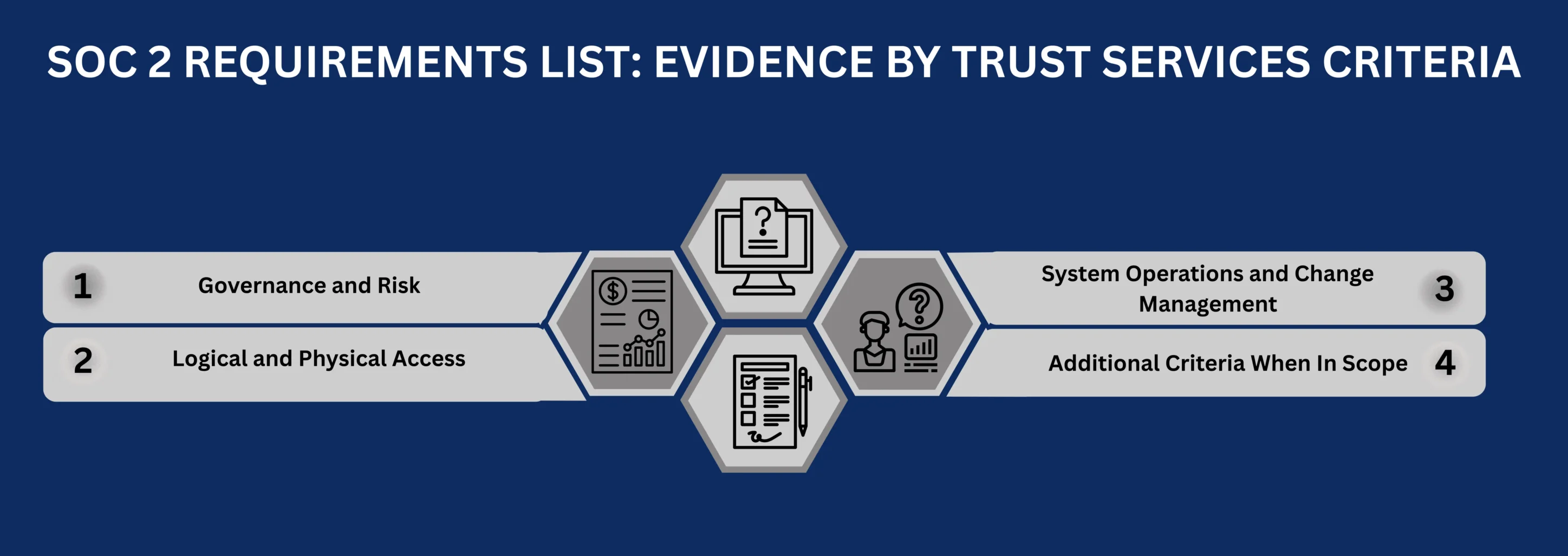
The Trust Services Criteria (TSC), established by the AICPA, define the control objectives and criteria against which a SOC 2 examination is conducted. The TSC are organized into five categories, each addressing a distinct dimension of service organization control. The Security criterion — also called the Common Criteria — is mandatory in every SOC 2 engagement. The remaining four criteria are applied based on the service commitments and system requirements relevant to the organization’s services.
The Security criterion requires that systems be protected against unauthorized access — both physical and logical. It encompasses logical access controls, network security, encryption, vulnerability management, and incident response procedures. The Availability criterion applies to organizations whose service commitments include system uptime and performance guarantees, requiring controls over capacity planning, monitoring, and disaster recovery. Processing Integrity addresses whether systems process data completely, accurately, and in a timely manner. This criterion is particularly relevant for Jacksonville payment processors, data analytics platforms, and logistics technology firms that guarantee data accuracy in their service commitments.
The Confidentiality criterion applies when organizations commit to protecting information designated as confidential — such as trade secrets, business-sensitive data, and contractually protected information — from unauthorized disclosure. The Privacy criterion addresses the collection, use, retention, disclosure, and disposal of personal information in accordance with the organization’s privacy notice and applicable privacy regulations. For Jacksonville healthcare IT vendors, fintech firms, and insurance technology platforms, both Confidentiality and Privacy criteria are frequently included in the SOC 2 examination scope to address the nature of information they handle on behalf of their clients.
The scope of a SOC 2 examination is defined by the service organization’s system boundaries — the infrastructure, software, people, procedures, and data that form the system subject to audit. For Jacksonville organizations operating hybrid cloud environments, the scope includes both on-premises components and cloud-hosted infrastructure. Sub-service organizations — third-party vendors relied upon to deliver in-scope services — are addressed either through the carve-out method, which excludes them from scope while noting their role, or the inclusive method, which extends the examination to cover their controls.
The certification decision — whether to issue an unqualified, qualified, adverse, or disclaimer of opinion — rests with the Licensed CPA Firm acting as independent examiner. The decision is based on the totality of evidence collected during the SOC 2 audit, the significance of any exceptions identified, and the examiner’s professional judgment regarding whether the controls, as a whole, meet the applicable Trust Services Criteria. No organization can direct or influence the examiner’s opinion. This independence is the defining feature that gives SOC 2 attestation its credibility in enterprise procurement and vendor risk management contexts.
- ✓The Five Trust Services Criteria Categories
- ✓Scope Boundaries and Independent Certification Decision
Benefits of SOC 2 Certification for Jacksonville-Based Organizations
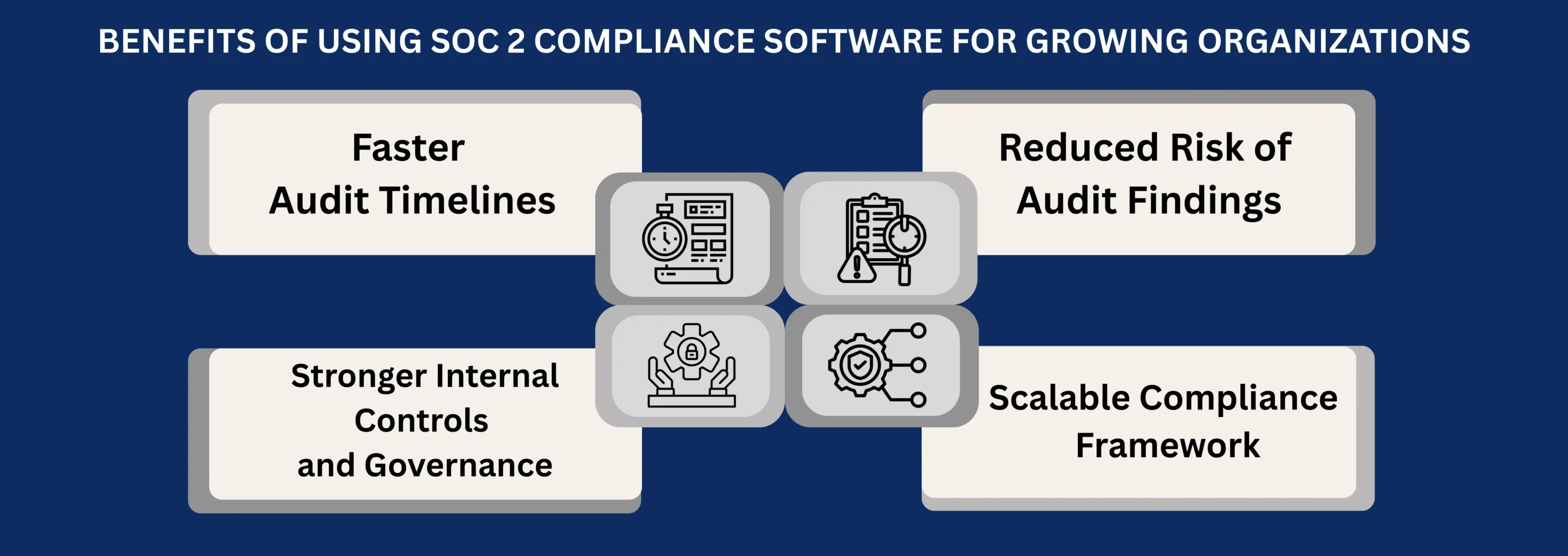
SOC 2 Certification delivers independently verified documentation of control effectiveness that Jacksonville organizations can present across multiple business contexts. The benefits extend beyond satisfying individual client requests. A completed SOC 2 report functions as a durable, standardized assurance artifact that simultaneously addresses vendor due diligence, regulatory-adjacent oversight, and organizational risk governance objectives.
The primary benefit of SOC 2 Certification is independent, third-party verification that an organization’s controls are designed and operating effectively against defined criteria. Unlike self-assessments or internal audit reports, a SOC 2 attestation report is issued by a Licensed CPA Firm under professional standards that carry legal accountability. For Jacksonville-based SaaS providers and cloud service companies, this independently verified status satisfies enterprise procurement requirements that explicitly require third-party attestation rather than self-reported compliance documentation.
SOC 2 attestation also provides structured evidence for the organization’s own risk governance processes. The audit report documents specific control exceptions, identifies areas where control design or operation requires attention, and establishes a baseline against which subsequent audit periods are assessed. Jacksonville organizations that undergo annual SOC 2 Type 2 audits accumulate a record of control performance over time — a factor that enterprise clients and financial institution procurement teams increasingly evaluate when assessing long-term vendor relationships.
A current SOC 2 Type 2 report is recognized across financial services, healthcare, technology, and logistics procurement programs as an acceptable — and often preferred — form of vendor security assurance. For Jacksonville organizations targeting national enterprise clients or expanding into international markets, SOC 2 attestation removes a significant barrier to procurement consideration. Financial institution vendor panels, federal contractor supply chains, and multinational corporate procurement programs routinely accept SOC 2 reports as the basis for vendor security review. This acceptance reduces the burden of responding to individualized client security questionnaires and streamlines the overall vendor approval process.
- ✓Independent verification of control design and operating effectiveness by a Licensed CPA Firm
- ✓Standardized attestation document accepted across financial, healthcare, and technology procurement programs
- ✓Reduction in client-specific security questionnaire burden through a reusable SOC 2 attestation report
- ✓Documented control performance history across annual SOC 2 audit cycles
- ✓Recognition in enterprise vendor due diligence and third-party risk management programs
- ✓Support for international market access where SOC 2 attestation is an accepted assurance framework
- ✓Structured basis for internal control governance and ongoing risk monitoring
- ✓Verified Control Effectiveness and Third-Party Validation
- ✓Market Access, Procurement Recognition, and Ongoing Surveillance
SOC 2 Report Validity, Maintenance, and Recertification
A SOC 2 Type 2 report covers a defined observation period — typically twelve months — and is considered current for approximately twelve months from the report end date. Enterprise clients and procurement programs generally treat reports older than twelve months as lapsed, requiring the organization to complete a new SOC 2 audit to demonstrate continued control effectiveness. Annual recertification through successive Type 2 engagements is the standard practice for Jacksonville organizations maintaining SOC 2 compliance as an ongoing vendor assurance commitment.
Observation Period and Report Coverage
The observation period for a SOC 2 Type 2 examination is the timeframe during which the Licensed CPA Firm assesses whether controls operated effectively. Most organizations target a twelve-month observation period aligned with their fiscal or calendar year. Shorter periods — as brief as six months — are permissible and sometimes used for initial Type 2 engagements. Evidence of control operation must exist for the full duration of the observation period. Controls implemented after the period start date will not have evidence covering the entire timeframe and may result in exceptions for the uncovered portion.
The SOC 2 report issued at the conclusion of the examination documents the specific observation period covered. Clients and procurement teams reviewing the report assess both the coverage period and the report issuance date to determine currency. For Jacksonville organizations managing multiple client relationships, maintaining continuous SOC 2 coverage — with successive observation periods that leave no gap — is a recognized best practice for ensuring that attestation remains valid across all active vendor relationships simultaneously.
Conditions for Suspension or Withdrawal of Attestation
SOC 2 attestation does not carry a formal suspension or withdrawal mechanism in the same manner as ISO certification schemes. Each SOC 2 report is a point-in-time or period-in-time attestation rather than a continuous certification status. However, material changes to the service organization’s control environment — such as significant system changes, security incidents, or control failures — can affect the accuracy of a previously issued report and may require disclosure to affected clients. Organizations that experience material changes during a coverage period should assess whether those changes affect the representations made in the current attestation report.
SOC 2 Certification Requirements for Jacksonville Organizations
SOC 2 Certification requires Jacksonville organizations to demonstrate a defined control environment documented through verifiable evidence. The Licensed CPA Firm conducting the SOC 2 examination evaluates both the design of controls and — in Type 2 engagements — their consistent operation over the observation period. Requirements are evaluated against the applicable Trust Services Criteria rather than a fixed prescriptive control list. As a result, acceptable controls may vary based on the organization’s size, technology environment, and service commitments.
A SOC 2 examination requires organizations to maintain documented evidence of control operation throughout the observation period. Key documentation categories include: information security policies governing access management, change control, incident response, and vendor management; risk assessment records demonstrating periodic identification and evaluation of control risks; system configuration documentation capturing the technical controls in place; and operational records such as access review logs, patch management records, security monitoring outputs, and business continuity test results. For Jacksonville organizations, evidence is typically collected from cloud management consoles, ticketing systems, SIEM platforms, and HR systems that document user provisioning and termination processes.
A system description — a formal written description of the service organization’s system boundaries, services, infrastructure, and control environment — is a required component of every SOC 2 report. The system description is prepared by management and evaluated by the Licensed CPA Firm for accuracy and completeness. It must address the five components of the COSO framework as applied to the service organization: the control environment, risk assessment process, information and communication systems, monitoring activities, and control activities. Inaccuracies in the system description are themselves findings that the examiner must address in the attestation report.
Technical controls evaluated in a SOC 2 audit include logical access management (user authentication, role-based access controls, multi-factor authentication), network security (firewall configurations, intrusion detection, network segmentation), encryption (data at rest and in transit), vulnerability management (scanning frequency, patch cycles, remediation timelines), and monitoring (SIEM alerting, log retention, security event review). Organizational controls encompass background screening procedures, security awareness training programs, vendor due diligence processes, change management approval workflows, and incident response plan testing. The examiner assesses each control category for both design suitability and — in Type 2 engagements — operational consistency across the observation period.
- ✓Documentation and Evidence Requirements
- ✓Technical and Organizational Control Requirements
SOC 2 Certification in Jacksonville: Sector-Specific Applications
SOC 2 audit requirements in Jacksonville vary in emphasis across the city’s primary industry sectors. While the AICPA Trust Services Criteria apply uniformly, the specific controls evaluated and the evidence types most relevant to each examination are shaped by the nature of the organization’s services, the sensitivity of the data processed, and the contractual commitments made to clients. Understanding these sector-specific dynamics helps Jacksonville organizations determine which Trust Services Criteria categories to include in their SOC 2 examination scope.
Financial Services, Fintech, and Banking Technology
SOC 2 Certification in Jacksonville is a routine procurement requirement for financial services vendors. It typically covers Security and Availability as baseline criteria, with Confidentiality and Processing Integrity added when the vendor processes financial transactions, manages customer account data, or supports core banking functions. Jacksonville’s banking technology sector — which includes core banking platform providers, payment gateway operators, and treasury management SaaS firms — faces SOC 2 Type 2 requirements from both bank clients subject to OCC and FDIC third-party risk guidance and from federal financial regulators that review bank vendor management programs. SOC 2 compliance that Jacksonville fintech companies demonstrate through annual Type 2 attestation satisfies these requirements with independent, examiner-verified documentation.
Insurance technology platforms operating in Jacksonville — serving both regional carriers and national insurers with Florida operations — encounter SOC 2 attestation requirements through insurer vendor management programs and state-level cybersecurity regulatory expectations. The NAIC Insurance Data Security Model Law, adopted in Florida, establishes cybersecurity program standards for licensed insurers that extend to their third-party service providers. SOC 2 attestation provides insurance technology vendors with a structured mechanism for demonstrating compliance-adjacent control effectiveness to insurer clients conducting third-party security reviews under this regulatory framework.
Healthcare IT, Logistics Technology, and Cloud Service Providers
Healthcare IT vendors serving Jacksonville’s major health systems — including organizations supporting electronic health record platforms, revenue cycle management systems, and patient engagement applications — encounter SOC 2 requirements as part of business associate agreement execution and health system vendor security review programs. While HIPAA establishes the regulatory baseline, health system procurement teams treat SOC 2 Type 2 reports as the standard vendor assurance mechanism for independently verifying that technology vendors maintain effective security and availability controls over the systems that access, store, or process protected health information.
Cloud infrastructure providers, managed service providers, and data center operators serving Jacksonville’s enterprise market are among the most frequent participants in SOC 2 audit engagements. Their clients’ own compliance programs — whether financial regulatory, healthcare, or government-adjacent — require documented evidence that the underlying infrastructure providers maintain verified control environments. SOC 2 Type 2 attestation for cloud service providers covers Security and Availability criteria as a baseline, with the examination scope extending to include all infrastructure components, data center locations, and support personnel within the defined system boundary.
SOC 2 vs. Other Attestation and Certification Frameworks
Jacksonville organizations evaluating third-party assurance options frequently consider SOC 2 alongside other frameworks, including ISO 27001, SOC 1, and HITRUST. Each framework serves distinct purposes, is governed by different standards bodies, and produces different output documents. Understanding these distinctions is essential for organizations assessing which framework — or combination of frameworks — best addresses their client requirements and regulatory-adjacent obligations.
SOC 2 Compared to ISO 27001 and SOC 1
SOC 2 differs from ISO 27001 in several material respects. SOC 2 is an attestation engagement — the examiner issues an opinion on the organization’s controls — while ISO 27001 is a certification issued by an accredited certification body following an audit of the management system. SOC 2 is governed by AICPA standards and is most widely recognized in North American enterprise procurement contexts. ISO 27001 is an international standard with broad global recognition, particularly in European and Asia-Pacific markets. For Jacksonville SaaS companies targeting both U.S. financial institution clients and international enterprise customers, pursuing both SOC 2 attestation and ISO 27001 certification may be warranted based on client requirements in each target market.
SOC 1 — governed by AT-C Section 320 — addresses controls relevant to user entities’ financial reporting and is designed for organizations whose services affect the financial statements of their clients. SOC 2, by contrast, addresses operational control objectives across the five Trust Services Criteria categories and is not scoped to financial reporting controls. Jacksonville payment processors, fund administrators, and financial data service providers may require both SOC 1 and SOC 2 reports to address the full spectrum of client assurance requirements — financial reporting assurance through SOC 1 and operational security assurance through SOC 2 attestation.
SOC 2 Examination vs. Compliance Attestation
SOC 2 compliance and SOC 2 attestation represent distinct concepts that are sometimes conflated. SOC 2 compliance refers to an organization’s adherence to its own stated policies and to contractual or regulatory requirements — a condition that can exist without independent verification. SOC 2 attestation, by contrast, is the formal expression of an independent examiner’s opinion regarding the organization’s controls, issued under professional standards with legal accountability. An organization may maintain strong internal controls without undergoing a SOC 2 examination, but only a completed SOC 2 audit produces the independently verified attestation report that enterprise procurement programs and third-party risk management frameworks require.
FAQ
▶
What is SOC 2 Certification and why do Jacksonville organizations need it?
▶
What is the difference between a SOC 2 Type 1 and Type 2 report?
▶
How long does the SOC 2 audit process take for a Jacksonville organization?
▶
Which Trust Services Criteria categories should a Jacksonville organization include in its SOC 2 scope?
▶
How long is a SOC 2 attestation report valid?
▶
What types of organizations in Jacksonville require SOC 2 Certification?
▶
Can SOC 2 compliance replace other regulatory requirements for Jacksonville organizations?
▶
Who performs the SOC 2 audit for Jacksonville organizations?
SOC 1 VS SOC 2: WHICH REPORT YOUR CUSTOMERS ACTUALLY ASK FOR
If you sell SaaS or provide outsourced services, you have likely been asked for a SOC report. However, the follow-up question is rarely easy to answer…
SOC 2 Certified: What Does It Mean for Your Business
For companies that handle sensitive data or run cloud-based services, the question “Can you provide your SOC 2 report?” carries enormous weight. Yet, …
HOW SOC 2 AUDITORS REVIEW EVIDENCE OVER TIME
Most businesses pursuing a SOC 2 report spend months building security controls but overlook a fundamental reality: SOC 2 auditors do not just verify …
Get In Touch
have a question? let us get back to you.